
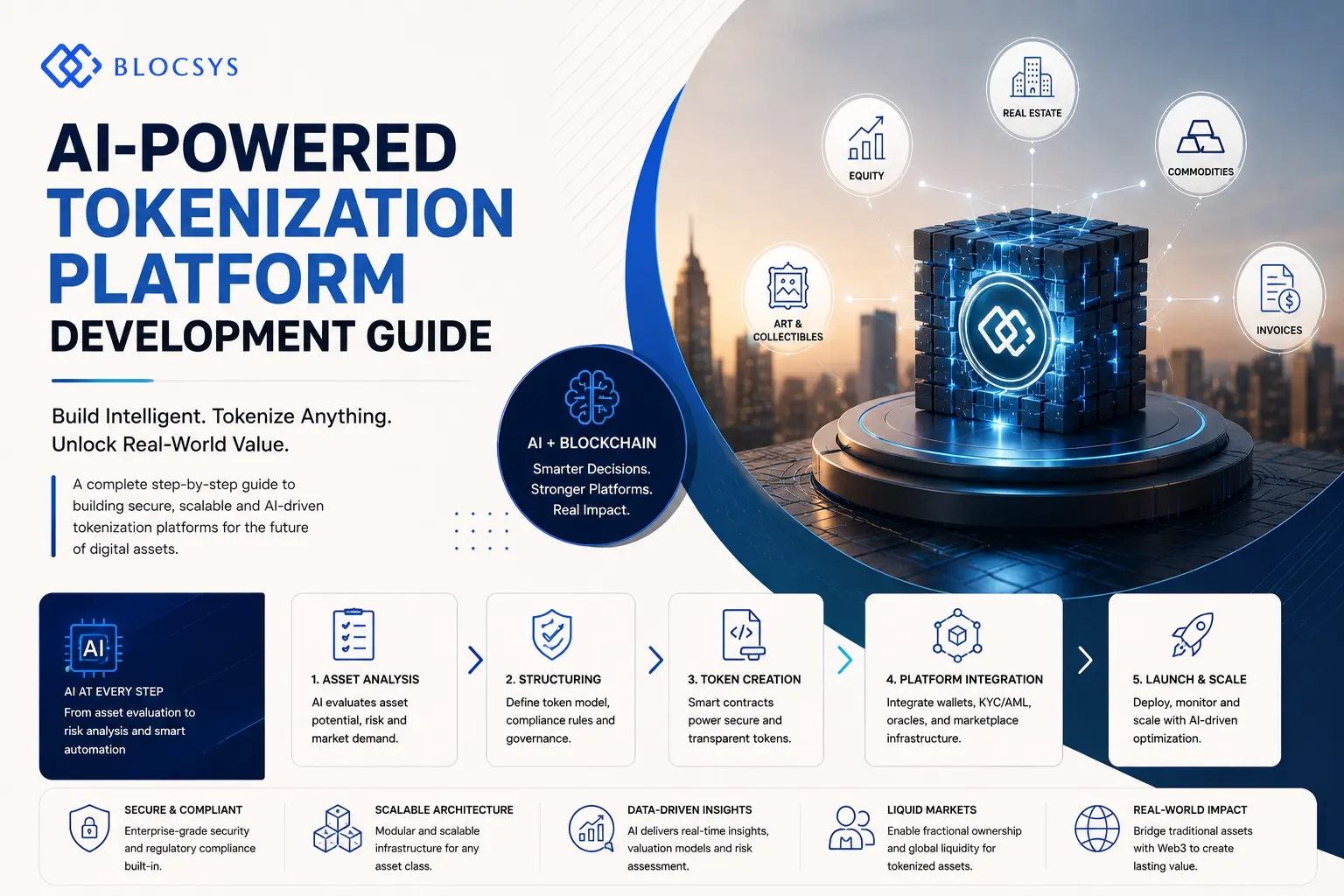
How to Build an AI-Powered Tokenization Platform: Features, Architecture, and Development Considerations
Financial institutions and fintech companies are moving past pilot projects and asking a harder question: how do you actually build an AI-powered tokenization platform that works at enterprise scale? It’s not a small undertaking. You’re combining blockchain infrastructure, AI models, legal frameworks, and financial workflows into one system. This guide walks through what that platform looks like, what it needs, and where AI genuinely helps versus where human oversight and legal review still carry the weight.
What Is an AI-Powered Tokenization Platform?
An AI-powered tokenization platform is a software system that converts real-world assets, such as real estate, bonds, equity, or commodities, into blockchain-based digital tokens while using artificial intelligence to support tasks like data analysis, document review, and risk flagging. The blockchain layer handles issuance, ownership records, and transfers. The AI layer supports decision-making inputs, not the legal or financial decisions themselves. Human teams and licensed professionals remain responsible for compliance, valuation sign-off, and legal structuring.
This distinction matters. AI doesn’t tokenize assets on its own, and it doesn’t grant regulatory approval. It processes data faster than manual review, surfaces patterns, and reduces some of the grunt work involved in asset onboarding. The tokenization engine, smart contracts, and legal wrapper do the actual work of creating a compliant digital asset.
Why Businesses Are Building AI-Powered Tokenization Platforms
Real-world asset tokenization has moved from experimental to institutional. According to the Boston Consulting Group’s widely cited 2022 projection, tokenized illiquid assets could reach $16 trillion by 2030. More recent industry tracking from firms like RWA.xyz shows on-chain tokenized treasury and private credit products growing steadily through 2024 and into 2025, with institutional players including asset managers and banks now issuing tokenized funds directly on public and permissioned chains.
Businesses want two things from tokenization: liquidity and operational efficiency. A tokenized bond or equity share can settle faster than traditional instruments and open access to fractional ownership. However, manually onboarding assets, verifying documents, running valuations, and monitoring compliance across hundreds of assets doesn’t scale well with spreadsheets and manual review. That’s where AI enters the picture, not as a replacement for financial or legal judgment, but as a support layer that speeds up data processing.
Enterprises evaluating a real world asset tokenization strategy usually start by asking what an AI layer actually adds. The honest answer: faster document parsing, anomaly detection in transaction data, and pattern recognition across large asset pools. It doesn’t replace appraisers, auditors, or compliance officers.
The platforms that succeed aren’t the ones with the flashiest AI features. They’re the ones where the blockchain layer, the AI layer, and the legal structure were designed together from day one, instead of bolted together after the fact.
Core Features of an AI-Powered Tokenization Platform
Every AI-powered tokenization platform needs a baseline set of capabilities before AI even enters the conversation. Think of these as the non-negotiables.
Essential Platform Features
| Feature | Purpose |
|---|---|
| Asset onboarding module | Collects documentation, ownership proof, and asset metadata |
| Tokenization engine | Converts verified asset data into blockchain tokens |
| Smart contract layer | Automates issuance, transfer rules, and compliance logic |
| KYC/AML module | Verifies investor identity and screens for risk |
| Investor dashboard | Lets investors view holdings, distributions, and documents |
| Admin and asset management console | Gives issuers control over asset lifecycle and reporting |
| Oracle and data integration | Feeds external data, such as pricing, into smart contracts |
| API layer | Connects the platform to custodians, exchanges, and banking rails |
These features form the operational backbone. Without them, you don’t have a tokenization platform, you have a database with a blockchain label attached to it.
![AI-powered tokenization platform — [Flow diagram showing AI-powered tokenization platform architecture layers: Data & Oracle Layer → AI Analysis Layer → Tokenization Engine → Smart Contract Layer → Blockchain Network → Investor & Asset Management Interfaces]](https://s3.blocsys.com/blocsys/blog-images/1787357056752-23b45ceae31ed0cf.webp)
AI Capabilities Within an AI Tokenization Platform
What does AI actually do inside an AI tokenization platform development project? It’s worth being precise here because vague claims about “AI-powered everything” don’t hold up under scrutiny.
Current, Confirmed AI Applications
Document processing is the most mature use case. AI models can extract data from title deeds, financial statements, and legal contracts, cutting down manual data entry during asset onboarding. Natural language processing tools can flag missing clauses or inconsistent terms across legal documents for human review.
Anomaly detection is another established use. Machine learning models trained on transaction patterns can flag unusual investor behavior or suspicious transfer patterns, feeding that signal into compliance teams for investigation. This supports AML monitoring; it doesn’t replace it.
Emerging and Developing AI Capabilities
AI-assisted valuation support is developing but still requires caution. Models can analyze comparable sales data, market trends, and asset performance history to generate valuation inputs. However, final valuations for regulated assets typically still require licensed appraisers or valuation professionals, depending on jurisdiction and asset class. Treat AI valuation output as a data point, not a certified appraisal.
Risk scoring models are also emerging, using historical data to assign preliminary risk indicators to assets or counterparties. These scores support underwriting and due diligence teams rather than making autonomous approval decisions.
AI Agents and Automation: Where the Line Sits
AI agents are increasingly discussed for tasks like monitoring compliance triggers or automating routine reporting. This is a developing area. Autonomous AI agents making binding financial or legal decisions without human sign-off remain outside current regulatory comfort zones for most institutional use cases. Build automation carefully, with human checkpoints at every consequential decision.
AI-Powered Asset Evaluation, Valuation, and Risk Analysis
How does AI help with asset tokenization during evaluation? It speeds up the analysis of large data sets, comparing an asset against market benchmarks, historical performance, and comparable transactions. For real estate, this might mean cross-referencing recent sales in the same region. For bonds, it could mean analyzing credit history and issuer performance trends.
That said, AI-powered asset tokenization workflows still need a validation checkpoint. A model trained on historical data can miss context, like a pending zoning change or a one-off market event. Institutions building an AI asset tokenization platform should design the workflow so AI output routes through a qualified reviewer before it becomes part of the official asset record.
This is where governance design matters as much as the model itself. A platform that logs every AI-generated valuation input, along with the human reviewer’s decision, builds a defensible audit trail. That audit trail matters more to institutional investors than the AI model’s sophistication.
Tokenization Engine and Smart Contract Architecture
The tokenization engine is the core conversion layer. It takes verified asset data, wraps it in a legal and technical structure, and mints tokens according to a defined standard, such as ERC-20 for fungible tokens or ERC-3643 and similar permissioned standards built for regulated securities.
![AI-powered tokenization platform — [Flow diagram showing tokenization engine process: Asset Verification → Legal Structuring → Token Standard Selection → Smart Contract Deployment → Token Minting → Investor Wallet Distribution]](https://s3.blocsys.com/blocsys/blog-images/1787357054423-a8af50f09ffbdaf2.webp)
Smart Contract Responsibilities
Smart contracts handle the rules-based logic: who can hold a token, how transfers execute, how dividends or coupon payments distribute, and what compliance checks run before a transaction settles. They don’t interpret regulation. They execute pre-programmed rules that legal and compliance teams define upfront.
For a company building an equity tokenization platform or a corporate bond tokenization product, smart contract design needs to reflect the actual securities structure, including transfer restrictions, investor accreditation checks, and lock-up periods. Getting this wrong doesn’t just create a technical bug, it can create a compliance failure.
Blockchain Architecture and Network Selection
Choosing the right blockchain infrastructure shapes everything downstream. Public chains like Ethereum offer strong liquidity and composability but come with variable transaction costs. Permissioned or hybrid chains give institutions more control over validator access and data privacy, which matters for regulated securities.
Key Architecture Decisions
- Public, permissioned, or hybrid blockchain deployment
- Layer 1 versus Layer 2 scaling approach for transaction throughput
- Token standard selection based on asset type and jurisdiction
- Interoperability requirements across chains and custodians
- Node infrastructure and validator management approach
There’s no universal right answer here. A tokenized real estate fund targeting accredited investors has different requirements than a tokenized carbon credit marketplace aimed at broader retail participation. Teams exploring a carbon tokenization platform face different oracle and verification needs than those building fixed-income products, since carbon credit data typically comes from environmental registries rather than financial data providers.
AI and Data Layer Integration
An AI-driven tokenization platform depends on clean, reliable data. Oracles feed external information, like asset prices, interest rates, or property valuations, into smart contracts. AI models process that same data stream to detect anomalies or generate analysis for human reviewers.
The data layer typically includes market data feeds, document repositories, KYC/AML data providers, and oracle networks like Chainlink for on-chain price feeds. Consequently, data quality directly affects both AI output reliability and smart contract execution accuracy. Garbage data in, unreliable tokens out.
Compliance, KYC/AML, and Regulatory Considerations
How can a tokenization platform support compliance? It builds KYC/AML checks, investor accreditation verification, and transaction monitoring directly into the onboarding and transfer workflow. It does not, by itself, guarantee regulatory compliance. That depends on the asset type, jurisdiction, investor base, and how the platform is legally structured.
Regulatory frameworks vary significantly by market. In the United States, tokenized securities generally fall under SEC oversight and existing securities law. The European Union’s Markets in Crypto-Assets (MiCA) regulation, which became fully applicable in December 2024, addresses crypto-asset service providers, though tokenized traditional securities often still fall under existing MiFID II frameworks. Switzerland’s FINMA operates under its established DLT Act framework. The UAE’s Dubai Financial Services Authority (DFSA) and Abu Dhabi Global Market (ADGM) have each introduced digital asset frameworks and sandboxes. Singapore’s Monetary Authority (MAS) has run tokenization pilots through Project Guardian since 2022.
None of these frameworks mean AI can independently satisfy compliance obligations. Legal counsel needs to confirm the applicable framework before any AI-powered tokenization platform goes live with real assets and real investors.
Investor and Digital Asset Management
Once tokens are live, AI tokenized asset management tools help track portfolio performance, distribution schedules, and secondary market activity. Investor dashboards typically show holdings, transaction history, distribution payments, and compliance documents in one place.
For issuers, the asset management console needs to handle corporate actions, like dividend distributions or bond coupon payments, alongside reporting obligations. A well-designed asset tokenization platform ties this management layer directly to the smart contract logic, so distributions execute automatically once approved, reducing manual reconciliation work.
APIs, Integrations, and Enterprise Connectivity
Enterprise adoption depends on integration, not just features. Your platform needs API connections to custodians, banking rails, identity verification providers, market data feeds, and potentially existing portfolio management systems. Without this, the platform becomes an isolated tool instead of part of the institution’s operating infrastructure.
Well-documented REST or GraphQL APIs let asset managers plug the tokenization platform into existing back-office systems. This matters more for enterprise adoption than almost any other technical decision, since institutions rarely want to replace their entire technology stack for one product line.
Security Architecture
Security spans multiple layers: smart contract auditing, wallet key management, infrastructure security, and AI model security. Smart contracts should go through independent third-party audits before mainnet deployment. Multi-signature wallets and hardware security modules protect custody operations.
Security Priorities
- Independent smart contract audits before launch
- Multi-signature and cold storage custody solutions
- Role-based access control across admin functions
- Encrypted data storage for sensitive investor information
- Continuous monitoring for unusual transaction patterns
AI models introduce their own risk surface, including data poisoning and adversarial manipulation of inputs. Teams building AI tokenization platform development projects need security reviews that cover both the blockchain layer and the AI pipeline, not just one or the other.
Scalability and Governance
Scalability isn’t only about transaction throughput. It’s also about how the platform handles growing asset volume, expanding investor bases, and multi-jurisdiction operations. Layer 2 solutions and efficient smart contract design help manage on-chain costs as volume grows.
Governance covers how upgrades happen, who can modify smart contract parameters, and how disputes get resolved. Enterprises often prefer governance models with clear administrative controls rather than fully decentralized governance, particularly for regulated securities where accountability needs to trace back to a legal entity.
Development Process and Technology Stack
Typical Development Stages
- Requirements gathering and regulatory scoping
- Platform architecture and blockchain network selection
- Smart contract development and AI model integration
- Frontend and backend build, including investor and admin portals
- Security audits and compliance review
- Testnet deployment and quality assurance
- Mainnet launch and post-launch monitoring
A typical technology stack combines Solidity or similar smart contract languages, a chosen blockchain network, backend frameworks like Node.js or Python, AI/ML frameworks for document and data analysis, and cloud infrastructure for hosting and scaling. Testing needs to cover smart contract logic, API integrations, AI model accuracy, and security penetration testing before any production launch.
Enterprise Use Case: Illustrative Scenario
Consider a hypothetical mid-size asset manager wanting to tokenize a commercial real estate portfolio. The business problem: illiquid assets tied up in traditional fund structures, limiting investor access. A platform requirement would include AI-assisted document processing for property records, a tokenization engine issuing permissioned securities tokens, KYC-gated investor onboarding, and integration with an existing fund administration system.
In this illustrative case, AI would support document review and comparable-sales analysis, while licensed appraisers confirm final valuations and legal counsel structures the offering under applicable securities exemptions. This scenario is hypothetical and meant to illustrate how the pieces fit together, not a description of an actual deployment.
Development Challenges and Cost Considerations
Building an AI-powered tokenization platform involves real complexity: regulatory uncertainty across jurisdictions, integrating legacy financial systems, and training or fine-tuning AI models on limited domain-specific data. Teams also need to manage the gap between what AI can reliably do today versus emerging capabilities still being tested.
Cost varies significantly based on asset type, jurisdiction, feature scope, and integration requirements. Rather than relying on generic figures that rarely reflect your actual project, use the Blocsys Cost Estimator Tool to get a scoped estimate based on your specific platform requirements.
The Future of AI-Powered Tokenization Platforms
Looking ahead, AI and real-world asset tokenization will likely deepen their integration, particularly around automated compliance monitoring and more sophisticated risk modeling. However, expect this evolution to happen alongside regulatory frameworks, not ahead of them. Institutions building today should design for flexibility, since both AI capabilities and regulatory requirements will continue shifting over the next several years.
Why Businesses Need an Experienced Development Partner
Building an AI-powered tokenization platform touches blockchain engineering, AI integration, financial compliance, and enterprise systems simultaneously. Few in-house teams carry all four competencies. That’s why financial institutions and fintech companies increasingly work with specialized partners who’ve already navigated these layers together.
Blocsys works with financial institutions, asset managers, and enterprises on real world asset tokenization projects, combining blockchain architecture, smart contract development, and AI integration into one coordinated build. Teams that need to scale engineering capacity can also explore hiring real world asset tokenization developers or working with a dedicated blockchain engineering team for ongoing platform development.
Frequently Asked Questions
Here are direct answers to the questions we hear most often about building an AI-powered tokenization platform.
What is an AI-powered tokenization platform?
An AI-powered tokenization platform is a system that converts real-world assets into blockchain tokens while using AI to support tasks like document analysis, risk flagging, and data processing. The blockchain and smart contract layers handle issuance and ownership, while AI assists human teams with data-heavy tasks rather than making legal or compliance decisions independently.
How do you build an AI-powered tokenization platform?
You start with regulatory scoping and requirements gathering, then design the blockchain architecture, tokenization engine, and smart contracts. Next, you integrate AI models for document processing and data analysis, build investor and admin interfaces, and connect APIs to custodians and banking systems. Security audits, compliance review, and testnet deployment happen before any mainnet launch with real assets.
What features should an AI-powered tokenization platform include?
Core features include an asset onboarding module, a tokenization engine, smart contract infrastructure, KYC/AML verification, investor and admin dashboards, oracle integration for external data, and API connectivity for enterprise systems. AI capabilities typically layer on top to support document review, anomaly detection, and valuation analysis, feeding structured insights to human reviewers.
How does AI work with blockchain tokenization?
AI processes data before and during tokenization, like extracting information from legal documents or flagging unusual transaction patterns, while blockchain handles the actual issuance, ownership records, and transfers through smart contracts. The two layers work together but serve distinct roles: AI supports analysis and speed, blockchain provides the immutable transaction and ownership record.
What technology is used to build an RWA tokenization platform?
A typical stack includes smart contract languages like Solidity, a blockchain network such as Ethereum or a permissioned alternative, backend frameworks like Node.js or Python, AI/ML frameworks for document and data analysis, oracle services for external data feeds, and cloud infrastructure for hosting. Token standards like ERC-20 or permissioned standards like ERC-3643 handle the asset representation itself.
How does AI help with asset tokenization?
AI speeds up document processing during asset onboarding, flags anomalies in transaction or compliance data, and generates valuation and risk analysis inputs based on historical and market data. It doesn’t replace licensed appraisers, auditors, or compliance officers; it processes large data volumes faster so human experts can review and confirm decisions more efficiently.
How do smart contracts work in a tokenization platform?
Smart contracts execute pre-programmed rules for token issuance, transfer restrictions, investor eligibility checks, and distribution payments like dividends or coupons. They run automatically once conditions are met, but they only enforce rules that legal and compliance teams define during platform design; they don’t interpret regulation on their own.
How can a tokenization platform support compliance?
A platform supports compliance by embedding KYC/AML checks, investor accreditation verification, and transaction monitoring into onboarding and transfer workflows. However, the platform itself doesn’t guarantee compliance, since regulatory requirements depend on the specific asset, jurisdiction, investor type, and business structure, all of which need legal review.
How much does it cost to build an AI-powered tokenization platform?
Cost depends on asset type, feature scope, jurisdictional requirements, AI integration complexity, and the blockchain network chosen. There’s no single fixed figure that applies across projects. The Blocsys Cost Estimator Tool provides a scoped estimate based on your specific platform requirements.
How long does it take to develop an AI-powered tokenization platform?
Timelines vary based on regulatory scoping complexity, feature set, AI model integration depth, and third-party integrations like custodians or banking rails. Projects involving regulated securities and multi-jurisdiction compliance generally take longer than simpler tokenization use cases, since legal structuring and security audits both add necessary time before launch.
Conclusion
Building an AI-powered tokenization platform means combining blockchain infrastructure, AI-assisted data analysis, and legal compliance into a coordinated system, not stacking technologies on top of each other. The businesses seeing real results are the ones treating AI as a support layer for human decision-making, not a replacement for licensed professionals and legal frameworks. Whether you’re an asset manager exploring tokenized real estate or a fintech company building tokenized securities infrastructure, the architecture decisions you make early will shape everything downstream, from compliance to investor trust.
If you’re planning an AI-powered tokenization platform for your institution, start with a partner who understands both the blockchain and AI sides of the build. Visit Blocsys to talk through your platform requirements, or explore our real world asset tokenization services to see how we approach architecture, compliance, and AI integration together.
Ready to move beyond theory and build an intelligent platform that delivers real-world value? Blocsys Technologies specialises in engineering enterprise-grade AI and blockchain solutions for the fintech, Web3, and digital asset sectors. Connect with our experts today to discuss your vision and chart a clear path from concept to a secure, scalable reality.
