
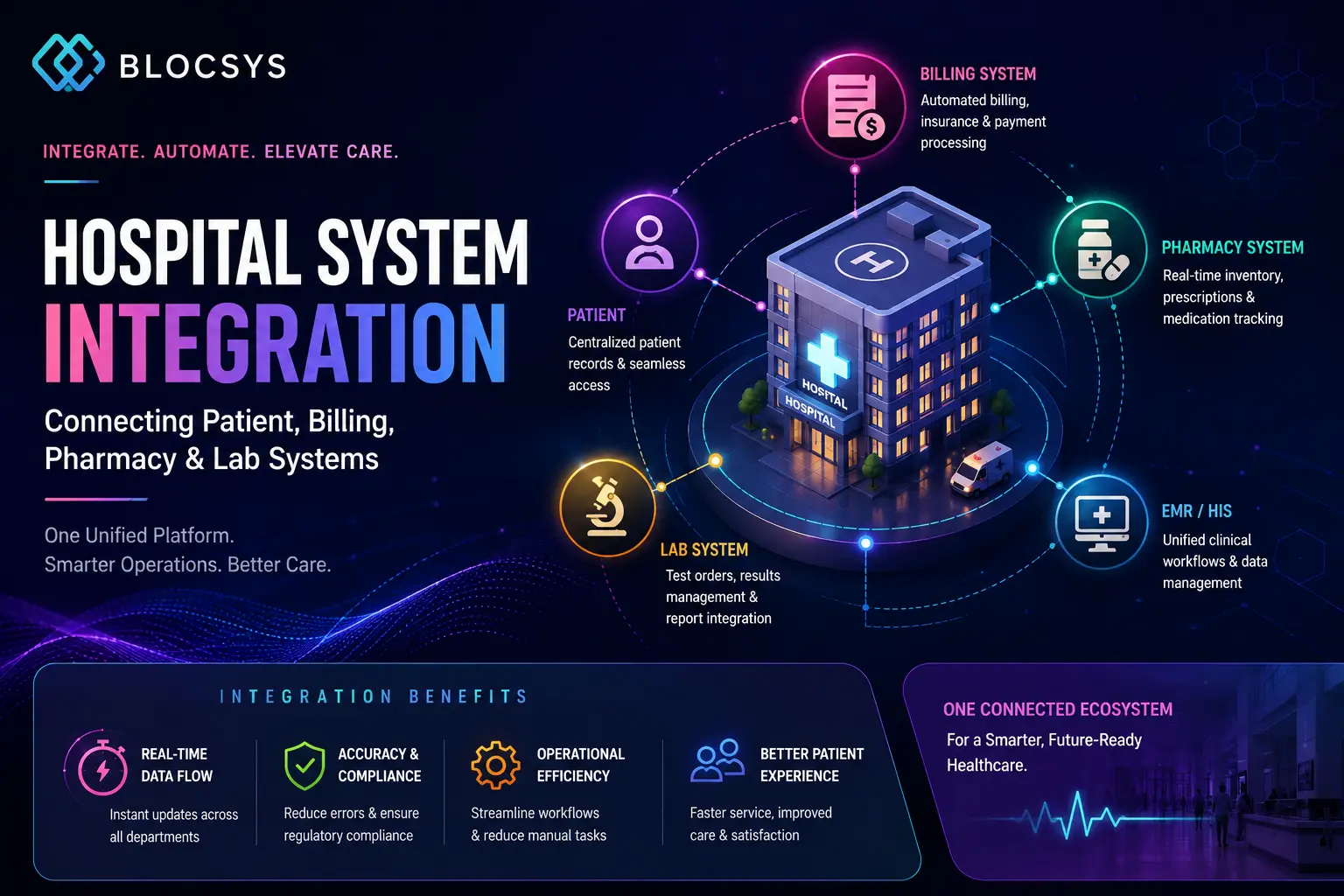
A patient arrives at a mid-sized hospital with a referral, a prescription, and a set of diagnostic orders. Registration captures the demographics. The clinician enters the encounter in the EHR. The laboratory opens a separate order, the pharmacy receives another version of the prescription, and billing waits for staff to reconcile everything before a claim can move forward. The patient sees separate queues, while the hospital sees duplicate entry, delayed results, missed charges, and an audit trail that depends too heavily on manual work.
Hospital system integration connects these clinical, financial, pharmacy, laboratory, and administrative workflows through a coordinated data exchange layer. This guide is for hospital administrators, CIOs, CTOs, healthcare IT teams, clinics, diagnostic centres, and technology providers deciding how to make that connection reliable. It focuses on the difficult operational questions, not just whether an integration exists: how to prevent duplicate charge capture, reconcile pharmacy and lab activity, protect patient records, support consent-based exchange, and keep claims defensible.
For organisations assessing a hospital management system, the central decision is architectural. A connected hospital workflow should let each department use the tools suited to its job while preserving one dependable patient and encounter context.
Table of Contents
- Why Disconnected Hospital Systems Create Operational Friction
- Core Components of Hospital System Integration
- Connecting Patient Records and Clinical Workflows
- Integrating Billing, Pharmacy, and Laboratory Systems
- Healthcare Interoperability Standards and API Architecture
- Security, Consent, and Patient Data Protection
- Implementation Process and Common Challenges
- Why Choose Blocsys for Hospital System Integration
- Frequently Asked Questions About Hospital System Integration
- What is hospital system integration?
- Why do hospitals need healthcare interoperability?
- How does EHR integration connect patient records?
- What is hospital billing integration?
- How does pharmacy integration improve hospital workflows?
- How does laboratory integration work?
- Which interoperability standards should a hospital use?
- What are healthcare APIs used for?
- How should hospitals protect integrated patient data?
- How long does hospital software integration take?
- How much does hospital software integration cost?
- Is hospital system integration suitable for clinics and diagnostic centres?
- Why should a hospital choose Blocsys?
Why Disconnected Hospital Systems Create Operational Friction
A disconnected hospital rarely fails because one system is completely unusable. The friction appears between systems. A nurse registers a patient in the hospital management system, a consultant records the encounter in an EHR, the laboratory technician enters a test request into an LIS, and the pharmacy team receives a prescription through a separate queue. Billing then reconstructs the episode from screens, printouts, and conversations.
That reconstruction creates several failure points:
- Duplicate demographics: A spelling variation or wrong identifier can create a second patient record.
- Order mismatches: A lab order may be associated with the wrong encounter or remain open after a cancellation.
- Delayed reporting: A result can be available in the LIS but not visible in the clinical record.
- Missed or duplicated charges: A test, medicine, procedure, or consultation may be billed twice, or not billed at all.
- Manual reconciliation: Finance and clinical operations spend time comparing records rather than resolving genuine exceptions.
The practical definition of healthcare system integration is broader than connecting screens. Integration means that systems exchange structured events, preserve shared identifiers, apply business rules, and return status information to the workflow that initiated the transaction. Basic connectivity moves data. Operational interoperability makes that data usable, traceable, and actionable.
Practical rule: If a project connects applications but leaves staff reconciling patient identity, encounter status, pricing, and exceptions manually, it has delivered connectivity, not a connected hospital workflow.
The architecture must also reflect local operating realities. In India, ABDM-aligned FHIR exchange is becoming a core design consideration, while hospitals may still depend on established billing, pharmacy, and laboratory engines. In the United States, UK, Europe, UAE, Singapore, Canada, and Australia, privacy, consent, data residency, payer, and health information exchange requirements shape the implementation differently.
A credible business case therefore starts with workflow mapping. Document where patient records, orders, results, dispensing events, payments, insurance details, appointments, and accounting entries originate. Then decide which system owns each fact and which systems are allowed to consume or update it. Hospitals comparing build options can also use a hospital management software cost assessment to separate product licensing from integration, migration, testing, training, and support effort.
Core Components of Hospital System Integration
An integrated hospital network has several specialised systems, but it needs a controlled way to coordinate them. The EHR usually acts as the clinical backbone, holding patient history, documentation, orders, prescriptions, and results. The billing and insurance layer manages charges, eligibility details, invoices, payment events, payer submissions, and accounting hand-offs.
The pharmacy system has a different responsibility. It must manage prescription validation, dispensing, substitutions where authorised, stock, batch and expiry information, returns, and medication-related charges. The LIS and diagnostic platforms manage orders, sample collection, analyser interfaces, result validation, report release, and, where relevant, imaging workflows.
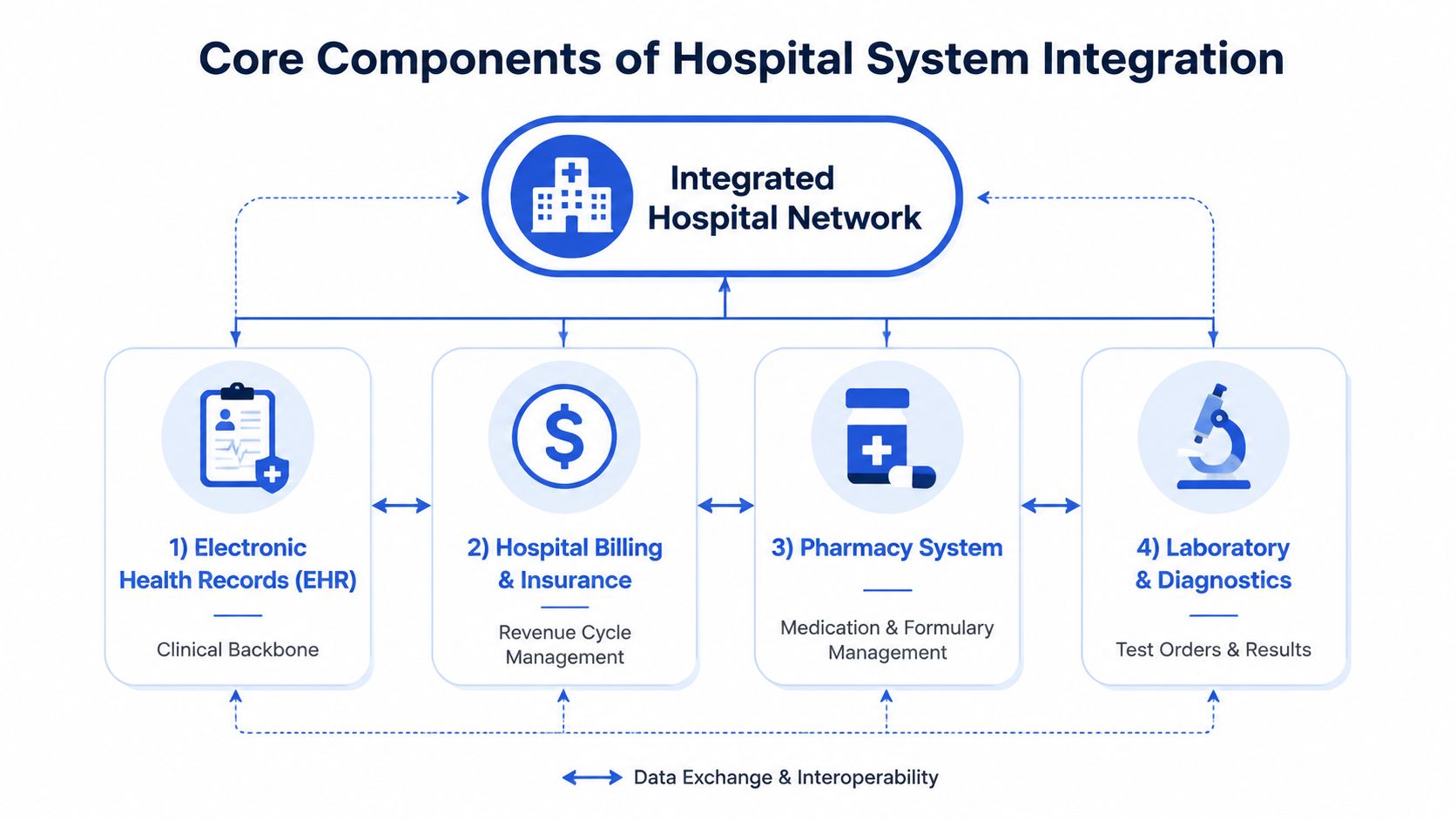
The systems and their dependencies
| System | Primary responsibility | Important exchanges |
|---|---|---|
| EHR or clinical record | Notes, diagnoses, orders, prescriptions, results, discharge records | Patient identity, encounter status, clinical documents, medication and diagnostic data |
| Billing and insurance | Charges, invoices, claims, payments, adjustments, accounting events | Consultation, procedure, test, medicine, payer, tax, and claim status |
| Pharmacy management | Dispensing, stock, formulary, returns, and medication pricing | Prescription, dispense status, item, quantity, inventory, and charge |
| LIS and diagnostics | Orders, samples, analyser results, reports, and release status | Test order, specimen, result, report, and service price |
| Appointments and administration | Scheduling, registration, referrals, beds, authorisations, and patient communication | Demographics, provider, department, appointment, admission, discharge, and payer data |
The distinction between module connectivity and true interoperability matters. A billing module may display a lab charge without receiving the laboratory’s order, collection, cancellation, and result status. A pharmacy module may display a prescription without returning a confirmed dispense or partial-fill event. Those designs create a visually integrated product while preserving operational silos underneath.
A hospital management system should therefore be evaluated by workflow coverage, not by the number of modules listed in a brochure. India-focused HIS guidance, including hospital information management system guidance for India, is especially relevant where ABHA-linked exchange, GST reporting, claims, and departmental operations must coexist.
The same principle applies outside healthcare. A corporate bond tokenization platform may use structured records, permissions, and workflow controls for financial operations, but hospital integration requires clinical context, consent, safety controls, and healthcare-specific terminology.
Connecting Patient Records and Clinical Workflows
The safest integration pattern begins with a canonical patient and encounter model. The patient identity should have a controlled matching process, while the encounter should distinguish outpatient, inpatient, emergency, diagnostic, pharmacy, and reimbursement activity without creating unrelated local versions.
FHIR-based document exchange supports this model by standardising information such as discharge summaries, prescriptions, and laboratory reports. India’s National Health Authority hospital digital standards explicitly call for support for an extended set of clinical ABDM FHIR profiles for cross-system data exchange, as described in the draft NABH standards for HIS and EMR systems.
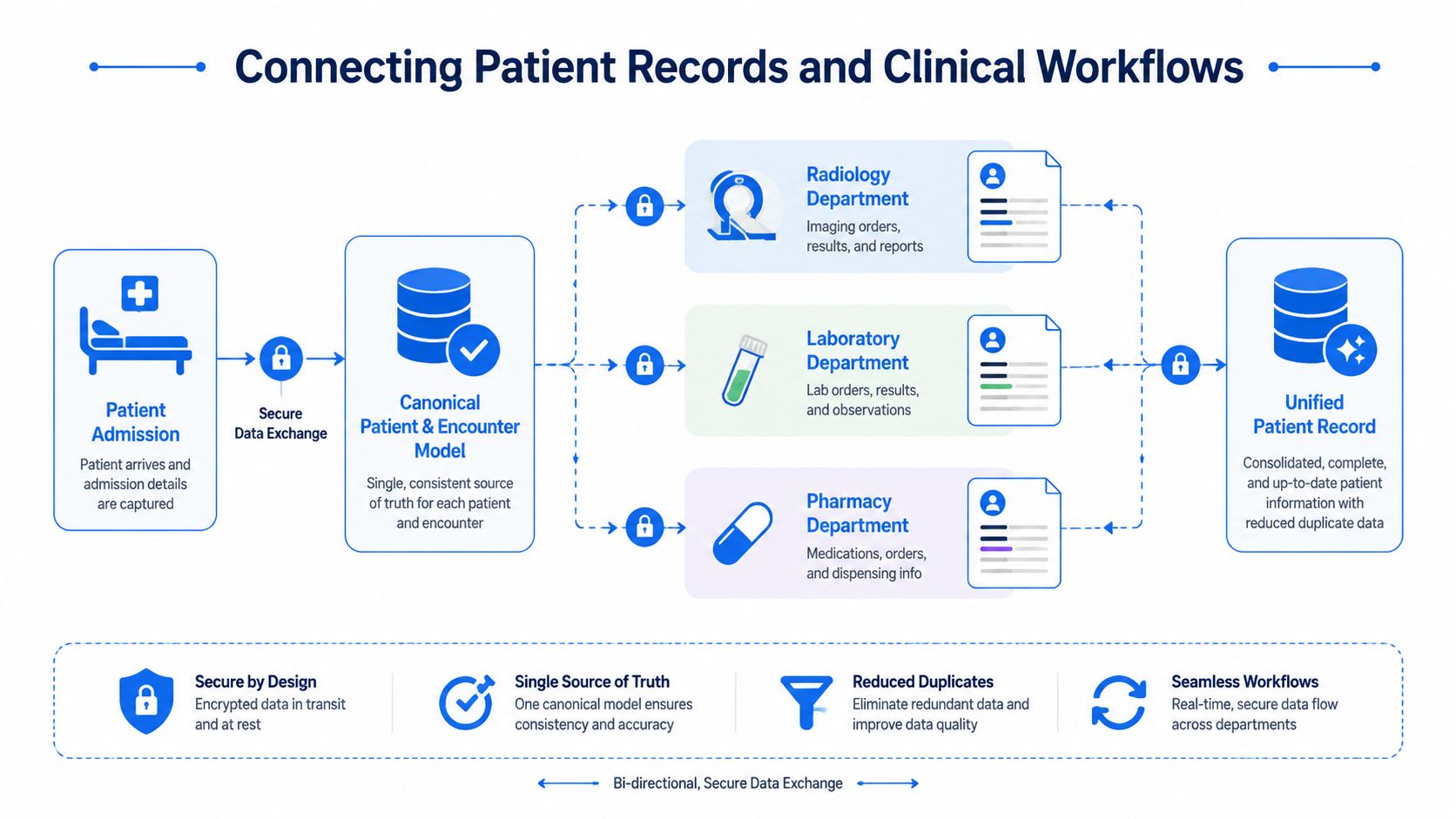
A prescription-to-dispense workflow
A reliable pharmacy integration usually follows a sequence:
- The clinician creates the prescription in the consultation workflow, linked to the correct patient and encounter.
- The integration layer validates identifiers and medication data, then sends a structured prescription to the pharmacy system.
- The pharmacist records the dispensing event, including quantity, substitution or partial fulfilment where applicable, and the relevant inventory movement.
- The pharmacy returns status to the clinical record and billing system.
- Billing uses the dispense event, rather than a manually retyped prescription, to create or validate the medicine charge.
This sequence prevents the clinical record from implying that a medicine was dispensed when it wasn’t. It also gives finance a traceable relationship between prescription, dispense, stock movement, and charge.
A test-order-to-result workflow
The same pattern applies to diagnostics. An order originates in the consultation or admission workflow, moves to the LIS as a structured request, and receives a sample or accession identity. The laboratory returns collection, processing, validation, cancellation, and result events. The final machine-readable result is attached to the patient record and made available to billing and downstream continuity-of-care workflows.
A single canonical model reduces duplicate demographics and order mismatches. It also lowers reconciliation effort because departments reuse the same patient and encounter context instead of re-entering it. The longitudinal record can support inpatient, outpatient, and reimbursement workflows while preserving a cleaner audit trail for claims and compliance.
Hospitals considering a broader platform can review hospital ERP development for AI-powered healthcare management as a reference point for connecting clinical and administrative processes without treating them as separate applications.
Integrating Billing, Pharmacy, and Laboratory Systems
The difficult part of integration is often the revenue trail. A consultation can generate a diagnostic order, a specimen collection event, a medicine dispense, a procedure, and a payment or claim. If each department creates its own financial record, the hospital must determine which events are billable, which were cancelled, which were included in a package, and which require payer-specific handling.
The right design distinguishes clinical intent, operational completion, and financial posting. A prescription isn’t automatically a dispense. A lab order isn’t automatically a completed test. A completed test isn’t always separately chargeable. Integration rules must represent those distinctions.
| Integration Point | Operational Challenge | Integration Solution | Measurable Outcome |
|---|---|---|---|
| Patient and encounter identity | Duplicate records and charges attached to different visits | Canonical identity, encounter mapping, and match-review queues | Fewer duplicate records and clearer account ownership |
| Lab order and result | Orders remain open, results are re-entered, charges are missed | Structured order, specimen, status, result, and charge events | Lower manual re-entry and a clearer report-to-bill trail |
| Prescription and dispensing | Prescribed items differ from dispensed items or stock records | Dispense confirmation linked to prescription and inventory movement | Better charge accuracy and stock reconciliation |
| Split billing | OPD, IPD, diagnostics, pharmacy, and payer accounts diverge | Shared encounter context with department-level posting rules | Easier exception handling and claim preparation |
| GST and claim reporting | Tax, package, payer, and service details require manual comparison | Central pricing, tax, payer, and adjustment rules | More consistent invoices and audit-ready transaction history |
The available verified material identifies this as an important India-specific implementation issue. Hospital operators need registration, billing, laboratory, pharmacy, payment, ABHA-linked, GST, and claim workflows to operate from a coherent record, yet feature pages often stop at “automatic” flow without explaining exceptions. The operational gains should therefore be measured locally, using baseline and post-deployment values for missed charges, stock variance, transcription errors, and report-to-bill cycle time, rather than borrowed benchmarks.
Choosing the integration pattern
Point-to-point integration can work for a small environment with few applications and stable interfaces. It tends to become difficult to govern as more systems exchange data, because each connection carries its own mapping, retry logic, monitoring, and security configuration.
An integration engine or enterprise service bus provides central routing, transformation, message monitoring, and error queues. It suits hospitals with legacy LIS, pharmacy, billing, and imaging systems, but it introduces a platform that needs ownership, support, and interface governance.
An API-first architecture works well for new modules and patient-facing services. It exposes reusable services through healthcare APIs, but it still needs adapters for older systems and careful controls for write operations.
Custom hospital management software development in India can combine these patterns. Separately, Blockchain Development can support enterprise, public, private, or hybrid blockchain applications, but a blockchain should not be used as a substitute for a hospital’s transaction engine, clinical data model, or consent manager.
Healthcare Interoperability Standards and API Architecture
India’s health IT guidance supports a pragmatic hybrid architecture. The Ministry of Health and Family Welfare’s recommended standards list HL7 v2.8.2 for event and message exchange, ASTM/HL7 CCD for summary records, and DICOM for imaging and waveform exchange, with FHIR positioned as a newer, easier-to-upgrade exchange model, as documented in the recommended healthcare interoperability standards.
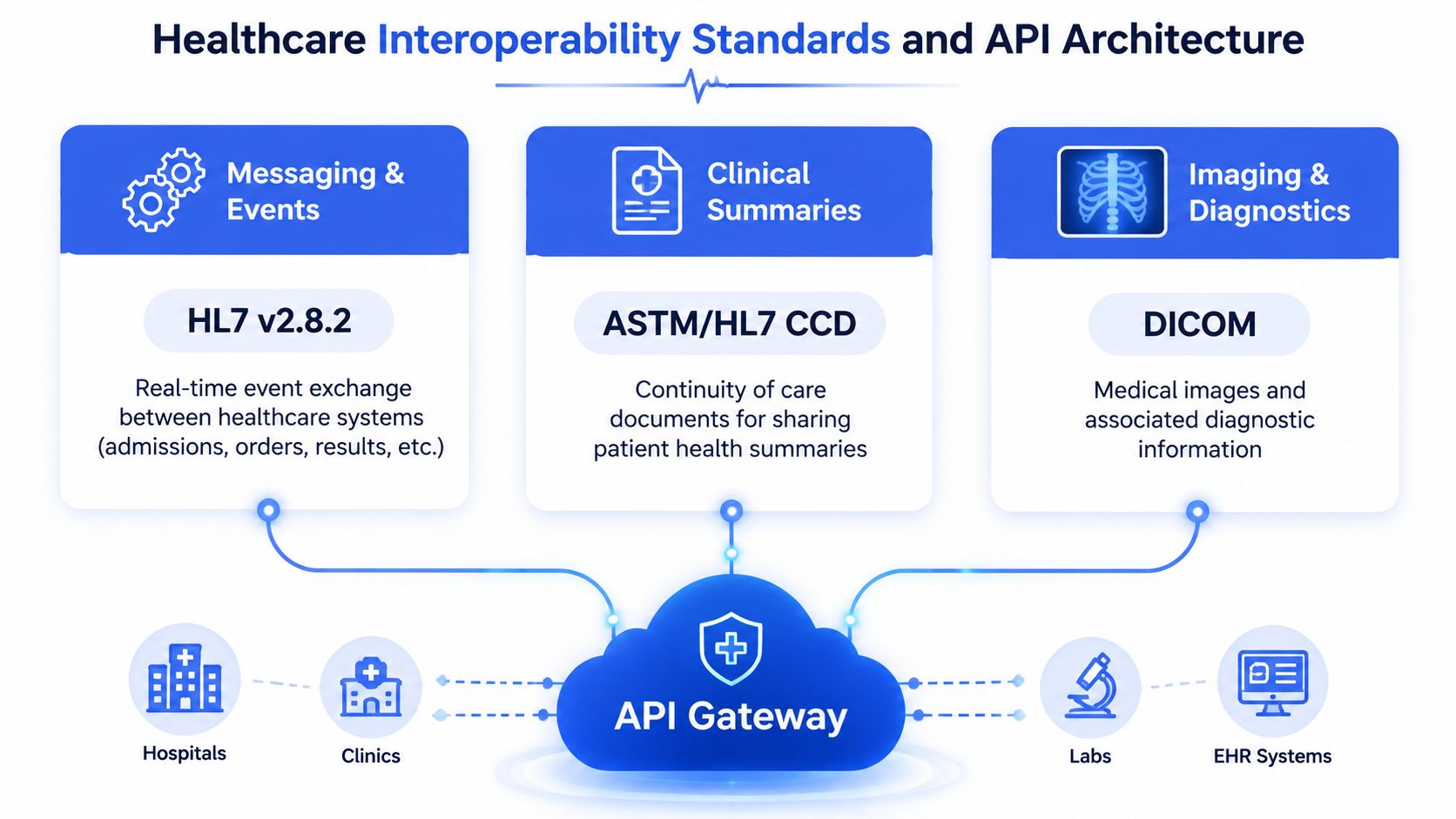
Matching standards to the job
- HL7 v2.8.2 is useful for events such as admissions, orders, results, transfers, and updates emitted by established hospital applications.
- ASTM/HL7 CCD supports summary records, including information that must move across care settings.
- DICOM handles medical imaging and waveform exchange, usually alongside PACS and radiology workflows.
- FHIR provides resource-based exchange through modern API patterns and is well suited to patient records, documents, applications, and ABDM-aligned exchange.
The practical design is not “replace every legacy interface with FHIR immediately.” A laboratory, pharmacy, or billing engine can continue emitting HL7 v2-style messages. Middleware receives those events, validates them, applies mapping and terminology rules, and normalises them into FHIR resources for the EHR or ABDM layer. The reverse path may be needed when a newer clinical application must send an order into a legacy system.
This reduces coupling because the source system doesn’t need to understand every downstream application. It also supports controlled retries, dead-letter queues, message acknowledgement, correlation identifiers, and interface monitoring. Those capabilities matter when an analyser is offline, a pharmacy transaction is rejected, or a payer response arrives after the encounter has closed.
An API gateway should enforce authentication, authorisation, throttling, schema validation, consent checks, and logging. The gateway isn’t the data model. It is the controlled entry point around services that understand patients, encounters, orders, results, medications, claims, and financial events.
Security, Consent, and Patient Data Protection
Hospital integration must make data available to authorised users without making the entire patient record available to every system. That requires least-privilege access, role-based permissions, service identities, encryption in transit and at rest, strong authentication, audit logs, and monitored administrative access. Clinical staff may need results, pharmacists may need prescriptions and allergies, and billing teams may need charges and payer information, but those roles shouldn’t automatically inherit unrestricted clinical access.
India’s ABDM consent architecture allows health facilities to create digital health records linked to ABHA and access previous patient records only after patient consent. The consent is revocable and time-bound, according to the government explanation of ABDM consent-based data exchange. ABDM interoperability guidance identifies the Health Information Exchange and Consent Manager as the mechanism for exchanging personal health data with consent, and states that an ABHA address is required to link records across multiple systems, as set out in the HIP and HIU guidelines.
A practical control framework
- Define data ownership: Assign authoritative systems for identity, encounter, medication, laboratory result, pricing, and claim status.
- Limit data by purpose: Send the pharmacy what it needs to dispense, not the entire clinical history.
- Record provenance: Preserve source system, user or service identity, timestamp, correlation identifier, and change history.
- Manage consent states: Store granted, denied, expired, and revoked permissions as enforceable states.
- Test exceptions: Verify what happens when consent expires, a patient withdraws access, or a system cannot be reached.
US deployments must consider HIPAA obligations and payer or health information exchange arrangements. UK and European projects need privacy, lawful processing, data subject rights, and residency considerations under applicable frameworks. UAE, Singapore, Canada, and Australia also require local review of health data handling, hosting, access, retention, and breach response.
Teams that handle sensitive information in other regulated sectors can also consult client data security for personal injury firms for a practical perspective on access-control design. For healthcare-specific architecture, blockchain in healthcare for securing data interoperability should be assessed as a supplementary control option, not as a replacement for established identity, consent, and audit mechanisms.
Implementation Process and Common Challenges
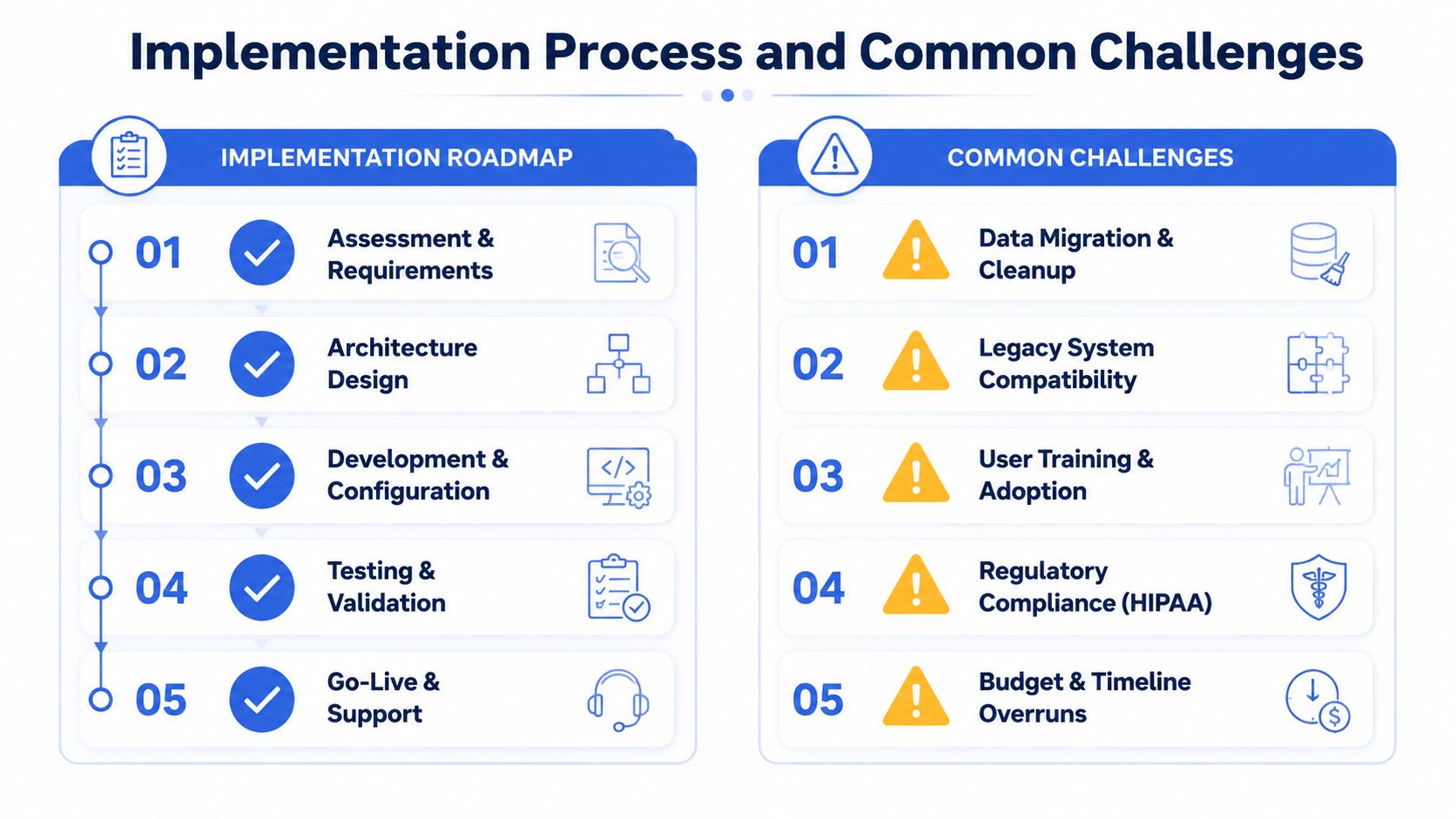
Integration projects go wrong when teams start with interfaces instead of workflows. Begin by selecting a small number of high-value journeys, such as consultation-to-lab-result, prescription-to-dispense, or discharge-to-claim. Map every event, owner, identifier, status, exception, and financial consequence before choosing technology.
A deployment roadmap
- Assessment and requirements: Interview clinicians, laboratory staff, pharmacists, finance, claims teams, registration staff, and administrators. Capture real exceptions, not just the happy path.
- Architecture design: Define the canonical patient and encounter model, integration engine or gateway, source-of-truth rules, security boundaries, message patterns, and monitoring approach.
- Development and configuration: Build adapters, mappings, validation rules, FHIR resources, legacy HL7 routes, pricing logic, consent checks, and exception queues.
- Testing and validation: Use representative patient, OPD, IPD, diagnostic, pharmacy, split-billing, cancellation, refund, and claim-rejection scenarios.
- Go-live and support: Start with controlled workflows, train users by role, monitor failed messages, and establish ownership for interface incidents.
Point-to-point connections may be acceptable when the application environment is small and unlikely to change. An integration engine is usually easier to govern when multiple legacy systems must exchange events. An API-first model is appropriate for new capabilities, but it shouldn’t be mistaken for a complete migration strategy.
The recurring challenges are practical:
- Data migration and cleanup: Historical records may use inconsistent identifiers, incomplete fields, or local codes.
- Legacy compatibility: Older systems may support only specific message structures or limited write-back.
- Change management: Staff may create workarounds if the new flow adds clicks or hides the status they need.
- Testing gaps: Teams often test successful results but not rejected orders, duplicate messages, partial dispensing, cancellations, or late payer responses.
- Ownership ambiguity: An interface without a named operational owner becomes an unresolved queue.
Implementation insight: Measure the workflow before automating it. Otherwise, the project may simply move the same ambiguity from a paper queue into a faster digital queue.
Why Choose Blocsys for Hospital System Integration
Hospitals usually need more than a standalone module. They need a technology partner that can translate clinical workflows into data contracts, connect established systems, and preserve operational control when an integration fails. Blocsys works in the healthcare software and enterprise technology space, supporting hospital management systems, healthcare platforms, API development, security architecture, and digital transformation initiatives.
The useful engagement model starts with the hospital’s operating reality. A clinic may need patient registration, appointments, prescriptions, billing, and laboratory reporting. A diagnostic centre may prioritise sample tracking, analyser connectivity, report release, and revenue posting. A hospital network may need a shared identity model, role-based access, payer workflows, ABHA-linked exchange, and a governed integration layer across facilities.
Blocsys can support Hospital Management System Development, Healthcare Software Development, Hospital Software Integration, Healthcare Platform Development, and enterprise healthcare technology solutions. The architecture should be selected after reviewing the existing EHR, LIS, pharmacy platform, billing engine, accounting system, payer connections, data residency needs, and departmental ownership. That keeps the solution proportionate and avoids forcing a small organisation into an unnecessarily complex platform.
For teams considering AI or blockchain, the same discipline applies. AI should be introduced where structured, governed data and clear human oversight exist. Blockchain should be considered only where its audit, verification, or multi-party trust characteristics solve a defined problem. Blocsys also provides technology work across AI, blockchain, and enterprise software, but healthcare integration still depends first on identity, workflow, interoperability, consent, and security fundamentals.
A practical next step is a paid or scoped discovery exercise that produces a system inventory, workflow map, integration-priority matrix, canonical data model, security requirements, and implementation roadmap. For early cost planning, use the Blocsys Cost Estimator Tool and treat the result as a planning input, not a substitute for requirements analysis.
Frequently Asked Questions About Hospital System Integration
What is hospital system integration?
Hospital system integration connects EHR, patient registration, billing, insurance, pharmacy, laboratory, imaging, scheduling, accounting, and administrative applications through controlled data exchange. The objective is to preserve consistent patient and encounter information while allowing each department to complete its own workflow.
Why do hospitals need healthcare interoperability?
Healthcare interoperability lets authorised systems exchange information in a usable form. It can reduce duplicate entry, prevent order mismatches, support faster access to results, and give billing teams a clearer relationship between clinical activity and financial events. Technology alone isn’t enough. Shared identifiers, terminology, governance, and workflow ownership are also required.
How does EHR integration connect patient records?
EHR integration uses a canonical patient and encounter model, interface mappings, APIs, messages, and document exchange. Consultation orders can move to laboratory or pharmacy systems, while dispense events and validated results return to the longitudinal patient record. Identity matching and exception review are essential.
What is hospital billing integration?
Hospital billing integration links clinical and operational events to charges, invoices, claims, payments, tax records, adjustments, and accounting workflows. A well-designed flow distinguishes an order from a completed service and a prescription from an actual dispense, which helps prevent duplicate or missed charges.
How does pharmacy integration improve hospital workflows?
Pharmacy integration connects prescriptions with dispensing, inventory, pricing, returns, and billing. It gives the clinical record a reliable dispense status and lets finance use the confirmed transaction instead of retyping the prescription. Stock, batch, expiry, substitution, and partial fulfilment rules still need pharmacy-specific controls.
How does laboratory integration work?
Laboratory integration sends structured test orders from the clinical workflow to the LIS, links them to specimen and accession information, and returns status updates and validated results. The result can then attach to the patient record and support billing. Analyser connectivity and local test-code mapping require separate validation.
Which interoperability standards should a hospital use?
The choice depends on the source and destination systems. HL7 v2.8.2 remains relevant for event and message exchange, ASTM/HL7 CCD supports summary records, DICOM supports imaging and waveform exchange, and FHIR provides a modern resource-based exchange model. A hybrid architecture is often more realistic than an immediate replacement of legacy interfaces.
What are healthcare APIs used for?
Healthcare APIs expose controlled functions and data for applications such as patient records, appointments, orders, results, pharmacy, billing, portals, analytics, and external exchange. They should enforce authentication, authorisation, schema validation, consent checks, rate controls, and audit logging.
How should hospitals protect integrated patient data?
Use least-privilege access, role-based permissions, strong authentication, encryption, monitoring, audit trails, retention rules, and tested incident response. Consent must be represented as an enforceable state when the workflow involves consent-based exchange. Regulatory requirements vary by jurisdiction, so legal and security review should accompany architecture decisions.
How long does hospital software integration take?
The timeline depends on the number and condition of source systems, interface availability, data quality, workflow complexity, testing requirements, vendor cooperation, and the scope of migration. A reliable estimate requires discovery and interface assessment rather than a generic calendar promise.
How much does hospital software integration cost?
Cost varies with system count, custom workflow requirements, data migration, integration-engine licensing, API access, security controls, testing, training, and support. Hospitals should assess total delivery and operating costs, then use a requirements-based estimate. The Blocsys Software Development Cost Estimator can support early planning.
Is hospital system integration suitable for clinics and diagnostic centres?
Yes, but the architecture should match operational scale. A clinic may need a focused connection between registration, EHR, pharmacy, laboratory, and billing. A diagnostic centre may prioritise order, sample, analyser, result, invoice, and payer workflows. Both should define ownership, security, and exception handling before implementation.
Why should a hospital choose Blocsys?
Blocsys supports hospital management system development, healthcare software development, hospital software integration, healthcare platform development, and enterprise technology projects. Hospitals should evaluate Blocsys through its proposed architecture, workflow understanding, security approach, interoperability plan, delivery responsibilities, and support model.
Hospital system integration succeeds when the hospital treats it as an operating model, not a connector purchase. Start with patient and encounter identity, then connect orders, results, dispensing, charges, claims, payments, and administrative events through standards-based interfaces, enforceable controls, and visible exception handling. That approach gives CIOs a clearer path to safer clinical workflows and a cleaner revenue trail across departments.
For hospitals, healthcare networks, clinics, and diagnostic centres planning their next integration initiative, Blocsys Technologies offers hospital management system development, healthcare software integration, healthcare platform development, and enterprise technology solutions for connected patient, billing, pharmacy, and laboratory workflows. Visit Blocsys Technologies to discuss your architecture, integration priorities, and next implementation step.
