
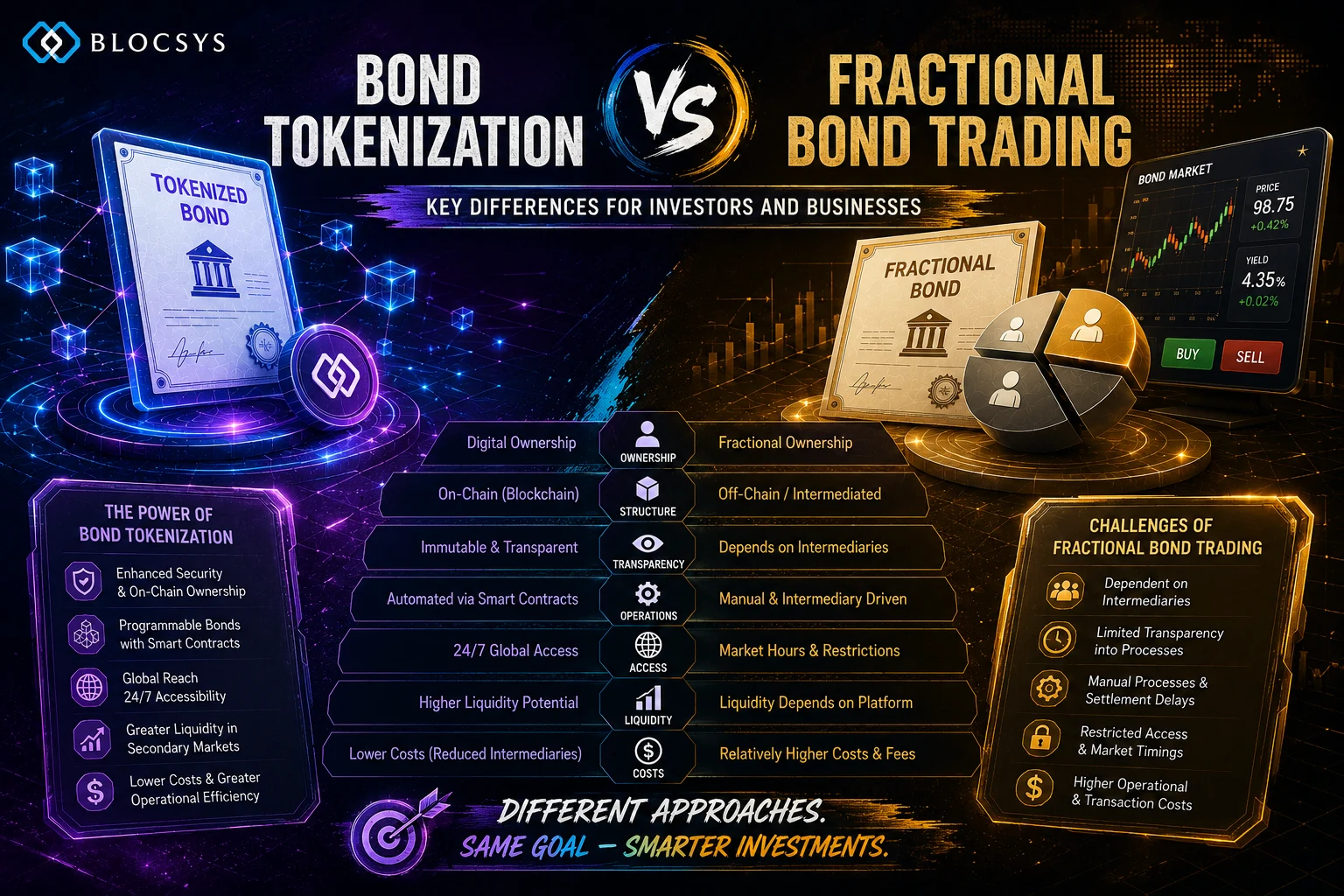
Most advice on Bond Tokenization vs Fractional Bond Trading starts with the wrong question: how small can the investment be? That matters, but it isn’t the decisive issue. Tokenization changes the bond’s market structure, while fractional bond trading usually changes only how investors access an existing instrument.
This distinction matters to corporate issuers, banks, asset managers, wealth platforms, fintechs, and institutional investors evaluating tokenized bonds, fractional bonds, digital securities, and blockchain-based bonds across the US, UK, Europe, the UAE, Singapore, Germany, Switzerland, Canada, and Australia. The decision affects legal ownership, custody, transfer restrictions, settlement finality, compliance architecture, and the route to secondary-market liquidity.
The practical recommendation is straightforward. Choose fractional bond trading when the objective is smaller exposure within established market plumbing. Choose bond tokenization when the objective is programmable issuance, shared-ledger ownership records, controlled transferability, and redesigned post-trade operations. Organisations assessing that transition can also review Blocsys Technologies for enterprise blockchain and digital-asset infrastructure capabilities.
Table of Contents
- Why Bond Tokenization and Fractional Bond Trading Are Not the Same Thing
- What Bond Tokenization Means
- What Fractional Bond Trading Means
- Bond Tokenization vs Fractional Bond Trading Across the Investor Decision Criteria
- Ownership, Compliance, and the Legal Reality Investors Must Understand
- Which Model Fits Which Use Case for Issuers and Investors
- Choosing the Right Model and How Blocsys Delivers Tokenized Bond Infrastructure
- Frequently Asked Questions on Bond Tokenization and Fractional Bond Trading
- What is bond tokenization?
- What does fractional bond trading mean?
- What is the main difference between tokenized bonds and fractional bonds?
- Does a token holder legally own the bond?
- Do tokenized bonds always have lower minimum investments?
- Are tokenized bonds more liquid?
- How does settlement differ between the models?
- Who provides custody for a tokenized bond?
- Which regulations apply to tokenized bonds?
- Can tokenized bonds connect with traditional financial infrastructure?
- What risks should investors monitor?
- Who should use a bond tokenization platform?
- How much does corporate bond tokenization platform development cost?
- Why choose Blocsys for tokenized bond infrastructure?
Why Bond Tokenization and Fractional Bond Trading Are Not the Same Thing
Tokenization and fractional trading are often presented as interchangeable ways to make bonds accessible. They aren’t. Fractional trading is primarily a distribution-layer change. Tokenization is an issuance, ownership, and settlement-layer change.
A fractional product can allow an investor to purchase a small economic interest in a conventional bond. The original security may continue to exist under its established issuance documents, identifier, custodian, registrar, and settlement process. The platform or intermediary then records each investor’s entitlement and passes through coupons, redemption proceeds, and losses.
A tokenized bond can represent the bond itself, or legally defined rights connected to it, through a token recorded on a distributed ledger. The ledger may govern ownership transfers, eligibility checks, payment instructions, and servicing events, subject to the applicable legal framework. The result isn’t a smaller lot size. It can be a different operating model for the entire bond lifecycle.
Practical rule: If the underlying security, registrar, custody arrangement, and settlement rail stay unchanged, you’re probably evaluating fractional access rather than full bond tokenization.
The distinction changes implementation priorities:
- Issuers need to decide whether they want a new digital issuance architecture or merely broader distribution.
- Investors need to establish whether they hold legal title, beneficial ownership, or a contractual claim against an intermediary.
- Custodians need to understand whether the authoritative record sits in a conventional account system, a permissioned ledger, or a legally recognised digital registry.
- Compliance teams need to determine whether restrictions are enforced through contracts and smart contracts, or through platform controls and intermediaries.
A market-structure decision made as a marketing decision can produce the wrong custodian, incomplete investor disclosures, and a compliance model that fails at transfer or default. A useful technical overview of the distinction appears in blockchain securities tokenization, but the commercial conclusion is simple: don’t approve a bond product until the legal ownership and settlement model are documented.
What Bond Tokenization Means
Bond tokenization represents a regulated debt instrument, or legally defined rights connected to it, as digital tokens recorded on a distributed ledger. The token’s legal effect depends on governing law, offering documents, custody arrangements, and regulatory permissions. A blockchain entry does not automatically become the authoritative ownership register, and a token does not automatically qualify as a security.
A serious corporate bond tokenization programme must connect five layers:
- Legal instrument. The issuer defines the debt obligation, repayment terms, coupon mechanics, default events, investor rights, and applicable law.
- Digital representation. The token represents ownership, a beneficial interest, or specified contractual rights.
- Transfer logic. Smart-contract rules restrict transfers by investor eligibility, jurisdiction, holding period, whitelist status, or other offering conditions.
- Lifecycle automation. Coupon calculation, payment instructions, maturity processing, redemptions, and corporate actions connect to programmed workflows.
- Institutional integration. The platform connects with onboarding systems, custodians, payment rails, registries, reporting tools, and, where required, a central securities depository or digital registry.
Native on-chain issuance carries a specific meaning. If the bond is only mirrored on a blockchain while the legally decisive ownership record remains elsewhere, the ledger may improve operational visibility. It does not create the same legal or settlement model as a bond designed around a digital ownership and transfer record.
Role allocation must be explicit. The issuer remains responsible for the debt obligation and disclosure. A tokenization agent may administer issuance and registry processes. Smart-contract auditors review code risk. Licensed custodians safeguard assets or keys, depending on the structure. Transfer agents, paying agents, broker-dealers, and settlement institutions may still be required.
Cross-jurisdiction issuance adds another test. Eligibility rules, transfer restrictions, investor disclosures, custody arrangements, and settlement finality must work together across the relevant legal regimes. Treating tokenization as a technology project alone leaves ownership and enforcement questions unresolved.
Resources on how handles tokenized treasuries help distinguish an on-chain representation from an operating model connected to regulated finance. For lifecycle design, tokenized bonds and corporate bond lifecycle management offers a relevant technical reference. A corporate bond tokenization platform can support issuance, smart-contract workflows, settlement, and investor management after the legal and regulatory model is defined.
What Fractional Bond Trading Means
Fractional bond trading gives investors a sub-unit economic position in a bond that remains whole at the original issuance and settlement layer. The investor may receive a proportionate share of coupon payments, maturity proceeds, and credit losses, while the underlying bond’s issuance architecture remains unchanged.
A platform can create this exposure through a pooled account, nominee arrangement, custodian account, special purpose vehicle, or another intermediary structure. The original bond may keep its established identifier and documentation. The investor’s position is recorded in platform books, custodian records, or an SPV ownership structure, rather than represented by a native blockchain token.
This is a market-structure decision, not merely a smaller-ticket product. A fractional holder may lack direct enforcement rights against the issuer and instead depend on the platform, nominee, trustee, or SPV to exercise rights, receive payments, and respond to a default. The legal documents determine the result. The product label does not.
What the investor receives
Fractional bond trading reduces the capital required to gain exposure to a corporate bond. It can also simplify portfolio construction for wealth managers and digital investment platforms. Smaller access does not by itself provide direct bond ownership, faster settlement, or blockchain-based transferability.
Coupon and principal flows usually pass through the structure:
- The issuer or paying agent pays the custodian, trustee, nominee, or SPV.
- The intermediary calculates each investor’s entitlement.
- The platform distributes the relevant amount to fractional holders.
- Default, restructuring, or enforcement decisions may be handled collectively or by the intermediary.
The model is therefore a ticket-size and distribution innovation. It suits investors who want bond exposure through a familiar brokerage or wealth platform and do not require direct control of a digital security. Issuers and platforms should present it that way, rather than implying that fractional access changes ownership or settlement finality.
Blockchain may appear in a fractional product without changing the legal nature of the underlying bond. Tokenization and fractionalization are therefore different design choices. The distinction also applies in other asset classes, including fractional ownership using blockchain technology, where the decisive question is whether the token changes legal ownership or records only an economic claim.
Bond Tokenization vs Fractional Bond Trading Across the Investor Decision Criteria
Investors should compare the models against operating requirements, not promotional language. The following table identifies the principal differences.
Bond Tokenization vs Fractional Bond Trading decision criteria
| Criterion | Bond Tokenization | Fractional Bond Trading |
|---|---|---|
| Ownership | A token may represent legal ownership, beneficial ownership, or defined contractual rights, depending on the structure | Investors usually hold a sub-unit claim recorded by a platform, custodian, nominee, or SPV |
| Minimum investment | Can support small denominations if the legal and platform design permits | Can reduce the ticket size without altering the underlying bond |
| Issuance | May use native digital issuance and smart-contract controls | The original bond is issued through conventional market infrastructure |
| Investor eligibility | Eligibility can be enforced through wallets, whitelists, transfer rules, and onboarding controls | Eligibility is commonly enforced by the intermediary or platform |
| Transferability | Tokens can support controlled digital transfers, subject to law and approved venues | Transfers usually occur through the platform’s books or conventional market channels |
| Settlement | Can support shared-ledger settlement and linked transfer of securities and money | The underlying bond normally settles through established custody and settlement arrangements |
| Custody | May involve digital-asset custody, institutional wallets, custodians, or a hybrid model | Usually relies on conventional custodians, nominees, brokers, or SPVs |
| Infrastructure | Requires ledger, smart contracts, compliance logic, integrations, and operational controls | Uses brokerage, custody, registry, payment, and platform infrastructure |
The most important criterion is settlement finality. A tokenised structure may be designed so that the asset and payment move together on a shared ledger. That capability must still be recognised by the applicable legal and settlement framework. Fractional trading generally leaves settlement of the underlying instrument on its established rails.
Transfer restrictions are another dividing line. A token can be programmed to prevent transfers to unapproved wallets or investors outside a permitted jurisdiction. A fractional platform can also block transfers, but the control normally sits in the platform’s application, account database, and contractual terms rather than in the asset’s transfer logic.
Custody requires equally careful analysis. Token ownership may mean control of a wallet, a claim recorded by a custodian, or beneficial ownership under an SPV. Fractional investors usually depend on the intermediary’s records and insolvency arrangements. Before investing, ask who holds the bond, who controls the register, and what happens if the platform becomes insolvent.
A fuller market comparison is available in traditional corporate bonds versus tokenized corporate bonds. The recommendation for an investment committee is to approve the legal structure first, then assess technology. Reversing that order creates expensive rework.
Ownership, Compliance, and the Legal Reality Investors Must Understand
The investment decision starts with legal ownership, not wallet architecture. Ask who owns the underlying bond and what rights the investor can enforce.
In a direct tokenised structure, the token may serve as the authoritative ownership record, subject to governing law and regulation. Under a custodial or SPV arrangement, the custodian or SPV may hold legal title while token holders receive beneficial interests. A fractional product may instead give investors a contractual claim against a platform or nominee, not a direct claim against the issuer.
That distinction determines the investor’s position after missed payments, restructuring, insolvency, or enforcement. Review the offering memorandum, trust deed, custody agreement, wallet terms, transfer-agent arrangements, and default procedures. A polished interface does not resolve unclear priority rights.
Jurisdiction changes the answer
US structures may rely on securities-law exemptions such as Reg D or Reg S, while also requiring analysis of broker-dealer, transfer-agent, custody, and alternative trading system rules. Tokenisation does not remove those obligations. Software can enforce eligibility and transfer conditions, but the issuer still needs a valid offering and distribution framework.
UK issuers and platforms must assess financial-promotion rules, FCA permissions, custody, and digital-asset treatment. European structures require separate review of the applicable securities framework, including CSDR and the EU Pilot Regime. MiCA may apply to certain crypto-asset activities, but it is not a universal framework for tokenised securities.
The UAE, Singapore, Switzerland, Canada, and Australia require local analysis. VARA and DFSA rules can differ within the UAE. MAS-led digital-asset initiatives in Singapore do not create permission elsewhere. Swiss teams must assess FINMA classification, while Canadian and Australian issuers need to consider CSA and ASIC positions. German firms must review EU rules alongside local licensing and custody requirements.
Legal ownership is a product feature. It must be specified in documents, not inferred from blockchain functionality.
Smart contracts can encode whitelist rules, investor restrictions, holding periods, and transfer approvals. Fractional platforms can apply similar restrictions through centralised controls. The key question is where control operates, and which record prevails if the code, database, custodian, and legal register disagree.
India shows why an infrastructure pilot does not settle the legal position. SEBI announced in May 2026 that it planned a corporate bond tokenisation pilot, with implementation expected within 6 to 9 months, according to the reported SEBI pilot timeline. For a focused discussion of the regulatory direction and private-debt implications, see SEBI corporate bond tokenization and the private debt market.
India currently lacks a dedicated legal framework expressly recognising tokenised securities or blockchain registries. That leaves open questions about statutory registers, depository roles, custody, and investor protection, as discussed in India’s tokenised-securities legal analysis. Cross-border teams can consult 2026 compliance solutions for finance for additional context, but local counsel must determine the actual requirements.
Which Model Fits Which Use Case for Issuers and Investors
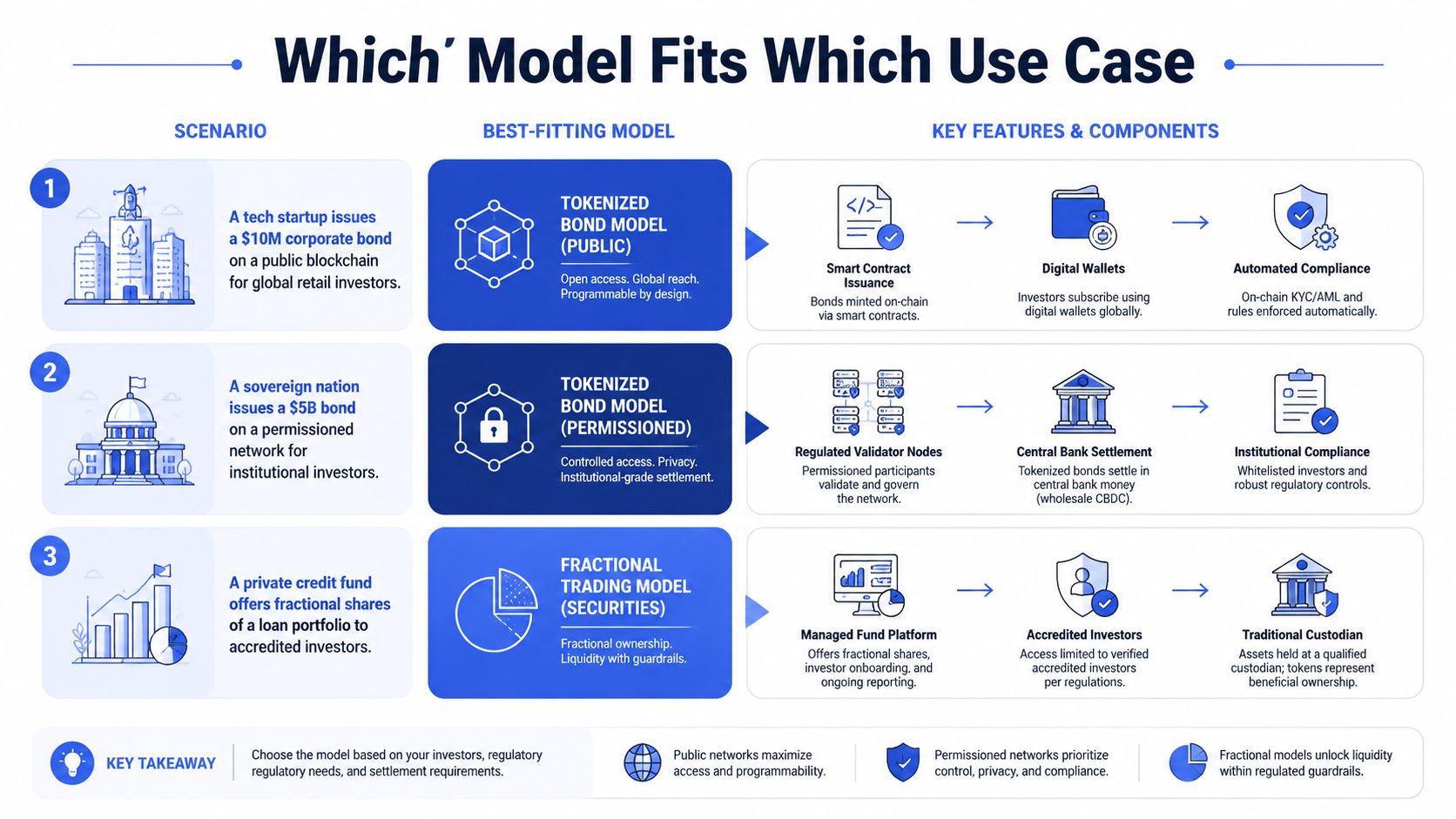
The right model depends on the binding constraint. If the constraint is investor ticket size, fractional trading may solve the problem with less operational disruption. If the constraint is reconciliation, settlement coordination, ownership transparency, or programmable lifecycle servicing, tokenization addresses a deeper layer.
Public-chain corporate issuance may favour tokenized bonds when the issuer has a legally approved distribution model, a controlled wallet architecture, and a clear plan for investor eligibility. The chain doesn’t eliminate securities compliance, but token-level restrictions can support it.
Sovereign and supranational issuance on permissioned networks typically favours tokenization when central banks, regulated validators, and institutional custodians need a shared settlement environment. India’s wholesale CBDC pilot, launched on 1 November 2022, has been used as a technical testing ground for asset, bond, and security tokenisation experiments, according to Indian legal and market analysis of the RBI pilot.
Private-credit funds and wealth platforms often favour fractional trading when they need to package exposure to loans or bonds for an existing accredited or retail distribution channel. The fund can preserve familiar custody and reporting while dividing economic exposure. That model is usually more practical where the issuer doesn’t need a new digital issuance rail.
Secondary-market liquidity requires realism. Tokenization can make transfer rules and ownership records more efficient, but it doesn’t create buyers. Fractionalisation can reach an established brokerage audience, but it may inherit the liquidity limitations of the underlying bond and platform.
A hybrid can work. An issuer may tokenise the primary bond, then support fractional secondary access through a regulated trading venue, broker-dealer routing, or an approved alternative trading system. The trade-off is greater integration complexity, more reconciliation points, and the need to align digital ownership with conventional market participants.
Choosing the Right Model and How Blocsys Delivers Tokenized Bond Infrastructure
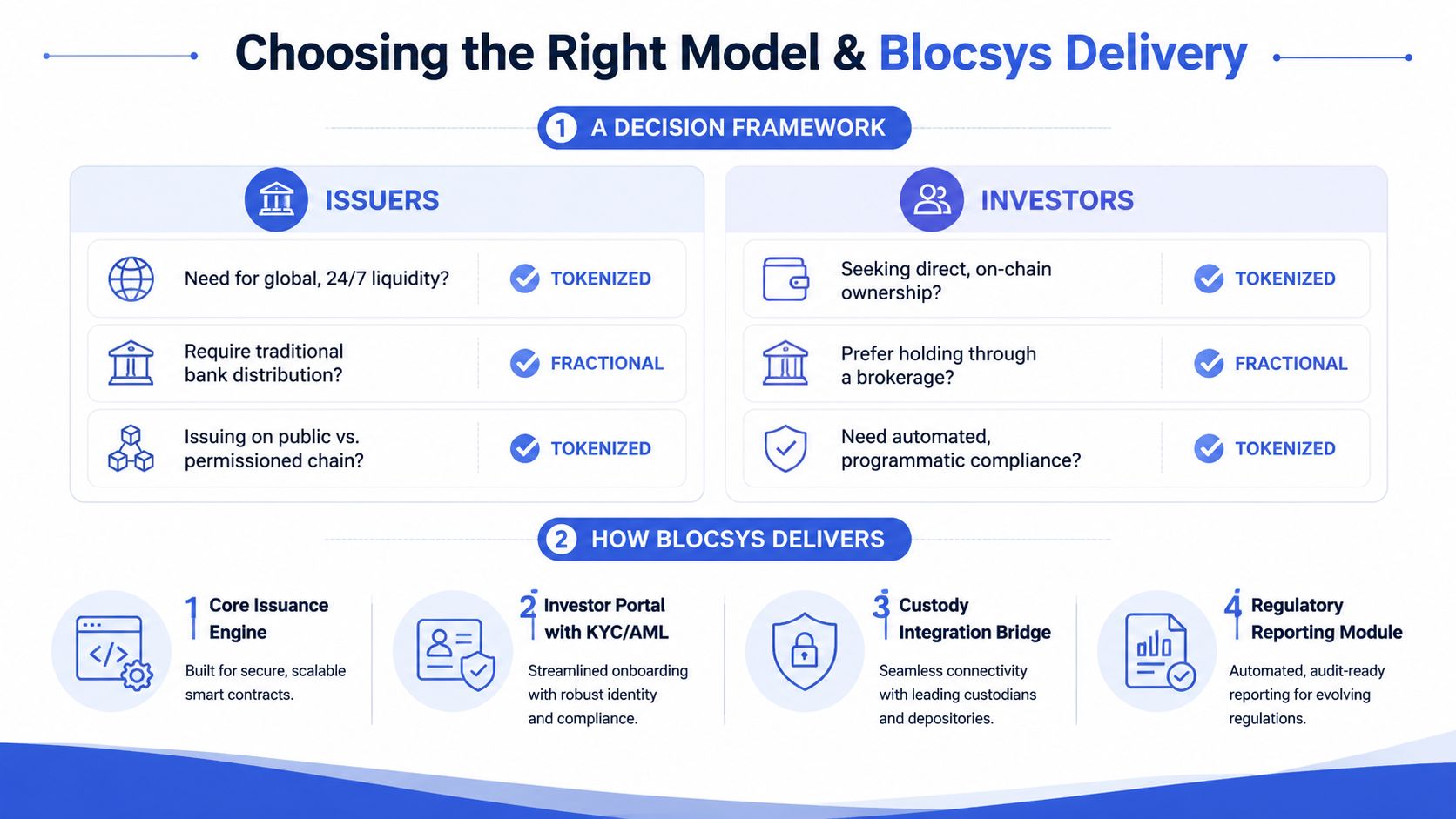
Start with five questions, ranked in this order:
- Which jurisdiction governs the security, issuer, investors, custody, and venue?
- Does the target investor base need direct digital ownership or only smaller exposure?
- Does the settlement design require linked delivery of securities and money?
- Where will secondary liquidity come from?
- Which compliance, reporting, custody, and interoperability controls must operate from day one?
Tokenization is the stronger choice for issuers seeking programmable primary-market issuance, controlled cross-border distribution, automated lifecycle events, and a shared ownership record. Fractional structures are the pragmatic choice when investors want smaller positions through conventional brokerage, custody, and reporting channels.
Blocsys can map those requirements into enterprise tokenization infrastructure. Its delivery scope can include smart-contract architecture, permissioned investor onboarding, jurisdictional compliance layers, oracle integrations for coupon and redemption events, custody connectivity, issuance workflows, ownership management, settlement orchestration, asset servicing, and regulatory reporting. Organisations assessing adjacent automation can also review GenAI use cases in finance for broader operational context.
Blocsys Technologies should be evaluated as an engineering partner, not as a competing investment platform. Its relevant work includes enterprise blockchain development services for organisations moving from conventional bond infrastructure toward secure, scalable digital securities systems. Where smaller ticket sizes are the only requirement, a fractional model may remain the better answer.
Frequently Asked Questions on Bond Tokenization and Fractional Bond Trading
What is bond tokenization?
Bond tokenization represents a debt instrument, or legally defined rights connected to it, through digital tokens recorded on a distributed ledger. The token may serve as the ownership record or represent beneficial ownership, depending on the legal documents, custody arrangement, registry, and jurisdiction. Blockchain functionality alone doesn’t determine the investor’s legal rights.
What does fractional bond trading mean?
Fractional bond trading lets an investor obtain a sub-unit economic position in a bond that remains whole within the original issuance and settlement system. A platform, custodian, nominee, or SPV records the investor’s entitlement and passes through coupon and redemption economics under the product’s terms.
What is the main difference between tokenized bonds and fractional bonds?
Tokenized bonds can change how the security is issued, recorded, transferred, settled, and serviced. Fractional bonds usually change only the investor’s access and position size, while the underlying bond, custody structure, and settlement architecture remain conventional.
Does a token holder legally own the bond?
Not necessarily. A token holder may own the bond directly, hold beneficial ownership through a custodian or SPV, or hold a contractual claim against an intermediary. Investors should review the governing documents to identify the legal owner, the authoritative register, enforcement rights, and insolvency protections.
Do tokenized bonds always have lower minimum investments?
No. Tokenization can support smaller denominations, but the minimum depends on the legal structure, offering terms, platform controls, investor eligibility, custody model, and distribution rules. A fractional platform may provide small access without tokenizing the underlying bond.
Are tokenized bonds more liquid?
Not automatically. Tokenization can improve transfer processes, make ownership records easier to coordinate, and support access to approved venues, but liquidity still depends on buyers, sellers, market-making arrangements, eligibility rules, and the availability of a compliant secondary market.
How does settlement differ between the models?
A tokenized structure can be designed for shared-ledger settlement, including linked movement of the digital security and payment where the legal and technical framework permits it. Fractional trading generally relies on the established settlement process for the underlying bond, with the platform recording investor allocations separately.
Who provides custody for a tokenized bond?
Custody may involve a regulated digital-asset custodian, conventional financial institution, institutional wallet, nominee, SPV, or a hybrid arrangement. The correct model depends on local law and the instrument’s legal structure. Investors should distinguish custody of the token from custody of the underlying bond.
Which regulations apply to tokenized bonds?
The answer depends on the issuer, investors, offering, venue, custody arrangement, and jurisdictions involved. US securities exemptions and intermediary rules, UK financial-promotion and custody requirements, European securities and pilot-regime frameworks, and local rules in the UAE, Singapore, Switzerland, Canada, and Australia may all be relevant. No single framework applies globally.
Can tokenized bonds connect with traditional financial infrastructure?
Yes, they can be designed to connect with custodians, payment providers, investor onboarding systems, registries, reporting tools, and conventional settlement institutions. Interoperability requires defined legal roles, secure interfaces, reconciliation controls, and agreement on which record prevails when systems diverge.
What risks should investors monitor?
Investors should assess issuer credit risk, documentation risk, custody and insolvency risk, smart-contract risk, operational resilience, wallet security, transfer restrictions, liquidity risk, regulatory change, tax treatment, and the reliability of coupon and redemption processing. Tokenization can change operations, but it doesn’t remove the underlying bond’s credit risk.
Who should use a bond tokenization platform?
Banks, corporate issuers, asset managers, investment firms, fintechs, and digital-asset businesses should consider tokenization when they need programmable issuance, controlled digital ownership, automated servicing, or redesigned settlement workflows. Organisations that only need to distribute smaller conventional bond positions may find fractional bond trading more efficient.
How much does corporate bond tokenization platform development cost?
Development cost depends on the legal structure, jurisdictions, investor onboarding, smart-contract scope, custody integrations, settlement design, reporting requirements, security testing, and operational support. A project team should define those requirements before estimating delivery. Organisations with a cost-focused brief can use the Blocsys Software Development Cost Estimator to begin scoping.
Why choose Blocsys for tokenized bond infrastructure?
Blocsys Technologies develops enterprise blockchain and digital-asset systems for financial technology use cases, including tokenization infrastructure, smart contracts, investor workflows, compliance controls, custody connectivity, and scalable platform architecture. The relevant engagement should begin with legal and market-structure requirements, then translate them into an implementation plan for the issuer’s chosen jurisdictions and distribution model.
Blocsys Technologies offers corporate bond tokenization, digital securities platform development, smart-contract engineering, investor onboarding, compliance workflows, settlement orchestration, custody integrations, and enterprise blockchain infrastructure. Visit Blocsys Technologies to discuss whether tokenized issuance, fractional access, or a hybrid bond platform fits your market-structure and distribution objectives.
