
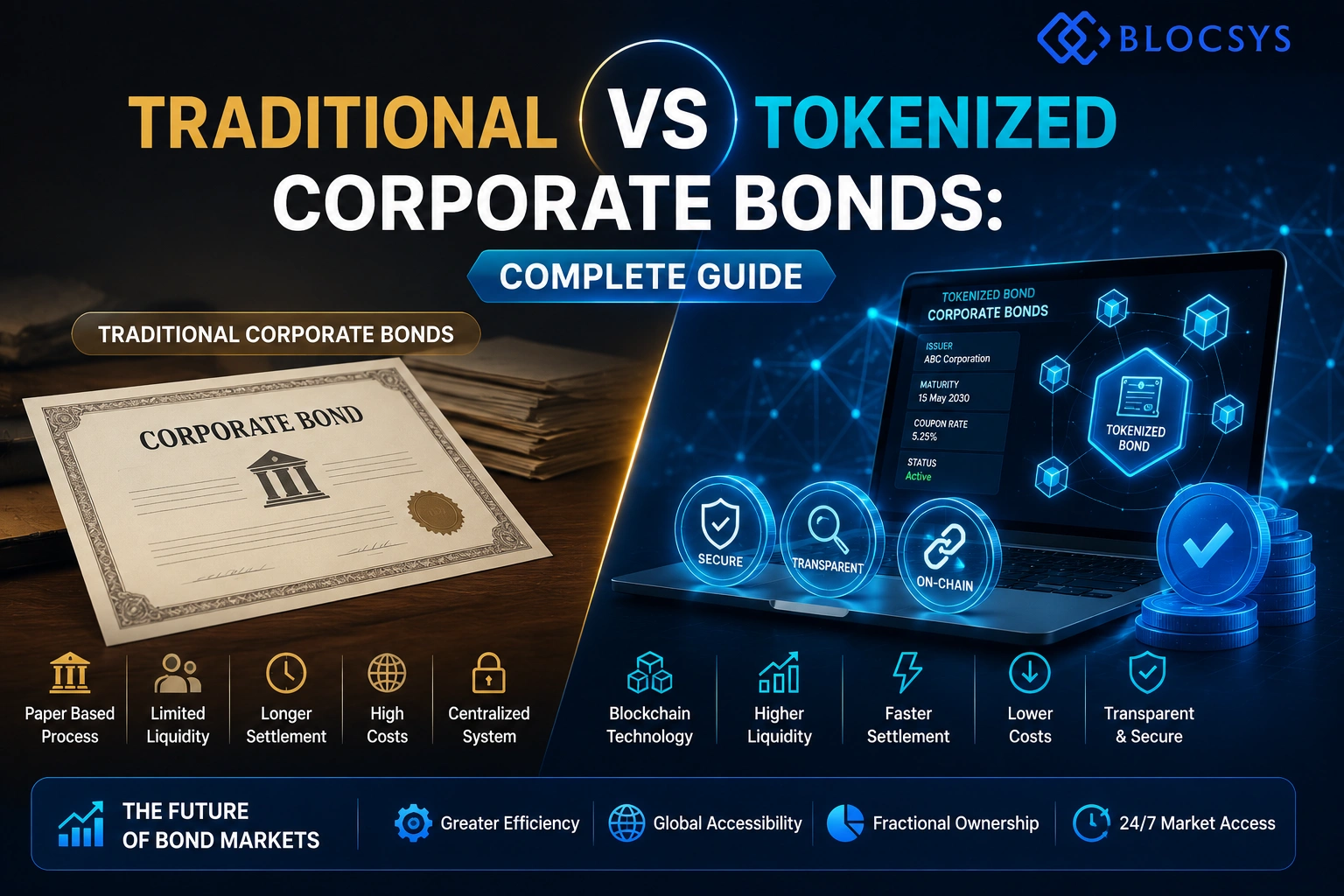
Traditional Corporate Bonds vs. Tokenized Corporate Bonds: Complete Comparison
A treasury team can have a good bond book and still feel trapped by it. Coupons need reconciling, transfer approvals sit in inboxes, settlement drags through intermediaries, and the secondary market often feels thinner than the headline portfolio suggests. That is why the comparison between traditional and tokenized corporate bonds matters now, especially for CTOs, CIOs, issuers, asset managers, and fintech leaders who need a cleaner operating model without changing the underlying credit exposure. If you’re mapping a pilot, a platform build, or a market-entry strategy, the practical lens starts with the right comparison, the kind used in how to tokenize real-world assets.
Table of Contents
- Introduction and Article Overview
- Understanding Traditional Corporate Bonds
- Understanding Tokenized Corporate Bonds
- Traditional vs Tokenized Bonds: Side-by-Side Comparison
- What Is the Difference Between Traditional and Tokenized Bonds
- How to Build a Corporate Bond Tokenization Platform
- Regulatory and Custody Considerations for Tokenized Bonds
- Enterprise Use Cases and Case Studies
- Future Outlook and Decision Framework
- Frequently Asked Questions
- Why Choose Blocsys for Bond Tokenisation and Next Steps
Introduction and Article Overview
A CFO looking at a corporate bond portfolio usually sees two problems at once: the economics and the plumbing. The economics may still be sound, but the operating workflow can be slow, manual, and expensive to run, especially when issuance, servicing, custody, and trading all depend on multiple counterparties. Tokenization does not change the issuer’s repayment obligation. However, it can change how efficiently that obligation is issued, transferred, and serviced.
That distinction matters for teams evaluating tokenized corporate bonds, tokenization of corporate bonds, and broader digital securities strategies. The question is not whether a bond should become a new asset class, because it doesn’t. Instead, the question is whether the same bond can be delivered with less friction, tighter control, and better distribution mechanics across global institutional finance markets, including the UAE, Europe, the UK, the USA, Singapore, Germany, Switzerland, the Netherlands, Canada, Australia, and India.
Practical rule: if the credit risk stays the same, the implementation case must be won on operational performance, investor reach, and market structure.
For a corporate finance team, the comparison has to be data-backed and implementation-ready. The strongest signals come from multilateral and central-bank evidence, then from architecture choices like DAML, Canton Network, permissioned ledgers, and compliance automation. In enterprise terms, a corporate bond tokenization platform starts to look less like a speculative experiment and more like a workflow upgrade for issuance, servicing, and secondary trading.
Understanding Traditional Corporate Bonds
A traditional corporate bond begins with structuring, underwriting, and documentation, then moves through syndication, settlement, and ongoing servicing. The issuer relies on banks, custodians, paying agents, registrars, and clearing infrastructure to distribute the instrument and keep records aligned. That stack exists for good reasons, but it adds coordination layers every time a bond changes hands or a coupon is paid.
The friction shows up in ordinary operational tasks. Teams reconcile ownership records across systems, process transfer instructions through intermediaries, and wait for settlement cycles to close before treating cash as final. In practice, that’s why conventional corporate bond operations often feel heavier than the credit itself.
If you want a quick way to test how debt or cash flow assumptions interact with debt servicing, the DSCR Calculator from CEFCore is a useful planning aid before a financing discussion gets too far down the road. It won’t model tokenization, but it can help teams ground the repayment side of the discussion.
Where the operational cost sits
The biggest cost is rarely the headline coupon. Instead, it’s the accumulated overhead of coordination, exception handling, manual reconciliation, and fragmented records across parties that don’t share a single execution layer. That is also why a traditional issuance can look efficient on paper and still be cumbersome in production.
Conventional bond workflows are robust, but they’re built around control points designed for a slower market structure.
For issuers, that means more back-office dependency. For investors, it often means less flexibility in ticket size and secondary-market access. For technology teams, it means that any meaningful improvement usually has to come from the infrastructure layer, not from the bond itself.
Traditional corporate bond programs also sit close to legacy market rails. Therefore, comparisons against a blockchain vs traditional systems model are useful. They show where the old workflow still works well, and where it introduces delay, reconciliation drag, and expensive human oversight.
Understanding Tokenized Corporate Bonds
A tokenized corporate bond is still a bond. The issuer owes principal and interest under the same legal obligation, but the bond is represented and serviced on a permissioned ledger. The digital token is the container for the instrument’s lifecycle logic, not a new economic promise. This is the core idea behind tokenised corporate bonds as an operating model rather than a new financial product.
How the lifecycle changes
The main difference is in execution. Tokenized instruments can embed the bond terms, including the interest rate, payment schedule, and maturity date, into smart contracts. Additionally, those contracts can calculate and distribute payments automatically when a coupon date arrives (DAML and real world asset tokenization). That cuts out much of the manual reconciliation that slows conventional servicing.
The broader operational effect is equally important. Tokenized structures can support faster settlement, more direct issuer-investor communication, and lower friction across issuance and transfer workflows, while keeping the same underlying credit exposure. Therefore, tokenization is best understood as an infrastructure upgrade, not a credit upgrade.
India is a useful reference point because the business case is mostly structural. Research on tokenized bonds found that minimum investment amounts can drop to roughly $110,000 on average versus $185,000 for conventional bonds, and mean bid-ask spreads can narrow to 19 basis points versus 30 basis points for conventional bonds by the same issuers. Those numbers matter because they signal broader distribution and better tradability, not a different risk profile.
Why permissioned networks matter
Enterprise tokenization is usually built on permissioned infrastructure because issuers need access control, auditability, and regulatory alignment. A practical corporate bond tokenization company has to design for issuance rules, transfer restrictions, investor eligibility, and servicing logic in the same stack.
The DAML model is relevant here because it treats bond logic as enforceable business logic, not just as a digital record. That is the difference between a document repository and a programmable securities rail.
Traditional vs Tokenized Bonds: Side-by-Side Comparison
Teams comparing traditional vs tokenized bonds usually want one clear table, not a narrative. The table below breaks down the operational differences that matter most to issuers, investors, and operations teams.
| Factor | Traditional Bonds | Tokenized Bonds |
|---|---|---|
| Liquidity | Often fragmented, line-specific secondary markets | Tighter bid-ask spreads and easier transferability by design |
| Settlement time | Typically T+1 to T+2, dependent on intermediaries | Can approach near-real-time settlement on permissioned ledgers |
| Minimum investment | Higher ticket sizes, often above $185,000 for comparable issuance | Lower average ticket sizes, improving access and distribution |
| Custody | Custodian banks and registrars hold and reconcile records | Regulated digital custody integrated with the ledger layer |
| Coupon servicing | Manual reconciliation across intermediaries | Smart contracts automate coupon calculation and payment |
| Transparency | Records dispersed across separate systems | Shared, permissioned ledger supports a cleaner source of truth |
The IMF found that tokenized bonds have issuance costs that are, on average, 0.22 percentage points lower than conventional bonds. Investors also accept a yield spread 0.78 percentage points lower, and bid-ask spreads run 0.035 percentage points lower than matched conventional bonds. Separately, the European Central Bank reported that tokenised bonds had a 0.14 percentage point lower yield spread at issuance and a 27% reduction in the average bid-ask spread over time versus comparable conventional bonds.
Those findings matter because they point to the same pattern from different institutions: improved market structure. The value is not a new bond coupon. Instead, the value is lower friction in issuance and trading.
If the bond economics stay unchanged, tokenization must earn its place by improving settlement, servicing, or access.
What Is the Difference Between Traditional and Tokenized Bonds
The short answer: the legal obligation stays the same, but the operating layer changes. A traditional bond runs on paper-based and intermediary-heavy rails, where custodians, registrars, and paying agents each hold a piece of the record. A tokenized bond runs the same legal terms through a permissioned ledger, where issuance, transfer, coupon, and redemption logic are embedded in smart contracts.
Practically, that difference shows up in three places. First, settlement moves faster because fewer intermediaries need to confirm the same transaction. Second, minimum investment thresholds tend to fall, because fractional and programmable ownership is easier to manage on-chain. Third, reporting becomes more transparent, since every party works from a shared, permissioned source of truth instead of reconciling separate books.
Credit risk does not change. Therefore, the decision to tokenize should be driven by operational and distribution goals, not by an expectation of different returns.
How to Build a Corporate Bond Tokenization Platform
A production-grade tokenized bond stack needs more than a smart contract. It needs orchestration across investor onboarding, identity checks, issuance, custody, and secondary trading. That is where many pilots stall, because they underestimate how much of the workflow sits outside the chain. Corporate bond tokenization platform development should start with the legal and compliance model, not the token standard.
Core system modules
The front end starts with investor onboarding and KYC/AML checks. Those steps are not optional in institutional securities, and they should be enforced before a wallet can receive or transfer a bond token. From there, the issuance engine generates the instrument terms, transfer rules, and servicing logic. The back end then routes those instructions into DAML smart contracts on the Canton Network, where the execution layer can preserve privacy and permissioning.
A workable architecture usually includes these components:
- Identity and eligibility layer: validates investor status, jurisdiction, and transfer permissions.
- Issuance orchestration layer: configures bond terms, approvals, subscription records, and allocation logic.
- Custody integration layer: connects tokens with regulated custody and settlement workflows.
- Secondary-market layer: supports compliant transfer and order interaction where the venue permits it.
- Reporting and audit layer: preserves event logs for finance, compliance, and operations teams.
The practical upside is that tokenized bonds can automate issuance, transfer, coupon, and redemption logic in smart contracts. This reduces manual coordination and supports faster settlement and direct issuer-investor communication (Blocsys guide, Blocsys enterprise guide).
Design choices that matter
Security comes from role-based access control, segregation of duties, and permissioned data visibility. Privacy matters just as much, because corporate bond transactions often involve confidential investor allocations and jurisdiction-specific rules. Moreover, interoperability with ERP, treasury, and compliance systems matters, because no finance team wants a tokenized bond platform that becomes another isolated silo.
Implementation rule: design the bond token as a compliance object first, and a transfer object second. That sequence prevents avoidable governance problems later.
In this context, a specialised digital securities platform development partner, a DAML development company, or a Canton Network development company becomes relevant. Not every vendor can connect legal terms, operating controls, and lifecycle automation into one production stack.
Regulatory and Custody Considerations for Tokenized Bonds
Regulation is not an afterthought in bond tokenization; it is the foundation. Most jurisdictions still require a regulated custodian or transfer agent to hold or record legal title, even when the economic transfer happens on-chain. Consequently, a compliant platform needs to map token transfers back to a recognised legal register.
Custody design typically falls into two models. In the first, a regulated custodian holds private keys and controls transfers on behalf of investors. In the second, investors self-custody within a permissioned environment that still enforces eligibility and transfer restrictions at the smart-contract level. Either way, the custody model has to satisfy the same investor-protection standards as a conventional bond registrar.
Jurisdiction matters too. The UAE’s DIFC, the EU’s DLT Pilot Regime, the UK’s Digital Securities Sandbox, and India’s GIFT City each set different rules for who can issue, who can hold, and how transfers must be recorded. Therefore, a corporate bond tokenization platform aimed at multiple markets needs configurable compliance rules, not a single hardcoded ruleset.
Enterprise Use Cases and Case Studies
In enterprise finance, tokenization works best when the issuer has a real distribution or servicing problem, not when it wants novelty. That is why the most credible use cases tend to sit in regulated markets where manual coordination is already expensive.
A useful pattern appears in venues such as Dubai’s DIFC, Europe’s digital-securities pilots, and India’s GIFT City ecosystem, where structured issuance, regulated access, and institutional investor onboarding can be aligned more cleanly than in fragmented public-market setups. The business case often starts with reducing reconciliation overhead and broadening access through smaller denominations.
The European Central Bank reported tokenised bonds had a 0.14 percentage point lower yield spread at issuance and a 27% narrower bid-ask spread over time versus conventional bonds. For issuers, that translates into a better distribution story. For investors, it suggests a more tradable instrument when the same issuer is used as the baseline.
A realistic deployment can look like this:
- UAE institutional issuance: a permissioned tokenized bond program supports investor eligibility controls, direct lifecycle servicing, and tighter settlement coordination.
- European digital-security pilot: the issuer uses smart contracts to automate coupon and redemption events while keeping the legal bond structure intact.
- GIFT City-linked structure: the issuance stack is aligned with cross-border distribution and institutional onboarding requirements, reducing back-office strain.
The internal challenge is usually not the smart contract. Instead, it’s the operational handoff between legal, compliance, treasury, custody, and the trading venue. That’s why a deployment partner needs to understand both securities operations and blockchain architecture. For teams mapping U.S. market structure and infrastructure choices, the discussion in digital bond issuance in the US is a relevant reference point.
Future Outlook and Decision Framework
The next 12 to 24 months are likely to favour institutions that can move from curiosity to operational design. Tokenized bonds are already showing their strongest value in environments where settlement friction, investor access, and servicing overhead are visible enough to justify change. The market is not asking whether bonds can be digital. Instead, it is asking which issuers can do it without breaking compliance or increasing operational risk.
A practical readiness test
A useful decision framework starts with three questions.
Can the organisation support programmable issuance and transfer rules? If legal, compliance, and operations cannot agree on the control model, the project will stay stuck in pilot mode.
Does the issuer have a genuine liquidity or distribution problem? If the current bond is already placed efficiently, tokenization may not change much. However, if secondary trading is thin or minimum ticket sizes are restrictive, the case becomes stronger.
Can the platform support lifecycle automation without weakening governance? That means coupon, transfer, redemption, and reporting logic should all be auditable and permissioned.
The evidence on lower issuance costs, lower accepted yield spreads, and narrower bid-ask spreads suggests that the market structure argument is getting stronger. The practical takeaway is simple: enterprises should treat tokenized bonds as a treasury and market-access program, not just a blockchain experiment.
The right pilot is the one that proves control, not the one that looks flashy in a demo.
That means prioritising governance, onboarding, and settlement design before scale. It also means choosing vendors that can work across capital markets workflows, not just token minting.
Frequently Asked Questions
What is the difference between traditional and tokenized bonds?
Traditional bonds rely on custodians, registrars, and paying agents to record ownership and process payments manually. Tokenized bonds carry the same legal obligation, but issuance, transfer, coupon, and redemption logic run on a permissioned ledger through smart contracts, which cuts settlement time and reconciliation work.
Are tokenized corporate bonds and tokenised corporate bonds the same thing?
Yes. “Tokenized” and “tokenised” are US and UK spelling variants of the same concept. Both refer to corporate bonds represented and serviced on a blockchain-based, permissioned ledger.
Do tokenized bonds carry different credit risk than traditional bonds?
No. The issuer’s repayment obligation stays the same regardless of format. Tokenization changes the operating layer, including settlement speed, minimum ticket size, and servicing automation, not the underlying credit risk.
What does a corporate bond tokenization platform need to include?
At minimum, it needs an identity and eligibility layer, an issuance orchestration layer, custody integration, a secondary-market transfer layer, and a reporting and audit layer. Skipping any of these usually stalls a pilot before it reaches production.
How long does corporate bond tokenization platform development typically take?
Timelines vary by jurisdiction and custody model, but most institutional builds move from scoping to a working pilot in a few months, provided legal, compliance, and technology teams align on the control model early.
Why Choose Blocsys for Bond Tokenisation and Next Steps
Blocsys fits this problem where the work happens: at the intersection of securities workflow, blockchain architecture, and enterprise integration. For financial institutions, bond issuers, and asset managers, that means a practical path to corporate bond tokenization platform development, RWA tokenization, DAML smart contract development, Canton Network development, and broader enterprise blockchain solutions without treating compliance as an afterthought.
The point isn’t to replace the bond. Instead, it’s to re-engineer the issuance and servicing stack around it. That matters when teams need a tokenization roadmap, investor onboarding design, transfer restriction logic, custody alignment, and reporting workflows that can stand up in regulated markets such as the UAE, Europe, and India.
If your team is comparing a proof of concept against a production rollout, the next step is a structured scoping conversation. Define the bond structure, investor classes, compliance rules, custody model, and servicing logic first, then map the platform architecture against them. That sequence keeps the project grounded in capital-markets reality instead of abstract blockchain promises.
A CTA for Blocsys Technologies. Reach out to Blocsys if you’re planning a corporate bond tokenisation pilot, a digital securities platform, or a DAML and Canton Network implementation and want a clear production roadmap, architecture review, and cost estimate suited for your market.
