


Enterprise Bond Tokenization You Can Trust: What an EY-Assessed Platform Means for Institutional Buyers
Institutional buyers don’t take infrastructure claims at face value. Before any bank, asset manager, or corporate issuer commits capital to a new settlement rail, they want proof, not marketing copy. That’s why an EY assessed platform has become a meaningful signal in enterprise bond tokenization conversations. It doesn’t replace due diligence, however it does show a platform has been examined against defined criteria by an established professional services firm. This guide walks through what enterprise bond tokenization actually involves, what an EY assessed platform can and can’t tell you, and how Blocsys approaches infrastructure built for institutional scrutiny.
What Is Enterprise Bond Tokenization?
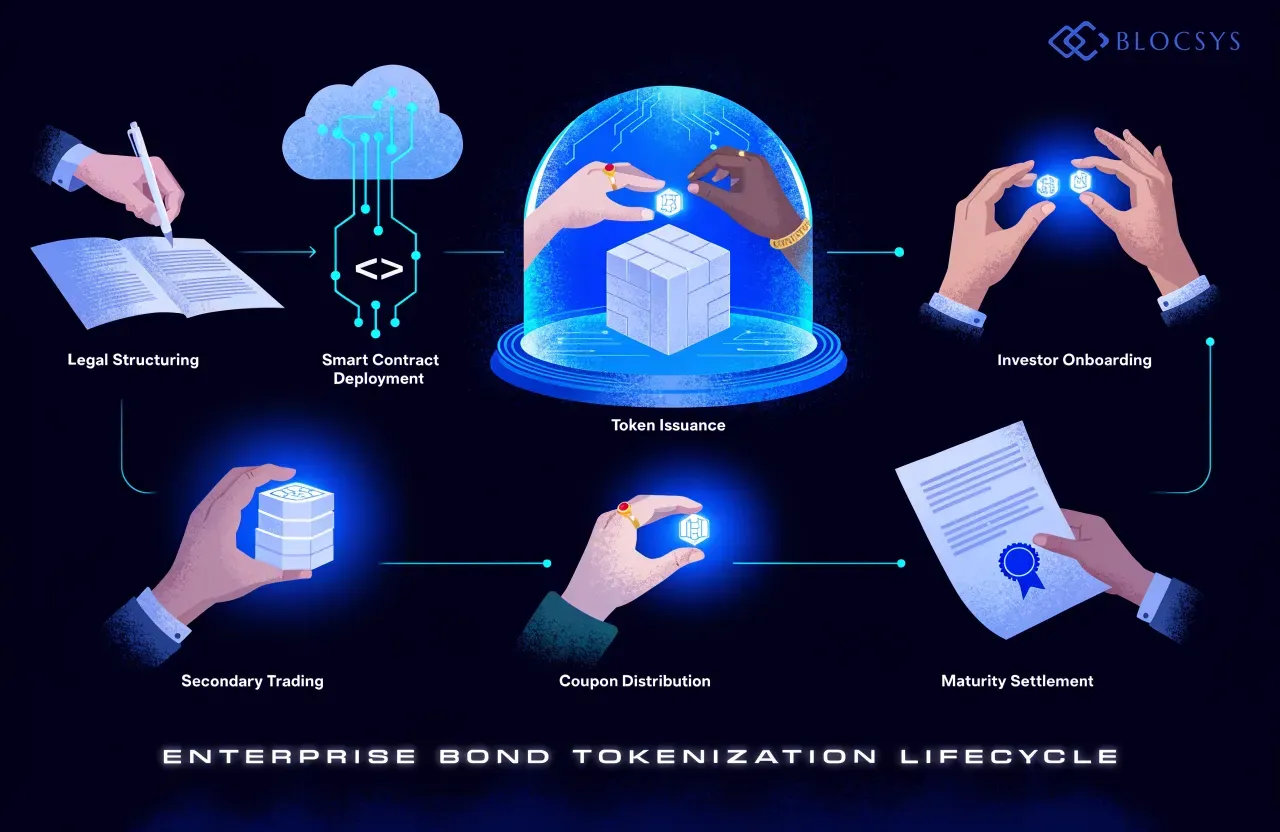
Enterprise bond tokenization converts the economic and legal rights of a corporate bond into a digital token on a blockchain. Each token represents a claim, ownership record, or entitlement tied to the underlying debt instrument. Unlike consumer crypto assets, tokenized bonds must map back to real legal agreements, real issuers, and real regulatory frameworks.
Think about it as a parallel rail for existing capital markets infrastructure, not a replacement for it. The bond terms, coupon schedule, and repayment obligations stay the same. What changes is how ownership gets recorded, transferred, and reconciled.
Corporate bond tokenization has moved from pilot programs to production deployments across the US, UK, and Europe. Singapore’s MAS, Switzerland’s FINMA, and the UAE’s ADGM have each published frameworks addressing digital securities. Germany’s eWpG law already permits fully electronic bond issuance. That said, jurisdiction still dictates how a tokenized bond gets classified, transferred, and taxed.
Digital Securities vs. Traditional Bond Issuance
Traditional bond issuance relies on custodians, transfer agents, and clearing houses working across separate ledgers. Digital securities consolidate much of that into shared, permissioned infrastructure. Consequently, settlement times shrink, reconciliation errors drop, and investor reporting becomes more transparent. However, the legal wrapper around the bond still determines enforceability, not the blockchain itself.
Why Institutional Buyers Need Trusted Tokenization Infrastructure
Institutional capital moves slowly for a reason. Compliance teams, risk committees, and boards all need assurance before approving new rails for regulated instruments. Trust in this context isn’t abstract, it’s built from governance, security, and operational transparency working together.
A platform handling tokenized bonds touches investor funds, ownership records, and regulatory reporting simultaneously. Any weakness in access controls, smart contract logic, or custody arrangements creates real financial exposure. Therefore, institutional buyers evaluate infrastructure the same way they’d evaluate a custodian or clearing counterparty.
This is where independent scrutiny earns its place. An EY assessed platform gives buyers a documented reference point instead of relying purely on vendor claims. It won’t answer every question, but it narrows the list of things you have to take on faith.
Institutional buyers don’t ask whether blockchain works. They ask whether this specific platform, with this specific governance model, deserves their bond issuance. That’s a much narrower and much harder question to answer.
What Does an EY Assessment Mean for a Bond Tokenization Platform?
An EY assessment means EY has reviewed a platform’s architecture, controls, or processes against a defined scope and methodology. For a bond tokenization platform, this typically covers areas like smart contract logic, security controls, and operational governance. The result is a professional evaluation, not a stamp of unconditional approval.
Buyers should ask exactly what was assessed, when, and against what criteria. An EY security assessment platform review, for instance, focuses on technical vulnerabilities and access controls. An EY compliance assessment instead looks at process alignment against relevant frameworks. These are different exercises, and a vendor should be able to name which one applies.
EY Assessed Blockchain: What Gets Reviewed
When EY reviews blockchain infrastructure, the scope generally includes smart contract code, permissioning logic, key management, and system architecture. An EY audited blockchain platform review may also examine transaction logs and node configuration. Even so, the assessment reflects a point-in-time review, not continuous monitoring.
An enterprise-grade audited platform earns that description through repeatable processes, not a single review. Consequently, institutional buyers should ask how often assessments happen and whether findings get remediated and re-tested.
EY Assessment vs Audit vs Regulatory Approval
These terms get used interchangeably in marketing, but they mean different things. Understanding the distinction protects institutional buyers from overestimating what a platform has actually proven.
| Term | What It Means | What It Doesn’t Mean |
|---|---|---|
| EY Assessment | A scoped, professional review of specific controls, architecture, or processes against defined criteria. | Not a guarantee of security, not legal compliance, not financial statement assurance. |
| Financial Audit | An examination of financial statements against accounting standards, typically for issuers or funds. | Doesn’t evaluate technology architecture or smart contract behavior. |
| Attestation | A formal statement about specific facts or controls at a point in time, often narrower in scope than an assessment. | Doesn’t imply ongoing monitoring or future performance. |
| Regulatory Approval | Authorization from a securities regulator (SEC, FCA, MAS, FINMA, BaFin) to operate or issue in a jurisdiction. | Not granted by any professional services firm, including EY. |
An EY assessed bond tokenization platform has completed a review process. It hasn’t necessarily received regulatory approval in every jurisdiction where it operates. Institutional buyers should verify both, separately, before proceeding.
What Institutional Buyers Should Evaluate in a Tokenized Bond Platform
Independent assessment is one input among several. Beyond that, institutional buyers need a structured way to evaluate the platform itself, end to end.
Platform Architecture and Smart Contracts
Architecture determines resilience. Ask whether the platform uses a permissioned or public ledger, how nodes are distributed, and how upgrades get deployed without disrupting live positions. Smart contracts should be modular, version-controlled, and tested against edge cases like partial redemptions or corporate actions.
Asset Issuance and Ownership Management
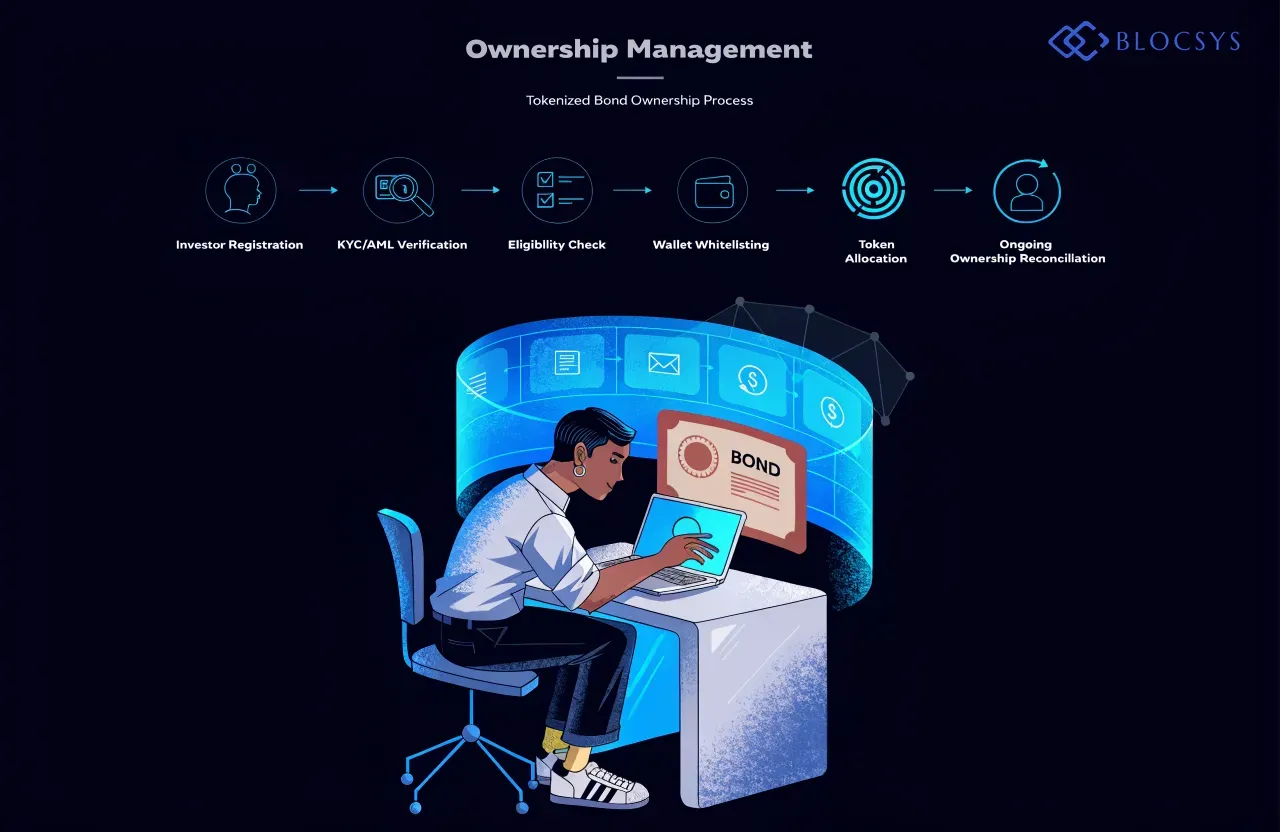
Issuance workflows need clear roles: who mints tokens, who approves them, and how cap tables reconcile with the blockchain record. Ownership management should support fractional holdings, transfer restrictions, and jurisdiction-specific eligibility rules without manual workarounds.
Investor Onboarding and Compliance Workflows
Onboarding needs to handle KYC, AML, and accreditation checks before any token reaches an investor’s wallet. A compliance-ready platform embeds these checks into the transfer logic itself, so restricted transfers simply can’t execute. This matters more than it sounds, because manual compliance checks don’t scale across thousands of holders.
Custody and Transaction Controls
Custody arrangements should separate key management from platform operations wherever possible. Multi-signature approvals, role-based access, and transaction limits reduce single points of failure. Institutional buyers should also confirm how the platform handles lost keys, disputed transactions, and emergency freezes.
Reporting and Audit Trails
Every transaction, ownership change, and coupon payment needs an immutable, timestamped record. Good reporting tools export this data in formats compliance and risk teams already use. Without strong audit trails, reconciliation with custodians and regulators becomes a manual, error-prone process.
Integration and Scalability
A tokenization platform rarely operates alone. It needs to connect with existing custody providers, settlement systems, and reporting tools. Scalability matters too, since a platform built for one issuance should handle recurring issuances without re-architecture.
Security and Governance Controls
Security and governance work together. Security controls protect the technical layer, however governance determines who can change what, and under which approvals. An independently assessed platform should document both, not just one.
Look for role-based access control, multi-party approval for critical actions, and clear incident response procedures. Governance should also define how disputes get escalated and how upgrades get approved before deployment. These controls, taken together, are what actually make a platform enterprise-ready, not the tokenization technology alone.
Smart Contracts and Bond Lifecycle Management
Smart contracts automate the bond lifecycle from issuance through maturity. Coupon payments, redemptions, and default scenarios all need to be coded and tested in advance. Furthermore, contracts should support corporate actions like early redemption or restructuring without requiring a full redeployment.
Smart contract development for regulated instruments differs meaningfully from typical DeFi contracts. It prioritizes auditability, upgrade safety, and compliance logic over speed or composability. That’s a deliberate trade-off, and it’s the right one for institutional debt instruments.
How Blocsys Can Enable Enterprise Bond Tokenization
Blocsys builds enterprise blockchain infrastructure for institutions moving real financial instruments onto digital rails. Our work spans corporate bond tokenization, investor onboarding workflows, custody integrations, and compliance-aware smart contracts.
We design platforms around the exact controls institutional buyers evaluate: role-based governance, audit trails, transaction limits, and integration-ready architecture. Where issuers also need adjacent capabilities, we support equity tokenization and real world asset tokenization on the same underlying infrastructure.
To be clear, Blocsys builds the technology. We don’t provide EY assessments, regulatory approval, or legal compliance sign-off. Those come from independent firms and regulators, and issuers should engage them directly alongside their technology partner.
Why Choose Blocsys for Compliance-Ready Tokenization Infrastructure
Blocsys works with banks, asset managers, and corporate issuers who need infrastructure built for scrutiny from day one. Our asset tokenization platform approach covers architecture, smart contracts, custody integration, and reporting, all designed to hold up under institutional review.
If you’re scoping a build, our software development cost estimator gives you a realistic starting range before you commit budget. Additionally, our broader blockchain development services support institutions building complementary infrastructure, from post-trade reconciliation to OTC trading rails.
The platforms that win institutional trust aren’t the ones that shout loudest about blockchain. They’re the ones that hand a compliance officer a clean audit trail and don’t flinch when asked hard questions.
Frequently Asked Questions
Here are direct answers to the questions we hear most often about enterprise bond tokenization and EY assessed platforms.
What is an EY-assessed bond tokenization platform?
An EY-assessed bond tokenization platform is one where EY has conducted a scoped, professional review of its architecture, security controls, or processes. The assessment reflects the specific scope agreed with the platform provider, not a blanket certification of every feature.
What does EY assessment mean for an enterprise platform?
It means an established professional services firm has independently reviewed defined aspects of the platform, such as security controls or compliance processes. It signals rigor and transparency, but institutional buyers still need to confirm the exact scope and date of the review.
How is an EY assessment different from an audit or regulatory approval?
An EY assessment is a scoped review against defined criteria, while a financial audit examines financial statements against accounting standards. Regulatory approval, by contrast, comes only from securities regulators like the SEC, FCA, or MAS, never from a professional services firm.
Why does independent assessment matter for institutional buyers?
Independent assessment gives buyers a documented, third-party reference point instead of relying solely on vendor claims. It helps compliance and risk teams justify infrastructure decisions internally, even though it doesn’t replace their own due diligence.
What should institutions evaluate before selecting a bond tokenization platform?
Institutions should evaluate architecture, smart contract quality, custody arrangements, investor onboarding workflows, compliance automation, audit trails, and integration capabilities. Independent assessments support this evaluation but shouldn’t replace a structured internal review.
How can tokenized bond platforms support compliance and governance?
They can embed KYC, AML, and eligibility checks directly into transfer logic, so non-compliant transactions simply can’t execute. Strong governance also requires role-based approvals and documented escalation paths for disputes or emergency actions.
What security controls should an enterprise bond tokenization platform include?
Look for multi-signature custody, role-based access control, transaction limits, and documented incident response procedures. An EY security assessment platform review often examines exactly these controls, though ongoing monitoring still falls on the platform operator.
How do smart contracts support tokenized bond lifecycle management?
Smart contracts automate coupon payments, redemptions, and maturity settlement based on pre-coded terms. They also enforce transfer restrictions and eligibility rules automatically, reducing manual reconciliation work across the bond’s life.
Can private companies and financial institutions build tokenized bond platforms?
Yes, both private companies and regulated financial institutions can build tokenized bond infrastructure, provided they work within applicable securities laws in their target jurisdictions. Partnering with an experienced blockchain development company like Blocsys helps translate legal requirements into working technology.
How much does it cost to build a corporate bond tokenization platform?
Costs vary based on architecture complexity, compliance requirements, and integration scope, often ranging from tens of thousands to several hundred thousand dollars. The Blocsys cost estimator tool gives a tailored estimate based on your specific requirements.
What makes a tokenization platform enterprise-ready?
An enterprise-ready platform combines strong architecture, documented governance, compliance automation, scalable integrations, and transparent reporting. Independent review, such as an EY assessed platform status, adds credibility, but operational maturity across all these areas is what actually sustains institutional confidence.
Why choose Blocsys for bond tokenization platform development?
Blocsys combines enterprise blockchain expertise with practical experience building compliance-aware smart contracts, custody integrations, and investor management tools. We work directly with institutions to turn tokenization requirements into secure, scalable infrastructure, without overselling what the technology alone can guarantee.
Conclusion: Building Bond Tokenization Infrastructure You Can Defend
Trust in enterprise bond tokenization doesn’t come from a single credential. It comes from architecture, governance, security, and transparency working together, with independent review adding a useful, bounded layer of confidence. An EY assessed platform gives institutional buyers a documented reference point, however it’s one input among many in a much larger evaluation.
If your institution is evaluating or building tokenized bond infrastructure, start with the fundamentals: architecture, compliance workflows, custody, and audit trails. From there, Blocsys can help you design and build a corporate bond tokenization platform built to withstand institutional scrutiny, not just pass a single review.
Ready to move beyond theory and build an intelligent platform that delivers real-world value? Blocsys Technologies specialises in engineering enterprise-grade AI and blockchain solutions for the fintech, Web3, and digital asset sectors. Connect with our experts today to discuss your vision and chart a clear path from concept to a secure, scalable reality.
