
India’s digital health infrastructure has already reached a scale where privacy failures can spread far beyond one hospital database. By December 2023, 50.39 crore ABHAs had been created nationwide, while a study citing the ABDM dashboard reported 67 crore ABHA Health IDs, 1.3 lakh registered health facilities, and more than 42 crore uploaded health records by 2026 according to the cited ABDM assessment. For CIOs, hospital administrators, and healthcare technology teams, DPDP compliance for hospital management systems is therefore an architecture problem, not a policy exercise. This guide shows how to connect consent, purpose limitation, access control, EHR security, auditability, retention, integrations, and breach response across real Indian hospital workflows.
Table of Contents
- Why DPDP Compliance Is Now Critical for Hospital Management Systems
- What Patient Data Hospital Systems Handle Under DPDP
- Building Consent Management Into EHR Workflows
- Security Controls and Access Management for Hospital Data
- Managing Data Sharing and Third-Party Integrations
- Common DPDP Compliance Mistakes Hospitals Make
- How Blocsys Builds Privacy-Aware Hospital Technology
- Frequently Asked Questions
- What does DPDP compliance mean for a hospital management system?
- Does the DPDP Act apply to electronic health records in India?
- What patient data should hospitals include in a DPDP inventory?
- Is a one-time consent form at admission sufficient?
- How should consent revocation work in an EHR?
- What access controls should hospitals implement?
- Are encryption and backups enough for EHR security?
- How should hospitals share records with laboratories and insurers?
- What does DPDP require when patient data is no longer needed?
- What should a hospital do after a personal data breach?
- How much does hospital management system development cost?
- Why should a hospital consider Blocsys for EHR and healthcare software development?
- Conclusion
Why DPDP Compliance Is Now Critical for Hospital Management Systems
The Digital Personal Data Protection Act, 2023, enacted as Act No. 22 of 2023, applies to hospitals whose records now move across connected clinical and administrative systems. The ABDM assessment referenced earlier recorded 257.0 million linked health records as of May 15, 2023. Patient information is no longer confined to one hospital application. It passes through EHRs, exchanges, vendors, and analytics workflows.
That connectivity changes the engineering problem. Registration data may flow into an EHR, laboratory information system, radiology archive, pharmacy application, billing platform, insurer interface, telemedicine service, or ABDM-connected exchange. A weak API, service account, export process, or backup can expose records beyond the original purpose. A policy stating “share data only for treatment” cannot enforce that rule unless the platform connects consent, purpose, identity, and access decisions.
The financial exposure is only one part of the problem
A review of Indian healthcare breaches reported a 156% increase in healthcare-related cyber incidents between 2018 and 2022, with more than 38 million patient records affected and an average detection time of 197 days as reported in the cited breach review. It also estimated a mean financial impact of ₹4.2 crores per incident, and attributed 67% of breaches to inadequate security protocols, 28% to insider threats, and 5% to advanced cyberattacks.
The DPDP penalty schedule creates direct compliance exposure. The highest cap is ₹250 crore for failure to implement reasonable security safeguards, ₹200 crore for breach-notification failures and children’s-data violations, and ₹50 crore for other violations as summarised in the government publication.
| Breach scenario | Maximum penalty | Typical hospital impact |
|---|---|---|
| Failure to maintain reasonable security safeguards | ₹250 crore | Unauthorised access, operational disruption, forensic work, patient notification, and loss of trust |
| Failure to notify the Board and affected Data Principals | ₹200 crore | Escalating regulatory exposure when incident procedures are slow or incomplete |
| Other violations | ₹50 crore | Repeated governance, notice, consent, or process failures |
Hospitals should treat every new EHR module, vendor API, and analytics feature as a change to the privacy and security architecture.
Legacy hospital management systems often grant access by department, depend on shared workstations, or keep data in separate vendor-controlled databases. These arrangements may preserve clinical speed, yet they make it difficult to prove who accessed a record, why access was permitted, whether consent covered the activity, and whether retention remains lawful. The practical fix is context-aware control. Clinicians should not face unnecessary prompts, while sensitive actions still require identity checks, purpose validation, logging, and review.
Teams assessing technical evidence for governance can consult Blocsys’ discussion of DPDP and blockchain document verification compliance challenges. Blockchain does not replace DPDP compliance, and raw clinical records should not be placed on an immutable ledger. A narrowly defined evidence workflow may use immutability, provided privacy, access, correction, and retention requirements are designed into it from the start.
What Patient Data Hospital Systems Handle Under DPDP
Hospital systems handle much more than a patient’s diagnosis. A practical data inventory should follow the patient journey and trace each field to a database, message, file, API, or user action. Registration may collect identity and contact details, while clinical modules process symptoms, diagnoses, treatment history, prescriptions, imaging, laboratory results, and mental-health information. Billing and insurance workflows introduce payment details, claims information, policy identifiers, and correspondence.
Under DPDP, healthcare data processed digitally is digital personal data. The hospital must understand which organisation decides the purpose and means of processing, which vendor acts on its instructions, and which activities require patient-facing notice and consent. The framework’s consent model requires consent to be free, specific, informed, unconditional, and unambiguous, with notice explaining the purpose, rights-exercise path, and complaint mechanism as described in the India-focused legal analysis.
Build the inventory around workflows, not departments
A data map should identify:
- Registration and patient portals: Names, contact details, identifiers, appointment history, communications, login records, and device or session information.
- Clinical records: Diagnoses, treatment notes, prescriptions, allergies, procedures, and care plans.
- LIS and PACS: Test orders, results, specimen details, images, reports, and clinician access events.
- Billing and insurance: Invoices, claims, payment references, authorisations, and documents sent to insurers or third-party administrators.
- Connected services: Telemedicine records, referral information, ABDM exchange events, pharmacy data, and vendor support access.
- Operational evidence: Audit logs, export files, backups, system events, API payloads, and administrator actions.
The last category is often missed. A hospital may secure its primary EHR while leaving exports, log archives, development copies, or integration queues weakly protected. Those copies still need governance when they contain information that can identify a patient.
A data inventory should also record purpose, lawful basis, owner, recipients, retention rule, security classification, and deletion method. This turns DPDP compliance for hospitals into an actionable control register. For example, the purpose for sending a laboratory result to a treating physician differs from the purpose for using a historical record in research or product analytics. The same record may need different permissions, masking, and consent status depending on the transaction.
Hospital leaders evaluating hospital system integration across billing, pharmacy, and laboratory systems should ask vendors to demonstrate this field-level and workflow-level traceability rather than accepting a broad statement that the platform is “secure”.
Building Consent Management Into EHR Workflows
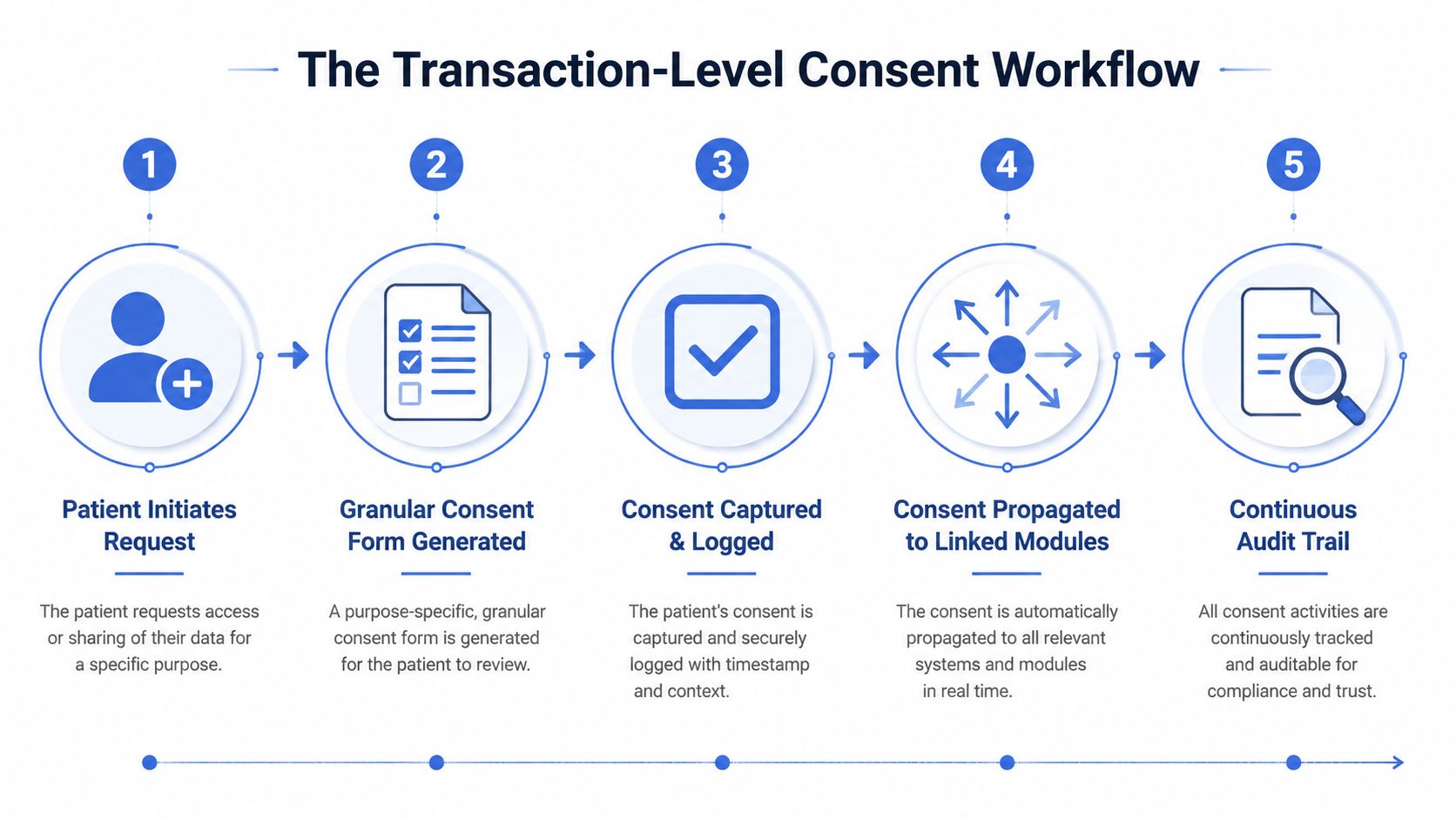
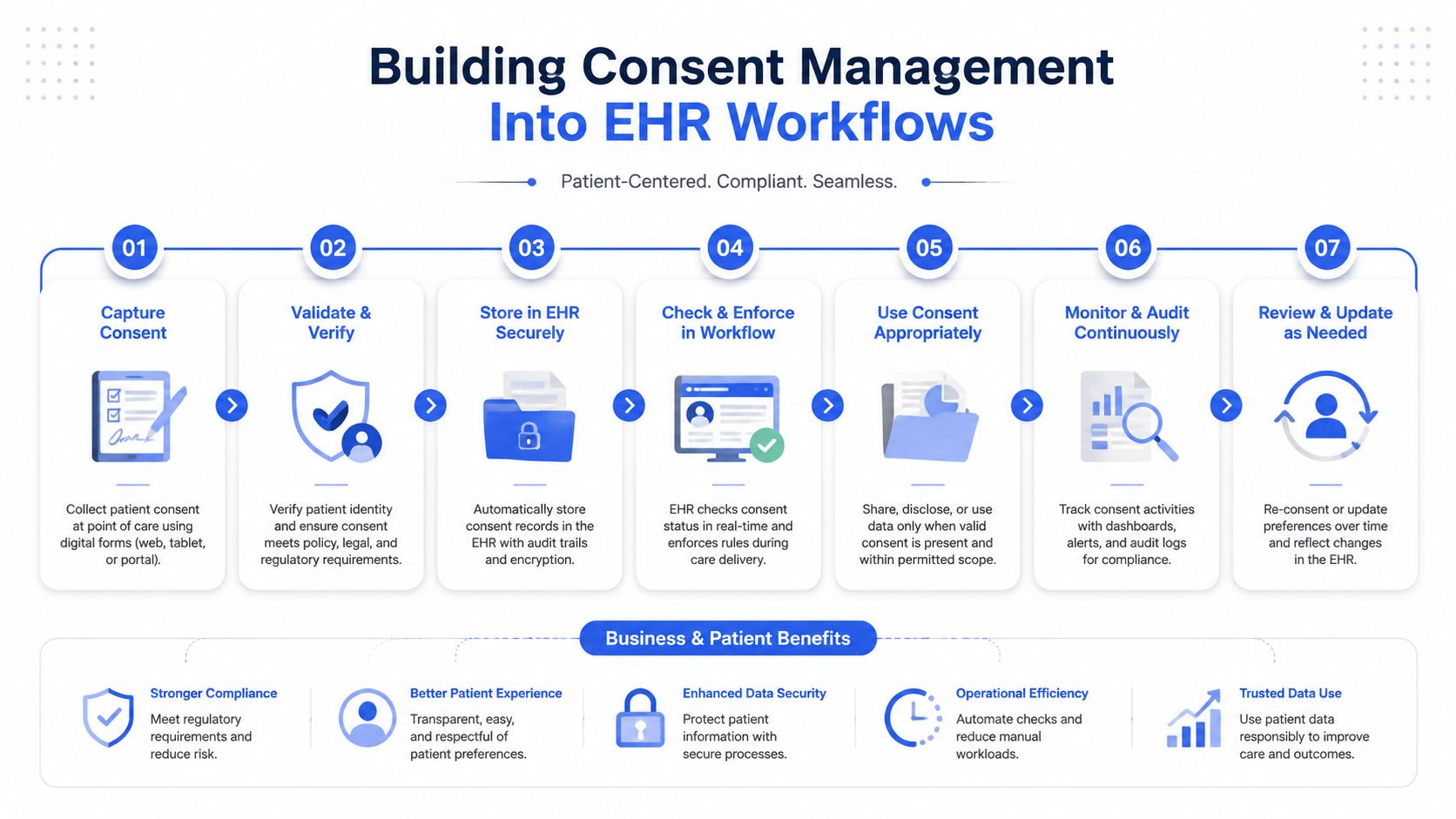
A registration checkbox is rarely enough. DPDP requires a consent experience that is specific, informed, and unambiguous, while hospital care involves multiple transactions with different recipients and purposes. A patient may agree to treatment, permit a referring specialist to view selected records, decline sharing with an insurer until a claim is filed, and withdraw permission for a secondary use later.
That means consent should be treated as a shared EHR service, not a static form stored in the admission module. Each consent record should carry the purpose, data categories, recipient, version of the notice, timestamp, capture channel, status, and revocation history. It should also expose a machine-readable decision that downstream systems can enforce.
A workable consent architecture
A hospital can implement the service through a central consent ledger or consent-as-a-service component. Registration, diagnostics, pharmacy, billing, telemedicine, and ABDM exchange should query the consent state before releasing or consuming data. Event-driven propagation can notify connected systems when consent is granted, changed, or revoked, while APIs should reject transactions that fall outside the permitted purpose.
The workflow needs clear handling for difficult clinical situations:
- Routine care: Capture purpose-specific permission during registration or treatment.
- Optional sharing: Present separate choices for referrals, insurers, external laboratories, or other recipients.
- Secondary use: Require a distinct authorisation for research, analytics, or product development where applicable.
- Revocation: Record the withdrawal and propagate it to downstream workflows and access policies.
- Emergency access: Use a controlled break-glass process that records the reason, actor, time, and affected record.
- Review: Give privacy and compliance teams evidence of current and historical consent states.
The Act recognises limited legitimate uses, including medical emergencies and public-health threats, but hospitals shouldn’t use those exceptions as a general replacement for consent India-focused DPDP legal guidance. Emergency access should be narrow, explainable, and reviewed after the event.
A shared consent layer can be introduced without replacing every clinical application at once. An integration gateway can first enforce consent for high-risk outbound transactions, then extend the same policy to internal services. During an EHR modernisation programme, the design principles in this guide to hospital ERP development are useful when evaluating modular workflows, event handling, and interoperability.
The architecture should remain purpose-specific. A secure consent pattern used for a corporate bond tokenization platform is not automatically suitable for healthcare, because clinical consent requires patient context, care urgency, revocation, and privacy-sensitive data minimisation.
Security Controls and Access Management for Hospital Data
Access control is where many hospital policies become operationally weak. A department-wide role such as “nurse” or “billing user” may be easy to administer, but it can expose more patient information than the employee needs for a particular task. DPDP-aligned hospital data security requires demonstrable accountability, reasonable safeguards, and controls that support purpose limitation.
Role-based access control remains useful, especially for stable clinical responsibilities. It becomes stronger when combined with attributes such as patient relationship, care episode, location, specialty, time, and emergency status. A surgeon treating a patient may need broader access during an active episode than the same user needs after the episode closes. A billing employee may need invoice details but not psychiatric notes or diagnostic images.
Compare the control, not the policy
| Control area | Typical hospital implementation | DPDP-aligned requirement | Compliance gap |
|---|---|---|---|
| User identity | Shared workstation accounts or generic departmental credentials | Individual, attributable identities | The hospital can’t reliably prove who viewed or changed a record |
| Permissions | Static roles assigned by department | Least-privilege access linked to purpose and context | Staff receive access that exceeds their task |
| Emergency access | Informal verbal approval | Break-glass access with reason capture and review | Emergency use becomes indistinguishable from ordinary browsing |
| Privileged accounts | Long-lived administrator access | Restricted, monitored, and time-bound privileges | A compromised account can move across systems |
| Session security | Basic timeout or inconsistent controls | Strong authentication and controlled sessions | Patient portals and clinical workstations become easier targets |
| Audit evidence | Logs record access but not purpose | Logs connect actor, record, action, purpose, and outcome | The hospital can’t demonstrate meaningful accountability |
Security teams should also separate authentication, authorisation, and monitoring. Multi-factor authentication helps establish identity, but it doesn’t decide whether a user should see a particular record. Encryption protects data at rest and in transit, but it doesn’t stop an authorised user from exporting an unnecessarily broad dataset. A policy document describes intent, while technical enforcement produces evidence.
A clinician should be able to reach the information needed for care quickly. That doesn’t require giving every user unrestricted visibility into every patient.
Hospitals should test access through realistic scenarios, including rotating clinicians, temporary staff, outsourced billing, nursing stations, mobile devices, and vendor support. Teams examining medical data breach monitoring for hospitals can use breach reporting as a reminder that exposure often begins with weak operational controls, not only advanced attacks.
For higher-assurance evidence, hospitals can evaluate compliance-ready audit trails with cryptographic evidence. Cryptographic integrity can help detect tampering with logs, but it doesn’t replace access governance, retention controls, incident response, or a lawful processing decision.
Managing Data Sharing and Third-Party Integrations
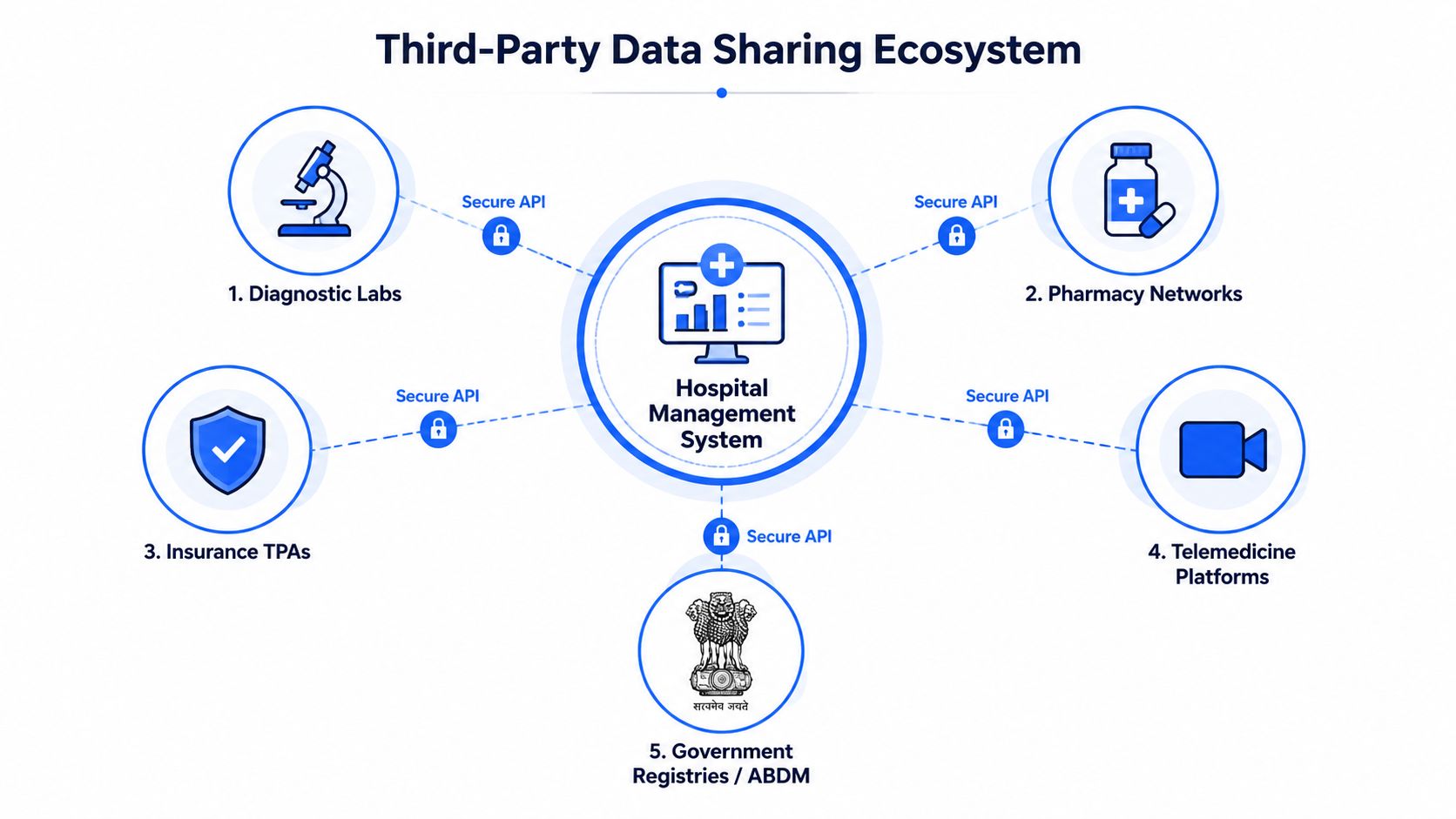
A hospital’s EHR is usually an ecosystem rather than a single product. Laboratory chains receive orders and return results. Pharmacies process prescriptions. Insurers and third-party administrators receive claims information. Telemedicine providers handle consultation data, and ABDM-connected services may support exchange between authorised participants.
Each connection creates a new control boundary. The hospital needs to know what data leaves the core system, who receives it, what purpose applies, how consent travels with the message, how the recipient protects the data, and what happens when the patient withdraws permission. The organisation deciding the purpose and means of processing may act as a Data Fiduciary, while a vendor processing information on its instructions may act as a Data Processor. Contracts help allocate duties, but they don’t allow the hospital to ignore its own governance responsibilities.
Design the integration around a data contract
Every interface should have a documented data contract covering:
- Minimum payload: Send only the fields required for the transaction.
- Purpose: State why the receiving party needs the information.
- Consent state: Attach or reference the applicable consent decision.
- Security: Use authenticated, authorised, encrypted API exchanges.
- Traceability: Log sender, recipient, patient reference, fields, purpose, and outcome.
- Failure handling: Prevent silent retries from creating unauthorised duplicates.
- Vendor oversight: Review access, subprocessors, support channels, and deletion behaviour.
A laboratory result sent to a referring physician is materially different from a historical dataset sent to an analytics provider. The integration gateway should enforce that distinction rather than treating all outbound traffic as equivalent.
Interoperability work also needs operational ownership. The CIO may own platform security, clinical leadership may own care workflows, procurement may own vendor terms, and the privacy function may own notices and rights handling. Without a shared operating model, each team assumes another team has checked the data path.
Tools such as blockchain document verification for healthcare, legal, and government records may be relevant for verifying document integrity in narrowly defined workflows. They shouldn’t be used to place identifiable medical records into an immutable system without a clear purpose, deletion strategy, and privacy assessment. Similarly, Blockchain Development can involve public, private, or hybrid networks, but the network choice alone doesn’t resolve DPDP duties.
Common DPDP Compliance Mistakes Hospitals Make
Hospitals often start with encryption, a signed admission form, or a cloud contract and treat that control as proof of compliance. Each addresses only one part of the operating model. DPDP compliance depends on how the hospital management system behaves when a patient gives consent, withdraws it, requests action, or is affected by a breach.
Mistake one, treating encryption as the entire answer
Encryption protects stored and transmitted information against interception and some forms of unauthorised disclosure. It does not stop excessive internal access, inappropriate exports, weak credentials, missing audit logs, or an API that sends unnecessary fields to a vendor. The correction is a layered design covering identity, least privilege, network segmentation, encryption, monitoring, tested backups, and incident response.
Mistake two, using one blanket admission form
A single form may group treatment, billing, referrals, research, analytics, and marketing under one broad statement. That makes it difficult to demonstrate that consent was specific and informed. It also breaks when a patient withdraws permission for one purpose while continuing treatment.
Use purpose-specific consent with version history, a clear withdrawal path, and enforcement at the transaction boundary. The EHR should check the relevant consent before releasing data, rather than leaving staff to interpret a document manually.
Mistake three, assuming the vendor owns the liability
Cloud hosts, EHR suppliers, laboratories, and billing providers may process information for the hospital. Outsourcing does not remove the hospital’s responsibility to map data flows, select vendors, monitor access, and coordinate incident handling. Contracts should define security expectations, support access, incident escalation, retention, deletion, and cooperation with rights requests.
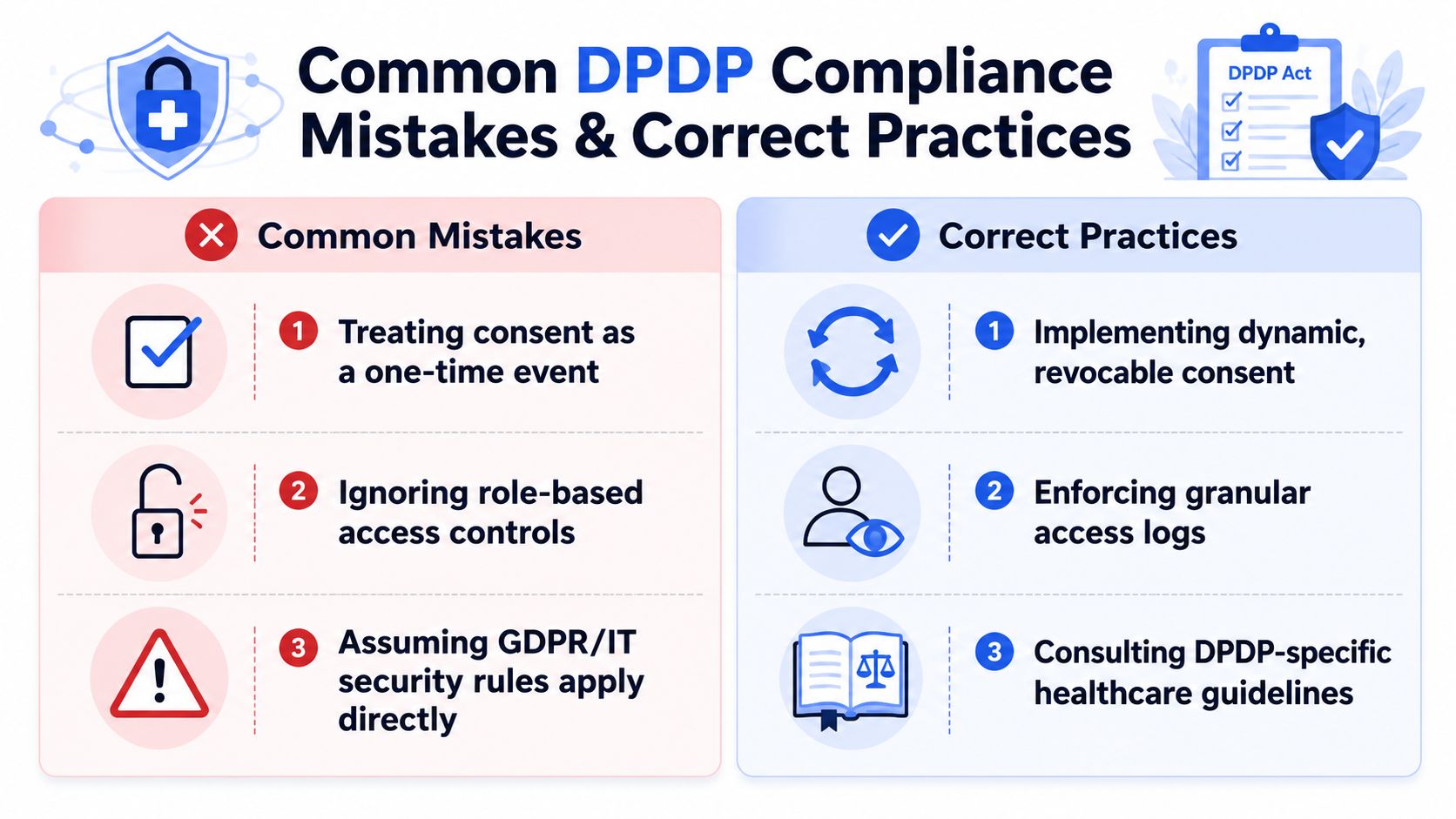
Mistake four, treating compliance as a one-time project
New modules, integrations, AI features, reporting extracts, and vendor changes can alter the processing risk. India-focused guidance recommends mapping data across EHR, LIS, PACS, telemedicine, billing, and external integrations, with DPIA-style reviews for new processing activities practical healthcare guidance. A change gate should record the data used, purpose, consent status, access rules, and retention period before deployment.
Breach response also needs engineering ownership. As covered earlier in this guide, failure to notify can attract penalties up to ₹200 crore. The response plan must identify decision-makers, evidence sources, communication channels, and containment actions before an incident occurs. Logs, alerting, access revocation, and message approval should be tested as part of the hospital’s operating process, not drafted only in a policy file.
How Blocsys Builds Privacy-Aware Hospital Technology
Blocsys approaches hospital technology as an interconnected operating environment. The aim isn’t to label a hospital management system “compliant” because it contains encryption or a consent screen. The engineering team must translate legal requirements into enforceable behaviours across data models, APIs, user journeys, integrations, logs, and operational procedures.
Architecture decisions that matter
A privacy-aware platform can include:
- Consent-aware APIs: Services check purpose, recipient, data scope, and current consent before completing an exchange.
- Clinical access policies: Role-based permissions can be refined with patient relationship, care context, specialty, and time.
- Data minimisation: Database schemas and payloads limit each module to the attributes it needs.
- Protected data movement: Encryption applies to data at rest and in transit, while network segmentation limits lateral movement.
- Evidence-grade auditability: Logs capture access, modification, export, administrative action, and consent events in a tamper-evident manner.
- Integration governance: Laboratories, pharmacies, insurers, telemedicine providers, and ABDM-connected services use documented policies and monitored interfaces.
- Incident readiness: Detection, triage, containment, evidence preservation, and notification workflows are designed together.
The breach-response workflow must be calibrated with legal counsel and the hospital’s incident team. Technical systems can detect suspicious access and assemble evidence, but software cannot independently decide whether a notification duty has arisen or guarantee legal compliance. Hospitals need accountable decision-makers, tested playbooks, and current contact paths.
Modernising legacy systems without disrupting care
Replacing every legacy module at once is rarely practical. A safer migration can begin with an inventory and risk assessment, followed by an integration gateway that centralises identity, consent checks, field filtering, and logging. High-risk interfaces can be prioritised first, while older applications continue operating behind controlled boundaries.
Blocsys can support Hospital Management System Development and related EHR infrastructure work around secure workflows, interoperability, consent management, access control, audit trails, and privacy-aware data handling. The organisation still needs to define lawful purposes, approve policies, train staff, oversee vendors, and obtain appropriate legal advice.
For hospitals planning a new platform, the decision should be based on demonstrable controls rather than feature volume. Ask for a consent-revocation demonstration, an emergency-access report, a complete data-flow map, a sample audit investigation, a vendor-access review, and a tested restoration scenario. Those artefacts reveal more than a generic compliance badge.
Blocsys Technologies develops privacy-aware hospital management systems, EHR-related infrastructure, secure data workflows, consent services, access controls, audit trails, and healthcare interoperability layers for hospitals and healthcare enterprises. Visit Blocsys Technologies to discuss a compliance architecture assessment, a legacy modernisation plan, or a secure healthcare platform build.
Frequently Asked Questions
What does DPDP compliance mean for a hospital management system?
DPDP compliance means the hospital can govern digital personal data through its full lifecycle, from collection and notice through processing, sharing, access, retention, deletion, and breach response. A hospital management system should support purpose-specific processing, valid consent where required, controlled access, secure integrations, auditable activity, and rights handling, but software features alone don’t make a hospital legally compliant.
Does the DPDP Act apply to electronic health records in India?
Yes. Healthcare information processed digitally falls within the DPDP framework as digital personal data. EHR platforms should therefore be assessed across registration, clinical documentation, laboratory, radiology, pharmacy, billing, telemedicine, ABDM exchange, backups, exports, and vendor support workflows.
What patient data should hospitals include in a DPDP inventory?
Hospitals should include identity and contact details, clinical histories, diagnoses, prescriptions, test results, images, billing and insurance information, portal activity, device or session data, audit logs, exports, backups, API messages, and administrator actions. The inventory should record purpose, owner, recipients, access conditions, retention basis, and deletion method for each relevant data flow.
Is a one-time consent form at admission sufficient?
Usually, a blanket admission form is not a reliable consent design for every hospital use case. DPDP requires consent to be free, specific, informed, unconditional, and unambiguous, so hospitals should separate treatment, billing, referrals, external sharing, telemedicine, ABDM exchange, research, and other purposes where the processing context differs.
How should consent revocation work in an EHR?
A revocation should create an auditable status change in a central consent service and trigger policy updates across connected systems. Registration, laboratory, radiology, pharmacy, billing, telemedicine, and outbound integration services should stop using the affected data for the withdrawn purpose, subject to any lawful basis or legal retention requirement that still applies.
What access controls should hospitals implement?
Hospitals should use individual identities, least-privilege permissions, role-based access refined by patient relationship and care context, strong authentication, restricted privileged accounts, time-bound emergency access, automated review, and detailed logs. Break-glass access may support urgent care, but it should capture the reason and receive post-event review.
Are encryption and backups enough for EHR security?
No. Encryption and protected backups are important safeguards, but EHR security also requires identity management, authorisation, network segmentation, secure APIs, vulnerability management, monitoring, logging, incident response, vendor controls, and tested restoration. A hospital must also demonstrate that users and connected services can access only the data needed for an authorised purpose.
How should hospitals share records with laboratories and insurers?
The hospital should define the purpose, minimum data set, recipient, consent state, security requirements, retention expectations, and audit evidence for each exchange. APIs should enforce those rules rather than relying only on contracts or manual staff checks. Vendor agreements should also address incident escalation, support access, subprocessors, deletion, and cooperation with patient rights requests.
What does DPDP require when patient data is no longer needed?
Section 8(7) requires a Data Fiduciary to delete personal data once the specified purpose is met, unless retention is necessary to comply with another law official Act text. Hospitals should map retention to a documented lawful basis, apply it consistently to primary systems and copies, and ensure deletion or approved disposal reaches exports, caches, backups, and vendor environments where applicable.
What should a hospital do after a personal data breach?
The hospital should activate its incident-response plan, contain the affected systems, preserve evidence, assess the data and people affected, involve legal and privacy decision-makers, and notify the Data Protection Board of India and affected Data Principals as required. Failure to notify both can attract a penalty of up to ₹200 crore DPDP breach-response analysis.
How much does hospital management system development cost?
The cost depends on the modules, integrations, migration complexity, security architecture, consent requirements, clinical workflows, deployment model, and support scope. A hospital should define its data flows and compliance controls before requesting a fixed estimate, then compare vendors through demonstrations of access, consent, audit, integration, and incident workflows. Teams can use the Blocsys Software Development Cost Estimator as an early planning aid.
Why should a hospital consider Blocsys for EHR and healthcare software development?
Blocsys can help design and build privacy-aware hospital management systems, EHR infrastructure, secure data workflows, consent management, role-based access, audit trails, and interoperability layers. Hospitals should evaluate the engagement through architecture workshops, security requirements, clinical workflow validation, migration planning, and evidence of technical controls, while retaining responsibility for legal decisions, governance, staff training, and operational compliance.
Conclusion
DPDP compliance for hospital management systems succeeds when legal duties become visible in the technology. Consent must be specific and revocable, access must reflect clinical purpose, integrations must minimise and trace data, retention must be deliberate, and breach response must be rehearsed. Hospitals that start with a data map, prioritise high-risk workflows, and modernise through controlled architectural layers can improve patient data protection without treating privacy as an obstacle to care.
Contact Blocsys to assess your hospital’s EHR architecture, map patient-data flows, design consent-aware integrations, and plan a practical path from legacy systems to secure, privacy-aware healthcare infrastructure.
