Tokenized Equity Liquidity: How Blockchain Could Improve Access to Private Share Markets
Private company shares sit on a spectrum from illiquid to nearly frozen. Founders, employees, and early investors often hold equity worth real money on paper, yet they can’t easily sell it. That’s where the conversation around tokenized equity liquidity comes in. Blockchain-based ownership records, controlled transfers, and digital infrastructure could change how private shares move between buyers and sellers. This guide explains why private-share liquidity is so constrained today, what tokenization actually does, and where the real opportunities and limits lie. If you’re evaluating infrastructure for this shift, Blocsys works with companies and financial institutions building exactly this kind of technology.
Why Private Shares Often Lack Liquidity
Private company equity isn’t like a public stock you can sell in seconds. There’s no central exchange, no continuous order book, and often no willing buyer at all. Selling a stake usually means finding a counterparty yourself, negotiating a price, and waiting weeks or months for approval.
Several structural issues drive this. Cap tables live in spreadsheets or fragmented databases. Transfer restrictions require board or company consent. Buyers need to be accredited or otherwise qualified under securities law. Consequently, even a willing seller and willing buyer can face real friction before a deal closes.
The Core Drivers of Private Share Market Liquidity Problems
Four factors show up again and again across jurisdictions:
- Legal transfer restrictions written into shareholder agreements and company bylaws
- Lack of standardized, verifiable ownership records outside the issuing company
- Limited investor discovery — there’s no public venue to find counterparties
- Manual settlement processes involving lawyers, signatures, and wire transfers
Together, these constraints explain why private share market liquidity remains thin compared to public markets. Even well-known “secondary market” platforms for private shares mostly aggregate a small pool of matched buyers rather than offering continuous trading.
Private markets were never designed for frequent trading — they were designed for long-term ownership. The infrastructure gap isn’t a technology failure; it’s a structural one that better records and transfer tools can start to close.
What Is Tokenized Equity Liquidity?
Tokenized equity liquidity refers to the potential ease of buying, selling, or transferring private company shares that have been represented as digital tokens on a blockchain. Each token corresponds to a unit of ownership, recorded on a shared ledger instead of, or alongside, a traditional cap table.
It’s important to be precise here: tokenization itself doesn’t create demand for shares. What it does is give ownership a digital, programmable format. That format can support faster transfers, clearer audit trails, and more efficient investor onboarding — all of which can support liquidity, without guaranteeing it.
How Tokenized Equity Liquidity Differs From Public Market Liquidity
| Factor | Public Equity Markets | Tokenized Equity Liquidity |
|---|---|---|
| Trading venue | Regulated stock exchange | Permissioned platform or licensed secondary venue |
| Buyer pool | Open to public investors | Often limited to eligible/accredited investors |
| Settlement time | T+1 or T+2 | Potentially near-instant, depending on infrastructure |
| Ownership record | Central securities depository | Blockchain ledger, often paired with a legal registry |
| Price discovery | Continuous, order-book driven | Still developing; often negotiated or auction-based |
As the table shows, tokenized shares don’t automatically inherit public-market liquidity. They inherit a different set of tools — and those tools need to be built well to matter.
How Blockchain Could Improve Private Share Markets
Blockchain’s core contribution isn’t magic liquidity. It’s better infrastructure for the parts of private-share trading that are currently manual, slow, or opaque. Let’s break down where that infrastructure actually helps.
Digital Ownership Records
A blockchain-based cap table gives every shareholder a verifiable, tamper-evident record of what they own. Unlike spreadsheets, this record can be updated automatically when a transfer happens, and it can be checked independently by auditors, regulators, or new investors. This is the foundation for blockchain-based ownership — a single source of truth that doesn’t depend on someone manually reconciling spreadsheets.
Tokenized Share Trading and Transfer Efficiency
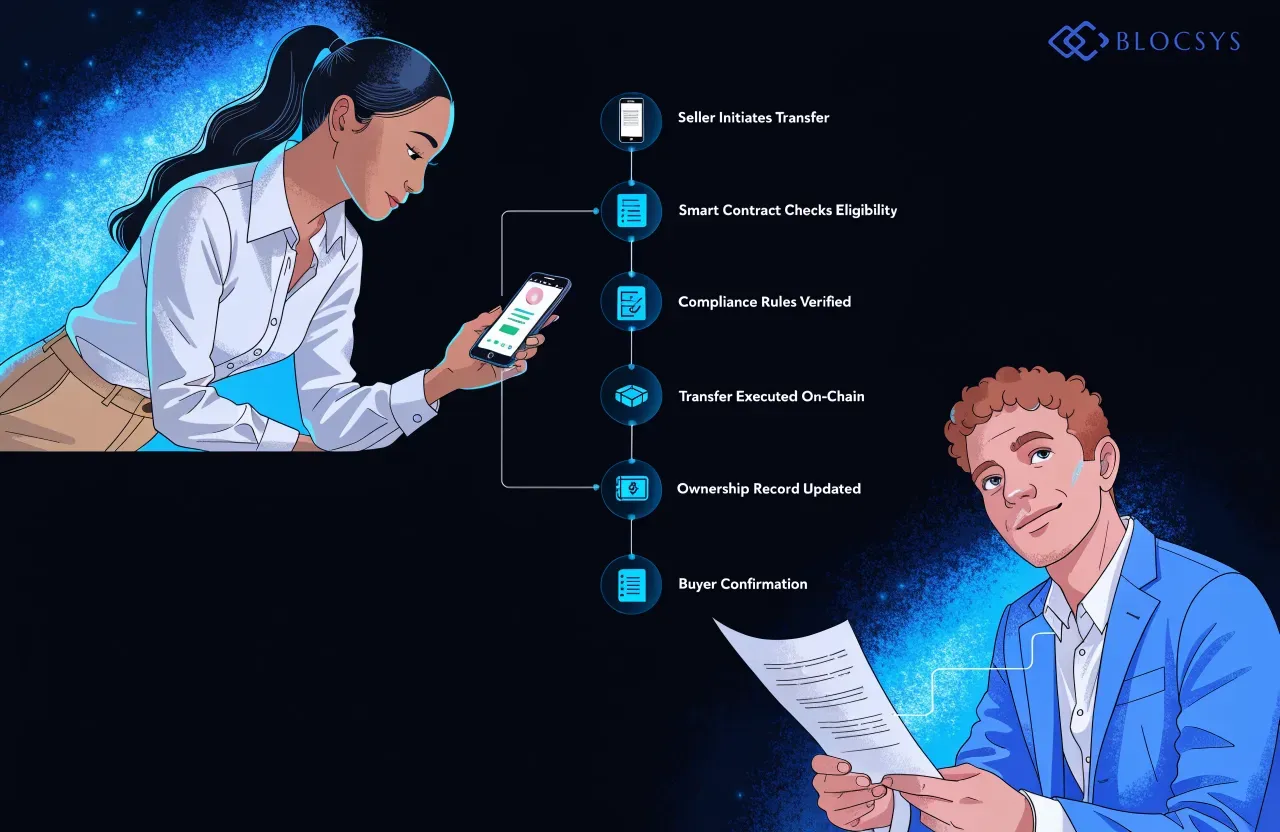
Tokenized share trading becomes possible when ownership tokens can move between eligible wallets through smart contracts. Instead of drafting new transfer documents for every sale, the contract enforces the rules automatically. That said, “possible” isn’t the same as “liquid” — a working transfer mechanism still needs buyers, sellers, and a venue that connects them.
Where Tokenized Equity Liquidity Gains Traction
Tokenized equity liquidity tends to improve most in scenarios with a defined investor base — employee share sales, secondary rounds among existing shareholders, or structured private placements. In these cases, blockchain infrastructure reduces the operational lag between “I want to sell” and “the sale is recorded,” even if it doesn’t create new demand out of thin air.
Tokenized Shares and Secondary Markets
A tokenized shares secondary market is a trading venue — regulated or permissioned — where holders of tokenized private equity can sell to other eligible investors after the initial issuance. This is distinct from the primary token issuance itself.
Building this kind of venue requires more than smart contracts. It requires licensing (in most jurisdictions, operating a secondary market for securities requires some form of broker-dealer, ATS, or MTF authorization), investor verification, and a functioning buyer network. Without those pieces, tokenization alone won’t produce a real market.
Private Equity Secondary Market Context
The traditional private equity secondary market already exists — funds and LPs trade stakes through specialized brokers and platforms. Tokenization could plug into this existing structure by making the underlying interests easier to fractionalize, transfer, and track. However, established secondary market participants still rely on legal agreements, not just token transfers, to finalize deals.
Investor Access and Transferability
One of the more concrete benefits of tokenization is streamlined investor onboarding. Instead of manual paperwork for every deal, a platform can verify an investor once and reuse that verification across multiple transactions.
Eligibility Checks and Investor Onboarding
Digital identity and KYC/AML checks can be embedded into the onboarding flow, with eligibility status attached to an investor’s wallet or account. This matters because private securities almost always carry restrictions — accredited investor rules in the US, professional investor thresholds in the EU and UK, and similar frameworks in Singapore, the UAE, and Switzerland. A platform needs to enforce these rules automatically, not just document them.
Blockchain for Private Share Trading and Transfer Rules
Smart contracts can encode transfer restrictions directly — blocking a transfer to an ineligible wallet before it happens, rather than catching the problem after the fact. This is a meaningful upgrade over manual review. Still, the underlying legal restrictions don’t disappear; they’re just enforced more consistently. This is what “blockchain for private share trading” really means in practice — automation of rules that already exist, not removal of them.
Ownership Records and Settlement
Settlement in private markets today often takes days or weeks, involving multiple intermediaries confirming the same information independently. Blockchain settlement compresses this by letting the transfer of tokens and the transfer of legal ownership rights happen closer together in time.
Digital Share Liquidity and Settlement Speed
Digital share liquidity depends partly on how fast settlement can happen once a trade is agreed. Faster settlement reduces counterparty risk and capital lock-up time, which can make investors more willing to transact. That’s a genuine efficiency gain — though it’s a supporting factor for liquidity, not a liquidity guarantee on its own.
Transaction History and Auditability
Every transfer on a blockchain-based system creates a permanent, timestamped record. This gives companies, auditors, and regulators a clear transaction history without needing to request records from multiple parties. For enterprises managing complex cap tables, that transparency alone can save significant administrative time.
Compliance and Transfer Controls
Compliance isn’t optional in tokenized equity — it’s the backbone of whether a platform can legally operate. Different jurisdictions impose different requirements, and a platform serving global investors needs to account for all of them.
Jurisdiction-Specific Considerations
- United States: Securities Act exemptions (Reg D, Reg S, Reg A+) govern private offerings; transfer agents and broker-dealer rules apply to secondary trading.
- United Kingdom: FCA rules on financial promotions and regulated activities apply to platforms facilitating share transfers.
- European Union: MiFID II and, increasingly, the DLT Pilot Regime shape how tokenized securities can be traded on regulated infrastructure.
- Switzerland: FINMA’s DLT Act framework explicitly addresses ledger-based securities.
- Singapore: MAS regulates digital securities offerings under the Securities and Futures Act.
- UAE: ADGM and VARA provide distinct frameworks for security tokens depending on the free zone.
- Canada and Australia: Provincial securities regulators and ASIC respectively require registration or exemption for token-based securities offerings.
Given this complexity, compliance rules need to be built into the platform’s transfer logic from day one — not added afterward.
The platforms that succeed in this space treat compliance as core architecture, not a bolt-on feature. Retrofitting regulatory logic into a token contract after launch is far harder than designing for it upfront.
Custody and Security
Custody of tokenized shares raises questions that don’t exist for public equities held at a central depository. Who holds the private keys? What happens if an investor loses access? How does custody interact with legal ownership?
Institutional Custody Requirements
Financial institutions typically require qualified custodians, multi-signature wallet architecture, and clear recovery procedures before they’ll hold tokenized securities at scale. Security audits, smart contract reviews, and insurance arrangements all factor into whether an institution trusts a given platform. Without solid custody design, even a technically sound tokenization system won’t gain institutional adoption.
Challenges and Limitations
It’s worth being direct about the limits here. Tokenization addresses infrastructure problems — it doesn’t solve market depth problems on its own. A few specific challenges stand out.
- No guaranteed buyer pool: tokenizing a share doesn’t create investors who want to buy it.
- Regulatory fragmentation: cross-border trading means navigating multiple, sometimes conflicting, frameworks.
- Interoperability gaps: tokens issued on different platforms or chains may not be easily transferable between them.
- Valuation uncertainty: private companies lack continuous price discovery, so even a liquid transfer mechanism may face wide bid-ask spreads.
- Legal enforceability: a token transfer needs to align with the company’s actual legal ownership records to be valid.
Recognizing these limits matters. Overpromising liquidity where none exists erodes trust — and that trust is exactly what these markets need to grow.
What a Tokenized Private Share Market Needs
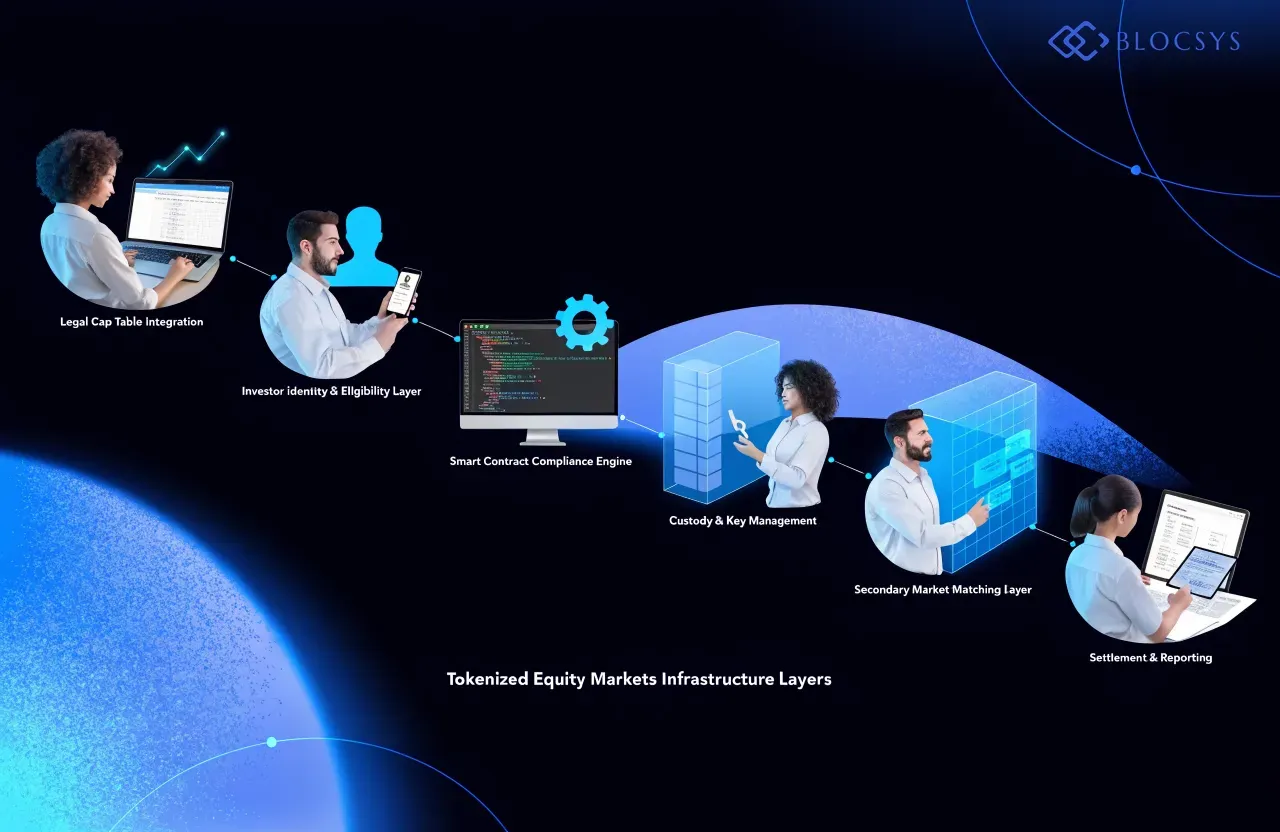
For tokenized equity liquidity to move from theoretical to practical, a market generally needs several pieces working together, not just a token standard.
Core Infrastructure Components
- A licensed or exempt venue for secondary trading
- Verified investor identity and eligibility systems
- Smart contracts encoding transfer and compliance rules
- Reliable custody and key management
- Integration with legal cap table and transfer agent records
- Sufficient participant density to support actual matching of buyers and sellers
Miss any one of these, and the system tends to stall. That’s why building this kind of platform typically calls for specialized expertise rather than a generic token deployment.
How Blocsys Can Enable Tokenized Equity Infrastructure
This is where Equity Tokenization Platform Development from Blocsys comes in. We help companies and financial institutions design and build the underlying infrastructure this article describes — without overstating what any single piece of technology can deliver.
Our work typically covers:
- Digital ownership management systems that mirror legal cap table records
- Investor onboarding flows with built-in eligibility and KYC/AML checks
- Smart contract development for compliant token transfers, sourced from our Smart Contract Development practice
- Compliance workflow automation tailored to jurisdiction-specific rules
- Secondary-market infrastructure design, including matching and settlement logic
- Custody integrations with qualified custodians and multi-signature architecture
- APIs connecting tokenization platforms to existing financial systems
- Scalable blockchain architecture built through our broader Blockchain Development services
We also support related work in Real World Asset Tokenization and general Asset Tokenisation Platform development, for organizations extending tokenization beyond equity into other asset classes. We build the infrastructure — we don’t promise liquidity or regulatory approval, since those depend on market conditions and each jurisdiction’s regulators.
Future of Private Share Liquidity
Where does this go next? Expect gradual progress rather than sudden transformation. Regulatory frameworks like the EU’s DLT Pilot Regime and Switzerland’s DLT Act suggest regulators are actively building room for tokenized securities to trade on recognized infrastructure.
Meanwhile, institutional interest in private share trading infrastructure continues to grow, driven by demand from employees at late-stage private companies and LPs seeking earlier exits from illiquid fund positions. As more platforms achieve regulatory clarity and build genuine participant networks, liquidity for tokenized shares should improve incrementally — market by market, jurisdiction by jurisdiction.
Why Choose Blocsys
Blocsys operates as an enterprise blockchain development company with direct experience across equity tokenization, RWA tokenization, smart contracts, and Web3 financial infrastructure. We work with private companies, asset managers, and fintech firms who need technology partners that understand both the blockchain layer and the regulatory context surrounding it.
We don’t oversell what tokenization can do. Instead, we build the digital ownership, transfer, compliance, and settlement infrastructure that gives your organization a credible foundation for tokenized equity — whether you’re issuing shares, building a secondary venue, or connecting existing systems to blockchain rails. If you’d like a cost picture for your specific project, our Software Development Cost Estimator is a useful starting point.
Frequently Asked Questions
Here are direct answers to the questions we hear most often about tokenized equity liquidity.
Why do private company shares have limited liquidity?
Private shares are hard to sell because there’s no central exchange, transfer restrictions require company approval, and buyers must often meet accredited or qualified investor criteria. Ownership records are also fragmented across spreadsheets and legal documents, which slows down the discovery and verification process for any potential buyer.
What does tokenized equity liquidity actually mean?
Tokenized equity liquidity refers to the potential ease of trading private company shares represented as blockchain tokens. It describes an improved capability for transfer and record-keeping, not a guaranteed outcome — actual liquidity still depends on having willing buyers, sellers, and a compliant trading venue.
Does tokenizing shares guarantee a liquid market?
No. Tokenization improves the infrastructure around ownership records, transfers, and compliance, but it doesn’t create investor demand or a functioning secondary market by itself. A real market still requires licensed venues, verified participants, and enough trading activity to match buyers with sellers.
How can tokenized shares access a secondary market?
Tokenized shares typically move to secondary markets through licensed platforms — such as an ATS in the US or an MTF in the EU — that connect verified investors and enforce transfer eligibility through smart contracts. The underlying legal ownership record still needs to align with the platform’s token ledger for the transfer to be valid.
Who can buy tokenized private company shares?
Eligibility depends on jurisdiction and the specific offering’s exemption. In the US, this often means accredited investors under Reg D; in the EU and UK, it typically means professional or qualified investors. Platforms verify this eligibility during onboarding and enforce it automatically through smart contract rules.
How does blockchain improve share transfer efficiency?
Blockchain lets smart contracts check investor eligibility and execute transfers automatically, replacing manual document drafting and multi-party sign-off. This reduces the operational lag between agreeing to a sale and finalizing it, though it doesn’t remove the underlying legal transfer requirements.
What role does settlement play in tokenized equity trading?
Settlement is where ownership actually changes hands after a trade is agreed. Blockchain-based settlement can compress the time between trade agreement and finalized ownership transfer, reducing counterparty risk compared to traditional multi-week private-market settlement processes.
What compliance requirements apply to tokenized shares?
Requirements vary by jurisdiction but generally include securities law compliance (such as Reg D or Reg S in the US, MiFID II in the EU, or FCA rules in the UK), KYC/AML checks, and enforced transfer restrictions matching the original offering’s exemption terms. Platforms need to encode these rules directly into their transfer logic.
How is custody handled for tokenized private shares?
Institutional-grade custody typically involves qualified custodians, multi-signature wallet architecture, and documented key recovery procedures. This matters because losing access to a private key without proper custody controls can mean losing access to the underlying ownership record entirely.
How much does building a tokenized equity platform cost?
Costs vary based on scope — including compliance complexity, custody integrations, and secondary-market features — so there’s no single fixed number. Blocsys offers a Software Development Cost Estimator to help organizations get a project-specific estimate.
Can tokenized equity platforms work across multiple countries?
Yes, but cross-border platforms need to account for each jurisdiction’s specific securities and transfer rules — the US, UK, EU, Switzerland, Singapore, UAE, Canada, and Australia all apply different frameworks. This usually means building jurisdiction-aware compliance logic rather than a single global rule set.
Why should a company work with Blocsys for equity tokenization?
Blocsys combines enterprise blockchain development experience with a clear understanding of the compliance, custody, and infrastructure requirements tokenized equity demands. We build the technical foundation — digital ownership records, smart contracts, onboarding, and settlement systems — while being transparent that liquidity and regulatory approval depend on market and legal factors outside any platform’s control.
Conclusion
Private-share liquidity has been constrained by manual processes, fragmented records, and limited investor access for decades. Blockchain-based infrastructure offers a credible path toward improving parts of that equation — faster transfers, clearer ownership records, and more efficient investor onboarding. However, tokenized equity liquidity isn’t automatic. It depends on regulatory clarity, real investor demand, and well-built platforms that handle compliance, custody, and settlement correctly from the start.
If your organization is exploring this space, Blocsys can help you build that foundation. Explore our Equity Tokenization Platform Development services to see how we approach digital ownership, compliance, and secondary-market infrastructure for tokenized equity liquidity — built to match your jurisdiction’s requirements, not around generic promises.
Ready to move beyond theory and build an intelligent platform that delivers real-world value? Blocsys Technologies specialises in engineering enterprise-grade AI and blockchain solutions for the fintech, Web3, and digital asset sectors. Connect with our experts today to discuss your vision and chart a clear path from concept to a secure, scalable reality.