
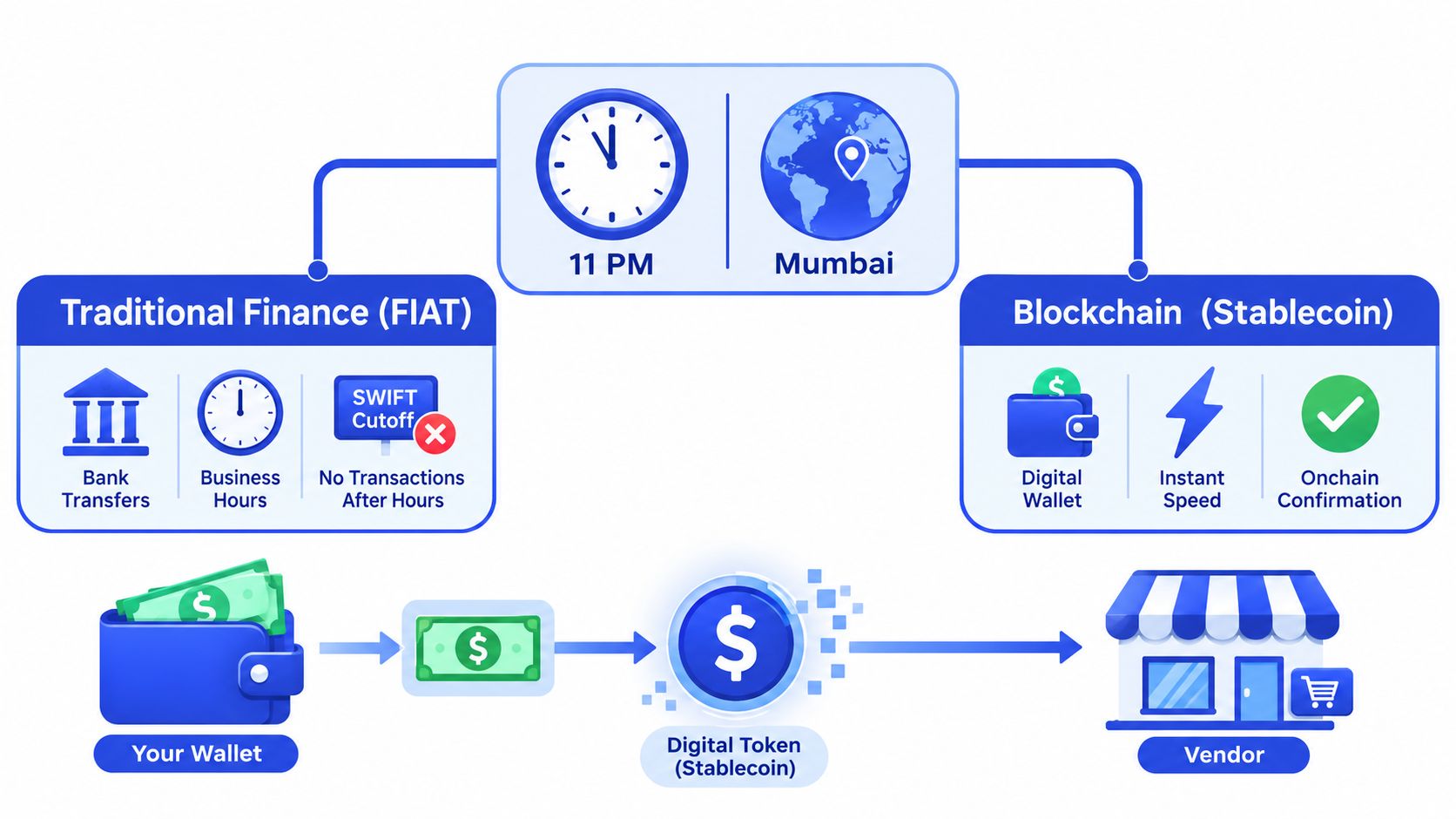
A fintech treasurer in Mumbai needs to settle a US vendor invoice late at night. The bank’s operating window has closed, the correspondent chain is opaque, and the treasury team can’t easily tell whether the payment will arrive today or after the next processing cycle. A stablecoin rail offers a different model: dollar-denominated value can move between controlled wallets on a blockchain, with the transaction, status, and settlement record visible through infrastructure the business operates or integrates.
That promise explains the interest in Robinhood Chain stablecoins, but the practical question is more precise: what does the chain support today, and what must a fintech still build before it can offer reliable onchain payments? This guide is for payment providers, financial institutions, enterprises, developers, and technology leaders evaluating stablecoin settlement, wallets, smart contracts, compliance controls, APIs, and cross-border payment infrastructure. For organisations planning the broader build, Blocsys works on blockchain infrastructure, digital assets, smart contracts, and financial technology platforms.
Table of Contents
- What Stablecoins and Onchain Payment Rails Actually Mean
- Robinhood Chain Architecture and Stablecoin Foundations
- How an Onchain Stablecoin Payment Could Work
- Stablecoin Transfers Versus Traditional Payment Rails
- Enterprise Use Cases for Stablecoin Settlement
- Compliance, Security, and Jurisdictional Reality
- Challenges, Limitations, and the Next 12 to 24 Months
- Frequently Asked Questions
- What are Robinhood Chain stablecoins?
- How do stablecoin payments work on Robinhood Chain?
- Is USDG supported on Robinhood Chain?
- How does stablecoin settlement differ from a bank transfer?
- Do businesses need a wallet for onchain payments?
- What are the transaction fees on Robinhood Chain?
- What role do smart contracts play in stablecoin payments?
- Which enterprise use cases fit Robinhood Chain stablecoin settlement?
- Is Robinhood Chain a regulated payment network?
- How can businesses secure stablecoin transactions?
- How do businesses integrate Robinhood Chain payments?
- What does stablecoin payment platform development cost?
- Why should a business choose Blocsys for this type of build?
- Conclusion
What Stablecoins and Onchain Payment Rails Actually Mean
A stablecoin is a blockchain-native token designed to track a reference asset, usually a fiat currency such as the US dollar. Unlike a volatile cryptocurrency, its payment utility depends on the issuer’s reserve model, redemption arrangements, compliance controls, and the ability of the token to remain usable across wallets and applications. The blockchain provides a public transaction record, but it doesn’t by itself guarantee that reserves are sufficient, redemption is available, or every user may legally hold the asset.
Onchain payment rails are the technical layers that let value move between blockchain addresses. They include the network’s execution and settlement model, token contracts, wallets, signing systems, smart contracts, RPC endpoints, indexers, monitoring tools, and the operational controls around them. A bank transfer updates balances inside a closed financial network. An onchain transfer sends a signed message to a contract or account and records the resulting state change on a shared ledger.
The payment problem is different from crypto trading
Retail trading asks whether an asset can be bought, sold, borrowed, or exchanged. A payment rail asks different questions:
- Can the payer prove control of the funds?
- Can the system screen the recipient and transaction?
- Can the recipient reconcile the payment with an invoice?
- Can a smart contract release value only after a condition is met?
- Can the business recover from a failed, delayed, or incorrectly addressed transaction?
That distinction matters. A stablecoin may be liquid on an exchange yet unsuitable for enterprise settlement if the business lacks custody controls, address screening, accounting integration, or a compliant redemption path. The strongest use cases usually involve 24/7 availability, cross-border coordination, programmable conditions, and transparent reconciliation, rather than ordinary domestic retail purchases.
For a deeper view of the asset category and its role in financial infrastructure, see this analysis of stablecoins and the future of digital finance. Robinhood Chain fits into this picture as an Ethereum-compatible rollup environment where tokenised assets, stablecoins, and financial applications can share an onchain settlement layer.
Robinhood Chain Architecture and Stablecoin Foundations
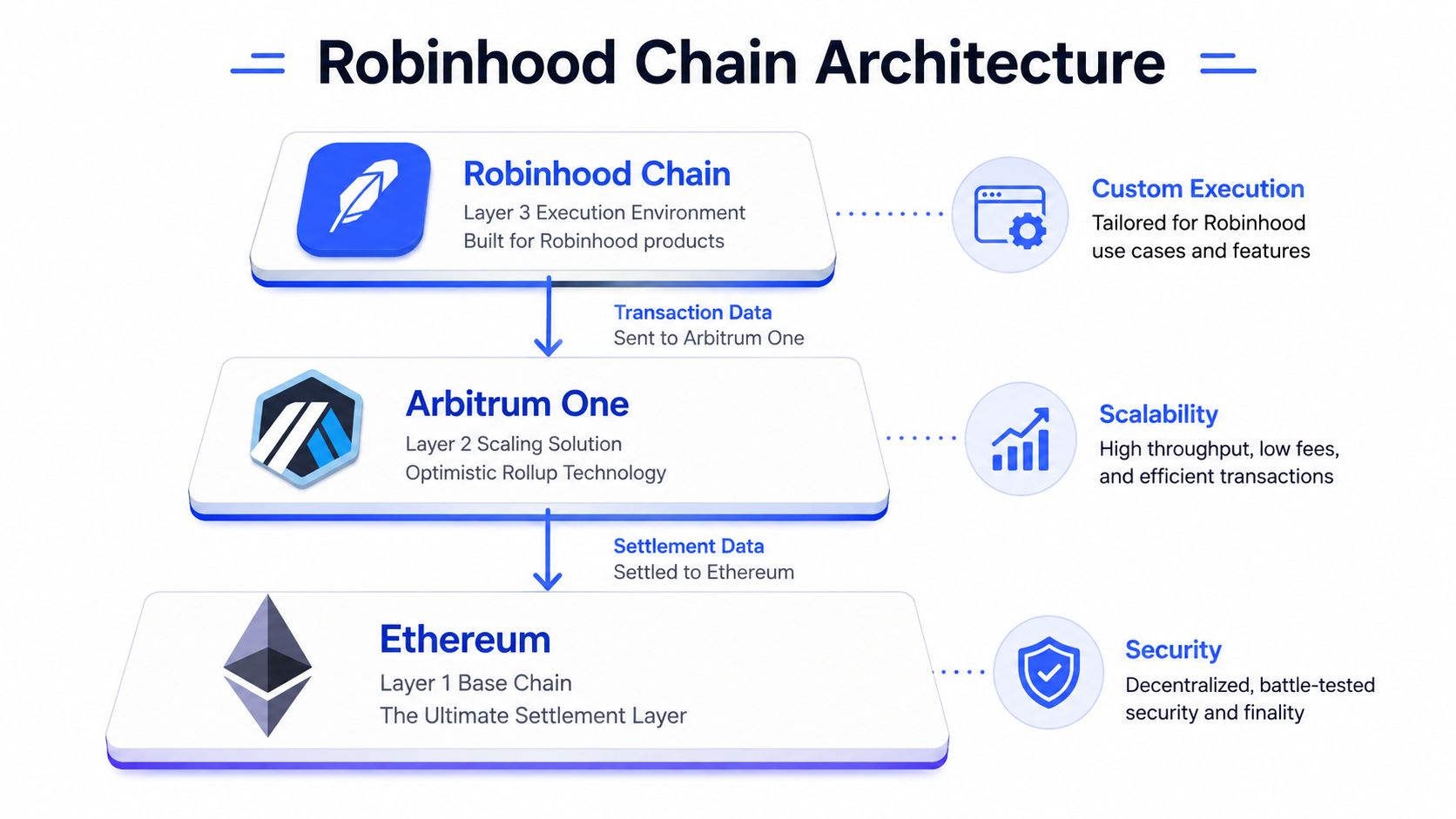
Robinhood Chain should be treated as blockchain infrastructure, not automatically as a finished payment product. The documented architecture is based on Arbitrum Orbit and Nitro, with Ethereum blobs used for data availability. The chain’s mainnet chain ID is 4663, according to the available technical description from DeFiPrime’s Robinhood Chain overview. That design gives developers an EVM-compatible environment while separating application execution from Ethereum’s base-layer execution.
What the architecture changes for builders
An Orbit-based chain can provide a dedicated execution environment for applications rather than forcing every transaction through Ethereum mainnet. Developers can use familiar EVM tooling, deploy Solidity contracts, connect wallets, and expose application services through RPC endpoints. The practical benefit is control over the application environment, transaction routing, and asset integrations, although the chain still inherits dependencies from its sequencer, data availability configuration, bridges, and settlement path.
Robinhood Chain is designed around tokenised assets and financial applications. Fungible stablecoins generally use ERC-20 contracts. Other token standards can represent assets with different transfer, ownership, or metadata requirements. The existence of a token contract, however, doesn’t mean that an issuer has completed reserve, custody, licensing, distribution, or redemption arrangements.
What’s live versus what must still be built
The current foundation supports tokenised asset activity and wallet-based interactions. It doesn’t mean every enterprise payment primitive is available as a ready-made service. A production payment platform still needs to implement:
- Treasury wallets, including signing policies, segregation, and transaction limits.
- Payment orchestration, including invoice matching and payout scheduling.
- Compliance controls, including KYC, sanctions screening, and transaction monitoring.
- Operational APIs, including webhooks, reconciliation, retry logic, and incident handling.
- Liquidity and redemption relationships, which sit outside the chain itself.
Robinhood Chain’s architecture can make stablecoin settlement technically attractive, especially where an enterprise wants one environment for tokenised assets and digital dollars. It doesn’t remove the need for regulated intermediaries or careful product design. Developers assessing the ecosystem can also review this practical discussion of Robinhood Chain’s mainnet implications for financial applications.
How an Onchain Stablecoin Payment Could Work
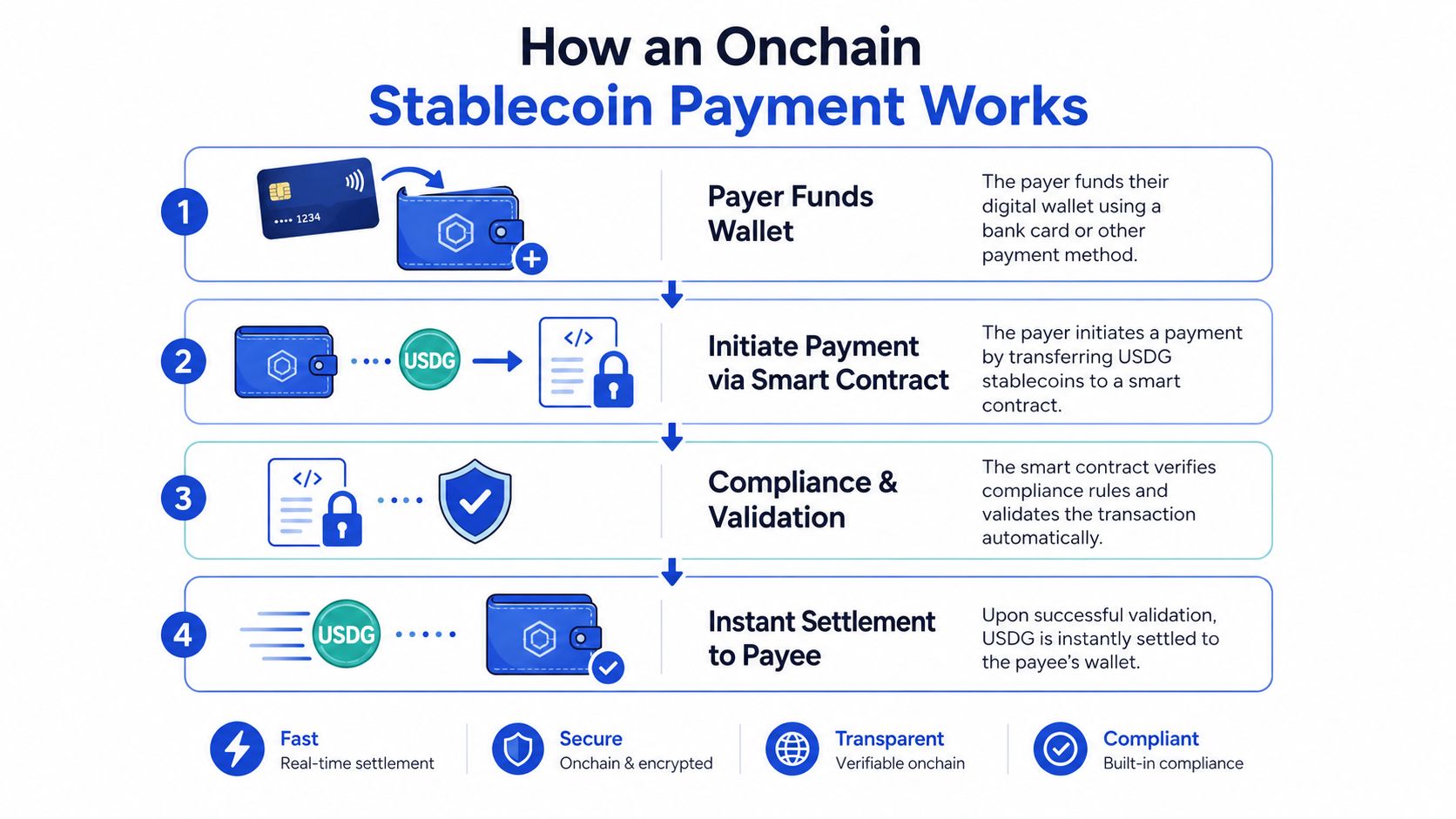
Consider USDG as an illustrative payment token, not as proof that every proposed payment feature is already packaged by Robinhood Chain. A business could hold the asset in a custodial account or a self-custody treasury wallet, subject to the issuer’s terms, the business’s jurisdiction, and the controls imposed by its service providers.
A controlled transaction flow
The payer prepares funds. The treasury system verifies that the wallet is funded, the payment amount matches the approved invoice, and the recipient address belongs to the intended vendor. The business should separate address approval from payment execution, rather than allowing an operator to paste an unverified address into a production transaction.
The wallet creates the transfer. An ERC-20 transfer call identifies the token contract, recipient address, and amount. The wallet or custody provider applies policy checks before signing. On Robinhood Chain, the gas model and supported fee-payment options must be confirmed from current network documentation. Teams shouldn’t assume that stablecoins can pay gas or that a paymaster is available without verifying the implementation.
The transaction enters the network. The signed transaction is broadcast through an RPC endpoint and ordered by the chain’s execution infrastructure. The application can listen for transaction status, token-transfer events, and block confirmations. A webhook service should translate those technical events into business states such as submitted, observed, confirmed, reconciled, or exception.
The payee receives the asset. The recipient wallet can observe the token balance after the transaction is included. Internal accounting should still wait for the organisation’s defined settlement policy, because a visible balance update and final settlement assurance aren’t always the same event.
A serious implementation also handles rejected addresses, insufficient gas, duplicate payment requests, chain reorganisations, RPC outages, and mismatched token contracts. Wallet infrastructure development can cover the custody and orchestration layer, but the business remains responsible for its compliance and operating model.
A related Tokenization Platform Development project may use comparable wallet, contract, and compliance components for real-world assets, securities, real estate, commodities, and digital assets. Those components shouldn’t be treated as interchangeable with a payment product without separate testing and controls.
Stablecoin Transfers Versus Traditional Payment Rails
Stablecoin settlement doesn’t beat every existing rail. Cards generally offer the most familiar consumer experience. Wires remain important for regulated, high-value transfers. ACH supports established domestic workflows. Stablecoins become more compelling when a business needs cross-border movement, programmable release conditions, continuous availability, or a shared reconciliation record.
For India, the competitive bar is especially high. UPI reached 228 billion transactions in 2025, according to Worldline’s report on India’s digital payments milestones. A stablecoin rail doesn’t need to replace UPI to be useful. It needs to solve a problem UPI doesn’t address, such as dollar settlement, cross-border vendor payments, treasury movement, or programmable escrow.
| Dimension | Stablecoin, Robinhood Chain | ACH | Card Networks | Wire Transfer |
|---|---|---|---|---|
| Cost model | Network fees, custody costs, compliance operations, and possible conversion or bridge costs | Bank and processor pricing within established domestic workflows | Merchant service fees and network costs | Bank, correspondent, and foreign-exchange charges |
| Availability | Designed for continuous blockchain access, subject to infrastructure and compliance availability | Controlled by banking and processor operating windows | Broad consumer acceptance, with authorisation and settlement stages | Dependent on bank operating processes and correspondent availability |
| Programmability | Smart contracts can encode escrow, routing, limits, and release conditions | Usually requires separate banking and workflow systems | Programmability is controlled by network and processor integrations | Instructions are generally less composable once submitted |
| Finality | Technical confirmation and economic settlement must be distinguished, especially before underlying rollup settlement | Governed by the banking system’s rules and reversibility processes | Authorisation isn’t the same as final merchant settlement | Strong operational conventions, but timing and recall rules vary |
| Best fit | Cross-border settlement, treasury, tokenised assets, and conditional payments | Domestic recurring and account-to-account payments | Retail checkout and consumer acceptance | Large, regulated, bank-to-bank transfers |
A $50,000 cross-border B2B payment illustrates the difference. A wire may pass through correspondent institutions and internal compliance queues. A stablecoin transfer can move as an onchain token transaction, but the business still needs a compliant acquisition route, recipient screening, liquidity, accounting treatment, and a way to convert or redeem the asset. The blockchain reduces some coordination friction. It doesn’t eliminate foreign exchange, tax, banking, or regulatory work.
The economics also depend on transaction size and workflow density. Micro-payments can become unattractive when every transfer requires operational checks, wallet management, and conversion. Treasury-scale payments may justify that overhead when programmable conditions and cross-border availability matter. The right comparison is therefore not “blockchain is cheaper”, but “which parts of the existing payment process can this rail remove, automate, or make auditable?”
A broader review of cross-border crypto payment solutions is useful when comparing providers, custody models, conversion paths, and settlement orchestration.
Enterprise Use Cases for Stablecoin Settlement
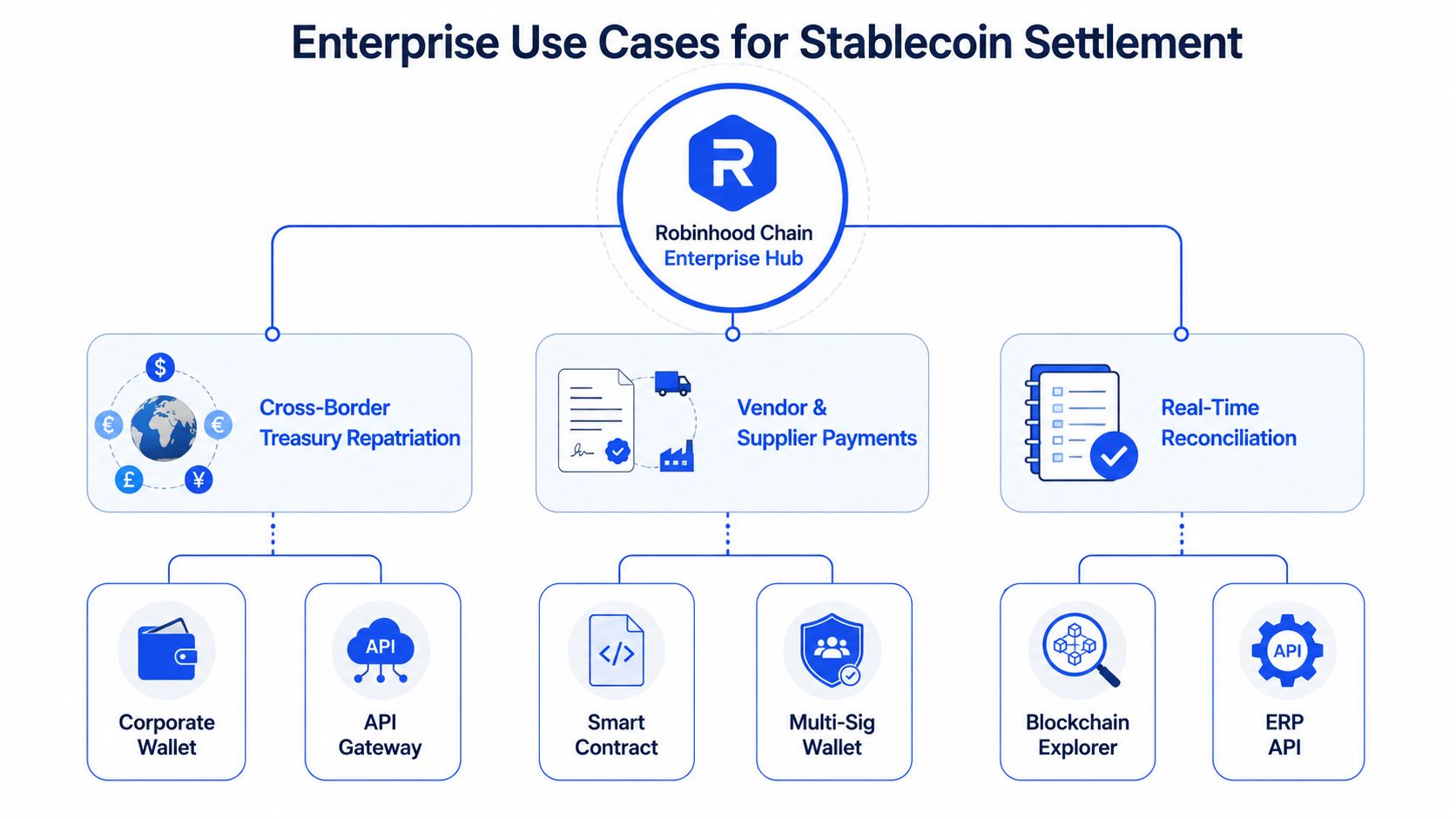
Enterprises should start with a defined payment problem, not with the token. A stablecoin can represent the settlement asset, while wallets, APIs, smart contracts, compliance services, and treasury systems determine whether the product works in production.
Cross-border treasury
A multinational can use controlled wallets to move dollar-denominated value between operating entities or approved liquidity providers. The chain handles the token transfer, while the treasury platform manages approval thresholds, entity-level accounting, FX instructions, and reconciliation. A custody integration is usually preferable for organisations that need policy enforcement, role separation, and recoverability.
Supplier and vendor settlement
A B2B platform can attach a stablecoin payout to an approved invoice. The payment service validates the supplier, checks the invoice state, screens the destination wallet, and releases funds through a wallet or payment contract. The vendor needs a clear redemption or conversion route, otherwise the payment merely shifts the operational burden from the buyer to the supplier.
Tokenised securities and distributions
Tokenised securities can use smart contracts to automate transfer restrictions, ownership records, and distribution instructions. Dividend or coupon workflows may connect eligible holders to a payment process, but those flows require issuer, custodian, transfer-agent, and regulatory coordination. A corporate bond tokenization platform can combine digital bond issuance, smart contract automation, settlement workflows, and investor management for banks, financial institutions, and capital markets.
Escrow and marketplace payments
A marketplace can lock funds until a delivery event, approval, or dispute window is complete. An oracle or authorised off-chain service may provide the trigger, while the smart contract controls release. That pattern is useful for trade finance and freelancer platforms, but it creates new failure modes around oracle accuracy, dispute authority, refunds, and contract upgrades.
The distinction between available infrastructure and a finished product is important. Tokenised asset support and wallet access can provide a technical base. Enterprise payment applications still require off-chain orchestration, integration with ERP or accounting systems, monitoring, customer support, and jurisdiction-specific controls.
Compliance, Security, and Jurisdictional Reality
Stablecoin payment design must follow the legal status of the asset, the activity, and the parties involved. A token can move technically while the business handling it still falls within payment, financial crime, tax, securities, money transmission, or virtual asset rules.
India illustrates the issue clearly. India has no dedicated stablecoin law, so stablecoins sit within the broader Virtual Digital Asset perimeter rather than being legal tender or an RBI-authorised payment instrument. Current treatment includes a 30% tax on gains from VDA transfers and 1% TDS on specified transfers, while VDA activity is subject to AML/CFT oversight after being brought under PMLA and FIU-IND supervision, as described in the India section of Plasma’s stablecoin regulation map. A payment layer for India therefore needs tax reporting, KYC, transaction monitoring, and recordkeeping from the start.
India’s payment framework is also tightly controlled. The RBI is the sole authorising authority under the Payment and Settlement Systems Act, and non-bank payment aggregators require RBI authorisation. The relevant prudential threshold is ₹15 crore net worth at application, rising to ₹25 crore within three years, according to Crypto Briefing’s coverage of Robinhood Chain and USDG. Those requirements don’t automatically determine whether a blockchain design is permissible, but they affect the entities that operate payment collection, custody, aggregation, and settlement services.
Different jurisdictions create different product boundaries
The EU, US, UK, UAE, and Singapore shouldn’t be treated as one regulatory market. Stablecoin issuer obligations, payment licensing, custody rules, marketing restrictions, reserve requirements, and access conditions can differ materially. A business should map the customer, issuer, token, wallet provider, payment activity, and redemption path in each target jurisdiction before writing product requirements.
For teams working through European payment classifications, the RegisterCompany.ie PSD2 guide from Chern & Co provides useful context on the distinction between payment agents and payment institutions. It isn’t a substitute for local legal advice, but it helps product teams identify questions that must be answered before launch.
Security belongs in the architecture
Treasury wallets need hardware-backed or policy-controlled key management, multi-party approval, spending limits, and emergency procedures. Bridges introduce additional trust and technical assumptions, so cross-chain transfers should be isolated, monitored, and limited. Onchain analytics should screen addresses and flows, while reserve attestations and issuer disclosures should inform asset selection.
A compliance-ready design also needs immutable audit records, case management, suspicious-activity escalation, and a clear process for freezing or rejecting transactions where the legal model requires it. Compliance-ready blockchain platform design should be treated as a product requirement, not a post-launch feature.
Challenges, Limitations, and the Next 12 to 24 Months
The main limitation isn’t whether a token can be transferred. EVM-compatible chains make that part familiar. The harder work sits around reliability, liquidity, compliance, and operational recovery.
RPC availability and indexer latency can affect what an application displays, even when the underlying transaction has been accepted. A treasury dashboard that depends on one provider creates a fragile control point. Production systems should use provider redundancy, event replay, reconciliation against chain state, and explicit handling for delayed or conflicting notifications.
Gas behaviour also matters during concentrated settlement activity. A payment product must know which asset pays fees, how the treasury replenishes that asset, and what happens when the fee balance is empty. If a team uses a bridge, it must model liquidity, message delays, token representation, and the risk that an asset arrives on a chain where the recipient cannot redeem it.
The gap between a demo and a payment product
A tokenised-asset demonstration can prove that a contract mints or transfers. It doesn’t prove that the business can onboard customers, screen wallets, process refunds, reconcile every transaction, satisfy auditors, or support a failed payout. Reserve information, issuer permissions, fiat on-ramps, KYC partners, and local reporting obligations can remain unresolved even after the onchain transaction works.
The next 12 to 24 months should be evaluated through three practical lenses:
- Licensing and banking relationships: Stablecoin providers and payment platforms will need clearer pathways across markets, including relationships with banks and regulated intermediaries.
- Liquidity and interoperability: More Orbit environments and other L2s increase the need for reliable routing, canonical assets, bridge controls, and transparent finality assumptions.
- Enterprise tooling: Treasury teams need SDKs, policy engines, accounting connectors, monitoring dashboards, and support processes that are designed for finance operations rather than only for developers.
The strongest architecture will keep the chain layer modular. Wallet custody, compliance screening, FX, ERP integration, and reporting should be replaceable services around the settlement contract, not hard-coded assumptions inside it. Blocsys Technologies develops blockchain infrastructure, digital asset systems, stablecoin workflows, smart contracts, and financial technology platforms that can be designed around these requirements.
A practical build conversation should begin with the asset, jurisdictions, counterparties, custody model, settlement policy, and failure procedures. Teams estimating the broader software scope can use the software development cost estimator before turning a stablecoin concept into a delivery plan.
Blocsys Technologies supports organisations building stablecoin payment platforms, wallets, smart contracts, transaction workflows, APIs, compliance controls, and enterprise blockchain integrations. Visit Blocsys Technologies to discuss a production-focused architecture for Robinhood Chain payment use cases and the next steps for implementation.
Frequently Asked Questions
What are Robinhood Chain stablecoins?
Robinhood Chain stablecoins are dollar-denominated or otherwise fiat-referenced tokens that can operate within the chain’s EVM-compatible settlement environment, subject to the token issuer’s support and the chain’s current integrations. They’re not automatically legal tender or a complete payment service, so businesses still need custody, compliance, liquidity, and reconciliation controls.
How do stablecoin payments work on Robinhood Chain?
A payer funds an approved wallet, creates a token transfer, signs the transaction, and broadcasts it through an RPC endpoint. The network records the transfer, the recipient observes the token balance, and the business applies its own confirmation and settlement policy before marking the invoice complete.
Is USDG supported on Robinhood Chain?
USDG can be used as an illustrative stablecoin for a Robinhood Chain payment flow, but teams must verify current network documentation, token contracts, issuer terms, wallet support, and jurisdictional availability before treating it as a production payment asset. Support shouldn’t be inferred from a general stablecoin or wallet reference.
How does stablecoin settlement differ from a bank transfer?
Stablecoin settlement records a token movement on a blockchain and can connect directly to smart contracts, wallets, and automated workflows. A bank transfer updates balances through regulated financial institutions and their operating processes. Stablecoin settlement may reduce coordination friction, but it doesn’t remove conversion, compliance, tax, custody, or redemption requirements.
Do businesses need a wallet for onchain payments?
Yes, a business needs a mechanism that controls blockchain addresses and signs transactions, whether that mechanism is self-custody software, a qualified custody provider, or an integrated treasury platform. Enterprise wallets should include approval policies, key protection, spending limits, address allowlists, monitoring, and recovery procedures.
What are the transaction fees on Robinhood Chain?
Transaction fees depend on the chain’s current gas model, the transaction type, network conditions, and the infrastructure used to submit it. Teams shouldn’t assume that fees can be paid in stablecoins or that a paymaster is available until those capabilities are confirmed in current technical documentation and tested in the target environment.
What role do smart contracts play in stablecoin payments?
Smart contracts can enforce payment conditions such as escrow, staged release, approved recipients, transfer restrictions, or automated distribution. They also introduce contract, oracle, upgrade, and key-management risks, so every payment contract needs independent testing, access controls, monitoring, and a defined recovery process.
Which enterprise use cases fit Robinhood Chain stablecoin settlement?
Potential use cases include cross-border treasury movement, vendor settlement, tokenised-asset distributions, programmable escrow, and reconciliation workflows. The strongest candidates are payments where continuous availability, shared transaction records, or programmable conditions solve a real operational problem that domestic rails don’t address.
Is Robinhood Chain a regulated payment network?
Robinhood Chain is blockchain infrastructure, not a universal authorisation for payment activity. Whether a business can operate a stablecoin payment product depends on its activity, customers, token, custody model, jurisdictions, and relationships with regulated providers. The chain’s technical capabilities don’t replace licensing or compliance analysis.
How can businesses secure stablecoin transactions?
Businesses should use controlled custody, multi-party approvals, address allowlists, transaction simulation, sanctions screening, monitoring, provider redundancy, bridge risk controls, and reconciliations against onchain state. Security also requires incident procedures for compromised keys, incorrect addresses, delayed transactions, issuer actions, and smart-contract vulnerabilities.
How do businesses integrate Robinhood Chain payments?
Integration typically combines an EVM-compatible RPC connection, wallet or custody service, token contract interaction, indexer or event listener, webhook layer, compliance provider, accounting connector, and treasury dashboard. The application should expose business statuses such as submitted, confirmed, reconciled, and failed instead of showing only a transaction hash.
What does stablecoin payment platform development cost?
The cost depends on the custody model, number of jurisdictions, wallet architecture, smart-contract scope, compliance integrations, payment corridors, accounting systems, and operational requirements. A useful starting point is the software development cost estimator, followed by a technical discovery process that separates the chain integration from the regulated service design.
Why should a business choose Blocsys for this type of build?
Blocsys can support blockchain infrastructure, stablecoin workflows, wallets, smart contracts, tokenisation, transaction APIs, compliance controls, and financial technology integrations. Businesses should evaluate the engagement against their own regulatory advice, custody requirements, target markets, and delivery scope rather than assuming any technology partner provides regulatory approval or access to proprietary Robinhood services.
Conclusion
Robinhood Chain stablecoins present a credible infrastructure direction for tokenised assets and programmable settlement, but the payment-rail opportunity is still a system-design challenge rather than a single contract deployment. The chain can provide an EVM-compatible execution environment, while enterprises must add wallets, custody, compliance, monitoring, liquidity, reporting, and integrations around it.
The most defensible opportunities are cross-border treasury, vendor settlement, tokenised-asset distributions, and programmable escrow. In India, the opportunity must be designed around VDA tax, AML oversight, KYC, reporting, and the existing multi-rail payments environment. In the US, Europe, the UK, UAE, Singapore, and other markets, the same architecture needs jurisdiction-specific treatment. Teams that define those boundaries early can test whether stablecoin settlement solves a real business problem before committing to a larger platform build.
