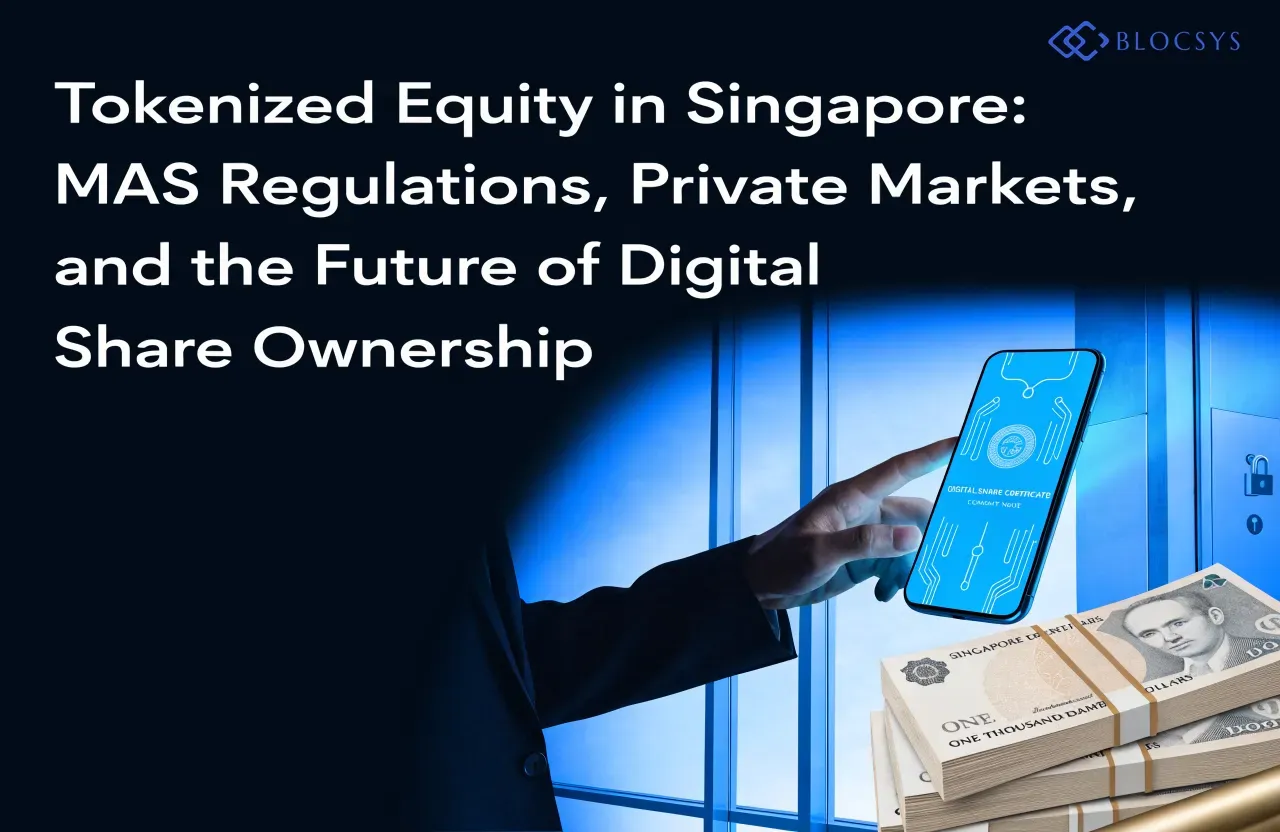
Tokenized Equity in Singapore: MAS Regulations, Private Markets, and the Future of Digital Share Ownership
Tokenized equity in Singapore is moving from a theoretical concept to a genuine infrastructure conversation among private companies, fund managers, and financial institutions. As Singapore strengthens its position as a regional digital-asset hub, founders and investors alike are asking how blockchain can represent ownership, streamline private-market transactions, and improve access to capital. This article breaks down what tokenized equity actually means in Singapore, how MAS regulates the space, and how companies can approach a compliant Equity Tokenization Platform Development strategy without overstating what the technology can legally do.
What Is Tokenized Equity in Singapore?
Tokenized equity in Singapore refers to representing ownership interests, or economic rights tied to those interests, in a private or public company using blockchain-based tokens. Instead of a paper share certificate or an entry in a company’s register of members, a digital token records who holds an interest and how much of it they hold. That’s the simple version. The legal reality is more layered.
Traditional equity ownership in Singapore works through the Companies Act, where a company maintains a register of shareholders, issues share certificates or electronic entries, and records transfers through its company secretary or a transfer agent. Ownership rights, voting rights, and dividend entitlements flow from that legal register, not from any technology used to track them.
Here’s the part many teams gloss over: a blockchain token does not, by itself, create legally recognized ownership of company shares. The token is a representation. Whether it carries enforceable rights depends entirely on the underlying legal structure, such as a trust arrangement, a nominee holding structure, or a direct share registry link, and on whether that structure satisfies Singapore’s corporate and securities law requirements.
That distinction matters for anyone comparing tokenized equity Singapore offerings. A well-structured digital securities offering ties the token to a real legal right through binding documentation. A poorly structured one just puts a picture of a share on a blockchain, with no enforceable claim behind it. Founders, investors, and compliance teams need to ask, at every step, what legal instrument actually backs the token.
Tokenized Equity vs. Tokenized Shares vs. Digital Securities vs. Security Tokens
These terms get used loosely, so let’s separate them. Tokenized equity is a broad label for any blockchain representation of an ownership or economic interest in a company. Tokenized shares Singapore usually refers more specifically to a token structured to mirror an actual class of shares, often through a custody or nominee arrangement. Digital securities Singapore is the regulatory category MAS uses; it covers capital-markets products issued or represented digitally, including tokenized shares, bonds, and units in collective investment schemes. Security tokens is a technical term describing the blockchain instrument itself, regardless of the legal wrapper. General RWA tokenization is a wider category that includes real estate, commodities, and receivables, not just company equity. Equity tokenization sits as one specific application inside that broader RWA universe.
Why Singapore Is Emerging as a Digital Securities Hub
Singapore has built a reputation as a careful, well-regulated jurisdiction for digital assets, and that reputation directly supports interest in tokenized equity Singapore projects. The Monetary Authority of Singapore has consistently favored a licensing-and-guidance approach over outright restriction, which gives institutions a clearer compliance path than many other markets offer.
Several factors make Singapore attractive for equity tokenization Singapore initiatives specifically. First, its capital-markets law, the Securities and Futures Act, already accommodates digital representations of capital-markets products, so issuers aren’t operating in a legal vacuum. Second, Singapore hosts a dense concentration of venture capital firms, family offices, and private equity firms that actively look for better private-market infrastructure. Third, MAS has run structured industry initiatives, including Project Guardian, that explore tokenized asset settlement and interoperability with regulated financial institutions.
Additionally, Singapore’s private markets have historically suffered from limited liquidity and slow, manual share-transfer processes. Founders issuing employee equity, VCs managing cap tables across portfolio companies, and family offices holding illiquid private-company stakes all deal with the same friction: paperwork-heavy transfers, delayed settlement, and opaque ownership records. Blockchain-based infrastructure addresses that friction directly, which is why private equity tokenization Singapore conversations keep gaining momentum among asset managers and institutional investors.
The jurisdictions that win in digital securities won’t be the ones with the loosest rules. They’ll be the ones where institutions can actually rely on the regulatory answer they get. Singapore has built exactly that kind of predictability, and that’s why serious capital keeps showing up here first.
MAS Regulations for Tokenized Equity in Singapore
What are MAS regulations for tokenized equity? In short, MAS doesn’t have a single standalone “tokenized equity law.” Instead, tokenized equity in Singapore falls under existing frameworks depending on how the token is structured and what rights it carries. If a token represents a capital-markets product, such as shares or units backed by a company or fund, it typically falls under the Securities and Futures Act (SFA). If the arrangement involves payment functions or digital payment tokens, the Payment Services Act (PSA) may also apply.
Under the SFA, offers of capital-markets products generally require a prospectus, unless an exemption applies, such as offers to accredited investors, institutional investors, or small private placements under prescribed limits. This is one of the most important Singapore equity tokenization regulations points: tokenizing a share offering does not remove the underlying securities-law obligations. If a traditional share offering would require a prospectus or fall under a specific exemption, the tokenized version generally faces the same analysis.
Entities operating platforms that facilitate dealing in, or providing custody for, digital capital-markets products may also need to consider capital-markets services (CMS) licensing, or custody-related licensing requirements, depending on their specific activities. MAS Equity Tokenization Regulations, in practice, mean issuers and platforms need to map their business model against existing licensing categories rather than assume tokenization creates a new, lighter-touch regime.
Established Rules vs. Pilot Programs
It’s worth separating what’s confirmed regulation from what’s still exploratory. MAS licensing requirements under the SFA and PSA, prospectus obligations, and AML/CFT requirements under the MAS Notices are established, binding rules. Project Guardian, by contrast, is an industry collaboration exploring asset tokenization and DeFi applications with participating financial institutions; it’s a pilot and testing initiative, not a licensing framework, and participation in it doesn’t equal regulatory approval for a specific tokenized equity model. No authoritative source confirms that MAS has pre-approved any particular tokenized equity structure as compliant. Every issuer still needs its own legal and regulatory assessment.
Investor Eligibility and Disclosure
Investor eligibility categories under Singapore law generally include accredited investors, institutional investors, and retail investors, each with different disclosure and protection requirements. Many private tokenized equity offerings target accredited or institutional investors specifically because that pathway typically involves lighter prospectus obligations, though it still carries strict eligibility verification duties. Companies exploring tokenized private equity Singapore structures need to build investor-classification checks directly into onboarding, not treat it as a one-time formality.

How Tokenized Equity Platforms Work in Singapore
A tokenized equity platform connects legal share structures to blockchain infrastructure, but it’s not just a token generator. It’s a coordinated system involving legal documentation, a transfer agent function, custody, compliance screening, and a blockchain ledger acting as the technical record layer.
Most platforms serving the Singapore market use permissioned or permissioned-hybrid blockchain networks, rather than fully public, anonymous networks, because compliance controls need to sit at the protocol level. This lets the platform enforce transfer restrictions and investor eligibility rules directly through code, rather than relying purely on manual review after a transaction request comes in.
Core Platform Components
- Legal structuring layer — defines what rights the token actually represents and how it connects to the company’s official register.
- Issuance layer — smart contracts that mint tokens tied to verified investor wallets after onboarding is complete.
- Compliance engine — enforces KYC/AML status, investor accreditation, and jurisdictional restrictions before any transfer executes.
- Custody layer — manages private keys and wallet security, either through self-custody, institutional custody, or a hybrid model.
- Ownership and reporting layer — reconciles on-chain records against the company’s official shareholder register.
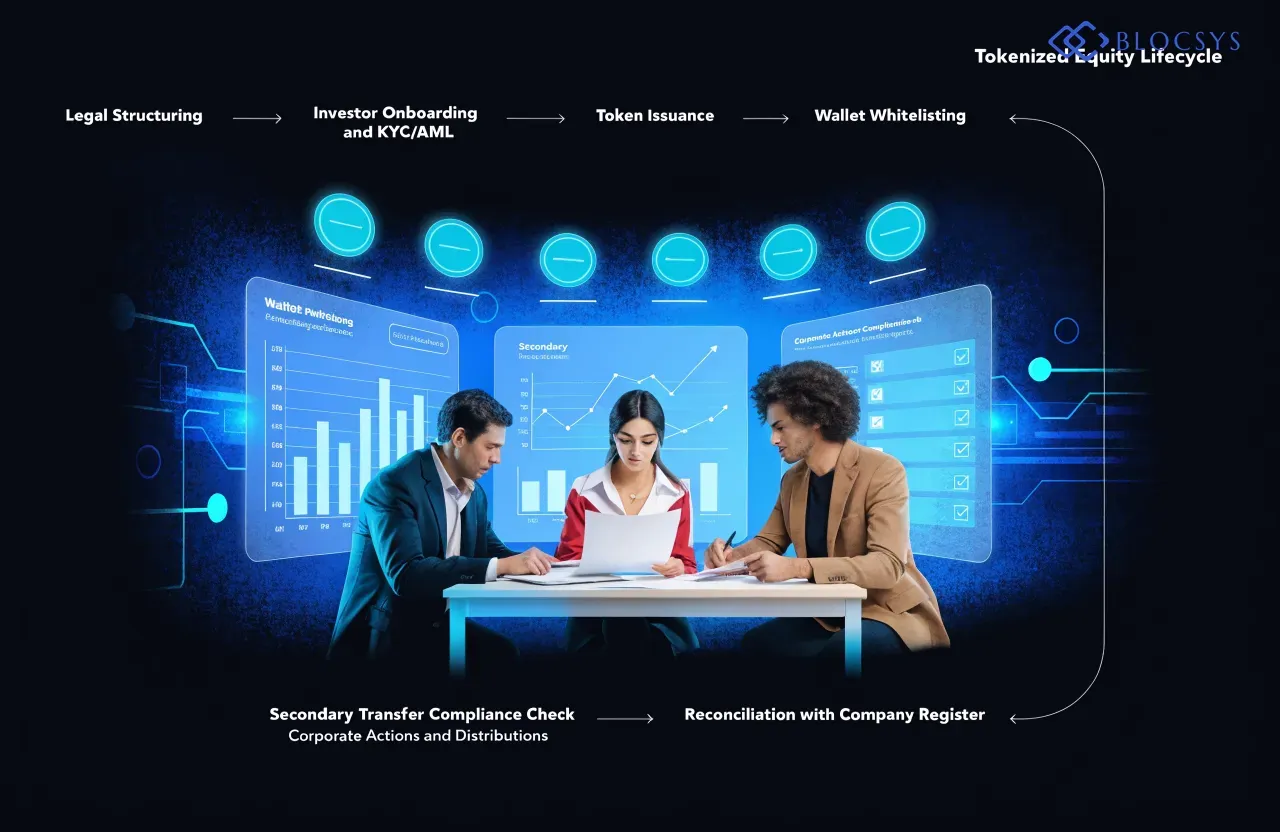
The Tokenized Equity Lifecycle
Understanding the full lifecycle helps explain why equity tokenization Singapore projects require more than a smart contract deployment. Each stage carries its own legal, technical, and compliance requirements.
Structuring and Issuance
Everything starts with legal structuring. The company, its legal counsel, and often a corporate services provider decide how the token will connect to actual share ownership, whether through direct share issuance, a nominee structure, or a special purpose vehicle. Once that’s settled, the company prepares offering documentation, determines the applicable SFA exemption or prospectus pathway, and defines the token’s economic and voting rights, if any.
Investor Onboarding and KYC/AML
How does KYC/AML work for tokenized equity investors? Investors go through identity verification, sanctions and politically exposed persons screening, source-of-funds checks, and investor-classification confirmation before receiving any tokens. This typically happens through a compliance module integrated into the platform, which then whitelists the investor’s wallet address. Only whitelisted wallets can receive, hold, or transfer the tokenized equity, which is how the system enforces eligibility rules technically rather than just contractually.
Token Issuance and Ownership Records
Once onboarding clears, the platform mints tokens to the investor’s approved wallet. The blockchain ledger then serves as a real-time, auditable record of who holds what, updated automatically with every compliant transaction. This doesn’t replace the company’s statutory register; it operates alongside it, and reconciliation between the two needs to happen consistently.
Secondary Transfers, Corporate Actions, and Exit
Secondary transfers on a well-built platform still route through the compliance engine, checking that both the seller’s and buyer’s wallets meet eligibility rules before the transfer executes. Corporate actions, such as dividend distributions, bonus issues, or capital calls in a private equity tokenization Singapore context, can be automated through smart contracts that calculate and distribute payments proportionally to token holders. Exit or redemption mechanisms depend on the underlying deal structure, whether that’s a buyback, a secondary sale, or a liquidity event tied to an eventual listing or acquisition.
Smart Contracts and Programmable Ownership
Smart contracts do a lot of the operational heavy lifting in tokenized equity Singapore structures, but they don’t replace legal ownership. That distinction deserves repeating because it’s where a lot of confusion happens. A smart contract can enforce that only whitelisted wallets receive tokens. It can automate dividend calculations. It can block a transfer that would breach a lock-up period. What it can’t do is independently create a legally binding ownership claim; that still depends on the underlying legal agreement and corporate registry.
Think of smart contracts as the enforcement layer sitting on top of a legal foundation. Transfer restriction logic, such as lock-up periods, investor caps, or jurisdictional blocks, gets coded directly into the token contract. Compliance controls check wallet whitelisting status before allowing any movement. Shareholder record updates happen automatically with each valid transaction, reducing the manual reconciliation work that traditional cap-table management requires.
Where this gets genuinely useful for private companies is corporate governance automation, voting mechanisms for token holders, automated cap-table updates after funding rounds, and streamlined distribution of proceeds during exit events. However, legal, compliance, and custody processes still need human oversight and proper documentation running alongside the code. A smart contract bug or an incorrectly configured parameter doesn’t just cause a technical error; it can create a genuine legal ownership dispute if the on-chain and off-chain records diverge.
Custody, Transfer Restrictions, and Settlement
Custody in tokenized equity Singapore deployments generally falls into three models: self-custody, where the investor controls their own private keys; institutional custody, where a regulated custodian holds keys on behalf of investors; and hybrid custody, combining elements of both with recovery mechanisms. Institutional investors and family offices, in particular, tend to prefer regulated custody arrangements because private key loss has no recovery path on most blockchain networks, and that risk is unacceptable for large equity positions.
Transfer restrictions matter more in equity tokenization than in almost any other tokenized asset category, because company law and securities exemptions often cap who can hold shares, how many holders a private company can have, and under what conditions transfers can occur. A properly built platform encodes these restrictions directly into the token’s smart contract, blocking non-compliant transfers automatically rather than relying on after-the-fact enforcement.
Settlement is where tokenized equity shows one of its clearest advantages over traditional private-market transactions. Traditional private share transfers can take days or weeks, involving manual paperwork, signature collection, and register updates. Blockchain-based settlement can compress that timeline significantly, since ownership updates and compliance checks happen within the same transaction. That said, settlement finality on-chain still needs to sync with the company’s official register to have full legal effect, so platforms need clear reconciliation processes rather than treating on-chain settlement as automatically final in a legal sense.
Private-Market and Institutional Use Cases in Singapore
Several applications are already established in practice, while others remain emerging or exploratory. It’s worth being clear about which is which.
Established Applications
Private companies use tokenized structures to manage employee equity programs, giving employees clearer visibility into vesting schedules and holdings. Venture capital and private equity firms use tokenized structures to streamline cap-table management across portfolio companies, reducing administrative overhead. Digital securities issuance for accredited-investor offerings has become a genuine, active category, with platforms handling onboarding, compliance, and issuance for private placements.
Emerging and Developing Applications
Secondary marketplaces for tokenized private shares are developing, though liquidity remains limited compared to public markets. Cross-border investor access, where legally permitted under Singapore’s exemption regimes and the investor’s home jurisdiction rules, is expanding but requires careful multi-jurisdictional compliance review. Institutional-grade settlement between tokenized private assets and regulated payment rails is an active area of exploration through initiatives like Project Guardian, rather than a fully commercialized offering yet.
Illustrative scenario: Picture a Singapore-based growth-stage company preparing a Series B round. Instead of issuing paper share certificates to each accredited investor, it works with a tokenization partner to structure the round as tokenized shares Singapore, backed by proper legal documentation and integrated KYC/AML onboarding. Investors receive tokens representing their equity stake, cap-table updates happen automatically, and the company’s legal team maintains reconciliation with the statutory register. This is a hypothetical example illustrating how the pieces fit together, not a claim about any specific deployed platform or completed transaction.
Benefits, Limitations, and Challenges
The benefits of equity tokenization Singapore approaches are real, but they come with genuine trade-offs that founders and institutions need to weigh honestly.
| Benefit | Practical Limitation |
|---|---|
| Faster settlement and reduced paperwork | Legal finality still depends on syncing with the official company register |
| Improved cap-table transparency | Requires disciplined reconciliation processes to avoid record mismatches |
| Broader potential investor access within legal limits | Securities law eligibility rules still apply fully to token holders |
| Automated compliance enforcement via smart contracts | Smart contract errors can create real legal ownership disputes |
| Potential for secondary liquidity over time | Secondary markets for private tokenized shares remain immature |
Additional challenges include integration complexity with existing corporate secretarial systems, the need for specialized legal counsel familiar with both securities law and blockchain structures, and investor education, since many private-market participants are still unfamiliar with how digital share ownership actually functions legally. Consequently, successful projects tend to invest heavily in clear documentation and investor communication, not just technical build-out.
Development Considerations and Cost Factors
Building a compliant tokenized equity platform involves several cost drivers that vary by project scope. Legal structuring and regulatory review typically represent a substantial upfront cost, since counsel needs to map the specific offering against SFA requirements and applicable exemptions. Smart contract development and auditing costs depend on the complexity of transfer restrictions, corporate action automation, and integration requirements. KYC/AML and compliance-engine integration adds ongoing operational cost, since screening needs to run continuously, not just at onboarding. Custody infrastructure, whether built in-house or through a third-party custodian partnership, adds another layer of cost and vendor evaluation.
Because these variables shift significantly based on company size, investor base, and platform ambition, generic cost figures don’t hold up well across projects. Companies evaluating Equity Tokenization Platform Development for their specific structure typically benefit from a scoped estimate. Blocsys’ Software Development Cost Estimator Tool gives a useful starting reference point for teams sizing up budget before committing to a full build.
Singapore Compared With Other Tokenization Markets
Singapore’s approach differs from jurisdictions that either restrict digital securities heavily or leave them largely unregulated. Where some markets still lack clear digital-securities frameworks, Singapore’s SFA and PSA already provide a working, if demanding, path to compliance. Where some jurisdictions have rushed bespoke tokenization laws, Singapore has largely applied existing capital-markets principles to digital instruments, which gives institutions a more familiar compliance reference point. This measured approach is a big part of why family offices and asset managers based in the region increasingly look at Singapore first when considering Real World Asset Tokenization strategies more broadly, and tokenized equity specifically.
Why Businesses Need an Experienced Tokenization Development Partner
Getting tokenized equity in Singapore right means coordinating legal structuring, securities compliance, smart contract architecture, custody integration, and investor onboarding into one coherent system. Getting any one piece wrong, whether that’s a misconfigured transfer restriction or a gap between on-chain and off-chain records, creates real legal exposure, not just a technical bug.
Blocsys works as a blockchain, Web3, fintech, and enterprise technology partner for companies building digital-asset infrastructure, including equity tokenization, digital securities systems, and smart contract-driven compliance controls. Whether you’re a private company structuring your first tokenized funding round, an asset manager building a digital securities product, or a private-market platform developing compliant ownership management, having a technical partner who understands both blockchain architecture and the regulatory context matters. Blocsys’ Smart Contract Development and Dedicated Blockchain Engineering Team services support exactly this kind of build, from architecture through deployment.
The Future of Digital Share Ownership in Singapore
Singapore’s regulatory posture, combined with its dense private-market ecosystem, positions it well for continued growth in digital securities and tokenized equity adoption. As MAS continues refining its stance through initiatives like Project Guardian and ongoing SFA guidance, institutional confidence in tokenized structures is likely to keep building gradually, rather than shifting overnight.
For private companies and financial institutions, the practical takeaway is straightforward: tokenized equity in Singapore works best when the technology serves a clearly structured legal and compliance foundation, not the other way around. Companies that treat tokenization as a compliance-first, technically sound infrastructure decision, rather than a marketing angle, are the ones building durable digital share ownership systems.
Frequently Asked Questions
Here are direct answers to the questions we hear most often about tokenized equity in Singapore.
What is tokenized equity in Singapore?
Tokenized equity in Singapore is a blockchain-based representation of ownership or economic interests in a company, structured through legal documentation that ties the token to actual rights. The token itself doesn’t automatically create legal ownership; it depends on the underlying trust, nominee, or direct-issuance structure and compliance with Singapore’s Securities and Futures Act.
How does equity tokenization work in Singapore?
It works by combining legal share structuring, investor KYC/AML onboarding, and blockchain-based issuance into one coordinated process. Once investors clear compliance checks, tokens representing their equity stake get issued to whitelisted wallets, with the blockchain ledger tracking ownership alongside the company’s official shareholder register.
What are MAS regulations for tokenized equity?
MAS doesn’t run a separate tokenized-equity law; instead, digital securities fall under the existing Securities and Futures Act and, where relevant, the Payment Services Act. Requirements include prospectus obligations or applicable exemptions, investor eligibility rules, and potential capital-markets services licensing depending on the platform’s activities.
Are tokenized shares legal in Singapore?
Tokenized shares can be legal in Singapore when structured properly under existing securities and company law, with clear legal documentation linking the token to genuine ownership rights. Simply issuing a blockchain token without a compliant legal structure and required disclosures doesn’t satisfy Singapore’s regulatory requirements.
How are tokenized shares different from traditional shares?
Traditional shares are recorded through a company’s statutory register and transferred via manual paperwork or a transfer agent. Tokenized shares Singapore use blockchain records to track ownership and automate transfer restrictions, but they still need reconciliation with the company’s legal register to carry full effect.
Can private companies tokenize equity in Singapore?
Yes, private companies can tokenize equity in Singapore, typically through offerings to accredited or institutional investors under applicable SFA exemptions. This requires proper legal structuring, compliant investor onboarding, and a platform that enforces transfer restrictions matching Singapore’s private-company shareholder limits.
What technology is required to build a tokenized equity platform in Singapore?
A tokenized equity platform needs smart contract infrastructure for issuance and transfer restrictions, a KYC/AML compliance engine, custody solutions for wallet and key management, and reconciliation tools linking on-chain records to the company’s official register. Legal structuring sits alongside all of this as the foundation the technology enforces.
How does KYC/AML work for tokenized equity investors?
Investors submit identity documents, undergo sanctions and politically exposed persons screening, and confirm their investor classification, such as accredited or institutional status, before receiving tokens. Once verified, their wallet address gets whitelisted, and only whitelisted wallets can hold or transfer the tokenized equity going forward.
What role does MAS play in Singapore’s tokenization ecosystem?
MAS regulates digital securities activity under the Securities and Futures Act and Payment Services Act, sets licensing requirements for capital-markets and custody services, and runs industry initiatives like Project Guardian to explore tokenized asset infrastructure. MAS doesn’t pre-approve specific tokenized equity products; each offering still needs its own compliance assessment.
How much does it cost to build a tokenized equity platform in Singapore?
Costs vary significantly based on legal structuring complexity, smart contract scope, compliance-engine integration, and custody requirements, so there’s no single fixed figure that applies across projects. Companies typically get a clearer picture through a scoped estimate, such as Blocsys’ Software Development Cost Estimator Tool, based on their specific offering structure.
Ready to move beyond theory and build an intelligent platform that delivers real-world value? Blocsys Technologies specialises in engineering enterprise-grade AI and blockchain solutions for the fintech, Web3, and digital asset sectors. Connect with our experts today to discuss your vision and chart a clear path from concept to a secure, scalable reality.