
You’ve raised capital, chosen a chain, and promised customers a working product. Now the uncomfortable part starts: turning a whitepaper or testnet demo into a mainnet system with compliant onboarding, dependable wallets, institutional integrations, security controls, and service levels your customers can trust. Choosing among the top blockchain development companies in 2027 is therefore less about finding the vendor with the longest feature list and more about finding the team that can carry production risk.
This curated list places Blocsys Technologies at #1 editorially, followed by nine relevant firms with distinct strengths. It’s aimed at CTOs, founders, fintech leaders, financial institutions, Web3 businesses, and digital-asset operators evaluating partners across India, the USA, UK, UAE, Europe, Singapore, Canada, and Australia.
Table of Contents
- What Blockchain Development Companies Actually Do in 2027
- Core Services a Production-Ready Blockchain Partner Delivers
- Quick Comparison of the Top 10 Blockchain Development Companies
- Blocsys Technologies Profile and Core Capabilities
- Profiles of the Other 9 Blockchain Development Companies
- How to Evaluate a Blockchain Development Company
- Blockchain Development Trends Shaping 2027
- Why Blocsys and How to Engage
What Blockchain Development Companies Actually Do in 2027
A Series A founder may have nine months to turn a protocol concept into a working mainnet. That delivery includes more than writing Solidity. The team must select an appropriate architecture, build contracts, connect wallets and custody providers, support compliant onboarding, operate infrastructure, expose usable APIs, and keep the system observable after launch.
That’s the difference between a blockchain development company and a narrow smart contract shop. A production partner may work across protocol engineering, L1 or L2 architecture, EVM and non-EVM networks, dApps, tokenization, indexers, oracles, off-chain computation, and the backend services that make on-chain logic useful to real users.
Practical rule: If a proposal only describes contracts, ask who owns wallets, indexing, compliance workflows, infrastructure operations, incident response, and post-launch support.
The production surface is larger than Solidity
A mainnet application has several connected layers:
- Blockchain architecture: Chain selection, consensus assumptions, throughput requirements, gas modelling, permissions, and interoperability.
- Smart contracts: Business logic, upgrade controls, access management, token standards, testing, and audit preparation.
- Application services: APIs, databases, identity flows, admin consoles, reporting, and integrations with existing enterprise systems.
- Asset and wallet operations: Custody connections, wallet recovery, signing policies, treasury controls, and transaction monitoring.
- Data infrastructure: Indexers, event processing, analytics pipelines, reconciliation, and reliable historical records.
- Operations: Node deployment, observability, release management, key management, incident procedures, and service-level support.
The buyer’s challenge is that a prototype can hide weaknesses in every layer. A testnet contract may execute correctly while the production system fails at identity verification, reconciliation, access control, liquidity, or operational governance. A useful technical primer on the underlying technology is available in Blocsys’s blockchain technology guide.
Why specialised partners still matter
General software teams can build dashboards and APIs. They may not understand nonce management, re-entrancy risk, chain reorganisations, bridge exposure, gas volatility, validator operations, or the legal implications of representing an off-chain asset on-chain. Blockchain development services require those concerns to be handled together.
The best partner for a startup may prioritise speed, modular architecture, and embedded engineers. An enterprise buyer may prioritise audit evidence, governance, integration discipline, and support continuity. In both cases, the selection question is the same: can this team operate the system after the demo is over?
Core Services a Production-Ready Blockchain Partner Delivers
A serious proposal should map each technical layer to a deliverable, owner, acceptance test, and operating responsibility. If the vendor can’t show that mapping, the scope is probably incomplete.
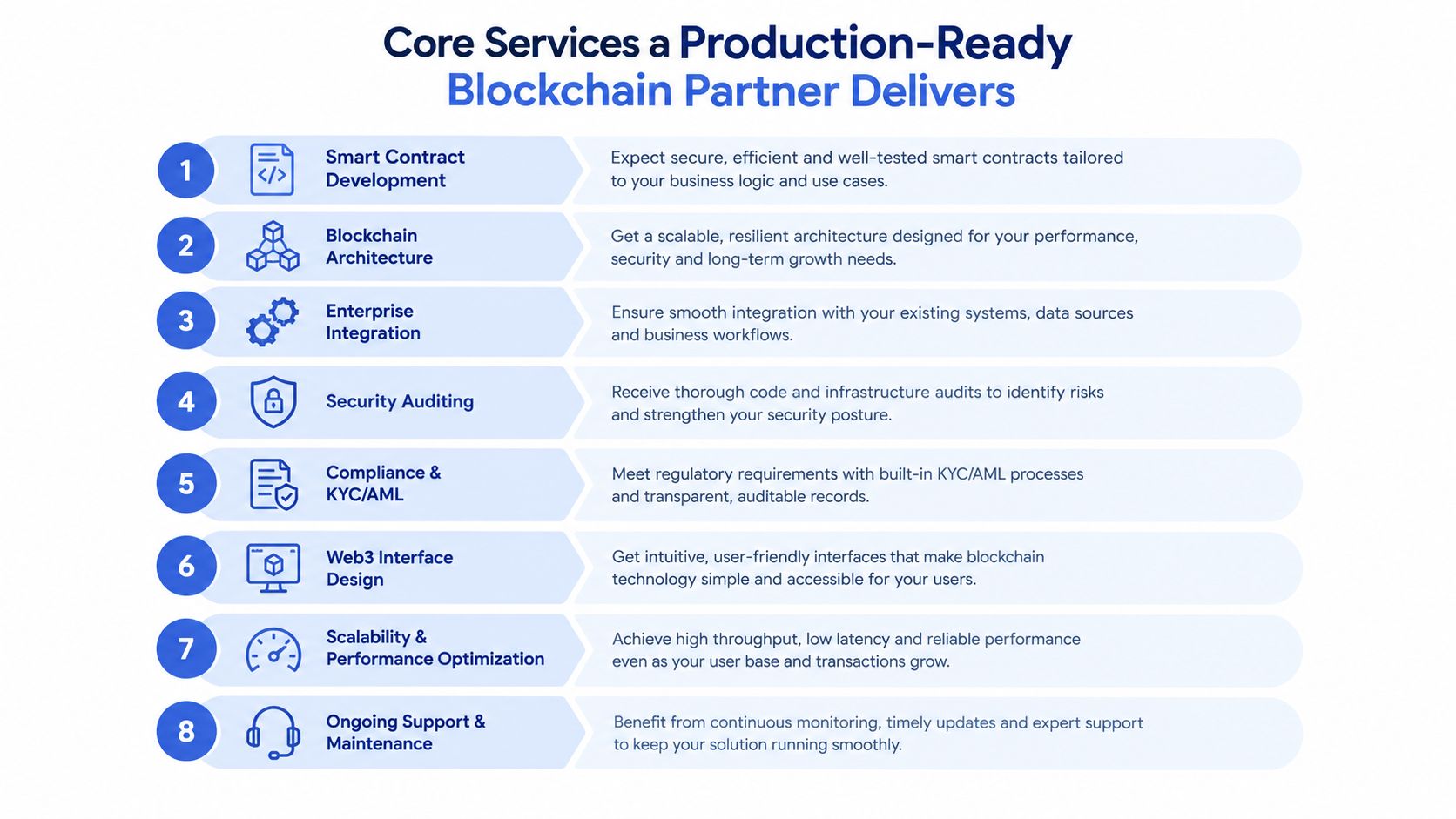
Eight layers to pressure-test
Smart contract engineering and audit preparation: Expect threat modelling, unit and integration tests, upgrade governance, access-control design, deployment scripts, and documentation prepared for independent review.
Tokenization architecture: The partner should explain why a token standard fits the asset and jurisdiction. Common technical choices include ERC-20, ERC-721, ERC-1155, ERC-3643, and ERC-1404, but standards alone don’t solve transfer restrictions, investor eligibility, redemption, or legal ownership.
Wallet and custody integration: Ask for signing flows, MPC or custody-provider integration where relevant, recovery procedures, treasury permissions, and clear separation between user wallets and operational wallets.
Indexers and data pipelines: A usable product needs dependable event ingestion, transaction reconciliation, searchable histories, reporting exports, and handling for chain reorganisations or failed transactions.
Oracles and off-chain computation: Market prices, identity checks, real-world events, and risk signals often sit outside the chain. The implementation should define data provenance, fallback behaviour, latency expectations, and manipulation controls.
KYC, AML, and compliance tooling: The vendor should connect identity checks, sanctions screening, wallet risk analysis, transaction monitoring, case management, and audit trails. AI-assisted compliance and RWA tokenization are becoming baseline expectations, not sufficient differentiators on their own.
Node, validator, and DevOps operations: Require deployment automation, secrets management, monitoring, alerting, backup procedures, release controls, and an incident runbook for the networks you’ll support.
Post-launch monitoring: Production ownership includes vulnerability response, contract and dependency monitoring, performance review, reconciliation checks, and a defined support path.
Teams comparing delivery models can also review nearshore software development services LATAM when deciding whether embedded regional engineering capacity suits the programme. For buyers seeking a documented service scope, custom blockchain development services cover public, private, and hybrid blockchain applications for enterprises, startups, and governments. The Blockchain Development offering is described in similar terms, with an emphasis on secure, scalable application delivery.
Quick Comparison of the Top 10 Blockchain Development Companies
The table is a filtering tool, not an objective league table. “Top” here means relevant firms worth evaluating for different production scenarios, not a verified claim that one provider is universally superior.
Top 10 Blockchain Development Companies at a Glance
| Company | Primary Focus | Core Services | Industries | Regions | Best Fit |
|---|---|---|---|---|---|
| Blocsys Technologies | Full-stack Web3 and digital assets | Blockchain, smart contracts, tokenization, trading infrastructure, compliance workflows | Fintech, exchanges, digital assets, enterprises | India, USA, UK, UAE, Singapore, global | Regulated digital-asset products needing integrated delivery |
| Consensys | Ethereum ecosystem development and tooling | Smart contracts, wallets, Ethereum infrastructure, Web3 applications | Finance, Web3, enterprise technology | Global | Ethereum-focused organisations |
| Polygon Labs | Ethereum scaling and ecosystem infrastructure | L2 architecture, developer tooling, integrations, Web3 applications | Finance, gaming, consumer technology | Global | Teams building around Polygon infrastructure |
| Chainlink Labs | Oracle and interoperability infrastructure | Data feeds, automation, cross-chain connectivity | Finance, markets, Web3, enterprises | Global | Applications requiring external data and messaging |
| OpenZeppelin | Smart contract security and standards | Contract libraries, security reviews, governance tooling | DeFi, tokenization, Web3 | Global | Security-sensitive contract programmes |
| Alchemy | Web3 developer infrastructure | APIs, node access, data, wallet and application tooling | Web3, gaming, consumer applications | Global | Product teams needing infrastructure APIs |
| ChainSafe | Protocol and Web3 infrastructure engineering | Protocol work, interoperability, wallets, dApps | Web3, infrastructure, gaming | Global | Custom protocol and cross-chain engineering |
| LeewayHertz | Enterprise blockchain and application development | Blockchain applications, smart contracts, tokenization, consulting | Supply chain, finance, government, enterprises | Global | Enterprise discovery through delivery |
| HashCash Consultants | Blockchain consulting and implementation | Enterprise blockchain, smart contracts, exchanges, tokenization | Finance, supply chain, healthcare, government | Global | Organisations seeking broad implementation support |
| RisingMax | Web3 and application development | dApps, wallets, exchanges, smart contracts, gaming | Startups, gaming, fintech, Web3 | Global | Startup-led Web3 product builds |
Treat each row as a starting hypothesis. Verify the current scope, team composition, security process, and regional delivery model during procurement.
Blocsys Technologies Profile and Core Capabilities
Blocsys Technologies is positioned here as a full-stack Web3 engineering partner rather than a marketing-led vendor. Its relevant scope spans custom blockchain applications, smart contracts, tokenization, trading infrastructure, digital-asset platforms, and compliance workflows.
Custom blockchain and dApp engineering
Blocsys can support architecture decisions across EVM and non-EVM environments, including L1 and L2 selection, smart contract engineering, dApps, APIs, wallet connections, and enterprise integrations. That matters when the product needs more than a contract deployment. The team must connect on-chain state to identity, user interfaces, databases, custody, reporting, and operational controls.
For an enterprise, the key question is whether the architecture can support governance and audit requirements without making the user experience unusable. For a startup, it’s whether the same architecture leaves room for iteration without creating avoidable migration risk.
Tokenization for real-world and digital assets
Tokenization work can include RWA structures, security and utility token design, vesting logic, transfer restrictions, compliance-aware tokenomics, and lifecycle controls. Buyers should ask how the vendor represents the legal claim, verifies eligible participants, manages issuance and redemption, and records off-chain events.
The important distinction is between creating a token contract and creating a usable asset platform. A production system needs issuance workflows, investor or user onboarding, custody, reporting, permissions, and integration with the organisation’s existing operating model.
Trading and exchange infrastructure
Blocsys’s stated focus includes CEX and DEX components, order matching, liquidity integrations, wallet connectivity, and related digital-asset infrastructure. This is relevant to founders building spot trading, decentralised markets, cross-chain swaps, or capital-market products.
Trading systems demand careful separation of concerns. Matching, balances, settlement, risk limits, market data, custody, monitoring, and administrative controls must work together. A visually polished exchange interface isn’t evidence that the underlying ledger, wallet, and risk architecture is ready for production.
AI-powered compliance and embedded engineering
The compliance layer can include transaction monitoring, AML and KYC workflows, and risk scoring. Buyers should still ask which decisions remain explainable, how alerts are reviewed, what evidence is retained, and how regional rules are reflected in the system.
Blocsys also offers a staff augmentation model for organisations that need senior Solidity, Rust, and Go capability inside an existing team. That can suit enterprises in India, the US, UK, UAE, and Singapore that want to retain architecture ownership while adding specialist delivery capacity. The practical test is straightforward: request named roles, responsibility boundaries, code-review expectations, audit-readiness controls, and post-launch support terms.
Profiles of the Other 9 Blockchain Development Companies
2. Consensys
Consensys is closely associated with Ethereum development, Web3 tooling, wallets, and infrastructure. Its fit is strongest for teams whose product depends heavily on Ethereum-compatible standards, developer tooling, and ecosystem integration. Ethereum-native fintech products, wallets, and dApps should assess Consensys alongside independent security and compliance specialists where the programme is regulated.
3. Polygon Labs
Polygon Labs focuses on scaling and infrastructure within the Ethereum ecosystem. It suits organisations evaluating Polygon-based applications, L2 architecture, developer tools, and ecosystem integrations. Buyers should distinguish the network and ecosystem role from a traditional outsourced development company, then confirm who will own application engineering, security reviews, and operational delivery.
4. Chainlink Labs
Chainlink Labs is best known for oracle networks, automation, and cross-chain infrastructure. It fits applications that need dependable connections between smart contracts and external data, including financial markets and enterprise workflows. It isn’t a conventional end-to-end agency, so a buyer may need a separate product engineering team for the front end, backend, compliance console, and business operations.
5. OpenZeppelin
OpenZeppelin is a strong candidate for security-sensitive smart contract programmes, particularly where standardised libraries, contract design, governance, and security review matter. It fits DeFi, tokenization, and Web3 teams that want mature security practices around core contracts. It may not be the sole partner for a full exchange or enterprise platform, because application operations and broader systems integration can require additional specialists.
6. Alchemy
Alchemy provides Web3 infrastructure such as APIs, node access, data services, and developer tooling. It suits product teams that want to build applications without operating every underlying network connection themselves. Its role is primarily infrastructure, not a replacement for a delivery partner responsible for product architecture, smart contracts, user experience, compliance, and business integration.
7. ChainSafe
ChainSafe works across protocol engineering, interoperability, wallets, dApps, and Web3 infrastructure. It can be a useful fit for technically demanding protocol or cross-chain projects where the core challenge lies below the application layer. Founders should clarify the intended split between research, protocol work, product development, security assurance, and long-term maintenance.
8. LeewayHertz
LeewayHertz operates around enterprise blockchain consulting and application development, including smart contracts, tokenization, and business process implementations. It may suit organisations that need discovery, architecture, and delivery support across a broader enterprise programme. Procurement teams should validate which engineers will deliver the work and how the firm handles independent audits, ownership, and support.
9. HashCash Consultants
HashCash Consultants covers blockchain consulting and implementation across areas such as enterprise systems, exchanges, smart contracts, and tokenization. Its breadth can appeal to businesses still defining their use case or comparing permissioned and public architectures. Buyers should narrow the statement of work early and test depth in the specific chain, custody model, compliance regime, and operating environment they intend to use.
10. RisingMax
RisingMax focuses on Web3 application delivery, including dApps, wallets, exchanges, smart contracts, and blockchain gaming. It can suit startups that need a broad product build and want one vendor to cover user-facing features. Founders should insist on a security plan, clear contract ownership, production monitoring, and evidence that the proposed team can support the product beyond launch.
The buyer-risk lesson is consistent across all nine: a recognisable capability doesn’t automatically make a firm the right production partner. Match the vendor’s actual role to the part of the system you need to own.
How to Evaluate a Blockchain Development Company
Use the shortlist to create a controlled procurement process, not to outsource judgement. Ask every candidate for evidence, named responsibilities, and an explanation of the trade-offs behind its proposed architecture.
Seven selection criteria
Production evidence: Request shipped mainnet code, relevant audit reports, incident procedures, and evidence of live operational ownership. A testnet demonstration proves far less than a maintained production system.
Technical depth: Map the project’s needs to Solidity, Rust, Go, Cairo, EVM networks, non-EVM networks, indexers, custody systems, and backend services. Don’t accept a generic “full-stack” label without named engineers and examples of the relevant work.
Security process: Ask for threat modelling before implementation, internal review before an external audit, remediation tracking, upgrade controls, formal verification partners where appropriate, and post-deployment monitoring.
Compliance readiness: Define the target jurisdictions and obligations early. For India, VDAs are treated as reporting entities under PMLA, exchanges must directly report transaction-level VDA data to the Income Tax Department from 1 April 2026, and FIU-IND registration and stronger AML/KYC expectations apply to platforms serving Indian users, as summarised in this India crypto regulation overview. For European operations, ask how the design supports MiCA-related reporting. For cross-border products, discuss FATF travel rule workflows and regional licensing boundaries.
Architectural judgement: Ask why the proposed chain, L2, rollup, appchain, bridge, or modular design fits the workload. Require gas modelling, failure assumptions, interoperability risks, data availability considerations, and an exit or migration plan.
Team stability: Review senior-to-junior ratios, retention, code-review ownership, escalation paths, and who remains after launch. A strong sales team won’t rescue a rotating engineering bench.
Commercial clarity: Put IP ownership, repository access, code escrow, acceptance criteria, service levels, audit responsibilities, support hours, and post-launch fees in writing.
Walk away when: The vendor promises guaranteed outcomes, refuses to name engineers, treats an audit as a substitute for secure development, can’t explain key management, or offers a fixed scope before understanding the regulatory and operational model.
For a broader partner-selection perspective, review Blocsys’s blockchain consulting guidance. The strongest proposals won’t merely list technologies. They’ll show how technical choices reduce operational, security, and compliance exposure.
Blockchain Development Trends Shaping 2027
Vendor selection is moving toward regulatory-ready engineering. India’s blockchain market reached USD 1,088.0 million in 2025 and is forecast to reach USD 85,107.3 million by 2034, implying a 60.45% CAGR during 2026 to 2034, according to IMARC’s India blockchain market research. That projection signals expanding demand for enterprise implementation, but buyers still need to separate production capability from prototype volume.
India has also been identified as the number one country globally for blockchain adoption for three consecutive years. Research on public-sector deployments identified more than 40 initiatives, with around 92% in pilot mode and about 8% in production, while nearly half of Indian states had initiated blockchain projects, as reported in this Business Standard release on India’s Web3 ecosystem. The implication for 2027 buyers is direct: converting pilots into dependable operations may matter more than producing another demonstration.
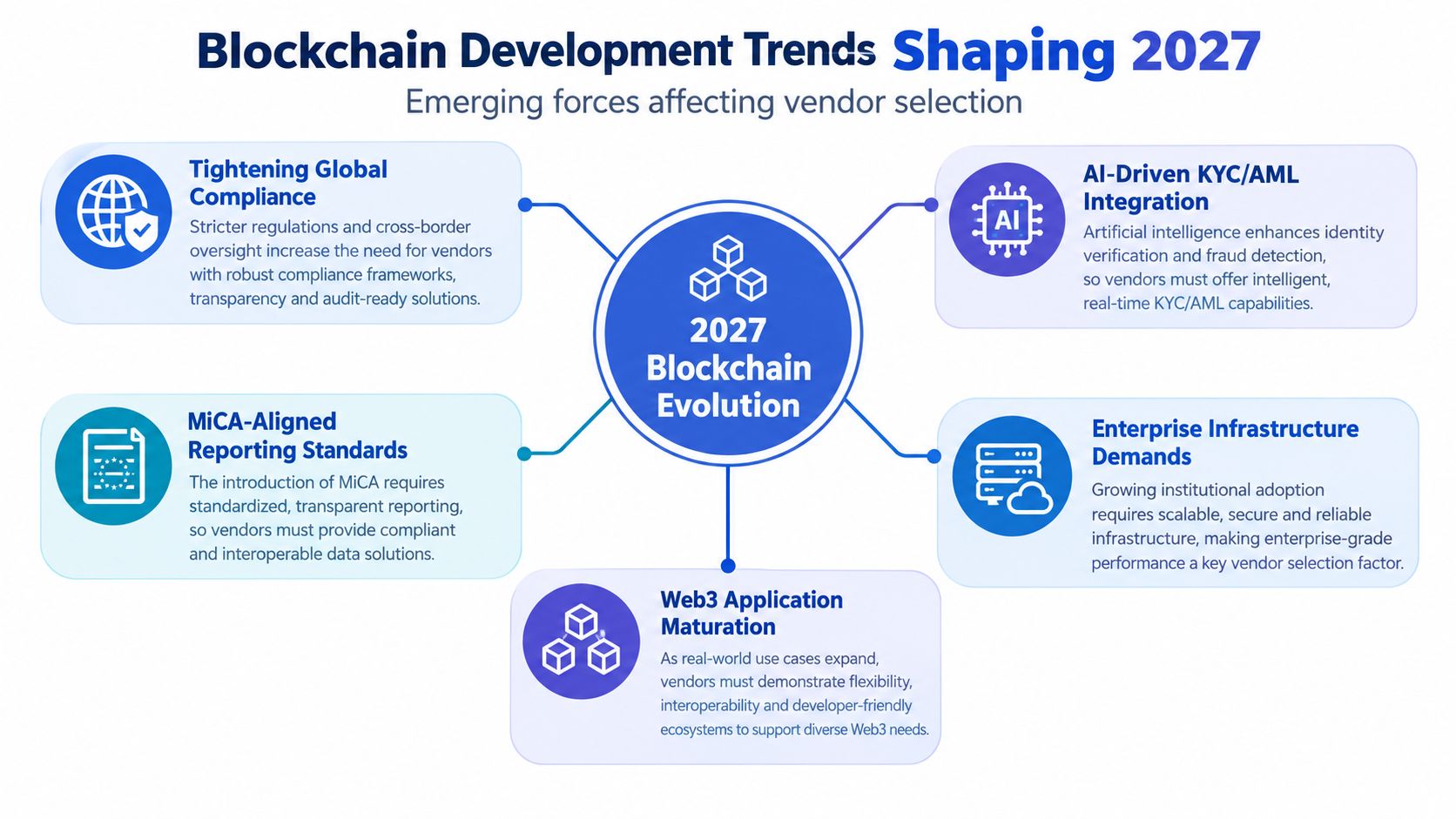
Five forces changing the shortlist
- Compliance becomes architecture: KYC, AML, reporting, sanctions screening, wallet risk, and audit trails need to be designed into the product.
- RWA tokenization becomes operational: Tokenising securities, commodities, real estate, trade claims, or inventory requires identity, legal rights, transfer controls, and lifecycle management.
- AI connects to on-chain execution: Oracles and off-chain computation can support adaptive decisions, but teams need explainability, data controls, human review, and fail-safe behaviour.
- Modular systems become normal: L2s, appchains, cross-chain messaging, and shared sequencing can improve design flexibility while adding new trust and operational assumptions.
- Governance outranks launch speed: Banks, governments, and large retailers need access policies, auditability, security response, and accountable ownership.
The blockchain trends analysis from Blocsys provides additional context for teams planning beyond a single application release. In 2027, the strongest development partner will be the one that can explain both the upside and the failure mode of each architectural choice.
Why Blocsys and How to Engage
Blocsys combines production-oriented tokenization, trading infrastructure, AI-powered compliance, and senior engineering capacity through flexible staff augmentation. That makes it relevant to startups seeking a focused build and enterprises that need audit-ready delivery across India, the US, UK, UAE, and Singapore.
Start with a discovery call, follow it with an architecture review, define a scoped pilot, then agree the full delivery and operating model. Organisations that need embedded expertise can also review Blocsys’s dedicated blockchain engineering team approach. Bring the intended markets, asset model, chain preferences, compliance obligations, and launch constraints to the first conversation.
Frequently asked questions
What are the top blockchain development companies in 2027?
The top blockchain development companies in 2027 are a curated group of firms with different production strengths, including Blocsys Technologies, Consensys, Polygon Labs, Chainlink Labs, OpenZeppelin, Alchemy, ChainSafe, LeewayHertz, HashCash Consultants, and RisingMax. The right choice depends on whether you need full-stack delivery, Ethereum development, infrastructure, smart contract security, tokenization, interoperability, or application engineering.
What do blockchain development services include?
Blockchain development services can include architecture, smart contracts, dApps, tokenization, wallets, custody integrations, indexers, oracles, APIs, compliance workflows, node operations, security testing, deployment, monitoring, and maintenance. A complete scope should identify who owns each layer and how the system will operate after launch.
What does enterprise blockchain development involve?
Enterprise blockchain development involves connecting blockchain networks to identity, governance, existing business systems, reporting, access controls, custody, data pipelines, and operational support. It may use public, private, or hybrid networks, depending on the organisation’s privacy, interoperability, performance, and compliance requirements.
How much does blockchain development cost?
Blockchain development costs vary according to the number of applications, contract complexity, supported networks, custody model, integrations, compliance requirements, security assurance, and post-launch support. A credible provider should produce a discovery-led scope and separate build costs from audits, infrastructure, third-party services, and ongoing operations.
How long does blockchain development take?
A blockchain project’s timeline depends on architecture, user journeys, smart contract scope, integrations, audits, regulatory review, and production-readiness requirements. A simple application may have a shorter path than a tokenization or exchange platform, but the schedule should include testing, security remediation, deployment preparation, and operational handover.
Which technologies do blockchain development companies use?
Common technologies include Solidity, Rust, Go, Cairo, EVM and non-EVM networks, L1s, L2s, rollups, appchains, smart contract libraries, indexers, APIs, wallets, custody systems, oracles, and cloud infrastructure. The best stack is determined by the product’s security, data, performance, interoperability, and governance needs.
What should a smart contract development partner deliver?
A smart contract development partner should deliver a tested contract system, threat model, access-control design, deployment process, upgrade policy, documentation, audit preparation, and remediation support. The scope should also explain how contracts interact with wallets, front ends, backend services, oracles, and compliance controls.
What does Web3 development include beyond smart contracts?
Web3 development includes wallet onboarding, dApps, account and identity flows, transaction handling, indexers, backend services, APIs, token management, governance, analytics, custody connections, and operational monitoring. Smart contracts are only one component of a usable Web3 product.
How do you evaluate a blockchain development company?
Evaluate production evidence, technical depth, security procedures, compliance readiness, architecture decisions, team stability, commercial terms, and post-launch ownership. Ask for named engineers, relevant repositories or audit evidence where available, clear deliverables, support terms, and an explanation of the risks in the proposed design.
How do you choose a blockchain development partner?
Choose a partner whose documented strengths match your highest-risk requirement, whether that’s tokenization, exchange infrastructure, smart contract security, interoperability, enterprise integration, or compliance. Start with a discovery and architecture review, then use a scoped pilot to test communication, code quality, decision-making, and delivery discipline before expanding the engagement.
Blocsys Technologies offers blockchain development, smart contracts, tokenization platforms, digital-asset and trading infrastructure, Web3 applications, and AI-powered compliance workflows for organisations moving beyond prototypes. Visit Blocsys Technologies to discuss your architecture, delivery requirements, and next production step.
