
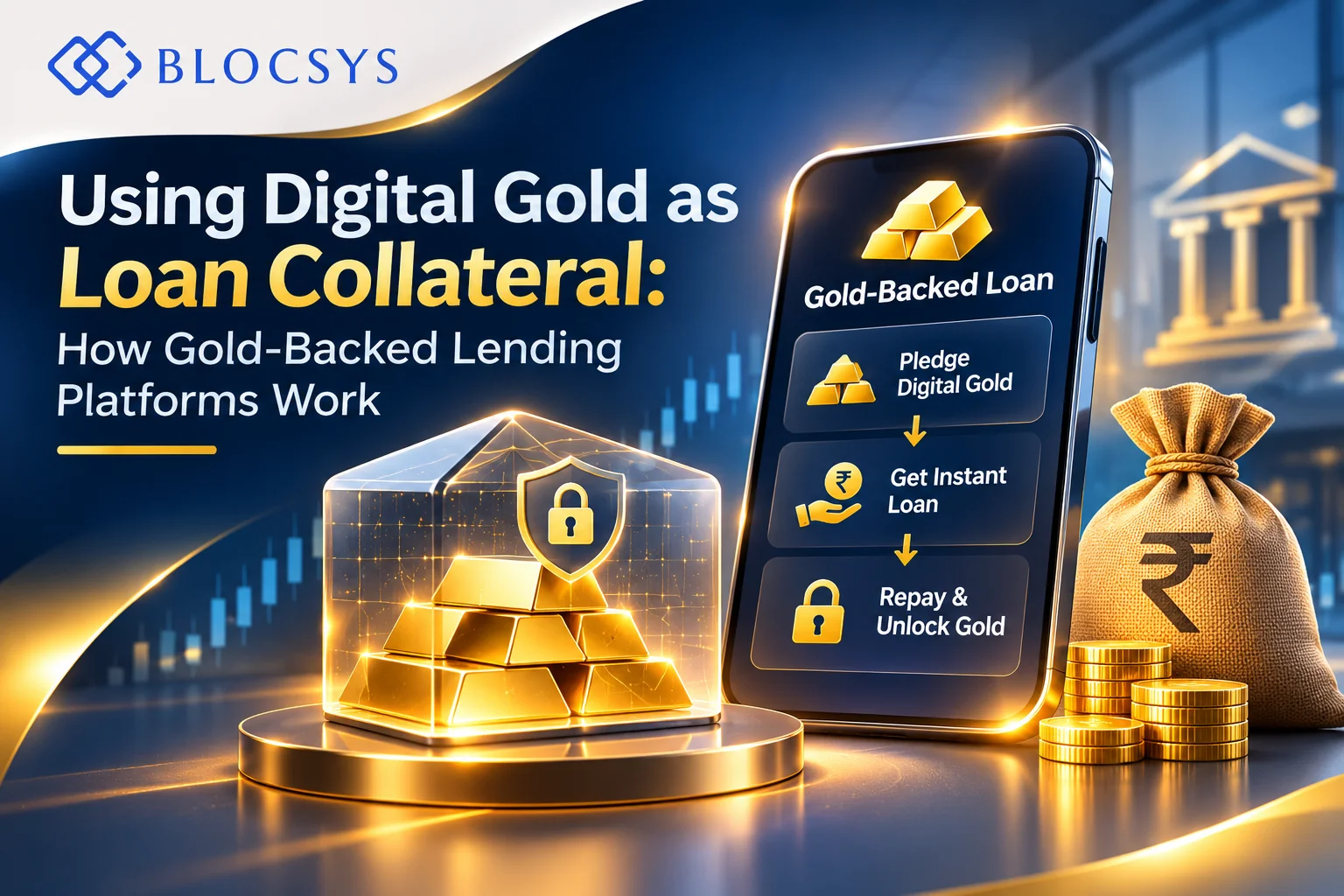
Using Digital Gold as Loan Collateral: How Gold-Backed Lending Platforms Work
Gold has backed loans for centuries. Walk into any Indian town and you’ll find a gold loan counter at the local NBFC branch. Now digital gold is entering that conversation, and lenders are asking a new question: can digital gold as loan collateral actually work in practice? The short answer is “sometimes, under the right structure.” Unlike physical gold loans, where you hand over jewellery or coins to a lender’s vault, digital gold-backed loans depend on ownership records, custody arrangements, and legal agreements that connect a digital certificate to real, vaulted metal. This article explains how that connection works and what fintech teams, banks, and digital gold loan platform builders need to think through. If you’re exploring this space, digital gold and silver app development is where the technology groundwork typically starts.
What Is Digital Gold Collateralization?
Digital gold collateralization means pledging your digital gold holdings as security for a loan, instead of selling them outright. You still own the underlying grams of gold. However, a lien gets placed against that ownership record until you repay what you borrowed.
This differs from simply holding digital gold in an investment account. An investment holding sits free and clear — you can sell it anytime. Once pledged, that same holding gets locked. You can’t transfer or redeem it until the loan closes.
Not every digital gold platform supports this. Many digital gold apps are built purely for buying, selling, and redeeming gold, with no lending layer attached. Digital gold collateralization only works when a platform has built the pledge, lien, and custody infrastructure, and found a lender willing to accept that digital record as valid security.
The gap between “owning digital gold” and “pledging digital gold” is entirely legal and operational — not technical. Blockchain can record a pledge instantly, but a lender won’t disburse a rupee until their legal team confirms the lien actually holds up in a default scenario.
How Gold-Backed Lending Platforms Work
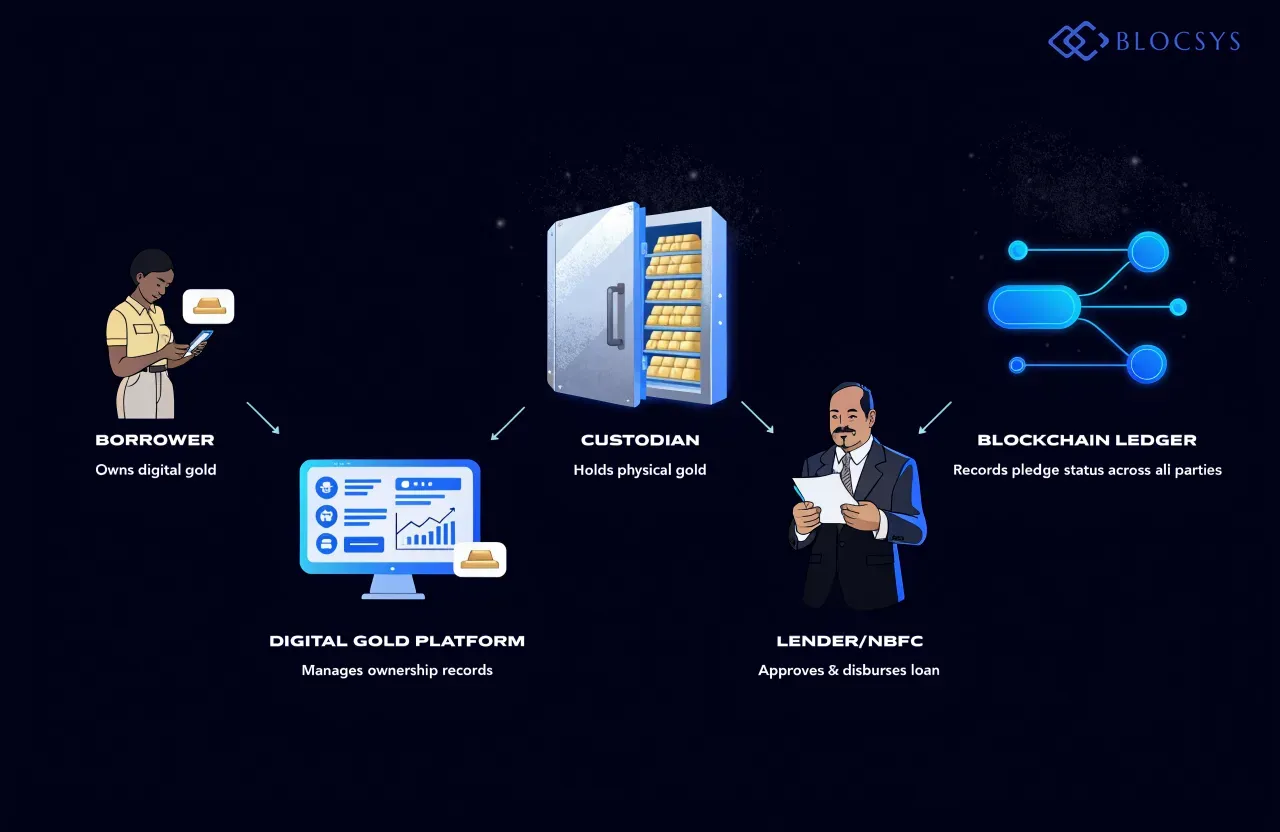
A typical digital gold loan platform brings together several parties. First, there’s the borrower, who owns digital gold and wants cash without liquidating the asset. Second, there’s the lender — a bank, NBFC, or fintech lending partner — who actually disburses funds and bears the credit risk.
Third, the digital gold platform itself sits in the middle, managing ownership records and facilitating the pledge workflow. Fourth, a custodian or vaulting partner holds the physical gold that backs every digital gram. Finally, in many markets, a trustee or escrow arrangement may exist to protect everyone if the platform itself runs into trouble.
These parties work together through contractual agreements, not assumption. The platform doesn’t automatically become a lender; it typically partners with or refers borrowers to licensed lending institutions. Consequently, gold-backed lending platforms often function as technology and distribution layers, while regulated entities handle actual credit decisions and disbursement. In India, for instance, RBI’s regulatory framework for NBFCs and gold loan companies governs who can legally lend against gold-type collateral — a digital gold platform can’t bypass that by calling itself a “lending platform.”
How Customers Can Use Digital Gold to Obtain Loans
Here’s roughly what a customer journey might look like on a gold-backed lending platform, illustrated for context rather than as a fixed standard.
- The customer checks which digital gold holdings are eligible for pledging — not all gold accounts qualify automatically.
- They submit a loan request specifying the amount needed against a certain quantity of gold.
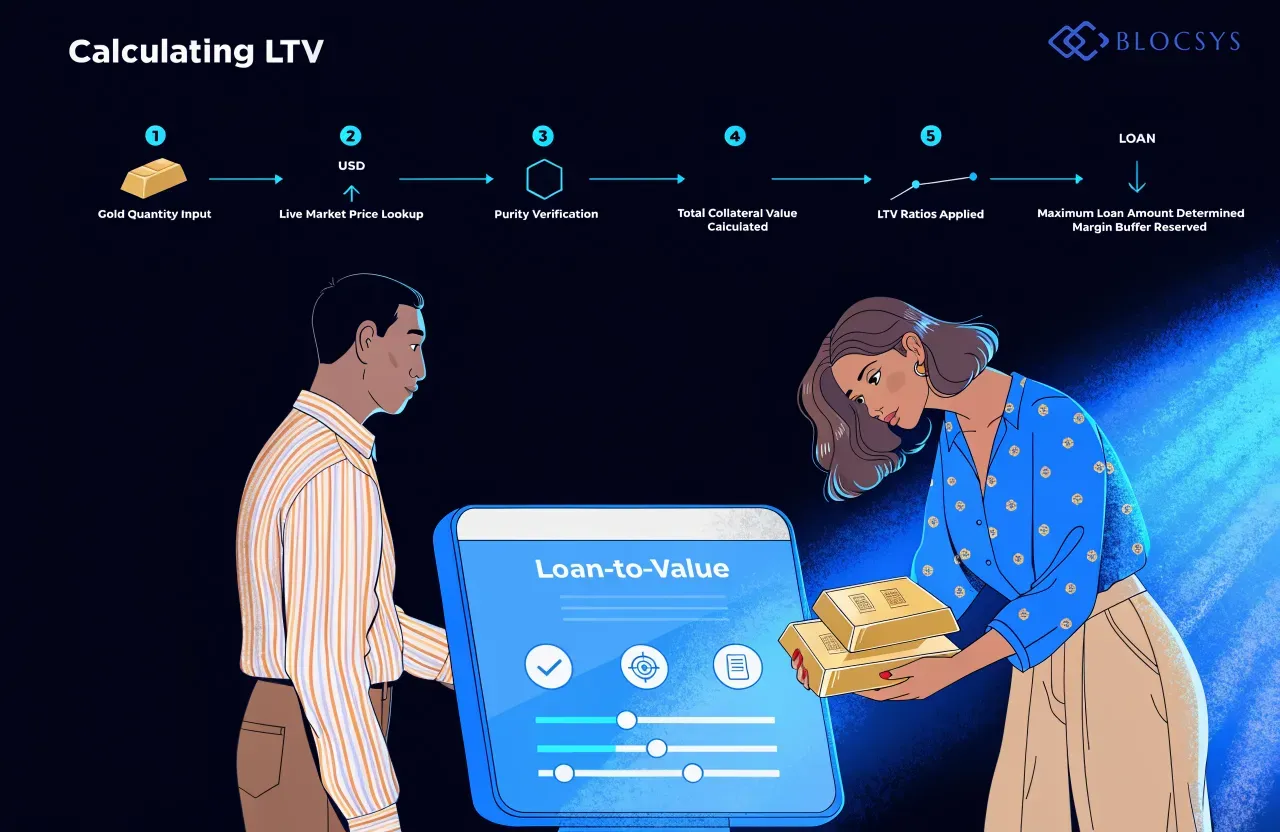
- The platform runs a gold valuation using live market rates and purity data.
- Based on valuation, the system calculates loan eligibility using the applicable LTV ratio.
- The customer reviews loan terms, interest rate, and tenure, then agrees to pledge their holdings.
- Collateral gets locked, a lien gets marked, and the lender approves disbursement.
- Funds get transferred to the customer’s bank account, typically within hours rather than days.
- During the loan tenure, the customer repays through EMIs or a bullet payment, depending on the loan structure.
- Once repayment is complete, the lien lifts and the pledged holdings release back to free ownership.
Every step here depends on tight integration between the digital gold loan platform and the lender’s loan management system. Without that integration, you end up with manual reconciliation, delayed disbursements, and frustrated customers.
How Lenders Determine the Value of Digital Gold Collateral
Gold collateral valuation starts with the live market price of gold, usually benchmarked against rates published by recognized bullion associations or exchanges. Purity matters too — digital gold is typically sold at 24K/99.9% purity, which simplifies valuation compared to jewellery loans where purity varies.
Lenders then apply a Loan-to-Value ratio, which caps how much they’ll lend against the collateral’s market value. For traditional gold loans in India, RBI guidelines have historically capped LTV for gold jewellery loans around 75%, though this figure has shifted over time and lenders should always confirm current regulatory limits directly with RBI publications rather than relying on older figures.
Here’s a simple illustrative example. Say a customer holds 50 grams of digital gold valued at ₹6,500 per gram, totaling ₹3,25,000. If a lender applies a 70% LTV — purely illustrative, not a fixed rule — the maximum loan amount would be roughly ₹2,27,500. Actual LTV ratios depend entirely on the lender’s risk policy, the jurisdiction’s regulations, and the specific loan product.
Gold price fluctuations complicate this further. If gold prices drop after disbursement, the collateral value falls below the safe margin. That’s why many lenders build in margin calls or additional collateral requirements, similar to how margin trading works in equity markets.
The Role of Pledging, Lien Marking and Collateral Locking
Once a borrower agrees to loan terms, the platform needs to pledge digital gold formally. This isn’t just a status flag in a database. It’s a legally meaningful lien marking that restricts the borrower from selling, transferring, or redeeming that gold while the loan remains outstanding.
Collateral locking typically works at the system level. The pledged quantity gets ring-fenced within the customer’s account, and any attempt to sell or transfer that portion gets blocked automatically. Meanwhile, the lender gets visibility into the pledge status through a dashboard or system integration, so they know the security interest is actively enforced.
However, locking a digital record alone doesn’t create a legally enforceable security interest. That requires a proper pledge agreement, often registered or documented per applicable law, specifying the lender’s rights if the borrower defaults. Platforms sometimes assume the technology layer alone establishes legal protection — it doesn’t. Legal counsel needs to structure the pledge agreement, custody terms, and enforcement rights separately from the software that tracks them.
How Blockchain Supports Digital Gold Collateral Tracking
Blockchain earns its place in this workflow through transparency, not magic. Every digital gold loan platform needs a reliable, tamper-resistant way to track ownership, pledge status, and transaction history — and blockchain can genuinely help with that.
Specifically, blockchain can record each unit of digital gold with a unique identifier tied to vaulted inventory. When a customer pledges gold, that pledge event gets recorded immutably, creating an auditable trail showing exactly when collateral got locked, by whom, and against which loan.
Additionally, blockchain collateral tracking supports real-time reconciliation between the digital gold platform and the lender. Instead of end-of-day batch reports, lenders can query pledge status instantly. This matters a lot during collateral monitoring — if gold prices drop and a margin call becomes necessary, faster data means faster action.
Still, blockchain records don’t replace legal ownership documentation. A blockchain entry shows what happened on the platform; it doesn’t automatically establish a legal security interest recognized by courts. Therefore, platforms need blockchain-based digital ownership records working alongside, not instead of, proper legal agreements.
What Happens When a Borrower Repays or Defaults on a Loan?
When a borrower repays in full, the lien lifts and pledged gold returns to free, transferable status. Good platforms automate this collateral release immediately upon final payment confirmation, rather than making customers wait days for manual processing.
Partial repayments sometimes allow partial collateral release too, though this depends heavily on the specific loan product’s terms.
Default scenarios are trickier. If a borrower misses payments beyond an agreed grace period, the lender typically gains rights to liquidate the pledged gold to recover the outstanding amount. Gold liquidation usually happens at prevailing market rates, with any surplus after loan settlement returned to the borrower.
These default handling procedures must be spelled out clearly in the loan agreement — not assumed from platform behavior. Moreover, applicable consumer protection regulations in each jurisdiction may dictate notice periods, grace windows, and liquidation procedures before a lender can act. A digital gold loan platform’s default management workflow needs to mirror whatever its legal agreements and local regulations actually require, which varies significantly between India, the UAE, Singapore, and Western markets.
What Are the Risks of Using Digital Gold as Loan Collateral?
Gold price volatility sits at the top of this list. A sudden price drop can push an existing loan above safe LTV thresholds, exposing lenders to under-collateralized positions. Consequently, robust collateral monitoring systems that track price movement in near real-time become essential, not optional.
Custody risk matters just as much. If the vaulting partner holding physical gold faces operational failure, fraud, or insolvency, every digital gold holding built on that custody arrangement is affected.
Ownership disputes can arise too, particularly if pledge records and legal agreements aren’t tightly synchronized. Unauthorized transfers present another concern — a system bug that fails to lock collateral properly could let a borrower transfer “pledged” gold elsewhere, leaving the lender without real security.
Regulatory uncertainty adds further complexity. Digital gold itself isn’t uniformly regulated across India, the UK, USA, UAE, Singapore, Germany, Canada, and Australia. Some jurisdictions treat it as a commodity purchase; others may view gold-backed lending arrangements through securities or consumer credit lenses. Therefore, a platform expanding across these markets needs separate legal review for each jurisdiction rather than assuming one compliance approach fits all.
What Makes Digital Gold Eligible for a Loan?
Essential Features of a Digital Gold Lending Platform
Building a functional digital gold collateral management system requires several interconnected components.
- Customer account management with KYC and eligible holdings verification
- Real-time gold valuation feeds tied to market pricing
- LTV ratio calculation engines configurable by lender policy
- Pledge and lien marking workflows with automated collateral locking
- Blockchain-based ownership and transaction records for auditability
- Lender dashboards showing portfolio-wide collateral monitoring
- Loan application, approval, and disbursement workflow integration
- Repayment tracking and automated collateral release triggers
- Notification systems for margin calls, due dates, and default warnings
- Reporting tools for compliance, audit, and regulatory submissions
- APIs for lending system integration with existing bank or NBFC core systems
Skipping any of these creates operational friction later. A platform without proper lending system integration, for instance, forces manual reconciliation between the digital gold ledger and the lender’s loan book — a recipe for errors at scale.
What Should Lenders Consider Before Accepting Digital Gold as Collateral?
Banks, NBFCs, and fintech companies considering this model need to start with partnerships, not code. Who’s the lending entity — does the digital gold platform partner with an existing licensed lender, or does it need its own lending license? In most markets, the latter is a significant regulatory undertaking.
Custody arrangements need equal attention. Which vaulting partner holds the physical gold, and what legal structure connects that custody to the digital ownership record? Additionally, collateral eligibility rules must be defined upfront — minimum pledge quantities, purity standards, and which customer accounts actually qualify.
System integration planning matters too. A bank’s existing loan management system wasn’t built for digital gold collateral, so middleware or API layers typically need custom development.
Operational planning should cover staffing for collateral monitoring, customer support for pledge-related queries, and clear escalation paths for default scenarios. Teams exploring AI-powered loan application intelligence alongside this model often find it helps streamline eligibility checks and risk scoring during the loan approval stage.
How Blocsys Helps Businesses Develop Digital Gold Platforms
Blocsys Technologies Pvt. Ltd. works with businesses building digital gold and silver platforms, handling the blockchain integration, ownership record architecture, and transaction management that sits underneath these products. For companies exploring gold-backed lending platform development, having solid platform infrastructure first matters — collateral workflows depend on accurate, well-structured ownership data.
Through digital gold and silver app development, Blocsys builds the account management, transaction tracking, and blockchain-based record-keeping that a lending-ready platform needs as its foundation. This kind of infrastructure can support future lending-related workflows, provided the business pairs it with proper legal agreements and lender partnerships. Blocsys also brings experience from related domains like blockchain document verification systems, which overlaps meaningfully with the auditability needs of collateral tracking.
If you’re planning a digital gold loan platform or exploring digital gold lending platform development, it’s worth discussing your specific business model and technology requirements with a team that’s built this infrastructure before. Blocsys can walk through what’s technically feasible for your use case.
Conclusion
Digital gold as loan collateral isn’t a universal feature — it’s a capability that exists only where legal structure, lender acceptance, custody arrangements, and technology all align. When they do, borrowers get a genuinely useful alternative to selling gold outright during a cash crunch, while lenders gain a liquid, transparent form of security.
Getting there means treating collateral eligibility, gold collateral valuation, pledge management, and blockchain-based tracking as equally important pieces, not just technical afterthoughts. Gold loan collateral arrangements built on digital gold require the same legal rigor as any traditional gold loan — arguably more, given how new this model still is across most markets.
If your business is evaluating gold-backed lending platform development or needs a stronger digital gold collateral management foundation, start with digital gold and silver app development and build the lending workflow from solid ground up.
Frequently Asked Questions
Here are direct answers to the questions we hear most often about digital gold as loan collateral.
Can digital gold be used as loan collateral?
Yes, but only on platforms specifically built for it, with a lender willing to accept the arrangement. Not every digital gold holding or platform supports this by default.
How does a digital gold-backed loan work?
You pledge a portion of your digital gold holdings, the platform locks that collateral, and a lender disburses funds based on its calculated value. Repayment releases the pledge.
How do lenders calculate the LTV ratio for digital gold loans?
Lenders value the pledged gold at current market rates, then apply a maximum lending percentage based on their own risk policy and applicable regulatory limits.
How is digital gold pledged against a loan?
The platform marks a lien against the specified quantity, restricting sale or transfer, while the lender records the pledge as active security for the loan.
What is collateral locking in a digital gold lending platform?
It’s the system-level restriction that prevents a borrower from selling or moving pledged gold until the loan is fully repaid or otherwise settled.
How can blockchain track pledged digital gold?
Blockchain records each pledge event, ownership change, and collateral movement as an immutable entry, giving lenders and platforms a shared, auditable history.
What happens to digital gold collateral after loan repayment?
The lien lifts, and the pledged gold returns to free, transferable status in the borrower’s account, typically processed automatically upon final payment.
What happens if a borrower defaults on a digital gold-backed loan?
The lender generally gains the right to liquidate the pledged gold at market rates to recover the outstanding balance, per the loan agreement’s terms.
Do Banks and NBFCs Accept Digital Gold as Collateral for Loans?
Some do, depending on their internal policy, legal structure, and regulatory environment. It’s not a universal practice yet, so acceptance varies by lender and jurisdiction.
What Features Should a Digital Gold-Backed Lending Platform Include?
Core needs include ownership records, real-time valuation, LTV calculation, pledge and lien management, blockchain tracking, and integration with the lender’s loan management system.
Ready to move beyond theory and build an intelligent platform that delivers real-world value? Blocsys Technologies specialises in engineering enterprise-grade AI and blockchain solutions for the fintech, Web3, and digital asset sectors. Connect with our experts today to discuss your vision and chart a clear path from concept to a secure, scalable reality.
