KYC Integration in Digital Gold Apps: Customer Verification and Onboarding
If you’re building a digital gold or silver platform, customer trust starts long before the first purchase. It starts the moment someone signs up. KYC integration in digital gold apps is what turns a simple registration form into a verified, accountable customer relationship. Without it, you’re letting unknown users transact on a platform built around a regulated commodity, and that’s a risk most serious gold businesses can’t afford to take.
Jewellers, bullion dealers, and fintech founders exploring digital gold and silver app development often assume KYC is a single checkbox feature. It isn’t. It’s an architecture decision that touches your backend, your third-party vendors, your data policies, and your customer experience all at once. Let’s break down how it actually works.
Introduction – Why KYC Integration Matters in Digital Gold Apps
Digital gold apps let customers buy, store, and sell gold or silver in small denominations, often starting from a few rupees. That accessibility is the whole appeal. However, it also means platforms need a reliable way to confirm who’s actually behind each account before enabling purchases, withdrawals, or physical delivery.
Customer verification plays a direct role in account security. It reduces the chances of fraudulent sign-ups, duplicate accounts, and unauthorised transactions. Consequently, it protects both the business and the genuine customer.
A digital gold platform without proper identity verification isn’t lightweight — it’s just exposed. The moment real money and real metal are involved, verification stops being optional and becomes operational infrastructure.
Compliance obligations also shape why verification matters. Depending on your business model, operating entity, and the regulated partners you work with, specific identification and reporting requirements may apply. We’ll address this in detail later, but it’s worth stating upfront: not every digital gold business carries identical KYC obligations.
What Is KYC Integration and How Does It Work?
KYC integration is the technical process of connecting a digital gold app with an identity verification service so that customer-submitted details get checked against authoritative records. In simple terms, your app collects information, sends it to a verification provider through an API, and receives a verified or rejected response back.
This is different from basic registration. A basic sign-up only asks for a name, email, and password. Mobile number verification adds a layer by confirming a working phone number through an OTP. Identity verification goes further, checking whether submitted documents or ID numbers genuinely belong to the person applying. Formal KYC combines several of these checks together, often with document validation, to meet a defined compliance standard.
Here’s the distinction that matters for product planning: registration confirms a person exists. KYC confirms who that person is. Digital gold app KYC integration sits precisely at that second layer, and getting the architecture right determines how smoothly customers move from sign-up to active account.
How Customer Onboarding Works in a Digital Gold Application
Customer onboarding in digital gold apps typically follows a sequence: registration, OTP verification, identity submission, document checks, and account activation. Each stage adds a bit more trust before the customer gets full platform access.
A Practical Onboarding Example
Picture a customer named Priya downloading a gold savings app. She registers with her mobile number and receives an OTP to confirm it’s genuinely hers. Next, she enters her PAN details and uploads a photo ID. The app sends this data to a verification API in the backend. Within moments, a response comes back: verified, pending, or rejected.
If verified, Priya’s account activates and she can start buying gold immediately. If the verification is pending, she sees a status screen with an estimated wait time. If rejected, say her uploaded document was blurry, she receives a clear reason and a resubmission option, rather than a dead end.
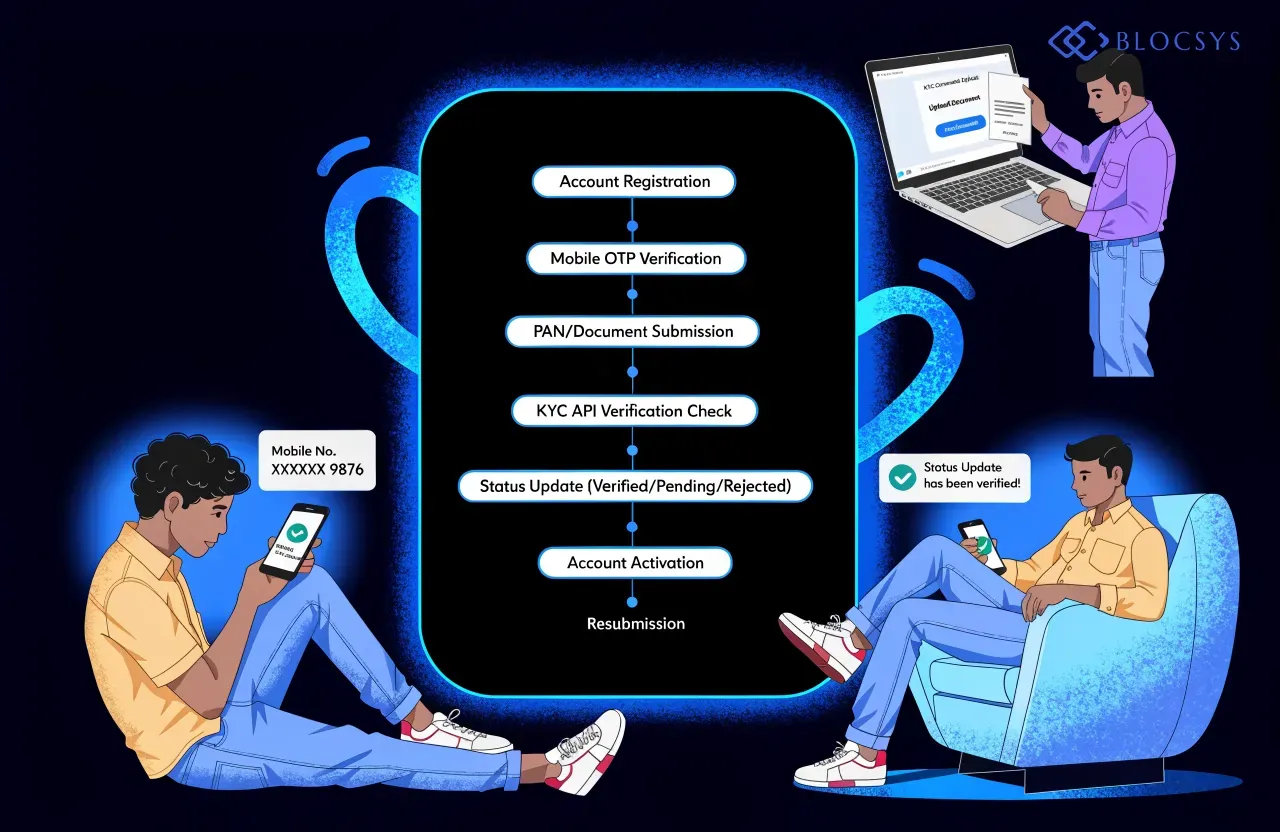
This layered approach means customers aren’t blocked at the door. Instead, they progress naturally, and the app only restricts higher-value actions, like large purchases or withdrawals, until full KYC verification in digital gold apps is complete.
Types of KYC Verification Methods Used in Digital Gold Apps
Several verification methods commonly appear in Indian digital gold applications, each serving a different purpose.
PAN Verification
PAN verification confirms that a submitted Permanent Account Number is valid and matches the name provided. It’s widely used for financial transactions above certain thresholds and helps establish a traceable identity link for tax and reporting purposes.
Aadhaar-Related Verification
Aadhaar-based verification can support identity checks, but access to Aadhaar authentication APIs is restricted under UIDAI regulations to specific authorised entities. A private digital gold app typically cannot connect directly to Aadhaar authentication unless it operates through a permitted intermediary or regulated partner. This is an important distinction, and businesses should confirm eligibility before assuming Aadhaar integration is available to them.
OTP Authentication and Document-Based Checks
OTP verification confirms mobile number ownership and is often the first verification layer. Document-based verification, meanwhile, involves uploading government-issued IDs for manual or automated review. None of these methods work in isolation; rather, they’re usually combined based on transaction limits and the risk profile of the customer.
Essential Features Required for KYC Integration
A well-built KYC system needs several supporting features working together, not just a single verification call.
- Structured customer information collection forms
- Secure document upload with format and size validation
- OTP-based mobile and email authentication
- Real-time verification status tracking
- Automated rejection notifications with clear reasons
- Resubmission workflows for corrected documents
- Admin dashboard for manual review of edge cases
- Verification history logs for audit purposes
Each of these pieces reduces friction for the customer while giving your operations team the visibility needed to manage exceptions. Without status tracking and resubmission, for instance, a single rejected document could permanently lose a customer.
KYC Integration Architecture for Digital Gold Applications
At its core, KYC integration architecture connects five components: the customer-facing app, your backend server, the KYC API provider, a verification engine, and your admin dashboard, all backed by a secure database.
Here’s how a typical request flows. The customer submits details through the app. The backend server, not the app directly, sends an authenticated API request to the KYC provider. The provider’s verification engine checks the data and returns a response. Your backend validates that response, updates the database, and triggers a status update visible to both the customer and your admin team.
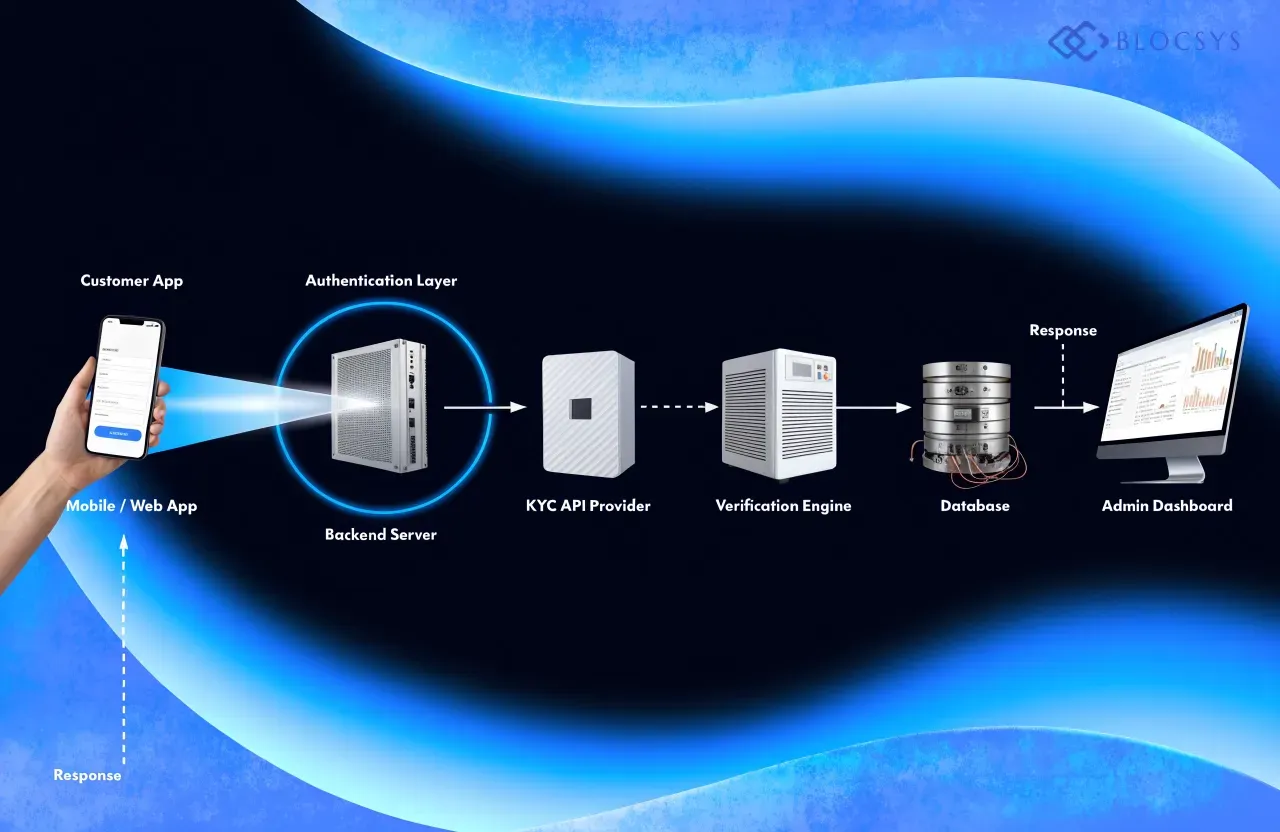
Why route everything through the backend instead of letting the app call the KYC provider directly? Because API keys, verification logic, and customer documents should never sit exposed in a public-facing frontend. A compromised app build could otherwise leak credentials or allow tampered requests. Keeping this layer server-side is a basic architectural safeguard, not an optional extra.
How Third-Party KYC APIs Connect with Digital Gold Apps
Third-party KYC APIs work by accepting structured customer data, such as PAN numbers or document images, authenticating the request using API keys or tokens, and returning a verification result, usually within seconds for automated checks.
When evaluating a KYC API integration services provider, look beyond just the price list. Check which verification methods they actually support, how clear their documentation is, what security certifications they hold, and whether their service is legally permitted for your business category. Some providers specialise in PAN and document checks only; others offer broader identity verification API coverage.
Integration itself generally involves registering as a client with the provider, receiving sandbox credentials for testing, building the API calls into your backend, and handling both success and failure responses gracefully. Testing thoroughly in sandbox mode before going live avoids costly surprises with real customer data.
How to Handle Failed, Pending and Rejected KYC Applications
Not every KYC verification in digital gold apps succeeds on the first attempt, and that’s normal. Common causes include mismatched names, blurry document scans, incomplete form fields, or expired identity documents.
When a verification fails, the app should explain why, in plain language, rather than showing a generic error. Pending cases need a visible status and realistic timelines so customers aren’t left guessing. For rejected applications, offer a direct resubmission path instead of forcing customers to start registration over from scratch.
Manual review also deserves a place in your workflow. Automated checks can’t catch every nuance, and your admin dashboard should let a human reviewer approve edge cases that machines flag incorrectly. This combination of automation and oversight keeps the onboarding process fair without slowing down the majority of straightforward cases.
Security and Data Privacy Requirements for KYC Integration
Customer verification data, PAN numbers, uploaded IDs, and personal details, is sensitive by nature. Protecting it requires encrypted data transmission, strict access controls, and secure storage for uploaded documents.
Consent management matters too. Customers should clearly understand what data is being collected, why, and how long it will be retained, before they submit anything. Data minimisation, collecting only what’s genuinely needed for verification, further reduces exposure if a breach ever occurs.
Audit logs that record who accessed what customer data, and when, support accountability within your team. Businesses operating in India should align their data handling with applicable data protection requirements and sector-specific obligations relevant to their operating entity. That said, strong security practices reduce risk; they don’t by themselves guarantee full regulatory compliance, which depends on your specific business structure and legal obligations.
How KYC Integration Improves the Digital Gold Customer Onboarding Experience
A thoughtfully designed verification flow doesn’t need to feel like a hurdle. Clear instructions at each step, honestly, go a long way. Tell customers exactly what document to upload and why.
Transparent status indicators, verified, pending, or action needed, reduce support queries because customers aren’t left wondering what’s happening. Timely notifications, whether by SMS or in-app alerts, keep people informed without them having to check manually.
Easy resubmission matters most when something goes wrong. If a customer uploaded the wrong document, letting them fix it in two taps beats forcing a full restart. These design choices won’t guarantee higher conversion on their own, but they do remove unnecessary friction from an otherwise serious process.
KYC Integration Services Offered by Blocsys
Blocsys works with businesses planning digital gold and silver applications, building the backend systems, mobile apps, and admin dashboards that support customer onboarding and verification workflows. This includes custom API integration work that connects your application with third-party KYC providers based on your specific project requirements.
Typical engagement areas include backend development for secure verification request handling, mobile and web application development for the customer-facing onboarding journey, and admin dashboard development for status management and manual review. Blocsys doesn’t provide KYC verification services directly or claim partnerships with specific identity verification vendors; instead, the focus is on building the application layer that integrates with whichever compliant provider your business selects.
For businesses exploring Blockchain Document Verification System for Secure Digital Proof, there’s also scope to combine document authenticity checks with your onboarding flow, depending on project needs.
How Much Does KYC Integration Cost in a Digital Gold App?
KYC integration costs break down into two separate buckets: software development costs and third-party provider charges. These shouldn’t be confused with one another when budgeting.
Development costs depend on backend complexity, the number of verification methods supported, admin review tooling, and security requirements like encryption and access control layers. Third-party provider charges, on the other hand, are usually billed per verification call or through monthly volume slabs, and vary by vendor and verification type.
Additional cost factors include document storage infrastructure, ongoing API maintenance as provider specifications change, and ongoing monitoring for failed or flagged verifications. Because pricing models differ so widely across KYC vendors, businesses should request direct quotes from shortlisted providers rather than relying on generic estimates.
Why Choose Blocsys for Digital Gold and Silver App Development?
Blocsys works as a technology development partner for businesses building digital gold and silver app development projects from the ground up. Capabilities span custom application development, backend systems, Android and iOS apps, web platforms, and admin dashboard development.
For businesses considering blockchain-based features alongside their gold platform, Blocsys also has experience across adjacent areas like Defi Dapps Development and Demat 2.0, Tokenization & CBDC Integration, useful if your roadmap extends beyond a standard gold savings app.
Development work can be structured around your specific customer onboarding and verification requirements, rather than a one-size-fits-all template. That flexibility matters because every gold business, jeweller-led, fintech-led, or bullion-dealer-led, approaches compliance a little differently.
Conclusion – Build a Digital Gold App with a Reliable KYC Onboarding System
Getting KYC integration in digital gold apps right means more than ticking a compliance box. It means building a verification architecture that’s secure on the backend, transparent for customers, and flexible enough to handle rejections and resubmissions gracefully. Get this foundation right, and everything else, transactions, storage, delivery, becomes easier to trust.
Planning to launch a digital gold application with a smooth customer onboarding and verification process? Connect with Blocsys to discuss your business requirements and explore a customised development approach.
Frequently Asked Questions
Here are direct answers to the questions we hear most often about KYC integration in digital gold apps.
What is KYC integration in a digital gold app?
It’s the technical connection between your application and an identity verification service, letting customer details get checked automatically before full account access is granted.
How does KYC verification work in digital gold applications?
The app collects customer data, sends it securely through the backend to a verification API, and receives a verified, pending, or rejected response that updates the customer’s account status.
Which documents may be required for digital gold app KYC?
Commonly requested items include PAN details and a government-issued photo ID, though exact requirements depend on your business model and chosen verification provider.
How can businesses integrate PAN verification into a digital gold app?
Through a backend API call to a PAN verification provider, which checks the number’s validity and name match, returning a structured response your app can act on.
Can Aadhaar-based verification be integrated into a digital gold application?
Only through authorised channels permitted under UIDAI regulations. Most private apps cannot access Aadhaar authentication directly and should confirm eligibility with legal counsel first.
How do third-party KYC APIs work?
They accept customer data through authenticated requests, run checks against official or proprietary records, and return a verification result your backend processes.
What happens when a customer’s KYC verification fails?
The app should show a clear rejection reason and offer a resubmission option, while flagging the case for manual review if needed.
How can digital gold apps protect customer KYC information?
Through encrypted data transmission, restricted access controls, secure document storage, consent collection, and data minimisation practices.
How much does KYC integration cost in a digital gold application?
Costs split between software development work and separate third-party provider charges, which are typically billed per verification or by volume.
Can Blocsys develop a digital gold app with custom KYC integration?
Yes. Blocsys builds the application, backend, and API integration layers that connect with your selected KYC provider, based on your project’s specific requirements.
Ready to move beyond theory and build an intelligent platform that delivers real-world value? Blocsys Technologies specialises in engineering enterprise-grade AI and blockchain solutions for the fintech, Web3, and digital asset sectors. Connect with our experts today to discuss your vision and chart a clear path from concept to a secure, scalable reality.