
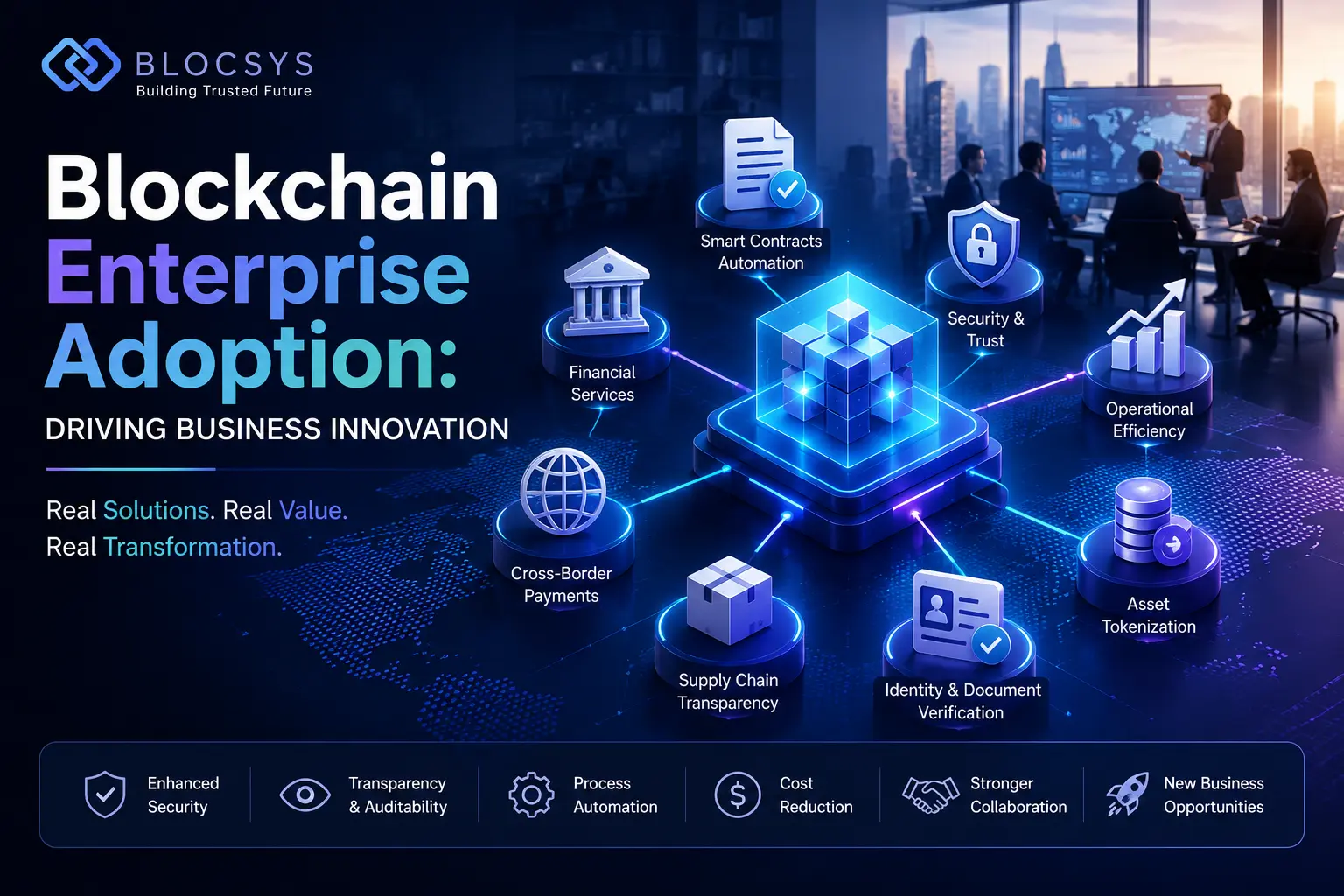
Enterprise blockchain adoption has moved past the whitepaper stage. Banks settle assets on permissioned ledgers, insurers automate claims with smart contracts, and manufacturers track parts across borders using shared, tamper-resistant records. This shift didn’t happen overnight, and it isn’t universal — many pilots still stall before production. But in 2026, enterprise blockchain adoption looks less like an experiment and more like infrastructure. If you’re an IT leader, compliance officer, or executive evaluating enterprise blockchain solutions, understanding what’s actually working, and what isn’t, matters more than chasing hype.
Enterprise blockchain adoption refers to the process by which organizations integrate distributed ledger technology into core business operations, such as payments, record-keeping, asset management, or supply chain tracking. It typically involves permissioned or hybrid blockchain infrastructure rather than fully public networks. Adoption ranges from limited pilots to production systems that support real transactions and regulatory reporting.
What is Enterprise Blockchain ?
Enterprise blockchain isn’t one technology — it’s a category. At its core, it’s a shared, cryptographically verified ledger that multiple parties can trust without a single intermediary controlling every record. Unlike consumer-facing crypto applications, enterprise blockchain focuses on business logic: who can see what, who can write what, and how records reconcile across organizations.
That distinction matters. Enterprise blockchain development isn’t about speculation. It’s about solving coordination problems between parties who don’t fully trust each other but still need to transact. Think trade finance between banks, or supply chain data shared between a manufacturer and its logistics partner.
Tokenized real world assets differ from native crypto assets because they represent something that exists in the traditional financial system. That distinction matters for compliance, custody, and legal enforceability. A tokenized Treasury bill, for example, still relies on the underlying Treasury security and its legal structure; the token is a representation, not a replacement for that structure.
Public, Private, Permissioned, and Consortium Blockchain
These terms get mixed up constantly, so here’s the plain-language version. A public blockchain, like Ethereum, is open to anyone; no single entity controls it. A private blockchain restricts participation to one organization, which runs and governs the network internally. A permissioned blockchain allows known, verified participants to join and transact, with access controlled by rules the network operator sets. A consortium blockchain is a permissioned network governed jointly by multiple organizations — common in banking and supply chain networks where competitors need to share infrastructure without ceding control to one party.
Most enterprise blockchain platform deployments today use permissioned or consortium models. Public blockchain infrastructure is increasingly used too, especially for tokenized assets and stablecoin settlement, but usually alongside permissioned layers for compliance and access control.
Why Enterprise Blockchain Adoption Is Changing in 2026
Three things changed the trajectory of enterprise blockchain adoption over the past two years. First, stablecoins moved from crypto-native use to mainstream payment rails — the Bank for International Settlements and multiple central banks have published research tracking this shift throughout 2024 and 2025. Second, tokenization of real-world assets gained institutional backing, with asset managers and custodians building production infrastructure rather than proof-of-concept demos. Third, regulatory clarity improved in several major markets, reducing the uncertainty that kept many enterprises on the sidelines.
Consequently, boards are asking sharper questions. Instead of “should we explore blockchain,” they’re asking “which business problem justifies this infrastructure investment.” That’s a healthier question, and it’s why enterprise blockchain adoption in 2026 looks more selective, and more durable, than the pilot-heavy years before it.
The organizations getting real value from blockchain aren’t the ones chasing the technology — they’re the ones that started with a reconciliation headache, a settlement delay, or a trust gap between counterparties, and found blockchain was the right tool for that specific job.
Starting With the Business Problem, Not the Technology
Here’s a principle worth repeating: enterprise blockchain adoption should begin with a clearly defined business problem, not a technology mandate. Too many early projects failed because teams asked “how do we use blockchain” instead of “what’s broken that blockchain might fix.” Ask instead: Where do we lack a single source of truth across organizational boundaries? Where do reconciliation delays cost time or money? Where does verifying authenticity or provenance require manual, error-prone steps? If blockchain doesn’t clearly address one of these, a traditional database or API integration is probably the better, cheaper answer.
How Businesses Identify Suitable Blockchain Use Cases
Not every workflow needs a distributed ledger. Enterprises that evaluate blockchain use cases well tend to run through a consistent checklist before committing budget.
- Do multiple independent parties need to share and trust the same data?
- Is there a genuine need for an auditable, tamper-evident record?
- Would removing a central intermediary reduce friction, delay, or dispute risk?
- Can the workflow tolerate the governance and integration overhead blockchain introduces?
- Does the use case involve settlement, ownership transfer, or verification that benefits from shared state?
If the answer to most of these is yes, blockchain is worth prototyping. If a single organization controls all the data and no external party needs to verify it, a conventional database usually wins on cost and simplicity.
Practical Objectives Driving Enterprise Blockchain Adoption
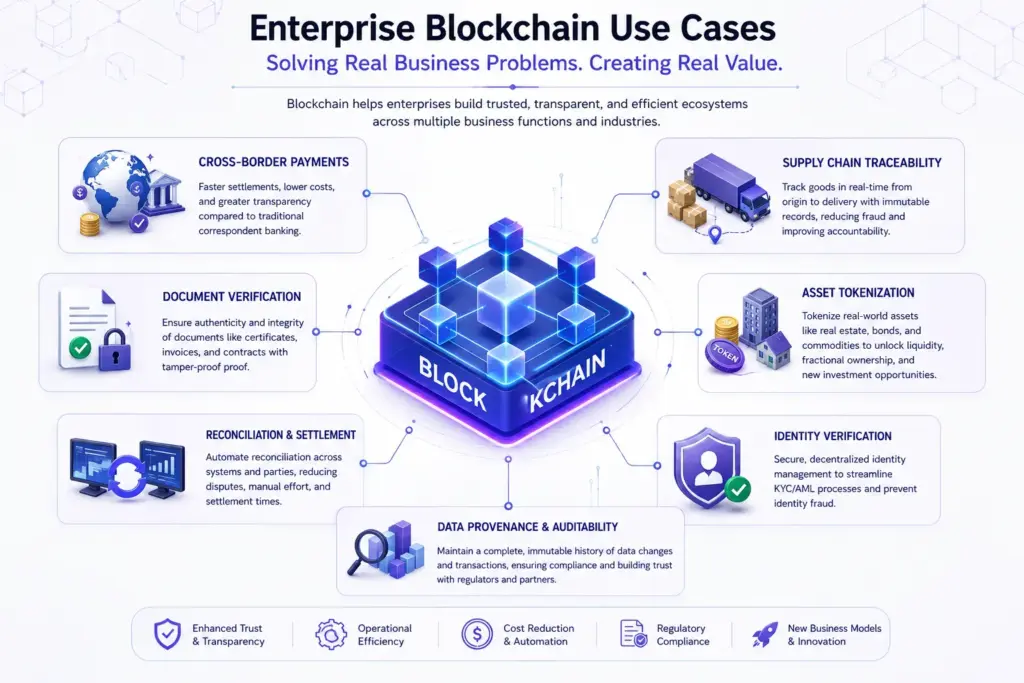
Across industries, the objectives repeat: shared records, auditability, transaction verification, process automation, settlement, asset tokenization, cross-border payments, supply chain traceability, identity verification, document verification, reconciliation, compliance monitoring, and data provenance. None of these are exotic. They’re operational problems that blockchain addresses through shared, verifiable state rather than siloed databases and manual reconciliation between parties.
Major Enterprise Blockchain Use Cases by Industry
Enterprise blockchain use cases now span far more industries than the early financial-services-only narrative suggested. Here’s where meaningful, production-oriented adoption is showing up.
IndustryPrimary Use CaseAdoption Stage (2025–2026)Financial ServicesInstitutional settlement, tokenized depositsProduction and expanding pilotsPaymentsStablecoin-based cross-border settlementGrowing production useCapital MarketsTokenized securities, post-trade reconciliationPilots and early productionSupply ChainProvenance tracking, certification verificationProduction in select sectorsInsuranceSmart-contract claims automationPilots and limited productionHealthcareData provenance, credential verificationEarly pilotsTrade FinanceDocument verification, letters of creditConsortium pilots, some production
Blockchain in Financial Services and Capital Markets
Financial services remains the most mature sector for enterprise blockchain adoption. The Depository Trust & Clearing Corporation, major global custodians, and several central banks have run tokenization and settlement pilots exploring how permissioned ledgers can compress settlement timelines and reduce reconciliation breaks. The Bank for International Settlements’ Project Agorá and various wholesale CBDC pilots reflect institutional-level exploration, not universal production rollout. It’s important to distinguish these: some initiatives, like JPMorgan’s Kinexys platform (formerly Onyx), process live institutional transactions, while many others remain in structured pilot phases.
Asset tokenization is where the momentum is clearest. Tokenized money market funds and tokenized treasuries have grown into a multi-billion-dollar category, according to on-chain data tracked by firms like rwa.xyz throughout 2025. That said, tokenized real-world assets still represent a small fraction of total global capital markets — meaningful growth, not mass displacement of existing infrastructure.
Blockchain for Supply Chains
Supply chain traceability is one of the clearer enterprise blockchain use cases because it solves a real multi-party trust problem: verifying that a product’s origin, handling, and certification claims are accurate across organizations that don’t share a database. Food safety, pharmaceuticals, and organic certification are common applications. Blocsys, for instance, has worked on blockchain-based traceability infrastructure through its blockchain organic certification and food traceability platform, which illustrates how certification data can be recorded immutably across a supply chain network.
Blockchain for Payments and Stablecoins
Stablecoin-based payments have become one of the most concrete examples of blockchain technology for enterprises moving into production. Stablecoin transaction volumes reached trillions of dollars annually by 2025, according to data cited in industry reports, though a meaningful share of that volume reflects trading and crypto-native activity rather than enterprise commercial payments. Still, enterprises are increasingly piloting stablecoins for treasury operations and cross-border settlement, where traditional correspondent banking introduces delay and cost.
The regulatory backdrop matters here. In the United States, the GENIUS Act, signed into law in 2025, established a federal framework for payment stablecoin issuance, giving enterprises clearer rules for stablecoin-based settlement. The European Union’s Markets in Crypto-Assets Regulation (MiCA) similarly created a compliance framework for stablecoin issuers operating in the EU. Singapore’s MAS and the UK’s FCA have each advanced their own stablecoin and digital asset frameworks over the same period. None of these frameworks make a given transaction automatically compliant — compliance still depends on the specific business model, jurisdiction, and counterparties involved.
Enterprise Digital Assets and Institutional Tokenization
Enterprise digital asset strategy now extends beyond stablecoins into tokenized bonds, funds, and private credit. BlackRock’s tokenized fund (BUIDL), launched in 2024, and various tokenized treasury products from other asset managers, are confirmed, live examples of institutional tokenization already operating in production. Corporate bond tokenization is an emerging area where issuers explore programmable settlement and fractional ownership; Blocsys supports this space through corporate bond tokenization infrastructure and broader real-world asset tokenization development.
For enterprises exploring their own tokenization strategy, the underlying question is the same as with any blockchain use case: does representing this asset as a token create genuine settlement, liquidity, or transparency benefits over existing infrastructure? A dedicated asset tokenization platform can help structure that evaluation rather than defaulting to a generic build.
This matters because traditional securities processing often relies on multiple reconciliations across separate systems. With smart contract logic, transfer restrictions and eligibility checks can execute automatically at the point of transaction, rather than through downstream manual review. That said, smart contracts still need rigorous auditing — a poorly coded contract introduces new operational risk rather than removing old ones.
AI and Blockchain Integration
AI and blockchain are increasingly discussed together, but it’s worth being precise about the relationship. AI models are good at analyzing data, spotting patterns, and recommending or automating decisions. Blockchain is good at verifying, permissioning, and auditing those decisions after they’re made. The two aren’t interchangeable, and AI computation generally shouldn’t run directly on-chain — it’s too resource-intensive and blockchain execution environments aren’t built for it. A more realistic pattern: an AI model flags a suspicious transaction, and a smart contract enforces the permission rules or compliance check before the transaction settles on-chain. Or an AI system verifies document authenticity off-chain, and the verification result gets recorded on a blockchain for auditability. This combination is largely emerging and exploratory in enterprise settings today, with production deployments still limited, but the architectural pattern is gaining traction across fintech and compliance teams.
On-chain settlement can, in principle, reduce the multi-day settlement cycles common in traditional markets. However, actual settlement speed and finality depend on the underlying blockchain, legal recognition of on-chain transfers, and whether both counterparties operate on compatible systems. We’ve seen claims about instant settlement overstated in marketing materials — the reality is more nuanced and still maturing across most asset classes.
Collateral mobility is where tokenization earns its keep for institutions. Moving eligible collateral between venues without waiting on batch settlement cycles is a real operational win — but only once custody, legal transfer, and counterparty systems are all aligned.
This matters because traditional securities processing often relies on multiple reconciliations across separate systems. With smart contract logic, transfer restrictions and eligibility checks can execute automatically at the point of transaction, rather than through downstream manual review. That said, smart contracts still need rigorous auditing — a poorly coded contract introduces new operational risk rather than removing old ones.
Smart Contracts and Business Process Automation
Smart contracts are self-executing code that runs predefined logic when certain conditions are met. In plain terms: if X happens, Y executes automatically, without a person manually approving each step. That’s useful for repetitive, rules-based processes like releasing payment upon delivery confirmation, or triggering an insurance payout when verified data meets a claim threshold.
However, smart contracts don’t eliminate the need for careful controls. Bugs in contract code have caused real financial losses across the industry, which is why enterprise blockchain development typically includes rigorous auditing, access controls, and upgrade mechanisms before contracts touch production funds. Blocsys’ smart contract development work emphasizes this kind of structured, security-first approach rather than treating automation as a plug-and-play feature.
Where secondary trading does exist, it often happens through regulated venues or over-the-counter arrangements between institutional counterparties. If your firm is evaluating distribution channels for tokenized instruments, reviewing OTC Trading Platform Development approaches can clarify how bilateral settlement and price discovery work outside public exchanges.
Document and Data Verification
Document verification is a straightforward, high-value enterprise blockchain use case. Recording a cryptographic hash of a document on-chain lets any party confirm the document hasn’t been altered, without exposing its contents. Blocsys’ tamper-proof document verification platform reflects this pattern — useful for contracts, certifications, and compliance records where authenticity matters more than public visibility.
Enterprise Blockchain Architecture and Legacy Integration
Here’s something enterprises get wrong early on: blockchain doesn’t replace your ERP, your core banking system, or your existing database. It complements them. Most transaction data, customer records, and operational logic still live in traditional systems. Blockchain typically handles the specific slice that needs shared trust — a settlement record, a certification hash, an ownership transfer. That means integration architecture matters as much as the blockchain layer itself. APIs and middleware connect blockchain networks to existing enterprise software. Oracles feed real-world data, like prices, delivery confirmations, or identity attestations, onto the chain, since blockchains can’t natively access external information. Wallets and custody solutions manage private keys and digital asset holdings, often through regulated custodians for institutional use. Off-chain databases still store the bulk of operational data, with blockchain used selectively for what genuinely needs verification.
Interoperability between different blockchain networks, and between blockchain and legacy systems, remains an active engineering challenge. Enterprises running multi-chain strategies increasingly need bridge infrastructure and standardized protocols to avoid fragmented, siloed deployments.
Choosing an Enterprise Blockchain Platform
Platform choice depends on your governance model and performance needs. Ethereum-based permissioned layers, Hyperledger Fabric, R3 Corda, and various layer-2 networks each suit different governance and throughput requirements. An experienced dedicated blockchain engineering team can help match architecture to actual business requirements rather than defaulting to whatever platform is trending.
Blockchain Security and Privacy Considerations
Security in enterprise blockchain adoption isn’t a single feature — it’s layered. Smart contract code needs auditing before deployment. Access controls need to enforce who can read, write, or execute transactions. Private keys and custody infrastructure need institutional-grade protection, since lost or stolen keys can mean irreversible asset loss. Data privacy is a separate concern from security. Permissioned blockchains let enterprises restrict visibility to authorized participants, but public blockchain deployments require additional privacy techniques, like zero-knowledge proofs or off-chain data storage, to avoid exposing sensitive business information. Neither blockchain type automatically guarantees compliance with data protection regulations like GDPR — that depends on how the specific system is architected.
Regulatory and Compliance Considerations
Regulatory context varies significantly by jurisdiction, asset type, and business model, so generic claims about blockchain compliance don’t hold up. In the US, digital asset activity intersects with SEC and CFTC jurisdiction depending on how an asset is classified. The GENIUS Act addresses payment stablecoins specifically, not all digital assets. In the EU, MiCA governs crypto-asset issuance and service provision. Singapore’s MAS and the UK’s FCA maintain their own licensing and disclosure regimes. For enterprises, this means KYC/AML procedures, transaction monitoring, record retention, and permissioned access controls still need to be built around the specific regulatory obligations that apply to your industry and jurisdiction. Blockchain can support compliance by making records more auditable, but it doesn’t make a business model compliant on its own. Legal counsel familiar with digital asset regulation in your operating jurisdictions remains essential.
Challenges and Limitations of Enterprise Blockchain Adoption
Let’s be honest about the friction points, because pretending they don’t exist undermines credibility. Enterprise blockchain adoption still faces real obstacles.
- Integration complexity with legacy systems, which often takes longer than initial project timelines assume.
- Governance disputes in consortium models, where multiple organizations must agree on rules and upgrades.
- Scalability limits on certain networks, particularly for high-frequency transaction use cases.
- Regulatory uncertainty in some jurisdictions and asset categories, which slows institutional commitment.
- Talent gaps, since experienced blockchain architects and smart contract developers remain in short supply relative to demand.
- Unclear ROI when a use case doesn’t genuinely require shared, multi-party trust.
Many pilots don’t reach production, and that’s not necessarily a failure. Sometimes it means the underlying problem was better solved another way. That’s a legitimate outcome of proper evaluation, not a sign the technology failed broadly.
Consequently, institutions increasingly favor permissioned or hybrid infrastructure that connects to existing custody and compliance systems rather than fully public, unrestricted networks. Standards bodies and industry groups continue working on common frameworks, but universal interoperability is still an emerging goal, not a solved problem.
How Businesses Can Evaluate Blockchain ROI
Avoid vague promises about cost savings or efficiency gains without evidence specific to your use case. Instead, measure against concrete baselines: How long does reconciliation currently take, and would shared ledger access reduce disputes? How many manual verification steps exist today, and could smart-contract automation remove specific ones? What’s the cost of the trust gap you’re trying to close, whether that’s fraud risk, delayed settlement, or audit overhead? If you’re scoping a project and want a realistic sense of investment required, Blocsys’ software development cost estimator provides a practical starting point rather than relying on generic industry figures that don’t reflect your specific architecture and compliance requirements.
Globally, regulators in Singapore, Hong Kong, the UAE, and the UK have published guidance or run regulatory sandboxes for tokenized securities, while the EU’s MiCA framework primarily addresses crypto-assets rather than traditional tokenized securities. Compliance professionals should treat every jurisdiction’s rules independently rather than assuming one regulatory approach applies globally.
The Future of Enterprise Blockchain Adoption
Looking ahead, several trends are shaping where enterprise blockchain adoption heads next. Tokenized real-world assets are expected to keep growing, based on institutional roadmaps from major custodians and asset managers, though actual growth rates remain forecasts rather than guarantees. Stablecoin regulation is likely to mature further across major markets following the frameworks established in 2025. Interoperability standards between blockchain networks are receiving increased engineering attention as multi-chain enterprise deployments become more common. AI and blockchain integration will likely deepen, particularly around verification and audit workflows, though widespread production deployment of these combined systems is still emerging rather than mainstream. None of this guarantees universal adoption — some industries and use cases simply won’t need blockchain, and that’s a reasonable outcome of the technology finding its actual fit.
Additionally, secondary market liquidity, as noted earlier, isn’t guaranteed simply because an asset is tokenized. Interoperability gaps between platforms add friction. Institutions considering real world asset tokenization development should budget time and resources for these operational realities rather than assuming a purely technical rollout.
Why Enterprises Need Experienced Blockchain Infrastructure Partners
Enterprise blockchain adoption succeeds or fails based on execution, not just strategy. Choosing the right architecture, integrating with legacy systems, structuring smart contracts securely, and navigating jurisdiction-specific compliance all require hands-on technical experience. That’s where an experienced blockchain development partner makes a measurable difference versus a generic technology vendor.
Blocsys works with enterprises, financial institutions, and technology teams across tokenization, smart contract development, and enterprise blockchain infrastructure, helping organizations move from a defined business problem to a working, compliant, production-ready system. If you’re evaluating enterprise blockchain solutions and want a partner who understands both the technical and regulatory realities, explore what Blocsys can build with you.
Similarly, a custodian bank might explore using tokenized Treasury holdings as intraday collateral for margin calls, reducing reliance on end-of-day batch processes. Again, this reflects the kind of use case institutions are piloting industry-wide, not a confirmed Blocsys deployment. These scenarios illustrate where the technology’s practical value lies — in workflow efficiency, not novelty.
Frequently Asked Questions
Here are direct answers to the questions we hear most often about enterprise blockchain adoption.
What is enterprise blockchain adoption?
Enterprise blockchain adoption is the process of integrating distributed ledger technology into core business operations like payments, settlement, record-keeping, or supply chain tracking. It typically uses permissioned or consortium blockchain infrastructure rather than fully public networks, allowing verified organizations to share and verify data without a single controlling intermediary. Adoption ranges from early pilots to production systems handling real transactions and compliance reporting across regulated industries.
Why are businesses adopting blockchain in 2026?
Businesses are adopting blockchain because stablecoin payments matured into production use, institutional tokenization gained real regulatory backing, and several major markets clarified digital asset rules through frameworks like the GENIUS Act and MiCA. These developments reduced the uncertainty that previously kept enterprises in pilot mode. Organizations are now targeting specific, well-defined problems, such as settlement delays or cross-party reconciliation, rather than exploring blockchain as a general innovation exercise.
What are the main enterprise blockchain use cases?
The main enterprise blockchain use cases include institutional settlement, asset tokenization, cross-border payments through stablecoins, supply chain traceability, document and credential verification, trade finance automation, insurance claims processing, and post-trade reconciliation in capital markets. Each use case shares a common thread: multiple parties need to trust and verify shared data without relying entirely on one central intermediary controlling the records.
How is enterprise blockchain different from public blockchain?
Enterprise blockchain typically uses permissioned or consortium networks where participation is restricted to verified, known organizations, while public blockchain networks like Ethereum allow anyone to join without approval. Enterprise deployments prioritize governance control, data privacy, and regulatory compliance, whereas public blockchains prioritize decentralization and open access. Many enterprises now use hybrid models, combining permissioned layers for sensitive operations with public blockchain infrastructure for settlement or tokenized assets.
Which industries benefit most from enterprise blockchain?
Financial services, capital markets, payments, supply chain, trade finance, and insurance currently show the most mature enterprise blockchain adoption. These industries share frequent multi-party transactions, heavy reconciliation overhead, and strong needs for auditability and provenance verification. Healthcare and manufacturing are earlier in adoption but show growing interest, particularly for data provenance, credential verification, and certification tracking across complex partner networks.
How does blockchain improve business processes?
Blockchain can improve business processes by creating a shared, tamper-evident record that multiple parties trust without needing a central authority to reconcile disputes. Smart contracts can automate rules-based steps, like releasing payment upon confirmed delivery, reducing manual approval delays. However, improvements depend entirely on the specific implementation and use case; blockchain doesn’t automatically guarantee faster, cheaper, or more secure processes without proper architecture and controls.
What are the challenges of enterprise blockchain adoption?
Key challenges include integration complexity with legacy ERP and database systems, governance disputes in multi-organization consortium models, scalability limits on certain networks, and regulatory uncertainty in some jurisdictions and asset categories. Talent shortages in blockchain architecture and smart contract development also slow projects. Many pilots don’t reach production, often because the underlying business problem didn’t actually require shared, multi-party trust infrastructure.
How much does enterprise blockchain development cost?
Enterprise blockchain development costs vary significantly based on architecture complexity, integration requirements, smart contract scope, and regulatory compliance needs, so generic figures aren’t reliable. Costs depend on whether you’re building a permissioned network, a tokenization platform, or a smart contract layer integrated with existing systems. Blocsys’ software development cost estimator offers a more accurate, project-specific starting point than industry-wide averages.
How do enterprises integrate blockchain with existing systems?
Enterprises integrate blockchain through APIs and middleware that connect the ledger to existing ERP, database, and payment systems, rather than replacing that infrastructure outright. Oracles feed external data, like prices or delivery confirmations, onto the chain, since blockchains can’t access outside information natively. Off-chain databases continue storing the bulk of operational data, with blockchain applied selectively to the specific records or transactions that genuinely need shared verification.
What is the future of enterprise blockchain adoption?
The future of enterprise blockchain adoption points toward continued growth in tokenized real-world assets, expanding stablecoin regulation following 2025 frameworks, and deeper interoperability between blockchain networks and legacy enterprise systems. AI and blockchain integration is also expected to grow, particularly for verification and audit workflows. That said, adoption will likely remain selective, applied where multi-party trust and auditability provide genuine value rather than universally across every business function.
