
You’ve probably seen the demo: an autonomous agent finds a data source, chooses a tool, signs a transaction, and reports that the job is complete. The difficult part starts afterward. Production teams must determine which identity the agent uses, what it can spend, how a counterparty verifies its authority, where funds settle, and who investigates an abnormal transaction.
This practical guide to Blockchain for AI Agents in 2026 is for AI developers, Web3 teams, fintechs, enterprises, SaaS businesses, CTOs, and technical architects moving beyond prompt-driven assistants. It maps blockchain capabilities to specific agent problems, compares them with traditional infrastructure, and shows what a production-ready AI agent blockchain development programme needs before autonomous execution touches meaningful assets.
Table of Contents
- Why AI Agents Need New Digital Infrastructure in 2026
- What Blockchain Adds to AI Agents
- Agent Identity, Wallets, and Programmable Permissions
- AI Agent Payments, Stablecoins, and Machine-to-Machine Settlement
- Smart Contracts, Agent Reputation, and Coordinated Workflows
- Security, Compliance, and Risk Considerations for Production
- Blocsys as a Partner for AI Agent Blockchain Infrastructure
- Frequently Asked Questions About Blockchain for AI Agents
- What is blockchain for AI agents?
- Why do AI agents need blockchain in 2026?
- How can AI agents make blockchain payments?
- What is an AI agent wallet?
- How does blockchain verify AI agent identity?
- Can AI agents own and manage digital assets?
- How do AI agents use smart contracts?
- What is agentic commerce and how does blockchain support it?
- What are the risks of connecting AI agents to blockchain?
- How much does it cost to build a blockchain-based AI agent platform?
Why AI Agents Need New Digital Infrastructure in 2026
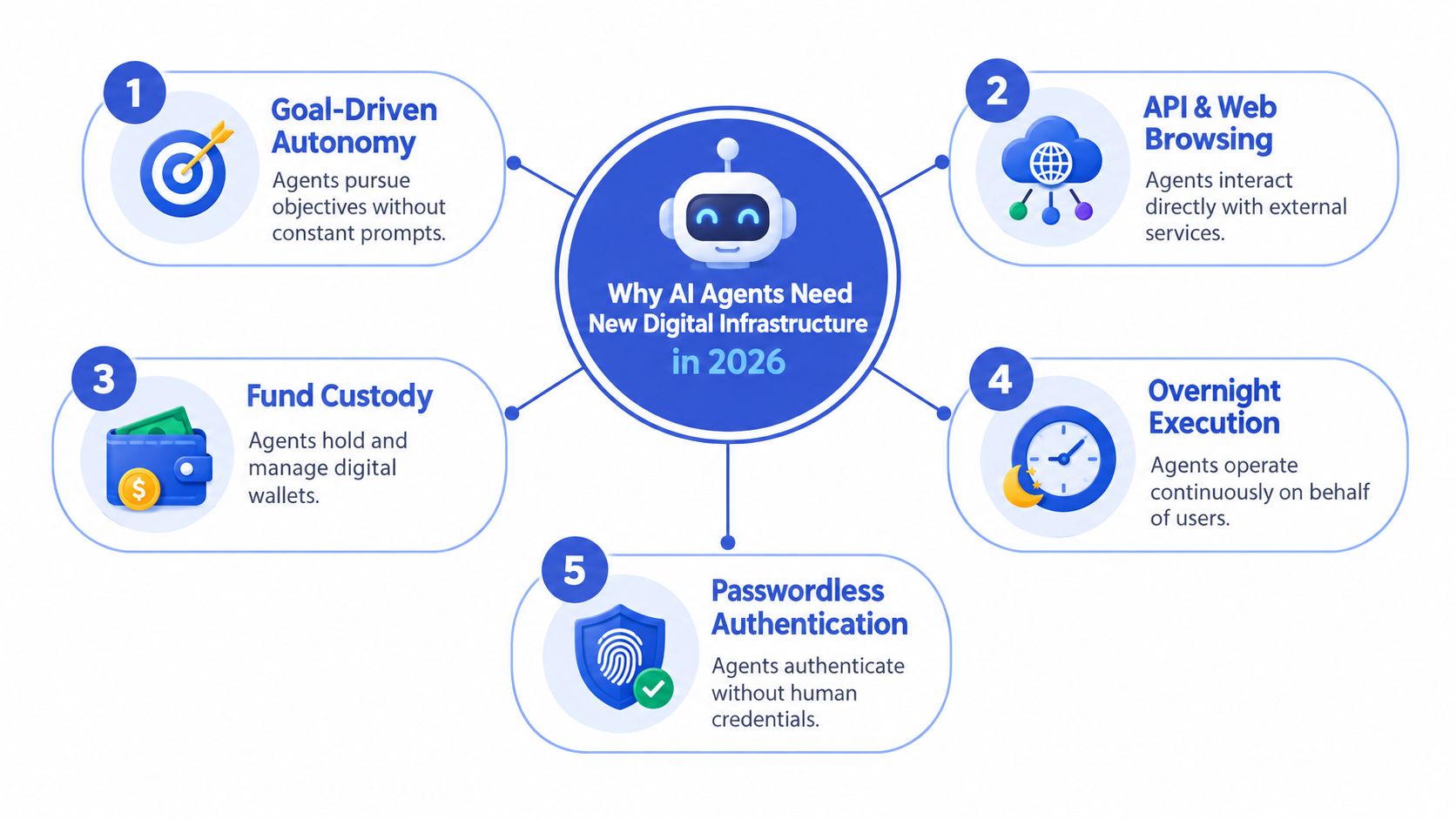
An assistant waits for a person to ask a question. An autonomous agent receives an objective, selects tools, calls external services, evaluates results, and may continue operating while nobody is watching. That change affects infrastructure more than model selection. A system that can act overnight needs a durable identity, bounded authority, payment access, and evidence of every material decision.
The traditional account stack assumes a human sits behind the screen. Passwords, browser sessions, one-time approvals, and card billing work well when a person confirms each action. They fit poorly when software must authenticate to several vendors, pay for usage, renew access, or coordinate with another agent without exposing a master credential.
The machine actor needs its own control plane
A agent infrastructure separates five concerns:
- Identity: A verifiable identifier represents the software actor and its principal.
- Authorisation: Policy defines permitted contracts, functions, counterparties, assets, and limits.
- Custody: A wallet or signing service holds authority without handing raw key material to the model.
- Settlement: Payment completes between parties, preferably with clear finality and reconciliation.
- Auditability: Operators can reconstruct what the agent signed, why it was allowed, and what state changed.
Blockchain is useful because these primitives can be represented through keys, smart accounts, signed messages, credentials, and public or permissioned state. It gives an agent a native way to sign and settle with parties that don’t share the same database. It doesn’t, however, make the model trustworthy by itself. The model still needs deterministic policy enforcement outside its reasoning loop.
Teams designing the API layer should also consider API-first trust infrastructure for developers in 2026, especially when agents combine conventional services with blockchain actions. The strongest architecture treats blockchain as a controlled execution and settlement layer, not as a replacement for every API, queue, database, and observability system.
India offers a useful infrastructure signal. MeitY launched the National Blockchain Framework in 2021 with an outlay of ₹64.76 crore, and official reporting says it had verified over 34 crore documents by October 2025, including more than 48,000 documents in its Document Chain component according to the reported National Blockchain Framework data. For AI agents, the significance is practical: identity, provenance, and tamper-evident records already have a large public-sector deployment context rather than existing only as a laboratory concept.
What Blockchain Adds to AI Agents
Blockchain adds value when an agent must act across organisations that don’t share a trust boundary. It is less useful when the entire workflow already runs inside one company’s cloud account, database, and identity provider.
Five capabilities matter most:
- Portable identity lets an agent present a cryptographic identifier to multiple counterparties. The identity can remain stable while short-lived permissions change.
- Programmable wallets allow policies to sit around signing authority. A wallet can restrict contract functions, assets, destinations, and transaction values.
- Machine-to-machine payments give software a settlement method that doesn’t depend entirely on human billing accounts or a central custodian.
- Verifiable reputation can record completed work, attestations, payment history, or disputes in a form counterparties can inspect.
- Tamper-evident coordination logs create shared evidence of commitments, escrow, approvals, and settlement events.
The distinction between proof of execution and proof that an agent made a good decision is essential. A blockchain can show that a wallet signed a transaction and that a contract changed state. It can’t prove that the model interpreted a document correctly, selected the best supplier, or resisted malicious instructions. Those questions require evaluation, policy controls, signed inputs, monitoring, and human review.
| Capability | Best-fit agent problem | Better off using traditional stack |
|---|---|---|
| Portable blockchain identity | Cross-platform authority and shared verification | Single-tenant service authentication |
| Programmable wallet | Bounded asset control and delegated execution | Internal service accounts with no asset custody |
| Machine payments | Open, automated settlement between independent parties | Employee expenses and familiar consumer checkout |
| Reputation registry | Counterparty selection across an open marketplace | Private vendor scoring inside one organisation |
| Shared coordination log | Escrow, delivery proofs, and multi-party state | High-volume internal events and private operational data |
A public chain can also expose commercial relationships, wallet balances, and transaction patterns. That makes it a poor default for confidential supplier data or private model context. Teams often need a hybrid design, with sensitive reasoning and business records off-chain, and only proofs, commitments, permissions, or settlement events anchored on-chain.
India’s ecosystem illustrates why this design space is attracting builders. Official reporting cited around 1.8 lakh startups by March 2026, with nearly 89% of new startups using AI solutions, while one market forecast valued India’s AI agents market at USD 0.28 billion in 2024 and projected USD 3.55 billion by 2030, with a 53.5% CAGR from 2025 to 2030 reported in this India AI agent ecosystem overview. That commercial momentum creates demand for blockchain agent infrastructure, but it doesn’t remove the need to choose the narrowest technology that solves the actual trust problem. A useful implementation perspective is available in AI and blockchain integration in 2026.
Agent Identity, Wallets, and Programmable Permissions
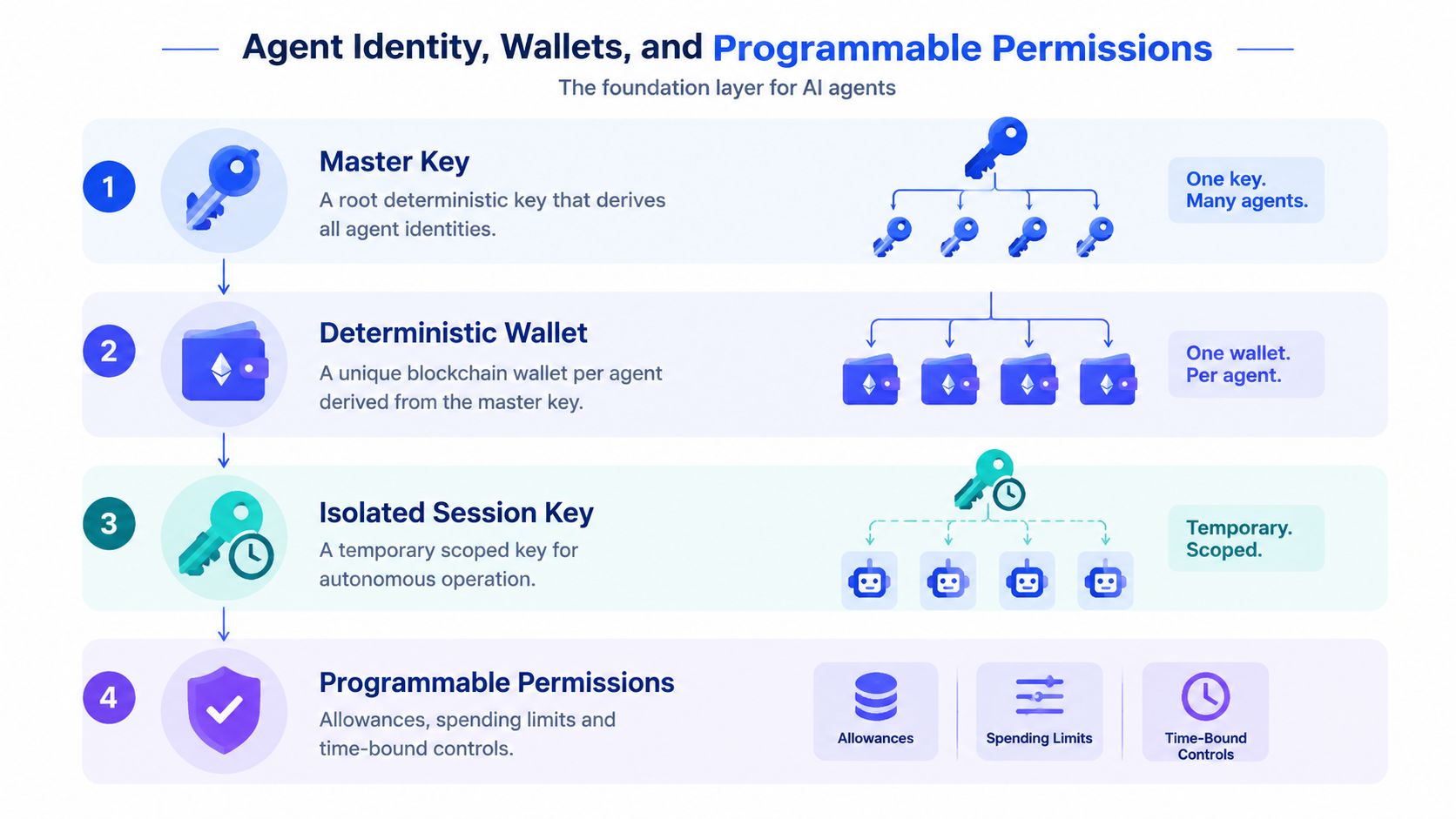
An AI agent wallet shouldn’t be a private key pasted into an environment variable. The safer pattern is layered authority. A root key or institutional custody layer controls identity, while the agent receives a separate session key with explicit limits and an expiry condition.
A practical permission model
A production flow usually looks like this:
- Master key: Store the root authority in a controlled custody environment. The model must never access it directly.
- Deterministic wallet: Derive a predictable wallet or smart account for the agent, with a stable public identity.
- Session key: Issue a temporary sub-key for a defined task, environment, or operating window.
- Programmable permissions: Enforce transaction limits, destinations, contract functions, and approval thresholds at the wallet or policy layer.
Useful controls include a maximum value per transaction, a cumulative operating limit, allowlisted counterparties, function-level contract restrictions, and time-boxed sessions. A treasury agent might rebalance only approved assets, while a procurement agent might pay only registered vendors. A human approval can remain mandatory when the requested action exceeds policy.
Ethereum account abstraction patterns such as ERC-4337 smart accounts and delegated-account approaches associated with EIP-7702 are relevant because they move beyond the assumption that an externally owned account must sign every action with unrestricted authority. Teams still need to validate chain support, wallet compatibility, recovery design, gas sponsorship, and the exact security properties of the implementation before treating an emerging standard as production infrastructure.
Custody choice depends on the threat model. A non-custodial wallet may suit a user-controlled application. An institutional platform may prefer an MPC vault, a hardware-backed signer, or a TEE-based key manager. Providers such as Coinbase MPC, Fireblocks, and Turnkey are examples teams may evaluate, but the integration must be tested against policy enforcement, recovery, audit logging, and operational access requirements.
Practical rule: Keep the agent’s public identity stable, but make its operating authority disposable.
Revocation is as important as issuance. If a session key is compromised, the platform should disable that key, block pending actions where possible, and preserve the agent identity without rotating every downstream relationship. For regulated assets, the permission model also needs to represent transfer restrictions, investor eligibility, and approval evidence. A corporate bond tokenization platform can use smart contract automation and digital issuance workflows, but an agent interacting with it still requires explicit authority and compliance checks.
The deeper wallet design trade-offs are covered in AI-driven Web3 wallets and digital asset management. The key point is simple: an AI agent wallet is a policy-enforced execution account, not merely a place to store tokens.
AI Agent Payments, Stablecoins, and Machine-to-Machine Settlement
Autonomous software needs payment rails that match software behaviour. A human can tolerate a monthly invoice or a card checkout. An agent may need to purchase a single data response, pay another agent for computation, escrow funds until delivery, or stream value while a service remains active.
Three rails deserve comparison.
| Dimension | Stablecoin on a layer-two network | Card or agent payment API | ACH or wire |
|---|---|---|---|
| Settlement model | On-chain transfer and smart contract settlement | Card-network authorisation and merchant capture | Bank-account settlement |
| Programmability | Strong, including escrow and conditional release | Moderate, controlled by provider APIs | Limited |
| Consumer experience | Depends on wallet and funding design | Familiar and highly integrated | Familiar for businesses |
| Chargebacks | Usually not native | Established dispute workflows | Banking processes apply |
| Main operational concern | Key custody, chain finality, issuer and compliance controls | Provider dependence and account approval | Delayed reconciliation and manual exceptions |
Stablecoins such as USDC can support machine-to-machine payments because an agent can sign a transfer without presenting a password to a vendor. A contract can hold funds, release them after a delivery proof, or divide proceeds between participants. An x402-style flow extends that pattern to pay-per-request services, where a server returns a payment requirement and the agent supplies payment evidence before receiving the response. This remains an emerging payment pattern, not a universal replacement for subscriptions, cards, or invoices.
A representative transaction sequence is:
- The agent requests an API resource.
- The provider returns the required asset, network, amount, and recipient.
- The agent checks the request against its budget and destination policy.
- It signs an authorised transfer payload, such as an EIP-3009-style transfer with authorisation.
- A facilitator or contract verifies the payment and the provider returns the resource.
- The platform records the request, policy decision, settlement reference, and response status.
Cards still win for consumer protection, refunds, merchant familiarity, and dispute handling. Bank rails remain appropriate for larger institutional settlement, payroll-like flows, and counterparties that aren’t prepared to manage digital assets. Stablecoins are strongest where the parties need programmable, cross-border, machine-native settlement and can operate compliant wallet infrastructure.
Teams entering regulated fintech markets should review local licensing, custody, payments, and digital-asset rules. A practical resource on launching a fintech startup in Israel can help frame that jurisdiction-specific work, although it can’t replace advice for the target market. For a deeper treatment of the architecture, see AI agent crypto payments.
India is developing a particularly relevant model. NPCI is preparing a Unified Agentic Protocol that would allow authorised AI agents to make small UPI payments without human approval for every transaction, using mechanisms such as UPI Circle and Reserve Pay with user-defined spending caps reported by Reuters. The reported plan shows that practical agentic commerce doesn’t have to be fully decentralised. Verified identity, constrained delegation, and an auditable existing payment rail may be the better answer for a given market.
Smart Contracts, Agent Reputation, and Coordinated Workflows
A single agent can call a contract. A useful agentic commerce network needs several agents to discover one another, agree on terms, perform work, and settle without making every step dependent on a human operator.
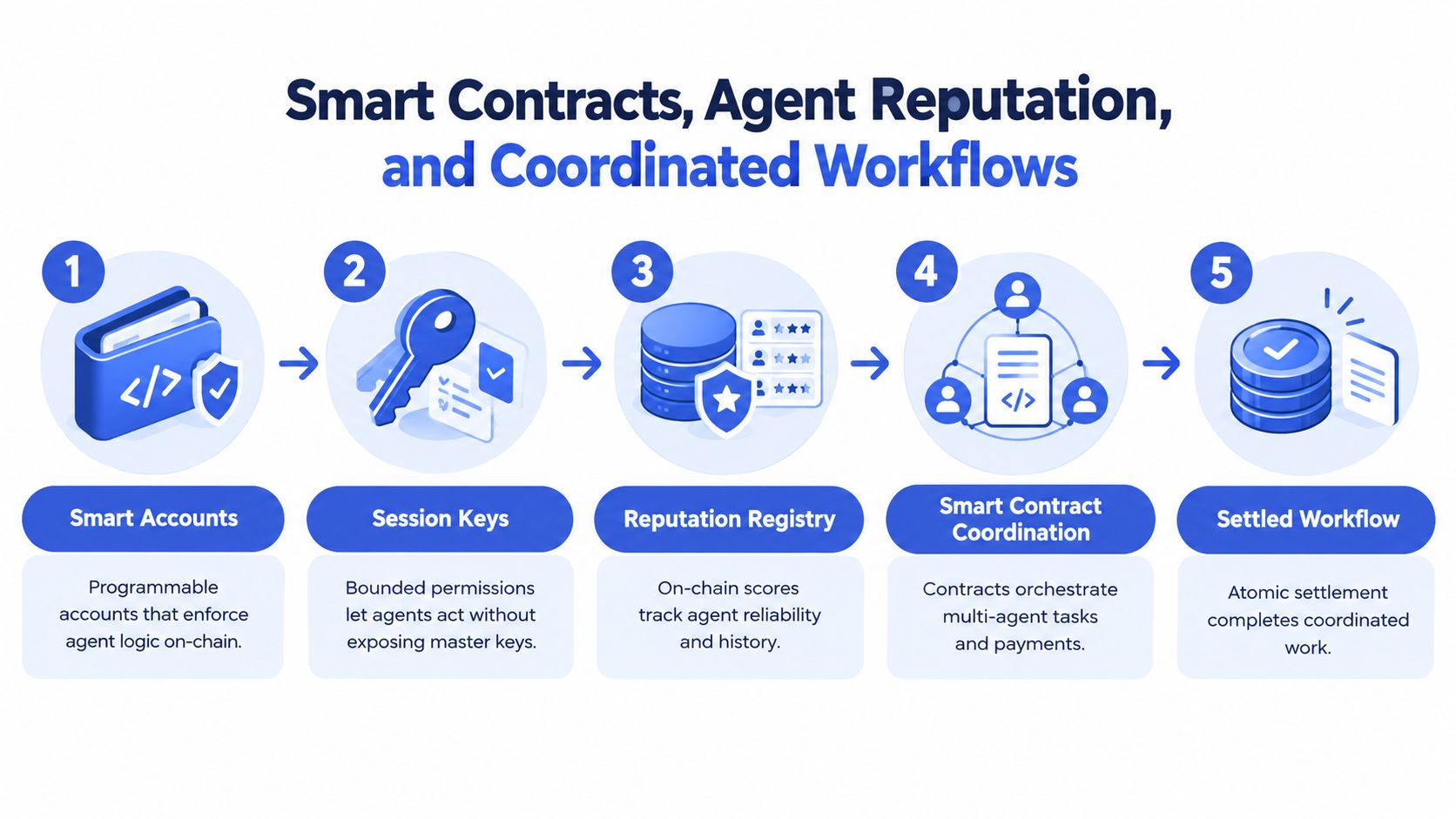
Consider a buyer agent sourcing a market report. It can select two research agents, place payment in escrow, provide a structured task specification, and receive signed deliverables. A verifier, oracle, or human reviewer evaluates the outputs against an agreed rubric. The contract then releases the winner’s payment and returns an agreed portion of the unsuccessful bid.
The blockchain records commitments and settlement. It doesn’t determine whether a report is insightful unless the evaluation method is defined clearly.
An on-chain reputation registry can attach evidence to an agent identity, including completed tasks, payment history, credentials, and dispute outcomes. ERC-8004-style registry concepts are relevant here as an emerging direction, but teams should distinguish a proposed or developing standard from a mature, widely interoperable deployment. Reputation can help a counterparty filter candidates, yet it doesn’t solve identity farming, collusion, subjective scoring, or portability between networks.
The workflow can combine:
- Smart accounts for policy-controlled execution.
- Session keys for task-specific authority.
- Escrow contracts for conditional payment.
- Attestations for delivery or compliance evidence.
- Registries for discovery and historical context.
- Pause and upgrade controls for incident response.
Multi-agent systems may also pool capital, divide revenue, or coordinate through a DAO-like governance structure. Those models introduce additional concerns, including voting capture, contract upgrades, oracle dependence, and unclear responsibility when an automated decision causes loss. Use audited libraries where possible, keep custom logic narrow, define emergency pause conditions, and make upgrade authority visible to operators and counterparties.
A contract should never assume that a language model is a reliable source of truth. Put critical conditions into deterministic code, require signed external evidence where appropriate, and route ambiguous cases to a human or a bounded fallback. Teams evaluating workflow architecture can use this smart contract development guide to compare design approaches before committing to custom orchestration.
The following video provides additional context on smart contract workflow design:
Security, Compliance, and Risk Considerations for Production
The first live transaction changes the security model. An agent that only reads data can be wrong. An agent that controls funds can be wrong and expensive at the same time.
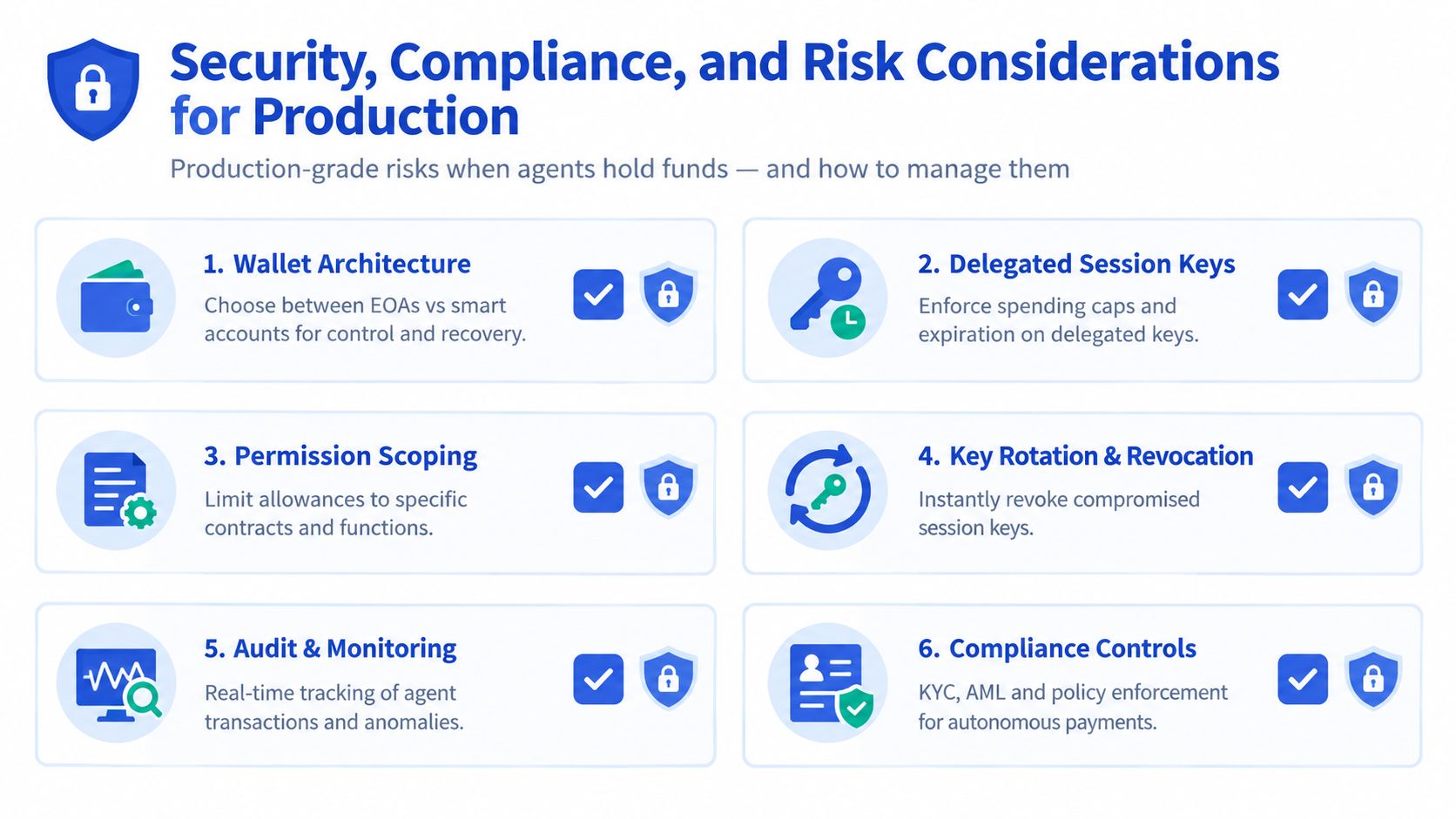
Threats that need explicit controls
Prompt injection is only one layer. Attackers can manipulate web content consumed by the model, alter tool parameters, exploit excessive token allowances, compromise a session key, or persist malicious instructions in shared agent memory. A blockchain transaction can be perfectly valid cryptographically and still be unauthorised from the business owner’s perspective.
Stablecoin workflows add issuer, blacklist, redemption, and depeg considerations. Cross-chain systems add bridge risk, reorganisation risk, message-delivery failure, and different assumptions about finality. Oracles and fiat conversion services become part of the trust boundary when the agent acts on prices, exchange rates, compliance data, or delivery conditions.
A production checklist should include:
- Wallet architecture: Choose EOAs or smart accounts based on recovery, policy, compatibility, and custody requirements.
- Session-key limits: Enforce value caps, expiry, nonce management, and task-specific scopes.
- Permission scoping: Restrict allowances to approved contracts, functions, assets, and destinations.
- Monitoring: Detect unusual frequency, destination changes, repeated failures, and policy-boundary attempts.
- Emergency controls: Maintain a kill switch that can stop signing and block new execution.
- Incident response: Document technical escalation, customer communication, legal review, and evidence preservation.
Blockchain Development may involve public, private, or hybrid networks, but production delivery still depends on the surrounding controls. Teams need transaction simulation, static analysis, contract audits, signer isolation, secrets management, and operational runbooks. They also need to test model-specific failures, including tool hijacking and instructions hidden inside untrusted data.
Compliance belongs at the signing boundary
Compliance checks shouldn’t exist only in a dashboard after settlement. Sanctions screening, customer and counterparty rules, transfer restrictions, jurisdiction controls, and approval evidence should influence whether the signer will authorise the action. For cross-border payments, the relevant Travel Rule and licensing obligations depend on the jurisdictions, assets, counterparties, and service model involved. MiCA and US stablecoin policy developments, including the GENIUS Act, require careful legal interpretation rather than generic claims about compliance.
India’s policy direction also highlights the implementation gap. The 2025 AI Governance Guidelines discussion points towards techno-legal tools including blockchain, smart contracts, watermarking, labelling, provenance, grievance handling, and flexible sector oversight summarised by Digital Policy Alert. The same reporting says more than 80% of Indian organisations were exploring autonomous agents in 2025, and nearly half reported multiple live GenAI use cases, while large-scale integration remained limited same source. The practical challenge is proving traceability without creating a brittle compliance stack that stops every workflow.
Production standard: Design the agent for the worst-case day, not the demo-day happy path.
Blocsys as a Partner for AI Agent Blockchain Infrastructure
The implementation gap usually appears between the model team and the transaction team. The model team can produce a capable agent, while the payments or Web3 team understands wallets, contracts, and settlement. A production platform needs both disciplines connected through a clear policy plane.
Blocsys Technologies works across blockchain, Web3, AI, fintech, smart contracts, wallets, and enterprise platforms. For an AI agent system, that can translate into several workstreams:
- Agent wallets and policy controls: Separate identities, session authority, spending limits, and revocation paths.
- On-chain identity and attestations: Connect agents to principals, credentials, counterparties, and auditable actions.
- Payment infrastructure: Integrate stablecoin rails, conventional payment services, and fiat conversion where the operating model requires them.
- Contract orchestration: Implement escrow, settlement, permissions, tokenised assets, and multi-agent workflows.
- Monitoring and compliance: Link transaction events with operational alerts, review queues, and evidence retention.
The right engagement depends on the product. A SaaS company may need an agent that pays approved vendors for usage-based services. An enterprise may need supplier settlement with human approvals above policy thresholds. A marketplace may need discovery, credentials, escrow, reputation, and dispute handling across independent agent operators. Each case requires different choices around chain, custody, privacy, and integration partners.
For asset-focused businesses, Tokenization Platform Development can support platforms for real-world assets, securities, real estate, commodities, and digital assets using enterprise blockchain technology. An autonomous agent connected to such a platform should still operate within investor, transfer, disclosure, and approval rules defined by the asset and jurisdiction.
Before scoping an AI agent platform development project, prepare the target workflows, asset types, payment corridors, custody model, approval thresholds, counterparties, data-residency needs, and incident-response owners. Estimate the broader engineering effort with a software development cost estimator, then validate that estimate against security reviews, compliance design, integrations, and operational support.
The 12 to 24 month outlook is likely to favour hybrid systems. Traditional identity, databases, queues, and payment APIs will continue to handle private and high-throughput operations. Blockchain will earn its place where autonomous agents need shared authority, programmable settlement, asset ownership, or evidence that independent parties can verify.
Blocsys Technologies offers custom blockchain and AI-powered platform development for wallets, smart contracts, payment systems, tokenisation, and enterprise Web3 workflows. If you’re planning production-grade infrastructure for autonomous agents, visit Blocsys Technologies to discuss your architecture, custody model, compliance requirements, and next implementation steps.
Frequently Asked Questions About Blockchain for AI Agents
What is blockchain for AI agents?
Blockchain for AI agents is the use of cryptographic identity, wallets, smart contracts, programmable permissions, and on-chain settlement to let autonomous software act within defined rules. It can help agents prove authority, hold digital assets, transact with independent counterparties, and leave verifiable execution records.
Why do AI agents need blockchain in 2026?
AI agents don’t always need blockchain. It becomes relevant when an agent must operate across organisations, control digital assets, make machine-to-machine payments, coordinate through shared rules, or provide tamper-evident evidence of actions. Internal workflows may work better with conventional cloud identity, databases, and payment APIs.
How can AI agents make blockchain payments?
An agent checks a payment request against policy, selects an approved asset and network, creates a transaction or signed authorisation, and submits it through a wallet or custody service. A smart contract or payment facilitator can verify the transfer and release the requested service.
What is an AI agent wallet?
An AI agent wallet is a blockchain account controlled through software and policy rather than unrestricted model access to a private key. It can use session keys, spending caps, allowlisted destinations, contract restrictions, expiry rules, monitoring, and human approval thresholds.
How does blockchain verify AI agent identity?
A blockchain verifies that a known key or smart account signed an action. To connect that account to a business, person, or workload, the system needs additional evidence such as delegated credentials, attestations, registry records, or enterprise identity bindings. A signature proves control of a key, not the quality or legality of the agent’s decision.
Can AI agents own and manage digital assets?
An agent can control a wallet that holds digital assets, subject to the custody and legal structure chosen by the operator. The agent should operate through restricted permissions, not unrestricted access to treasury keys. Ownership, beneficial control, tax treatment, and liability remain jurisdiction-specific questions.
How do AI agents use smart contracts?
Agents can call smart contracts to transfer assets, place funds in escrow, execute approved trades, record attestations, or coordinate a workflow. Deterministic contract logic should enforce critical limits, while the model handles bounded decisions and tool selection.
What is agentic commerce and how does blockchain support it?
Agentic commerce is commerce in which software agents discover services, negotiate or select terms, purchase resources, and settle transactions on behalf of users or organisations. Blockchain can support it with machine identities, programmable wallets, stablecoin payments, escrow, and shared settlement records.
What are the risks of connecting AI agents to blockchain?
Risks include prompt injection, malicious tool inputs, excessive permissions, compromised session keys, smart contract vulnerabilities, oracle errors, bridge failures, stablecoin restrictions, poor recovery design, and unclear legal responsibility. Monitoring, policy enforcement, simulation, revocation, emergency stops, and human escalation are necessary controls.
How much does it cost to build a blockchain-based AI agent platform?
The cost depends on the number of agents, supported chains, custody model, payment rails, smart contract scope, compliance requirements, integrations, privacy design, testing, and ongoing operations. A useful first step is to define one transaction-critical workflow and estimate it with a software development cost estimator, then add security, legal, infrastructure, and support work.
