
AI has changed the shape of API risk faster than most platform teams have updated their architecture. A 2026 software-development market report says 28.7 million developers worldwide are building software, and 84% of developers now use or plan to use AI tools, up from 76% in 2024. That matters because APIs are no longer serving only mobile apps, partner portals, and internal dashboards. They’re increasingly serving code assistants, automated workflows, compliance bots, settlement engines, and software agents that make decisions at machine speed.
That shift changes what “trust” means. In 2026, trust can’t sit only in an API gateway policy, a bearer token, or a static key vault entry. It has to live across contracts, identity, policy, auditability, runtime controls, and change management. That is what API-first trust infrastructure is really about: designing the API as a governed trust boundary from day one.
This briefing is for CTOs, product leaders, platform architects, and developers building in regulated and high-assurance markets. It focuses on a gap many API guides still miss: how to design APIs for autonomous and machine-to-machine behaviour, not just for human developers. If your roadmap includes fintech, Web3, digital verification, enterprise AI, or programmable payments, the operating model below is the one worth pressure-testing now.
Table of Contents
- The Dawn of Autonomous APIs
- Why Traditional API Security Falls Short
- Pillars of a Modern API Trust Architecture
- Developer Workflow for Building Secure APIs
- Enterprise Use Cases in Global Markets
- How Blocsys Delivers Enterprise-Grade Trust Infrastructure
- Frequently Asked Questions
The Dawn of Autonomous APIs
Nearly 28.7 million developers now shape the software supply side globally, and a growing share of their output is consumed first by software, not people. That shift changes the design target for APIs. The central question is no longer only whether a human developer can integrate quickly. It is whether an API can establish and preserve trust when the caller is an agent, an orchestration engine, or another service executing at machine speed.
This is the architectural break many 2026 API guides still miss. They focus on human-centric developer experience, then treat machine-to-machine trust as a security add-on. In practice, the rise of AI agents and automated service economies pushes trust into the core of API design. Contracts define what a machine is allowed to do. Workload identity determines who is acting. Policy decides what is permitted under which conditions. Verifiable logs record what happened later, across systems and jurisdictions.
The operating model changes with the caller.
An agent can trigger payment, submit a verification request, retrieve sensitive data, and call downstream services in a single chain of actions. That compresses decision time and expands blast radius. APIs that were acceptable in a human-paced workflow can become unsafe in an autonomous one, even if authentication and transport security are already in place.
For product leaders and CTOs, the implication is straightforward. Trust controls belong in the contract lifecycle, deployment pipeline, and runtime path. They cannot sit only at the perimeter. Teams integrating AI and blockchain are reaching the same conclusion, as seen in emerging AI and blockchain system design for 2026. The hard questions are consistent across sectors: which machine identity initiated the call, what policy authorized it, what version of the contract was in force, what downstream actions followed, and how that sequence can be proven during an audit or dispute.
That marks the dawn of autonomous APIs. The API is no longer just an integration surface. It is becoming the trust boundary for machine actors.
Why Traditional API Security Falls Short
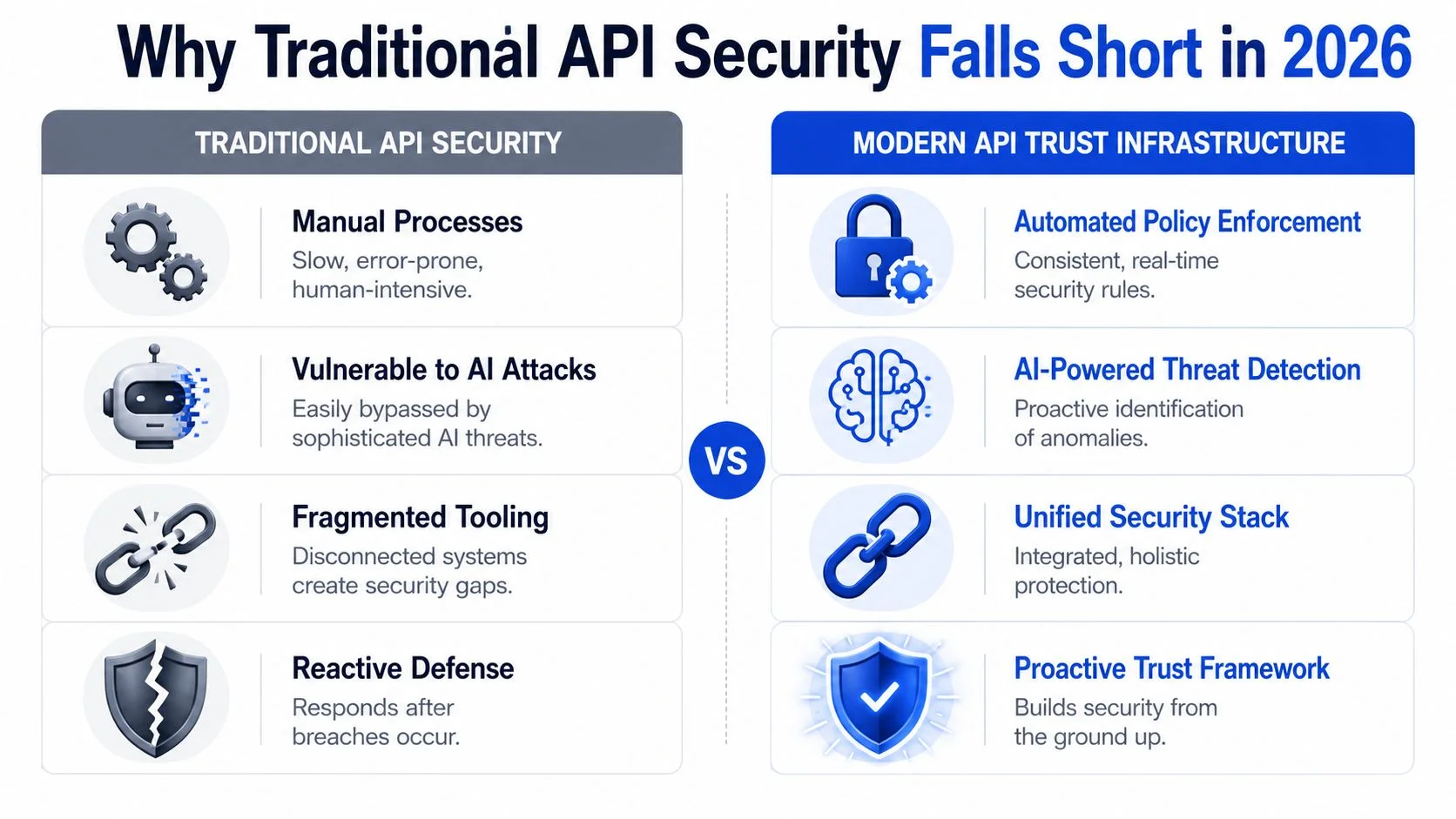
Most legacy API security patterns were built for a world where the primary risks were developer mistakes, exposed endpoints, and weak authentication hygiene. Those still matter. But they’re no longer the full threat model.
When machine actors call APIs, they don’t get tired, they don’t wait for business hours, and they don’t stay inside neat role boundaries. They chain tools, retry aggressively, explore undocumented paths, and amplify small schema or policy mistakes into system-wide failures.
The mismatch is now operational
One of the clearest signals comes from 2026 API commentary on developer behaviour, which says 89% of developers use generative AI, but only 24% design APIs specifically for agent consumption. That gap explains why so many teams feel they have “secured APIs” while still running systems that are poorly prepared for autonomous use.
The problem isn’t just authentication. It’s architecture.
Traditional approaches often assume:
- Human-paced interaction: Rate limits, approvals, and support processes assume a person is present to interpret failure and adjust behaviour.
- Single-purpose credentials: Static keys and broad service accounts assume one integration, one owner, one narrow use case.
- Perimeter confidence: If traffic reaches the gateway and presents valid credentials, many stacks still assume the request is probably legitimate.
- Post-event review: Logging exists, but auditability is often too fragmented to reconstruct intent, policy context, or downstream effects cleanly.
That model breaks under agentic workloads.
Why machine actors break old assumptions
An AI agent consuming several APIs can create a risk chain that looks benign at each step. A prompt triggers a tool call. The tool pulls customer records. Another call triggers a payment workflow. A third updates a ledger or pushes a message into a downstream queue. If each step is individually authenticated but not jointly governed, the system may still behave in ways nobody explicitly approved.
Mature API security now depends less on whether requests are authenticated and more on whether they are attributable, policy-constrained, contract-valid, and reviewable after the fact.
That’s a major shortcoming of traditional API security. It treats trust as access. Modern systems have to treat trust as verified behaviour under policy.
For platform teams reworking this stack, cyber risk management practice becomes relevant much earlier in the delivery lifecycle. You can’t wait for production telemetry to discover that your API semantics are too permissive for machine callers. By then, the contract, the permissions model, and the operational assumptions are already misaligned.
Pillars of a Modern API Trust Architecture
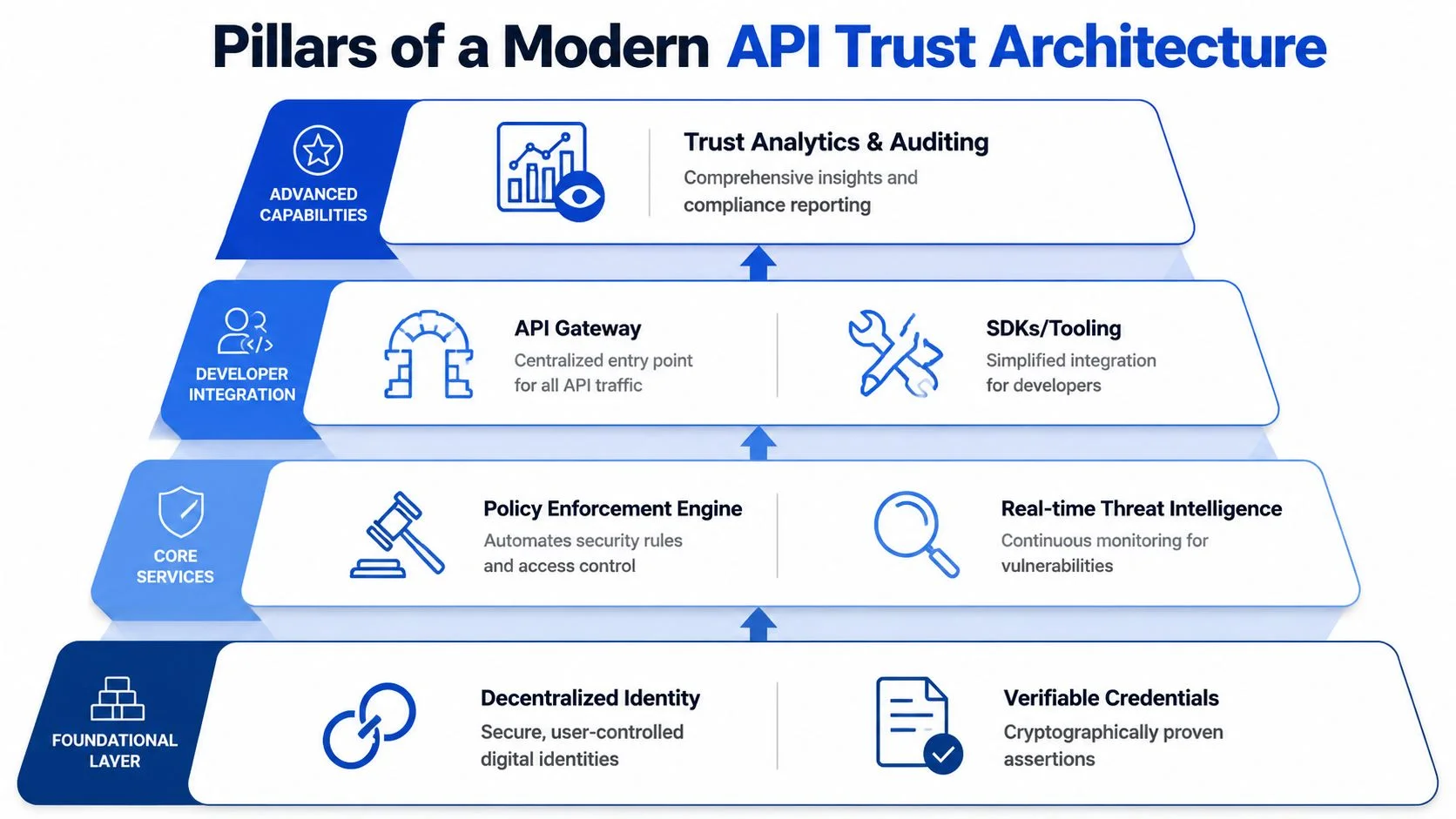
A modern API trust architecture has to answer four questions at once. What is the API allowed to do? Who or what is calling it? Which controls are enforced before and during execution? What evidence survives after execution?
The most useful 2026 framing comes from a security-first API pipeline methodology, which defines five pillars: Governance & Planning, Secure Design, Continuous Testing, Pipeline Controls, and Runtime Protection, beginning with risk assessment and threat-modelling. The value of that model is that it treats trust as a delivery system, not a tool category.
Five pillars that belong in one system
A lot of teams implement these pillars in fragments. The architecture works better when they are designed together.
| Pillar | What it governs | What leaders should ask |
|---|---|---|
| Governance and Planning | Data flows, asset classification, threat boundaries, ownership | Do we know which APIs handle regulated actions, and who approves behavioural changes? |
| Secure Design | Contracts, auth models, scopes, error semantics, trust boundaries | Are we designing for least privilege and machine-readable policy from the start? |
| Continuous Testing | Unit, integration, contract, and abuse-case validation | Can we detect drift before a consumer or partner sees it? |
| Pipeline Controls | CI hardening, build isolation, change checks, dependency discipline | Could an attacker or misconfiguration alter what we ship? |
| Runtime Protection | Live policy enforcement, anomaly detection, observability, response | Can we block unsafe behaviour without waiting for a manual review cycle? |
This architecture also changes who owns “API security”. It no longer sits only with AppSec or the gateway team. Product, platform, DevOps, and security all shape trust outcomes through versioning, policy design, and release controls. Teams that want an external benchmark for validating testing depth often review resources like Affordable Pentesting’s SaaS solution to pressure-test whether their pipeline and runtime assumptions hold up under realistic attack paths.
Where cryptographic trust fits
The five pillars define process and control. They don’t tell you which primitives to choose. In higher-assurance environments, that’s where cryptographic identity and tamper-evident evidence become useful.
Examples include:
- Service identity with strong provenance: Workloads need identities that are distinct from human user accounts and scoped to actual execution contexts.
- Verifiable credentials for delegated permission: Instead of long-lived broad access, systems can present cryptographically provable claims about what they’re allowed to do.
- Immutable evidence for critical events: Some actions benefit from a tamper-evident record of approval, execution, or state transition, especially where disputes or audits matter.
- Selective disclosure of metadata: Trust doesn’t require exposing raw payloads everywhere. It often requires proving specific facts about a transaction or document.
The strongest trust stacks don’t push every event onto a chain. They decide which events need immutable evidence and keep the rest in conventional systems with stronger policy discipline.
That distinction matters in fintech, tokenisation, and verification platforms. For example, Merkle batching for many proofs anchored in one on-chain transaction is relevant when teams need verifiable attestations without treating every API event as a full blockchain write. The architectural goal is not maximal decentralisation. It is selective verifiability where business risk justifies it.
Developer Workflow for Building Secure APIs
Architecture only matters if teams can ship it repeatedly. The most practical workflow in 2026 starts with the API contract, then ties testing, CI controls, and runtime observability back to that contract.

Start with the contract, not the endpoint
A 2026 implementation guide for building APIs recommends spec-first contract design followed by three test layers: unit tests, integration tests, and contract tests to detect drift before consumers do. That sequence is more than good API hygiene. It’s a trust control.
When the contract is the source of truth, several things improve at once:
- Consumer expectations become explicit. Response structures, auth requirements, and error handling stop living in tribal knowledge.
- Breaking changes become visible earlier. CI spec-diff checks can flag incompatible edits before merge.
- Governance becomes automatable. Reviewers can inspect intended behaviour at the contract level instead of inferring it from implementation details.
- Agent consumption becomes safer. Machine callers rely heavily on predictable semantics and stable error formats.
A secure workflow usually looks like this:
- Design the OpenAPI contract first: Define schemas, auth methods, status codes, and idempotency expectations before handlers are written.
- Generate SDKs and validation artefacts from the spec: This reduces manual divergence between documentation and implementation.
- Run the three testing layers continuously: Unit tests validate handlers, integration tests validate infrastructure interactions, and contract tests catch consumer-facing drift.
- Review contract diffs in pull requests: Teams should treat schema and policy changes as operational changes, not documentation updates.
Decision test: If your team can merge a breaking change without noticing it, the API isn’t under trust control yet.
Secure the build path and runtime path together
A secure API can still become an untrusted service if the CI pipeline is weak. The zero-trust pipeline model described earlier emphasises hardened runners and ephemeral build agents, meaning each CI job executes in a fresh environment rather than inheriting state from earlier jobs. That sharply reduces the risk of persistence, hidden modification, and configuration drift.
This is also where trust infrastructure intersects with data handling. For sensitive verification and compliance systems, teams increasingly prefer designs where hashes or proofs move through the API while raw artefacts remain under tighter local or bounded storage controls. That pattern is explored in local hashing with only metadata sent to the API, and it reflects a broader principle: minimise what the API needs to know in order to prove what it needs to prove.
Here’s a useful build-to-runtime checklist:
- Harden CI runners: Use isolated, short-lived build environments with tightly scoped secrets.
- Gate on spec diffs and policy checks: Don’t let incompatible contracts or missing controls slip through as “minor” updates.
- Instrument tail latency and endpoint errors: P95 and P99 latency, plus endpoint-level error rates, reveal real partner and user pain faster than averages do.
- Separate authentication from authorisation logic: Token validation alone doesn’t answer whether a machine actor should perform a regulated action.
- Log decision context, not only request metadata: For critical paths, keep evidence of policy outcome, credential context, and versioned contract state.
A concise walkthrough is useful when you’re socialising these practices across engineering, product, and security teams:
The teams that do this well make one cultural shift. They stop treating trust as a security review gate and start treating it as a developer workflow primitive.
Enterprise Use Cases in Global Markets
API-first programmes are already mainstream enough that execution quality now matters more than intent. A 2026 industry survey reported that 82% of organisations have adopted some level of an API-first approach, while 25% operate as fully API-first organisations, up 12 percentage points since 2024. The strategic implication is easy to miss: once API-first becomes normal, trust infrastructure becomes a competitive separator.
Fintech and programmable payments
In regulated financial products, the issue isn’t merely protecting endpoints. It’s proving that payment initiation, balance movement, compliance checks, and partner callbacks happened under the right policy conditions.
That matters in several situations:
- Open banking and embedded finance: Third parties need stable contracts, fine-grained permissions, and evidence trails for disputed actions.
- Stablecoin and tokenised payment rails: APIs touch custody, issuance, settlement, and cross-system controls. Policy enforcement and auditability become part of product design.
- Treasury and wallet operations: Machine-to-machine flows often trigger actions across banking, ledgering, and blockchain systems in one sequence.
Verification, trade, and multi-party workflows
Cross-border document and data exchange has a different trust problem. Several actors may need to verify that a fact is true without receiving the full underlying record. That makes selective disclosure, event evidence, and immutable attestations more useful than broad data sharing.
A practical example is secure cross-border document verification for international trade services. In that kind of workflow, the API is not just a transport layer. It becomes the trust layer that coordinates issuers, verifiers, and auditors while limiting unnecessary data exposure.
Agentic software in regulated operations
The next use case is still underbuilt in public infrastructure guidance: software agents interacting with compliance, support, payment, or asset-management systems under bounded authority.
A useful design lens is to ask three questions before deploying any agent-facing API:
| Question | Why it matters |
|---|---|
| Can the agent prove its execution context? | A service identity alone may not capture which model, runner, or approval path initiated the call. |
| Can policy constrain delegated action? | Agents often need narrower, revocable permissions than human admins or backend services. |
| Can investigators reconstruct intent later? | For disputes, incidents, or audits, teams need more than raw request logs. |
Global markets such as the US, UK, EU, UAE, Singapore, and Switzerland don’t all regulate software systems in the same way. But they do converge on one operating expectation. Systems that touch money, identity, records, or regulated decisions need clearer controls, stronger change governance, and more defensible auditability than consumer APIs built for convenience.
How Blocsys Delivers Enterprise-Grade Trust Infrastructure
For organisations building in blockchain, fintech, tokenisation, and AI-heavy environments, the implementation challenge is usually integration across layers. The hard part isn’t choosing one security product. It’s making contract design, policy enforcement, runtime evidence, and developer workflow operate as one system.
That’s where Blocsys fits. The company works on blockchain and AI infrastructure for fintechs, exchanges, tokenisation projects, and compliance-heavy digital platforms. In practice, that means helping teams design secure backend systems, verifiable workflow layers, and production-ready integration models where APIs are part of the trust boundary rather than just the access surface.
For product leaders, the useful lens is to treat trust infrastructure as a build programme with four workstreams:
- Contract and platform design: API specifications, versioning discipline, auth models, and machine-readable policy boundaries.
- Evidence and verification: Where hashes, signatures, attestations, or ledger anchors are needed, and where they are not.
- Operational hardening: CI/CD controls, environment isolation, runtime policy enforcement, and observability.
- Commercial feasibility: Delivery scope, sequencing, and architecture trade-offs tied to budget and product phase.
That last part is often neglected. Teams can scope early-stage platform work more realistically with the software development cost estimator from Blocsys, especially when trust requirements affect infrastructure complexity from the start.
Frequently Asked Questions
What is API-first trust infrastructure
API-first trust infrastructure is an architectural model where trust is designed into the API lifecycle from the beginning. It combines contract-first design, identity, policy enforcement, testing, pipeline controls, observability, and auditability so the API can support both human users and machine actors with predictable, reviewable behaviour.
Why do developers need trust infrastructure in 2026
Developers are building for a world where APIs are consumed by services, workflows, and AI-assisted systems, not just people. That changes the failure modes. Teams need stronger guarantees around contract stability, delegated permissions, policy enforcement, and evidence trails when automated systems trigger sensitive actions.
How does blockchain improve API security
Blockchain doesn’t replace core API security controls. It can improve trust where a system benefits from tamper-evident records, verifiable state transitions, or independent proof that an event happened. It is most useful for selected high-value events, not as a blanket replacement for conventional databases, gateways, or policy engines.
What is secure API authentication architecture
A secure API authentication architecture identifies the caller, validates its credentials, and links that identity to the specific permissions and policies that should apply at runtime. In stronger designs, authentication is paired with scoped authorisation, contract-aware validation, and decision logging so access can be constrained and reconstructed later.
How do API trust systems protect enterprise applications
They reduce ambiguity. A trust system makes the contract explicit, narrows permissions, checks for drift in delivery pipelines, enforces policy at runtime, and preserves evidence of important actions. That protects enterprise applications from silent schema breaks, over-privileged services, weak change control, and poor incident reconstruction.
How can teams evaluate implementation readiness
A useful readiness check is qualitative and direct:
- Contract discipline: Is the API spec the source of truth?
- Testing depth: Are unit, integration, and contract tests all in place?
- Pipeline hardening: Are build environments isolated and reviewable?
- Runtime controls: Can policy be enforced continuously, not just documented?
- Auditability: Can the team explain who or what acted, under which version and rule set?
If the answer to several of those is unclear, the trust layer is still immature.
How can Blocsys help
Blocsys can help organisations design and build trust-aware API platforms for fintech, blockchain, AI, and verification use cases. That can include secure backend architecture, blockchain-integrated trust models, API workflow design, and delivery planning for production systems that need stronger policy, auditability, and operational control.
If you’re planning an API platform where machine actors will handle money movement, verification, compliance, or autonomous workflows, it’s worth reviewing the architecture before those assumptions harden into production debt. Blocsys Technologies works with teams building blockchain and AI-powered infrastructure, and can help assess trust boundaries, implementation patterns, and delivery scope for secure API-first systems.
