
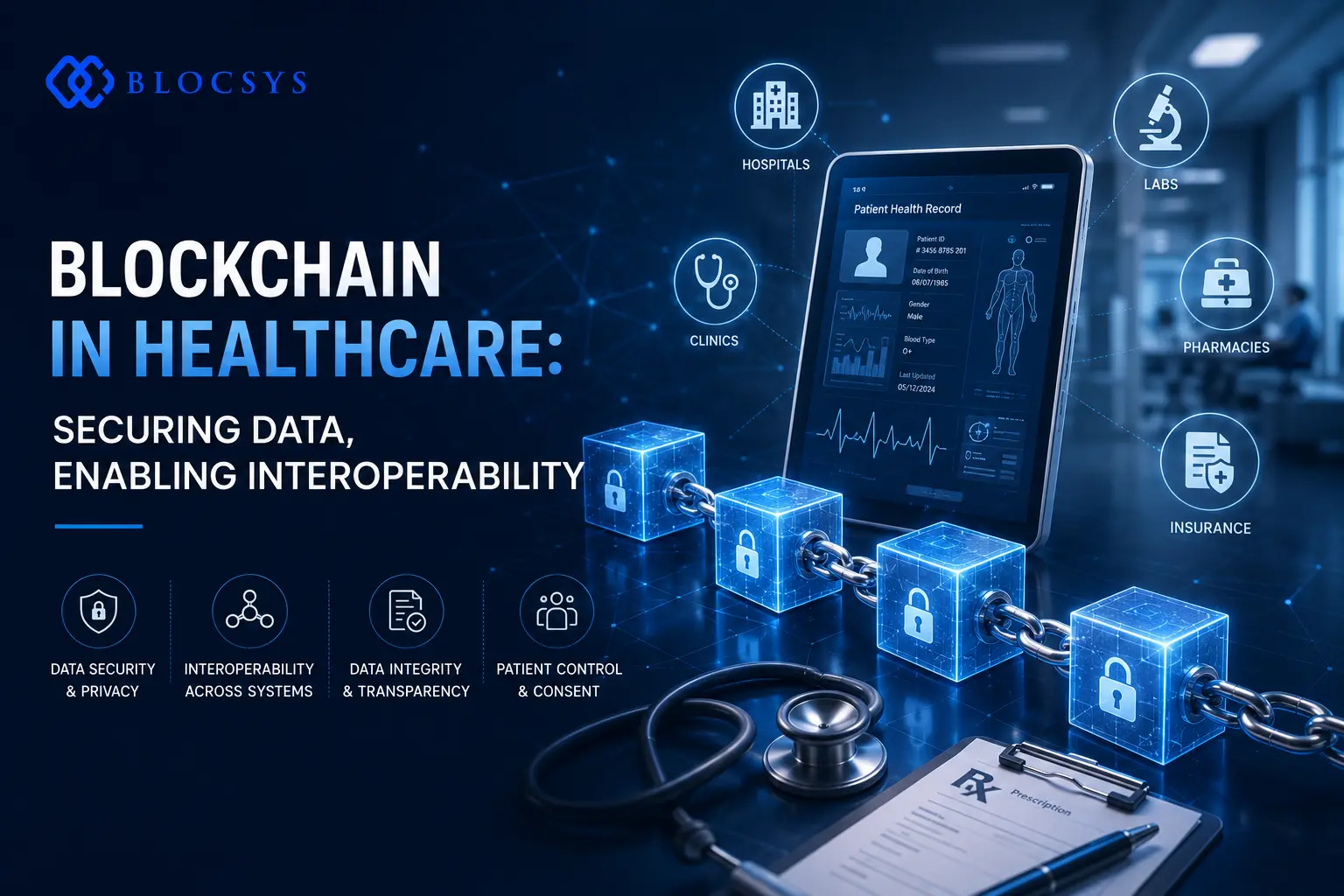
Healthcare runs on data that moves between more parties than almost any other industry: hospitals, labs, pharmacies, insurers, specialists, and patients themselves. Yet most of that data still lives in silos that don’t talk to each other well. That’s exactly where blockchain in healthcare enters the conversation. Used correctly, it doesn’t replace your electronic health record system or your compliance program. Instead, it gives healthcare organizations a new way to verify, audit, and coordinate data across parties who don’t fully trust one another but still need to work together. This article walks through what that actually looks like in practice, where it helps, and where it doesn’t.
What Blockchain in Healthcare Actually Means
Blockchain in healthcare refers to using distributed ledger technology to record, verify, and share proof of healthcare-related events. Think consent changes, prescription issuance, credential verification, or a lab result being generated. The ledger itself doesn’t usually hold the medical record. It holds a cryptographic fingerprint, a timestamp, and a record of who did what and when.
That distinction matters more than almost anything else in this article. Healthcare blockchain isn’t about dumping patient charts into a shared database. It’s about creating a tamper-evident audit trail that multiple organizations can rely on without needing a single central authority to referee every transaction. Hospitals, insurers, and labs each keep their own systems. The ledger simply proves that specific events happened exactly as claimed, in the order claimed.
Blockchain healthcare solutions built this way tend to sit alongside existing infrastructure rather than on top of it. They’re integration layers, not replacement systems. We’ll come back to that repeatedly, because it’s the single most common misconception vendors and consultants gloss over.
Why Healthcare Organizations Need Better Data Security and Interoperability
Healthcare data breaches remain some of the costliest incidents across any industry, largely because medical records carry information that’s valuable for years, not days. Credit card numbers get canceled. A patient’s diagnosis history doesn’t expire the same way.
At the same time, interoperability gaps cost real money and real outcomes. A patient transferred between hospitals often has their history re-entered by hand. Labs re-run tests because results didn’t transfer cleanly. Insurers spend weeks reconciling claims data that providers already had on file. None of this is new, but it’s gotten more visible as regulators push harder on data exchange requirements and patients expect the same seamless experience they get from banking apps.
Healthcare data interoperability and healthcare data security are usually treated as separate problems. In practice, they’re linked. A system that shares data poorly often compensates by over-restricting access, which hurts care coordination. A system that shares too freely creates security exposure. Blockchain-based healthcare architecture is one of several tools that can help balance that tension, particularly around consent, audit, and multi-party verification.
The mistake we see most often is organizations treating blockchain as a database replacement. It’s not a database. It’s a trust layer that sits on top of the databases you already have, and it only earns its place when three or more parties need to agree on the same facts without a central referee.
How Blockchain Can Secure Healthcare Data
Healthcare data security benefits from blockchain in a few specific ways, and it’s worth being precise about each one rather than making a blanket claim.
Tamper-Evident Audit Trails
Every write to a blockchain ledger is cryptographically linked to the one before it. If someone alters a past record, the chain breaks in a way that’s immediately detectable. For healthcare, that means you can prove a lab result wasn’t quietly changed after the fact, or that a consent form wasn’t backdated.
Cryptographic Hashing Instead of Raw Storage
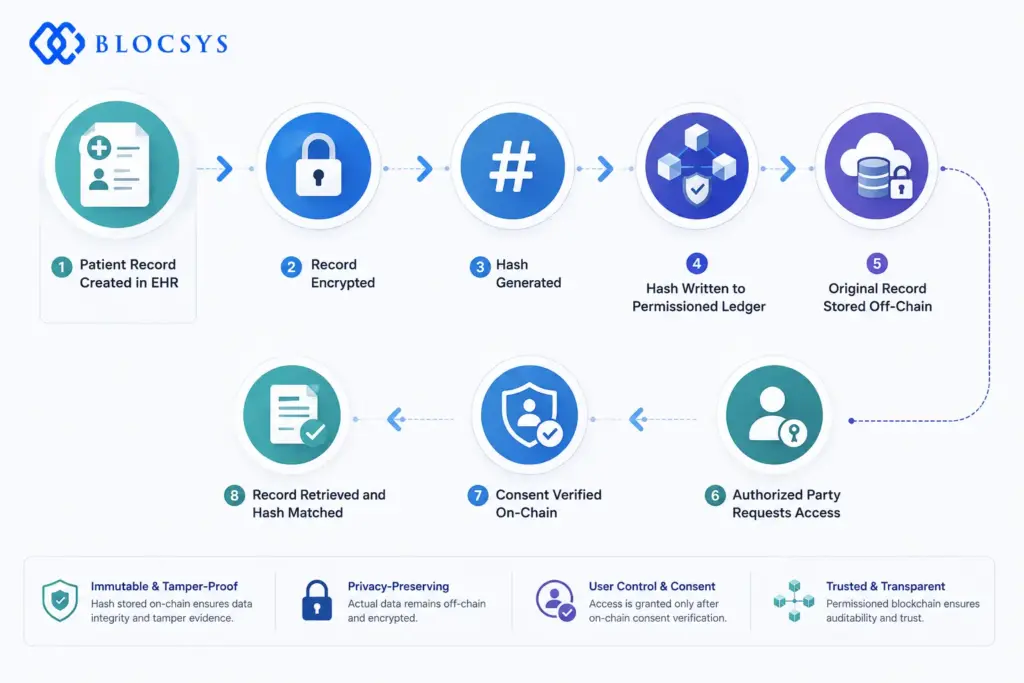
This is the part organizations get wrong most often. You don’t store the actual medical record on-chain. You store a hash, a unique digital fingerprint of the record, while the real data stays in your existing systems, encrypted and access-controlled. Anyone with the original file can verify it matches the hash. Anyone without it sees nothing meaningful. That’s how blockchain medical records work in practice: verification on-chain, sensitive content off-chain.
Access Control Through Permissioned Networks
Public blockchains like Ethereum’s mainnet are visible to anyone. That’s a poor fit for protected health information, full stop. Healthcare blockchain development almost always uses permissioned networks, where only vetted, authenticated participants can read or write. Hyperledger Fabric and similar frameworks are common choices precisely because they let you define who sees what.
None of this means blockchain automatically makes a healthcare system secure or compliant. It doesn’t. Encryption key management, network security, staff training, and access governance still have to be done right. Blockchain adds a verification layer; it doesn’t replace the rest of your cybersecurity program.
Blockchain and Healthcare Data Interoperability
Healthcare interoperability has a long history of standards trying to solve a hard coordination problem. HL7 FHIR is the current dominant standard for structuring and exchanging clinical data through APIs, and it’s not going anywhere. Blockchain doesn’t compete with FHIR. It complements it.
Here’s how that works in a real architecture. FHIR APIs handle the actual structure and transport of clinical data between systems. Blockchain healthcare interoperability adds a shared, verifiable record of consent, provenance, and access history that sits across organizational boundaries. So when Hospital A shares a FHIR-formatted record with Hospital B, the blockchain layer can confirm the patient consented, log that the exchange happened, and prove the data wasn’t altered in transit.
Consequently, you get a system where the clinical data still moves through standard, well-understood channels, but the trust and audit layer becomes shared instead of siloed per organization. That’s a meaningful upgrade over today’s typical setup, where each hospital’s audit log is its own island.
Why Blockchain Doesn’t Replace Interoperability Standards
It’s tempting to pitch blockchain as a fix for fragmented healthcare data management. It isn’t, and any vendor claiming otherwise deserves scrutiny. Interoperability requires shared data formats, shared terminology, and shared APIs first. Blockchain can’t force two EHR systems to agree on how they code a diagnosis. What it can do is add trust and traceability once those systems already agree on format, which is exactly why pairing it with FHIR-based exchange makes more sense than trying to use it standalone.
Blockchain and EHR/EMR Systems
Blockchain EHR integrations don’t ask providers to abandon Epic, Cerner, or whatever platform they’ve already invested millions into. Instead, the ledger typically connects through an API layer, recording hashes of record versions, logging access events, and managing consent flags that the EHR then respects.
This approach avoids one of the biggest failure points in past healthcare IT projects: forcing a rip-and-replace of systems that clinicians already know how to use. A well-designed hospital management system can incorporate blockchain-backed verification for specific workflows, like admissions records or discharge summaries, without disrupting the rest of the platform clinicians rely on daily.
The result is incremental. You’re not betting the whole EHR on new technology. You’re adding a verification and coordination layer around the edges where multi-party trust actually matters.
Patient Data Management and Consent
Consent management is arguably the strongest use case for blockchain in healthcare today. Patients often don’t know who has access to their records, or when that access was granted, used, or revoked.
A blockchain-based consent ledger lets a patient grant, restrict, or revoke access to specific data categories, with every change timestamped and visible to authorized auditors. Researchers requesting access to anonymized data for a clinical trial, for example, can have their access request logged automatically, alongside proof the patient actually agreed to it.
This doesn’t mean the patient’s actual medical history sits on the chain. It means the permissions record does, which is a much smaller, less sensitive dataset that’s still extremely valuable for compliance and dispute resolution. Decentralized healthcare data models built this way keep the sensitive payload where it belongs, in secured, access-controlled systems, while making the permission layer transparent and auditable.
Medical Record Sharing Across Providers
Ask any hospital administrator about record transfers and you’ll hear the same complaint: too much manual reconciliation. A patient moves from an urgent care clinic to a specialist to a hospital, and each handoff risks lost context or duplicated tests.
Blockchain-based healthcare record sharing works by having each provider write a verifiable pointer to the record they hold, rather than the record itself, to a shared ledger. When the specialist needs the urgent care visit notes, they query the ledger, get a verified pointer, and retrieve the actual file through a secured API call, with the exchange logged automatically.
That reduces reconciliation overhead considerably, because everyone’s working from a shared, verified index of what exists and where, instead of chasing down separate systems and hoping the versions match.
Provider Identity and Credential Verification
Verifying that a physician’s license, board certification, or hospital privileges are current is a surprisingly manual, slow process across most health systems. Credentialing can take weeks, and re-verification happens on a lag.
Blockchain healthcare development applied here creates a shared, tamper-evident registry of credentials that licensing boards, hospitals, and insurers can all check against in real time. Once a licensing body issues a credential on-chain, any hospital in the network can verify it instantly rather than calling the issuing board directly.
This matters even more for telehealth and locum tenens staffing, where providers frequently work across state lines and multiple institutions. A shared, verifiable credentialing record cuts onboarding time and reduces the risk of a lapsed license slipping through.
Pharmaceutical and Medical Supply Chain Traceability
Counterfeit drugs and gray-market medical devices remain a serious global problem. The pharmaceutical supply chain runs through manufacturers, distributors, wholesalers, and pharmacies, and each handoff is a point where fraud or tampering can occur.
Blockchain healthcare solutions applied to supply chains record each transfer of custody as a verifiable event: manufacturer to distributor, distributor to pharmacy, pharmacy to patient. Combined with serialization requirements already in place under frameworks like the U.S. Drug Supply Chain Security Act, blockchain adds an additional, harder-to-forge layer of custody verification.
Cold-chain monitoring for temperature-sensitive drugs, like certain biologics and vaccines, is another area seeing real pilot activity. IoT sensors log temperature data, and that data gets hashed and anchored to the ledger, so a pharmacy receiving a shipment can verify it never left the required temperature range.
Healthcare Claims and Insurance
Claims processing is notoriously slow, partly because insurers, providers, and sometimes third-party administrators all keep separate records of the same episode of care, then spend time reconciling discrepancies.
Smart contracts, self-executing code that runs automatically when predefined conditions are met, can automate parts of this process. A claim tied to a verified procedure code, verified provider credential, and verified patient consent can trigger automatic adjudication for straightforward cases, cutting the manual back-and-forth considerably. Building this kind of automated workflow typically involves dedicated custom blockchain development tailored to a payer’s specific claims logic, since off-the-shelf smart contract templates rarely map cleanly to real adjudication rules.
This doesn’t eliminate the need for human review on complex or disputed claims. It does, however, reduce the volume of routine claims that require manual reconciliation, which is where most of the administrative cost sits today.
Clinical Research and Data Integrity
Clinical trials depend heavily on data integrity. Regulators need confidence that trial data wasn’t altered after collection, and researchers need a reliable audit trail showing exactly when and how data was recorded.
Blockchain-based healthcare platforms used in clinical research typically timestamp data collection events and anchor hashes of case report forms to a ledger the moment they’re recorded. If a dataset is later questioned, researchers can prove it matches what was originally submitted, unaltered.
This has particular value for multi-site trials, where different research institutions each collect a portion of the data. A shared, verifiable ledger of collection events gives sponsors and regulators a single source of truth for provenance, even though the raw data stays distributed across each site’s own systems.
Healthcare Cybersecurity and Privacy Considerations
None of the use cases above work if the underlying privacy and compliance foundation is weak. HIPAA in the U.S. and GDPR in the EU set specific requirements around how protected health information gets stored, accessed, and disclosed. Blockchain doesn’t grant automatic compliance with either.
GDPR’s right to erasure is a genuine technical tension with blockchain’s immutability. That’s exactly why sensitive data shouldn’t live on-chain in the first place. If only a hash sits on the ledger and the actual record lives in a conventional, erasable database, a deletion request can be honored without needing to alter the chain itself. The hash becomes meaningless once its source data is gone.
Healthcare cybersecurity teams evaluating a blockchain healthcare platform should ask the same questions they’d ask of any vendor: how is encryption key management handled, who can join the network, what’s the incident response plan, and how does the architecture handle a data subject’s deletion or correction request. A blockchain component doesn’t exempt an organization from any of this.
Public vs Permissioned Blockchain for Healthcare
Public blockchains are open, decentralized, and visible to anyone who wants to participate. That transparency is valuable in some industries. In healthcare, it’s usually a liability, since protected health information can’t be exposed on a network anyone can read.
Permissioned blockchains, by contrast, restrict who can join, read, and write. Hyperledger Fabric, Corda, and similar enterprise frameworks are built specifically for consortiums like hospital networks, insurer groups, or pharmaceutical supply chains, where participants are known and vetted. This is why nearly every serious healthcare blockchain deployment today uses a permissioned model rather than a public chain.
Some architectures use a hybrid approach: a public chain for anchoring hashes (giving an extra layer of tamper-evidence through a widely distributed network), paired with a permissioned layer for the actual healthcare data and access control. That combination is more common in pilots than in full production today, largely because it adds operational complexity.
Blockchain Integration With Existing Healthcare Systems
Every healthcare organization already runs on legacy infrastructure: EHRs, lab information systems, pharmacy management platforms, billing systems. Blockchain healthcare data management has to work with all of that, not around it.
In practice, integration happens through APIs. FHIR endpoints, HL7 v2 interfaces, and custom middleware connect existing systems to the ledger, writing hashes and access events without requiring a rebuild of core clinical software. This is where a lot of projects stall, not because the blockchain component fails, but because the integration work with decades-old hospital IT systems turns out to be the harder problem.
Organizations that get this right usually start with a narrow, well-defined workflow, like consent management or credential verification, prove it works end to end, then expand. Trying to blockchain-enable an entire hospital’s data infrastructure in one project is a reliable way to blow both budget and timeline.
Challenges of Blockchain Adoption in Healthcare
It’s worth being honest about the limitations, because overselling this technology has already hurt its credibility once.
- Scalability: High-volume healthcare transactions, like every lab result at a large hospital network, can strain blockchain throughput if the architecture isn’t designed carefully.
- Governance: Multi-party networks need clear rules on who can join, who validates transactions, and how disputes get resolved. This is an organizational challenge as much as a technical one.
- Regulatory uncertainty: Rules around data residency, cross-border data transfer, and health data specifically are still evolving in many jurisdictions.
- Legacy system integration: Older hospital IT infrastructure wasn’t designed with API-first connectivity in mind, which adds real integration cost.
- Data quality: Blockchain can verify a record hasn’t changed, but it can’t verify the original data was accurate. Garbage in, verifiably immutable garbage out.
- Implementation cost: Permissioned network setup, integration work, and ongoing governance all carry real cost that needs a clear ROI case, not just enthusiasm for the technology.
None of these are dealbreakers. They’re planning considerations. Organizations that go in with realistic expectations tend to get meaningfully better outcomes than those chasing a broad, all-encompassing blockchain transformation.
How to Build a Blockchain Healthcare Platform
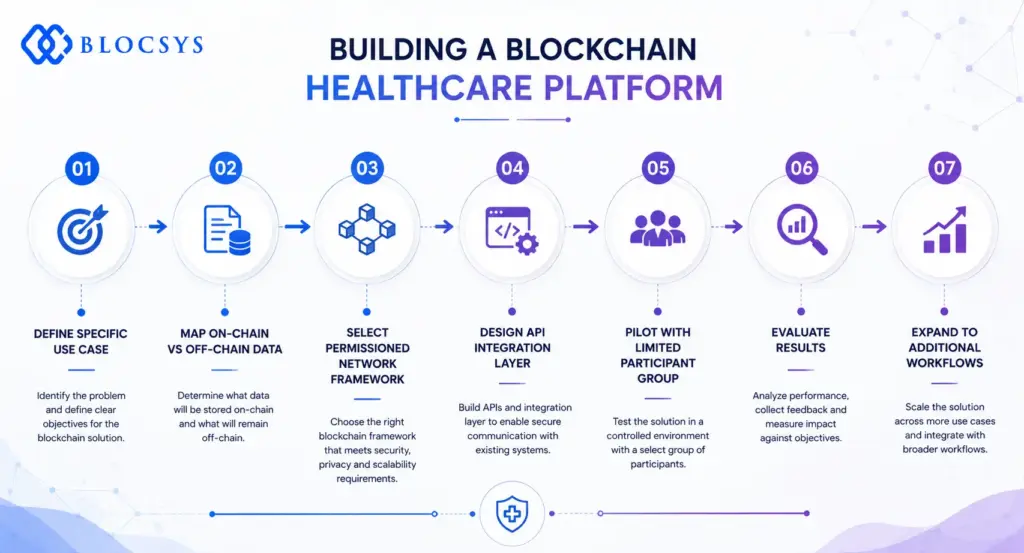
Building blockchain-based healthcare infrastructure well tends to follow a similar path across successful projects.
Start with a specific problem: consent tracking, credential verification, or supply chain traceability, rather than “blockchain for the whole hospital.” Map exactly what needs to be verified on-chain versus what stays in existing systems. Choose a permissioned network framework suited to your consortium size and governance needs. Then design the integration layer connecting your EHR, claims system, or supply chain software to the ledger through APIs.
Working with a team that’s done healthcare-specific blockchain integrations before saves significant time here, since the regulatory and interoperability nuances aren’t things you want to learn through trial and error on a live patient data system. A blockchain consultants engagement early on can help scope the architecture correctly before development spend begins, which is usually cheaper than redesigning mid-project.
How Businesses Should Evaluate a Healthcare Blockchain Solution
When evaluating vendors or internal proposals, a few questions cut through most of the marketing noise. Does the solution store sensitive data on-chain, or does it use hashes with off-chain storage? How does it handle GDPR erasure requests or HIPAA-required access controls? Is the network public or permissioned, and who governs participant access?
Also ask how the solution integrates with your existing EHR and FHIR-based interoperability infrastructure, rather than replacing it. And ask for a realistic cost and timeline estimate, since healthcare blockchain projects that skip proper integration planning tend to run well over budget. Tools like the Blocsys Software Development Cost Estimator can give you a starting reference point before you scope a full proposal.
Future of Blockchain in Healthcare in 2026
Heading further into 2026, the trend is toward narrower, better-integrated deployments rather than sweeping platform overhauls. Consent management, credential verification, and pharmaceutical traceability are the areas seeing the most real production activity, while broader clinical data exchange projects remain mostly in pilot stages.
Interoperability standards like FHIR continue maturing alongside blockchain healthcare interoperability efforts, rather than being displaced by them. Expect more hospital networks to pair blockchain-based verification with their existing hospital management system deployments for specific high-value workflows, particularly around consent and multi-party record verification, rather than treating blockchain as a standalone platform.
Organizations that succeed with blockchain in healthcare in 2026 will be the ones that treat it as one component in a broader data strategy, not a silver bullet. That’s a less exciting pitch than “blockchain fixes healthcare,” but it’s the honest one, and it’s the approach actually producing results in production environments today.
Bringing It Together
Blockchain in healthcare works best as a trust and verification layer, not a replacement for the systems you already run. It strengthens healthcare data security through tamper-evident audit trails and hashed verification. It supports healthcare data interoperability by adding a shared consent and provenance layer alongside standards like FHIR. And it creates real value across consent management, medical record sharing, provider credentialing, pharmaceutical traceability, claims processing, and clinical research integrity.
Getting there requires careful architecture, realistic scoping, and integration expertise that respects the legacy systems already in place. If your organization is exploring how blockchain-based healthcare infrastructure could fit into your data strategy, the team at Blocsys builds permissioned blockchain networks, smart contract automation, and enterprise integrations tailored to healthcare workflows. Whether you need to hire blockchain developers for a defined project or a dedicated blockchain engineering team for ongoing platform development, starting with a clear-eyed architecture review puts you in a far stronger position than starting with the technology and working backward.
Frequently Asked Questions
Here are direct answers to the questions we hear most often about blockchain in healthcare.
Is blockchain in healthcare HIPAA compliant?
Blockchain itself isn’t automatically HIPAA compliant, and no vendor should claim otherwise. Compliance depends on how the system is architected: whether protected health information stays off-chain in access-controlled storage, how encryption keys are managed, and how the permissioned network restricts access. A well-designed blockchain healthcare platform can support HIPAA compliance, but the technology alone doesn’t guarantee it.
Can medical records be stored directly on a blockchain?
Generally, no, and this isn’t recommended practice. Sensitive medical records should stay in encrypted, access-controlled off-chain storage. The blockchain typically holds a cryptographic hash of the record along with access and consent events, letting parties verify the record hasn’t been altered without exposing the actual patient data on the ledger itself.
Does blockchain replace HL7 FHIR or existing interoperability standards?
No. Blockchain complements interoperability standards rather than replacing them. FHIR handles the structure and API-based transport of clinical data between systems. Blockchain adds a shared, verifiable layer for consent tracking, audit trails, and data provenance across organizations, working alongside FHIR-based exchange rather than competing with it.
What’s the difference between public and permissioned blockchain in healthcare?
Public blockchains are open networks anyone can join and read, which makes them a poor fit for protected health information. Permissioned blockchains restrict participation to vetted organizations like hospitals, insurers, and labs, giving healthcare consortiums control over who can read and write data. Nearly all production healthcare blockchain deployments today use permissioned networks.
How does blockchain improve healthcare data interoperability?
Blockchain improves healthcare data interoperability by creating a shared, tamper-evident record of consent, data provenance, and access history across organizations that don’t share a central database. It doesn’t solve data format or terminology mismatches on its own, which is why it works best paired with standards like FHIR that already handle structured data exchange.
What are the main risks of adopting blockchain in healthcare?
The main risks include scalability limits under high transaction volume, integration complexity with legacy hospital IT systems, unclear governance across multi-party networks, and regulatory uncertainty around data residency and privacy law. Implementation costs can also run high if a project attempts broad transformation instead of starting with a narrow, well-defined use case.
Can blockchain help verify healthcare provider credentials?
Yes, this is one of the stronger current use cases. A shared, permissioned ledger of licenses and certifications lets hospitals, insurers, and licensing boards verify a provider’s credentials in real time instead of relying on slow manual checks. This is particularly useful for telehealth providers and staff working across multiple institutions or states.
How is blockchain used in pharmaceutical supply chains?
Blockchain records each transfer of custody in the pharmaceutical supply chain, from manufacturer to distributor to pharmacy, creating a verifiable chain of custody that helps combat counterfeit drugs. Combined with IoT sensor data, it can also verify cold-chain temperature compliance for sensitive medications and biologics during shipping.
Does GDPR conflict with blockchain’s immutability?
There’s real tension between GDPR’s right to erasure and blockchain’s immutable ledger design. The common solution is keeping actual personal data off-chain in conventional, erasable storage, while the blockchain only holds a hash. Once the source data is deleted, the hash becomes meaningless, which allows erasure requests to be honored without altering the chain itself.
How much does it cost to build a blockchain healthcare platform?
Cost varies significantly based on scope, from a narrow consent-management pilot to a multi-organization supply chain network. Key cost drivers include the integration work with existing EHR and claims systems, permissioned network setup, and ongoing governance. Getting a specific estimate typically requires scoping the exact use case with a development partner experienced in healthcare integrations.
Ready to move beyond theory and build an intelligent platform that delivers real-world value? Blocsys Technologies specialises in engineering enterprise-grade AI and blockchain solutions for the fintech, Web3, and digital asset sectors. Connect with our experts today to discuss your vision and chart a clear path from concept to a secure, scalable reality.
