
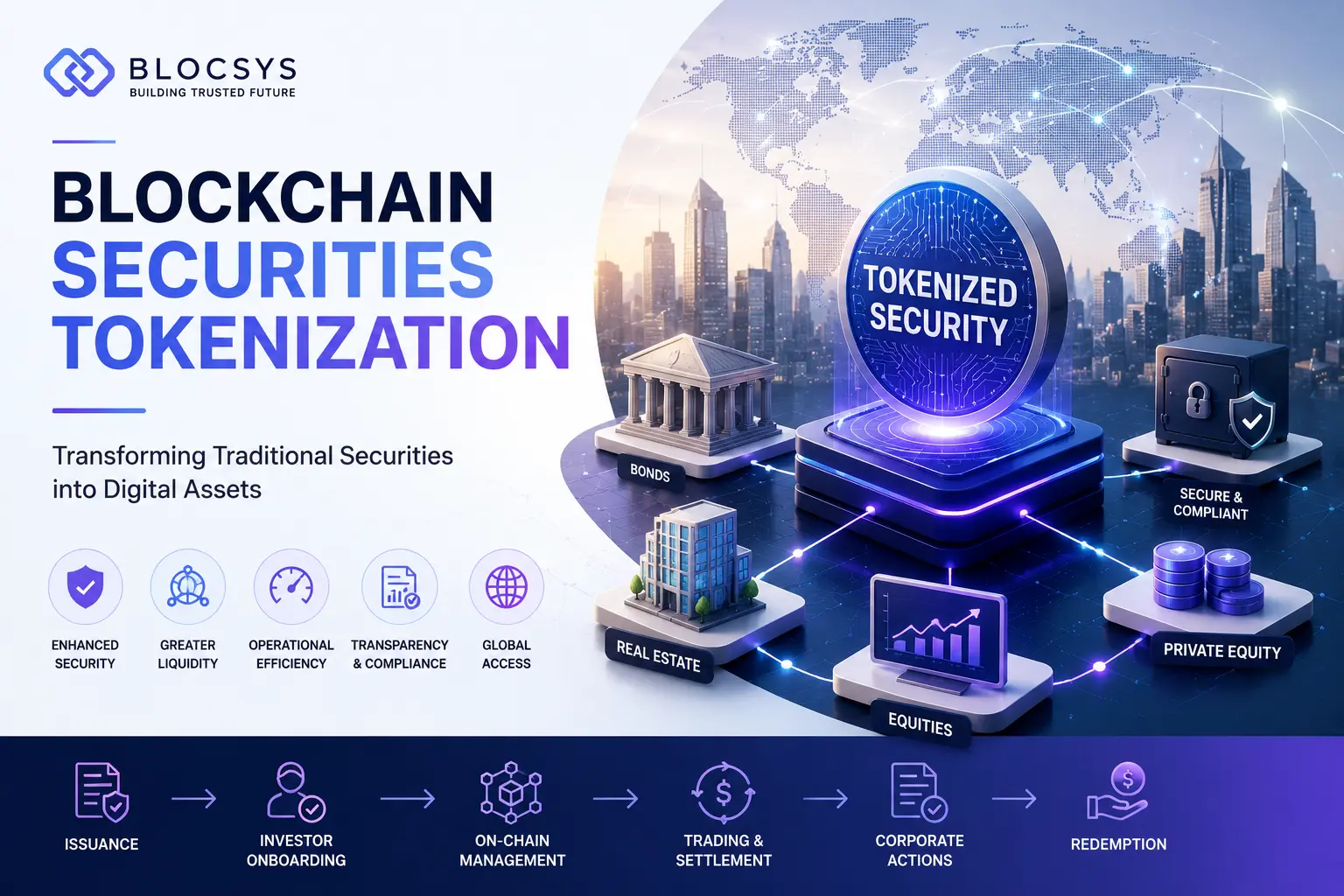
Securities tokenization has moved from experimental pilots to a real infrastructure conversation inside banks, asset managers, and custodians. If you’re a CTO, compliance lead, or capital markets executive weighing whether tokenized securities belong in your 2026 roadmap, you’re not alone. Institutions from Wall Street to Singapore are asking the same question: how do you represent regulated financial instruments on blockchain rails without breaking the legal and operational framework that makes securities trustworthy in the first place? That’s exactly what we’ll unpack here, and you can explore how Blocsys approaches this problem across the article.
What Is Securities Tokenization?
Securities tokenization is the process of representing ownership or economic rights in a regulated financial instrument, such as equity, debt, or a fund interest, as a digital token on a blockchain or distributed ledger. The token is linked to the underlying security through a legal structure, and it inherits that security’s regulatory status. It’s not a new asset class; it’s a new way to record, transfer, and service an existing one. That distinction matters more than most explainers admit. A token isn’t automatically a security, and a security doesn’t become compliant just because you tokenized it. We’ll come back to that.
Why Tokenized Securities Are Gaining Institutional Attention in 2026
Two years ago, security tokenization was mostly a research topic. Today, it’s a production conversation. BlackRock’s BUIDL fund, Franklin Templeton’s BENJI, and a growing list of tokenized money market and Treasury products have shown that regulated issuers can operate blockchain-based share classes at institutional scale. According to data tracked by industry platforms such as rwa.xyz, the tokenized U.S. Treasury market has grown from roughly a few hundred million dollars in 2023 to several billion dollars by 2025, though figures shift as new products launch.
Meanwhile, central banks and market infrastructure providers have taken notice. The Bank for International Settlements’ Project Agorá and the Monetary Authority of Singapore’s Project Guardian are examining how tokenized deposits and tokenized securities interact with wholesale settlement systems. These remain multi-institution pilots and research initiatives, not universal production standards. Still, they signal where serious capital markets thinking is headed.
The institutions that win in tokenized securities won’t be the ones who moved fastest onto a blockchain. They’ll be the ones who kept legal enforceability, custody, and compliance airtight while everyone else chased speed.
How Securities Are Tokenized: The Lifecycle
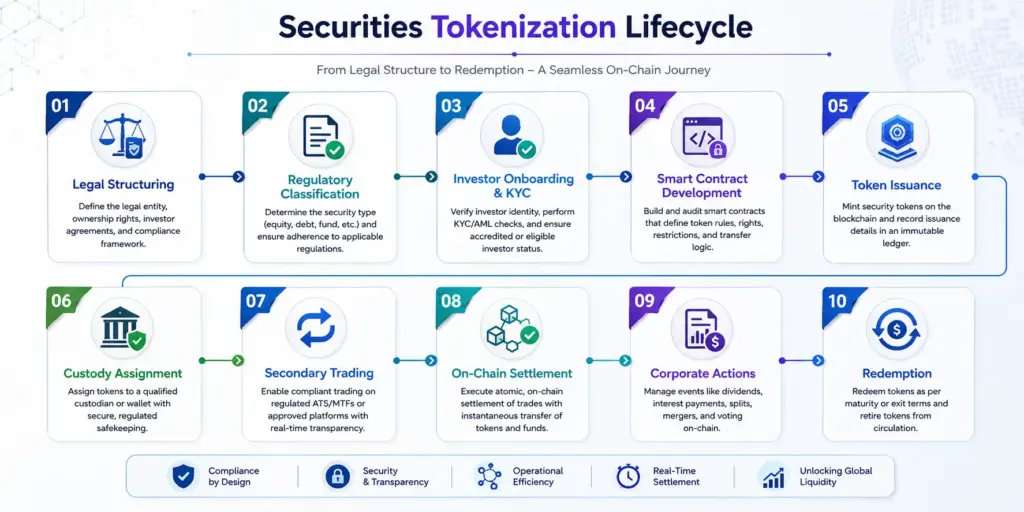
Tokenizing a security is a legal and operational exercise dressed up in blockchain terminology. Here’s roughly how it plays out in practice.
The Securities Tokenization Lifecycle
- Security selection and structuring: Issuers decide which instrument to tokenize, equity, bond, or fund unit, and structure the legal wrapper that ties the token to real ownership rights.
- Regulatory classification: Counsel determines how the instrument is classified under applicable securities law and which exemptions or registration paths apply.
- Issuer and investor onboarding: KYC, AML, and investor eligibility checks establish who can legally hold the token.
- Token design and smart contract development: Developers build transfer restrictions, compliance logic, and corporate action handling into the token contract.
- Issuance: Tokens are minted and distributed to verified investor wallets, often through a licensed transfer agent or placement partner.
- Custody and wallet infrastructure: Digital asset custody providers or qualified custodians safeguard the private keys controlling token ownership.
- Trading and transfer: Secondary transfers occur on permissioned venues or alternative trading systems, subject to the same restrictions as the underlying security.
- Settlement: Ownership changes are recorded on-chain, sometimes paired with cash-leg settlement.
- Corporate actions and servicing: Dividends, coupon payments, voting, and redemptions get executed through smart contracts or off-chain agents.
- Redemption or maturity: Tokens are burned or retired once the underlying obligation is fulfilled.
Security Tokens vs Tokenized Securities vs Digital Securities: Clearing Up the Terms
These terms get used interchangeably, but they’re not identical. Security tokens are the digital instruments themselves, the on-chain representation. Tokenized securities refers to the broader process and outcome of converting an existing security into token form. Digital securities is a wider category that includes both tokenized versions of traditional instruments and natively digital securities, ones issued directly on a blockchain without a prior paper or book-entry form.
Then there’s the umbrella term: tokenized assets, which covers securities alongside real estate, commodities, and other real-world assets. Securities tokenization is a specific, regulated subset of that broader real-world asset tokenization trend, and it carries the heaviest compliance burden because securities law governs almost every step.
Types of Securities That Can Be Tokenized
Tokenized Equities and Corporate Bonds
Tokenized equities represent shares in a company, public or private, issued or transferred via blockchain rails. Corporate bond tokenization applies the same logic to debt instruments, embedding coupon schedules and maturity terms into smart contracts. Siemens issued a €60 million digital bond on a public blockchain in 2023, and similar issuances have continued from European and Asian issuers since. These remain confirmed but still niche compared to total bond issuance volumes. If you’re evaluating this path, Blocsys’ corporate bond tokenization infrastructure and equity tokenization platform development services are built around exactly this use case.
Tokenized Funds and Private Credit
Tokenized funds represent shares in money market funds, ETFs, or private funds. Franklin Templeton’s OnChain U.S. Government Money Fund and BlackRock’s BUIDL are the most cited production examples, both operating with regulated fund structures. Tokenized private credit lets managers issue fractional interests in loan portfolios, improving transparency for investors, though secondary liquidity for private credit tokens remains limited and largely dependent on the platform’s investor network.
Tokenized Treasuries and Government Securities
Tokenized Treasuries represent claims on U.S. government debt or money market instruments backed by it. They’ve become the largest and most mature segment of the tokenized securities market, partly because Treasuries carry minimal credit risk and well-understood regulatory treatment. However, tokenized Treasury products still operate within existing securities and fund regulations; the blockchain layer doesn’t change the underlying legal obligations.
Asset ClassTokenization Maturity (2026)Primary ConsiderationTokenized TreasuriesProduction, growing fastestCustody and redemption mechanicsTokenized Money Market FundsProduction, multiple issuersFund regulatory complianceTokenized EquitiesEarly production, limited scaleTransfer restrictions, exchange listingCorporate Bond TokenizationPilot to early productionIssuer disclosure, secondary trading venuesTokenized Private CreditGrowing, platform-dependentInvestor eligibility, liquidity
The Role of Blockchain and Smart Contracts in Securities Tokenization
Benefits of Securities Tokenization
Done properly, securities tokenization can offer real operational advantages. It doesn’t guarantee them automatically, though; outcomes depend heavily on regulation, market structure, and adoption.
- Programmable compliance: Transfer restrictions and eligibility rules can be embedded directly into the token.
- Operational efficiency: Automated corporate actions and reduced manual reconciliation, where systems are properly integrated.
- Improved collateral mobility: Tokenized assets can potentially move between custodians and counterparties faster than paper-based transfers, where supported by infrastructure.
- Broader distribution and fractionalization: Where legally permitted, tokens can be divided into smaller denominations, widening potential investor access.
- Extended market access: Some platforms support near-continuous trading windows, though this depends entirely on venue rules and liquidity providers.
What tokenization does not automatically do is create liquidity, eliminate intermediaries, or guarantee lower costs. Those results depend on market adoption, custody arrangements, and whether enough investors and venues actually participate.
Tokenized Settlement and Delivery-versus-Payment
On-chain settlement can, in supported environments, reduce the multi-day settlement cycles common in traditional securities markets. Atomic delivery-versus-payment, where the cash leg and securities leg settle simultaneously within a smart contract, is one of the more promising technical capabilities blockchain offers. The Federal Reserve and DTCC have both published research exploring how tokenized settlement might integrate with existing systems, though production-scale DvP for regulated securities at national infrastructure level is still largely at the pilot and research stage as of 2026, not a broad market standard.
Tokenized Collateral, Securities Lending, and Liquidity
Tokenized collateral lets institutions post securities as collateral with faster recordkeeping and potentially broader eligibility across counterparties. JPMorgan’s Onyx platform has processed tokenized collateral and repo transactions in production for institutional clients, one of the clearer examples of confirmed institutional usage rather than pilot activity. Securities lending desks are exploring similar models, though most remain in early adoption phases.
Liquidity is the part everyone wants and nobody can promise. A tokenized security is only as liquid as the market willing to trade it. Fragmented venues, limited investor pools, and inconsistent secondary trading infrastructure still constrain liquidity for most tokenized securities outside Treasuries and major money market funds.
Custody and Investor Ownership Rights
Who actually owns a tokenized security? That question sits at the center of every serious institutional evaluation. The token itself is only evidence of ownership; the legal rights come from the underlying structure, the issuer’s records, and applicable law. Digital asset custody, whether through a qualified custodian, bank-grade custody solution, or self-custody arrangement, determines who controls the private keys and therefore who can move the asset.
Investor rights, voting, dividends, redemption, need to be preserved through the token design, not assumed. A poorly structured token can strip investors of protections they’d normally have under traditional securities law, so legal review at the design stage isn’t optional.
Interoperability With Traditional Capital Market Infrastructure
Tokenized securities don’t exist in isolation. They need to connect with transfer agents, custodians, brokers, and trading venues that still run on legacy rails. Blocsys’ work with real world asset tokenization infrastructure focuses heavily on this bridge, connecting blockchain-based issuance with the compliance and settlement systems institutions already depend on. Without that interoperability, a tokenized security becomes an isolated island rather than an upgrade to existing market plumbing.
Globally, regulators in Singapore, Hong Kong, the UAE, and the UK have published guidance or run regulatory sandboxes for tokenized securities, while the EU’s MiCA framework primarily addresses crypto-assets rather than traditional tokenized securities. Compliance professionals should treat every jurisdiction’s rules independently rather than assuming one regulatory approach applies globally.
Regulatory and Compliance Considerations
Regulatory treatment of tokenized securities varies by jurisdiction, issuer, and structure. In the U.S., the SEC continues to apply existing securities laws to digital assets that meet the Howey Test criteria; there’s no separate “tokenization exemption.” The FCA in the UK, ESMA under Europe’s DLT Pilot Regime, and MAS in Singapore have each published frameworks addressing tokenized securities, but none of these frameworks make tokenization itself a compliance shortcut.
Investor eligibility, KYC/AML, transfer restrictions, cross-border distribution rules, and issuer disclosure obligations all still apply exactly as they would for a traditional security. Compliance depends on the specific security, the platform, and the jurisdiction, not on the fact that it’s tokenized.
Challenges and Limitations
Let’s be honest about where friction still exists. Legal uncertainty across jurisdictions slows cross-border issuance. Custody standards are still maturing, and not every custodian supports every token standard. Liquidity remains thin outside a handful of asset classes. Interoperability between blockchain networks and legacy financial infrastructure requires custom engineering. And investor education is still catching up, many institutional allocators are cautious, not because the technology fails, but because the operational model is unfamiliar.
Institutional Use Cases
Picture a mid-sized asset manager wanting to issue a tokenized private credit fund. They’d need a transfer agent to maintain the official register, a custodian to secure investor wallets, a compliance layer enforcing accredited investor restrictions, and a settlement mechanism connecting to their existing fund administrator. That’s an illustrative scenario, not a specific deployment, but it reflects how tokenization projects actually get built in practice: piece by piece, integrated with existing counterparties rather than replacing them outright.
The Future of Tokenized Securities and Capital Markets
Where does this go from here? Expect continued growth in tokenized Treasuries and money market funds, since they’ve already proven the model works at institutional scale. Corporate bond and equity tokenization will likely expand gradually as legal frameworks and secondary trading venues mature. Central bank research into wholesale settlement, including Project Agorá, suggests longer-term interest in connecting tokenized securities with tokenized cash. None of this replaces traditional capital markets infrastructure overnight; it augments it, piece by piece, where the business case holds up.
Why Enterprises Need Experienced Securities Tokenization Infrastructure
Building a securities tokenization platform from scratch means solving legal structuring, smart contract security, custody integration, and compliance automation all at once, and getting any one piece wrong can undermine the whole issuance. That’s why institutions increasingly work with an established Asset Tokenization Platform partner rather than building in-house from zero. Blocsys designs configurable, compliance-aware infrastructure for issuers and financial institutions evaluating tokenized equities, bonds, funds, and private credit, built to integrate with the custody and settlement systems you already trust.
If you’re scoping a build and want a realistic sense of investment involved, Blocsys’ Software Development Cost Estimator Tool is a useful starting point before requesting a formal proposal.
Frequently Asked Questions
Here are direct answers to the questions we hear most often about securities tokenization.
What is securities tokenization?
Securities tokenization is the process of representing a regulated financial instrument, like equity, debt, or a fund interest, as a digital token on a blockchain. The token links to the underlying security through a legal structure, and it inherits that instrument’s regulatory obligations. It changes how the asset is recorded and transferred, not its fundamental legal classification.
How does securities tokenization work?
It works through a multi-stage lifecycle: legal structuring, regulatory classification, investor onboarding, smart contract development, issuance, custody assignment, secondary trading, settlement, and corporate action servicing. Each stage connects blockchain infrastructure to real legal rights and compliance obligations. Skipping any stage risks creating a token that lacks enforceable ownership rights, which is why experienced legal and technical partners matter.
What is the difference between security tokens and tokenized securities?
Security tokens are the digital instruments themselves, the on-chain representation of ownership. Tokenized securities describes the broader process and category of converting existing regulated instruments into token form. You can think of security tokens as the output and securities tokenization as the process that creates them, both terms describe closely related but distinct concepts.
What types of securities can be tokenized?
Equities, corporate bonds, government securities, money market funds, investment funds, and private credit can all be tokenized. Tokenized Treasuries currently represent the most mature and widely adopted category, given their lower credit risk and clear regulatory treatment. Tokenized equities and corporate bonds remain earlier-stage, growing gradually as legal frameworks and trading venues develop further.
What are the benefits of tokenized securities?
Potential benefits include programmable compliance, faster corporate action processing, improved collateral mobility, broader investor distribution, and reduced manual reconciliation, where supporting infrastructure exists. However, tokenization doesn’t automatically create liquidity, cut costs, or eliminate intermediaries. Actual benefits depend on regulation, custody arrangements, market adoption, and how well the platform integrates with existing capital markets infrastructure.
How does tokenization affect securities settlement?
Blockchain-based settlement can enable atomic delivery-versus-payment, where cash and securities legs settle simultaneously, in supported environments. This could reduce reconciliation and settlement risk compared to traditional multi-day cycles. That said, large-scale on-chain settlement integrated with national market infrastructure remains mostly at the pilot and research stage, led by initiatives like DTCC and Federal Reserve research programs.
How are tokenized securities regulated?
Tokenized securities are regulated under the same securities laws that govern their traditional counterparts. In the U.S., the SEC applies existing frameworks like the Howey Test; other regulators, including the FCA, ESMA, and MAS, have published guidance for digital securities without creating tokenization-specific exemptions. Compliance depends on the specific instrument, issuer, platform, and jurisdiction involved.
Can equities and bonds be tokenized?
Yes, both tokenized equities and corporate bond tokenization are active, confirmed categories, though adoption remains earlier-stage than tokenized Treasuries and funds. Siemens’ 2023 digital bond issuance and subsequent corporate issuances demonstrate real production activity. Scaling further depends on secondary trading venue development, custody standardization, and investor familiarity with digital securities.
What challenges do financial institutions face when adopting tokenized securities?
Common challenges include regulatory uncertainty across jurisdictions, immature custody standards, thin secondary market liquidity outside Treasuries, and the engineering complexity of connecting blockchain infrastructure with legacy systems like transfer agents and DTCC rails. Investor education and internal operational readiness also slow adoption, even when the underlying technology performs as designed.
How can businesses build a securities tokenization platform?
Businesses typically start by defining the legal structure and target asset class, then work with an experienced technology partner to build compliance-aware smart contracts, custody integration, and investor onboarding workflows. Working with an established Asset Tokenization Platform provider reduces the risk of costly redesigns and helps ensure the platform integrates properly with existing financial market infrastructure from day one.
Conclusion
Securities tokenization isn’t a shortcut around regulation, and it isn’t a guaranteed liquidity machine either. It’s infrastructure, a way to represent, transfer, and service regulated financial instruments more efficiently, when it’s built correctly. The institutions moving fastest in 2026 are the ones treating tokenized securities as a serious capital markets project, not a marketing exercise. Whether you’re exploring tokenized equities, corporate bond tokenization, or a tokenized fund structure, the foundation you build matters more than the speed you build it at.
Blocsys works with financial institutions, issuers, and asset managers evaluating exactly this kind of infrastructure. Explore Blocsys’ Asset Tokenization Platform, or visit the Blocsys homepage to see how our team approaches compliant, enterprise-grade securities tokenization from legal structuring through settlement.
Ready to move beyond theory and build an intelligent platform that delivers real-world value? Blocsys Technologies specialises in engineering enterprise-grade AI and blockchain solutions for the fintech, Web3, and digital asset sectors. Connect with our experts today to discuss your vision and chart a clear path from concept to a secure, scalable reality.
