
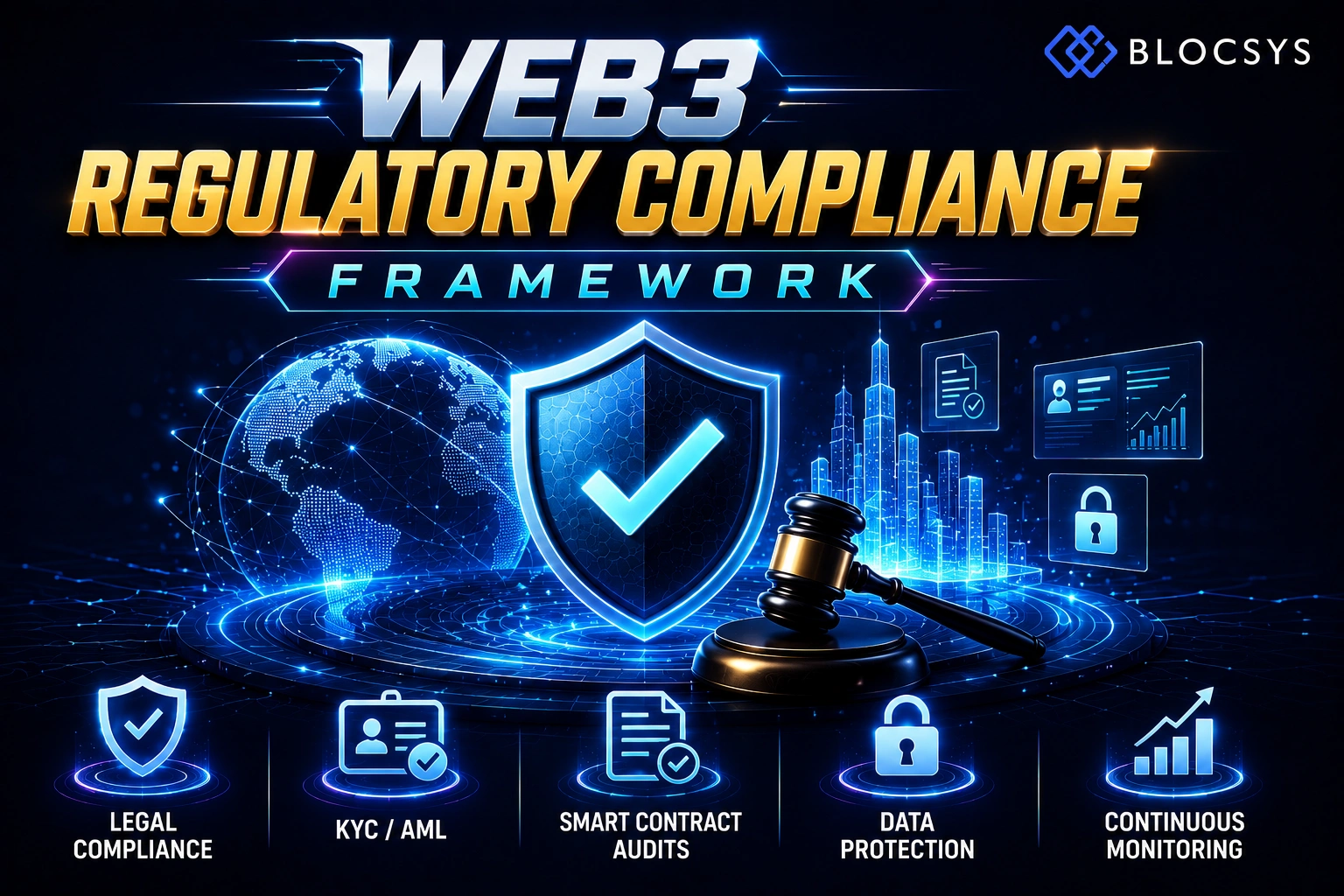
The digital economy is evolving at an unprecedented pace. Governments, regulators, and financial institutions worldwide are racing to keep up with decentralized technologies. A robust web3 regulatory compliance framework is no longer optional for businesses operating in this space. Moreover, companies that ignore compliance risk heavy fines, operational shutdowns, and lasting reputational damage. Therefore, understanding the building blocks of compliance is critical for any Web3 project pursuing long-term success.
Why Regulatory Compliance Matters in Web3
Web3 represents a fundamental shift in how value moves across the internet. Decentralized applications, smart contracts, and tokenized assets operate without traditional intermediaries. However, this decentralization does not place projects beyond the reach of the law. Regulators in the United States, European Union, and Asia are actively developing frameworks to govern these technologies. Consequently, businesses must engage proactively with compliance rather than waiting for enforcement actions to force their hand.
Additionally, institutional investors increasingly demand regulatory clarity before committing capital. A project with a clear compliance posture attracts greater trust from banks, venture capitalists, and enterprise partners. Furthermore, early compliance investment typically costs far less than the legal fees associated with regulatory penalties. Therefore, treating compliance as a core business function — not an afterthought — creates real and measurable competitive advantages.
The Risks of Non-Compliance
Non-compliant Web3 projects face several serious consequences. Regulatory agencies can freeze assets, revoke licenses, and impose significant monetary fines. Moreover, founders and executives can face personal legal liability in severe cases. Recent enforcement actions by the U.S. Securities and Exchange Commission against DeFi platforms highlight this growing reality. Additionally, the Financial Action Task Force (FATF) has issued binding global guidelines targeting virtual asset service providers. Therefore, staying informed about regulatory developments is now an operational necessity, not merely a legal formality.
Building a Web3 Regulatory Compliance Framework That Works
Constructing a solid compliance strategy requires systematic planning and continuous adaptation. A comprehensive web3 regulatory compliance framework typically covers identity verification, transaction monitoring, data privacy, and smart contract governance. Furthermore, it must account for jurisdiction-specific rules that vary significantly across regions. Consequently, a one-size-fits-all approach rarely succeeds in today’s global decentralized economy.
KYC and AML Requirements
Know Your Customer (KYC) and Anti-Money Laundering (AML) protocols form the foundation of any compliance strategy. Web3 platforms must verify the identity of users engaging in financial transactions. Moreover, they must monitor transaction patterns to detect suspicious or illicit activity in real time. Decentralized identity (DID) systems allow projects to maintain user privacy while still satisfying regulatory requirements. Additionally, automated AML tools can scan blockchain transactions continuously, flagging anomalies for human review. Therefore, integrating these tools early in the development lifecycle saves significant remediation costs down the road.
Smart Contract Auditing and Governance
Smart contracts execute automatically without human intervention. Consequently, vulnerabilities in code can result in massive, irreversible financial losses. Regulatory bodies are beginning to require formal audits of smart contracts used in financial applications. Furthermore, governance structures such as decentralized autonomous organizations must demonstrate clear accountability and decision-making transparency. Projects should follow established smart contract security best practices and engage third-party auditors on a regular basis. Additionally, maintaining a thorough audit trail supports regulatory examinations and builds lasting user confidence.
Navigating Global Regulatory Landscapes
Different jurisdictions approach Web3 regulation in markedly different ways. The European Union’s Markets in Crypto-Assets (MiCA) regulation establishes a comprehensive licensing regime for crypto-asset service providers. However, the United States relies on a fragmented patchwork of existing securities, commodities, and banking laws. Therefore, projects operating globally must map their activities against multiple regulatory regimes simultaneously. Furthermore, engaging qualified local legal counsel in each target market reduces the risk of unexpected compliance failures and enforcement surprises.
Token Classification and DAO Accountability
One of the most complex compliance challenges involves token classification. Regulators often determine whether a token qualifies as a security, a utility token, or a commodity based on its characteristics and specific use case. Moreover, misclassification can immediately trigger serious securities law violations. DAOs add further complexity because traditional legal systems struggle to assign liability to decentralized entities. However, jurisdictions including Wyoming and the Marshall Islands have introduced DAO-specific legislation to address this gap. Additionally, projects can explore DAO legal wrapper structures to formalize accountability without sacrificing decentralization.
Building a Future-Proof Compliance Strategy
Regulatory requirements in Web3 will continue evolving rapidly. Therefore, compliance strategies must build in flexibility and continuous regulatory monitoring. Businesses should appoint dedicated compliance officers, subscribe to regulatory intelligence services, and actively participate in industry working groups. Moreover, proactive engagement with regulators — through comment letters, sandbox programs, and open dialogue — positions companies as responsible and trustworthy actors in the space.
Furthermore, investing in Web3 compliance technology helps automate reporting, monitoring, and documentation workflows efficiently at scale. Ultimately, a well-designed web3 regulatory compliance framework is not a barrier to innovation — it is an enabler of sustainable and responsible growth. Additionally, companies that embed compliance into their culture from day one build stronger products, attract better partners, and earn lasting user trust. Therefore, the time to act on compliance is now, before regulators force a reactive — and far more costly — response.
CLARITY Act and Web3 Regulatory Compliance
The CLARITY Act is an important development for Web3 businesses operating in the United States, as it seeks to establish clearer regulatory boundaries for digital assets and market participants. For blockchain startups, tokenization platforms, crypto exchanges, and other Web3 businesses, understanding developments such as the CLARITY Act can help shape regulatory planning, asset classification, licensing considerations, and compliance strategies. Businesses should continue monitoring the legislation and applicable guidance as the U.S. digital asset regulatory framework evolves.
Frequently Asked Questions
What is a Web3 regulatory compliance framework?
A Web3 regulatory compliance framework is a structured system of policies, controls, technologies, and governance processes designed to help blockchain and Web3 businesses meet applicable legal and regulatory requirements. A comprehensive framework typically covers KYC, AML, transaction monitoring, token classification, data privacy, smart contract security, governance, reporting, and jurisdiction-specific compliance requirements.
Why is regulatory compliance important for Web3 businesses?
Regulatory compliance is important for Web3 businesses because decentralization does not remove legal obligations associated with financial activity, digital assets, identity, consumer protection, or data handling. A strong compliance framework can reduce enforcement risk, improve institutional trust, support licensing requirements, and make it easier for a Web3 platform to operate across multiple markets.
What KYC and AML controls should a Web3 platform implement?
A Web3 platform should typically implement identity verification, customer risk assessment, sanctions screening, beneficial-owner checks where applicable, transaction monitoring, suspicious-activity detection, and ongoing compliance reviews. These controls can be connected to blockchain analytics and decentralized identity technologies to help platforms verify users while maintaining appropriate privacy and regulatory controls.
How does transaction monitoring work in Web3 compliance?
Web3 transaction monitoring analyses blockchain activity to identify patterns that may indicate suspicious or illicit behaviour. Compliance systems can monitor wallet addresses, transaction values, transaction frequency, counterparties, geographic exposure, and risk indicators, then flag unusual activity for investigation or human review. Automated monitoring can operate continuously, making it suitable for blockchain platforms that process transactions around the clock.
How does token classification affect Web3 compliance?
Token classification affects Web3 compliance because the legal treatment of a token can determine which regulatory requirements apply to its issuance, distribution, trading, custody, and transfer. Depending on its characteristics and use case, a token may be treated differently under securities, commodities, payments, or other regulatory frameworks. Businesses should establish the legal classification before launching the token rather than assuming that a token is unregulated simply because it operates on a blockchain.
What role does smart contract auditing play in Web3 compliance?
Smart contract auditing helps identify vulnerabilities and weaknesses in blockchain code before they can result in financial or operational losses. For regulated Web3 applications, audits can also contribute to governance and risk-management evidence by demonstrating that critical contract logic has been independently reviewed. A strong compliance framework should combine smart contract audits with access controls, upgrade governance, monitoring, and documented incident-response procedures.
How does MiCA affect Web3 businesses in the European Union?
MiCA, the Markets in Crypto-Assets Regulation, establishes an EU-wide regulatory framework for covered crypto-asset activities and creates requirements for relevant crypto-asset service providers and certain token issuers. Web3 businesses operating in the European Union need to determine whether their activities fall within MiCA and assess the associated licensing, disclosure, governance, consumer-protection, and operational requirements.
How does Web3 compliance differ in the United States and Europe?
Web3 compliance differs between the United States and Europe because the two markets use different regulatory structures and approaches to digital assets. The EU has established a more unified framework through MiCA for covered crypto-asset activities, while the United States has historically relied on multiple securities, commodities, banking, and state-level regulatory regimes. Web3 businesses operating across both markets therefore need jurisdiction-specific legal and compliance mapping rather than one universal compliance model.
How can DAOs remain compliant with regulatory requirements?
DAOs can improve regulatory compliance by establishing clear governance responsibilities, documented decision-making processes, defined authority, and an appropriate legal structure or wrapper where required. Although a DAO may distribute decision-making across participants, regulators can still examine the activities, economic functions, and individuals or entities involved in operating the system. Clear governance and accountability therefore remain important even in decentralised organisations.
What is the role of the CLARITY Act in Web3 regulatory compliance?
The CLARITY Act is a US legislative development aimed at creating clearer regulatory boundaries for digital assets and market participants. For Web3 businesses, developments surrounding the legislation can influence how companies approach token classification, licensing, market structure, and compliance planning. Because the US digital-asset framework continues to evolve, businesses should monitor the legislation and applicable regulatory guidance rather than treating a developing proposal as a final compliance rule.
How can businesses build a future-proof Web3 compliance strategy?
Businesses can build a future-proof Web3 compliance strategy by combining jurisdiction-specific legal analysis with KYC/AML, transaction monitoring, token classification, smart contract security, data privacy, governance, auditability, and continuous regulatory monitoring. Compliance should be incorporated into the platform architecture from the beginning and updated as regulations, business models, supported assets, and target markets change.
