
Legacy document verification is becoming less defensible at the exact moment regulated businesses need more certainty, not less. The market itself reflects that shift. The Document Verification and Fraud Detection market was valued at USD 4.3 billion in 2025 and is projected to reach USD 25.0 billion by 2034 at a 21.5% CAGR, while global cybercrime costs reached USD 8 trillion in 2023 and document and biometric fraud each affect approximately 35% of crypto trading platforms, according to Intel Market Research’s analysis of document verification and fraud detection.
For founders, enterprise CTOs, compliance heads, and digital identity teams operating across the EU, UK, USA, UAE, Singapore, Switzerland, Malta, Canada, Australia, and other regulated markets, that changes the design brief. Verification can’t be a bolt-on workflow handled by manual review, brittle databases, or isolated vendor APIs. It has to become infrastructure.
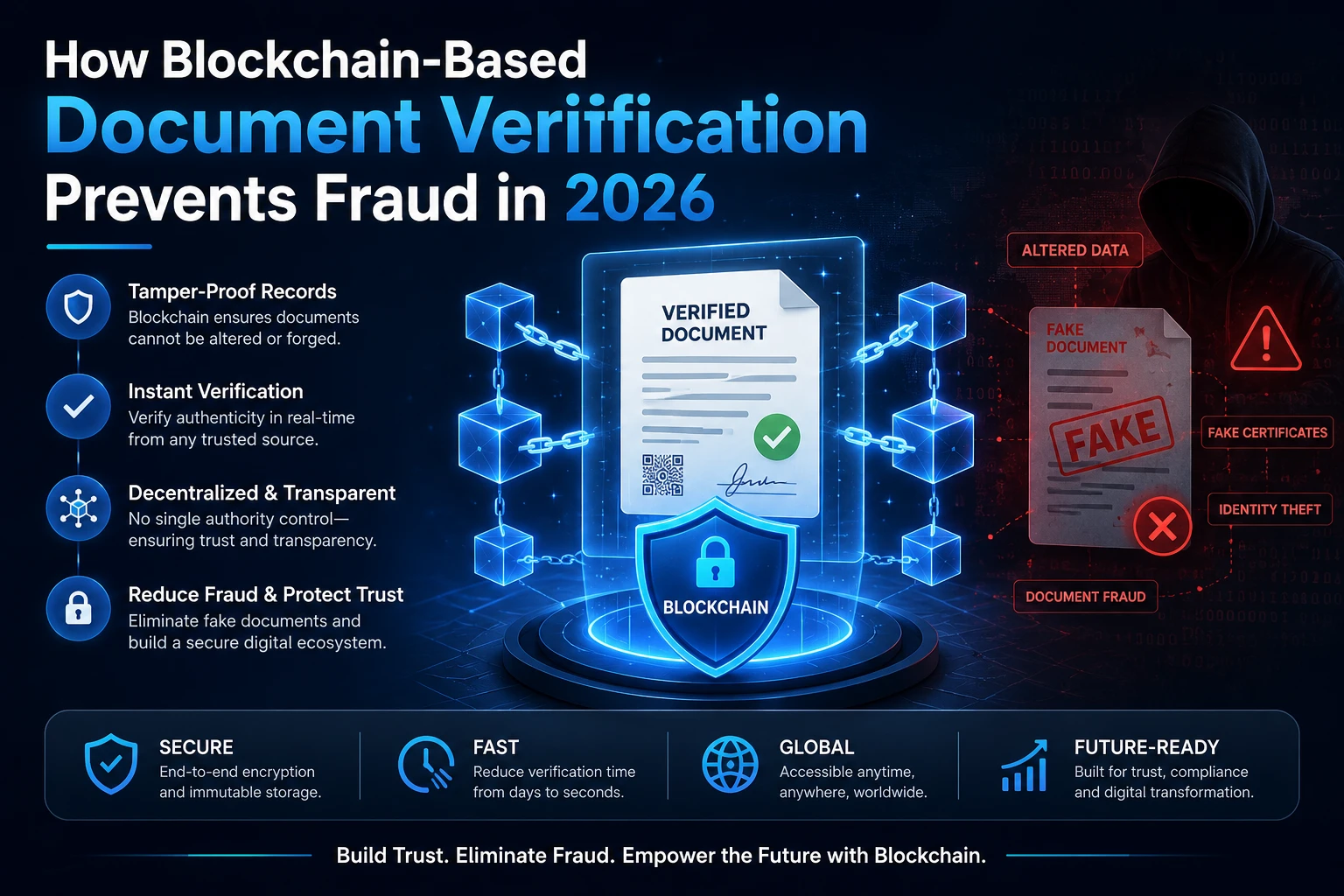
Blockchain-based document verification is a system that records a document’s integrity proof, issuer evidence, and verification logic in a tamper-resistant ledger, while keeping sensitive files in controlled storage. It gives enterprises a durable way to prove authenticity, detect alteration, and preserve auditability across borders.
The strategic question in 2026 isn’t whether blockchain can help with document fraud. It’s whether your architecture can use it in a way that still scales, still passes audit, and still adapts when regulation changes. For readers evaluating digital proof of document integrity systems, that’s where implementation quality matters. A useful companion perspective on this broader shift in trust infrastructure is Wonderment Apps’ piece on modernizing digital assets with blockchain tech, especially for teams thinking beyond a single verification workflow.
Table of Contents
- The Inevitable Rise of Immutable Document Verification
- Understanding the Architecture of a Blockchain Verification System
- How Immutability and Smart Contracts Neutralise Document Fraud
- Enterprise Use Cases in Banking Healthcare and Legal Sectors
- Integrating AI for Proactive and Predictive Threat Detection
- The Hybrid Architecture On-Chain Hashes and Off-Chain Data
- How Blocsys Engineers Future-Proof Verification Systems
- Frequently Asked Questions About Blockchain Document Verification
The Inevitable Rise of Immutable Document Verification
Enterprises don’t adopt immutable verification because blockchain is fashionable. They adopt it because conventional controls break down under scale, fraud pressure, and audit scrutiny.
In 2026, the biggest shift is architectural, not cosmetic. Compliance teams now need verification records that survive disputes, issuer changes, platform migrations, and cross-border investigations. Manual review can still play a role, but it can’t serve as the source of truth for high-volume systems where every approval creates downstream financial and legal exposure.
Three conditions are pushing immutable verification into the core stack:
- Fraud pressure is rising: Attackers can alter files, mimic source formats, and exploit fragmented review processes.
- Regulatory expectations are expanding: KYC and AML reviews increasingly require traceable controls, decision evidence, and defensible retention models.
- Digital products need lower trust friction: Onboarding, credential exchange, and partner due diligence all benefit when authenticity checks are machine-verifiable.
Strategic implication: Verification is no longer just about deciding whether a document looks real. It’s about proving, later and under challenge, what was submitted, who verified it, and whether it changed.
That distinction matters for CTOs selecting infrastructure. A basic verification vendor may tell you whether a submitted file passed a point-in-time check. A blockchain-based verification system can preserve a durable integrity record that remains testable after the transaction, after the onboarding event, and after the personnel involved have changed.
For enterprises operating in banking, legal tech, health tech, digital assets, and regulated SaaS, immutable verification becomes a control plane. It links document integrity, workflow governance, and audit readiness into a single operating model.
Understanding the Architecture of a Blockchain Verification System
A blockchain verification system works best when you think of it as a digital notary with programmable memory. It doesn’t solely store a file. It records the evidence needed to prove whether that file is authentic and unchanged.
For business leaders evaluating enterprise blockchain architecture and implementation patterns, the important point is that the system is not one component. It is a coordinated stack.
The five components that matter
First, the document is ingested. That might be a passport, degree certificate, medical record extract, legal agreement, or corporate filing. The system doesn’t need to publish the document itself to a ledger.
Next, the platform generates a cryptographic hash. That hash acts as the document’s fingerprint. If even a minor element changes, the resulting fingerprint changes as well.
Then the issuer or workflow authority signs the event digitally. This ties the verification act to an accountable party rather than to an anonymous process.
After that, a ledger records the proof. The blockchain stores the integrity commitment, timestamp, and related verification references in a form that is difficult to alter retroactively.
Finally, a verification layer checks future submissions against that record. If the newly computed fingerprint matches the anchored one, the document passes integrity validation. If not, it is flagged for tampering or substitution.
A practical market example of how teams package AI-assisted verification workflows around this kind of process can be seen in Ekipa AI’s Verifai product, which illustrates how business users increasingly expect verification tooling to combine automation with decision support.
Public versus permissioned design choices
Not every enterprise should use the same ledger model.
A public blockchain can offer stronger external verifiability and ecosystem interoperability. That matters when many independent verifiers need to validate records without trusting one operator.
A permissioned blockchain can offer tighter governance, transaction privacy, and policy control. That matters when regulated institutions need known validators and constrained access.
Most enterprise deployments don’t treat this as an ideological choice. They treat it as a systems design decision. If your use case involves public credentials, cross-organisation verification, or reusable attestations, broader interoperability may matter more. If your use case involves internal compliance records, restricted legal workflows, or sector-specific governance, permissioning may be more suitable.
The strongest verification architectures don’t ask whether blockchain is public or private in the abstract. They ask who needs to trust the record, who needs to govern it, and who must be able to challenge it later.
That’s the difference between a demo and an operating system.
How Immutability and Smart Contracts Neutralise Document Fraud
Fraud prevention happens when architecture closes the gap between what a document claims and what the system can prove.
Institutional buyers already recognise that strength. The Blockchain for Fraud Prevention market is projected to reach USD 77.6 billion by 2034, and in 2025 74% of crypto providers prioritised verification accuracy over speed while average user pass rates reached 94%, according to Market.us research on blockchain for fraud prevention.
Why tampering fails at the verification layer
Traditional fraud often succeeds because verification depends on human judgement, editable databases, or disconnected systems. A forged document can look convincing enough to pass. A changed PDF can circulate internally without anyone noticing that the original record no longer matches.
Immutability changes that.
When the original fingerprint of a document is anchored on-chain, later edits become detectable. The altered file may still look visually correct. It may still include logos, signatures, or formatting cues. But the integrity check won’t reconcile.
That neutralises several common attack paths:
- Post-issuance editing: names, dates, grades, licence terms, and account information can’t be changed without breaking the integrity proof.
- Back-dating or substitution: a fraudster can’t replace one document version with another while preserving the original ledger commitment.
- Database compromise: even if an internal system is altered, the external integrity anchor still exposes mismatch.
How smart contracts remove human weak points
Immutability alone isn’t enough. Enterprises also need rule enforcement.
Smart contracts act as the policy engine inside the verification stack. They define who can issue records, who can verify them, which status changes are permitted, and what conditions trigger approval or rejection. For organisations evaluating secure contract logic, smart contract auditing practices are directly relevant because weak verification code can introduce trust gaps even if the ledger itself is sound.
Smart contracts reduce fraud risk in ways manual workflows often can’t:
- Role control
Issuers, registrars, compliance reviewers, and counterparties can be assigned distinct permissions. - Deterministic checks
Verification rules execute the same way every time. That reduces inconsistency across regions or teams. - Automated evidence
The system records when a verification action occurred and under which rule set it was evaluated. - Controlled exception handling
Suspect submissions can be routed to enhanced review without letting front-line teams override policy casually.
Operational rule: Treat smart contracts as compliance logic, not just software. If they encode approval rights and evidentiary steps, they become part of your control framework.
That’s why the core value of blockchain verification isn’t just that records are hard to change. It’s that authorised actions become testable, replayable, and defensible.
Enterprise Use Cases in Banking Healthcare and Legal Sectors
The business case becomes clearest where document authenticity carries direct regulatory or commercial consequence.
Banking and fintech verification
In banking and fintech, document fraud doesn’t just create onboarding friction. It affects sanctions exposure, AML reporting quality, account opening risk, lending decisions, and transaction monitoring quality downstream.
Indian fintech KYC pilots provide a useful implementation signal. In those pilots, blockchain-based systems using off-chain IPFS storage and on-chain hashes via Ethereum smart contracts reduced unauthorised edit attempts by 96% and improved tamper-detection latency by 40 to 60% compared with centralised systems, according to research on blockchain-based verification in Indian KYC environments.
That result matters beyond India. It demonstrates that the strongest model is not “put documents on-chain”. It is “prove integrity on-chain while controlling sensitive data off-chain”.
For exchanges, neobanks, and payment platforms, that means stronger onboarding records and better audit defensibility when regulators ask how identity evidence was validated.
Healthcare record integrity
Healthcare systems deal with records that must be trusted across time, institutions, and legal contexts. That includes patient identity documents, provider credentials, consent artefacts, discharge summaries, and trial documentation.
A blockchain layer helps most when multiple actors must rely on a shared integrity proof without sharing unrestricted access to the full underlying record. Hospitals, laboratories, insurers, and digital health platforms can verify whether a record version is authentic without turning one central database into the only source of trust.
Legal documents and evidentiary confidence
Legal teams care less about hype and more about provability. Contract versions, board approvals, IP filings, and notarised records all benefit when authenticity is tied to timestamped integrity evidence.
Effective workflow design is paramount. Teams using tools that generate legal contracts with AI still need a separate mechanism to prove that the final executed artefact hasn’t been changed after approval. AI can accelerate drafting. Blockchain verification can preserve evidentiary confidence after execution.
For legal and compliance teams, the strongest value proposition is often not speed. It’s dispute resistance.
For a broader view of where these patterns fit in production systems, enterprise teams can compare them with other blockchain use cases shaping 2026.
Document Verification Methods Traditional vs Blockchain
| Feature | Traditional Verification | Blockchain-Based Verification |
|---|---|---|
| Security | Relies on manual checks, central databases, and editable records | Uses cryptographic integrity proofs and tamper-resistant ledger records |
| Auditability | Often fragmented across emails, portals, and internal systems | Creates durable, time-linked verification evidence |
| Cross-border trust | Depends on institution-by-institution validation | Supports shared verification across independent parties |
| Change detection | Alterations may go unnoticed until manual review | Any file change breaks the integrity match |
| Workflow enforcement | Reviewer discretion can vary | Smart contracts can standardise approval logic |
| Scalability | Manual review becomes operationally expensive | Automated integrity checks scale more predictably |
Integrating AI for Proactive and Predictive Threat Detection
Blockchain tells you whether a record has remained intact. AI helps determine whether the submission should have entered the system at all.
Blockchain proves integrity while AI screens intent
That division of labour matters. A blockchain system can confirm that a document matches a previously anchored fingerprint. It cannot, by itself, decide whether the original submission contained manipulated text, synthetic imagery, forged layouts, or mismatched biometric evidence.
AI closes that gap through several layers:
- OCR and data extraction identify whether document contents align with expected structures and fields.
- Visual analysis detects anomalies in fonts, spacing, image layers, and template inconsistencies.
- Biometric and liveness checks help establish whether the person presenting the credential is a real, present user rather than a spoofed identity.
- Pattern analysis flags suspicious behaviours across repeated submissions, device changes, or issuer anomalies.
This is why mature verification platforms increasingly combine both technologies. AI inspects the artefact and the actor. Blockchain preserves the resulting proof trail.
Why this matters for regulatory change
The hard problem in global compliance is not only fraud. It is moving standards.
As rules evolve, immutable ledgers can become awkward if the organisation treats a past verification event as permanently sufficient. That’s why the more effective approach is layered verification. Brave New Coin’s discussion of AI-enabled fraud controls notes that regulatory fragmentation is a key challenge and that modern systems use AI for “cryptographic, textual, and visual checks all at once” so verification can meet updated compliance demands without forking the ledger.
A useful technical framing for enterprise teams is this:
Blockchain preserves what happened. AI helps decide whether current standards are met.
That distinction allows an enterprise to keep old records immutable while still applying new review logic, new liveness controls, or tighter document analysis requirements to future interactions. For teams building this combined stack, AI for blockchain systems is no longer an experimental layer. It is part of the production security model.
The Hybrid Architecture On-Chain Hashes and Off-Chain Data
The most common misunderstanding in this market is also the most dangerous one. Enterprises often assume that stronger blockchain verification means putting more data on-chain.
It usually means the opposite.
Why fully on-chain is the wrong enterprise model
Personally identifiable information, regulated financial documents, healthcare records, and legal evidence sets don’t belong in a public immutable environment by default. Even in permissioned systems, writing raw records directly to the ledger creates governance, privacy, and retention complications that most regulated operators don’t want.
The architecture that scales is more restrained. The strongest platforms keep the sensitive payload in controlled storage and anchor only the integrity commitment on-chain.
That isn’t a compromise. It’s the practical model that aligns security with compliance.
According to analysis of scalable on-chain identity verification platforms, the winning architecture for auditable verification is to store identity data “off-chain in regulated, audited vaults” while anchoring only hash commitments on-chain. That model is described as essential for high-volume platforms managing KYC and AML across more than 220 countries.
What the hybrid model actually looks like
A strong hybrid architecture typically includes:
- Encrypted off-chain document storage
Files live in a regulated vault, secure cloud environment, or content-addressed store with access controls. - On-chain integrity anchors
The ledger records hashes, timestamps, issuer references, and policy-linked metadata. - Smart contract governance
Issuance, revocation states, access rights, and verifier permissions are enforced by code. - Version-aware verification services
APIs can check whether a document matches its anchored proof and whether it was validated under the correct rule set. - Compliance reporting hooks
Audit teams can reconstruct what happened without exposing all underlying documents to every participant.
This hybrid pattern creates a better balance across four competing goals:
| Design goal | Hybrid outcome |
|---|---|
| Privacy | Sensitive records remain under controlled access |
| Integrity | Any alteration to the stored file breaks the on-chain proof relationship |
| Scalability | Large files and repeated verifications avoid unnecessary on-chain cost |
| Regulatory alignment | Retention, deletion, and access policies stay manageable |
The deeper strategic implication is often missed. Once you separate document storage from document proof, you gain more freedom to update workflows, storage controls, and regional compliance policies without rewriting your trust layer.
How Blocsys Engineers Future-Proof Verification Systems
Enterprises rarely struggle with the idea of blockchain verification. They struggle with joining architecture, compliance, and operational delivery in one system.
What enterprise buyers should expect from an implementation partner
An enterprise-grade deployment should do more than verify a file hash. It should support jurisdiction-aware workflows, role-based approvals, API-driven integrations, and a governance model for changing standards.
That means asking tougher questions during vendor or partner evaluation:
- Can the system separate off-chain PII storage from on-chain proofing?
- Can rule logic evolve without invalidating historical evidence?
- Can internal compliance teams inspect and challenge verification paths?
- Can the platform integrate with KYC, case management, exchange, or trading infrastructure already in production?
- Can the design support both regional data controls and cross-border verification?
Where Blocsys fits
Blocsys builds blockchain and AI-powered infrastructure for fintechs, exchanges, and digital asset businesses that need production-ready verification and compliance systems. That includes custom smart contract logic, blockchain-backed document integrity workflows, and adjacent infrastructure such as blockchain development services and crypto trading platform development.
For enterprise buyers, the practical relevance is straightforward. A partner in this category should be able to design the hybrid architecture, connect verification to operational workflows, and account for how regulated products behave under audit, dispute, and regional expansion.
The most durable verification system is not the one with the most blockchain. It’s the one that preserves trust while giving the business room to operate.
That’s the standard CTOs should use when deciding whether to build, buy, or co-develop.
Frequently Asked Questions About Blockchain Document Verification
| Question | Answer |
|---|---|
| Can a blockchain-based document be revoked if a credential is no longer valid? | Yes. Enterprises typically don’t delete the historical proof. They change the status model around it. A verification system can preserve the original issuance record while marking the credential as revoked, expired, superseded, or subject to additional review. |
| Does blockchain verification mean the full document must be public? | No. In most enterprise deployments, the document stays off-chain in controlled storage. The blockchain records the integrity proof, timestamp, and related verification references rather than the full file contents. |
| How does decentralised identity fit into document verification? | Decentralised identity can provide reusable credentials and issuer-verifier relationships that reduce repeated document submission. It is most useful when multiple parties need to trust the same verified identity evidence without rebuilding the verification process from scratch. |
| What happens when regulations change after a document has already been verified? | Mature systems avoid treating one historical verification as permanently sufficient. They preserve the old record, then apply updated rule logic, AI checks, or policy requirements to later interactions and re-verification events. |
| Is blockchain verification suitable only for crypto and fintech? | No. The model is also relevant in healthcare, legal operations, education, corporate governance, and any sector where document integrity, issuer accountability, and auditability matter. |
| What should a CTO evaluate first before implementation? | Start with architecture and governance. Decide what stays off-chain, what is anchored on-chain, who controls issuance rights, how revocation works, and how the system will adapt to future compliance requirements. Cost and tooling matter, but control design matters more. |
If your team is designing document verification for KYC, regulated onboarding, legal records, healthcare workflows, or digital asset operations, Blocsys Technologies can help you assess the right architecture, define the on-chain and off-chain boundary, and build verification infrastructure that aligns with security, scalability, and compliance requirements. Connect with Blocsys to discuss blockchain document verification systems, decentralised identity workflows, smart contract architecture, and AI-assisted fraud prevention for enterprise environments.
Frequently Asked Questions
What is blockchain-based document verification?
It is a system that records a document’s integrity proof, issuer evidence, and verification logic on a tamper-resistant ledger, while keeping the sensitive files themselves in controlled storage. This gives enterprises a durable way to prove authenticity, detect alteration, and preserve auditability across borders.
Why is document fraud a growing concern for regulated businesses?
The Document Verification and Fraud Detection market was valued at USD 4.3 billion in 2025 and is projected to reach USD 25.0 billion by 2034 at a 21.5% CAGR, while global cybercrime costs reached USD 8 trillion in 2023. Document and biometric fraud each affect approximately 35% of crypto trading platforms, pushing fraud pressure and regulatory expectations higher for businesses across the EU, UK, USA, UAE, Singapore, Switzerland, Malta, Canada, and Australia.
How does a blockchain verification system actually work?
It functions like a digital notary with programmable memory: a document is ingested, the platform generates a cryptographic hash that acts as its fingerprint, the issuer or workflow authority digitally signs the event, and a ledger records the resulting integrity proof. If even a minor element of the document changes, the fingerprint changes too, making tampering detectable.
Why can’t manual review or traditional databases serve as the source of truth anymore?
Conventional controls break down under scale, fraud pressure, and audit scrutiny, and manual review cannot serve as a source of truth for high-volume systems where every approval creates downstream financial and legal exposure. Compliance teams increasingly need verification records that survive disputes, issuer changes, platform migrations, and cross-border investigations, which requires proving later, and under challenge, what was submitted, who verified it, and whether it changed.
What is driving enterprises toward immutable verification in 2026?
Three conditions are pushing immutable verification into the core stack: rising fraud pressure as attackers alter files and mimic source formats, expanding regulatory expectations for traceable KYC and AML controls and defensible retention models, and the need for lower trust friction in onboarding, credential exchange, and partner due diligence through machine-verifiable authenticity checks.
