
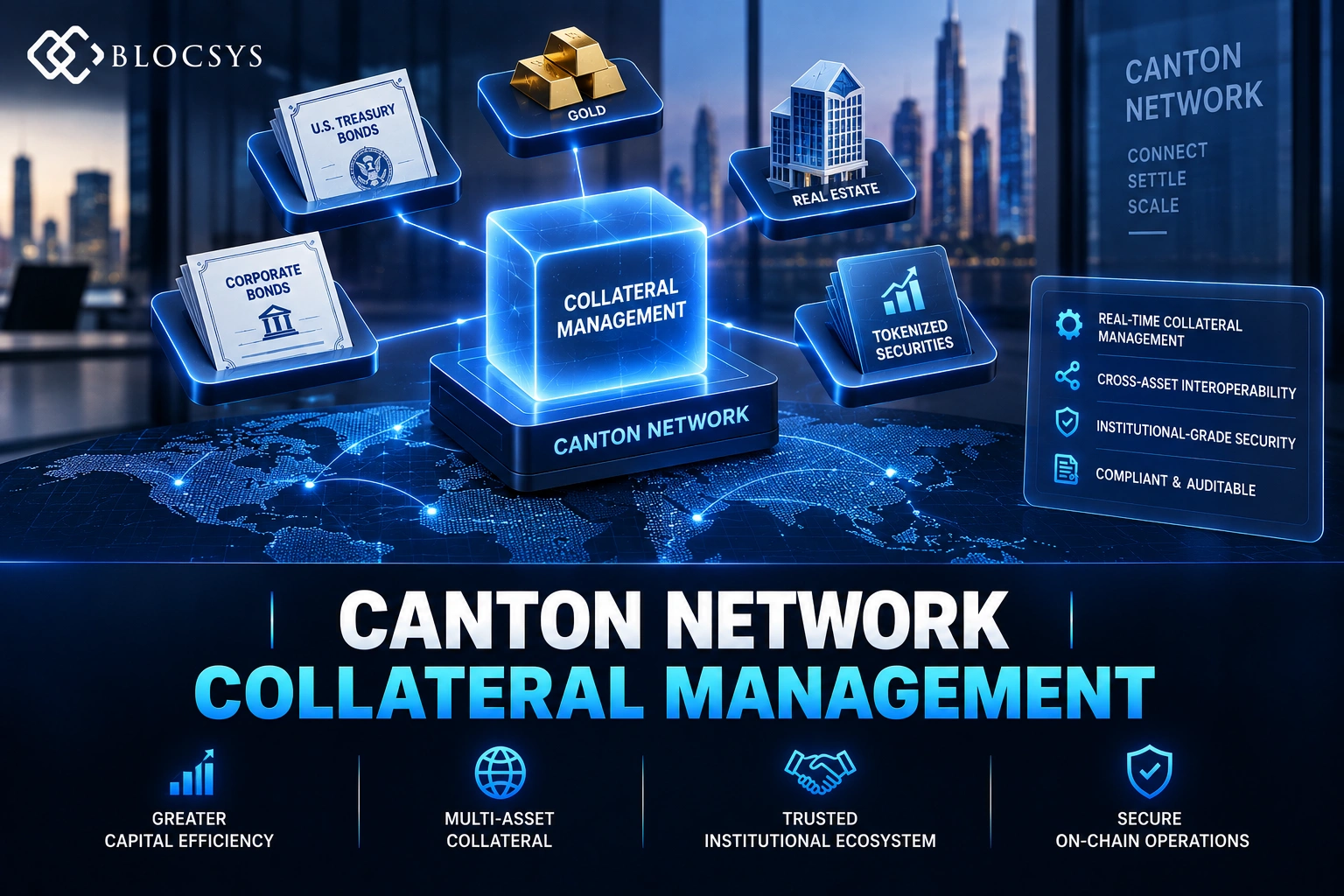
How Canton Network Is Transforming Onchain Collateral Management for Financial Institutions
Collateral sits at the center of nearly every institutional trade, yet the systems that manage it haven’t kept pace with modern markets. Banks, custodians, and asset managers still rely on batch processing, manual reconciliation, and siloed ledgers to track who owns what and who owes what. Canton Network Collateral Management offers a different approach — one built on synchronized, privacy-preserving smart contracts that let institutions move and verify collateral without exposing sensitive positions to the wrong parties. This article looks at why traditional collateral operations struggle, what onchain collateral management actually means, and how Canton Network’s architecture addresses the specific coordination problems that have made collateral mobility so expensive to fix.
The Real Cost of Traditional Collateral Management
Ask any treasury operations lead what keeps them up at night, and collateral fragmentation is usually near the top. Institutions hold collateral across multiple custodians, tri-party agents, and clearinghouses, each running its own ledger. Nothing talks to anything else in real time.
That fragmentation creates a cascade of problems. Reconciliation teams spend hours each day comparing records across counterparties, chasing breaks that stem from timing mismatches rather than actual errors. Settlement cycles introduce delays that tie up assets exactly when firms need liquidity most. Consequently, collateral often sits idle in one account while a firm scrambles to source eligible assets elsewhere.
Where Institutions Lose the Most Value
Manual processes remain surprisingly common in collateral operations, even at large institutions. Margin calls get confirmed by email or phone. Substitution requests route through multiple approval layers. Every manual step adds operational risk and slows down collateral mobility.
Counterparty coordination compounds the problem further. A pledgor and pledgee must agree on eligibility, valuation, and haircuts, often through separate systems that don’t share a common data model. Visibility limitations mean treasury teams frequently don’t know, in real time, exactly which assets are encumbered and which are free to redeploy. Therefore, firms hold larger liquidity buffers than they’d need with better visibility, which is its own hidden cost.
Collateral inefficiency isn’t a technology gap institutions accept anymore — it’s a balance sheet cost with a number attached. Firms that still reconcile collateral overnight are effectively paying a liquidity tax for using yesterday’s infrastructure.
What Onchain Collateral Management Actually Means
Onchain collateral management refers to recording collateral ownership, pledges, and transfers on a shared distributed ledger, so all authorized parties reference the same synchronized state instead of reconciling separate books after the fact. This isn’t the same as generic asset tokenization. Tokenization creates a digital representation of an asset. Onchain collateral management goes further — it governs how that asset moves, who has rights over it, and how those rights change atomically as obligations shift.
How It Differs From RWA Tokenization and Conventional Settlement
Real-world asset tokenization typically focuses on issuance: converting a bond, fund share, or equity into a digital token. That’s a necessary building block, but it doesn’t by itself solve collateral workflows. Collateral management additionally requires margin calculation, eligibility checks, substitution logic, and multi-party rights management, all synchronized across custodians and counterparties in near real time.
Conventional blockchain settlement, meanwhile, often assumes a single shared ledger where every participant sees every transaction. That model works for simple token transfers but breaks down for institutional collateral, where a bank’s exposure to one counterparty shouldn’t be visible to unrelated parties on the same network. This is precisely where Canton Network’s design diverges from typical public-chain settlement.
![Canton Network Collateral Management — [Flow diagram showing traditional collateral workflow versus onchain collateral workflow: Margin Call Issued → Manual Confirmation → Custodian Reconciliation → Settlement Delay, compared against Margin Call Issued → Smart Contract Validation → Synchronized Ledger Update → Atomic Settlement]](https://s3.blocsys.com/blocsys/blog-images/1788940027970-5823624d368a9f6f.webp)
What Canton Network Is and Why It’s Relevant to Financial Institutions
Canton Network is a privacy-enabled interoperability layer built on the Daml smart contract language, designed to let independently operated ledgers synchronize specific transactions without merging into one global, fully visible chain. Multiple regulated institutions, including custodians, exchanges, and asset managers, can transact on Canton while keeping counterparty-sensitive data restricted to the parties involved in each transaction.
That distinction matters enormously for collateral. A pledge agreement between a bank and a hedge fund needs to be visible to both parties and their custodians, and to no one else. Canton’s sub-transaction privacy model was built for exactly that requirement, rather than the all-or-nothing visibility most blockchain architectures assume.
Why This Matters More for Collateral Than for Simple Token Transfers
Collateral workflows involve multiple stakeholders touching the same asset over its lifecycle: the pledgor, the pledgee, custodians on both sides, sometimes a tri-party agent, and a clearinghouse. Each of these parties needs a synchronized, real-time view of the collateral’s status, but only the details relevant to their role. Canton Network Collateral Management, built on this architecture, gives institutions a way to coordinate across that many parties without forcing full transparency on everyone.
Firms evaluating this kind of infrastructure often start by exploring Canton Network Development services to understand what a production-grade implementation actually requires, from node operation to smart contract templates for collateral logic.
Canton Network Collateral Management: Tokenized Collateral and Asset Mobility
Tokenized collateral only creates value when it can move efficiently between parties. Canton Network Onchain Collateral workflows are built around smart contracts that represent both the tokenized asset and the rights attached to it — pledge status, encumbrance, and eligibility — in one synchronized record.
How Tokenized Collateral Moves on Canton
When a bank pledges tokenized securities to a counterparty on Canton, the smart contract updates ownership rights and encumbrance status in a single synchronized step. Both parties’ systems reflect the new state simultaneously. There’s no batch window. There’s no overnight lag.
This matters for collateral mobility specifically. Instead of waiting for end-of-day settlement to confirm a transfer, treasury teams can see, near-instantaneously, which assets are free to redeploy elsewhere. That’s a meaningful shift from traditional collateral management, where the same asset might appear encumbered in one system and free in another until reconciliation catches up.
Illustrative Scenario: Cross-Custodian Collateral Transfer
Consider a hypothetical scenario. An asset manager needs to post additional collateral to a broker-dealer following an intraday margin call. Under a traditional model, the asset manager’s custodian confirms availability, initiates a transfer instruction, and waits for the broker-dealer’s custodian to acknowledge receipt — a process that can take hours.
In an onchain collateral model built on Canton, the smart contract governing the margin agreement can validate eligibility, check available inventory, and execute the transfer with synchronized finality across both custodians’ systems within the same workflow. This is an illustrative example of how the architecture could support intraday movement — not a description of a live production deployment.
Institutions exploring how tokenized securities become eligible collateral often start with the underlying tokenization layer. Blocsys’s Real World Asset Tokenization and Asset Tokenization Platform pages cover how assets get structured before they can participate in collateral workflows.
Privacy and Interoperability in Canton Network Solutions
Privacy and interoperability tend to pull in opposite directions in most distributed systems. Canton Network Solutions address this by separating consensus from visibility — parties agree on the validity of a transaction without every node needing to see its full content.
Sub-Transaction Privacy Explained
Here’s the practical effect: a custodian validating a collateral transfer sees the parts of the transaction relevant to custody — asset identifiers, quantities, settlement instructions. It doesn’t see the counterparty’s broader trading book or unrelated positions. This selective disclosure model lets multiple institutions share infrastructure without sharing competitively sensitive information.
Interoperability works alongside this privacy model through Canton’s synchronization protocol, which allows independently operated ledgers, potentially run by different custodians or clearing venues, to settle transactions atomically across ledger boundaries. That’s a meaningfully different proposition than requiring every institution to migrate onto a single shared chain.
Why Regulated Institutions Care About This Distinction
Data governance requirements in banking and capital markets generally prohibit exposing client positions to unrelated third parties. Any onchain infrastructure serving regulated institutions has to respect that constraint from the ground up, not as an afterthought. Canton’s architecture was designed with this requirement in mind, which is part of why it has attracted interest from financial market infrastructure providers evaluating distributed ledger technology for institutional use cases.
That said, the technology itself doesn’t guarantee regulatory compliance. Institutions still need to evaluate data residency, custody rules, and reporting obligations under their applicable regulators, whether that’s the SEC, FCA, ESMA, or another authority, on a jurisdiction-by-jurisdiction basis.
Smart Contracts and Automated Collateral Workflows
Smart contracts written in Daml encode the business logic governing collateral: eligibility rules, haircut schedules, substitution rights, and margin thresholds. Once encoded, these rules execute automatically when conditions are met, rather than requiring manual sign-off at every step.
What Gets Automated, and What Doesn’t
Automated collateral workflows can handle margin calculation, eligibility verification against pre-agreed criteria, and execution of substitutions when a pledged asset needs to be swapped for another. However, exception handling, dispute resolution, and initial legal agreement negotiation still require human oversight. Automation doesn’t replace collateral managers; it reduces the volume of routine confirmations they have to process manually.
Programmable collateral workflows also support delivery-versus-payment and delivery-versus-delivery structures natively. Because the smart contract can condition one leg of a transaction on the other, both legs settle together or not at all. That atomicity removes a category of settlement risk that exists whenever asset and payment legs move through separate systems on separate timelines.
Atomic settlement isn’t a nice-to-have feature bolted onto collateral management. It’s the mechanism that finally lets institutions treat delivery-versus-payment as a guarantee rather than a best-effort process.
Firms building this logic typically work with a dedicated team through Smart Contract Development to translate legal collateral agreements into Daml templates that enforce those terms programmatically.
![Canton Network Collateral Management — [Flow diagram showing automated collateral workflow architecture: Collateral Agreement Terms Encoded → Real-Time Eligibility Check → Margin Threshold Monitoring → Smart Contract Triggers Substitution or Call → Atomic Settlement Across Custodians]](https://s3.blocsys.com/blocsys/blog-images/1788940028450-c376de9fbba56087.webp)
Settlement, Reconciliation, and Canton Network Financial Solutions
Reconciliation exists mainly because separate systems maintain separate records of the same underlying reality. Canton Network Financial Solutions reduce this problem structurally rather than procedurally. When counterparties reference the same synchronized ledger state for a given transaction, there’s simply less to reconcile after the fact.
How Synchronized Settlement Changes Operations Teams’ Work
Operations teams currently spend significant time investigating breaks that turn out to be timing differences rather than genuine errors. With synchronized settlement, both parties confirm the same transaction state at the same moment. That doesn’t eliminate reconciliation entirely, firms still need to verify data against internal books, legal records, and risk systems, but it removes a large share of the noise that comes from cross-institution timing mismatches.
Intraday collateral movement becomes more practical under this model too. Instead of batching transfers into end-of-day cycles, institutions can settle collateral movements as margin obligations change throughout the trading day. That’s particularly relevant for firms managing volatile portfolios where intraday exposure swings materially.
Canton Network Collateral Management vs Traditional Collateral Infrastructure
| Dimension | Traditional Collateral Infrastructure | Canton Network Collateral Management |
|---|---|---|
| Settlement timing | Batch, often end-of-day | Near real-time, transaction-level |
| Reconciliation | Manual, post-trade comparison across ledgers | Synchronized state reduces cross-ledger breaks |
| Visibility | Siloed per custodian or venue | Selective, permissioned across relevant parties |
| Collateral mobility | Limited by settlement cycles | Supported by atomic, near-instant transfers |
| Privacy | Achieved via separate systems | Achieved via sub-transaction privacy on shared infrastructure |
This comparison reflects architectural capability rather than a claim that every institution has already migrated production workloads onto this model. Adoption varies significantly by firm and by asset class.
Collateral Optimization and Liquidity Management
Collateral optimization means allocating the right asset, at the right time, to the right obligation, without over-collateralizing or leaving eligible assets idle. This has always been a hard problem because it requires real-time visibility into inventory across every custodian and account a firm uses.
Where Better Visibility Translates to Liquidity Gains
When a treasury team has synchronized visibility into which assets are encumbered and which are free, they can make faster, more precise allocation decisions. Consequently, firms can potentially reduce the liquidity buffers they hold purely to cover uncertainty about collateral status. That’s a meaningful outcome for treasury desks under pressure to optimize capital efficiency.
It’s worth being precise here: these are architectural capabilities and demonstrated potential, not universal outcomes. Actual liquidity improvements depend on how deeply an institution integrates onchain collateral workflows with its existing treasury and risk systems, and on how much of its collateral pool is represented onchain in the first place.
Institutional Risk Management Implications
Reduced settlement lag lowers counterparty risk exposure during the window between trade agreement and final settlement. Atomic delivery-versus-payment removes the risk of one leg settling without the other. Better reconciliation reduces operational risk from manual error. Together, these effects touch several categories of institutional risk that collateral managers track separately today.
Token lifecycle management, meaning issuance, transfer restrictions, and eventual redemption of tokenized collateral, also needs governance as portfolios scale. Institutions handling this at volume often look at a Token Management System to administer that lifecycle consistently across asset classes.
Enterprise Implementation Considerations
Adopting onchain collateral management isn’t a drop-in replacement for existing systems. It requires integration with custody platforms, risk engines, and existing settlement rails that institutions have relied on for decades.
Integration With Existing Financial Infrastructure
Most institutions won’t rip out core systems to adopt this model. Instead, they’ll build integration layers connecting Canton-based collateral contracts to existing custody and risk platforms via APIs. This lets a firm pilot onchain collateral workflows for a specific asset class or counterparty relationship before expanding scope.
Node operation, participant onboarding, and template design for collateral-specific smart contracts all require specialized engineering expertise. Firms building this internally, or supplementing internal teams, often turn to Dedicated Blockchain Engineering Teams or explore options to Hire Blockchain Developers with Daml and distributed ledger experience specifically.
Budgeting for a Canton Network Collateral Management Build
Costs vary widely depending on scope, whether a firm needs a full node deployment, custom smart contract templates for its specific collateral agreements, or integration work with multiple custodians. Institutions scoping a project early can get a directional estimate using the Software Development Cost Estimator before committing to a detailed build plan.
Risks and Limitations
No infrastructure shift comes without tradeoffs, and onchain collateral management is no exception. Network maturity, participant density, and regulatory clarity all affect how much value an institution can realize today versus over the next few years.
What’s Proven vs What’s Still Emerging
Canton’s privacy and interoperability architecture is documented and operational for participants already using the network. However, broad institutional adoption specifically for collateral management is still developing across the industry. Firms should treat pilots and proofs of concept as exactly that, not as evidence of widescale production deployment, unless a specific institution has publicly confirmed otherwise.
Regulatory treatment of tokenized collateral also varies by jurisdiction and continues to evolve. Institutions should consult qualified legal and compliance counsel before relying on any onchain collateral arrangement for regulatory capital or margin purposes. This article doesn’t constitute legal or financial advice.
The Future of Institutional Onchain Collateral
Looking ahead, the direction is fairly clear even if the timeline isn’t. As more custodians, clearinghouses, and asset managers connect to shared synchronization infrastructure, collateral mobility across institutions should keep improving. Cross-border collateral movement, currently slowed by differing settlement systems across the US, UK, and European markets, stands to benefit particularly from interoperable, synchronized ledgers.
Expansion into new collateral types, including tokenized money market fund shares and digital bonds, will likely follow as tokenization infrastructure matures alongside collateral-specific smart contract templates. Firms evaluating Canton Network Blockchain Development today are positioning for that broader shift rather than solving only today’s problem.
How Blocsys Supports Canton-Based Blockchain Solutions
Blocsys works as a blockchain, Web3, and fintech engineering partner for institutions building enterprise-grade digital asset infrastructure. Our work spans smart contract development, tokenization platforms, and blockchain integration for financial applications, the same building blocks that underpin onchain collateral workflows.
For institutions exploring Canton Network Collateral Management specifically, Blocsys can support architecture planning, smart contract design, and integration between onchain collateral logic and existing custody or risk systems. Related engineering work, including Equity Tokenization Platform Development and Corporate Bond Tokenization Platform Development, feeds directly into building eligible tokenized collateral pools.
Frequently Asked Questions
Here are direct answers to the questions we hear most often about Canton Network Collateral Management.
What is Canton Network collateral management?
It’s the use of Canton Network’s synchronized, privacy-preserving ledger to record, transfer, and manage collateral ownership and rights across institutional counterparties, replacing siloed post-trade reconciliation with shared, permissioned transaction state.
How can Canton Network support onchain collateral?
Canton supports onchain collateral through smart contracts that encode eligibility, margin, and settlement rules, combined with sub-transaction privacy that lets only relevant parties see specific collateral positions while still settling atomically.
Why is privacy important for institutional collateral management?
Banks and asset managers can’t expose client positions or trading books to unrelated parties on shared infrastructure. Canton’s privacy model lets institutions share settlement infrastructure without sharing competitively sensitive data.
How does Canton Network improve collateral mobility?
By synchronizing ledger state across parties in near real time, Canton reduces the settlement lag that traditionally keeps collateral tied up during batch processing windows, letting institutions redeploy eligible assets faster.
Can financial institutions tokenize collateral on Canton Network?
Yes. Institutions can represent securities, bonds, and other eligible assets as tokenized collateral on Canton, with smart contracts governing pledge status and transfer rights. This requires a tokenization layer in addition to the collateral logic itself.
How does onchain collateral differ from traditional collateral management?
Traditional collateral management relies on separate ledgers reconciled after the fact. Onchain collateral management uses a shared, synchronized record so counterparties reference the same transaction state without a separate reconciliation step.
Can Canton Network integrate with existing financial systems?
Yes, through API-based integration layers connecting Canton-based smart contracts to existing custody, risk, and treasury platforms, allowing institutions to adopt onchain collateral workflows incrementally rather than replacing core systems outright.
What are the benefits of tokenized collateral?
Tokenized collateral can enable faster transfer, more precise real-time visibility into encumbrance status, and atomic settlement tied to payment or delivery obligations, though actual benefits depend on integration depth and network participation.
Is Canton Network suitable for banks and financial institutions?
Canton’s architecture was specifically designed around the privacy and interoperability requirements regulated institutions need, which is why it has drawn interest from banks, custodians, and market infrastructure providers evaluating institutional blockchain use cases.
How much does it cost to build a Canton Network collateral management solution?
Cost depends on scope, including node deployment, smart contract complexity, and the number of custody or risk system integrations required. A Software Development Cost Estimator can provide a directional estimate before detailed scoping.
Conclusion
Collateral management has stayed manual and fragmented far longer than most other parts of institutional finance, mainly because no infrastructure could synchronize multiple parties without forcing full transparency on everyone involved. Canton Network Collateral Management changes that equation by combining synchronized settlement with selective privacy, giving institutions a realistic path toward faster, more transparent, and more mobile collateral operations.
Getting there requires careful architecture, real integration work, and a clear-eyed view of what’s proven versus what’s still emerging. If your institution is evaluating Canton Network Collateral Management or onchain collateral infrastructure more broadly, Blocsys can help you scope the technical requirements and build the systems that connect tokenized collateral to your existing operations. Get in touch to discuss your Canton Network development needs.
Ready to move beyond theory and build an intelligent platform that delivers real-world value? Blocsys Technologies specialises in engineering enterprise-grade AI and blockchain solutions for the fintech, Web3, and digital asset sectors. Connect with our experts today to discuss your vision and chart a clear path from concept to a secure, scalable reality.
