Corporate Bond Tokenization: What Issuers Need Beyond Smart Contracts
Deploying a smart contract takes days. Running a functioning bond programme on top of it takes a lot more. Corporate bond tokenization isn’t just a coding exercise — it’s an operating model. Issuers, treasury teams, and compliance officers often discover this gap only after the contract is live and the first coupon date arrives. Before you launch, you need people, processes, and institutional agreements working alongside the technology. That’s the part this article focuses on: what you need beyond the code, and who’s accountable for each piece. If you’re evaluating corporate bond tokenization solutions, this is the groundwork that determines whether the programme actually works.
Why Smart Contracts Are Only One Part of Corporate Bond Tokenization
A smart contract automates what you tell it to automate. It can mint tokens, enforce transfer rules, and trigger a payment function on a set date. That’s genuinely useful. However, it can’t decide who’s legally entitled to issue the bond, verify an investor’s identity, or resolve a failed bank transfer on its own.
Think about it this way: the contract executes logic, but someone still has to write the logic correctly, keep it updated, and handle everything the code wasn’t built to judge. Legal documentation, investor rights, and registrar functions sit outside the blockchain layer. So does dispute resolution.
Regulators have been exploring how tokenized records fit into existing infrastructure. India’s Demat 2.0 discussions, referenced in SEBI’s public FAQ materials, describe pilot arrangements for depository-linked tokenized records — not a universally available production capability. If your programme touches a jurisdiction with evolving rules like this, you’ll want to track developments through Demat 2.0, Tokenization & CBDC Integration rather than assume the pilot framework applies everywhere.
Smart contracts don’t remove accountability — they just move it. Someone still signs off on every exception the code can’t handle, and that someone needs to be named before launch, not after.

The Issuer Responsibilities That Must Be Defined Before Launch
Before a single token mints, you need clarity on issuance authority. Who approved the bond terms? Which board resolution or corporate action authorizes the issue? These aren’t blockchain questions — they’re corporate governance questions that predate any tokenization platform decision.
Next comes role allocation. In a traditional bond, issuers, trustees, registrars, paying agents, and custodians each carry defined duties. Tokenization doesn’t erase these roles; it changes how they interact with the ledger. Consequently, you need written agreement on who updates records, who confirms ownership during a dispute, and who’s liable if a reconciliation breaks down.
Unclear responsibility is where operational risk creeps in. If the issuer assumes the technology provider handles investor disputes, and the provider assumes the registrar does, nobody actually owns the problem when it shows up. Document this early — ideally before you sign a contract with a corporate bond tokenization platform provider, not after.
Investor Records, Onboarding, and Ownership Reconciliation in Bond Tokenization
Here’s where many issuers underestimate the work. A token on a ledger isn’t automatically a legally recognized ownership record. Depending on your jurisdiction, the authoritative record might sit with a depository, a registrar, or a specific legal framework — and the token has to stay consistent with it.
Investor onboarding still requires identity verification and eligibility checks appropriate to the offering type and jurisdiction. You can’t skip this because the asset is tokenized. Additionally, you need a defined process for transfers: who approves them, how fast they settle, and what happens if the on-chain record and the off-chain register disagree.
Reconciliation between these two records isn’t optional. It’s ongoing, operational work. Avoid assuming one universal ownership-record model applies everywhere — what counts as the legal record in one market may differ substantially in another. Corporate bond investor record management, in practice, means someone checks both ledgers regularly and flags mismatches before they compound.
Payments, Redemption, and Post-Issuance Operations
Coupon payments look simple on paper: a smart contract calculates the amount and triggers a transfer. In practice, payments fail. A bank account closes. A wire bounces. An investor’s details change without anyone updating the record.
Someone has to own exception handling for these cases, and it generally isn’t the smart contract. You’ll need a defined workflow for retries, manual overrides, and investor notifications when something doesn’t go through on schedule.
Redemption and maturity processing carry similar weight. At maturity, you’re not just burning tokens — you’re confirming final ownership, releasing final payment, and closing out the legal obligation underlying the bond. Corporate actions like early redemption, partial calls, or restructuring add further complexity that code alone won’t resolve.
Paying agents and custodians typically remain central to this process, even in a tokenized structure. Their job doesn’t disappear; it shifts toward verifying that the automated trigger matches the actual cash movement.
Integrations, Reporting, and Auditability for Tokenized Bonds
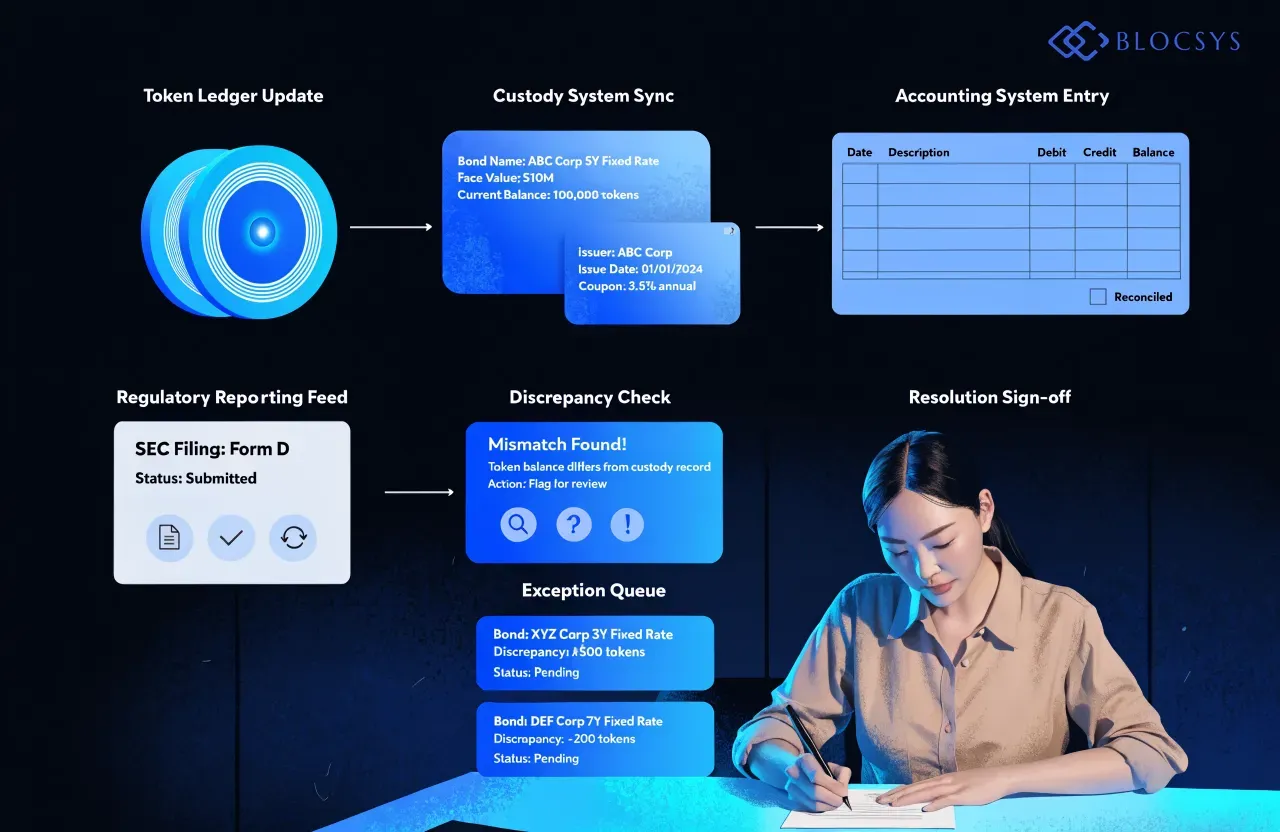
Tokenized bond settlement integration means your token ledger has to talk to systems that already exist — accounting software, custody platforms, regulatory reporting tools, and internal treasury dashboards. None of these integrations happen automatically just because you’ve deployed a contract.
Data consistency across these systems matters more than most issuers expect going in. If your internal ledger says one thing and your custodian’s records say another, you have a reconciliation problem long before you have a legal one. Build a process that flags discrepancies quickly, rather than discovering them at audit time.
Auditability deserves its own attention too. Regulators, trustees, and auditors will want a clear trail showing who approved what and when. If you’re weighing broader asset coverage beyond bonds, platforms like Asset Tokenization Platform infrastructure show how audit trail design tends to scale across instrument types — the underlying discipline doesn’t change much.
Governance, Compliance, and Operational Risk in Corporate Bond Tokenization Programmes
Tokenization doesn’t remove your existing securities-law obligations. Whatever disclosure, eligibility, or reporting rules applied before still apply now — the ledger is a record-keeping layer, not a regulatory exemption. This point gets missed often enough that it’s worth stating plainly.
Access controls need real thought. Who can mint tokens? Who can pause a contract? Who approves a change to the payment schedule? These permissions should map to named roles with sign-off requirements, not a single private key held by one engineer.
Change management and incident response matter just as much. What happens if a smart contract bug is found after launch? Who decides whether to pause operations, and who communicates with investors during that window? Corporate bond compliance workflows should include this scenario explicitly, along with record retention policies that satisfy your jurisdiction’s requirements.
Ongoing monitoring closes the loop. Someone needs to watch the system daily — not just at launch — for anomalies, failed transactions, or drift between records.
A Practical Issuer Readiness Checklist
Use this as a working checklist before you commit to a launch date:
- Documented issuance authority, bond terms, and investor rights, reviewed by legal counsel.
- Written role allocation across issuer, trustee, registrar, paying agent, custodian, and technology provider.
- Investor onboarding and eligibility process defined for your jurisdiction and offering type.
- Ownership reconciliation process between the token ledger and the authoritative legal record.
- Payment and redemption workflows, including exception handling for failed transactions.
- Integration plan covering custody, accounting, and regulatory reporting systems.
- Audit trail design that satisfies trustee and regulator expectations.
- Access control matrix with named approvers for minting, pausing, and parameter changes.
- Incident response plan, including investor communication protocols.
- End-to-end testing of a full lifecycle event — issuance through redemption — before go-live.
Choosing a Corporate Bond Tokenization Partner
When you evaluate a corporate bond tokenization platform provider, don’t just ask about smart contract capability. Ask how they support the full operating model: investor servicing workflows, settlement integrations, reconciliation tooling, and exception handling. A provider that only ships code leaves the rest to you.
Ask for specifics on testing methodology, security practices, and what post-launch support actually covers. Does the provider help you build the monitoring dashboards you’ll need? Do they support integration work with your existing custody or accounting systems? These questions matter more than feature lists.
If you need dedicated engineering capacity to build and maintain this infrastructure over time, teams like Dedicated Blockchain Engineering Teams can supplement in-house capability, particularly for ongoing integration and monitoring work that outlasts the initial build. Either way, choose a partner who talks about operations as readily as they talk about code.
Corporate bond tokenization works best when the technology provider and the issuer treat the operating model as a shared responsibility, not a handoff. That’s the difference between a working programme and a stalled pilot.
Technology is the easy part to buy. Coordinating trustees, registrars, custodians, and compliance teams around it is the part that takes real planning. If you’re mapping out what a programme actually requires, Blocsys’s corporate bond tokenization platform development work starts from this operational view rather than treating the contract as the whole deliverable.
Frequently Asked Questions
Here are direct answers to the questions we hear most often about corporate bond tokenization.
What do issuers need beyond smart contracts for corporate bond tokenization?
You need documented issuance authority, defined roles across trustees and registrars, investor onboarding processes, reconciliation between ledgers, payment exception handling, and governance controls. The contract automates rules; it doesn’t create these frameworks.
Does tokenization replace the role of a bond trustee or registrar?
No. These roles still carry legal and operational responsibility. Tokenization changes how they interact with records, not whether they’re needed.
How do issuers handle a failed coupon payment on a tokenized bond?
Through a defined exception workflow — manual review, retry logic, and investor notification. The smart contract can trigger the attempt, but a human process resolves the failure.
Is the token itself legal proof of bond ownership?
That depends on your jurisdiction’s legal framework. In many markets, the authoritative ownership record still sits with a depository or registrar, and the token must stay reconciled with it.
What happens during redemption and maturity on a tokenized bond?
The issuer and paying agent confirm final ownership, verify the payment amount, release funds, and close out the legal obligation. Token burning follows confirmed settlement — it doesn’t substitute for it.
Does corporate bond tokenization reduce compliance obligations?
No. Existing securities-law, disclosure, and reporting obligations still apply. Tokenization changes the record-keeping layer, not the underlying regulatory requirements.
How should issuers evaluate a tokenization platform provider?
Look past smart contract development. Ask about investor servicing support, settlement integrations, reconciliation tooling, testing rigor, and post-launch operational support.
What integrations are typically needed for a tokenized bond programme?
Connections to custody systems, accounting software, and regulatory reporting tools are common. The specific integrations depend on your existing infrastructure and jurisdiction.
Who is responsible for reconciliation between token records and legal records?
This should be explicitly assigned — often shared between the issuer, registrar, and technology provider — and documented before launch, not figured out after a discrepancy appears.
What ongoing support does an issuer need after a tokenized bond launches?
Monitoring for anomalies, incident response for contract issues, reconciliation oversight, and support for corporate actions like partial redemptions or restructuring.
Ready to move beyond theory and build an intelligent platform that delivers real-world value? Blocsys Technologies specialises in engineering enterprise-grade AI and blockchain solutions for the fintech, Web3, and digital asset sectors. Connect with our experts today to discuss your vision and chart a clear path from concept to a secure, scalable reality.