
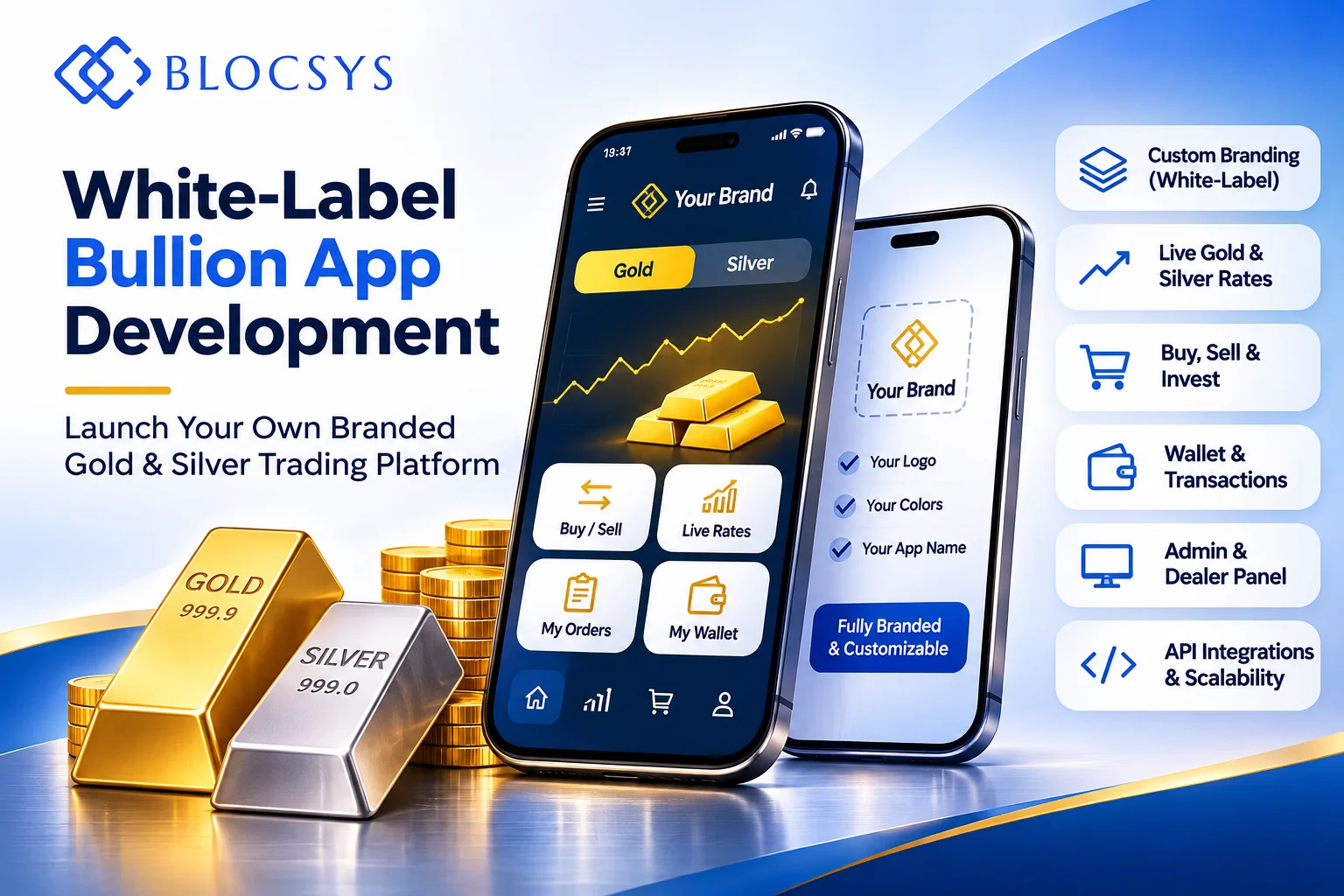
White-Label Bullion App Development: Launch Your Own Branded Gold and Silver Application
If you’re a bullion dealer, jewellery business owner or fintech founder, you’ve probably wondered how your customers would react to a branded gold and silver app with your name on it. White-label bullion app development is how many businesses answer that question without starting from a blank page. It lets you launch an application under your own brand, built on a software foundation that’s already designed around bullion workflows. In this article, we’ll walk through what that actually means, what you can customise, and where the real limits sit.
Gold and silver trading in India runs on relationships and trust, but customers increasingly expect digital access too. A branded app gives you that access point. However, not every white-label bullion app development path offers the same depth of customisation or ownership. Let’s break down how it works, what features matter, and how to evaluate a development partner before you commit.
What Is White-Label Bullion App Development?
White-label bullion app development means building a gold and silver application that launches under your brand name, logo and identity, using a software base that a development company has already engineered for bullion-specific functions. The provider handles the backend logic, rate management structure and core architecture. You handle the branding, business rules and customer-facing decisions.
Here’s the part people often miss: “white-label” doesn’t mean generic or inflexible. It simply describes the business model, not the quality or depth of the product. The actual scope of customisation, data ownership and feature set depends entirely on the agreement you sign with your bullion rate app development partner.
A branded app is only as useful as the agreement behind it. Businesses that skip the scope document end up discovering limitations after launch, not before.
It’s also worth separating this from two adjacent categories. Ready-made software is a fixed product you license as-is, often with minimal branding options. Fully custom development, on the other hand, builds every component from the ground up around your specific business rules. White-label bullion app development typically sits between these two, combining a proven foundation with negotiated customisation.
Why Should Businesses Launch Their Own Branded Bullion Application?
Think about how your customers currently check your rates. If it’s a phone call, a WhatsApp broadcast or a third-party rate site, you’re handing over the relationship to someone else’s platform. A branded gold and silver app keeps that interaction under your name, consequently strengthening recall every time someone opens it.
There’s also the operational side. A wholesale dealer managing fifty sub-dealers manually knows how messy that gets. An app with dealer-specific logins, order booking and transaction history centralises what used to live across spreadsheets and chat threads. That said, we won’t promise this guarantees more sales or faster growth — the app is a tool, not a growth strategy by itself.
For jewellery businesses, a branded app can also become a bridge between retail customers and wholesale buying behaviour, showing live rates alongside purity categories they already understand. Startups entering the precious metals space use this approach to establish credibility without building bullion-specific software from scratch. Moreover, having a direct channel reduces dependency on third-party rate apps that control the user experience.
Essential Features of a White-Label Bullion App
What should a branded bullion application actually include? At minimum, expect these core functions:
- Live gold and silver rate display, updated at intervals your business defines
- Purity-based pricing for categories like 22K and 24K gold, and standard silver grades
- Separate buy and sell rate configuration
- Customer registration and account management
- Dealer or sub-dealer accounts with role-based access
- Order booking for wholesale or retail transactions
- Transaction and order history records
- Push notifications for rate changes or order updates
- An administrative dashboard for rate and user control
Advanced or optional features sit a tier above this. Inventory management, ERP integration, multi-location dealer hierarchies and payment gateway connections usually need additional scoping and development effort. Don’t assume these ship by default in every white-label bullion app development package — confirm them explicitly in your project discussion.
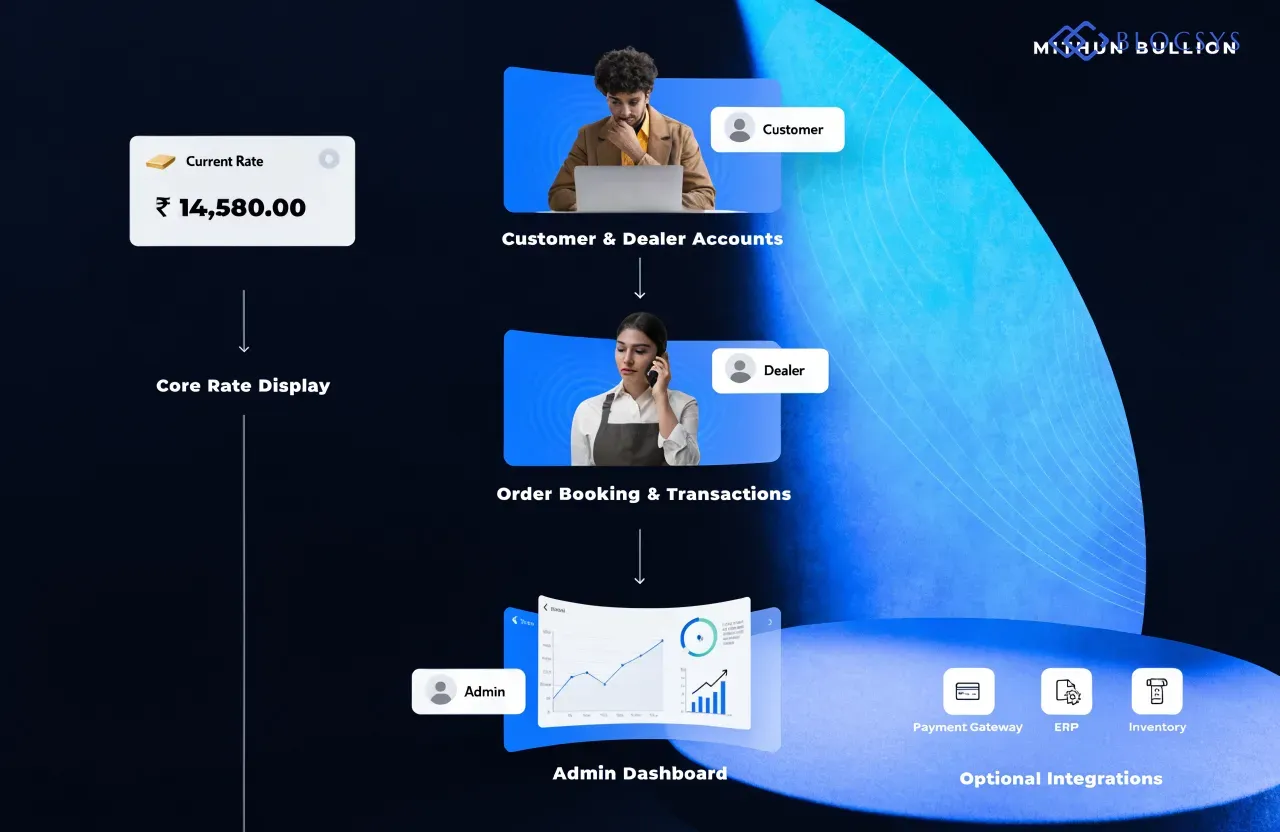
Distinguishing Standard Functionality From Advanced Add-Ons
Standard functionality covers what most bullion businesses need on day one: rates, accounts and order booking. Advanced add-ons address specific operational needs, such as connecting to an existing accounting system or managing physical stock across branches. Understanding this split early helps you budget realistically and avoid scope surprises later.
Branding and Customisation Options for a Branded Bullion Application
Branding goes well beyond swapping a logo. A properly built branded bullion application lets you define your app name, colour scheme, login screen design, dashboard layout and notification tone. Customer-facing text, onboarding flow and even the way purity categories are labelled can reflect how your business already talks to clients.
Here’s what’s important to clarify upfront: the degree of customisation depends on how the underlying system was architected. Some white-label bullion app development foundations allow deep interface changes and workflow adjustments. Others restrict you to colour and logo swaps, with structural changes requiring separate custom development work. Neither approach is wrong — they’re just different commercial models.
A web-based admin portal and customer dashboard typically accompany the mobile app, giving your team desktop access to manage rates and orders. Additionally, some businesses choose to add a lightweight web-based bullion management platform for staff who aren’t using the mobile app daily. Ask your development partner precisely which elements are configurable versus fixed before signing anything.
Gold and Silver Rate Management in a White-Label Bullion App
How does a branded app actually manage pricing? Rate management typically works across three layers: an international or domestic benchmark reference, a business-defined markup or adjustment, and the final customer-facing rate displayed in the app.
International benchmark prices, such as those referenced through LBMA data, reflect global market movement. Domestic Indian pricing often tracks MCX futures alongside import duty and GST considerations, which the World Gold Council has documented as key drivers of local price variation. Your business then applies its own buy and sell spread on top of these references — this is where your actual commercial decision-making happens, and it’s unique to you.
Administrators generally need the ability to set rates manually when required, override automated feeds during volatility, and view historical rate logs for reconciliation. We won’t suggest every business follows an identical pricing formula; margins, rounding rules and update frequency vary by dealer size, region and risk appetite.
Live Gold and Silver Price API Integration
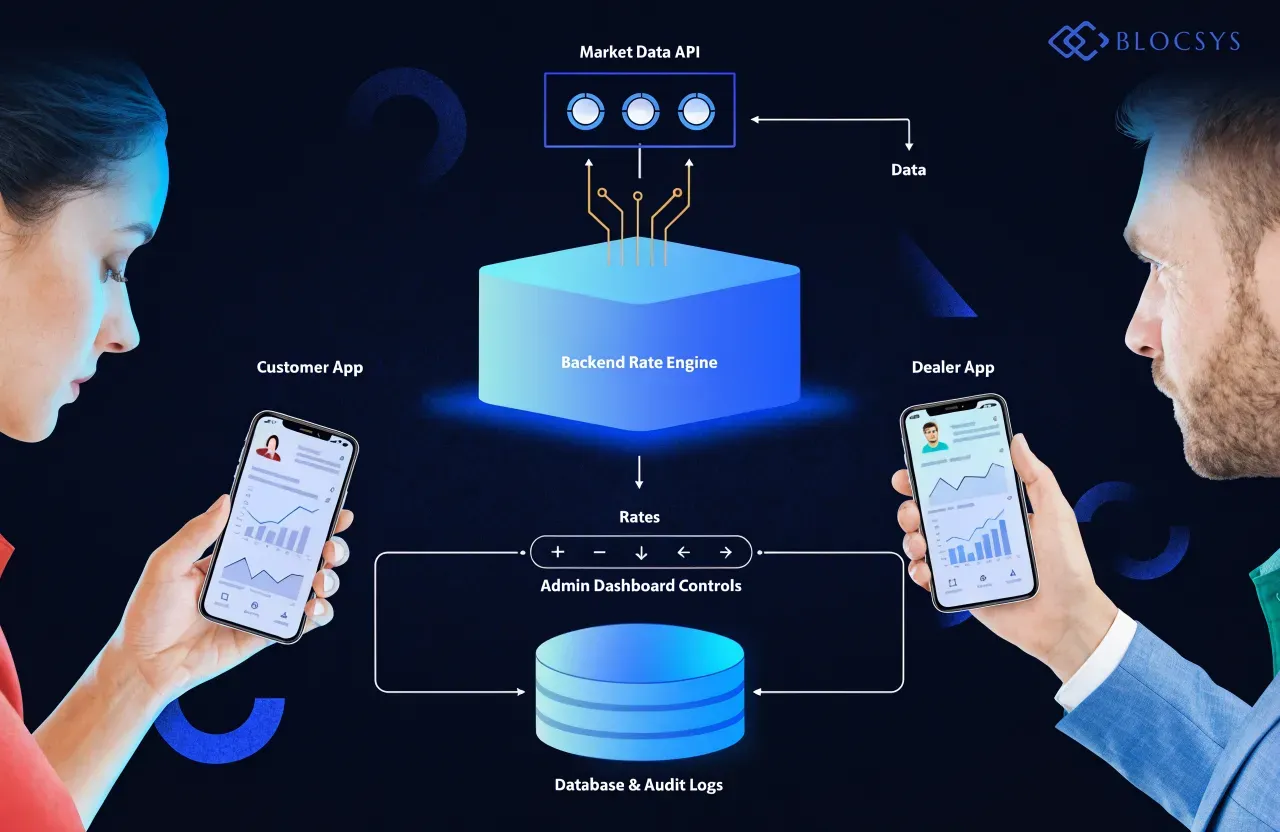
Can a white-label app display live gold and silver rates? Yes, through integration with a market data provider via API. The application pulls rate data on a scheduled or near real-time basis, applies your pricing logic, and pushes the final figure to the customer interface.
Different data providers vary in update frequency, data coverage and licensing terms, so this isn’t a one-size-fits-all integration. Some offer per-second updates; others refresh every few minutes. Furthermore, licensing conditions differ by provider and by country, which matters if you’re targeting markets like the UAE or Singapore alongside India.
A properly built system also needs fallback handling. If the API connection fails, the app should flag stale data or switch to a manual override rather than displaying an outdated rate silently. Monitoring and validation checks matter here just as much as the integration itself — a bullion app showing a wrong rate for even a few minutes can create real customer disputes.
Customer, Dealer and Order Management Features
Can a branded bullion application support dealer accounts and order booking? It should, if your business model involves wholesale distribution. Role-based permissions typically separate retail customers, registered dealers and sub-dealers, each seeing rates or discounts relevant to their tier.
Picture a wholesale bullion dealer in Ahmedabad supplying forty jewellery retailers across Gujarat. Each retailer logs in, views their specific rate tier, places an order request, and receives confirmation once the dealer’s team processes it. The transaction record stays stored for both sides, reducing disputes over verbal order confirmations.
That said, the actual order workflow — how confirmations happen, whether payment is collected in-app or offline, how disputes get resolved — needs to be designed around your existing business process. A generic order flow rarely fits every dealer’s operating style without adjustment.
Admin Dashboard and Backend Management
Your admin dashboard is where daily operations actually happen. Expect controls for rate updates, user and dealer account management, order approval, notification scheduling and API health monitoring. Reporting features typically let you export transaction logs or review rate change history over a given period.
Behind the scenes, this dashboard connects to the same backend serving your customer-facing app, so a rate change reflects instantly across both. Consequently, administrators need clear audit trails showing who changed what and when — particularly important if multiple staff members have access.
Technology and Integrations Required for a White-Label Bullion Application
A complete branded bullion solution generally spans an Android and iOS bullion application, a web-based admin and dealer portal, backend services, a database layer, and the pricing API connection described earlier. Authentication and role-based access control sit underneath all of it, ensuring customers, dealers and admins only see what’s relevant to their role.
Payment gateway integration, ERP connectivity and accounting software links are additional components, needed only if your business model requires in-app payments or automated bookkeeping. Cloud infrastructure, whether AWS, Azure or Google Cloud, hosts the backend and database, with official documentation from each provider outlining security and scaling options. We’re not prescribing one stack as mandatory here — the right technology choice depends on your scale, budget and existing systems.
Security, Maintenance and Scalability Requirements
Security in a multi-user bullion application covers authentication, encrypted data transmission, API security and database protection, alongside regular backups and audit trails. Since dealers and customers see financial data, access permissions need careful configuration so no one views information outside their tier.
Maintenance isn’t a one-time task either. Software updates, integration monitoring and ongoing technical support keep the app functioning as your data provider’s API evolves or as mobile operating systems update. Scalability planning — accounting for more users, additional dealer tiers or new business locations — should happen during initial architecture design, not as an afterthought.
It’s important to separate application security from bullion custody and compliance. Securing your app doesn’t address physical gold storage, financial transaction liability or regulatory obligations under Indian law — those remain your business’s responsibility, independent of the software.
White-Label Bullion App vs Custom Bullion App Development
Which approach fits your business better? It depends on how specific your workflow is and what you’re willing to invest upfront.
| Factor | White-Label Bullion App Development | Custom Bullion App Development |
|---|---|---|
| Development starting point | Existing bullion-focused foundation | Built from scratch around your workflow |
| Branding flexibility | Moderate to high, depending on agreement | Fully defined by your requirements |
| Feature customisation | Limited by base architecture | Unrestricted, built to specification |
| Ownership and licensing | Varies by contract terms | Typically full ownership |
| Suitable for | Businesses wanting faster market entry | Businesses with complex or unique workflows |
Neither option is universally cheaper or better. A white-label bullion trading app development approach can suit a business wanting to establish a digital presence without a long specification process. A fully custom build suits a business with workflows that don’t fit any existing template.
How to Choose the Right White-Label Bullion App Development Partner
Before signing with any provider, dig into how well they actually understand bullion operations. Do they know the difference between buy and sell spreads, or how dealer tiers typically work? Ask for examples of rate integration, dealer management and admin dashboard functionality specifically.
Clarify software ownership and licensing terms in writing. Who owns the codebase after launch? Can you move to another provider later if needed? Additionally, confirm what ongoing support looks like — is it included, or billed separately after a fixed period?
Finally, review the full project scope document line by line. Vague deliverables lead to disputes later. A development company worth hiring will walk you through integration responsibilities, timelines and support terms without pressure to sign immediately.
White-Label Bullion App Development Services Offered by Blocsys
Blocsys works with bullion dealers, jewellery businesses and precious metal companies on custom mobile and web application development tailored to their operating model. This includes backend development, administrative dashboard design, database architecture and third-party API integration for market data, payment gateways or ERP systems where relevant.
For businesses exploring blockchain-based features, such as tokenised asset tracking or transparent transaction ledgers, Blocsys also brings blockchain development experience into the conversation where it genuinely applies. Our bullion rate app development service focuses specifically on rate display, pricing logic and dealer workflows, while our digital gold and silver app development service addresses related digital gold functionality where businesses need it.
Rather than offering a single fixed template, Blocsys works through your specific requirements first — pricing structure, dealer hierarchy, branding expectations — before proposing an architecture. That conversation shapes what gets built, not the other way around.
Why Choose Blocsys for Bullion App Development?
What sets a development partner apart in this space isn’t flashy marketing — it’s whether they understand your business model before writing a single line of code. Blocsys approaches bullion and precious metal app projects by first mapping your pricing workflow, dealer structure and branding goals, then building the technical architecture around those specifics.
Our capabilities span custom mobile and web application development, backend systems engineering, administrative dashboard design and third-party API integration, including connections to market data providers and payment systems where your business needs them. We also bring scalable architecture planning into early discussions, so your app has room to grow as your dealer network or customer base expands.
We won’t claim fixed pricing packages, guaranteed timelines or specific client outcomes here, because every bullion business operates differently. What we can offer is a structured conversation about your requirements and a development approach shaped around them.
Conclusion – Launch Your Own Branded Gold and Silver Application
White-label bullion app development gives bullion dealers, jewellery businesses and precious metal companies a practical route to launching their own branded gold and silver application without building every component from zero. It combines rate management, customer and dealer access, order booking and administrative control under your brand identity.
That said, the right development approach depends entirely on your business model, how much customisation you need, which integrations matter, and where you see the business in a few years. A white-label bullion software development approach suits some businesses perfectly; others benefit more from a fully custom build.
Planning to launch your own branded gold and silver application? Connect with Blocsys to discuss your requirements for bullion rate app development, application branding, market data integration, customer management and a customised mobile or web platform built around how your business actually operates.
Frequently Asked Questions
Here are direct answers to the questions we hear most often about white-label bullion app development.
What is white-label bullion app development?
It’s the process of building a gold and silver application under your own brand, using a software foundation a development company has already built for bullion-specific functions like rate display and dealer management.
Can I launch a gold and silver application under my own brand?
Yes, through white-label or custom development, your app name, logo, colours and interface can reflect your business identity instead of the development provider’s.
What features should a white-label bullion app include?
At minimum, live gold and silver rates, purity-based pricing, buy and sell configuration, customer and dealer accounts, order booking, transaction records and an admin dashboard.
Can a white-label bullion application display live gold and silver rates?
Yes, through integration with a market data API, with your business applying its own pricing logic on top of the raw feed before display.
Can I customise the design and branding of my bullion application?
Generally yes, though the depth of customisation depends on the underlying architecture and your agreement with the development provider.
What is the difference between white-label and custom bullion app development?
White-label uses an existing bullion-focused foundation with negotiated customisation; custom development builds every component from scratch around your exact workflow.
Can a white-label bullion app support dealer accounts and wholesale order booking?
Yes, role-based accounts for dealers and sub-dealers alongside order booking features are common requirements, though the specific workflow needs to match your business process.
How much does white-label bullion app development cost?
Cost depends on feature scope, integrations, branding depth and ongoing support terms. There’s no fixed industry benchmark, so this should be confirmed through a project assessment.
How long does it take to develop a branded bullion application?
Timelines vary based on customisation scope, integration complexity and feature requirements. A development partner should confirm this after reviewing your specific project scope.
Can Blocsys develop a customised branded bullion application for my business?
Yes, Blocsys works with bullion and precious metal businesses on custom mobile and web application development, including rate management, dealer workflows and admin dashboards tailored to specific requirements.
Ready to move beyond theory and build an intelligent platform that delivers real-world value? Blocsys Technologies specialises in engineering enterprise-grade AI and blockchain solutions for the fintech, Web3, and digital asset sectors. Connect with our experts today to discuss your vision and chart a clear path from concept to a secure, scalable reality.
