
A fintech founder has a familiar decision in front of them. The product team needs spot trading, cross-chain swaps, or tokenised assets, but choosing between a centralised exchange stack and a decentralised exchange platform affects custody, liquidity, compliance, execution, and the time required to reach market.
This guide is for fintech founders, crypto product teams, and enterprise builders making that choice. It explains how DEX infrastructure works, where automated market makers and order books fit, how liquidity and security shape outcomes, and how India’s regulatory and market conditions change the build decision.
You’ll finish with a practical way to decide whether to build core infrastructure, integrate existing protocols, or use a hybrid model. The discussion applies globally, with specific attention to India’s offshore liquidity migration, PMLA obligations, tokenised settlement, and enterprise adoption.
Table of Contents
- Introduction to Decentralized Exchange Platforms and Who This Guide Serves
- How Decentralized Exchange Platforms Work Without Intermediaries
- Core Architecture and Key Components Behind Every DEX
- Liquidity Tokenomics and Market Quality That Sustain Trading
- Security Compliance and Trust Design for Non Custodial Trading
- Cross Chain Strategies and Enterprise Use Cases in Action
- Building vs Integrating a Decentralized Exchange Platform with Blocsys
Introduction to Decentralized Exchange Platforms and Who This Guide Serves
A founder might begin with a simple product brief: users connect wallets, choose two assets, and complete a swap. The complexity appears when the team asks harder questions. Who supplies liquidity? Where does the price come from? What happens if a smart contract fails, a bridge is compromised, or a user interacts with a sanctioned address?
A DEX is a non-custodial trading venue where users transact through smart contracts rather than depositing funds into an exchange account. The interface may look like a familiar trading application, but the underlying settlement takes place on a blockchain and the user signs transactions from a wallet.
That distinction matters for product teams. A startup may prioritise rapid launch and access to existing liquidity. A bank or capital-markets firm may require permissioned assets, auditable controls, investor eligibility rules, and integration with regulated settlement systems. A DeFi-native business may care more about composability, routing, and permissionless access.
What this guide helps you decide
The right question isn’t, “What is a decentralised exchange platform?” It’s, “Which exchange architecture fits the product, users, assets, and regulatory perimeter?”
You’ll find guidance on:
- Core mechanics: How wallets, smart contracts, liquidity pools, and settlement interact.
- Architecture: When to use an AMM, order book, router, oracle, bridge, or intent-based system.
- Market quality: How liquidity design affects slippage, price impact, and retention.
- Compliance: How a non-custodial model can support record-keeping, transaction monitoring, and beneficial-owner processes.
- Build versus integrate: Which capabilities should be owned and which can be connected to existing infrastructure.
India provides a useful stress test. The market has demonstrated substantial demand, yet policy, tax, liquidity concentration, and offshore migration make local exchange design unusually sensitive to trust and execution. Teams evaluating DeFi infrastructure and development should therefore treat decentralisation as an architectural choice, not a marketing label.
How Decentralized Exchange Platforms Work Without Intermediaries
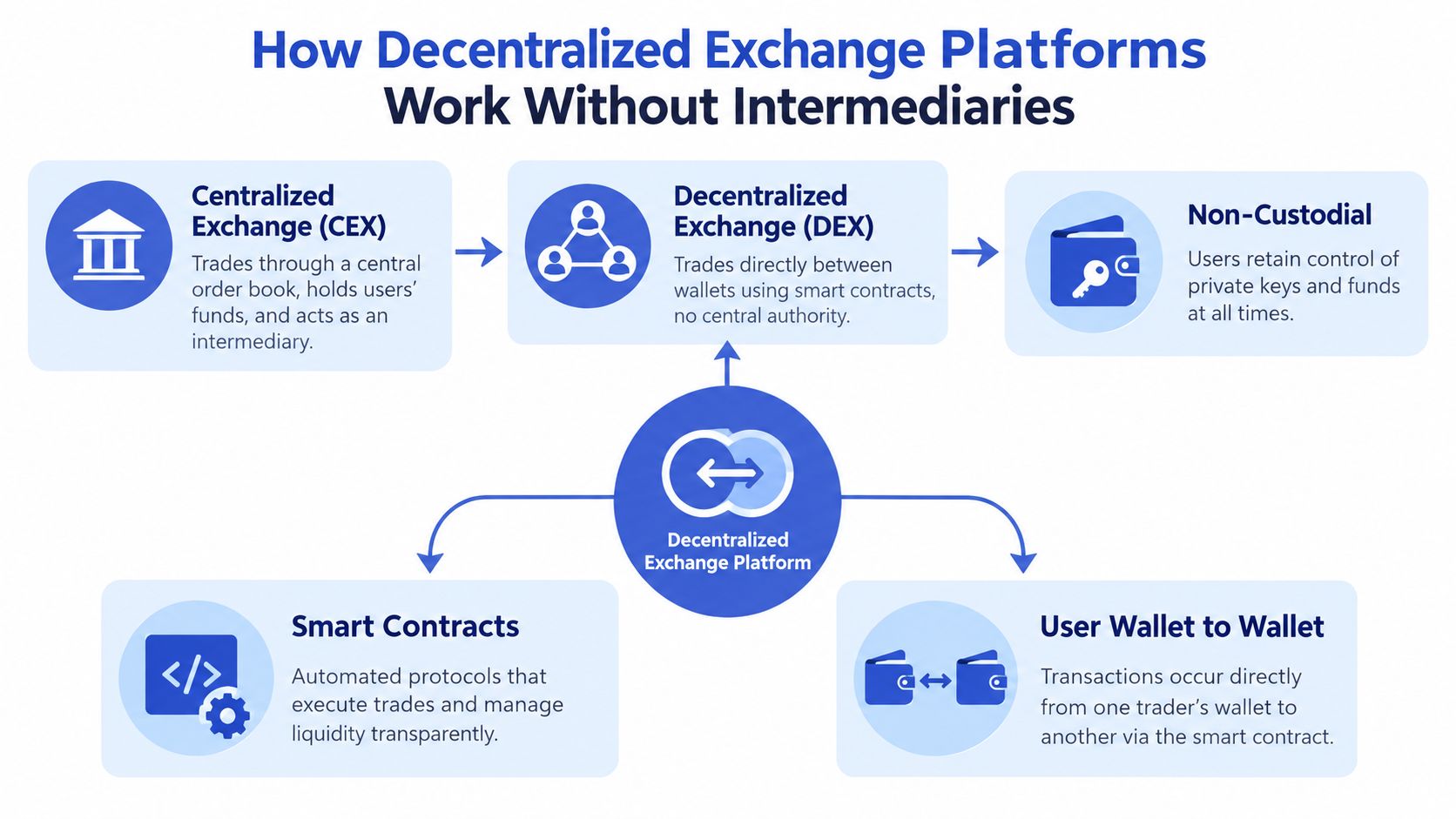
A centralised exchange works like a managed marketplace. The operator maintains accounts, records balances internally, matches orders, and usually holds user funds until withdrawal. A decentralised exchange platform separates those responsibilities across a blockchain, smart contracts, wallets, liquidity providers, and often independent routing systems.
Core concept: The user keeps control of assets, while smart-contract code enforces the rules for trading and settlement.
The basic transaction flow
A typical swap follows a clear sequence:
- The user connects a wallet. The wallet holds the assets and controls the signing key.
- The user selects a trading pair. For example, they might choose one token to sell and another to receive.
- The interface requests a quote. The protocol or router checks available liquidity, fees, price impact, and route options.
- The user approves the asset. Some token standards require a separate permission transaction before the swap.
- The user signs the trade. The wallet authorises the smart contract call.
- The blockchain validates settlement. The contract transfers assets according to its programmed conditions.
The exchange doesn’t need to maintain an internal balance database for the swap. The wallet-to-wallet movement happens through contract-controlled logic, and the blockchain provides the settlement record.
What “non-custodial” really changes
Non-custodial doesn’t mean risk-free. It means the platform generally doesn’t hold the user’s private keys or directly control funds in the same way a custodial exchange does. The user gains control, but also assumes responsibility for wallet security, transaction approval, token selection, and recovery procedures.
Smart contracts replace some intermediary functions, but they don’t eliminate the need for product design. The team still has to decide how quotes are generated, how failed transactions are handled, how suspicious activity is monitored, and which assets or addresses the interface will allow.
India’s policy environment makes this distinction especially important. On March 7, 2023, the Ministry of Finance classified entities providing services related to virtual digital assets as reporting entities under the Prevention of Money Laundering Act, 2002, as described in India’s blockchain and cryptocurrency legal overview. A wallet-based user journey therefore doesn’t automatically remove compliance responsibilities from the organisation operating the interface, contracts, routing layer, or related services.
Core Architecture and Key Components Behind Every DEX
A DEX is better understood as a collection of specialised components than as a single application. The front end helps users select trades, but execution depends on contracts, liquidity, pricing, routing, and settlement infrastructure.
Trading models
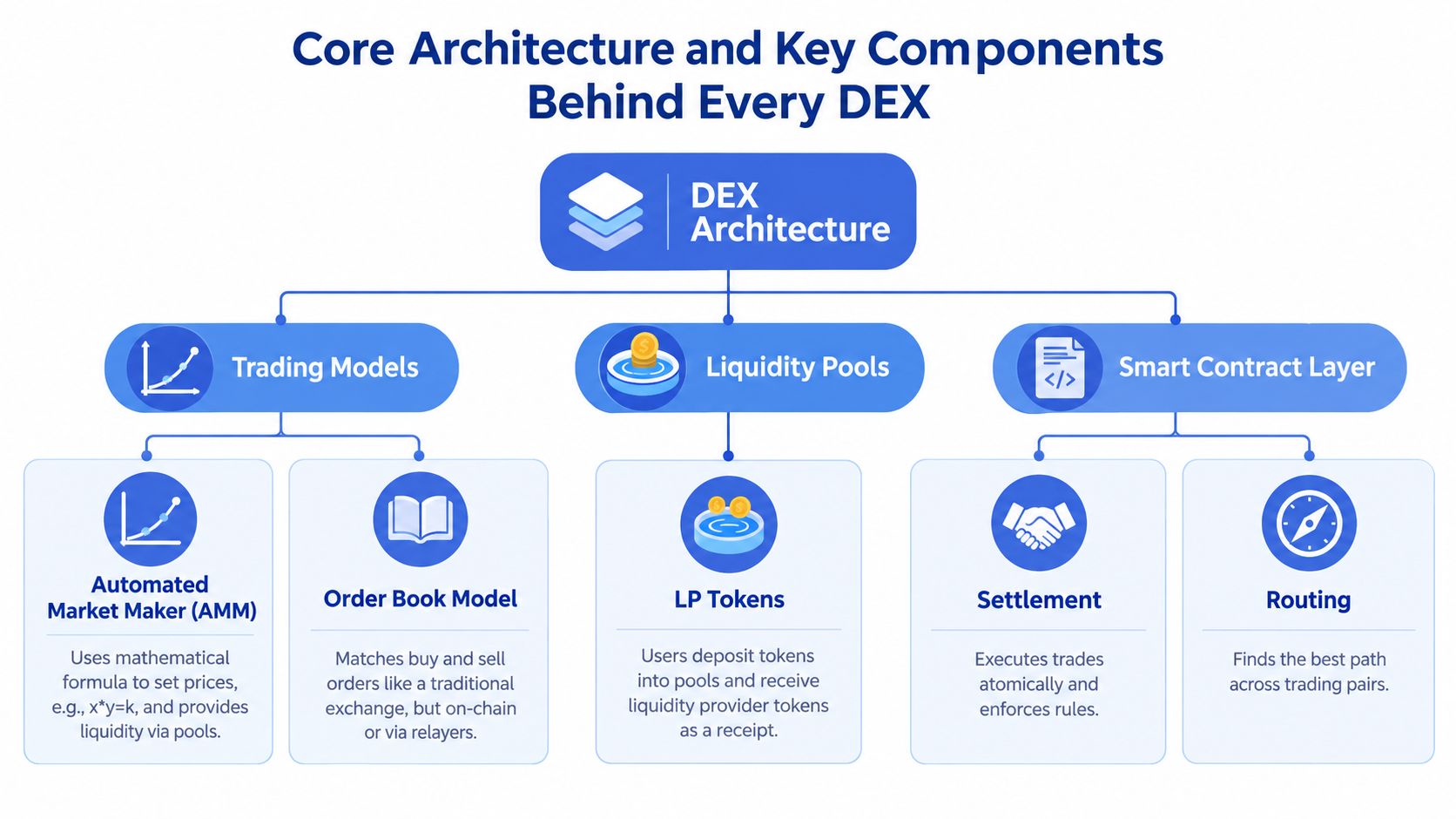
An automated market maker, or AMM, prices trades against a liquidity pool. The pool holds token reserves, and a mathematical curve determines how the exchange rate changes as users buy or sell. AMMs are straightforward to compose with other smart contracts, but larger orders can create price impact when available depth is limited.
An order book model uses bids and asks. It resembles a traditional exchange, although matching and settlement may be divided between on-chain contracts and off-chain relayers. Order books can suit traders who expect limit orders, advanced execution, or market-making strategies, but they require active quoting and efficient order management.
The choice depends on the market, not on ideology:
- AMM: Useful for permissionless spot pairs and composable DeFi markets.
- Order book: Suitable where price discovery, limit orders, and active market makers matter.
- Hybrid: Appropriate when the product needs familiar trading tools with blockchain-based settlement.
Supporting infrastructure
Liquidity pools provide immediately available reserves. Liquidity providers deposit assets and receive a representation of their position, often called an LP token. A router searches across pools or venues to identify a viable execution path, while an oracle supplies external reference information where the protocol needs it.
Bridges and cross-chain messaging add another risk boundary. They can move value or information between networks, but the design must account for wrapped assets, message verification, validator assumptions, and recovery procedures. A bridge shouldn’t be selected only because it supports a target chain.
Engineering priority: Throughput matters, but execution quality, contract security, governance, transparency, and market depth determine whether users can trust the system.
The CCData DEX Benchmark evaluates decentralised exchanges across more than 60 metrics covering security, governance, market quality, transparency, community, and user experience. That provides a useful evaluation mindset for product teams. A fast contract with weak upgrade controls or shallow liquidity isn’t a strong exchange foundation.
For capital-markets teams, the architecture may extend beyond crypto swaps. A corporate bond tokenization platform can use digital issuance, smart-contract automation, settlement logic, and investor management as part of a controlled market structure. Teams comparing on-chain and off-chain responsibilities can also review hybrid exchange platform architecture before choosing where matching, custody, and settlement should live.
Liquidity Tokenomics and Market Quality That Sustain Trading
Liquidity determines whether a DEX feels usable. A trader may accept self-custody and wallet signing, but they won’t return if quotes are unreliable, price impact is excessive, or a trade fails because the pool can’t support it.
A neutral policy report found 140 operational DEXs globally compared with 306 centralised spot exchanges, and DEXs represented 2% of the absolute trading volume of CEXs, according to the Esya Centre report on decentralised exchanges. The gap reflects more than user preference. Centralised venues often aggregate fiat access, institutional relationships, market makers, and operational support in one place.
Comparing liquidity models
| Model | Incentive Mechanism | Best For | Risk to Manage |
|---|---|---|---|
| Liquidity mining | Token rewards for depositing assets | Bootstrapping new pools | Reward dependence and mercenary liquidity |
| Fee sharing | Distribution of trading fees to liquidity providers | Markets with repeat organic flow | Insufficient fees when volume is weak |
| ve-tokenomics | Voting power and reward direction linked to locked governance tokens | Protocols coordinating emissions and pool priorities | Complex incentives and governance concentration |
| Concentrated liquidity | Providers allocate capital within selected price ranges | Active markets with defined trading bands | Position management and liquidity gaps outside ranges |
A strong design balances depth, capital efficiency, and provider retention. Liquidity mining can attract deposits quickly, but rewards alone don’t guarantee durable markets. Fee sharing aligns providers with actual usage, while concentrated liquidity can make capital more productive when participants actively manage their ranges.
Market quality beyond total volume
Product teams should monitor the user’s final execution rather than relying on headline volume. Useful measures include quote consistency, available depth, price impact, failed transactions, route reliability, pool utilisation, and the quality of liquidity during volatile conditions.
MEV also belongs in this analysis. Transaction ordering can affect users even when the contract executes exactly as programmed. Teams designing routing and protection mechanisms should understand what MEV means and decide whether private execution, solver competition, transaction simulation, or user-configurable protection belongs in the product.
India adds a liquidity migration challenge. CoinGecko’s 2023 study found that crypto traded in India across the top four exchanges totalled $2.61 billion from January to May 2023, compared with $14.78 billion in the same period of 2022, with average monthly volume declining from $1.66 billion to $0.52 billion over those periods, as summarised by India crypto adoption statistics. More recent commentary placed FY2024-25 spot trading volume at about $6.14 billion, from the same source. The lesson for DEX builders is practical: liquidity incentives must be paired with compliance, trusted UX, and routes that compete with offshore execution.
Security Compliance and Trust Design for Non Custodial Trading
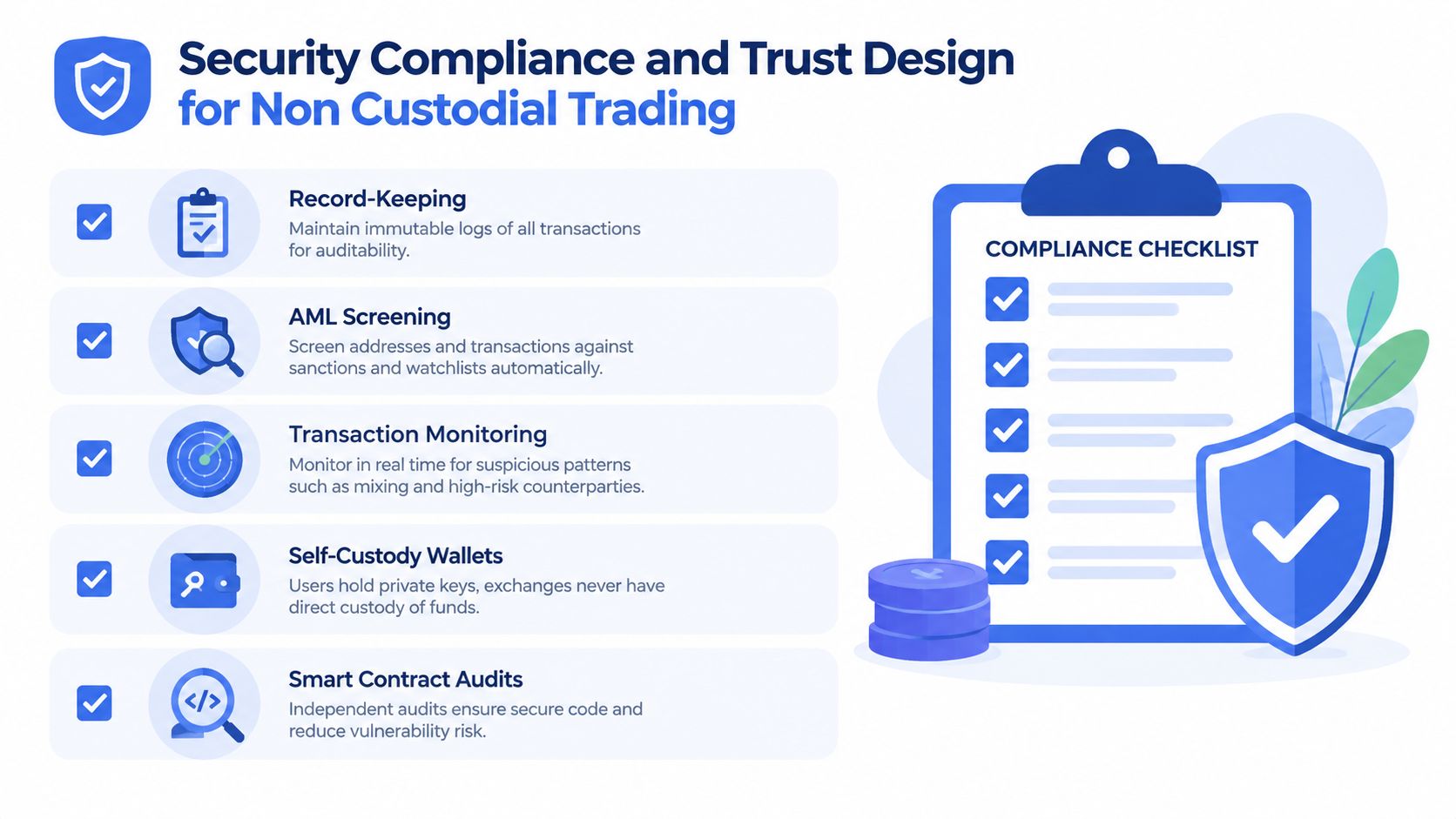
Self-custody and compliance are often treated as opposing choices. They don’t have to be, but the operating model must be designed carefully. A non-custodial interface can preserve user control while the organisation applies controls around access, monitoring, routing, asset eligibility, and audit records.
India-focused legal commentary identifies VDA service providers as subject to PMLA reporting obligations, while India doesn’t have a dedicated licensing regime specifically for DEXs or other DeFi-native activities. That gap shouldn’t be read as a permission to ignore controls. It means founders must map the actual service being provided, the entity operating it, the contracts and interface it controls, and the reporting obligations that may apply.
A workable compliance perimeter
A DEX product can introduce controls without taking possession of customer assets:
- Record-keeping: Store immutable or tamper-evident records of wallet interactions, quotes, approvals, executed trades, and relevant policy decisions.
- Suspicious transaction reporting: Establish an investigation workflow for activity that meets the organisation’s risk criteria and applicable reporting obligations.
- Beneficial-owner checks: Apply enhanced checks where users represent businesses, funds, or tokenised assets rather than acting as individual traders.
- Address screening: Screen wallets and transaction paths against sanctions and other risk indicators before permitting a route.
- Asset controls: Maintain token allowlists, issuer metadata, transfer restrictions, and contract-risk assessments for supported markets.
A useful wallet primer for non-technical stakeholders is this non custodial crypto wallet guide. It helps clarify the difference between controlling private keys and operating a compliant financial product around user-controlled wallets.
Designing for regulated digital money
The RBI’s direction is a significant design signal. Its internal working group recommended a token-based retail CBDC model in which the RBI creates tokens and authorised Token Service Providers distribute them to end users, while also exploring account-based wholesale CBDC, according to the RBI working group report.
For an India-facing DEX, that suggests future systems may need wallet-to-wallet settlement logic, controlled token issuance, policy-aware routing, and interoperability with regulated digital money. It doesn’t establish open-ended crypto liberalisation, so teams should avoid assuming that a permissionless design will automatically fit future rails.
The technical split between custody and control deserves formal documentation. Teams can compare the implications through custodial versus non-custodial wallet architecture. For real-world assets, Tokenization Platform Development covers secure and compliant platforms for securities, real estate, commodities, RWAs, and digital assets using enterprise blockchain technology.
Cross Chain Strategies and Enterprise Use Cases in Action
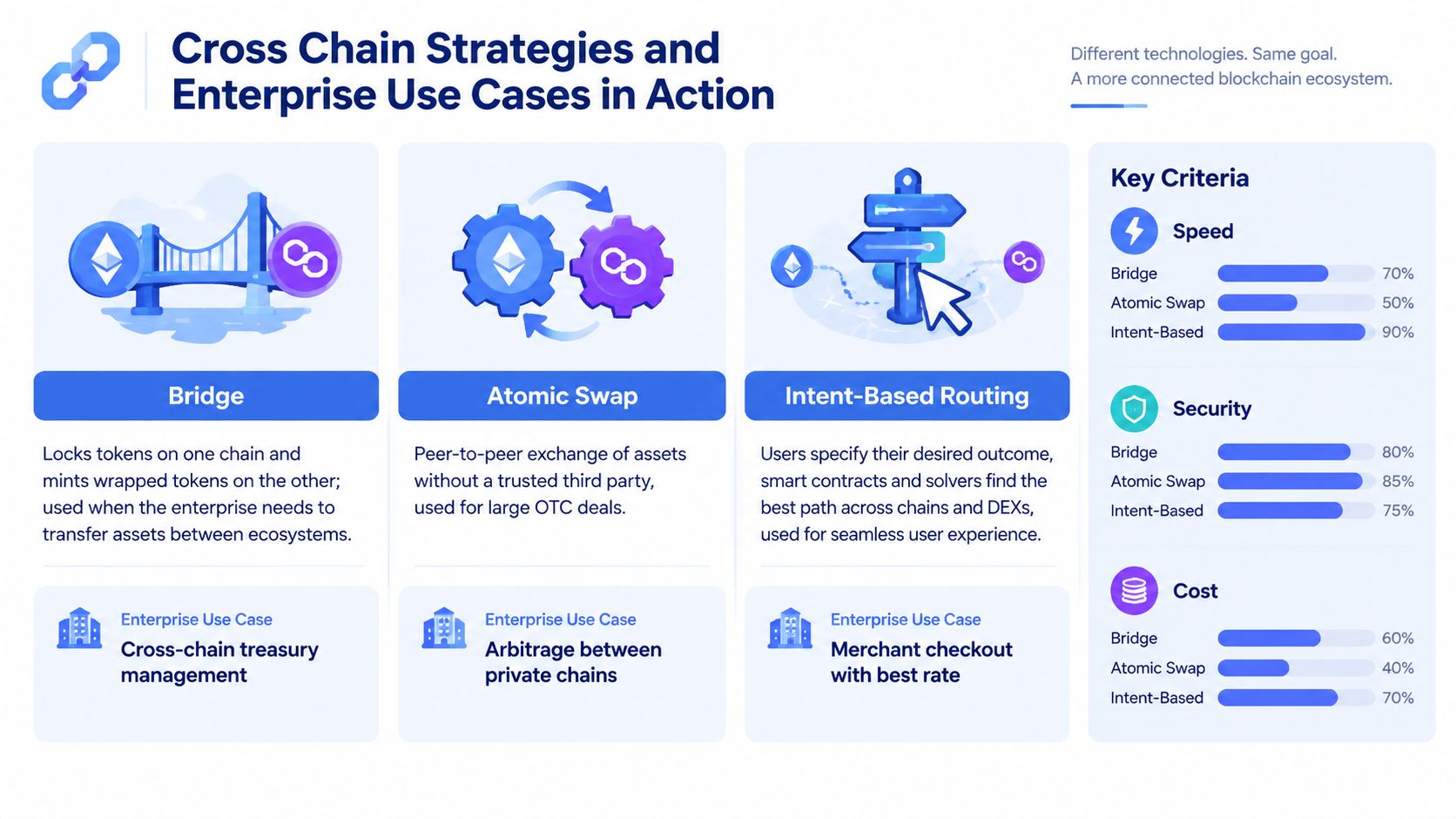
A merchant may want settlement in the asset offering the best available route, a treasury team may rebalance across ecosystems, and an investor may access a tokenised market without manually moving funds first. The user sees one outcome. The DEX must coordinate networks, liquidity, permissions, and settlement behind that outcome. This is the practical role of cross-chain and omnichain strategies.
Choosing the interoperability pattern
Bridges lock an asset on one chain and issue a corresponding representation on another. They can support treasury transfers and access to separate ecosystems. Their risk depends on message validation, validator design, contract security, and management of wrapped assets. A bridge is therefore less like a simple tunnel and more like a set of coordinated escrow and messaging controls.
Atomic swaps use cryptographic conditions to exchange assets without a trusted intermediary. They fit direct peer-to-peer transactions, provided both sides have compatible assets, suitable timing, and enough liquidity. If one condition fails, the transaction should unwind according to the contract rules.
Intent-based routing lets a user state the desired result while solvers or market makers find an execution path. The interface can become simpler, but the product team must define solver incentives, settlement guarantees, fallback behaviour, and the information users receive about execution. Teams comparing fragmented venues can analyze Sushi Polymarket cross-dex to examine routing and execution differences.
Where DEX architecture fits
| Product category | DEX fit | Centralised infrastructure still matters |
|---|---|---|
| Spot trading | Wallet-based swaps and programmable settlement | Fiat deposits, withdrawals, custody options, and support |
| Cross-chain swaps | Route discovery across networks | Bridge risk management and liquidity coordination |
| Tokenisation markets | Transfer rules, asset programmability, and audit trails | Issuer onboarding, investor checks, and legal structuring |
| DeFi-native products | Composability and permissionless contract interaction | Risk controls, monitoring, and user protection |
| Institutional markets | Controlled settlement and transparent rules | Deep liquidity, reporting, and institutional onboarding |
India’s market structure makes this an operating decision, not only a protocol decision. As of October 2025, 91.5% of Indian crypto trading occurred on offshore platforms and domestic exchanges retained 8.5%, according to India offshore crypto trading statistics. The same source reports one major Indian exchange’s FY2025 spot volume at ₹51,333 crore and institutional onboarding growth above 35% year on year. A DEX serving India therefore needs a clear reason for users to choose it, such as access, asset design, execution, or programmability, while centralised rails may still provide liquidity and institutional access.
Over the next 12 to 24 months, teams may evaluate tokenised settlement, AI-assisted routing and monitoring, and carbon-linked or other real-world asset markets. These are planning options, not guaranteed outcomes. Production systems should separate experiments from regulated services, expose operational controls, and document assumptions about networks, assets, and PMLA-aligned compliance without taking custody of user funds.
Building vs Integrating a Decentralized Exchange Platform with Blocsys
Build-versus-integrate decisions become clearer when the team separates differentiating capability from commodity infrastructure.
Build core components when the exchange’s value depends on proprietary routing, a specialised order book, controlled token standards, unique governance, or a market structure that existing protocols can’t support. Ownership gives the team more control, but it also creates responsibility for audits, monitoring, upgrades, incident response, liquidity strategy, and long-term maintenance.
Integrate existing components when speed, ecosystem liquidity, and proven contract behaviour matter more than protocol originality. Aggregators, wallet providers, bridge systems, identity services, analytics tools, and custody partners can reduce implementation effort, although each dependency introduces its own availability, security, governance, and commercial risks.
A hybrid model often suits enterprise teams. The organisation can own the user experience, policy engine, asset registry, compliance workflow, and reporting layer while integrating selected liquidity and settlement components. A structured review should cover:
- Market model: AMM, order book, hybrid, or intent-based execution.
- Asset policy: Permissionless tokens, approved assets, or regulated tokenised instruments.
- Compliance boundary: Which entity performs onboarding, monitoring, investigations, and reporting.
- Security ownership: Contract audits, key management, upgrade authority, and incident response.
- Liquidity plan: Internal market making, external pools, aggregators, or partner venues.
- Integration depth: Wallets, fiat rails, settlement networks, analytics, and institutional systems.
Blocsys Technologies works with fintechs, exchanges, and digital asset businesses on production-ready blockchain and AI-powered platforms, including trading infrastructure, tokenisation systems, and intelligent compliance workflows. Its Blockchain Development offering covers custom applications for enterprises, startups, and governments across public, private, and hybrid blockchain networks.
The right outcome isn’t maximum decentralisation. It’s an exchange architecture that gives users reliable execution, gives operators defensible controls, and gives the business a sustainable path from prototype to regulated scale.
Frequently Asked Questions
1. What is a decentralized exchange platform?
A decentralized exchange (DEX) is a non-custodial trading platform where users exchange digital assets directly through blockchain-based smart contracts. Instead of depositing funds with a central operator, users generally connect their own wallets and authorize transactions themselves.
2. How does a decentralized exchange work?
A typical DEX allows users to connect a wallet, select the assets they want to trade, receive a quote based on available liquidity, approve the transaction, and sign it through their wallet. Smart contracts then execute and settle the transaction on the blockchain.
3. What is the difference between a DEX and a centralized exchange?
A centralized exchange generally maintains custody of user assets and manages trading through its own internal infrastructure. A DEX uses blockchain smart contracts for trading and settlement, allowing users to retain control of their assets through their wallets.
4. What trading models can be used in a decentralized exchange?
A DEX can use different trading models, including automated market makers (AMMs), on-chain or hybrid order books, liquidity aggregators, and intent-based execution. The appropriate model depends on factors such as liquidity requirements, trading volume, execution speed, and the target users.
5. How does a DEX provide liquidity for trading?
Liquidity can come from liquidity pools, professional market makers, external decentralized protocols, liquidity aggregators, or a combination of these sources. The platform can route trades across available liquidity to improve execution and reduce price impact.
6. What is the role of smart contracts in a DEX?
Smart contracts define and execute the rules for trading, asset transfers, liquidity management, fees, and settlement. They allow transactions to be executed according to predefined conditions without requiring a centralized party to manually process each trade.
7. Can a decentralized exchange support cross-chain trading?
Yes. A DEX can support multiple blockchain networks through cross-chain infrastructure, bridges, interoperability protocols, or liquidity-routing systems. This can allow users to access assets and liquidity across different blockchain ecosystems without manually managing every network interaction.
8. How does a DEX manage security risks?
DEX security can involve audited smart contracts, secure wallet interactions, access controls, transaction monitoring, oracle protection, upgrade controls, and continuous infrastructure monitoring. Cross-chain functionality also requires additional security considerations because bridges and interoperability layers can introduce separate risks.
9. Can a decentralized exchange support tokenized assets?
Yes. A DEX can be designed to support tokenized assets, including approved digital securities and other blockchain-based financial instruments. For regulated or permissioned assets, the platform may also require investor eligibility, asset restrictions, compliance workflows, and controlled transfer mechanisms.
10. Can a DEX include KYC and compliance features?
Yes. Although DEXs are commonly associated with non-custodial and permissionless trading, a platform designed for regulated or institutional markets can incorporate KYC, AML monitoring, wallet screening, transaction monitoring, investor eligibility rules, and other compliance controls.
11. What factors affect liquidity and trading quality on a DEX?
Trading quality can be affected by liquidity depth, trading volume, pool design, market-making activity, routing efficiency, fees, network congestion, and price impact. A DEX needs an appropriate liquidity strategy to reduce slippage and provide consistent execution.
12. Can a blockchain development company build a customized decentralized exchange?
Yes. A blockchain development company can build customized DEX infrastructure covering smart contracts, AMM or order-book architecture, liquidity management, wallet integration, cross-chain trading, trading interfaces, compliance modules, analytics, and administrative systems. The architecture can be designed around the project’s assets, users, liquidity model, security requirements, and regulatory environment.
Blocsys Technologies can help you assess DEX architecture, liquidity strategy, cross-chain execution, tokenisation, and compliance-aware workflows for a production environment. Visit Blocsys Technologies to discuss your decentralised exchange platform requirements and define the next practical build or integration step.
