
Digital Gold SIP App Development: Key Features, Architecture and Blockchain Integration
Recurring investment features are changing how digital gold platforms get built. More jewellers, bullion dealers, and fintech startups now want customers to buy small amounts of gold on a schedule, not just in one-time purchases. That shift is exactly why Digital gold SIP app development has become a serious technical project, not a simple add-on. Building this functionality properly requires the right payment infrastructure, a clear investment workflow, and an architecture that can handle thousands of recurring transactions without breaking. If you’re a founder or CTO exploring this space, digital gold and silver app development is where the real planning starts.
What Is a Digital Gold SIP App?
A digital gold SIP app lets customers buy gold in small amounts at fixed intervals, usually weekly or monthly. Instead of paying a lump sum, the customer authorizes a recurring payment, and the platform converts each payment into gold units based on the live price.
Here’s the part business owners often miss: this isn’t the same as a mutual fund SIP. A mutual fund SIP pools money into fund units governed by securities regulations. Digital gold SIP applications simply automate recurring purchases of gold; they don’t inherit mutual fund structures, protections, or regulatory treatment. Treating them as equivalent is a common and risky assumption.
What you’re really building is a recurring commerce engine wrapped around a gold investment platform. That distinction matters for how you design payments, disclosures, and customer expectations.
How Digital Gold SIP Applications Work
Think about the customer journey from start to finish. First, they register and complete KYC where your business model requires it. Next, they pick an investment amount and a frequency, say, ₹500 every week.
After that, the customer authorizes recurring payments through a payment gateway or a mechanism like UPI AutoPay. On each scheduled date, the system triggers the payment, waits for confirmation, then calculates the gold quantity using the current price feed. Once the purchase is allocated, the app updates the customer’s holdings and sends a confirmation.
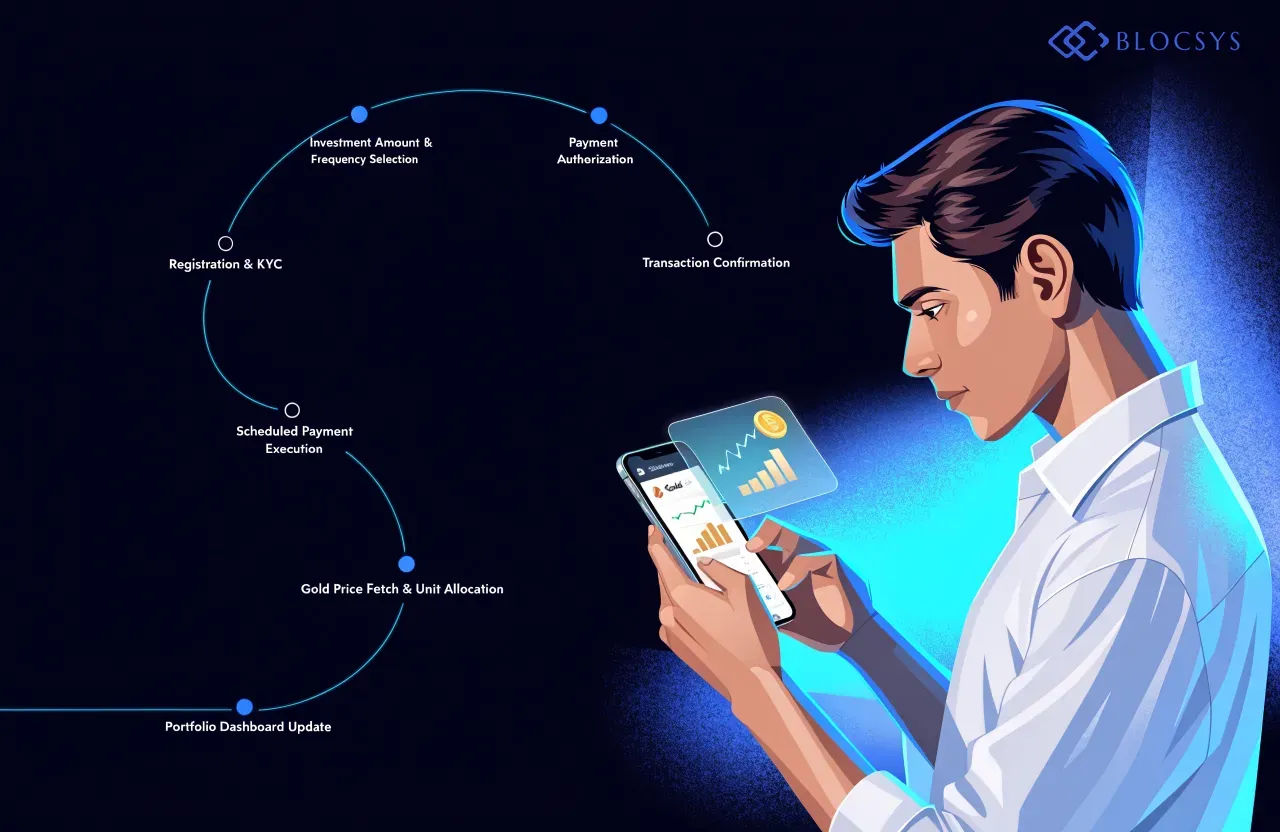
Consequently, every step in this chain needs to be logged. If a payment fails or a price feed lags, the business needs a clear audit trail to explain what happened. This is precisely why Digital gold SIP app development demands careful sequencing between payment confirmation and gold allocation, not just a pretty front-end.
Essential Features of a Digital Gold SIP App
A functional digital gold SIP application needs more than a buy button. Here’s what typically goes into a serious build:
- Customer registration and account management, including KYC workflows where applicable
- SIP scheduling with flexible frequency and amount options
- Payment method management, including cards, UPI, and net banking
- Real-time gold balance and portfolio tracking
- Detailed transaction history with timestamps and price references
- Push and email notifications for upcoming payments, failures, and confirmations
- A customer dashboard showing accumulated gold, invested amount, and current value
- Redemption or sell-back functionality
- An administrative dashboard for monitoring SIPs, reconciling transactions, and managing pricing rules
Each of these features connects to the others. A SIP scheduling engine, for instance, is useless without reliable payment management behind it. That’s why any digital gold SIP application should be scoped as one connected system rather than a checklist of screens.
Most digital gold platforms fail at the recurring layer, not the purchase layer. Anyone can build a one-time buy flow. Keeping a thousand scheduled payments reconciled with gold allocation every single day is where the real engineering happens.
Recurring Payments and Investment Scheduling
Recurring payments sit at the center of any digital gold SIP platform. The customer authorizes the payment once, and your system handles execution going forward. In India, this typically works through UPI AutoPay integration or standing instructions configured with a payment gateway partner, in line with NPCI guidelines on recurring mandates.
Globally, the pattern looks different depending on the market. In the UK, US, UAE, Germany, Singapore, Canada, and Australia, recurring payments usually run through card tokenization or direct debit schemes managed by the respective payment processor. Therefore, your architecture needs to support multiple recurring payment integrations if you’re targeting more than one region.
Failures will happen. A card expires. A bank account has insufficient funds. A good system retries on a defined schedule, notifies the customer, and pauses the SIP after repeated failures instead of silently dropping it. Additionally, customers should be able to pause, modify, or cancel their schedule without raising a support ticket.
Gold Price Calculation and Unit Allocation
Once a payment clears, the app needs to convert that money into gold. This sounds simple. It isn’t.
The system pulls a live gold price from a pricing API, applies the applicable spread or margin, and records the exact timestamp of the transaction. Because gold prices move constantly, even a short processing delay can create disputes if the price used doesn’t match what the customer saw.
Fractional allocation adds another layer of complexity. A ₹500 purchase rarely buys a round number of grams, so the system must calculate and store gold quantity to several decimal places. Moreover, every allocation record needs to tie back to the payment, the price snapshot, and the applied charges, so finance teams can reconcile balances accurately during audits.
Technology Architecture Behind a Digital Gold SIP App
Underneath the interface, a digital gold SIP platform runs on several interconnected layers. The frontend application, whether mobile or web, handles registration, scheduling, and portfolio visualization. Behind it, backend services manage business logic: scheduling jobs, payment orchestration, price calculation, and allocation.
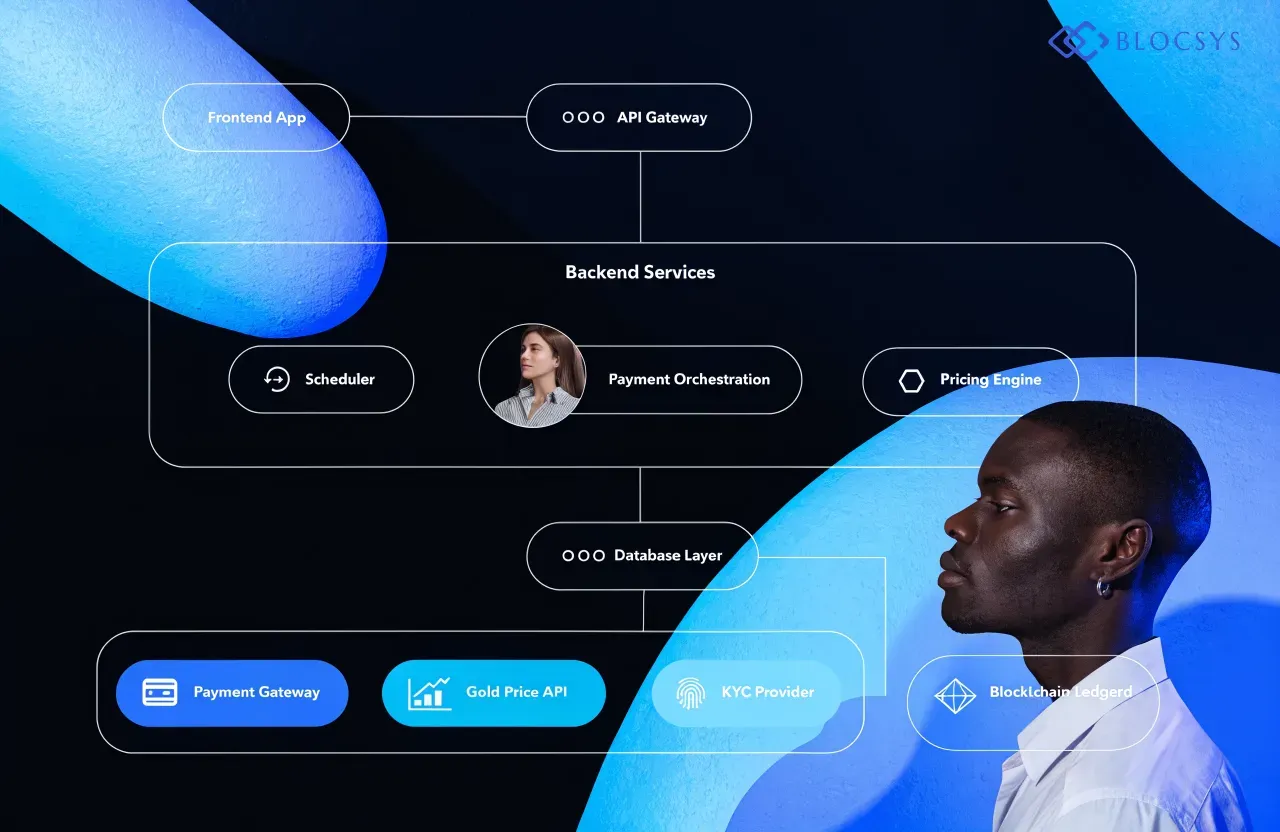
A relational database typically stores customer records, SIP schedules, and transaction history, since this data needs strong consistency guarantees. APIs connect the backend to payment gateways, gold price providers, and notification services. Administrative systems sit on top, giving operations teams visibility into failed payments, pending reconciliations, and overall SIP performance.
This is where custom digital gold application development earns its value. A generic e-commerce stack won’t handle scheduled financial transactions reliably. You need a purpose-built backend architecture that treats every recurring payment as a financial event requiring confirmation, logging, and reconciliation, similar in rigor to what underpins equity tokenization platform development for other asset classes.
How Blockchain Integration Can Improve Digital Gold SIP Platforms
Blockchain adds something traditional databases struggle to guarantee on their own: tamper-resistant transaction history. When each SIP payment, gold allocation, and ownership update gets recorded on a blockchain ledger, you get a traceable, time-stamped record that’s difficult to alter after the fact.
This matters most for audit trails and digital ownership records. If a customer disputes how much gold they own, you can point to an immutable transaction log rather than relying solely on internal database entries. A blockchain-based digital gold platform development approach typically layers this ledger alongside the primary database rather than replacing it, since blockchain isn’t optimized for the fast, frequent reads a customer dashboard needs.
However, blockchain records only cover the digital transaction layer. They don’t verify physical gold sourcing, custody, or vault storage, those remain separate operational and compliance functions handled by the gold-backing partner. Businesses evaluating a blockchain document verification system for related proof-of-record use cases will recognize the same underlying logic: blockchain secures data integrity, not physical custody.
Security and Data Management Considerations
Financial applications attract fraud attempts, so security can’t be an afterthought. Secure payment processing means tokenizing card details, never storing raw payment credentials, and encrypting data both in transit and at rest.
Strong authentication, think multi-factor login and biometric options, reduces account takeover risk. Role-based access controls limit what administrative staff can view or modify. Meanwhile, API security, including rate limiting and signed requests, protects the connections between your app and third-party services. Continuous transaction monitoring helps flag unusual patterns, like repeated failed payment attempts or sudden schedule changes, before they become bigger problems.
Third-Party Integrations Required for a Digital Gold SIP App
No digital gold SIP platform runs in isolation. You’ll need a payment gateway for processing transactions, recurring payment infrastructure like UPI AutoPay integration for Indian customers, and a reliable gold price API for accurate pricing.
Depending on your jurisdiction, KYC verification services may be required before customers can invest. Notification services handle SMS, email, and push alerts. Analytics and reporting tools give your business visibility into customer behavior and SIP performance. If you’re adding blockchain infrastructure for transaction records, that’s another integration layer entirely.
These integration requirements shift depending on your business model and the countries you operate in. A platform targeting India and the UAE, for example, needs different payment rails than one built for the US and Germany. The complexity here mirrors what fintech teams face building a crypto trading development company‘s infrastructure, where multiple payment and liquidity integrations must work together reliably.
Challenges in Developing a Digital Gold SIP Application
Recurring payment failures remain the most persistent operational headache. Cards expire, mandates lapse, and banks decline transactions for reasons outside your control. Your system needs graceful handling for all of it.
Pricing accuracy is another constant challenge, since gold prices fluctuate throughout the trading day. Transaction reconciliation, matching payments to gold allocations across thousands of customers, gets harder as volume grows. Add in platform scalability concerns, integration complexity across multiple third-party services, and the security risks inherent to handling customer money, and you can see why digital gold SIP application development isn’t a weekend project. Customer support also needs to scale alongside the platform, since payment and allocation disputes will come up regularly.
How to Build a Scalable Digital Gold SIP Platform
Start with business requirement analysis. What markets are you targeting? What payment rails do you need? Answer these before touching architecture decisions.
From there, plan the platform architecture, select features based on your actual customer needs rather than copying competitors wholesale, and map out your technology integrations. UI/UX design should prioritize clarity, since customers need to understand their gold holdings at a glance. Development and testing follow, including load testing for recurring payment spikes on scheduled dates.
Before launch, run a security assessment covering payment flows, API endpoints, and data storage. After deployment, ongoing maintenance, monitoring failed payments, updating price feed integrations, and patching vulnerabilities, keeps the platform reliable long after the initial build.
How Blocsys Helps Businesses Develop Digital Gold Platforms
Blocsys Technologies Pvt. Ltd. works with businesses planning blockchain-based digital asset platforms, including digital gold and silver applications. The team’s focus spans platform architecture, blockchain integration, and the application development work needed to support recurring investment workflows like gold SIPs.
For a business exploring a digital gold SIP app development company to build with, the relevant capabilities include designing backend systems that handle scheduled transactions, integrating blockchain layers for transaction traceability, and structuring administrative dashboards for operational control. These same architectural principles apply whether you’re building a gold SIP feature or a broader digital gold and silver app development project from scratch.
If you’re evaluating a digital gold app development company for your platform, it’s worth discussing your specific payment rails, target markets, and blockchain requirements upfront. That conversation shapes the entire build. Visit Blocsys to discuss your requirements with the team directly.
Conclusion
Building a digital gold SIP application isn’t just about letting customers buy gold on a schedule. It’s about combining recurring payment infrastructure, accurate price-to-unit calculation, scalable backend architecture, and blockchain-supported transparency into one coherent system. Get any one of those pieces wrong, and customer trust erodes quickly.
Digital gold SIP app development rewards businesses that plan the technical architecture before writing a single line of code. If you’re ready to scope your platform, explore digital gold and silver app development with a team that understands both the fintech and blockchain sides of the build.
Frequently Asked Questions
Here are direct answers to the questions we hear most often about digital gold SIP app development.
What is a digital gold SIP app?
It’s an application that lets customers buy digital gold at fixed intervals using recurring payments. Each payment gets converted into gold units based on the live price at the time of purchase.
How does a digital gold SIP application work?
Customers register, select an investment amount and frequency, then authorize recurring payments. The system executes each payment on schedule, calculates gold quantity, allocates it, and updates the customer’s portfolio.
What features should a digital gold SIP app include?
Core features include SIP scheduling, payment management, portfolio tracking, transaction history, notifications, redemption functionality, and an administrative dashboard for reconciliation and monitoring.
How can businesses integrate recurring payments into a digital gold app?
Businesses typically integrate payment gateways supporting recurring mandates, such as UPI AutoPay integration in India or card tokenization and direct debit schemes in other markets, depending on where customers are located.
How is gold quantity calculated in a digital gold SIP?
The system fetches the current gold price via an API, applies any applicable charges or spread, then divides the net investment amount by the price to determine the fractional gold quantity allocated.
What technology architecture is required for a digital gold SIP platform?
You need a frontend application, backend services for scheduling and payment orchestration, a database for transaction records, APIs connecting to payment gateways and price feeds, and an administrative system for oversight.
How can blockchain be integrated into a digital gold SIP application?
Blockchain can run alongside the primary database to record transactions, ownership updates, and allocation events immutably, supporting traceability and audit trails without replacing day-to-day data operations.
Which third-party integrations are required for a digital gold SIP app?
Typical integrations include a payment gateway, recurring payment infrastructure, a gold price API, KYC verification where required, notification services, and analytics or reporting tools.
How much does it cost to develop a digital gold SIP application?
Cost depends on factors like feature scope, number of payment integrations, blockchain requirements, target markets, and the complexity of administrative systems. There’s no fixed industry figure, each project is scoped individually.
How can businesses develop a scalable digital gold SIP platform?
Start with clear requirement analysis, plan the architecture for recurring transaction volume, choose reliable third-party integrations, and test thoroughly for payment spikes before launch, then maintain it actively afterward.
Ready to move beyond theory and build an intelligent platform that delivers real-world value? Blocsys Technologies specialises in engineering enterprise-grade AI and blockchain solutions for the fintech, Web3, and digital asset sectors. Connect with our experts today to discuss your vision and chart a clear path from concept to a secure, scalable reality.