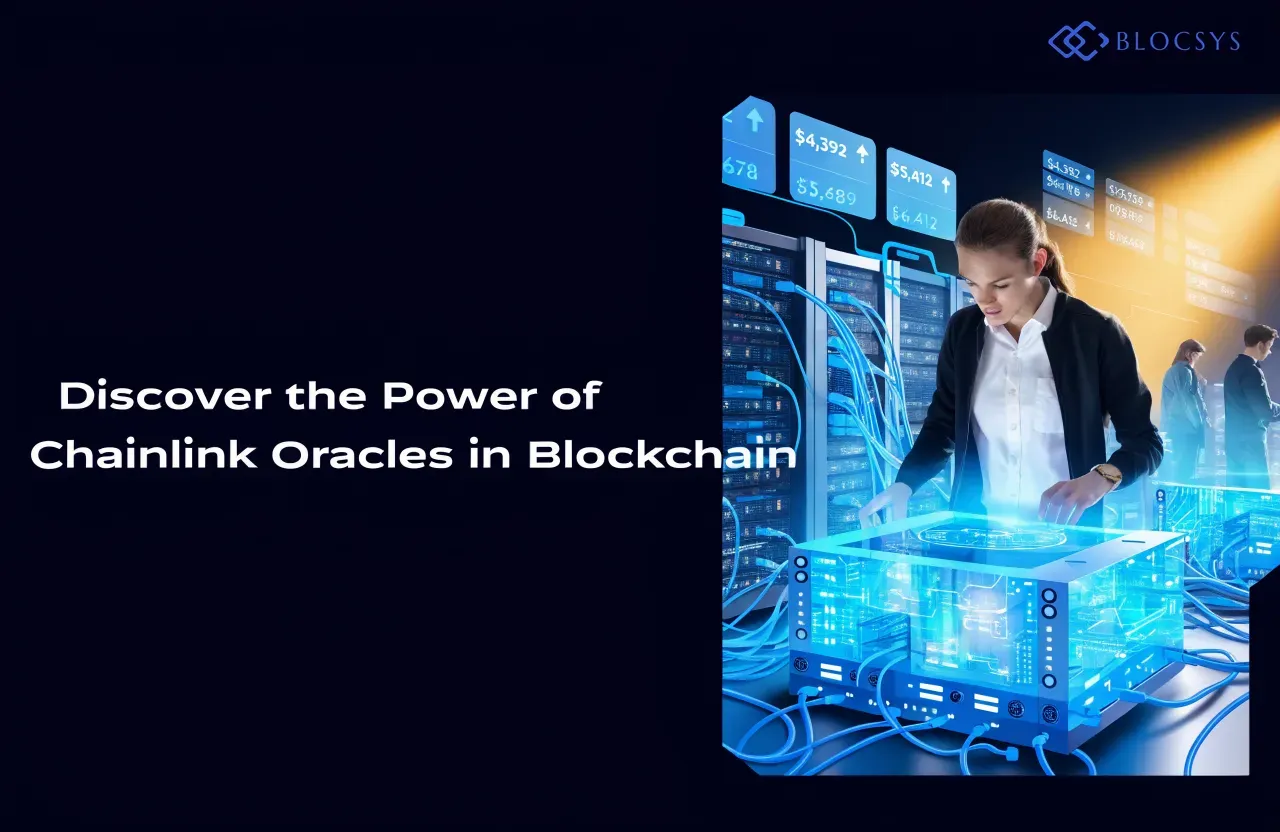
Discover the Power of Chainlink Oracles in Blockchain
Smart contracts are powerful, but they’re also blind. They can’t check a stock price, confirm a shipment arrived, or verify a bank’s reserves on their own. That’s where blockchain oracles come in. If you’re building DeFi protocols, tokenized assets, or enterprise blockchain systems in 2026, understanding how blockchain oracles work — and where Chainlink fits into that picture — isn’t optional anymore. It’s foundational. This article walks through what blockchain oracles actually do, how Chainlink’s decentralized oracle network operates, and what’s changed since the early days of simple price feeds.
What Is a Blockchain Oracle?
A blockchain oracle is a system that connects blockchain-based smart contracts with data or events that live outside the blockchain. Think of it as a translator. Blockchains are closed environments by design — they can only see what’s already recorded on-chain. Oracles bridge that gap, feeding external information into smart contracts so they can execute logic based on real-world conditions.
Without oracles, smart contracts could only react to on-chain events. That’s a serious limitation. Most useful applications — lending platforms, insurance products, tokenized funds — need something happening off-chain to trigger on-chain action. Blockchain oracles make that possible, and they’ve quietly become one of the most important pieces of infrastructure in Web3.
Why Smart Contracts Need External Data
Here’s why this matters so much: a smart contract’s entire value comes from automating decisions. But decisions need inputs. A lending protocol needs to know an asset’s price before it can decide whether to trigger a liquidation. A parametric insurance contract needs weather data before it can pay a claim. A derivatives platform needs interest rate benchmarks. None of that data originates on-chain.
Consequently, developers turn to blockchain oracles as the connective tissue between deterministic smart contract code and the messy, constantly changing world outside it.
The Oracle Problem, Explained Simply
The “oracle problem” refers to a core challenge in blockchain design: how do you bring off-chain data on-chain without reintroducing a trusted, centralized party? Blockchains achieve security through decentralization and consensus. However, if a smart contract simply pulls data from one external API, that API becomes a single point of failure. If it’s wrong, hacked, or manipulated, the smart contract acts on bad information — no matter how secure the underlying blockchain is.
This is precisely why decentralized oracle networks exist. Instead of trusting one data source, they aggregate data from multiple independent providers and nodes, reducing the risk that any single actor can manipulate the outcome.
![Blockchain Oracles — [Flow diagram showing the oracle problem: Off-Chain Data Source → Single API Call → Smart Contract Execution, contrasted with Multiple Data Providers → Decentralized Oracle Nodes → Aggregation → Smart Contract Execution]](https://s3.blocsys.com/blocsys/blog-images/1787311269226-db4806accf1d684f.webp)
How Decentralized Oracle Networks Work
A decentralized oracle network breaks the data delivery process into distinct stages. First, data acquisition — multiple independent node operators pull information from several data providers rather than one. Second, validation — responses get checked for consistency and outliers get flagged. Third, aggregation — the network combines individual data points into a single, agreed-upon value, often using median calculations to limit the influence of any one bad input. Finally, delivery — the aggregated result gets published on-chain where the smart contract can use it.
This layered process is what separates a serious decentralized oracle network from a basic centralized data feed. Centralized feeds are faster and cheaper to set up, but they concentrate risk. If that one provider goes offline, gets compromised, or reports inaccurate figures, every dependent contract suffers immediately. Decentralized oracle networks trade a bit of simplicity for meaningfully stronger resilience, which is why they’ve become the standard for anything handling real value.
Oracle infrastructure doesn’t remove trust from the equation — it redistributes it. You’re moving from trusting one data source to trusting a broader system of providers, nodes, aggregation logic, and governance working together. That distinction matters when you’re deciding how much value to put behind a contract.
Chainlink’s Role in Blockchain Oracle Infrastructure
Chainlink is a decentralized oracle network — not a blockchain itself. It’s infrastructure that connects blockchain-based smart contracts with external data, off-chain computation, and other blockchain networks. That distinction matters because Chainlink doesn’t process transactions or maintain its own ledger of application state the way a Layer 1 or Layer 2 blockchain does. Instead, it operates as a middleware layer that many blockchains and applications rely on for reliable data delivery.
It’s also worth being clear-eyed here: Chainlink is one of several established players in the blockchain oracles space, not the only option. Depending on your application’s needs — latency, cost, supported chains, data type — teams evaluate multiple oracle providers before settling on an architecture. That said, Chainlink has built one of the most widely integrated decentralized oracle networks in the industry, spanning dozens of blockchains and supporting a large share of DeFi’s total value secured.
Chainlink Data Feeds
Chainlink Data Feeds are pre-built, continuously updated price and reference data streams that smart contracts can pull on-chain. They’re the most widely used Chainlink product, and for good reason — accurate pricing data is the backbone of nearly every DeFi application. Lending markets use Data Feeds to calculate collateral ratios. Derivatives platforms use them to settle positions. Stablecoin issuers use them to monitor peg stability.
Each feed aggregates data from numerous independent node operators pulling from multiple premium data providers, then publishes a median value on-chain. This matters for tokenized assets too — a tokenized commodity or tokenized Treasury product still needs an accurate, tamper-resistant reference price to function correctly across DeFi integrations.
Chainlink Automation
Chainlink Automation handles the “what happens next” problem for smart contracts. Smart contracts don’t execute themselves — something has to trigger them. Automation is a decentralized network of nodes that monitors on-chain conditions and off-chain events, then triggers smart contract functions when predefined thresholds are met.
Practical examples include scheduled tasks like rebasing a token supply, threshold-based actions like triggering a liquidation once collateral drops below a set ratio, and routine maintenance like harvesting yield in a vault strategy. Rather than relying on a centralized server or a manual keeper, Automation distributes that responsibility across a decentralized oracle network, reducing the chance that a missed trigger causes financial loss.
Chainlink CCIP and Cross-Chain Interoperability
Cross-Chain Interoperability Protocol, or CCIP, is Chainlink’s messaging and token transfer infrastructure for moving data and assets between different blockchain networks. As tokenized assets, stablecoins, and DeFi applications increasingly span multiple chains, cross-chain interoperability has moved from a nice-to-have to a genuine architectural requirement.
CCIP allows a smart contract on one chain to send instructions, data, or tokens to a contract on another chain, with the decentralized oracle network verifying and relaying the message. This is directly relevant to enterprises building multi-chain tokenization platforms, where an asset might get issued on one network but need to settle or trade on another. It’s also worth noting that CCIP is one of several cross-chain messaging approaches in the market, and teams should evaluate its security model against their specific risk tolerance.
![Blockchain Oracles — [Flow diagram showing CCIP cross-chain messaging: Source Chain Smart Contract → CCIP Message Router → Decentralized Oracle Network Verification → Destination Chain Smart Contract → Action Executed]](https://s3.blocsys.com/blocsys/blog-images/1787311271435-e57b57914d73a2a5.webp)
Proof of Reserve and Tokenized Assets
Chainlink Proof of Reserve provides on-chain, automated verification of certain off-chain or cross-chain reserves backing a tokenized asset. For example, a stablecoin issuer might use Proof of Reserve to publish reserve data on-chain, giving smart contracts and users visibility into whether reported collateral aligns with circulating supply.
Here’s the important caveat: Proof of Reserve verifies a defined, specific scope of reserve data. It does not automatically confirm an institution’s overall solvency, its liabilities, its governance practices, or its full financial condition. It’s a transparency tool, not a comprehensive audit. Enterprises and DeFi protocols relying on Proof of Reserve should understand exactly what’s being verified — and what isn’t — before treating it as a complete risk assessment.
Blockchain Oracles in Real-World Asset Tokenization
Real-world asset tokenization has grown substantially as institutions explore on-chain representations of Treasuries, private credit, funds, and commodities. Tokenized assets typically need several categories of external data to function properly: accurate valuation feeds, reserve or collateral verification, corporate action data such as dividends or coupon payments, and compliance-related signals depending on jurisdiction.
This is exactly where blockchain oracles earn their keep. A tokenized Treasury product, for instance, might use Data Feeds for yield benchmarks and Proof of Reserve for underlying collateral visibility, while relying on CCIP if the token needs to move across chains for liquidity purposes.
If you’re exploring how tokenization infrastructure fits together, Blocsys’ Asset Tokenization Platform and Real World Asset Tokenization services address exactly this kind of data and infrastructure planning for institutions moving assets on-chain. For fixed-income specific tokenization, our Corporate Bond Tokenization work and Equity Tokenization Platform development also depend heavily on reliable oracle-backed data.
Blockchain Oracles in DeFi
DeFi oracles are arguably the most battle-tested application of blockchain oracle technology. Lending and borrowing protocols use price oracles to determine collateral value and trigger liquidations. Derivatives platforms use them to settle contracts fairly. Stablecoin systems monitor pegs and reserves. Automated liquidation engines depend on timely, accurate data to protect protocol solvency.
Without reliable blockchain oracles, none of this works safely. A stale or manipulated price feed can cause a protocol to liquidate positions incorrectly or, worse, let an attacker drain funds through a mispriced trade.
Oracle Security Risks You Should Know
Security is where oracle design gets serious. Common risks include data manipulation at the source, node compromise, insufficient decentralization among data providers, latency between data changes and on-chain updates, and stale data that hasn’t refreshed in time. Flash-loan-driven price manipulation has also been a recurring attack vector against protocols using thin, easily-moved liquidity pools as their sole price reference.
Governance risk matters too — who controls upgrades to the oracle network, and how are decisions made?
Here’s a point that gets missed often: using a reputable oracle provider doesn’t automatically make your smart contract secure. Your application still has to integrate the oracle correctly. That means validating responses, handling missing or stale data gracefully, setting sensible deviation thresholds, and writing sound contract logic around how oracle data gets consumed. A well-designed decentralized oracle network can still be undermined by a poorly integrated smart contract.
Centralized vs. Decentralized Oracles: The Trade-offs
| Factor | Centralized Data Feed | Decentralized Oracle Network | First-Party / App-Specific Oracle |
|---|---|---|---|
| Single point of failure | High risk | Low risk, distributed nodes | Depends on source diversity |
| Setup speed and cost | Fast, cheap | Slower, higher cost | Moderate, custom-built |
| Data manipulation resistance | Weak | Strong via aggregation | Varies by design |
| Best fit | Low-value, internal tools | DeFi, tokenized assets, high-value contracts | Niche or proprietary data needs |
Neither approach is universally “correct.” A centralized feed might be fine for an internal enterprise dashboard with no financial exposure. A decentralized oracle network makes far more sense once real value is at stake, since the cost of manipulation or downtime rises sharply. First-party oracle models, where a data provider runs its own oracle infrastructure, sit somewhere in between and suit specialized data types that generic feeds don’t cover well.
Enterprise Blockchain Use Cases for Oracles
Beyond DeFi, enterprise blockchain applications increasingly depend on oracle infrastructure. Insurance companies use oracles to trigger parametric payouts based on verified external events. Trade finance platforms use them to confirm shipment or customs data before releasing payment. Payments infrastructure uses oracles to reconcile off-chain banking data with on-chain settlement. Supply chain systems use them to log verified checkpoint data that triggers downstream contract logic.
How Businesses Should Evaluate an Oracle Solution
Choosing oracle infrastructure isn’t a one-size-fits-all decision. Evaluate providers on data-source quality, level of decentralization, aggregation methodology, update frequency, and latency. Additionally, weigh cost against your transaction volume, confirm which blockchain networks are supported, and understand the underlying security assumptions.
Fallback mechanisms and monitoring matter just as much — what happens when a feed goes stale? Governance transparency and compliance considerations round out the list, particularly for regulated financial applications where jurisdiction-specific rules apply.
One thing worth stating plainly: no oracle solution makes an application automatically compliant. Compliance depends on your jurisdiction, the asset type, your participants, and the applicable regulations — the oracle just supplies data.
![Blockchain Oracles — [Flow diagram showing enterprise oracle evaluation criteria: Data Source Quality → Decentralization Level → Latency & Cost → Network Coverage → Security Assumptions → Fallback & Monitoring → Final Provider Selection]](https://s3.blocsys.com/blocsys/blog-images/1787311270453-c49a98c8b7c6e916.webp)
Challenges and Limitations of Blockchain Oracles
Blockchain oracles have matured significantly, but they’re not a solved problem. Latency remains a real constraint for high-frequency applications. Cost scales with the number of chains and update frequency you need. And no matter how decentralized an oracle network is, it still depends on the quality of its underlying real-world data sources — garbage in, garbage out still applies.
Newer approaches, like Chainlink’s low-latency Data Streams model built for high-frequency use cases such as derivatives, show the space is still evolving rather than standing still.
The Future of Blockchain Oracle Infrastructure
As tokenization, stablecoins, and institutional blockchain adoption continue expanding across markets like the USA, UK, Europe, UAE, and Singapore, the demand for reliable blockchain oracles will only grow. Cross-chain interoperability is becoming a baseline requirement rather than an edge case, as assets and liquidity spread across multiple networks. Institutional players entering tokenized Treasuries, funds, and digital assets need oracle infrastructure they can actually trust for valuation, reserve verification, and settlement triggers.
We expect oracle networks to keep pushing on lower latency, broader chain coverage, and deeper enterprise integration over the next few years.
Whatever direction your project takes, getting the underlying architecture right from day one saves you significant rework later. Teams building on Blocsys get that architectural planning built into the development process from the start, rather than bolted on afterward.
Bringing It All Together
Blockchain oracles solve a problem smart contracts can’t solve alone: connecting deterministic on-chain code to a dynamic off-chain world. Chainlink has built one of the most established decentralized oracle networks for this purpose, offering Data Feeds, Automation, CCIP, and Proof of Reserve as building blocks — not a one-size-fits-all guarantee of security or compliance. Getting oracle integration right requires careful application design, not just picking a reputable provider.
If you’re building DeFi protocols, tokenized assets, or enterprise blockchain systems that need dependable external data, Blocsys’ Smart Contract Development team can help you architect oracle integrations that match your actual risk profile and use case. Curious what a custom oracle-connected build would cost? Check the Blocsys Cost Estimator Tool for a project-specific estimate rather than a generic figure.
Frequently Asked Questions
Here are direct answers to the questions we hear most often about blockchain oracles.
What is a blockchain oracle?
A blockchain oracle is infrastructure that connects blockchain-based smart contracts with external data and off-chain events. Smart contracts can’t independently access information like asset prices, weather conditions, or reserve data, so oracles retrieve, validate, and deliver that data on-chain. Blockchain oracles serve as the bridge between deterministic on-chain logic and the real-world information smart contracts need to execute meaningful actions.
Why do smart contracts need oracles?
Smart contracts execute automatically based on predefined conditions, but those conditions often depend on data that doesn’t exist on the blockchain, such as market prices or event outcomes. Without oracles, a smart contract would have no way to know if a payment was received off-chain or if an asset’s price changed. Oracles supply that missing context, letting smart contracts function as intended for real financial and business logic.
What is Chainlink used for?
Chainlink is used as decentralized oracle infrastructure that connects smart contracts with external data, off-chain computation, and other blockchain networks. It’s commonly used for price feeds in DeFi lending and trading, automated smart contract triggers, cross-chain messaging between blockchains, and reserve verification for tokenized assets and stablecoins. It’s not a blockchain itself — it’s middleware that many blockchains rely on.
How do Chainlink oracles work?
Chainlink oracles work through a decentralized network of independent node operators that fetch data from multiple sources, validate responses, and aggregate them into a single value, typically using a median calculation. That aggregated result gets published on-chain, where smart contracts can read it. This process reduces reliance on any single data source, lowering the risk of manipulation compared to a centralized feed.
What are Chainlink Data Feeds?
Chainlink Data Feeds are continuously updated, on-chain price and reference data streams sourced from multiple independent providers and node operators. They’re widely used across DeFi for collateral pricing, liquidation triggers, derivatives settlement, and stablecoin monitoring. Data Feeds aggregate numerous data points into a single median value, which helps limit the effect of any single inaccurate or manipulated data point on a smart contract’s execution.
What is Chainlink Automation?
Chainlink Automation is a decentralized network that monitors on-chain and off-chain conditions and triggers smart contract functions once predefined thresholds are met. It supports use cases like scheduled token operations, automated liquidations, and routine contract maintenance. Rather than relying on a centralized server or manual execution, Automation distributes triggering responsibility across a decentralized oracle network, reducing missed or delayed executions.
What is Chainlink CCIP?
Chainlink CCIP, the Cross-Chain Interoperability Protocol, is messaging and token transfer infrastructure that lets smart contracts on one blockchain communicate with contracts on another. It supports cross-chain interoperability for applications spanning multiple networks, such as multi-chain tokenization platforms or DeFi protocols needing to move assets between chains. A decentralized oracle network verifies and relays these cross-chain messages.
What is Chainlink Proof of Reserve?
Chainlink Proof of Reserve is an oracle-based service that verifies specific off-chain or cross-chain reserves and publishes that data on-chain. It’s often used by stablecoin issuers and tokenized asset platforms to give users visibility into whether reported collateral matches circulating supply. Importantly, Proof of Reserve verifies a defined scope of reserve data only — it doesn’t confirm an institution’s full solvency, liabilities, or overall financial condition.
Are blockchain oracles secure?
Blockchain oracles can be highly secure when built with strong decentralization, diverse data sources, and robust aggregation methods, but no oracle is automatically risk-free. Security risks include data manipulation, node compromise, stale data, and flash-loan-related attacks. Additionally, using a reputable oracle doesn’t guarantee a secure application — the smart contract itself must correctly validate oracle responses and handle edge cases like missing or delayed data.
How can businesses integrate blockchain oracle infrastructure?
Businesses typically integrate blockchain oracle infrastructure by identifying which external data or automation their smart contracts require, then selecting an oracle provider based on decentralization, data quality, latency, supported networks, and cost. From there, developers build the smart contract logic to correctly consume and validate that oracle data. Working with an experienced blockchain development partner helps ensure the integration matches the application’s actual security and compliance needs.
Ready to move beyond theory and build an intelligent platform that delivers real-world value? Blocsys Technologies specialises in engineering enterprise-grade AI and blockchain solutions for the fintech, Web3, and digital asset sectors. Connect with our experts today to discuss your vision and chart a clear path from concept to a secure, scalable reality.