The Future of Enterprise Blockchain in 2027: Adoption, Challenges, and Opportunities
Enterprise blockchain in 2027 won’t be judged by hype. It’ll be judged by whether it solves a real business problem cheaper, faster, or more reliably than what you already run. If you’re a CTO or CIO weighing this decision, the honest answer is: it depends on your integration readiness, your governance model, your security posture, and how mature your specific use case actually is. Blocsys works with enterprises asking exactly this question, and we’ve seen the pattern enough times to say it plainly — adoption follows business value, not the other way around.
The Current State of Enterprise Blockchain Adoption
Most enterprise blockchain deployments today sit somewhere between pilot and production. Financial institutions run permissioned networks for trade settlement and reconciliation. Supply chain operators track provenance across multi-party networks. However, very few organizations have fully retired legacy systems in favor of distributed ledgers.
Why the gap? Technology maturity matters, but business readiness matters more. A network can be technically sound and still fail commercially if participants lack incentive to join, or if governance roles were never clearly assigned.
Established implementations tend to share one trait: a narrow, well-defined problem involving multiple independent parties who don’t fully trust a single central database. Experiments without that multi-party dynamic rarely survive past the pilot stage.
What’s Driving Enterprise Blockchain Adoption in 2027?
Several forces are pushing enterprise blockchain in 2027 from experimentation toward operational use. None of them are new this year — they’ve been building since 2024 and 2025 — but their combined weight is shifting budget conversations.
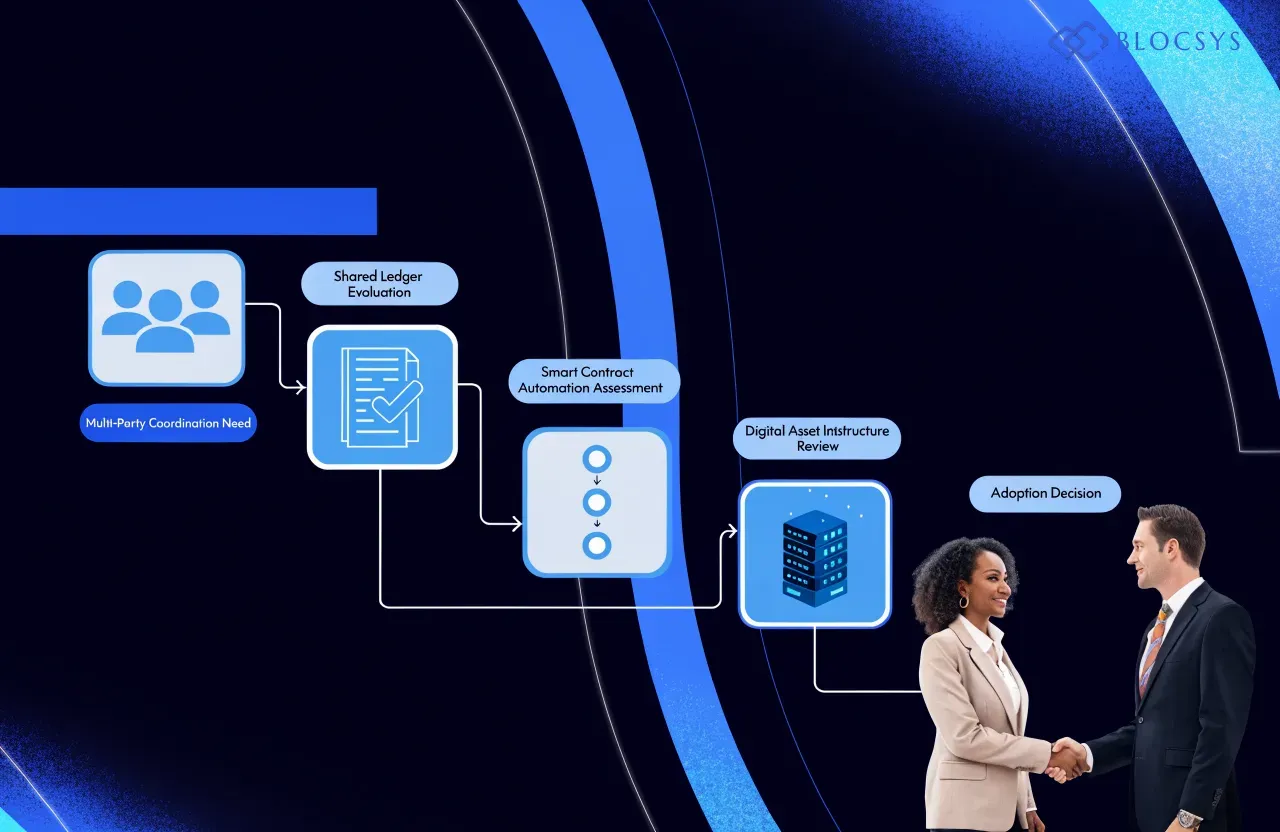
First, multi-party coordination costs. When several organizations need a shared, tamper-evident record, reconciling separate databases gets expensive. A shared ledger removes duplicate verification work.
Second, digital asset infrastructure. Tokenized bonds, equities, and real-world assets require settlement rails that traditional core banking systems weren’t built for. Institutions exploring this path need infrastructure, not just a proof of concept.
Third, automation through smart contracts. Conditional payments, compliance checks, and multi-step approvals can run automatically once terms are coded and agreed upon. That said, smart contract automation only helps when the underlying business process is itself well-defined — automating a messy process just makes the mess run faster.
Finally, traceability requirements in regulated industries are pushing adoption in food safety, pharmaceuticals, and capital markets, where auditors and regulators increasingly expect verifiable data trails.
Enterprise Blockchain Use Cases and Business Opportunities
Not every business problem needs a blockchain. Here’s how to think about where it genuinely adds value in 2027, industry by industry.
Supply Chain and Trade Finance
Manufacturing and food industries benefit when multiple suppliers, logistics providers, and auditors need a shared, verifiable record of custody. A blockchain supply chain traceability system works best when no single party controls the entire chain, and when disputes over data integrity are costly. If one company controls the whole chain end to end, a conventional database often does the job just as well, at lower cost.
Financial Services and Digital Assets
Banks and capital markets firms are using permissioned networks for post-trade reconciliation, where settlement delays and mismatched records create real financial risk. A platform like a permissioned blockchain infrastructure for post-trade operations reduces reconciliation friction between counterparties who each maintain their own books today.
Digital Identity and Shared Business Records
Document verification is another area with clear logic: once a credential or certificate is issued, multiple parties need to confirm it hasn’t been altered. A blockchain document verification system gives verifiers a tamper-evident reference without relying on the issuing party’s own database staying available and honest.
In each case, the business problem — not the technology — determines whether blockchain adds value. Treat that as your filter before any architecture conversation.
“The organizations that succeed with enterprise blockchain in 2027 aren’t the ones with the most sophisticated smart contracts. They’re the ones that figured out governance and participant incentives before writing a line of code.” — enterprise infrastructure advisory perspective
The Biggest Challenges Facing Enterprise Blockchain Adoption
Let’s talk about what actually stalls projects, because this is where most roadmaps go wrong.
Integration with legacy systems is the first wall. Core banking platforms, ERP systems, and decades-old databases weren’t designed to talk to a distributed ledger. Middleware and APIs can bridge the gap, but that bridging work often costs more than the blockchain component itself.
Interoperability is the second challenge. Enterprise blockchain in 2027 increasingly means connecting multiple networks — a permissioned chain for settlement, a public chain for liquidity, and internal systems for reporting. Standards like cross-chain messaging protocols are maturing, but they’re not yet uniform across vendors.
Scalability still matters for high-throughput use cases, though many permissioned networks have addressed transaction speed well enough for most enterprise workloads. Privacy is trickier: enterprises need selective data visibility, where counterparties see only what they’re entitled to, not the full ledger.
Security reviews take longer than teams expect. Smart contracts, once deployed, are hard to patch quietly. Therefore, audit cycles for production contracts typically run longer than a standard application release cycle.
Regulatory dependency varies sharply by jurisdiction. The EU’s MiCA framework, UK FCA guidance, UAE’s VARA regime, and Singapore’s MAS Payment Services Act each set different expectations for digital asset activity. A deployment compliant in one market may need rework in another. Blockchain technology itself doesn’t make a business compliant — the surrounding controls, reporting, and legal structure do that work.
Finally, talent and cost. Experienced blockchain architects remain scarce relative to demand, and unclear ROI makes budget approval harder than it should be.
From Blockchain Pilots to Production Implementation
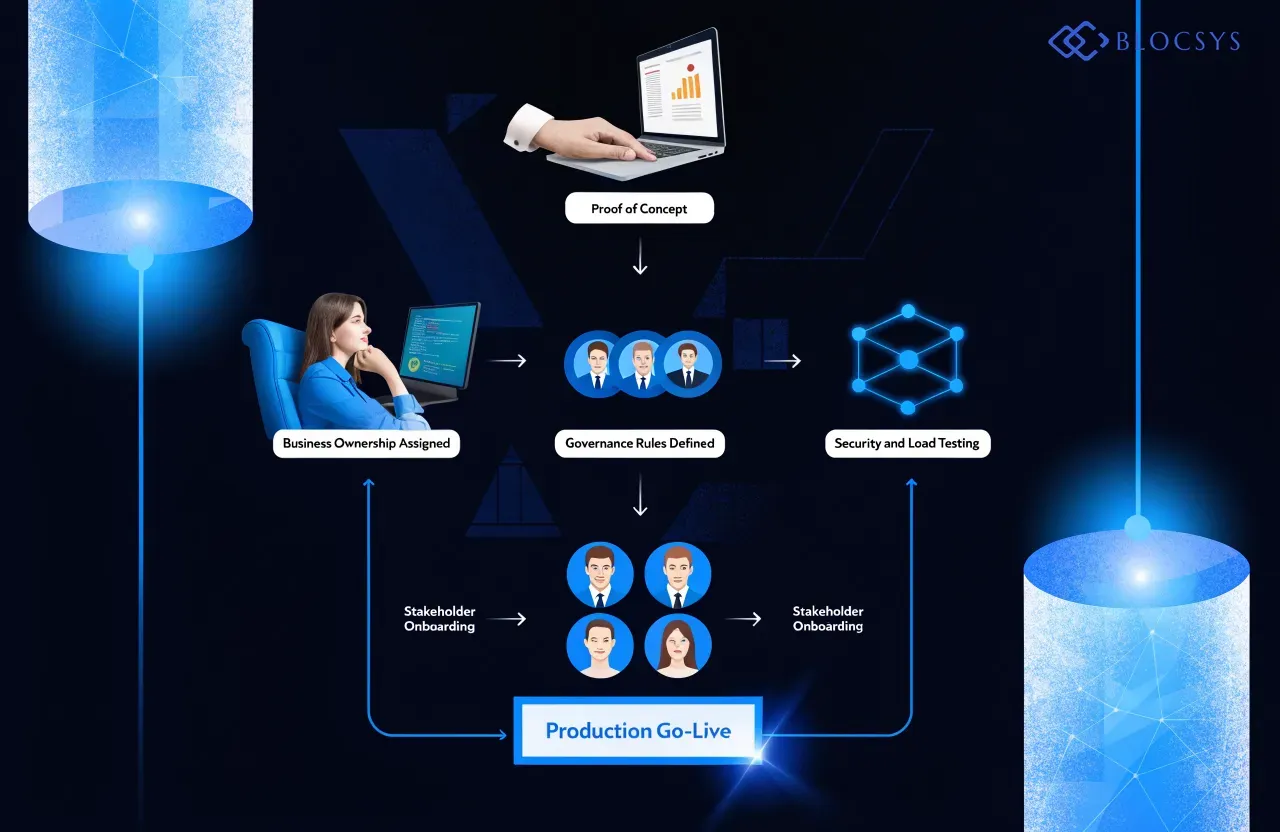
A proof of concept proves a concept. It doesn’t prove a production system. That distinction trips up more enterprise projects than any technical limitation does.
Production requires clear business ownership — someone accountable for uptime, data quality, and participant onboarding, not just the engineering team that built the pilot. It requires architecture that accounts for real transaction volume, not a demo dataset. It requires every stakeholder organization to actually commit operational resources, not just sign a memorandum of understanding.
Governance deserves special attention here. Who can propose a change to the network’s rules? Who resolves disputes between participants? Without answers, even a technically flawless system stalls at the negotiation table.
Security review, load testing, and disaster recovery planning all need to happen before go-live, not after. Consequently, the timeline from successful pilot to production often runs longer than the pilot itself took to build.
Enterprise Blockchain Infrastructure and Technology Decisions
Architecture choice depends entirely on your use case — there’s no universally correct answer here.
Public networks offer broad liquidity and composability, useful for digital assets that need external market access. Permissioned blockchain networks offer controlled participation and data visibility, better suited to consortiums of known business partners, such as banks reconciling trades or manufacturers verifying suppliers.
Custom-built infrastructure gives you control over performance and data handling, but it costs more to build and maintain. Configurable platforms get you to market faster, though you’ll inherit some constraints from the platform vendor.
On-chain components should generally handle what truly needs shared verification — ownership records, state transitions, settlement finality. Off-chain components handle everything else: bulk data storage, user interfaces, and anything requiring fast iteration. Keeping most logic off-chain and verification on-chain tends to produce systems that are both auditable and maintainable.
Interoperability planning deserves attention from day one. If you’ll eventually need to connect to other networks, building with recognized messaging standards now avoids costly rework later.
Emerging Opportunities for Enterprise Blockchain in 2027
Here’s where it gets genuinely interesting, if you separate what’s established from what’s still forming.
Tokenized real-world assets have moved from experimental to operational in several institutional settings, particularly for bonds and private credit. Platforms addressing infrastructure for tokenized assets are seeing renewed institutional interest as settlement and custody questions get clearer answers. That said, full secondary-market liquidity for tokenized assets across jurisdictions remains an emerging capability, not a settled outcome, going into 2027.
Cross-network interoperability is advancing, letting permissioned enterprise chains communicate with public settlement layers without compromising participant privacy. This capability is still maturing and should be evaluated case by case.
Automated, multi-party business processes — where smart contracts trigger payments, compliance checks, and record updates across organizational boundaries — represent a credible near-term opportunity for enterprises with repetitive, rules-based workflows involving external partners.
Institutional digital asset workflows, including custody, settlement, and reporting, are an area several banks and fintechs are actively building toward for 2027, though implementation timelines vary widely by jurisdiction and regulatory clarity.
How Businesses Can Prepare for Enterprise Blockchain Adoption
Before you commit budget, work through this readiness framework honestly.
- Define the specific business problem — not “blockchain,” but the actual friction, cost, or risk you’re trying to remove.
- Check feasibility: does your problem genuinely involve multiple parties who don’t trust a shared central database?
- Identify stakeholder requirements across every participating organization, not just your own.
- Assess technical fit: integration points, data volume, and performance needs.
- Address security and regulatory dependencies early, including jurisdiction-specific obligations.
- Estimate cost realistically, including ongoing operations, not just build cost.
- Set measurable success criteria before you start, so you can evaluate enterprise blockchain ROI against something concrete.
And sometimes the honest answer is: don’t. If a single organization controls all the data, and no external party needs independent verification, a conventional database remains faster and cheaper to build and maintain. Blockchain earns its complexity only when multi-party trust is genuinely the problem.
If your assessment points toward blockchain, working with dedicated blockchain engineering teams can shorten the gap between planning and a production-ready build, particularly where in-house blockchain expertise is limited. For founders mapping out a broader technology roadmap, the founder checklist for blockchain startups covers adjacent planning questions worth reviewing alongside this framework.
Conclusion: Preparing for the Next Phase of Enterprise Blockchain in 2027
Enterprise blockchain in 2027 won’t arrive as a single wave of adoption. It’ll arrive unevenly, use case by use case, driven by organizations that matched the technology to a genuine multi-party problem and did the governance work upfront. The challenges — integration, interoperability, security, unclear ROI — are real, but they’re manageable with honest evaluation rather than enthusiasm.
If you’re assessing whether enterprise blockchain adoption fits your organization’s 2027 roadmap, start with the business problem, not the technology. Blocsys helps enterprises evaluate, architect, and build blockchain infrastructure suited to their actual requirements — reach out if you’d like a second opinion on your use case before you commit resources.
Frequently Asked Questions
Here are direct answers to the questions we hear most often about enterprise blockchain adoption in 2027.
What is the future of enterprise blockchain in 2027?
Expect steady, use-case-specific growth rather than mass adoption. Enterprise blockchain in 2027 will likely expand most in financial settlement, supply chain traceability, and digital asset infrastructure, where multi-party trust problems are clearest.
What is driving enterprise blockchain adoption?
Multi-party coordination costs, demand for tamper-evident records, smart contract automation, and growing digital asset infrastructure needs are the main drivers. Regulatory clarity in select jurisdictions is also helping institutional confidence.
Which industries can benefit from enterprise blockchain?
Financial services, supply chain and manufacturing, healthcare and pharma traceability, and capital markets show the clearest fit. Benefit depends on having multiple independent parties who need shared, verifiable data.
What are the biggest challenges of enterprise blockchain implementation?
Legacy system integration, interoperability between networks, privacy-preserving data sharing, security review cycles, unclear regulatory requirements, and talent shortages top the list. Unclear ROI measurement also slows budget approval.
Why do enterprise blockchain projects struggle to move from pilots to production?
Pilots often skip governance, operational ownership, and realistic load testing. Production requires every participating organization to commit resources, not just sign off conceptually — that gap stalls many promising pilots.
How does blockchain interoperability affect enterprise adoption?
Without interoperability, enterprises end up with isolated networks that can’t exchange value or data with other chains or internal systems. This limits scalability and forces costly custom bridging work later.
Is enterprise blockchain more suitable than a traditional database?
Only when multiple independent parties need a shared, tamper-evident record and don’t fully trust a single central authority. If one organization controls all the data, a conventional database is usually faster and cheaper.
How can businesses evaluate the ROI of enterprise blockchain?
Set measurable success criteria before building — reduced reconciliation time, fewer disputes, faster settlement cycles. Compare total cost of ownership, including integration and operations, against the business friction you’re removing.
What security and regulatory considerations should enterprises address before adoption?
Smart contract audits, access control design, and data privacy architecture are essential technical steps. Regulatory obligations vary by jurisdiction — MiCA, FCA guidance, VARA, and MAS rules differ, so compliance needs legal review, not just technical design.
How can a business prepare for enterprise blockchain implementation in 2027?
Define the business problem clearly, confirm multi-party need, assess integration and regulatory dependencies, and set measurable outcomes upfront. Engage experienced blockchain engineering support early to validate feasibility before committing budget.
Internal links pending manual insertion.
Ready to move beyond theory and build an intelligent platform that delivers real-world value? Blocsys Technologies specialises in engineering enterprise-grade AI and blockchain solutions for the fintech, Web3, and digital asset sectors. Connect with our experts today to discuss your vision and chart a clear path from concept to a secure, scalable reality.