
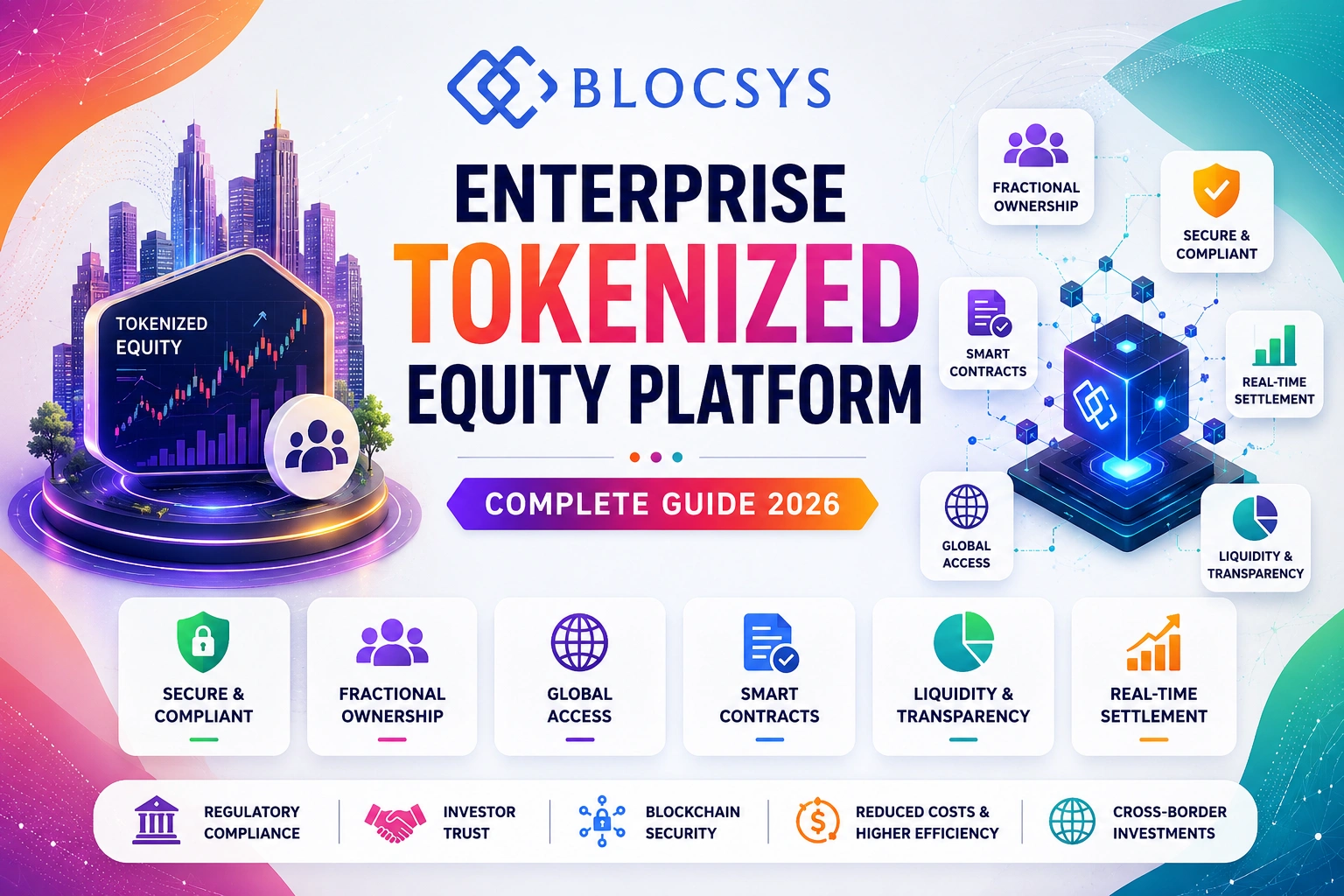
Enterprise Tokenized Equity Platform: Features, Benefits & Complete Guide 21/07/26
Picture a mid-sized private company that wants to raise capital without months of paperwork and outdated cap table spreadsheets. That’s exactly the gap an enterprise tokenized equity platform fills. It lets you issue, manage, and trade company shares as digital tokens on a blockchain, replacing paper certificates with something faster, transparent, and audit-ready. Enterprises across the USA, UK, Europe, UAE, and Singapore are already adopting this approach to modernize how they raise capital and manage ownership records. If you’re exploring how to build one, Blocsys has spent years helping founders and financial institutions design secure, compliant infrastructure, and our equity tokenization platform development team can walk you through exactly what it takes.
What Is an Enterprise Tokenized Equity Platform?
An enterprise tokenized equity platform is software infrastructure that converts company shares into digital tokens recorded on a blockchain. Each token represents fractional or full ownership, backed by smart contracts that enforce transfer rules automatically. Unlike a simple crypto wallet app, this is enterprise-grade software built for regulatory compliance, investor management, and corporate governance.
Think of it as your cap table, your investor portal, and your compliance engine, all working together on one system. You’ll see this referred to interchangeably as a tokenized equity platform, an equity tokenization platform, or enterprise equity tokenization software. They’re describing the same core idea: digital ownership that’s programmable, traceable, and far easier to manage than legacy systems.
Why Enterprises Are Adopting Tokenized Equity
Traditional equity management is slow. Cap tables live in spreadsheets. Share transfers take weeks. Investor onboarding involves stacks of documents that someone has to chase down manually. Consequently, founders and CFOs waste time on administrative work instead of growth.
Equity tokenization changes that equation. Ownership records update instantly. Compliance checks run automatically. Investors get real-time visibility into their holdings through a dashboard instead of a quarterly email update. Moreover, tokenized equity opens the door to fractional ownership, meaning smaller investors can participate in deals that once required six-figure minimums.
We keep telling clients the same thing: tokenization isn’t about chasing a trend, it’s about fixing a broken back office. The companies that get this right treat their enterprise tokenized equity platform as core infrastructure, not a marketing gimmick.
Business Benefits of an Enterprise Tokenized Equity Platform
Here’s why decision-makers keep asking about this technology. First, it reduces operational costs by automating tasks that used to require lawyers, transfer agents, and manual reconciliation. Second, it improves liquidity, since tokenized shares can move through regulated secondary markets far more easily than private paper stock. Third, it strengthens transparency, giving auditors, regulators, and investors a single source of truth.
Additionally, an enterprise tokenized equity platform helps you reach global investors. Family offices in Dubai, venture funds in Singapore, and institutional investors in Switzerland can all participate through the same compliant infrastructure, without the friction of cross-border paperwork slowing everything down.
Enterprise Architecture Overview for a Tokenized Equity Platform
A properly built enterprise tokenized equity platform has several layers working together. There’s the blockchain layer, where tokens live and transactions settle. There’s the smart contract layer, which enforces ownership rules, transfer restrictions, and voting rights. Then there’s the application layer, the dashboards and portals that investors, admins, and compliance officers actually use daily.
Underneath all of that sits an integration layer connecting to banking rails, identity verification providers, custody solutions, and reporting systems. Without this layer, tokenization becomes an isolated experiment rather than a functioning part of your capital markets stack. That’s why enterprises typically work with an experienced blockchain development company rather than building everything from scratch.
Must-Have Features of a Tokenized Equity Platform
Not every platform on the market is built for enterprise needs. Here’s what actually matters when you’re evaluating one.
Investor Onboarding and KYC/AML
Every investor needs identity verification before they can hold tokenized shares. Strong platforms automate KYC and AML checks, screening investors against sanctions lists and accreditation requirements in real time. This isn’t optional. Regulators in the UK, US, and EU expect it, and honestly, investors expect a smooth experience too, not a three-week wait for approval.
Cap Table Management
Your cap table becomes a living, auditable record instead of a static file. Every issuance, transfer, buyback, and conversion updates automatically. Founders get accuracy. Investors get confidence. Auditors get a paper trail that doesn’t require weeks of reconciliation.
Smart Contracts and Digital Share Issuance
Smart contracts govern how shares get issued, transferred, and restricted. They enforce lock-up periods, jurisdictional transfer limits, and voting mechanics without manual intervention. When you issue digital shares through a well-audited smart contract, you’re removing a huge amount of human error from the process.
Corporate Actions and Dividend Distribution
Stock splits, buybacks, and dividend payments are notoriously manual in traditional systems. On a tokenized equity platform, these corporate actions execute through smart contracts, and dividends distribute proportionally to token holders automatically. No spreadsheets, no delayed payments, no reconciliation headaches.
Compliance and Regulatory Automation
Compliance can’t be an afterthought. Built-in transfer restrictions, jurisdiction-based rules, and automated regulatory reporting keep your platform aligned with frameworks across the US, UK, EU, and UAE. Consequently, legal teams spend less time chasing manual exceptions.
Investor Dashboards and Wallet Integration
Investors want to see their holdings, transaction history, and dividend payments in one place. A clean dashboard, connected to secure custodial or non-custodial wallets, builds trust and reduces support tickets for your team.
Secondary Trading and Liquidity
One of the biggest draws of tokenized equity is liquidity. Platforms that support regulated secondary trading, whether through an internal marketplace or a connected OTC trading platform, give investors a realistic path to exit positions without waiting years for an acquisition or IPO.
Governance
Token-based voting mechanisms let shareholders participate in corporate decisions transparently. Every vote gets recorded on-chain, creating an immutable governance record that’s far harder to dispute than a paper ballot.
Blockchain Infrastructure and Security Best Practices
Choosing the right blockchain matters enormously. Permissioned networks offer privacy and control, which many enterprises prefer for equity issuance. Public chains offer broader liquidity and transparency. Many enterprise tokenized equity platform deployments actually use a hybrid model, issuing on a permissioned layer while settling through interoperable public infrastructure.
Security can’t be an afterthought either. Smart contracts need independent audits before deployment. Multi-signature custody protects treasury and issuance wallets. Role-based access control limits who can mint, freeze, or burn tokens. Furthermore, continuous monitoring catches suspicious activity before it becomes a real problem.
We’ve seen enterprises underestimate this layer, and it always costs them later. Security isn’t a checkbox, it’s ongoing work. Partnering with a firm that offers real blockchain developers with security experience, not just app developers who added “Web3” to their resume, makes a measurable difference.
Global Equity Tokenization Momentum and GIFT City
Equity tokenization momentum isn’t limited to Western markets anymore. Across Asia, new financial hubs are positioning themselves as testbeds for blockchain-powered capital markets, and GIFT City in India is one worth watching closely. As India’s international financial services centre, GIFT City is actively building fintech infrastructure, attracting global financial institutions, and encouraging experimentation with digital assets.
That said, it’s important to be precise here. GIFT City represents an emerging ecosystem rather than a fully matured regulatory framework for equity tokenization. Regulators there are still developing clear guardrails around tokenized securities, and enterprises should treat it as a market to monitor, not yet a finished blueprint to copy.
Still, the direction matters. Combined with growing interest across Dubai, Singapore, and Switzerland, hubs like GIFT City signal that global capital markets are moving toward blockchain-based infrastructure. Enterprises building an enterprise tokenized equity platform today should design for multi-jurisdictional flexibility from day one, since tomorrow’s regulatory map will likely look different from today’s.
Implementation Roadmap for an Enterprise Tokenized Equity Platform
Building this kind of system isn’t something you rush. Start with legal structuring, since your token needs a compliant wrapper tied to real equity rights. From there, define your technical architecture: blockchain choice, smart contract design, and integration points with banking and custody partners.
Next comes development and independent security auditing, followed by a controlled pilot with a small investor group. Finally, you scale, adding secondary trading, expanded investor onboarding, and additional corporate action automation. Rushing any of these steps usually creates expensive problems down the line.
Working with an experienced digital asset platform development partner shortens this timeline considerably, since you’re not solving problems that other enterprises have already solved.
Enterprise Use Cases for Tokenized Equity
Startups use tokenized equity to run compliant employee share programs with instant vesting updates. Private equity firms use it to offer fractional access to deals that once required massive minimum checks. Family offices use it to diversify across tokenized real estate, bonds, and equity within a single portfolio view.
Financial institutions are exploring adjacent tokenization use cases too, from corporate bond tokenization to real world asset tokenization more broadly. Once the infrastructure exists for one asset class, extending it to others becomes far less costly.
Traditional Equity vs Enterprise Tokenized Equity Platform
| Aspect | Traditional Equity | Enterprise Tokenized Equity Platform |
|---|---|---|
| Ownership Records | Spreadsheets, paper certificates | Blockchain-based, real-time cap table |
| Transfer Speed | Days to weeks | Minutes, via smart contracts |
| Liquidity | Limited, private negotiations | Regulated secondary trading options |
| Compliance | Manual checks | Automated KYC/AML and reporting |
| Investor Access | Restricted, high minimums | Fractional, broader global reach |
The Future of Tokenized Equity Platforms
What’s next for this space? Expect deeper interoperability between chains, more standardized token frameworks for securities, and closer integration with traditional custodians and exchanges. Institutional adoption will keep accelerating as regulatory clarity improves across the US, UK, EU, and UAE.
Artificial intelligence will play a growing role too, powering fraud detection, compliance monitoring, and investor risk scoring within these platforms. The enterprise tokenized equity platform of 2027 will likely look noticeably more automated than what’s available today.
Why Enterprises Choose Blocsys for Equity Tokenization Platform Development
Blocsys builds enterprise-grade blockchain, fintech, and Web3 infrastructure for founders, financial institutions, and asset managers worldwide. Our team designs secure smart contracts, compliant investor onboarding flows, and scalable architecture tailored to your jurisdiction and asset class.
Whether you need a full enterprise tokenized equity platform, a connected asset tokenization platform, or specialized infrastructure like a post-trade reconciliation platform, our engineers have already solved these problems for other enterprises. That experience saves you time, money, and costly mistakes.
How Enterprises Can Tokenise Equity
Enterprises can use blockchain-based equity platforms to tokenise equity and represent ownership through digital assets. Tokenising equity can streamline ownership management, improve transparency, and automate processes such as issuance, transfer, and settlement. For platforms serving the UK market, supporting businesses that want to tokenise equity also requires consideration of regulatory requirements, investor protections, and secure digital-asset infrastructure.
Frequently Asked Questions
Here are direct answers to the questions we hear most often about enterprise tokenized equity platforms.
What is an enterprise tokenized equity platform?
An enterprise tokenized equity platform is blockchain-based software that converts company shares into digital tokens, backed by smart contracts that manage ownership, transfers, and compliance. It replaces manual cap table spreadsheets with an automated, auditable system.
Enterprises use it to issue digital shares, onboard investors globally, and automate corporate actions like dividends and voting. Unlike consumer crypto apps, it’s built specifically for regulatory compliance, investor reporting, and enterprise-grade security requirements across multiple jurisdictions.
How does an enterprise tokenized equity platform work?
It works by tying legal equity ownership to a digital token recorded on a blockchain. Smart contracts enforce the rules around who can hold, transfer, or vote with that token, based on jurisdiction and investor accreditation status.
When a transaction happens, whether it’s an issuance, transfer, or dividend payment, the smart contract executes it automatically and updates the cap table in real time. This removes manual reconciliation and reduces settlement time from weeks to minutes.
What are the key features of a tokenized equity platform?
Key features include automated KYC/AML onboarding, real-time cap table management, smart contract-based share issuance, corporate action automation, dividend distribution, investor dashboards, wallet integration, secondary trading support, and on-chain governance tools.
Security features matter just as much: audited smart contracts, multi-signature custody, and role-based access control. Together, these features turn a tokenized equity platform into enterprise-ready infrastructure rather than a basic proof of concept.
Why should businesses adopt equity tokenization?
Businesses adopt equity tokenization to cut administrative costs, speed up share transfers, and reach a broader investor base through fractional ownership. It also improves transparency, since every transaction gets recorded immutably on-chain.
Additionally, it strengthens investor relationships. Real-time dashboards and automated dividend payments build trust, while compliance automation reduces legal risk. For founders and CFOs, that combination translates directly into operational efficiency and stronger investor confidence.
Which blockchain is best for enterprise equity tokenization?
There’s no single “best” chain, it depends on your compliance needs and investor base. Permissioned blockchains offer privacy and control, ideal for regulated share issuance. Public chains offer broader liquidity and interoperability.
Many enterprises choose a hybrid approach, issuing shares on a permissioned network while settling through interoperable infrastructure for liquidity. An experienced blockchain development partner can help you evaluate trade-offs based on your specific jurisdiction and asset type.
How does equity tokenization improve capital raising?
Equity tokenization improves capital raising by lowering minimum investment thresholds through fractional ownership, allowing more investors to participate. It also speeds up onboarding through automated KYC, meaning capital closes faster.
Furthermore, tokenized shares can reach international investors more easily, since the platform handles jurisdictional compliance automatically. This expands your potential investor pool well beyond what traditional private placements typically allow.
What compliance features should a tokenized equity platform include?
Look for automated KYC/AML screening, accredited investor verification, jurisdiction-based transfer restrictions, and built-in regulatory reporting. These features keep your platform aligned with frameworks across the US, UK, EU, and UAE.
Audit trails matter too. Every transaction should be traceable and immutable, giving regulators and auditors a clear record without manual reconciliation. Without these compliance features, a tokenization project simply isn’t enterprise-ready.
How secure are enterprise tokenized equity platforms?
Security depends heavily on implementation. Reputable platforms use independently audited smart contracts, multi-signature custody for treasury wallets, and role-based access control to limit who can mint or transfer tokens.
Continuous monitoring and incident response protocols add another layer of protection. When built correctly, an enterprise tokenized equity platform can actually be more secure than paper-based systems, since every action is logged and verifiable on-chain.
How much does it cost to build an enterprise tokenized equity platform?
Costs vary based on complexity, blockchain choice, compliance scope, and integrations needed. A basic pilot platform costs considerably less than a full enterprise deployment with secondary trading and multi-jurisdictional compliance.
Rather than guessing, it’s better to get a scoped estimate based on your specific requirements. Blocsys offers consultations to help enterprises understand realistic budgets before committing to a development roadmap.
How can Blocsys develop a secure enterprise tokenized equity platform?
Blocsys combines blockchain engineering, smart contract auditing, and fintech compliance expertise to build enterprise tokenized equity platforms tailored to your jurisdiction and asset class. We handle everything from legal structuring alignment to investor dashboard design.
Our team has built infrastructure spanning asset tokenization, corporate bonds, and post-trade systems, giving us practical experience most agencies simply don’t have. That means fewer surprises and a faster path from concept to launch.
Final Thoughts
Equity tokenization isn’t a future concept anymore, it’s happening now across the US, UK, Europe, UAE, and Singapore. Enterprises that move early gain operational efficiency, broader investor access, and stronger compliance infrastructure. Those that wait risk falling behind competitors who’ve already modernized their capital markets stack.
If you’re ready to build a secure, compliant enterprise tokenized equity platform, Blocsys is ready to help. Reach out to our team through Blocsys’ equity tokenization platform development services and let’s discuss what your enterprise actually needs. Alternatively, visit Blocsys to explore our full range of blockchain, fintech, and Web3 solutions.
Ready to move beyond theory and build an intelligent platform that delivers real-world value? Blocsys Technologies specialises in engineering enterprise-grade AI and blockchain solutions for the fintech, Web3, and digital asset sectors. Connect with our experts today to discuss your vision and chart a clear path from concept to a secure, scalable reality.
