
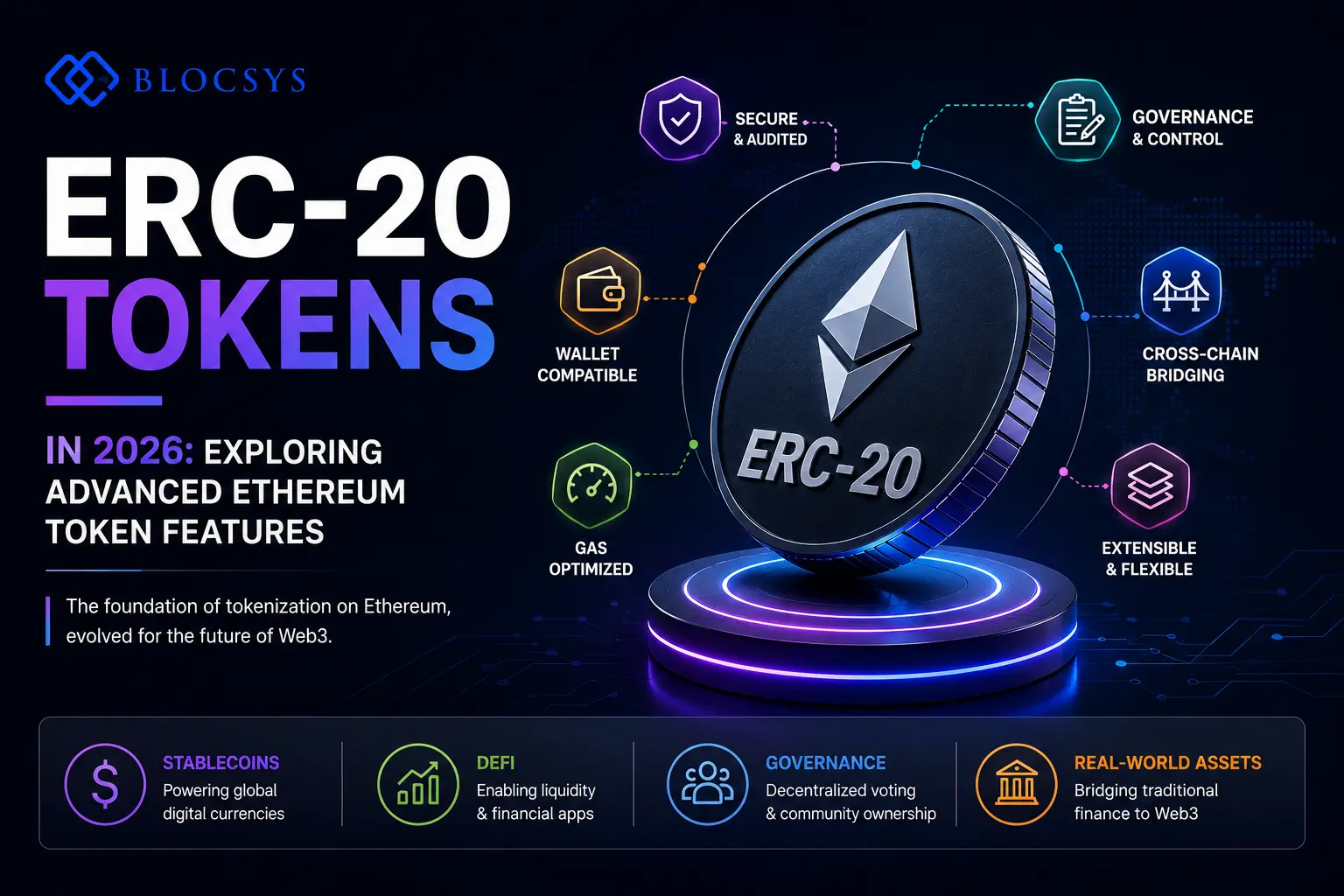
If you’ve built anything on Ethereum, you’ve touched ERC-20. It’s the token standard behind stablecoins, governance tokens, DeFi collateral, and a growing share of tokenized real-world assets. ERC-20 isn’t new, and it hasn’t been quietly replaced by some rebranded successor. What has changed is how developers extend it. In 2026, ERC-20 token development means combining a finalized, battle-tested interface with a mature ecosystem of extensions built for permits, governance, bridging, vaults, and more. Let’s walk through what’s actually changed since the standard’s early days and what it means for anyone planning an asset tokenization platform or a custom Ethereum token.
What Is the ERC-20 Token Standard?
ERC-20 is a technical standard for fungible tokens on Ethereum. “Fungible” simply means each token unit is identical and interchangeable, like dollars in a bank account, unlike an NFT where every item is unique. Ethereum Improvement Proposal 20 (EIP-20) defines the interface, and the Ethereum ERC registry still lists it as the Token Standard today.
Here’s why that matters: ERC-20 gives wallets, exchanges, and smart contracts a common language. A wallet doesn’t need custom code for every project’s token. It just needs to understand the ERC-20 interface, and it can display balances, send transfers, and interact with any compliant contract. That interoperability is the whole reason the standard took off.
How ERC-20 Tokens Work
An ERC-20 token is a smart contract that tracks balances in a mapping and exposes a defined set of functions and events. Every compliant contract follows the same interface, so behavior is predictable across the ecosystem. That predictability is what let thousands of tokens plug into the same DEXs, lending markets, and wallets without custom integration work for each one.
Core ERC-20 Functions and Events, Explained Plainly
The ERC-20 interface isn’t complicated once you strip away the jargon. Here’s what each piece actually does:
- totalSupply reports how many tokens exist in circulation.
- balanceOf tells you how many tokens a given address holds.
- transfer moves tokens from your own address to someone else’s.
- approve lets you authorize another address, often a smart contract, to spend a set amount on your behalf.
- allowance checks how much a spender is still approved to use.
- transferFrom lets an approved spender move tokens out of your balance, up to the approved amount.
- Transfer and Approval are events, on-chain logs that let wallets and dApps track activity without constantly polling contract state.
Together, these seven pieces form the entire ERC-20 token standard. Everything else you’ll read about below is an addition, not a replacement.
Decimals: A Display Convention, Not a New Accounting Model
Most ERC-20 tokens include an optional decimals value, commonly 18, mirroring ether itself. However, decimals don’t change how the contract stores balances internally. The contract still tracks whole integers under the hood; decimals just tell wallets and interfaces where to place the decimal point when displaying a human-readable amount. A token with 6 decimals and a balance of 1,000,000 simply displays as 1.0. Get this wrong in your front-end code, and you’ll show users incorrect balances, even though the underlying accounting was never at risk.
Why ERC-20 Still Matters in 2026
You might wonder why a standard from 2015 is still the backbone of Ethereum token development a decade later. The answer is simple: it works, and the ecosystem trusts it. Wallets, custodians, exchanges, auditors, and DeFi protocols have all built infrastructure around the ERC-20 interface. Replacing that foundation would mean rebuilding a massive amount of tooling for marginal benefit. Stablecoins, arguably the most economically significant category of crypto assets today, are overwhelmingly issued as ERC-20 tokens or ERC-20-compatible tokens on EVM-compatible chains. Governance tokens, DeFi collateral, payment tokens, and an increasing number of tokenized funds and real-world assets all rely on the same base interface. Consequently, ERC-20 token development remains one of the highest-demand services in enterprise Web3 work.
ERC-20 succeeded because it stayed simple. The moment you start bolting on unnecessary logic just because you can, you introduce new attack surface without a corresponding business reason. Every extension should map to a real requirement, not a checklist.
Where a Basic ERC-20 Implementation Falls Short
A bare-bones ERC-20 contract handles transfers and allowances well. It doesn’t, however, handle governance voting, emergency pausing, capped issuance, or gasless approvals. That’s by design. The standard is intentionally minimal so it stays composable. If your project needs more, you extend it, you don’t wait for a new base standard to appear. This is where modern ERC-20 token development diverges from the copy-paste contracts of the early 2020s. Production-grade tokens today are usually built on audited extension libraries, most commonly OpenZeppelin’s contracts, rather than written from scratch.
Modern ERC-20 Extensions Developers Use Today
OpenZeppelin’s current contracts library documents a set of ERC-20 extensions, including ERC20Permit, ERC20Bridgeable, ERC20Burnable, ERC20Capped, ERC20Crosschain, ERC20Pausable, ERC20Votes, ERC20Wrapper, ERC20FlashMint, and ERC20TemporaryApproval, alongside related standards like ERC-1363 and ERC-4626. None of these are part of the ERC-20 standard itself. They’re optional modules developers add when a specific use case calls for them.
ERC20Permit and EIP-2612: Gasless Approvals
Normally, approving a spender requires an on-chain transaction before the actual transfer can happen, two separate transactions, two gas fees. ERC20Permit, based on EIP-2612, changes that. Instead of calling approve directly, a user signs an off-chain message containing the spender, amount, and a deadline. The spender then submits that signature to the contract’s permit function, which verifies it and sets the allowance in the same transaction as the transfer. This matters for user experience, especially in DeFi apps where every extra transaction adds friction and cost. But permit signatures come with real security considerations. Deadlines prevent a signature from being used indefinitely. Nonces prevent the same signature from being replayed twice. Front-running is still a consideration if a permit transaction sits in the mempool before execution. Smart contract wallets don’t always support EIP-712 signing the same way EOAs do, so compatibility testing matters before you rely on permit as your primary approval flow.
ERC20Burnable, ERC20Capped, and ERC20Pausable
These three extensions handle supply and control logic that many production tokens need. ERC20Burnable lets token holders, or in some implementations, approved third parties, destroy tokens permanently, reducing total supply. It’s common in deflationary token models and in systems where burning represents redemption of an underlying asset. ERC20Capped enforces a hard ceiling on total supply during minting. Once the cap is hit, minting reverts. That said, a supply cap alone doesn’t prevent every form of economic manipulation, concentrated holdings, unlock schedules, and minting timing all still matter independently of the cap itself. ERC20Pausable adds an emergency stop switch, halting transfers, minting, or burning when triggered. This is useful for responding to a discovered vulnerability or a compliance event. But pausing depends entirely on who controls the pause function. If a single admin key controls it, that’s a centralization assumption, not decentralization, and it should be disclosed and governed accordingly, ideally through multisig or DAO-controlled access rather than a single key.
ERC20Votes: Governance and Delegated Voting
Governance tokens need more than a balance, they need a way to measure voting power at a specific point in time. ERC20Votes adds checkpointed balance tracking, so a DAO can determine how much voting power an address had at a past block, even if balances have since changed. This prevents vote manipulation through last-minute token transfers. It also supports delegation. Token holders can delegate their voting power to another address without transferring the tokens themselves, useful for holders who want exposure to governance outcomes without actively voting on every proposal. This pattern underlies most on-chain governance systems built on Ethereum today.
ERC20Wrapper, ERC20FlashMint, and ERC20TemporaryApproval
ERC20Wrapper creates a new ERC-20 token backed one-to-one by an existing ERC-20 token. Users deposit the underlying asset and receive the wrapped version, then redeem it later. The critical engineering requirement here is accounting integrity, the wrapper contract must always hold enough of the underlying token to honor every wrapped token in circulation. Any mismatch breaks the peg. ERC20FlashMint enables flash loans denominated directly in the token itself. The contract mints tokens temporarily within a single transaction, and the borrower must repay the loan plus any fee before that transaction ends, or the entire transaction reverts. Done correctly, this never results in permanent, uncollateralized supply growth. It’s a temporary accounting mechanism enforced by transaction atomicity, not a backdoor to inflate supply. ERC20TemporaryApproval is a newer addition addressing a long-standing DeFi risk, standing allowances. Traditional approvals persist until explicitly revoked, which means a compromised or malicious spender contract can drain funds long after the original interaction. Temporary approvals, which rely on transient storage introduced through EIP-1153, exist only for the duration of a single transaction, closing that exposure window. Because this is a newer pattern, teams should confirm exact implementation details and chain support before relying on it in production.
ERC-1363 and ERC-4626: Related Standards Worth Knowing
Two standards frequently discussed alongside ERC-20 extensions deserve their own explanation, because they’re not extensions in the same sense. ERC-1363 adds transfer-and-call and approve-and-call functionality, letting a token transfer or approval trigger a receiving contract’s logic in the same transaction. This is useful when you want a single transaction to both move tokens and execute contract logic, subscription payments or automatic staking, for example, instead of separate approve-then-call steps. It does introduce additional considerations around callback behavior and reentrancy, since the receiving contract executes code as part of the token operation. ERC-4626 is a distinct standard for tokenized vaults, not merely another ERC-20 flavor. A 4626 vault issues ERC-20 shares that represent a claim on a pool of underlying assets, think yield-bearing vaults where deposits earn interest over time. Share pricing, deposit and withdrawal accounting, and rounding all require careful implementation. Current OpenZeppelin documentation specifically warns about inflation attacks against empty or near-empty vaults, where an early attacker manipulates the share price by donating assets directly to the vault, distorting the exchange rate for subsequent depositors. Any team building vault infrastructure needs to account for this explicitly, not assume the standard handles it automatically.
Cross-Chain ERC-20 Functionality
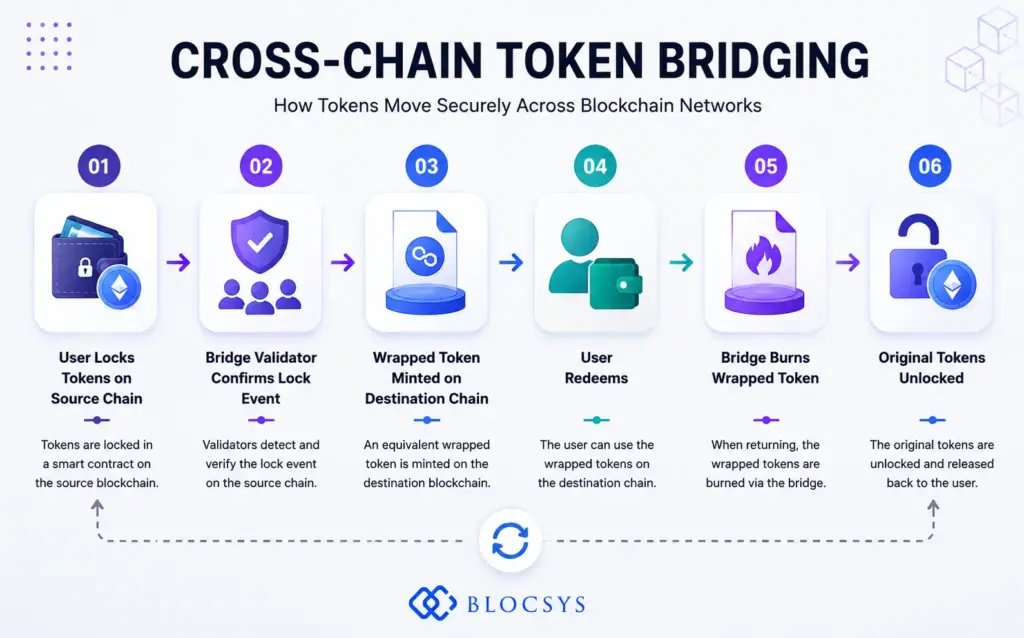
As liquidity spreads across multiple EVM chains and rollups, cross-chain token movement has become a core requirement rather than a nice-to-have. ERC20Bridgeable and ERC20Crosschain patterns define standardized ways for tokens to be minted and burned across chains under a bridge’s coordination. It’s worth distinguishing native deployments from wrapped or bridged representations clearly. A natively deployed token on each chain is governed by that chain’s contract logic directly. A bridged or wrapped representation depends on the bridge’s security model, its validators, its multisig, or its light-client verification. Bridge failures have historically been among the costliest exploits in crypto, so the trust assumptions behind any cross-chain token deserve real scrutiny before integration.
ERC-20 Use Cases: DeFi, Stablecoins, and Payments
ERC-20 remains the default token format across nearly every DeFi category, lending markets, decentralized exchanges, yield protocols, and derivatives platforms all rely on it as collateral or settlement currency. Stablecoins built as ERC-20 tokens continue to dominate on-chain payment volume, and governance tokens built with ERC20Votes power an increasing share of on-chain decision-making at protocols across the US, UK, Europe, UAE, and Singapore, all regions seeing accelerating institutional and regulatory engagement with digital assets. Payments applications also lean on ERC-20 for straightforward reasons: predictable interfaces, wide wallet support, and low integration overhead compared to building a custom asset format from scratch.
ERC-20 for Real-World Asset Tokenization
Real-world asset tokenization, representing bonds, equity, funds, or commodities as on-chain tokens, frequently uses ERC-20 as the technical container. But here’s the important distinction: deploying an ERC-20 contract does not, by itself, create legal ownership of an off-chain asset or establish regulatory compliance. The token is a technical representation. Legal enforceability depends on the underlying legal structure, the issuer’s jurisdiction, investor eligibility rules, and how transfer restrictions map to real-world entitlements. This is precisely why serious tokenization projects pair smart contract development with legal structuring from the start. Blocsys works with fintech companies, tokenization platforms, and enterprises building this kind of infrastructure through its Asset Tokenization Platform, along with dedicated solutions for corporate bond tokenization and equity tokenization, where compliance-aware token design matters as much as the Solidity itself. Teams evaluating a full real world asset tokenization build should treat the legal and technical tracks as inseparable, not sequential.
ERC-20 Security Considerations Every Team Should Know
Most ERC-20 incidents trace back to a small set of recurring mistakes: incorrect supply accounting, unauthorized minting paths, unrestricted burn functions, weak access control on admin functions, allowance-related vulnerabilities, reentrancy in custom transfer hooks, and precision loss from mismatched decimals across integrated contracts. Here’s something developers integrating third-party tokens need to internalize: not every token claiming ERC-20 compliance behaves identically. Some tokens don’t return a boolean from transfer as expected. Others impose transfer fees, rebase balances, or restrict certain addresses. Current security guidance consistently flags these inconsistencies as a real integration risk, not a theoretical one. That’s why safe interaction patterns, like OpenZeppelin’s SafeERC20 wrapper, and thorough compatibility testing matter before you trust an external token in your protocol.
Common Development Mistakes in ERC-20 Token Development
Beyond the security list above, teams frequently over-engineer token contracts, adding upgradeability, pausing, and minting authority without a clear business reason for each. Every added capability is also an added trust assumption and an added audit surface. Upgradeable tokens can help with long-term maintenance and bug fixes, but they require careful governance around who controls the upgrade key, and they shift some trust back toward centralized control, something enterprises and users alike deserve transparency about.
Basic ERC-20 vs. Customized Token Architecture
AspectBasic ERC-20Customized Production ArchitectureSupply modelFixed at deploymentCapped, mintable, burnable, or elastic based on needApprovalsStandard on-chain approve/transferFromERC20Permit for gasless approvals, optional temporary approvalsGovernanceNoneERC20Votes with delegation and checkpointsEmergency controlsNoneERC20Pausable with multisig or DAO-gated accessCross-chain supportSingle chain onlyBridgeable design with defined trust assumptionsCompliance featuresNoneTransfer restrictions, whitelisting, tied to legal structure
The right column isn’t automatically “better.” Every added row should map to a real requirement your project actually has, not a feature list you copied from another token.
How to Choose the Right ERC-20 Architecture
Real world asset tokenization is no longer a theoretical concept for institutions to watch from the sidelines. Tokenized Treasuries are live. Private credit tokenization is growing. Corporate bonds, equities, and real estate are following at varying paces, shaped by jurisdiction and market readiness. What separates successful programs from stalled ones is infrastructure — legal, technical, and compliance layers built to institutional standards from day one.
If your organization is evaluating institutional RWA tokenization, the right first step is understanding what your specific asset class, jurisdiction, and investor base require. Blocsys works with financial institutions, asset managers, and fintech firms to design and build tokenization infrastructure through its Asset Tokenization Platform, covering everything from smart contract architecture to compliance-ready issuance workflows. For teams scoping budget and timeline, Blocsys’ software development cost estimator tool offers a practical starting point before a full technical consultation.
Frequently Asked Questions
Here are direct answers to the questions we hear most often about ERC-20 token development.
What is an ERC-20 token?
An ERC-20 token is a fungible digital asset built on Ethereum following the ERC-20 token standard, defined in EIP-20. It implements a common interface, totalSupply, balanceOf, transfer, approve, allowance, and transferFrom, so wallets, exchanges, and smart contracts can interact with it in a predictable, standardized way regardless of which project issued it.
What are the latest ERC-20 extensions developers use in 2026?
Current OpenZeppelin documentation includes ERC20Permit, ERC20Burnable, ERC20Capped, ERC20Pausable, ERC20Votes, ERC20Wrapper, ERC20FlashMint, ERC20Bridgeable, ERC20Crosschain, and ERC20TemporaryApproval, plus related standards ERC-1363 and ERC-4626. These are optional additions to the base ERC-20 interface, chosen based on what a specific project actually requires, not mandatory upgrades to the standard itself.
What is ERC20Permit and EIP-2612?
ERC20Permit, based on EIP-2612, lets users approve token spending through an off-chain signature instead of a separate on-chain transaction. The spender submits the signed permit alongside the transfer, saving gas and reducing friction. Security depends on proper deadline enforcement, nonce tracking to prevent replay, and awareness that smart contract wallets don’t always support EIP-712 signing identically to standard wallets.
What’s the difference between ERC-20 and ERC-4626?
ERC-20 is the base fungible token standard. ERC-4626 is a related but distinct standard for tokenized vaults, where ERC-20 shares represent a claim on pooled underlying assets, typically for yield-generating strategies. ERC-4626 isn’t an ERC-20 extension; it’s built on top of ERC-20 shares and requires careful handling of share pricing and inflation attack risks in low-liquidity vaults.
Can ERC-20 tokens be used for real-world asset tokenization?
Yes, ERC-20 is commonly used as the technical container for tokenized bonds, equity, funds, and other real-world assets. However, deploying the contract alone doesn’t create legal ownership or regulatory compliance. That requires a properly structured legal framework behind the token, matched to the issuer’s jurisdiction and investor requirements.
What are the main security risks in ERC-20 token development?
Common risks include unauthorized minting, faulty access control on admin functions, allowance exploits, reentrancy in custom transfer logic, and precision errors from decimal mismatches. Integration risk also matters, some tokens claiming ERC-20 compliance behave inconsistently around return values or transfer restrictions, so safe interaction patterns and compatibility testing are essential when integrating third-party tokens.
How is a basic ERC-20 token different from a customized one?
A basic ERC-20 token only handles core transfers and allowances. A customized, production-grade token adds specific extensions, permit-based approvals, governance voting, supply caps, pausing, or cross-chain bridging, based on actual business requirements. Extra functionality should always solve a defined need rather than being added by default.
How can a business start ERC-20 token development?
Start by defining the token’s purpose, supply model, compliance requirements, and integration needs before writing contract code. From there, an experienced ERC-20 token development company can help select the right extensions, structure access control properly, and get the contract audited before deployment, especially for enterprises building on top of an asset tokenization platform or launching through an institutional-grade token launchpad.
Getting ERC-20 Token Development Right
ERC-20 isn’t a trend that needs reinventing every year, it’s finalized infrastructure that the entire Ethereum ecosystem depends on. What’s evolved is the surrounding toolkit: permit-based approvals, governance extensions, vault standards, and cross-chain bridging patterns that let teams build exactly what their application needs without bloating the base contract. Whether you’re issuing a stablecoin, launching a governance token, or structuring a tokenized fund, the right approach starts with matching extensions to actual requirements, not stacking features because they’re available. Blocsys builds custom token infrastructure through its Smart Contract Development services, covering everything from core ERC-20 implementation to permit integration, governance modules, and secure vault architecture, backed by audit-ready Solidity practices for fintech companies, DeFi platforms, and enterprises across the US, UK, Europe, UAE, Singapore, Canada, and Australia. If you’re evaluating a token build, the Asset Tokenization Platform is a solid place to start scoping what your project actually needs.
Ready to move beyond theory and build an intelligent platform that delivers real-world value? Blocsys Technologies specialises in engineering enterprise-grade AI and blockchain solutions for the fintech, Web3, and digital asset sectors. Connect with our experts today to discuss your vision and chart a clear path from concept to a secure, scalable reality.
