ERC-3643 vs. ERC-1400 for US Security Token Issuers: Features, Compliance, and Implementation Considerations
If you’re comparing ERC-3643 vs. ERC-1400 for a US security token project, here’s the short answer: neither standard wins outright. ERC-3643 gives you a modular identity and compliance framework built around permissioned transfers. ERC-1400 gives you a suite of related standards built around partitions and transfer validation. The right pick depends on your investor eligibility rules, your transfer restrictions, and whether your asset needs multiple classes or tranches. This article walks through the technical differences, the compliance gaps both standards leave open, and a practical framework for choosing between them — including how a real-world asset tokenization platform approach can help you avoid picking a standard before you’ve mapped your actual requirements.
What Are ERC-3643 and ERC-1400?
Before you can evaluate ERC-3643 vs. ERC-1400, you need a clear picture of what each one actually specifies. These aren’t competing “flavors” of the same idea — they solve overlapping but distinct problems.
ERC-3643 Token Standard Explained
The ERC-3643 token standard, formalized through the Ethereum Improvement Proposal process, defines interfaces for permissioned security tokens. It specifies how an identity registry, a trusted issuer registry, and claim topics work together to gate transfers. In plain terms: a wallet can only receive tokens if it holds verified claims from issuers the system trusts.
ERC-1400 Security Token Standard Explained
The ERC-1400 security token standard isn’t one contract — it’s a suite of related specifications. It covers transfer restrictions, transfer validation functions, and partitions that split a token’s supply into sub-balances. Different implementations adopt different pieces of the suite, so one project’s “ERC-1400 token” may look quite different from another’s.
Both are production-oriented frameworks, not SEC-endorsed templates. Neither one automatically determines whether your offering is lawful in the United States.
ERC-3643 vs. ERC-1400: Key Differences
Here’s where the comparison gets concrete. The table below breaks down ERC-3643 vs. ERC-1400 across the criteria that actually matter during architecture decisions.
| Criteria | ERC-3643 | ERC-1400 Suite |
|---|---|---|
| Structure | Single cohesive standard with defined interfaces | Collection of related specifications, adopted selectively |
| Investor identity verification | Standard-defined via identity registry and claims | Not natively specified; typically custom or paired |
| Transfer validation | Built-in compliance module checks before transfer | Transfer validation functions defined, logic is implementation-dependent |
| Token partitions | Not part of the core specification | Natively supported for tranches/classes |
| Admin and recovery | Supports agent roles and wallet recovery patterns | Implementation-dependent, varies by deployment |
| Customization | Modular compliance rules via pluggable modules | Flexible but requires more bespoke development |
Notice that some rows say “standard-defined” and others say “implementation-dependent.” That distinction matters more than any feature checklist. A capability being technically possible under a standard doesn’t mean it ships out of the box.
How ERC-3643 Works for Security Token Issuers
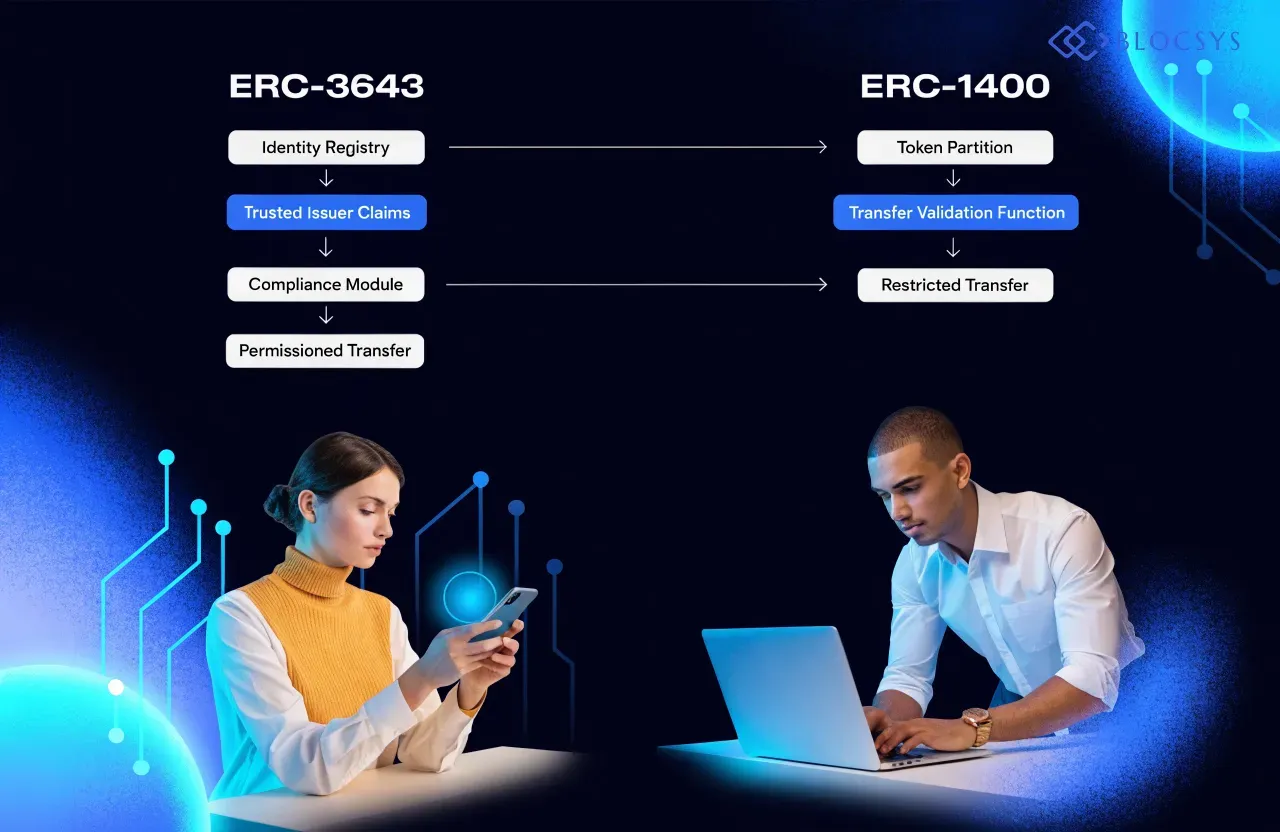
So how does this play out in a real deployment? The ERC-3643 token standard structures permissioned transfers around four components: the token contract, the identity registry, the trusted issuer registry, and compliance modules.
When an investor’s wallet attempts to receive tokens, the contract checks the identity registry for valid claims — things like jurisdiction, accreditation status, or KYC completion. Those claims must originate from issuers listed in the trusted issuer registry. Compliance modules then layer in additional rules, such as holding period limits or investor count caps.
ERC-3643 Identity Registry and Compliance Modules in Practice
This architecture gives you a reusable pattern. You don’t rewrite eligibility logic for every rule change; you swap or add a compliance module instead. Agent roles, defined in the specification, allow designated addresses to force transfers or recover tokens tied to lost wallets — a meaningful consideration for institutional issuers worried about key management.
However, the specification doesn’t mandate a specific identity provider. You’ll still need to integrate KYC vendors, decide where claims get issued, and build the operational process for revoking claims when an investor’s status changes.
The identity registry is the part teams underestimate. It’s not just a whitelist — it’s a living system that has to stay synchronized with real-world investor status changes, or your compliance logic enforces stale data.
How ERC-1400 Supports Security Token Requirements
Now let’s look at the other side of the ERC-3643 vs. ERC-1400 comparison. The ERC-1400 suite addresses a different pain point: representing complex capital structures on-chain.
ERC-1400 Token Partitions and Transfer Restrictions
Partitions let a single token contract track multiple sub-balances — think Series A versus Series B shares, or restricted versus unrestricted tranches, all under one contract address. If your asset has distinct investor classes with different transfer conditions, this matters. A corporate bond tokenization platform with senior and subordinated tranches is a good example of where partitions solve a real structural problem.
Transfer restriction and transfer validation functions, also part of the suite, let the contract check conditions before allowing a transfer and return a reason code when it fails. That’s useful for debugging and for giving transfer agents visibility into why a transaction didn’t go through.
What ERC-1400 Doesn’t Specify
Here’s the catch: not every ERC-1400 implementation includes identical functionality. Identity verification, claims management, and investor eligibility checks aren’t part of the core suite. You’ll typically pair ERC-1400 components with custom identity logic or a separate on-chain investor identity layer.
If your project doesn’t need partitions, adopting the full suite adds complexity without a corresponding benefit. That’s a case where ERC-3643’s more unified approach might fit better.
US Securities Compliance: What the Standards Do and Do Not Solve
This is the section issuers most often skip — and the one that causes the most expensive mistakes later. Technical transfer controls and legal compliance obligations are not the same thing.
Token-level restrictions can enforce rules you’ve already defined: blocking transfers to non-whitelisted wallets, capping investor counts, or restricting cross-border transfers. That’s valuable enforcement infrastructure. But it only works correctly if your legal team has already determined the applicable framework for your specific offering — whether that’s a registered offering, a private placement exemption, or something else entirely.
Recordkeeping, transfer agent responsibilities, and investor accreditation standards depend on your instrument and offering structure, not on which ERC standard you picked. The US Securities and Exchange Commission’s rules around exemptions and registration apply regardless of your smart contract architecture.
Issuers sometimes ask whether ERC-3643 “has compliance built in.” It has compliance mechanics built in. Whether those mechanics match your actual legal obligations is a separate question your counsel needs to answer.
Neither standard is officially mandated or endorsed for US offerings. Treat both as implementation tools, not legal shortcuts. Always get qualified legal advice before finalizing your offering structure.
Implementation Requirements for US Security Token Issuance
Choosing a standard is step one, not step ten. Here’s what actually goes into production-ready US security token issuance.
- Smart contract architecture design, including which modules or partitions you’ll actually use
- Identity verification integrations with KYC/AML vendors
- Compliance rule design mapped to your specific legal structure
- Role-based administration for issuers, transfer agents, and compliance officers
- Wallet and custody integration, including recovery procedures
- Token issuance and lifecycle management — redemptions, corporate actions, splits
- Transaction monitoring and event logging for recordkeeping
- Independent smart contract audit and ongoing maintenance
Notice how much of this sits outside either standard’s scope. A asset tokenization platform approach typically bundles these pieces together rather than leaving issuers to assemble them piecemeal. For the audit and testing phase specifically, pairing standard selection with smart contract development and auditing expertise reduces the risk of deploying permissioned logic with exploitable gaps.

Choosing Between ERC-3643 vs. ERC-1400 for US Security Token Issuers
Here’s a practical way to frame the decision instead of treating ERC-3643 vs. ERC-1400 as a binary feature contest.
When the ERC-3643 Token Standard Fits
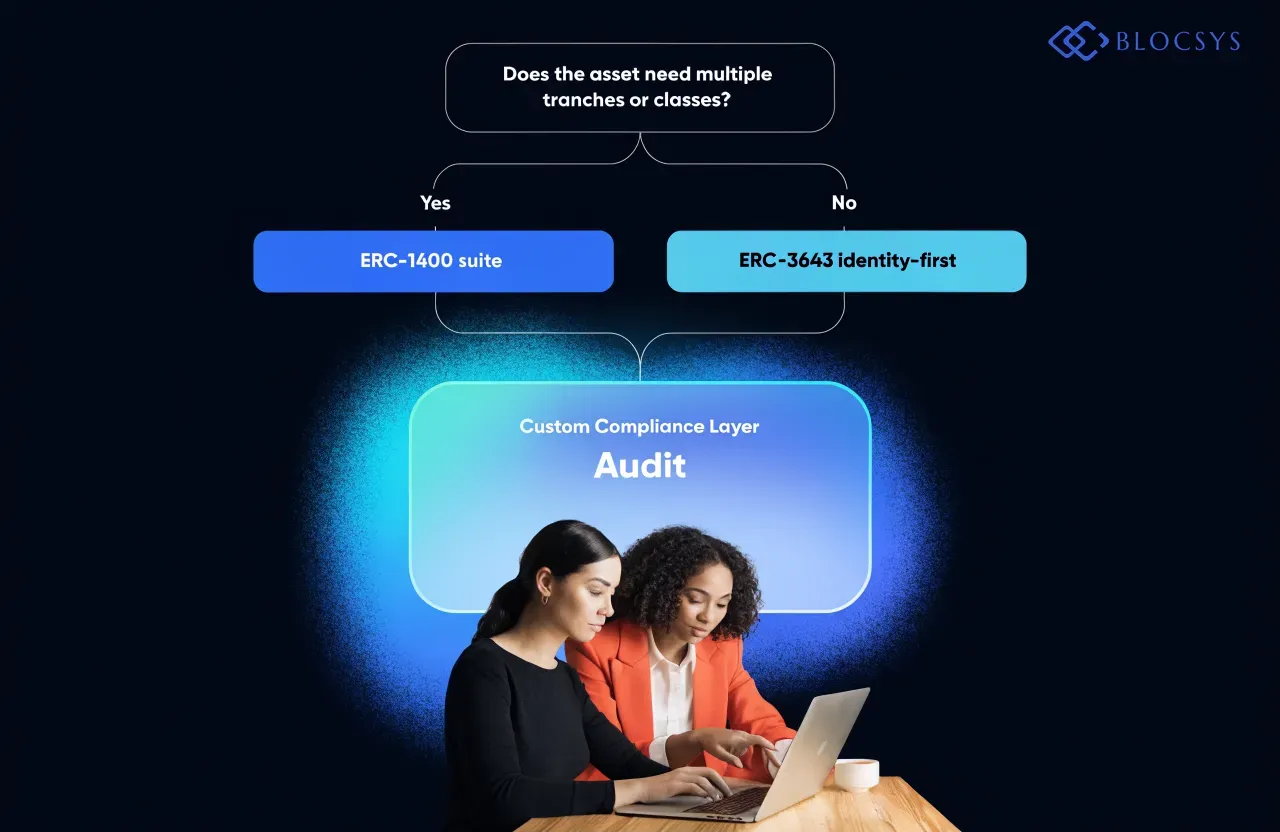
If your project needs a standardized identity and compliance interface — and you don’t have complex tranche structures — ERC-3643 is worth evaluating first. Equity-style offerings with a single investor class, where eligibility checks matter most, often fit this profile. An equity tokenization platform build frequently lands here.
When the ERC-1400 Security Token Standard Fits
If your instrument has multiple tranches, classes, or transfer conditions that need separate on-chain representation, examine the ERC-1400 suite’s partition and validation specifications. You’ll likely still need to pair it with custom or third-party identity infrastructure.
Many real deployments end up hybrid: ERC-1400-style partitions combined with ERC-3643-style identity and claims logic, plus custom compliance modules layered on top. Don’t assume you must pick exactly one standard and stop there.
Questions to Resolve Before Implementation
Work through these before your development team writes a line of Solidity:
- What is the asset’s legal classification, and under what offering structure will it be issued?
- Who is eligible to invest, and how will eligibility be verified and re-verified?
- What transfer restrictions apply — holding periods, jurisdiction limits, investor caps?
- Does the asset need multiple classes, tranches, or partitions?
- Who holds administrative authority, and what recovery mechanisms are required?
- What custody model will investors and institutions use?
- Which external systems — transfer agents, custodians, trading venues — need integration?
- What audit and testing process will validate the compliance logic?
- What lifecycle events (redemptions, corporate actions) must the architecture support?
Conclusion: Select the Standard Based on the Requirements
The ERC-3643 vs. ERC-1400 decision isn’t about which standard is objectively stronger. It’s about matching specified capabilities — identity verification, partitions, transfer validation — to your asset’s actual legal and operational needs. ERC-3643 brings a unified identity and compliance interface. The ERC-1400 suite brings flexible partition and validation mechanics. Both require additional integration work before they become a complete platform.
If you’re still mapping requirements before committing to an architecture, a real-world asset tokenization platform development partner can help you evaluate ERC-3643 vs. ERC-1400 against your specific offering, custody model, and compliance workflow. Blocsys works with issuers, fintech founders, and institutional teams on custom security token architecture, compliance integrations, and smart contract development — reach out to discuss your requirements before locking in a standard.
Frequently Asked Questions
Here are direct answers to the questions we hear most often about ERC-3643 vs. ERC-1400 for US security token issuers.
What is the main difference between ERC-3643 and ERC-1400?
ERC-3643 is a single, cohesive standard built around identity registries and compliance modules. ERC-1400 is a suite of related specifications centered on partitions and transfer validation, with identity logic typically handled separately.
Is ERC-3643 or ERC-1400 better for US security token issuers?
Neither is universally better. ERC-3643 fits projects needing standardized identity checks; ERC-1400 fits projects needing tranche or partition structures. Many deployments combine elements of both.
How does ERC-3643 verify investor eligibility?
It checks the identity registry for claims issued by trusted issuers, then runs compliance module rules before allowing a transfer to complete.
What are partitions in the ERC-1400 suite?
Partitions divide a token’s supply into sub-balances, letting one contract represent multiple classes or tranches with different transfer conditions.
Does ERC-3643 automatically make a security token legally compliant in the United States?
No. It provides technical enforcement mechanisms. Legal compliance depends on your offering structure, exemptions, and registration status, which require separate legal analysis.
Can ERC-1400 support restricted security token transfers?
Yes, through its transfer restriction and transfer validation functions, though the specific rules enforced depend entirely on your implementation.
Can a security token issuer combine a standard with custom smart contracts?
Yes, and it’s common. Issuers frequently layer custom compliance logic, identity integrations, or partition structures on top of either base standard.
What integrations may a security token platform require beyond its token standard?
KYC/AML providers, custody solutions, transfer agent systems, monitoring tools, and administrative dashboards typically sit outside the token standard itself.
Why are smart contract audits important when implementing a security token?
Compliance and transfer logic controls real investor assets and regulatory exposure. An independent audit catches logic errors before they reach production.
What should an issuer evaluate before selecting a security token development partner?
Look for experience with both identity-based and partition-based architectures, a track record of audited deployments, and willingness to map legal requirements before writing code.
Ready to move beyond theory and build an intelligent platform that delivers real-world value? Blocsys Technologies specialises in engineering enterprise-grade AI and blockchain solutions for the fintech, Web3, and digital asset sectors. Connect with our experts today to discuss your vision and chart a clear path from concept to a secure, scalable reality.