
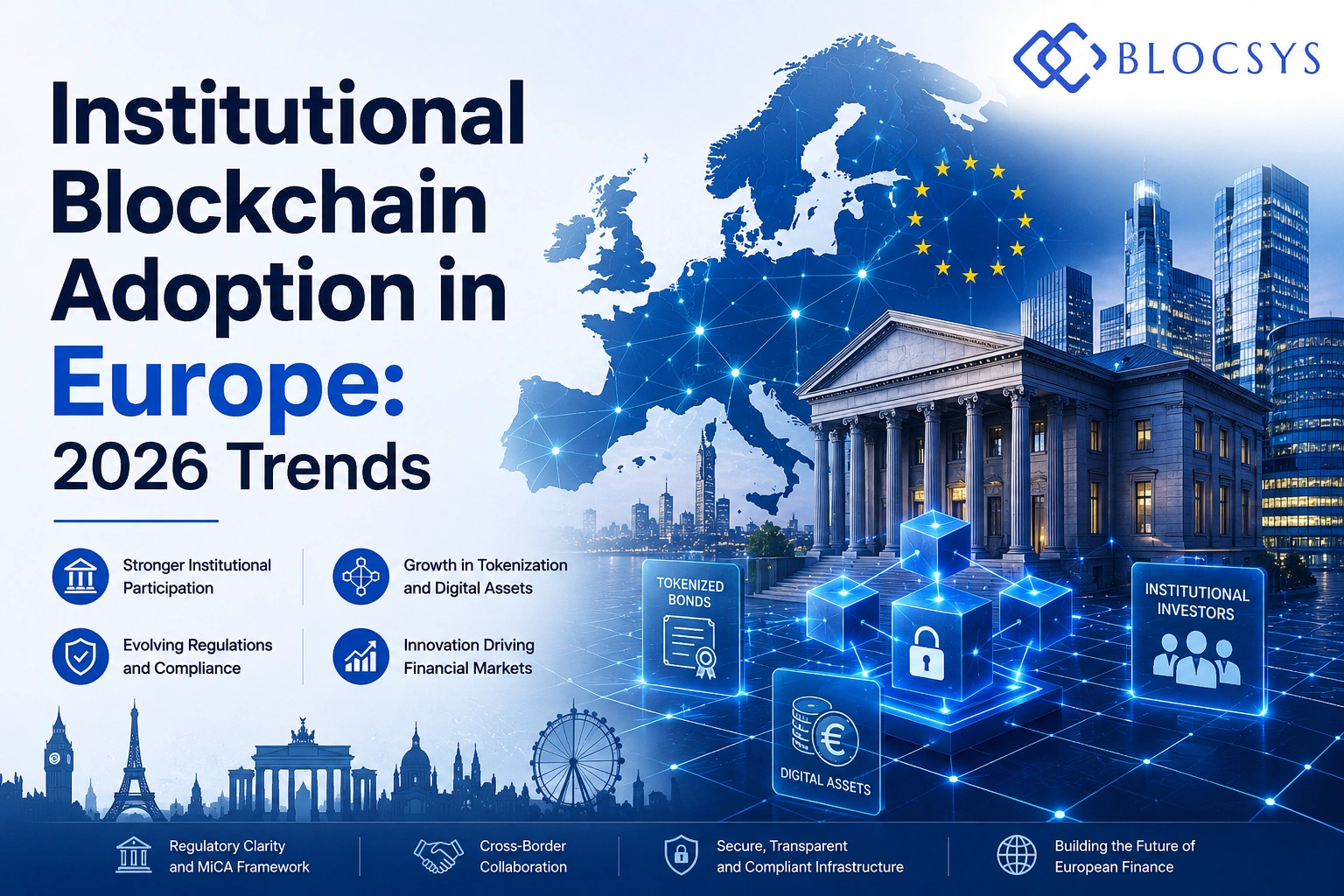
99% of continental European executives now say crypto rules will support adoption, and 53% had already set funding plans before 2026, well above the 42% global average. That is the signal behind Why Institutional Blockchain Adoption Is Accelerating in Europe in 2026. The question for European banks, insurers, capital-market firms, fintechs, and public-sector teams isn’t whether blockchain is interesting, it’s whether the plumbing is now reliable enough to move from pilot to production budget.
For the executive committee, the practical answer sits in five places, MiCA, ECB settlement work, Canton and DAML architecture, tokenisation use cases, and the 12 to 24 month operating plan. The institutions moving fastest are not chasing hype. They’re responding to clearer licensing, better settlement paths, and a market structure that finally makes production deployment defensible to compliance, risk, and treasury leaders.
Table of Contents
- Why Institutional Blockchain Adoption Is Accelerating in Europe Right Now
- What Institutional Blockchain Actually Means for Regulated Enterprises
- MiCA and the ECB DLT Settlement Bridge That Change the Calculus
- How Canton Network and DAML Power Institutional Coordination
- Tokenization Use Cases Driving Real Production Budgets in 2026
- The Bottleneck Is Plumbing, Not Hype
- A 12 to 24 Month Outlook for European Institutions and Where Blocsys Fits
Why Institutional Blockchain Adoption Is Accelerating in Europe Right Now
The pace in Europe is no longer theoretical. In a survey of more than 600 executives, 99% of continental European institutions said crypto rules will support adoption, and 53% had already locked in funding plans before 2026, compared with a 42% global average. For a bank executive, that shifts the question from whether blockchain has a place in the stack to how it gets budgeted, governed, and approved for production. The same survey also showed the U.K. treating blockchain as near-term infrastructure, with 36% of institutions already allocating budgets and 59% planning to commit funds during 2026, according to the Fireblocks survey summary.
Who this matters for
The organisations feeling this shift most strongly are the ones that have already run pilots and now need a production rationale. That includes European banks, fintechs, insurers, investment firms, public agencies, and the teams around them, CTOs, CIOs, compliance officers, operations leads, and risk committees. The decision is no longer about adopting blockchain in a general sense. It is about identifying which workflows can move onto a permissioned network, and which infrastructure has to be in place before anyone signs off.
Europe has also become a better place to make that decision because the policy backdrop is more concrete. The European Commission’s blockchain and web3 strategy sits inside the EU’s digital-future agenda, and academic work on European public-sector adoption keeps pointing to the same four enablers, regulatory frameworks, available funding, digital readiness, and ecosystem engagement. For teams comparing enterprise-grade tooling and deployment paths, the latest blockchain development trends in Europe are not a side note. They shape procurement, architecture, and the standard a vendor has to meet before a programme can move from pilot to budget.
Practical rule: if your programme still has to justify basic legitimacy, it is probably too early for production. If the main debate is custody, settlement, supervision, and how the network fits regulated operations, you are already in the right conversation.
One useful way to frame the opportunity is through enterprise-grade tooling, not speculation. For teams comparing architectures, Blockchain Development is relevant as a capability category because it covers secure, scalable, high-performance applications on public, private, and hybrid networks, including the kind of integration work institutions need when they are working through institutional-grade security in DeFi. That is the sort of language regulators, auditors, and procurement teams can work with.
What Institutional Blockchain Actually Means for Regulated Enterprises
Institutional blockchain isn’t a public crypto network with a corporate logo on top. It’s a permissioned distributed ledger designed for regulated participants who need privacy, deterministic execution, and clean auditability. In practice, that means a bank can move shared state across counterparties without giving up control over who sees what, who can validate what, and what gets finalised when.
The four properties that change the operating model
The first property is permissioned validators. Only verified participants operate the network, which is the difference between a market infrastructure and a public internet protocol. The second is privacy at the transaction level, so counterparties can interact without exposing sensitive position data to the whole network. The third is deterministic execution, which matters because risk and compliance teams need a contract to behave the same way every time. The fourth is interoperability, because institutions don’t operate in isolation, they clear, settle, and reconcile across systems.
SWIFT messages become DLT events, nostro balances become on-chain collateral, and reconciliation starts to look like consensus.
That shift changes what “production” means. A treasury team is no longer asking only whether a message was sent. It’s asking whether the asset moved, whether the legal state changed, whether the counterparty saw the same record, and whether the regulator can still reconstruct the event trail. Those are very different controls.
For a useful parallel, it helps to compare institutional blockchain with the security posture expected in regulated DeFi environments. A resource on institutional-grade security in DeFi shows why governance, controls, and verifiable execution matter when the audience is institutional rather than retail. The same logic applies here, only the control environment is stricter and the tolerance for ambiguity is much lower.
What changes operationally
Banks that get this right stop treating blockchain as a single product decision. They treat it as an operating model choice. That affects custody, key management, workflow design, controls testing, reconciliation, and incident response. It also affects how legal and operations teams write the internal playbook, because a ledger that is permissioned and interoperable has to satisfy both technical and regulatory stakeholders.
MiCA and the ECB DLT Settlement Bridge That Change the Calculus
MiCA is the most important regulatory shift because it gives institutions a single EU-wide licensing logic for Crypto-Asset Service Providers. One source says it was effective for stablecoins from mid-2024 and for service providers by December 2024, which matters because it reduces the fragmentation that previously forced firms to interpret different national rules across 27 member states. When compliance stops being a country-by-country puzzle, budgeting becomes far easier.
Why the licensing layer matters
The practical effect of MiCA is not just legal tidiness. It lowers the friction around custody, issuance, and exchange operations, and it makes cross-border go-to-market planning more realistic for regulated firms. For boards, that means a pilot no longer has to sit in a regulatory grey zone while every legal team drafts a separate view. The operational question becomes how quickly the institution can satisfy the common rulebook, not whether the rulebook exists.
The ECB side of the story is more structural still. In March 2026, the Eurosystem began accepting DLT-based assets as eligible collateral, and the Appia/Pontes roadmap describes a near-term settlement bridge to TARGET Services with an initial launch scheduled for Q3 2026. The ECB also plans blockchain-based transactions settled in central bank money starting in 2026, with test transactions using the digital euro potentially beginning by mid-2027 if legislation passes and an initial issuance targeted for 2029, according to the cited ECB and reporting links.
What that unlocks for institutions
This is not just policy signalling. It creates a pathway where tokenised assets can be settled, collateralised, and supervised inside existing European market plumbing. That is a very different proposition from asking institutions to rely purely on commercial-bank rails and then hope the operational controls can catch up later. Once central bank money, collateral eligibility, and settlement bridges enter the picture, production risk falls in a way that procurement committees can evaluate.
The broader backdrop is clear in Europe’s regulatory architecture. The MiCA-driven regulatory model gives service providers one licensing path, and the ECB’s market-infrastructure work points toward central-bank money settlement rather than loose experimentation. For teams building stablecoin or tokenised-asset infrastructure, the stablecoin settlement infrastructure for tokenised assets conversation now sits squarely inside production planning.
| Milestone | Date | What it unlocks for institutions |
|---|---|---|
| MiCA stablecoin effectiveness | Mid-2024 | Clearer issuance and custody rules |
| MiCA service-provider effectiveness | December 2024 | Single EU-wide licensing logic |
| DLT assets accepted as collateral | March 2026 | Tokenised collateral eligibility planning |
| Settlement bridge to TARGET Services | Q3 2026 | Near-term path to central-bank-money settlement |
| Blockchain-based transactions in central bank money | 2026 | Operational settlement anchor for tokenised instruments |
| Potential digital-euro test transactions | Mid-2027 | Testing of broader settlement interoperability |
For a related policy lens, Lagarde rejects euro stablecoins is useful context because it reinforces the direction of travel. Europe is building a framework around central-bank settlement and regulated infrastructure, not around ad hoc private money experiments.
How Canton Network and DAML Power Institutional Coordination
Canton has become attractive to institutions because it solves the coordination problem without forcing everyone into the same custody model or data exposure model. It works as a network of synchronisers, which means independent institutions can run shared workflows while keeping control of their own systems and permissions. That matters in capital markets, where counterparties need shared truth, but not shared leakage.
Why DAML matters to legal and operations teams
DAML gives the business logic a deterministic shape. Legal, operations, and risk teams can inspect the same contract behaviour rather than trying to infer how a loosely specified workflow might execute under load. That reduces the chance that the technology team and the controls team think they are discussing the same process when they are not.
This is also where the difference from public chains becomes obvious. Public networks optimise openness, while institutional networks optimise selective visibility, controlled participation, and workflow integrity. A board does not need a public chain that can broadcast everything. It needs a coordination layer that keeps counterparties aligned, supports compliance, and doesn’t expose trading or client data unnecessarily.
The architecture also changes where reconciliation sits. In older workflows, reconciliation comes after the fact. In Canton-style coordination, the workflow itself can reduce the need for repeated bilateral checks because the parties are executing against shared rules and synchronised states. That does not eliminate controls, it moves them earlier in the lifecycle.
Where institutions usually get this wrong
They try to force a public-chain mental model onto a regulated use case. That leads to the wrong design decisions, the wrong governance, and often the wrong vendor shortlist. If the requirement is privacy-preserving collaboration across institutions, then a coordination-first architecture is more defensible than a broadcast-first one.
The Canton and DAML interoperability model is relevant here because it clarifies how institutional workflow design differs from generic blockchain development. For teams still mapping architecture choices, the question is not whether distributed systems are useful. It’s whether the chosen network lets the bank keep custody, satisfy privacy needs, and preserve auditability at the same time.
The embedded video below is a useful boardroom explainer for teams that need a quick visual on how synchronisation and contract logic fit together.
Tokenization Use Cases Driving Real Production Budgets in 2026
The tokenisation budgets getting approved in Europe are not being driven by abstract enthusiasm. They’re being driven by workflows that already hurt, slow settlement, fragmented custody, illiquid positions, and expensive reconciliation. Equity, real estate, and commodities are the three use cases where the operational case is becoming easiest to explain to a CFO or CIO.
Where the value shows up
Equity and capital-market instruments are the cleanest fit when the institution wants faster issuance, programmable transfer rules, and tighter lifecycle control. The pressure point is the traditional settlement chain, where post-trade processes are still too manual for what should be near-real-time capital movement. A tokenised equity workflow can move that closer to atomic settlement and improve transfer governance. The tokenized equities use case is a practical reference point for teams that need to show how regulated issuance can fit existing market controls.
Real estate tokenisation solves a different problem, illiquidity. Property interests are hard to divide, hard to transfer cleanly, and slow to administer across multiple stakeholders. Tokenised structures can support fractional ownership, cleaner transfer logic, and more efficient investor access, provided the legal wrapper is sound and the transfer rules are enforceable.
Commodities are attractive because custody, provenance, and financing often span multiple entities and jurisdictions. Tokenisation can reduce paperwork friction and make ownership or financing logic more transparent, but only if the underlying asset controls are strong enough to stand up to audit.
For institutions building the operating model around these use cases, tokenization platform development matters because the actual work sits around the token itself. Compliance, lifecycle management, transfer restrictions, reporting, and investor checks need to be designed into the platform, not bolted on after the fact.
| Use case | Lifecycle stages | Compliance hooks | Primary technical challenge | What it enables for institutions |
|---|---|---|---|---|
| Equity | Issuance, transfer, corporate actions, redemption | Transfer restrictions, investor eligibility, reporting | Corporate action orchestration | Faster issuance and more controlled post-trade operations |
| Real estate | Asset onboarding, fractional issuance, secondary transfer, exit | KYC, transfer limits, ownership records | Legal wrapper alignment | Fractional access and cleaner transfer logic |
| Commodities | Asset registration, custody, transfer, financing | Provenance, custody controls, audit trail | Physical and digital record sync | Better traceability across custody and financing workflows |
The cross-border angle
The cross-border payments and CBDC interoperability angle matters because it links tokenisation to the settlement work already underway at the ECB. If the network can eventually settle in central bank money and connect to regulated rails, the tokenised asset stops being a closed experiment and starts looking like market infrastructure. That is why many European banks are treating tokenisation as part of broader capital-market modernisation, not as a separate fintech hobby.
The practical question for executive teams is whether the asset can move through the bank’s control environment without forcing a parallel operating model. That is where Qoory’s market analysis guide helps frame the decision, because liquidity, flow, and market structure determine whether a tokenised product stays a pilot or gets a budget line.
The Bottleneck Is Plumbing, Not Hype
Most coverage still asks whether institutions will adopt blockchain. That misses the point. The binding constraint is whether a tokenised instrument can be settled in central bank money, pledged as eligible collateral, and supervised inside existing European market rules. The ECB’s framing around a safe settlement anchor, public-private coordination, and a legal framework matched to the technology makes that clear.
What production teams are actually waiting for
They are waiting for market infrastructure plumbing to close the gap between token design and operational acceptance. If a bank cannot settle, collateralise, and supervise the asset inside its current control environment, the tokenisation project stays in pilot mode. That is why the ECB’s 2026 tokenised financial markets work matters more than another round of speculative commentary about adoption.
The practical issue is workflow, not sentiment. Production teams need a path that lets an institution move the asset through existing European rails without creating a new compliance headache or a parallel operating model. The market analysis guide from Qoory is useful background for teams that need to think in terms of liquidity, flows, and market structure rather than just product features. The same infrastructure logic is also why many institutions are treating trust as a layer as part of the architecture discussion, not as a branding exercise.
If the asset cannot settle, collateralise, or be supervised, it is not production-ready, no matter how elegant the token standard looks.
That is the planning question for the next committee meeting. Which workflows can move onto DLT rails once the ECB bridge is live in Q3 2026? That is much closer to how European institutions make capital decisions than any abstract debate about adoption.
Tokenisation design still matters. Infrastructure compatibility is the adoption trigger. When the settlement path and supervision model line up with the technology, the budget conversation changes quickly.
A 12 to 24 Month Outlook for European Institutions and Where Blocsys Fits
Over the next 12 to 24 months, the institutions that move fastest will do four things in parallel. They’ll check MiCA licensing readiness, assess DLT collateral eligibility, scope a Canton and DAML pilot, and choose one tokenisation use case that is operationally painful enough to justify the work. The organisations that wait for perfect clarity will miss the window where infrastructure, regulation, and market demand finally align.
| Action area | 2026 priority | 2027 priority |
|---|---|---|
| MiCA readiness | Map licensing scope and operating model | Close remaining control gaps |
| DLT collateral review | Assess asset classes and custody implications | Validate production collateral flows |
| Canton and DAML scoping | Define one regulated workflow | Expand to adjacent counterparties |
| Tokenisation use-case selection | Pick one instrument with clear economics | Scale only after controls are proven |
The risks worth managing now
The hard problems are not theoretical. Custody and key management still need strong operational design. Regulatory change can alter the economics of a pilot before it reaches production. Interoperability lock-in is another real risk, especially if the first architecture choice makes later integration expensive or slow.
Blocsys Technologies works in this zone as an enterprise blockchain development and consulting partner. In practice, that means helping institutions design tokenisation systems, workflow logic, and integration patterns for regulated environments, including Canton Network development, DAML smart-contract engineering, and delivery for tokenised asset platforms. For organisations that need an enterprise blockchain development company, the right starting point is usually the workflow, not the chain.
For banks, fintechs, insurers, and public-sector teams ready to move, the next step is not a broad innovation workshop. It’s a scoped conversation around licensing, settlement, interoperability, and production controls. If the use case is real and the governance is ready, there’s a clear path forward.
Blocsys Technologies helps European institutions turn blockchain strategy into production-grade systems, from tokenisation platforms and DAML workflows to enterprise integration and regulated settlement design. If your team is planning a Canton, MiCA, or tokenised-asset initiative, visit Blocsys Technologies to discuss the next step with a specialist team.
Fintech Blockchain in European Institutional Finance
The adoption of fintech blockchain is becoming an important part of institutional financial infrastructure across Europe, particularly in payments, settlement, digital assets, capital markets, and financial market infrastructure. Banks, asset managers, and fintech companies are exploring blockchain to create shared transaction records, automate multi-party financial workflows, and improve transparency across complex financial processes. As institutional blockchain adoption accelerates from pilot projects toward real-world implementation, fintech blockchain solutions can help European financial institutions modernize operations while addressing requirements around scalability, interoperability, security, and regulatory compliance.
Frequently Asked Questions
Why is institutional blockchain adoption accelerating in Europe in 2026?
Institutional blockchain adoption is accelerating in Europe in 2026 because clearer regulation, stronger settlement infrastructure, tokenization use cases, and greater institutional funding are making blockchain projects easier to justify for production. MiCA provides a more consistent regulatory framework for crypto-asset services, while ECB initiatives around DLT-based assets and settlement are helping connect tokenized markets with established financial infrastructure.
How are European banks using blockchain in 2026?
European banks are using blockchain for tokenized assets, payments, settlement, collateral management, digital asset custody, and shared financial workflows. The strongest institutional projects focus on operational problems such as fragmented reconciliation, slow settlement, limited asset liquidity, and complex multi-party coordination rather than adopting blockchain simply as a technology experiment.
What is institutional blockchain?
Institutional blockchain is distributed ledger infrastructure designed for regulated organisations that require controlled participation, transaction privacy, deterministic execution, interoperability, and auditability. Unlike open public blockchain networks, institutional architectures can restrict network access to verified participants and provide governance and data-sharing controls that align with banking, capital-markets, insurance, and other regulated workflows.
How does MiCA affect institutional blockchain adoption in Europe?
MiCA affects institutional blockchain adoption by establishing an EU-wide regulatory framework for covered crypto-asset activities and reducing some of the fragmentation created by different national approaches. For institutions, greater regulatory clarity can make it easier to assess licensing requirements, compliance responsibilities, custody models, and cross-border operating plans when developing blockchain-based financial services.
What role does the ECB play in European blockchain adoption?
The ECB is helping shape institutional blockchain adoption through work on DLT-based settlement, tokenized assets, and central-bank-money settlement. The Eurosystem’s initiatives are important because they explore how blockchain-based financial assets can connect with established European market infrastructure, potentially giving institutions a more credible path from tokenization pilots to regulated production workflows.
What is the Canton Network and why is it relevant to financial institutions?
Canton Network is an institutional blockchain network designed to coordinate financial workflows while allowing participating organisations to maintain control over their data and systems. Its privacy-aware architecture and synchronisation model are relevant to banks and capital-market institutions that need shared transaction states and coordinated execution without exposing sensitive financial or client information across the entire network.
What is DAML and how is it used in institutional blockchain?
DAML is a smart-contract and workflow language designed to represent business agreements and financial processes with deterministic contract logic. In institutional blockchain environments, DAML can help legal, operations, and technology teams define how assets, rights, permissions, and transactions should behave while supporting controlled coordination between multiple participants.
What are the main blockchain tokenization use cases for European institutions?
The main blockchain tokenization use cases for European institutions include tokenized equities, real estate, commodities, bonds, collateral, and other financial assets. These use cases can support programmable transfers, fractional ownership, automated lifecycle events, improved settlement, and more efficient asset administration when the tokenized asset is supported by an appropriate legal, custody, compliance, and settlement framework.
What are the biggest challenges to institutional blockchain adoption in Europe?
The biggest challenges include regulatory changes, custody and key management, interoperability with legacy financial systems, settlement infrastructure, privacy requirements, governance, security, and the cost of moving from a pilot to production. Institutions also need to ensure that tokenized assets can be settled, collateralized, monitored, and audited within their existing risk and compliance environment.
How can financial institutions move from a blockchain pilot to production?
Financial institutions can move from a blockchain pilot to production by selecting a clearly defined workflow, validating regulatory and legal requirements, testing security and interoperability, establishing governance and operational controls, and proving that the solution can integrate with existing financial infrastructure. A production roadmap should focus on measurable business and operational outcomes rather than treating the successful completion of a technical proof of concept as sufficient.
How much does it cost to build an institutional blockchain platform in Europe?
The cost of building an institutional blockchain platform in Europe depends on the use case, network architecture, smart-contract requirements, tokenization model, custody, compliance controls, integrations, security, interoperability, and regulatory requirements. A focused blockchain POC for one regulated workflow generally costs less than a production-grade platform designed for multiple institutions, tokenized assets, settlement, custody, and cross-border financial operations.
