

Blockchain Privacy has moved from a niche cryptography topic to a boardroom conversation. As enterprises, banks, and Web3 businesses push real transactions, real customer data, and real institutional assets onto public and permissioned ledgers, the old assumption that “blockchain equals transparency” starts causing real problems. You need auditability, sure, but you also need to protect trade secrets, customer identities, and financial details. That’s exactly where Blockchain Privacy Technology earns its keep, and if your team is building this kind of infrastructure, working with experienced Web3 developers who understand privacy engineering, not just smart contract syntax, makes a measurable difference.
What Is Blockchain Privacy, and Why It Matters More in 2026
Blockchain Privacy refers to the set of techniques, protocols, and architectural choices that protect sensitive transaction data, identity information, and business logic on a distributed ledger, without necessarily removing the network’s ability to verify and audit activity. It’s not one technology. It’s a category.
Back in 2024, most of this conversation lived in crypto-native circles: mixers, private DeFi pools, and academic ZK research. By 2026, the picture looks different. Institutional tokenization, stablecoin payment rails, and enterprise blockchain deployments have pulled privacy into mainstream financial infrastructure. Consequently, CTOs and compliance teams now ask a much sharper question: how do we get blockchain’s integrity guarantees without exposing everything to competitors, regulators we haven’t engaged, or bad actors watching the mempool?
Healthcare organizations handling patient records, banks settling institutional trades, and supply chain networks tracking proprietary sourcing data all share the same tension. They want the tamper-resistance of a shared ledger. They don’t want every counterparty, competitor, or anonymous observer reading their transaction history.
Why Enterprise Data Protection Depends on Privacy-Preserving Blockchain Design
Think about what actually sits on a public blockchain: wallet addresses, transaction amounts, timestamps, smart contract calls, token balances. Individually, each data point looks harmless. Together, they form a behavioral fingerprint.
For a retail crypto user, that’s uncomfortable. For an enterprise, it’s a liability. Imagine a corporate treasury moving funds between wallets. Anyone can watch the balance, infer payroll cycles, spot supplier payments, or reverse-engineer a merger before it’s announced. Financial institutions can’t operate that way, and neither can healthcare providers bound by HIPAA-style confidentiality expectations.
This is why Privacy-Preserving Blockchain infrastructure has become a procurement requirement rather than a nice-to-have. Enterprises evaluating blockchain now ask vendors directly: what data is public, what’s hashed, what’s off-chain, and who can see what. Blockchain Privacy Solutions that answer those questions clearly win deals; vague answers lose them.
Blockchain Privacy vs Blockchain Transparency: Where the Tension Lives
Public blockchains like Ethereum were built around transparency by design. Every node validates every transaction, and that only works if the data needed for validation is visible to the network. That’s a feature, not a flaw — it’s what gives blockchain its trustless verification.
However, transparency and privacy aren’t strictly opposites. Modern Blockchain Privacy Technology lets you selectively hide sensitive details, such as a transaction amount or a party’s identity, while still letting the network verify that the transaction is valid. The ledger stays auditable. The sensitive payload stays confidential. That distinction matters enormously, and it’s the core design principle behind almost every serious privacy protocol shipping in 2026.
Privacy on a public blockchain was never about hiding everything. It’s about proving what needs proving and hiding what doesn’t need exposing — that’s the entire discipline in one sentence.
Pseudonymity, Anonymity, Privacy, and Confidentiality: Not the Same Thing
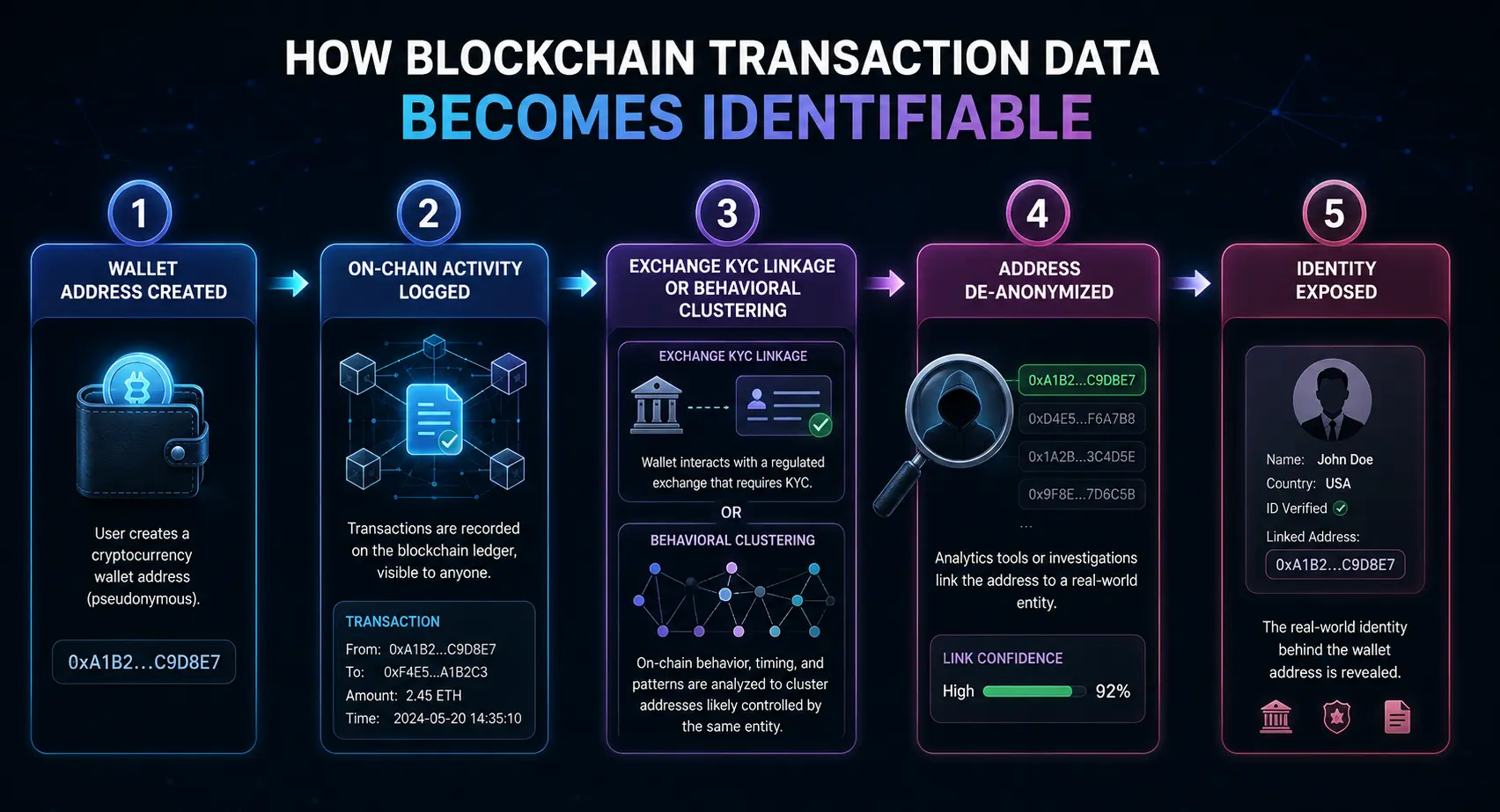
People conflate these terms constantly, and it causes real security mistakes. A wallet address isn’t your name, so it feels anonymous. It isn’t.
Pseudonymity means your identity is masked behind an address, but that address is still traceable and linkable across transactions. Chain analysis firms build entire businesses around de-anonymizing “pseudonymous” wallets by clustering behavior, exchange withdrawals, and timing patterns. Anonymity, by contrast, means no reliable link exists between the activity and a real-world identity at all — genuinely hard to achieve on a public chain without dedicated tooling.
Privacy is broader: controlling who sees what information, and when. Confidentiality specifically means the content of a transaction, such as an amount or contract terms, stays hidden from unauthorized parties. Understanding these four terms precisely is the first step before choosing any Blockchain Privacy Solutions for a real deployment.
Privacy-Enhancing Technologies Behind Modern Blockchain Privacy Solutions
Privacy-Enhancing Technologies, often shortened to PETs, cover a family of cryptographic and architectural tools. None of them provide identical guarantees, and treating them interchangeably is a common — and costly — mistake.
Zero-Knowledge Proofs, Explained Simply
A zero-knowledge proof lets one party prove a statement is true without revealing the information behind it. Say you want to prove you’re over 21 without showing your birthdate. That’s the essence of Zero-Knowledge Technology: prove the fact, hide the data.
On a blockchain, Zero-Knowledge Proofs let a user prove they hold sufficient funds, meet a compliance rule, or executed a transaction correctly, all without exposing the underlying numbers. Applications include private identity verification, confidential transaction validation, compliance attestation, private voting systems, authentication flows, and selective disclosure of credentials. Teams building this kind of cryptographic tooling often lean on specialized ZK proof privacy blockchain implementation architecture rather than building circuits from scratch.
ZK Rollups: Scaling Tool First, Privacy Tool Sometimes
Here’s a distinction worth getting right: not every ZK-based system is a privacy system. ZK rollups primarily use zero-knowledge proofs to compress thousands of transactions into a single succinct proof, verified cheaply on the base layer. That’s scaling, not confidentiality.
Most production ZK rollups today still post readable transaction data, or at least enough metadata to reconstruct activity. Privacy has to be engineered in separately, through additional shielding layers or private state circuits. If a project claims “ZK equals private,” ask what specifically gets hidden. For teams evaluating Ethereum-aligned scaling and privacy layers together, reviewing a proper Ethereum blockchain implementation architecture upfront avoids costly redesigns later.
Confidential Transactions
Confidential transaction schemes use cryptographic commitments, often Pedersen commitments paired with range proofs, to hide transaction amounts while still letting the network verify that inputs equal outputs and no value was created from nothing. The math checks out without the amount ever appearing in plaintext. This is a mature, well-studied approach, not experimental territory.
Secure Multi-Party Computation
Secure Multi-Party Computation, or MPC, lets multiple parties jointly compute a result over their combined private inputs without any party revealing its own input to the others. A consortium of banks could compute aggregate risk exposure without any single bank disclosing its book. That’s a genuinely useful enterprise pattern, and it’s already running in production for institutional key management and threshold signing schemes.
Trusted Execution Environments
Trusted Execution Environments, or TEEs, are protected hardware enclaves — think Intel SGX or AWS Nitro Enclaves — that process sensitive data in isolation from the rest of the operating system. Code and data inside stay encrypted from everything outside the enclave, even a compromised host OS.
The catch: you’re trusting the hardware manufacturer and the enclave’s attestation chain. TEEs have faced real side-channel vulnerabilities over the years. They’re fast and practical, but they carry a different trust assumption than pure cryptographic approaches like ZK proofs, and enterprises should evaluate that trade-off explicitly rather than assume “hardware-secured” means “unbreakable.”
Homomorphic Encryption
Homomorphic encryption allows computation directly on encrypted data, producing an encrypted result that decrypts to the correct answer, without ever exposing the raw inputs. Fully homomorphic encryption, or FHE, is the most powerful version, and 2025–2026 has seen real progress in reducing its notorious computational overhead. Still, FHE remains computationally expensive for many blockchain use cases today. It’s best suited to specific, well-bounded computations rather than general-purpose smart contract logic, at least for now.
TechnologyWhat It ProtectsTrust AssumptionMaturity in 2026Zero-Knowledge ProofsStatement validity without revealing inputsCryptographic (math-based)ProductionConfidential TransactionsTransaction amountsCryptographic commitmentsProductionSecure Multi-Party ComputationIndividual private inputsDistributed trust among participantsProduction for key management; growing for computeTrusted Execution EnvironmentsData processed inside enclaveHardware manufacturer + attestationProduction, with known trade-offsHomomorphic EncryptionData used in computationCryptographic (math-based)Active research, early pilots
Decentralized Identity and Selective Disclosure
Decentralized Identity, or DID, gives users control over their own identity credentials instead of relying on a central authority to vouch for them every time. Paired with verifiable credentials — cryptographically signed attestations following W3C standards — users can hold proof of things like age, accreditation, or employment status without a company storing that data centrally.
Selective disclosure is the practical payoff. A user can prove “I’m an accredited investor” without revealing net worth, address, or full legal name. This matters enormously for Web3 Privacy, because it flips the default from “share everything to prove one thing” to “share only what’s required.” For teams building document-backed credential systems, a blockchain document verification system can anchor proofs on-chain while keeping the underlying documents off-chain and access-controlled.
Privacy-Preserving KYC and AML: What It Can and Can't Do
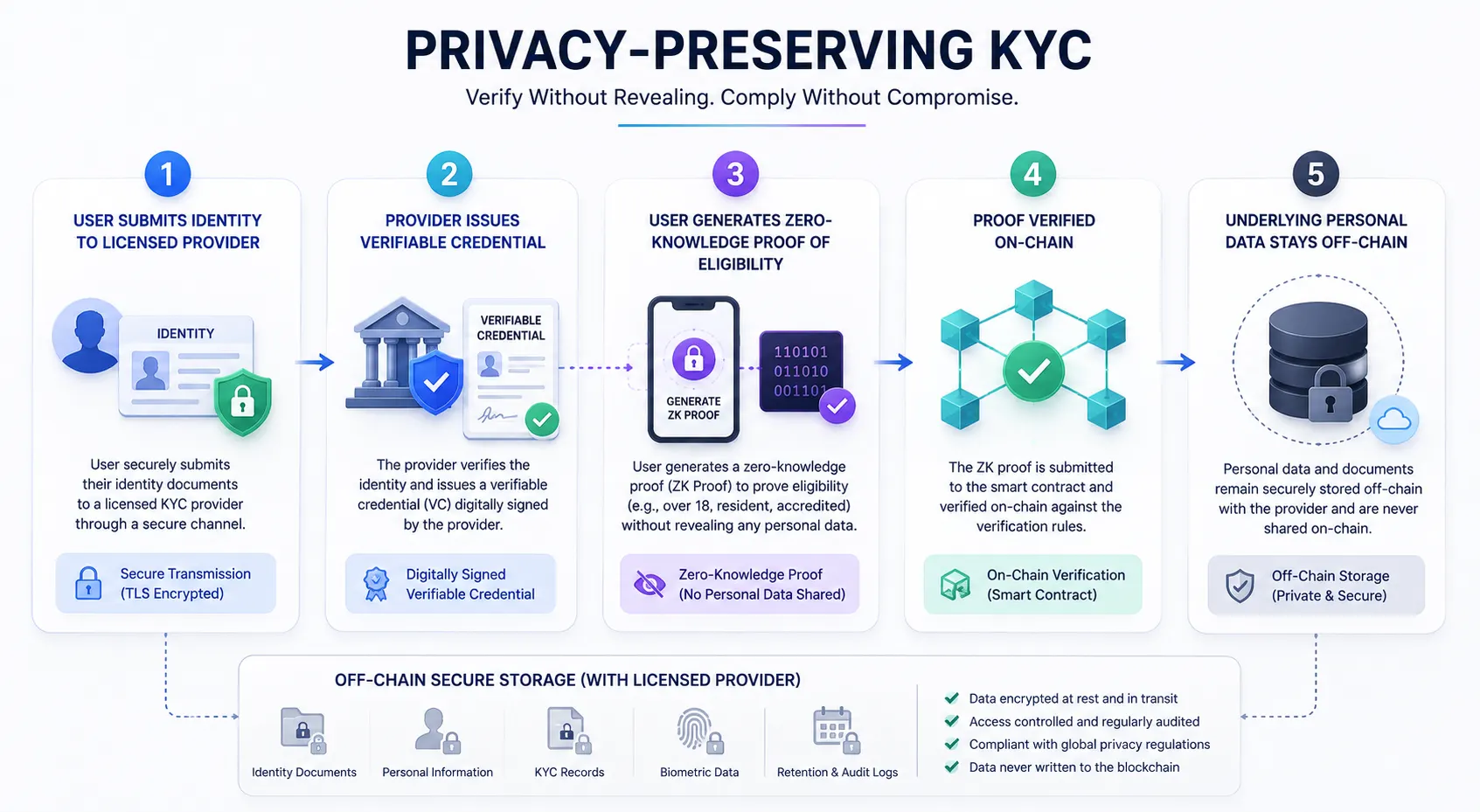
Privacy-preserving KYC workflows use Zero-Knowledge Proofs or selective-disclosure credentials so a user can prove they’ve passed identity checks, without exposing passport numbers or full profiles to every counterparty they interact with. That’s genuinely useful for reducing data sprawl across exchanges, DeFi platforms, and tokenization venues.
Here’s the part that gets oversold: zero-knowledge technology doesn’t automatically make a system KYC-compliant or AML-compliant. Compliance depends on who’s regulated, which jurisdiction applies, how the identity provider is licensed, how long records get retained, and whether the actual legal obligations are satisfied. A cryptographic proof is a tool inside a compliance program, not a substitute for one. Any vendor claiming otherwise deserves scrutiny.
Enterprise Blockchain Privacy Architecture: Putting the Pieces Together
Real deployments rarely use one privacy technology alone. Enterprise Blockchain Privacy usually combines permissioned network access, role-based access controls, encryption at rest and in transit, off-chain storage for sensitive records, and Zero-Knowledge Proofs or selective disclosure for the pieces that must be verified publicly.
The key architectural principle: store proofs, hashes, or verification results on-chain, not the raw sensitive data itself. A hash of a contract, a commitment to a transaction amount, or a cryptographic proof of eligibility can live on a public ledger safely. The underlying document, salary figure, or medical record stays in a controlled environment, referenced but never exposed. Building this correctly usually calls for dedicated blockchain engineering teams who understand both the cryptography and the compliance side of the equation, not just contract deployment.
Privacy in Tokenization and Real-World Assets
Tokenized securities, corporate bonds, private credit, and real estate all carry sensitive data: investor identity, ownership stakes, valuation, and transaction history. Not everything needs to be public, but not everything should be hidden either — regulators and auditors still need visibility.
Selective disclosure lets an issuer prove investor eligibility, transfer restrictions, and compliance status without broadcasting full cap tables to the public internet. Institutional tokenization platforms increasingly separate “proof of compliant ownership” from “public record of the asset existing.” That balance, not blanket privacy or blanket transparency, is what makes tokenization viable for regulated capital markets. This is also where post-trade infrastructure matters — platforms like a permissioned blockchain infrastructure for post-trade operations show how capital markets combine auditability with restricted visibility for institutional counterparties.
Privacy Challenges in DeFi and Payments
DeFi has a transparency problem that goes beyond identity. Wallet analytics tools can watch a whale’s collateral position and predict a liquidation before it happens. MEV bots scan the mempool and front-run trades, extracting value from ordinary users. Lending protocols expose exact collateral ratios, inviting targeted attacks.
Privacy-Enhancing Technologies address legitimate needs here: hiding order details from front-runners, shielding collateral positions from predatory bots, and protecting institutional trading strategies from competitors. That’s different from evading sanctions screening or laundering funds — the line between financial privacy and compliance evasion has to stay clear, and serious protocols build around that line rather than ignoring it.
Stablecoin payment rails face a similar trade-off. Institutions want transaction confidentiality for competitive reasons, while regulators want monitoring capability for financial stability. Confidential Transactions with built-in auditor keys — where a regulator or auditor can decrypt specific transactions under defined conditions — are one emerging approach to reconciling both needs.
Blockchain Privacy and Regulatory Compliance
Enterprises rarely need complete anonymity. They need privacy plus auditability — the ability to prove compliance to a regulator on demand, while keeping data closed to everyone else. That’s a fundamentally different design goal than the anonymity culture of early crypto.
GDPR and similar frameworks add real complexity here, particularly around personal data. Immutable ledgers can’t easily satisfy a “right to erasure” request if personal data sits directly on-chain. That’s why data minimization matters: keep personal data off-chain, store only hashes or proofs on the ledger, apply purpose limitation, enforce access control, and set clear retention policies. None of this constitutes legal advice — every deployment needs its own regulatory assessment based on jurisdiction and data type — but the architectural pattern of “prove on-chain, store off-chain” consistently reduces regulatory exposure.
Privacy and Blockchain Security Risks
Privacy technology doesn’t fix everything. Blockchain Security still depends on solid smart contract code, correctly implemented cryptography, protected private keys, and sound access controls. A perfectly private transaction routed through a vulnerable contract is still exploitable.
Metadata leakage deserves particular attention. Even when transaction content is hidden, timing patterns, gas usage, transaction frequency, and network-level IP data can reveal plenty. Researchers have repeatedly de-anonymized “private” transactions purely through side-channel and metadata analysis. Privacy engineering has to account for what’s visible around the encrypted core, not just the core itself.
The biggest privacy failures we’ve seen weren’t cryptographic breaks — they were metadata leaks nobody thought to model. You can hide the amount and still leak the story.
Privacy-by-Design for Blockchain Applications
Privacy-by-design means deciding what data goes on-chain, what stays off-chain, and what gets proven versus revealed, during architecture planning, not after launch. Retrofitting privacy onto a live system is expensive and often incomplete.
Ask early: what’s the actual threat model? Who are you protecting data from — competitors, the public, or specific bad actors? What regulatory obligations apply? Answering these questions before writing contract code saves painful rework later, and it’s a discipline our Web3 development teams build into every privacy-sensitive engagement from day one.
A Practical Framework for Choosing Blockchain Privacy Technology
There’s no single privacy technology suitable for every blockchain application. Instead, weigh these factors against your specific requirements:
- Data sensitivity and what actually needs protecting
- Threat model — who you’re defending against
- Regulatory requirements across relevant jurisdictions
- Required transaction transparency for auditors or regulators
- Identity verification needs and selective disclosure requirements
- Performance, scalability, and gas cost impact
- Interoperability with existing chains and enterprise systems
- Cryptographic assumptions and required trust model
- Infrastructure and hardware dependencies
- User experience impact and onboarding friction
- Implementation and ongoing operational cost
- Governance — who controls upgrades, keys, and disclosure conditions
Supply chain and traceability systems illustrate this well. A blockchain-powered organic certification and food traceability platform needs public proof of certification while keeping supplier pricing and sourcing relationships confidential — a different mix of technologies than a private equity tokenization platform would need. And fintech trading platforms weighing execution privacy against MEV exposure face yet another combination, similar to considerations we’ve covered in Robinhood-style blockchain trading infrastructure development.
The Future of Blockchain Privacy in 2026 and Beyond
Zero-knowledge tooling keeps getting faster and cheaper to prove, which is opening the door to more privacy-preserving applications running at production scale rather than staying stuck in research papers. Decentralized identity standards are maturing through W3C and Ethereum ecosystem work, pushing selective disclosure toward becoming a default expectation rather than a novelty.
Homomorphic encryption is still early — genuinely promising, not yet production-ready for general blockchain compute. Regulatory clarity around privacy-preserving compliance tools is improving gradually across the US, UK, EU, UAE, and Singapore, though frameworks still vary significantly by jurisdiction. Founders planning new blockchain ventures around these shifts should start with a clear-eyed technical roadmap; a founder checklist for blockchain startups in 2026 is a useful starting point before committing to a privacy architecture.
Frequently Asked Questions
Here are direct answers to the questions we hear most often about Blockchain Privacy.
Why is privacy important in blockchain?
Public blockchains expose transaction histories, wallet balances, and smart contract activity to anyone watching. Without Blockchain Privacy measures, enterprises risk revealing trade secrets, customer data, and financial strategy to competitors or bad actors. Privacy technology lets organizations keep the auditability and integrity blockchain provides while protecting sensitive information, which is exactly why banks, healthcare providers, and Web3 businesses now treat privacy as core infrastructure rather than an optional add-on.
Are blockchain transactions private?
Not by default. Most public blockchain transactions are pseudonymous, meaning they’re linked to a wallet address rather than a name, but that address can often be traced back to a real identity through exchange records or behavioral analysis. True privacy requires additional Privacy-Enhancing Technologies like Zero-Knowledge Proofs or confidential transactions layered on top of the base protocol, since the underlying ledger itself is designed to be transparent and verifiable.
What are privacy-enhancing technologies in blockchain?
Privacy-Enhancing Technologies, or PETs, are cryptographic and architectural tools that protect sensitive data on a blockchain. This category includes Zero-Knowledge Proofs, confidential transactions, secure multi-party computation, trusted execution environments, and homomorphic encryption. Each protects different data and relies on different trust assumptions, so enterprises typically combine several PETs based on their specific threat model, regulatory needs, and performance requirements rather than relying on one technology alone.
What are zero-knowledge proofs?
A zero-knowledge proof is a cryptographic method that lets one party prove a statement is true without revealing the underlying information. For example, you can prove you have enough funds for a transaction without disclosing your exact balance. Zero-Knowledge Technology powers private identity verification, confidential transactions, compliance checks, and blockchain scaling, though not every ZK application is designed for privacy — some focus purely on verification speed.
How do zero-knowledge proofs protect privacy?
Zero-knowledge proofs protect privacy by separating verification from disclosure. The network confirms a statement is mathematically true without ever seeing the private inputs behind it. This lets users prove eligibility, ownership, or compliance status without exposing personal data, transaction amounts, or business logic, which is why Zero-Knowledge Proofs sit at the center of most modern Blockchain Privacy Solutions built for enterprise and financial use cases.
What is the difference between privacy and anonymity in blockchain?
Privacy means controlling who can see specific information, while anonymity means no one can link an activity to a real-world identity at all. A blockchain wallet address provides pseudonymity, not anonymity or full privacy, since addresses can still be traced and linked through chain analysis. Genuine Blockchain Privacy requires deliberate technical measures beyond simply using an address instead of a name.
How can enterprises use privacy-preserving blockchain technology?
Enterprises combine permissioned network access, encryption, off-chain storage, and Zero-Knowledge Proofs to protect sensitive data while keeping verifiable records on-chain. Common applications include confidential financial settlements, private identity verification, protected supply chain data, and institutional asset tokenization. Privacy-Preserving Blockchain architecture generally stores hashes or proofs on-chain and keeps raw sensitive data in controlled, access-restricted environments instead.
Can blockchain privacy technology support KYC and AML?
Zero-knowledge proofs and selective-disclosure credentials can let users prove they’ve passed identity checks without exposing full personal details to every counterparty. However, this technology alone doesn’t guarantee KYC or AML compliance. Actual compliance depends on the identity provider’s licensing, applicable jurisdiction, data retention rules, and whether regulated entities are properly involved in the process, so legal and regulatory review remains essential alongside any technical implementation.
How does privacy affect real-world asset tokenization?
Tokenized securities, bonds, and real estate often need selective disclosure of ownership, investor eligibility, and transaction details rather than full transparency or full secrecy. Privacy technology lets issuers prove regulatory compliance and investor accreditation without publishing complete cap tables publicly. This balance supports institutional adoption of tokenization while still satisfying auditors and regulators who need visibility into compliant asset ownership and transfer activity.
What are the biggest challenges of blockchain privacy?
Key challenges include metadata leakage, where timing and transaction patterns reveal information even when content is encrypted, plus the computational cost of technologies like homomorphic encryption. Regulatory uncertainty, hardware trust assumptions in trusted execution environments, and the difficulty of reconciling immutable ledgers with data correction rights under laws like GDPR also complicate deployment. No single Blockchain Privacy technology solves every one of these challenges at once.
Bringing It All Together
Blockchain Privacy isn’t about choosing between transparency and confidentiality — it’s about engineering both into the same system deliberately. Zero-Knowledge Proofs, confidential transactions, secure multi-party computation, and decentralized identity each solve a different piece of that puzzle, and enterprises that understand the differences build stronger, more compliant systems than those chasing a single silver-bullet technology.
If your organization is planning a tokenization platform, a confidential payment rail, or an identity system that needs real privacy engineering behind it, the technical choices you make early will shape everything that follows. Our team can help you get those choices right — hire Web3 developers who’ve built privacy-aware blockchain infrastructure for regulated industries and know how to balance auditability with confidentiality from day one.
Ready to move beyond theory and build an intelligent platform that delivers real-world value? Blocsys Technologies specialises in engineering enterprise-grade AI and blockchain solutions for the fintech, Web3, and digital asset sectors. Connect with our experts today to discuss your vision and chart a clear path from concept to a secure, scalable reality.
