
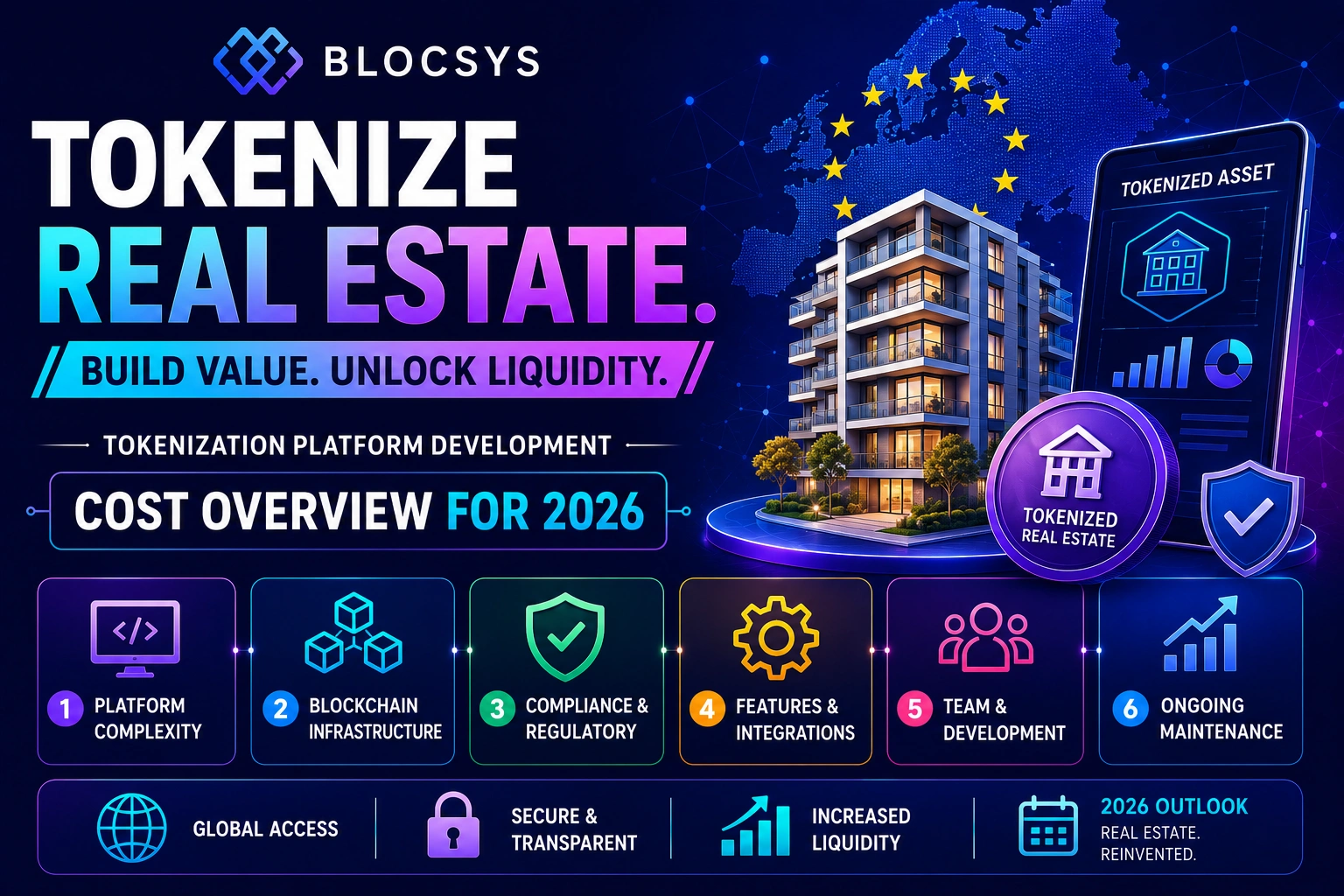
Tokenization Platform Development Cost for Real Estate in 2026
Real estate tokenization is no longer a niche experiment run by crypto enthusiasts. It’s become a serious infrastructure decision for developers, fund managers, and enterprises who want liquidity without giving up control of their assets. If you’re a founder or CTO trying to figure out what it actually costs to build a real estate tokenization platform in 2026, you’re in the right place. We’ll walk through the real cost drivers, the architecture choices that move the needle, and how firms are budgeting for this shift. Before you go further, it’s worth running your own numbers through the Software Development Cost Estimator, which gives you a tailored estimate based on your specific requirements. And if you want to see how a full-service technology partner approaches this space, the Blocsys homepage is a good starting point.
What Is Real Estate Tokenization, and Why Does It Matter in 2026?
Real estate tokenization converts ownership rights in a property into digital tokens recorded on a blockchain. Each token represents a fractional share, a debt instrument, or a claim on future cash flow. Instead of selling an entire building to one buyer, you can sell thousands of tokens to thousands of investors. That’s the core idea behind property tokenization, and it’s why institutional players are paying attention.
Here’s why 2026 feels different. Regulatory clarity has improved across major markets. Singapore, the UAE, Switzerland, and GIFT City have all published frameworks that make digital securities easier to issue compliantly. Meanwhile, ADGM and DIFC in the UAE continue building sandbox environments specifically for tokenized assets. Consequently, more real estate developers and property investment firms are asking a very practical question: what does it cost to actually build this?
How Real Estate Tokenization Actually Works
Think about a commercial building worth $10 million. Under a traditional model, only wealthy investors or institutions could participate. With a real estate tokenization platform, that same asset gets divided into, say, 10 million tokens at $1 each. Retail investors, family offices, and global buyers can all participate with far lower capital requirements.
The workflow generally follows a few stages: asset selection and legal structuring, valuation and due diligence, smart contract deployment, token issuance, and finally investor distribution through a compliant marketplace. Each stage has its own engineering and legal cost, which is exactly why a generic quote rarely fits any two projects the same way.
Property Tokenization Workflow Explained
Property tokenization isn’t just “put a deed on a blockchain.” It involves creating a special purpose vehicle (SPV) that legally holds the property, then issuing tokens that represent shares in that SPV. Smart contracts enforce the rules: who can buy, how dividends get distributed, and what happens during a sale event. This legal-technical bridge is where most of the engineering complexity lives.
The biggest mistake we see founders make is treating tokenization as a purely technical project. In reality, roughly 40% of the total build effort touches compliance, legal structuring, and jurisdiction-specific rules — not code. If you underestimate that layer, your timeline and budget both blow up.
Factors That Affect Real Estate Tokenization Platform Development Cost
Several variables push the real estate tokenization platform development cost up or down. Let’s break them down honestly, because vague pricing pages don’t help anyone planning a real budget.
- Blockchain choice: Ethereum, Polygon, Avalanche, Solana, or a permissioned chain each carry different gas, throughput, and compliance tradeoffs.
- Regulatory scope: Building for one jurisdiction costs less than supporting multi-jurisdiction securities laws across the US, EU, UK, and UAE simultaneously.
- Feature depth: A basic MVP differs enormously from an enterprise-grade platform with secondary trading, automated compliance, and institutional custody.
- Integration needs: Payment gateways, banking rails, identity verification providers, and property management systems all add cost.
- Security requirements: Smart contract audits, penetration testing, and bug bounty programs are non-negotiable at scale.
Generally speaking, a functional MVP starts around $60,000 to $90,000. A full enterprise real estate tokenization platform, however, can run anywhere from $150,000 to $500,000 or more, depending on jurisdiction complexity and custom features. These ranges aren’t arbitrary — they reflect real project data across similar asset tokenization builds.
Real Estate Tokenization Platform Architecture: What You’re Actually Paying For
Architecture decisions made in month one shape your cost structure for years. A well-designed real estate tokenization platform typically includes six core layers: the blockchain and smart contract layer, the asset tokenization engine, the investor onboarding and KYC/AML module, the wallet and custody layer, the admin and asset management dashboard, and the compliance and reporting layer.
Each layer needs to talk to the others seamlessly. Skimp on one, and the whole system feels fragile. That’s why experienced teams price architecture as a unit rather than stitching together disconnected quotes for each piece.
Blockchain Layer and Smart Contract Development Costs
Smart contract development is usually the most quoted, and most misunderstood, cost item. A basic ERC-1400 or ERC-3643 style security token contract might cost $15,000 to $25,000 to build and test. However, real estate tokenization platforms typically need multiple contracts working together: token issuance, dividend distribution, transfer restrictions, governance, and vesting logic.
When you add multi-signature custody, automated compliance checks (transfer restrictions based on investor accreditation), and cross-chain bridging, smart contract costs can climb to $40,000–$80,000. Audits add another $15,000–$40,000, depending on scope and the reputation of the audit firm. Skipping this step isn’t an option if you’re handling real capital.
Property Tokenization Workflow and Fractional Ownership Costs
Fractional ownership sounds simple on a slide deck. Building it correctly is harder. You need logic that tracks ownership percentages in real time, enforces minimum investment thresholds, handles secondary transfers without breaking compliance rules, and calculates proportional rental income or capital gains distributions automatically.
Most platforms budget $20,000–$45,000 specifically for fractional ownership logic and investor cap table management. This includes the dashboard investors use to track their holdings, request redemptions, and view distribution history. Without this layer, you don’t really have a real estate tokenization platform — you have a token with no investor-facing utility.
Investor Onboarding and the Real Estate Tokenization Platform Experience
Onboarding is where most retail investors either commit or walk away. A clunky sign-up flow kills conversion, regardless of how good your underlying blockchain infrastructure is. That means investing in a smooth identity verification flow, clear disclosure documents, and a wallet setup process that doesn’t require users to understand private keys.
Budget roughly $15,000–$30,000 for a polished onboarding experience, including document upload, e-signature integration, and accredited investor verification workflows tailored to your target markets.
KYC/AML Compliance in Real Estate Tokenization Platforms
You can’t legally sell tokenized securities without robust KYC/AML infrastructure. This isn’t optional, and regulators in the US, UK, EU, Singapore, and UAE are increasingly strict about it. Platforms typically integrate third-party providers like Sumsub, Onfido, or Jumio rather than building identity verification from scratch.
Compliance module costs generally range from $20,000 to $50,000, factoring in integration, ongoing API fees, sanctions screening, and automated accreditation checks. Additionally, you’ll need legal counsel to structure the offering correctly under Reg D, Reg S, MiCA, or equivalent frameworks depending on your target investor base. This legal work sits outside pure development cost but directly affects your total budget.
Wallet Integration, Digital Securities, and Asset Management
Wallet infrastructure determines how investors actually hold and transact their tokens. Some platforms use custodial wallets managed entirely by the platform operator, which simplifies the user experience but adds custody liability. Others integrate non-custodial wallets like MetaMask or WalletConnect, shifting key management responsibility to the investor.
Enterprise-grade platforms often build hybrid systems: custodial by default, with an option to self-custody. This flexibility costs more upfront, typically $25,000–$45,000, but it broadens your addressable investor base considerably. Digital securities management also requires an admin panel where operators can issue new token batches, manage cap tables, trigger dividend payouts, and generate regulatory reports on demand.
Why RWA Tokenization Extends Beyond Real Estate Alone
It’s worth noting that real estate tokenization sits within the broader RWA tokenization movement. Firms building real estate platforms often expand into adjacent asset classes later — corporate debt, equity, or carbon credits. If that’s part of your roadmap, look at how Real World Asset Tokenization infrastructure can be built modularly from day one, so you’re not rebuilding your core engine for every new asset type. Teams that plan for this from the start save significant rework costs later, especially when expanding into equity tokenization or corporate bond tokenization.
Security, Audits, and Infrastructure Expenses
Security failures in tokenized real estate aren’t hypothetical — they’re expensive and reputation-destroying. Budget for smart contract audits, penetration testing, secure key management (HSM or MPC-based custody), and ongoing infrastructure monitoring. Combined, these typically account for 15–20% of total development cost.
Cloud infrastructure, including node hosting, API gateways, and data storage for compliance records, adds another $2,000–$8,000 monthly depending on scale. Don’t treat this as an afterthought. Enterprises that skip proper audits often pay far more later fixing exploited vulnerabilities.
Real Estate Tokenization Platform Development Cost Breakdown
| Module | Estimated Cost Range (USD) |
|---|---|
| Blockchain & Smart Contract Development | $40,000 – $80,000 |
| Smart Contract Audits | $15,000 – $40,000 |
| Fractional Ownership & Cap Table Engine | $20,000 – $45,000 |
| KYC/AML Compliance Integration | $20,000 – $50,000 |
| Investor Onboarding & Dashboard | $15,000 – $30,000 |
| Wallet Integration & Custody | $25,000 – $45,000 |
| Admin Panel & Asset Management | $15,000 – $35,000 |
| UI/UX Design | $10,000 – $25,000 |
| Infrastructure & DevOps (annual) | $24,000 – $96,000 |
Add these up and you’ll see why a full enterprise real estate tokenization platform typically lands between $150,000 and $500,000, with ongoing infrastructure and compliance costs layered on top annually.
Pricing Models for Real Estate Tokenization Platform Development
Vendors generally offer three pricing structures. Fixed-price works well for well-scoped MVPs where requirements won’t change much. Time and materials suits enterprise projects with evolving compliance needs across multiple jurisdictions. Dedicated team engagement makes sense when you’re building a long-term product with continuous iteration, such as expanding from single-property tokenization into a multi-asset marketplace.
White-label solutions offer a faster, cheaper starting point — often $30,000–$70,000 — but customization limits can hurt you later if your compliance requirements shift. Custom-built platforms cost more upfront but give you full ownership of the codebase, architecture, and IP, which matters enormously if you’re raising institutional capital.
Development Timeline for a Real Estate Tokenization Platform
Timelines vary based on scope, but here’s a realistic breakdown most enterprise teams should plan around:
- Discovery, legal structuring, and architecture planning: 3–5 weeks
- Smart contract development and internal testing: 6–10 weeks
- KYC/AML and investor onboarding module build: 4–6 weeks
- Wallet integration and admin panel development: 5–8 weeks
- Security audits and compliance review: 3–6 weeks
- Testnet deployment, QA, and mainnet launch: 3–4 weeks
All told, expect four to seven months for a production-ready enterprise real estate tokenization platform. Simpler MVPs can launch in eight to twelve weeks if you’re willing to trim feature scope and rely more heavily on third-party integrations.
Ongoing Maintenance Costs You Shouldn’t Ignore
Launch day isn’t the finish line. You’ll need continuous smart contract monitoring, compliance rule updates as regulations shift, security patching, customer support infrastructure, and periodic re-audits as you add features. Most enterprises budget 15–20% of initial development cost annually for maintenance and updates.
Don’t underestimate this line item. We’ve seen platforms launch successfully, then stall six months later because nobody budgeted for ongoing regulatory reporting requirements or infrastructure scaling costs.
Cost Optimization Strategies for Real Estate Tokenization
You don’t have to build everything from scratch to launch a credible platform. Here are strategies that genuinely reduce spend without cutting corners on security or compliance:
- Use audited, open-source token standards (ERC-1400, ERC-3643) instead of custom contract logic where possible.
- Start with one jurisdiction and expand compliance scope after validating investor demand.
- Integrate established KYC/AML providers rather than building identity verification in-house.
- Choose a modular architecture so future asset classes, like carbon credit tokenization, don’t require a rebuild.
- Use a phased MVP-to-enterprise roadmap instead of building every feature before launch.
Furthermore, running your requirements through the Software Development Cost Estimator early helps you avoid scope creep before it becomes an expensive problem.
ROI Analysis: Is Real Estate Tokenization Worth the Investment?
Real estate tokenization unlocks liquidity that traditional property investment structures simply can’t offer. Developers raise capital faster by accessing global investor pools instead of waiting on a handful of institutional buyers. Property investment firms open new revenue streams through transaction fees on secondary token trading.
For enterprises, the ROI case strengthens further. Automated compliance and distribution logic cuts administrative overhead significantly compared to manual fund administration. Over a three-to-five-year horizon, most platform operators recover their build cost through transaction fees, management fees, and expanded investor reach — assuming the platform is built on solid compliance and security foundations from day one.
Why Enterprises Choose Blocsys for Real Estate Tokenization Platform Development
Blocsys builds enterprise-grade real estate tokenization platforms with a focus on compliance-first architecture, audited smart contracts, and modular design that scales across asset classes. Our team has deep experience across asset tokenization platform builds, RWA tokenization development, and enterprise blockchain infrastructure spanning the US, UK, UAE, Singapore, and GIFT City markets.
Whether you’re a startup founder validating your first MVP or an enterprise team scaling a multi-jurisdiction offering, Blocsys structures engagements around your actual risk profile and compliance needs — not a one-size-fits-all package. We’ve also supported adjacent builds like OTC trading platform development and hybrid trading and prediction market platforms, giving us a broad view of how digital asset infrastructure connects across markets.
Enterprises that succeed with real estate tokenization treat it as financial infrastructure, not a marketing feature. The winners spend real budget on compliance and audits upfront — because retrofitting security into a live securities platform is far costlier than building it right the first time.
Frequently Asked Questions
Here are direct answers to the questions we hear most often about real estate tokenization platform development cost.
What is a real estate tokenization platform?
A real estate tokenization platform is software infrastructure that converts property ownership rights into blockchain-based digital tokens. These tokens represent fractional shares, debt claims, or equity interests in a property held through a legal structure like an SPV. Investors buy, hold, and trade these tokens through a compliant marketplace, with smart contracts automatically enforcing transfer restrictions, dividend distributions, and ownership records.
Unlike traditional real estate investment, tokenization lowers minimum investment thresholds and enables secondary market liquidity that wasn’t previously available to retail investors.
How much does it cost to build a real estate tokenization platform in 2026?
A basic MVP typically costs $60,000–$90,000, while a full enterprise real estate tokenization platform ranges from $150,000 to $500,000 or more. The exact real estate tokenization platform development cost depends on blockchain choice, regulatory scope, feature complexity, and integration requirements. Multi-jurisdiction compliance, custom smart contracts, and institutional-grade custody push costs toward the higher end of that range.
We recommend using a detailed cost estimator tool to get numbers tailored to your specific project scope rather than relying on generic industry averages.
What factors affect real estate tokenization platform development cost?
Key cost drivers include blockchain network selection, smart contract complexity, the number of jurisdictions you’re compliant in, KYC/AML integration depth, wallet and custody architecture, and whether you’re building custom or using a white-label foundation. Security audits and ongoing infrastructure also factor heavily into total cost.
Feature scope matters too. Adding secondary trading, automated dividend distribution, or multi-asset support all increase both cost and timeline significantly.
Which blockchain is best for real estate tokenization?
There’s no single “best” blockchain — it depends on your priorities. Ethereum offers the strongest security and institutional trust but comes with higher gas fees. Polygon and Avalanche offer lower costs with strong EVM compatibility. Permissioned chains suit enterprises needing tighter control over validator networks and data privacy.
Many enterprise real estate tokenization platforms use a hybrid approach: Ethereum or a Layer 2 for settlement, paired with permissioned infrastructure for compliance-sensitive data.
How long does it take to build a real estate tokenization platform?
Most enterprise-grade builds take four to seven months from discovery through mainnet launch. This includes legal structuring, smart contract development, KYC/AML integration, wallet setup, security audits, and testing. A simplified MVP can launch in eight to twelve weeks if you scope features tightly and rely on third-party compliance providers instead of custom modules.
Timeline extensions usually come from multi-jurisdiction legal work, not engineering delays.
What features should a real estate tokenization platform include?
Core features include smart contract-based token issuance, fractional ownership management, KYC/AML-compliant investor onboarding, wallet integration, an admin dashboard for asset and cap table management, automated dividend distribution, and secondary market trading capability. Enterprise platforms often add multi-jurisdiction compliance modules, institutional custody options, and detailed reporting for regulators and auditors.
Security features like multi-signature approvals and transfer restriction logic are essential, not optional add-ons.
How much does smart contract development cost for real estate tokenization platforms?
Smart contract development for real estate tokenization platforms generally ranges from $40,000 to $80,000, covering token issuance, transfer restriction logic, dividend distribution, and governance contracts. Security audits add another $15,000–$40,000 on top of that. Costs increase with cross-chain functionality, multi-signature custody requirements, and jurisdiction-specific compliance logic built directly into the contract.
Never skip the audit step — it’s cheap insurance against catastrophic exploits later.
What is the cost of implementing fractional ownership and investor onboarding?
Fractional ownership logic, including cap table management and proportional distribution calculations, typically costs $20,000–$45,000. Investor onboarding, covering identity verification, accreditation checks, and a smooth sign-up experience, adds another $15,000–$30,000. Together, these modules form the investor-facing core of any real estate tokenization platform and directly influence conversion rates.
Underinvesting here often hurts adoption more than any technical shortcoming in the blockchain layer.
How can enterprises reduce real estate tokenization platform development costs?
Enterprises can reduce costs by using audited open-source token standards instead of custom contracts, integrating established KYC/AML providers rather than building identity verification in-house, and starting with a single jurisdiction before expanding compliance scope. Modular architecture also prevents costly rebuilds when adding new asset classes later.
Running requirements through a structured cost estimator early helps teams avoid scope creep, which is one of the biggest hidden cost drivers in tokenization projects.
How can Blocsys build a secure enterprise-grade real estate tokenization platform?
Blocsys approaches real estate tokenization with a compliance-first architecture, audited smart contracts, modular infrastructure, and jurisdiction-aware KYC/AML integration. Our team designs platforms that scale from a single-property MVP into a multi-asset RWA tokenization marketplace without requiring a full rebuild. We support builds across the US, UK, UAE, Singapore, and GIFT City regulatory environments.
Reach out through the Blocsys homepage to scope your project and get a tailored cost estimate for your specific compliance requirements.
Final Thoughts on Real Estate Tokenization Platform Investment
Building a real estate tokenization platform in 2026 requires balancing technical ambition with regulatory reality. The most successful platforms aren’t the ones with the flashiest features — they’re the ones built on solid compliance, audited smart contracts, and architecture that scales as you add new asset types. Real estate tokenization is moving from experimental to expected, and firms that invest properly now will hold a real advantage over those who rush an unaudited MVP to market.
If you’re ready to scope your project, start with the Software Development Cost Estimator to get a realistic budget tailored to your requirements. From there, the Blocsys team can walk you through architecture options, compliance strategy, and a development roadmap suited to your target markets — whether that’s the US, UK, UAE, Singapore, or GIFT City. Reach out today and let’s talk about what building your real estate tokenization platform actually looks like.
Ready to move beyond theory and build an intelligent platform that delivers real-world value? Blocsys Technologies specialises in engineering enterprise-grade AI and blockchain solutions for the fintech, Web3, and digital asset sectors. Connect with our experts today to discuss your vision and chart a clear path from concept to a secure, scalable reality.
