
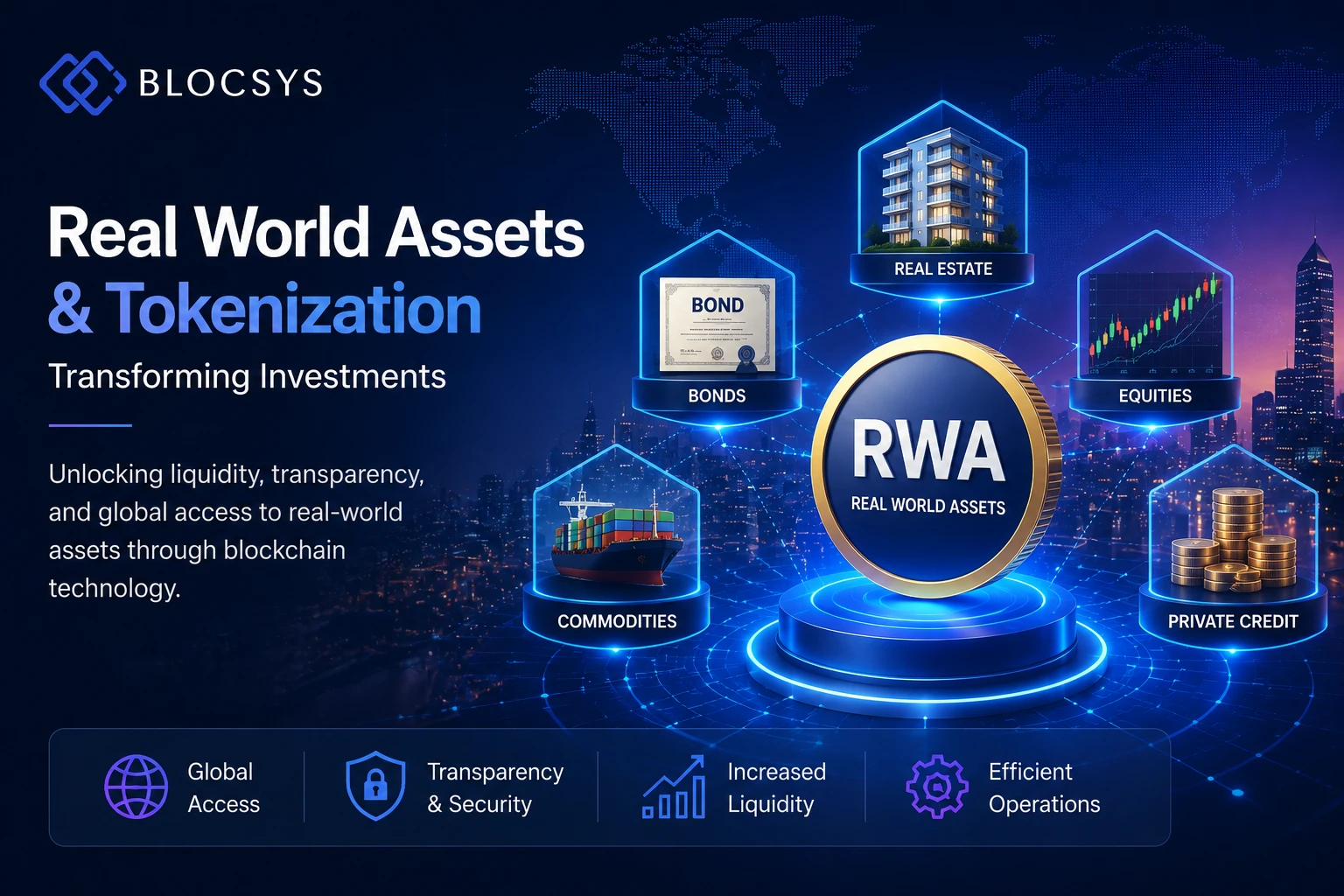
Real world asset tokenization has moved from a blockchain buzzword to a genuine institutional priority in 2026. Banks, asset managers, and fintech firms are no longer asking whether tokenization works — they’re asking how to deploy it responsibly. Real world asset tokenization is the process of representing ownership or economic rights in a physical or financial asset as a digital token on a blockchain. That token can represent a share of real estate, a fraction of a Treasury bill, or an interest in a private credit fund. The underlying asset still exists off-chain; the token simply records and transfers ownership rights more efficiently. This shift matters because it touches how investments get issued, settled, and serviced across capital markets.
What Real World Asset Tokenization Means
At its core, real world asset tokenization converts rights to an asset into a digital format that blockchain infrastructure can track, transfer, and program. Think of it as a digital wrapper around a legal claim. You’re not putting a building on-chain — you’re putting the ownership record, transfer rules, and servicing logic on-chain.
Tokenized real world assets differ from native crypto assets because they represent something that exists in the traditional financial system. That distinction matters for compliance, custody, and legal enforceability. A tokenized Treasury bill, for example, still relies on the underlying Treasury security and its legal structure; the token is a representation, not a replacement for that structure.
Why RWA Tokenization Is Gaining Institutional Attention in 2026
Institutional interest in RWA tokenization has grown steadily because on-chain infrastructure now supports production-grade use cases, not just pilots. According to RWA.xyz market tracking data, the total value of tokenized real-world assets (excluding stablecoins) surpassed $24 billion by mid-2026, with tokenized Treasuries and private credit accounting for the largest share. That’s a meaningful jump from a few billion dollars just three years earlier.
Boston Consulting Group and other market researchers have projected tokenized asset markets could reach into the trillions by the early 2030s, though these remain forward-looking estimates rather than confirmed outcomes. What’s confirmed is that firms like BlackRock, Franklin Templeton, and WisdomTree have launched tokenized money market and Treasury funds on public and permissioned blockchains, signaling that mainstream asset managers see production value here, not just experimentation.
Additionally, custody providers, transfer agents, and exchanges have built regulated infrastructure around these products. That combination — real issuers, real assets, real compliance wrappers — is what separates today’s RWA tokenization platform landscape from the speculative token launches of 2017 and 2018.
How Real World Assets Are Tokenized
Tokenizing an asset isn’t a single technical step. It’s a structured process that blends legal work, valuation, and blockchain engineering. Here’s how it typically unfolds.
The Real World Asset Tokenization Lifecycle
Tokenizing an asset isn’t a single technical step. It’s a structured process that blends legal work, valuation, and blockchain engineering. Here’s how it typically unfolds.
First, the issuer selects an eligible asset — a Treasury bill, a real estate parcel, a private credit portfolio, or a fund share. Next comes legal structuring, where lawyers define the token holder’s rights, often through a special purpose vehicle or trust structure. Valuation follows, establishing a fair price basis for issuance.
Once the legal and financial groundwork is set, developers deploy smart contracts that encode transfer restrictions, investor eligibility rules, and servicing logic. Token issuance happens next, followed by investor onboarding, which includes KYC and AML checks. After issuance, tokens move through custody, transfer, and eventually settlement when trades occur. Asset servicing — interest payments, dividends, redemptions — continues throughout the token’s life, right up to maturity or redemption.
Tokenization doesn’t remove the legal and operational complexity of owning an asset — it restructures where that complexity lives, moving much of it into programmable, auditable smart contract logic instead of manual back-office processes.
Types of Real-World Assets That Can Be Tokenized
Not every asset class has moved at the same pace. Some categories now have live, institutional-scale products; others remain earlier-stage or limited to pilots.
Asset ClassTokenization Status (2026)Example UseU.S. Treasuries & Money Market FundsLive, institutional scaleCash management, collateralPrivate CreditLive, growing rapidlyFund distribution, portfolio diversificationCorporate BondsPilots and early productionIssuance, settlement efficiencyEquitiesEarly-stage, jurisdiction-dependentFractional ownership, distributionReal EstatePilots, limited secondary liquidityFractional investmentCommoditiesEstablished for select assets (e.g., goldCollateral, trading )
Tokenized Treasuries and Funds
Tokenized Treasuries represent the most mature segment of real world asset tokenization today. Products from major asset managers give institutional investors on-chain exposure to short-term government debt, with daily accrual and near-instant transferability between eligible holders. These aren’t hypothetical — they’re operating funds with disclosed assets under management, reported through public trackers like RWA.xyz.
Tokenized fund structures, including those exploring decentralized models, are also expanding investor access to diversified strategies. If you’re evaluating fund-level tokenization, it’s worth reviewing how a Decentralized Traded Funds (DTF) Platform handles on-chain portfolio management and rebalancing logic.
Tokenized Private Credit and Corporate Bonds
Private credit is currently the largest non-Treasury segment of tokenized real world assets by value, driven largely by platforms serving direct lending funds. Tokenization here helps originators distribute loan participations to a broader investor base while maintaining transfer restrictions required under securities law.
Corporate bond tokenization is earlier in its adoption curve, though several banks and exchanges have run pilots for issuance and settlement. A properly structured Corporate Bond Tokenization platform needs to handle coupon payments, credit events, and secondary transfer rules without breaking compliance obligations.
Tokenized Equities and Securities
Tokenized equities remain more fragmented across jurisdictions. Some exchanges in Europe and Asia have launched regulated tokenized equity products, while U.S. approaches continue to develop under existing securities frameworks. Firms exploring equity tokenization need infrastructure built around investor eligibility and transfer agent coordination — this is where an Equity Tokenization Platform becomes essential rather than optional.
Tokenized Real Estate and Commodities
Real estate tokenization enables fractional ownership structures, though secondary liquidity for these tokens remains limited in most markets. Commodities, particularly gold, have a longer track record — tokenized gold products have existed since the late 2010s and represent one of the more established use cases outside Treasuries. Carbon credits are another commodity-adjacent category gaining structure, supported by dedicated Carbon Tokenization Platform Development approaches for registry-linked issuance.
Benefits of Real World Asset Tokenization
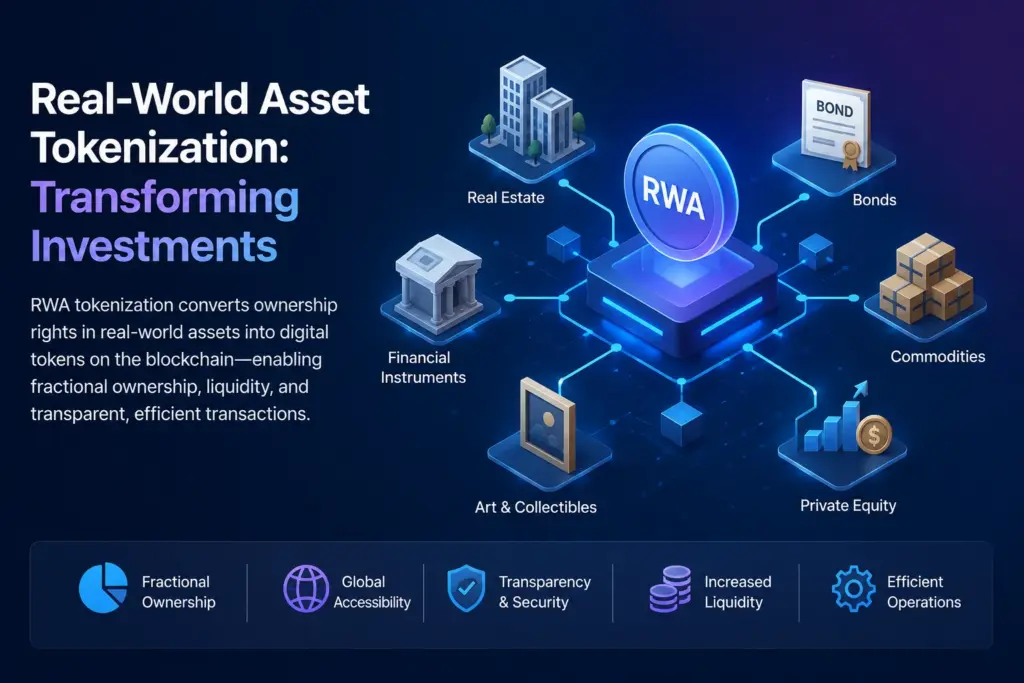
Why do institutions keep circling back to this technology? A few consistent themes emerge across the market.
- Programmable compliance and servicing logic embedded directly into smart contracts
- Improved transparency around ownership records and transaction history
- Operational efficiency in issuance and lifecycle management compared to manual processes
- Broader potential distribution to eligible investor pools, subject to regulatory limits
- Faster asset mobility for eligible collateral use cases
However, these benefits depend heavily on implementation. Tokenization alone doesn’t guarantee liquidity, lower costs, or faster settlement — those outcomes depend on market adoption, custody arrangements, and regulatory clarity in each jurisdiction.
Role of Blockchain and Smart Contracts in Asset Tokenization
Blockchain infrastructure provides the shared ledger that all parties — issuers, custodians, investors, and regulators where applicable — can reference for ownership records. Smart contracts then encode the rules: who can hold the token, how transfers happen, and what triggers a payment or redemption event.
This matters because traditional securities processing often relies on multiple reconciliations across separate systems. With smart contract logic, transfer restrictions and eligibility checks can execute automatically at the point of transaction, rather than through downstream manual review. That said, smart contracts still need rigorous auditing — a poorly coded contract introduces new operational risk rather than removing old ones.
Tokenized Collateral, Settlement, and Liquidity
Tokenized collateral is one of the more concrete institutional use cases already in motion. Some clearing and settlement pilots, including work referenced by the DTCC and various tri-party repo initiatives, have explored using tokenized money market fund shares as collateral for margin obligations. This isn’t universal yet, but it’s a confirmed area of institutional experimentation rather than pure speculation.
On-chain settlement can, in principle, reduce the multi-day settlement cycles common in traditional markets. However, actual settlement speed and finality depend on the underlying blockchain, legal recognition of on-chain transfers, and whether both counterparties operate on compatible systems. We’ve seen claims about instant settlement overstated in marketing materials — the reality is more nuanced and still maturing across most asset classes.
Collateral mobility is where tokenization earns its keep for institutions. Moving eligible collateral between venues without waiting on batch settlement cycles is a real operational win — but only once custody, legal transfer, and counterparty systems are all aligned.
This matters because traditional securities processing often relies on multiple reconciliations across separate systems. With smart contract logic, transfer restrictions and eligibility checks can execute automatically at the point of transaction, rather than through downstream manual review. That said, smart contracts still need rigorous auditing — a poorly coded contract introduces new operational risk rather than removing old ones.
Liquidity and Secondary Markets for Tokenized Assets
Secondary market liquidity remains one of the biggest open questions in RWA tokenization. Issuing a token doesn’t automatically create a trading venue or buyer pool for it. Some tokenized Treasury and money market products support redemption-based liquidity rather than active secondary trading, which is an important distinction for investors to understand.
Where secondary trading does exist, it often happens through regulated venues or over-the-counter arrangements between institutional counterparties. If your firm is evaluating distribution channels for tokenized instruments, reviewing OTC Trading Platform Development approaches can clarify how bilateral settlement and price discovery work outside public exchanges.
Interoperability and Digital Asset Infrastructure
Interoperability between blockchains, custody systems, and traditional financial rails remains an unresolved challenge across the industry. A tokenized asset issued on one chain isn’t automatically usable as collateral or tradeable on another without bridging infrastructure, which introduces its own security considerations.
Consequently, institutions increasingly favor permissioned or hybrid infrastructure that connects to existing custody and compliance systems rather than fully public, unrestricted networks. Standards bodies and industry groups continue working on common frameworks, but universal interoperability is still an emerging goal, not a solved problem.
Regulatory and Compliance Considerations
Tokenization doesn’t make an asset compliant by itself. Whether a tokenized asset qualifies as a security, and what rules apply, depends on the underlying asset, the issuer, the jurisdiction, and the investor type — not the technology wrapper. In the U.S., the SEC continues to evaluate digital asset securities under existing frameworks, and firms should treat tokenized securities with the same regulatory rigor as their traditional counterparts.
Globally, regulators in Singapore, Hong Kong, the UAE, and the UK have published guidance or run regulatory sandboxes for tokenized securities, while the EU’s MiCA framework primarily addresses crypto-assets rather than traditional tokenized securities. Compliance professionals should treat every jurisdiction’s rules independently rather than assuming one regulatory approach applies globally.
Challenges and Limitations of RWA Tokenization
Despite genuine progress, several limitations remain. Legal enforceability of on-chain ownership records varies by jurisdiction and isn’t uniformly tested in courts. Custody solutions for tokenized securities are still consolidating around a smaller number of qualified custodians. Investor eligibility rules can restrict who may hold certain tokens, limiting the pool of potential buyers.
Additionally, secondary market liquidity, as noted earlier, isn’t guaranteed simply because an asset is tokenized. Interoperability gaps between platforms add friction. Institutions considering real world asset tokenization development should budget time and resources for these operational realities rather than assuming a purely technical rollout.
Institutional Use Cases for Real World Asset Tokenization
Consider a hypothetical scenario: an asset manager wants to offer fractional access to a private credit fund for accredited investors. Tokenization could let them structure smaller minimum investments while maintaining transfer restrictions through smart contract logic — this is illustrative of how such a program might work, not a specific deployment.
Similarly, a custodian bank might explore using tokenized Treasury holdings as intraday collateral for margin calls, reducing reliance on end-of-day batch processes. Again, this reflects the kind of use case institutions are piloting industry-wide, not a confirmed Blocsys deployment. These scenarios illustrate where the technology’s practical value lies — in workflow efficiency, not novelty.
Why Enterprises Need Experienced Real World Asset Tokenization Development Partners
Building a real world asset tokenization platform involves far more than deploying a token contract. You need legal structuring expertise, custody integrations, compliance tooling, and secure smart contract architecture working together. Getting any one layer wrong creates operational or regulatory risk.
That’s why enterprises increasingly work with specialized teams rather than building everything in-house. Blocsys has built technical infrastructure across smart contract development and asset tokenization projects, helping institutions move from concept to compliant, production-ready systems. If you’re scoping a project, exploring options to hire real world asset tokenization developers is often the fastest way to get an honest technical assessment before committing budget.
The Future of RWA Tokenization and Investment Markets
Where does this go from here? Market forecasts vary widely, and it’s worth treating them as directional rather than precise. What’s clearer is the trend: more asset managers are testing tokenized structures, more custodians are building qualified infrastructure, and more regulators are publishing guidance rather than staying silent. Real world asset tokenization won’t replace traditional capital markets infrastructure overnight. Instead, it’s layering programmability and operational efficiency onto existing legal and financial structures. Institutions that build capability now — through pilots, partnerships, or dedicated platforms — will be better positioned as the infrastructure matures.
Moving Forward With Real World Asset Tokenization
Real world asset tokenization is no longer a theoretical concept for institutions to watch from the sidelines. Tokenized Treasuries are live. Private credit tokenization is growing. Corporate bonds, equities, and real estate are following at varying paces, shaped by jurisdiction and market readiness. What separates successful programs from stalled ones is infrastructure — legal, technical, and compliance layers built to institutional standards from day one.
If your organization is evaluating institutional RWA tokenization, the right first step is understanding what your specific asset class, jurisdiction, and investor base require. Blocsys works with financial institutions, asset managers, and fintech firms to design and build tokenization infrastructure through its Asset Tokenization Platform, covering everything from smart contract architecture to compliance-ready issuance workflows. For teams scoping budget and timeline, Blocsys’ software development cost estimator tool offers a practical starting point before a full technical consultation.
Frequently Asked Questions
Here are direct answers to the questions we hear most often about real world asset tokenization.
What is real world asset tokenization?
Real world asset tokenization is the process of representing ownership or economic rights in a physical or financial asset, such as real estate, Treasuries, or private credit, as a digital token on a blockchain. The token records and transfers ownership rights, while the underlying asset and its legal structure remain governed by existing laws. It doesn’t replace legal ownership frameworks; it digitizes how those rights are recorded and moved.
How does RWA tokenization work?
RWA tokenization follows a lifecycle involving asset selection, legal structuring, valuation, smart contract deployment, and token issuance. After issuance, investors go through onboarding and compliance checks before receiving tokens. Custody, transfer, and settlement happen on-chain or through hybrid systems, and asset servicing, like interest payments, continues until redemption or maturity. Each step blends legal, financial, and technical processes.
What types of real-world assets can be tokenized?
Common categories include U.S. Treasuries, money market funds, private credit, corporate bonds, equities, real estate, and commodities like gold. Tokenized Treasuries and private credit currently represent the most mature, institutional-scale segments. Equities, corporate bonds, and real estate tokenization are progressing at different speeds depending on jurisdiction, regulatory clarity, and market infrastructure readiness.
Why are institutions adopting RWA tokenization?
Institutions are exploring RWA tokenization because it offers programmable compliance, improved transparency, and more efficient asset servicing compared to manual back-office processes. Major asset managers have launched live tokenized Treasury and fund products, and custodians are building qualified infrastructure. Growth in this space is documented through public market trackers like RWA.xyz, which recorded tokenized assets surpassing $24 billion by mid-2026.
What are tokenized Treasuries?
Tokenized Treasuries are digital tokens representing ownership in short-term U.S. government debt instruments, issued through regulated fund structures. They allow eligible institutional investors to hold and transfer Treasury exposure on-chain, often with daily accrual tracking. Several major asset managers, including BlackRock and Franklin Templeton, operate live tokenized Treasury and money market products as of 2026.
What are the benefits of tokenized real-world assets?
Tokenized real-world assets can improve operational efficiency, transparency, and programmability in asset servicing and compliance workflows. They may also support faster collateral mobility for eligible use cases. However, benefits like liquidity and cost reduction depend heavily on market adoption, regulatory clarity, and platform design rather than being guaranteed outcomes of tokenization itself.
How does RWA tokenization improve investment processes?
Tokenization can streamline issuance, investor onboarding, and asset servicing by embedding compliance and payment logic directly into smart contracts. This reduces reliance on manual reconciliation across separate systems. It can also support more flexible distribution structures, such as fractional ownership, though actual process improvements vary based on how well the platform integrates with existing custody and compliance infrastructure.
What are the challenges of RWA tokenization?
Key challenges include limited secondary market liquidity, inconsistent legal enforceability of on-chain records across jurisdictions, and a still-consolidating pool of qualified custodians. Interoperability between blockchain networks and traditional financial infrastructure also remains unresolved. Institutions should plan for these operational and regulatory realities rather than treating tokenization as a purely technical implementation.
Is real world asset tokenization regulated?
Regulation depends on the underlying asset, issuer, jurisdiction, and investor type, not the tokenization technology itself. In the U.S., the SEC evaluates tokenized securities under existing securities law frameworks. Other jurisdictions, including Singapore, the UAE, Hong Kong, and the UK, have issued specific guidance or sandboxes. Tokenization doesn’t automatically make an asset compliant with any regulatory regime.
How can businesses build an RWA tokenization platform?
Building an RWA tokenization platform requires coordinated legal structuring, custody integration, compliance tooling, and secure smart contract development. Most institutions partner with experienced technology providers rather than building every layer independently. Blocsys supports this process through its Asset Tokenization Platform services, helping financial institutions and fintech firms design compliant, production-ready tokenization infrastructure tailored to their specific asset class.
Ready to move beyond theory and build an intelligent platform that delivers real-world value? Blocsys Technologies specialises in engineering enterprise-grade AI and blockchain solutions for the fintech, Web3, and digital asset sectors. Connect with our experts today to discuss your vision and chart a clear path from concept to a secure, scalable reality.
