
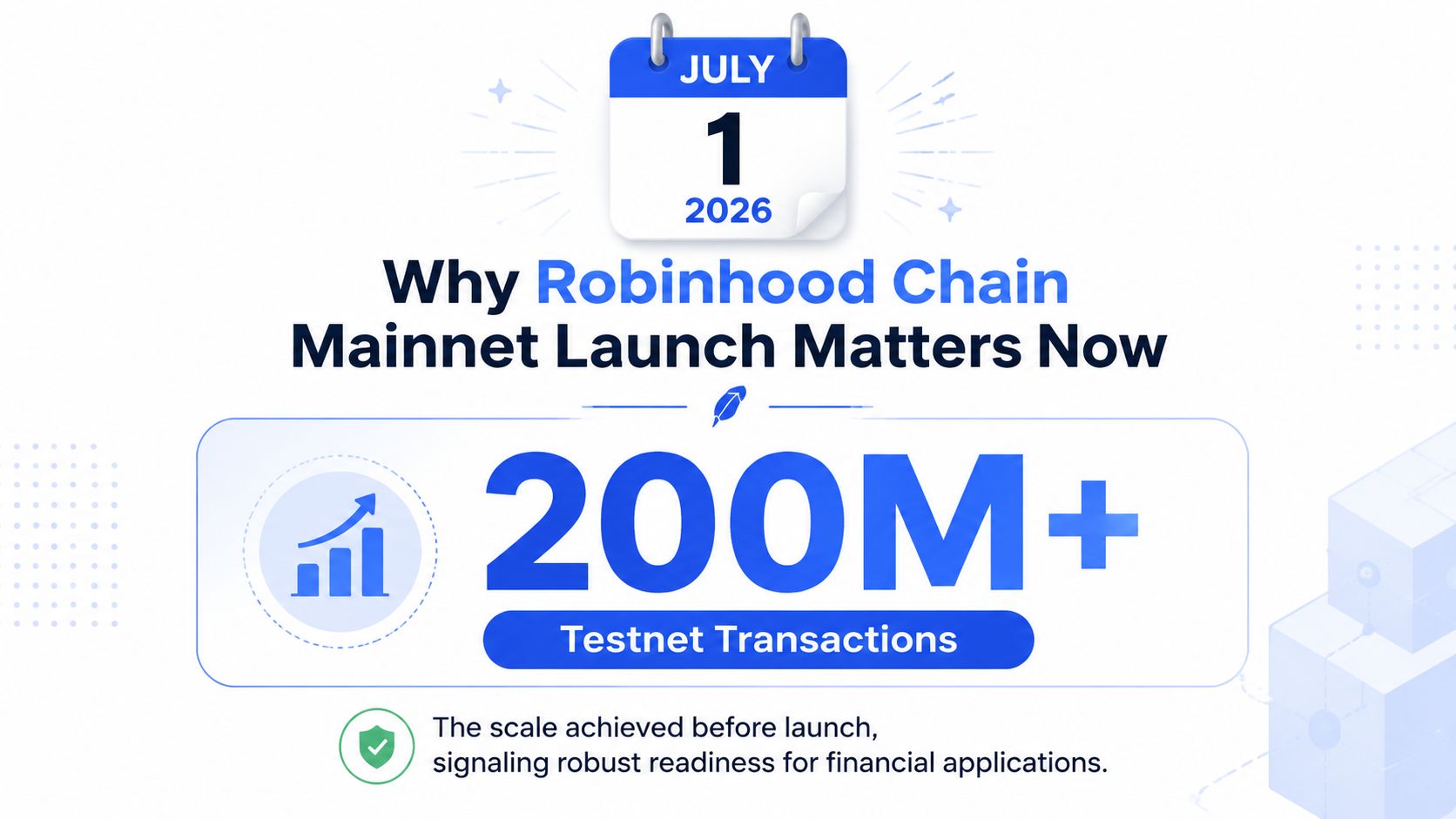
More than 200 million transactions ran on Robinhood Chain’s public testnet before the public mainnet launched on July 1, 2026, according to the ArbitrumDAO factsheet. That changes the conversation for financial product teams. Robinhood Chain is no longer only a test environment for tokenised assets. It’s a live Ethereum Layer 2 built on the Arbitrum Platform, with standard EVM tooling, production network access, and day-one oracle and interoperability infrastructure.
This article is for Web3 engineers, fintech founders, enterprise product leaders, and India-focused teams assessing whether to deploy tokenised securities, lending markets, trading systems, or cross-chain financial applications. The practical answer is not that Robinhood Chain is technically capable. The important question is which application categories have a credible path to production, compliance, liquidity, and reliable user onboarding.
Table of Contents
- Why Robinhood Chain Mainnet Launch Matters Now
- Understanding the Core Architecture Behind Robinhood Chain
- Day-One Integrations That Shape the Developer Experience
- Comparing the Best Financial App Use Cases on Robinhood Chain
- Implementation Patterns and Migration Steps for Product Teams
- The Honest View of India-Specific Constraints and Opportunities
- Looking Ahead and How Blocsys Can Help You Build
Why Robinhood Chain Mainnet Launch Matters Now
The July 1, 2026 mainnet launch followed a public testnet that went live in February, giving developers roughly five months to experiment before production. The scale of pre-launch activity matters because financial applications need more than a functioning chain. They need wallets, providers, indexers, contract tooling, oracle access, and operational evidence that the network can support real usage. The ArbitrumDAO factsheet records more than 200 million testnet transactions before mainnet, while CoinDesk’s launch coverage reported more than 13,900 smart contracts deployed within days of the debut.
For an existing Solidity team, the first advantage is familiar execution. Robinhood Chain is an EVM-compatible Layer 2, so contracts written for Ethereum-compatible environments can be adapted without designing around an entirely new virtual machine. Solidity and Vyper support lowers the cost of porting established financial logic, although teams still need to retest assumptions around gas behaviour, sequencing, finality, oracle delivery, and bridge operations.
The second advantage is that the chain launched with core financial rails available immediately. Robinhood says tokenised stock products became fully live on-chain at mainnet, while its Chain materials on tokenised assets and digital securities describe the broader infrastructure opportunity. Chainlink CCIP, Data Streams, and Data Feeds reduce the need for every application team to build its own messaging and pricing layer.
What changes for product teams
A team evaluating a new L2 can now assess Robinhood Chain as settlement infrastructure for tokenised US securities and continuous on-chain finance, not merely as a generic contract deployment target. The positioning is attractive for applications that need programmable ownership records, automated settlement, and market-data-dependent logic.
That doesn’t make the chain an automatic choice. Product leads should benchmark it against Base, Arbitrum One, and Optimism using the criteria that affect outcomes: available liquidity, compliance obligations, provider coverage, user wallet access, bridge reliability, oracle quality, and the cost of operating a new chain integration. Technical throughput alone won’t rescue an application with weak distribution or an unclear legal structure.
Practical rule: Treat Robinhood Chain as a specialised financial infrastructure option. Choose it when tokenised assets, on-chain markets, or Robinhood-aligned distribution are central to the product, not simply because the chain is new.
Understanding the Core Architecture Behind Robinhood Chain
Robinhood Chain is an Ethereum Layer 2 built on the Arbitrum Platform. Transactions execute on the L2, while the Arbitrum design supports settlement and dispute handling through Ethereum. Developers therefore get an Ethereum-compatible execution environment, with familiar smart-contract tooling and operational concerns.
The stack separates into four practical layers:
- Execution: EVM contracts run with Solidity or Vyper, using standard transaction and event semantics.
- Sequencing: A sequencer orders transactions and determines the execution flow. Financial applications must account for ordering, delayed inclusion, and sequencer availability.
- Data availability and settlement: The Arbitrum-based rollup posts information needed for verification and settlement through its Ethereum-oriented framework.
- Application access: Wallets, dapps, indexers, and backend services connect through JSON-RPC instead of a chain-specific execution interface.
The official Robinhood Chain developer documentation identifies chain ID 4663, native JSON-RPC support, and provider access through Alchemy, QuickNode, Blockdaemon, dRPC, and Validation Cloud. Robinhood’s mainnet support configuration lists ETH as the currency symbol and the official RPC endpoint as https://rpc.robinhoodchain.io.
The identifiers developers need
Teams can connect MetaMask, WalletConnect, ethers.js, viem, Hardhat, and Foundry through standard EVM workflows. Migration still requires explicit mainnet work. Deployment scripts, network allow-lists, explorer verification, indexer configuration, gas policies, and monitoring rules must all recognise the new network.
| Parameter | Value | Notes |
|---|---|---|
| Execution model | EVM-compatible Layer 2 | Supports standard Ethereum development patterns |
| Underlying platform | Arbitrum Platform | Provides the rollup-oriented settlement architecture |
| Chain ID | 4663 | Use it in wallets, deployment scripts, and backend validation |
| RPC endpoint | https://rpc.robinhoodchain.io | Native JSON-RPC access |
| Gas currency | ETH | Confirm wallet funding and fee handling before release |
| Provider options | Alchemy, QuickNode, Blockdaemon, dRPC, Validation Cloud | Useful for redundancy and production operations |
Teams considering Blockchain Development should distinguish inherited Arbitrum behaviour from application-specific assumptions. Compatibility helps with tooling and contract portability, but financial workloads still need independent tests for deterministic oracle updates, transaction ordering, reorg handling, access controls, and settlement workflows. Successful deployment on another Arbitrum-based network does not establish that a contract is safe for tokenised securities.
The architectural choice also depends on the application’s risk profile. A comparison of Robinhood Chain and Ethereum for tokenisation is useful for reviewing execution, settlement, compliance, and liquidity requirements together, rather than choosing a network from EVM compatibility alone.
Day-One Integrations That Shape the Developer Experience
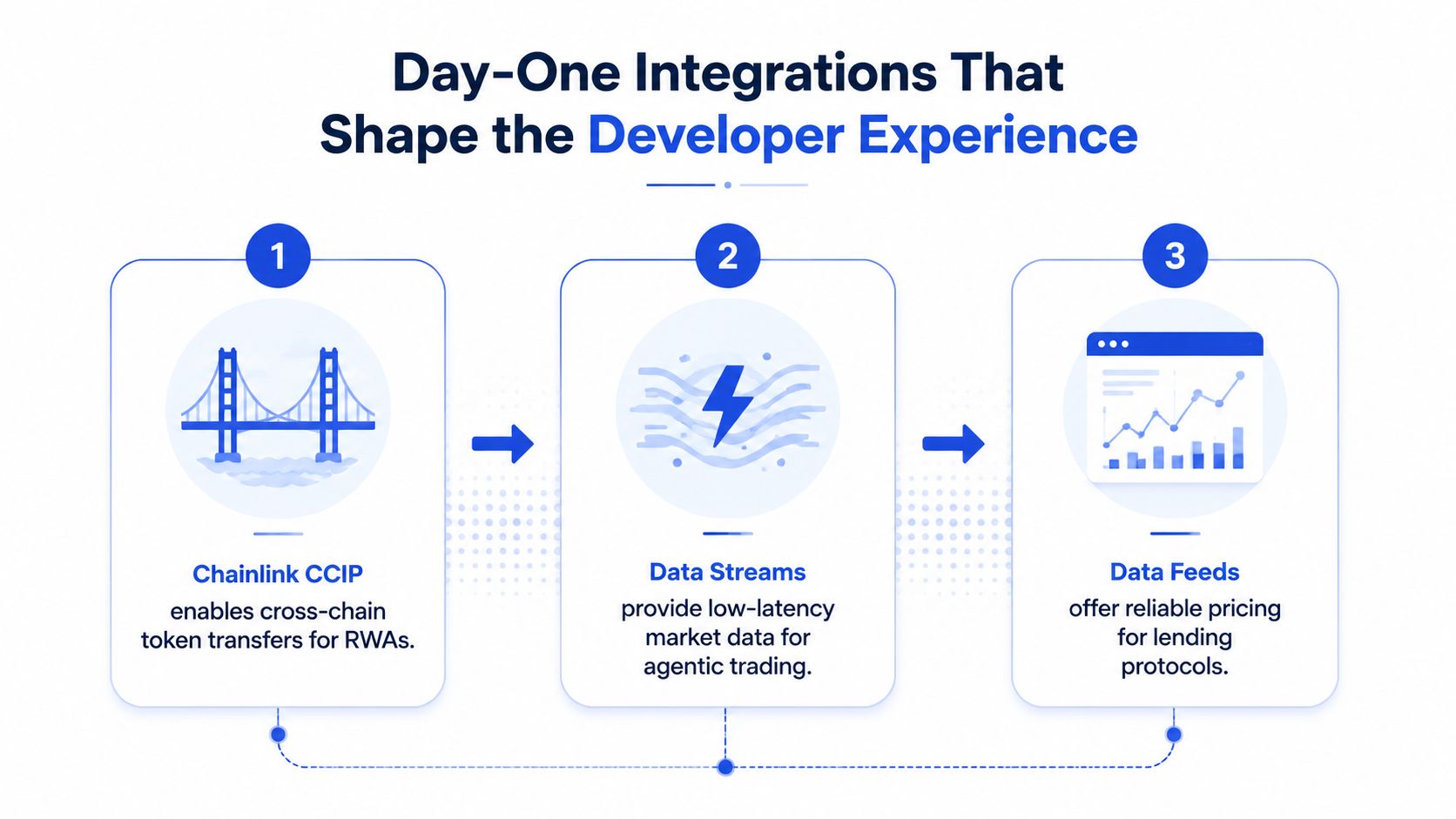
The mainnet’s most important developer benefit may be what teams don’t have to build from scratch. Robinhood launched with Chainlink CCIP, Chainlink Data Streams, and Chainlink Data Feeds live from day one, according to Robinhood’s Chainlink announcement.
CCIP handles messaging and asset movement
Chainlink CCIP provides a standard approach to cross-chain messaging and token transfers. For a financial application, that can support instructions such as moving collateral, notifying a destination-chain receiver, or coordinating settlement between an asset ledger and a liquidity venue.
The benefit is architectural consistency. A lending protocol or tokenised asset platform can build receiver contracts around defined message handling instead of maintaining several unrelated bridge integrations. CCIP doesn’t remove bridge risk, jurisdictional restrictions, or the need to validate token representations. It gives teams a more structured interoperability layer to assess and monitor.
Data Streams and Data Feeds serve different jobs
Data Streams are suited to applications that need timely market information, including trading interfaces, derivatives, perpetual markets, and automated strategies. Data Feeds support contract-level pricing for uses such as collateral valuation, liquidation checks, and tokenised asset reference prices.
That distinction matters. A trading engine may need low-latency updates, while a lending market needs conservative pricing, stale-data checks, and circuit breakers. Teams shouldn’t treat “oracle integration” as one feature. They need separate policies for update frequency, deviation thresholds, fallback behaviour, and what the protocol does when data becomes unavailable.
The same infrastructure can support tokenised RWAs, lending, cross-chain settlement, and agentic workflows. It also gives India-focused product teams a more credible starting point for risk checks and synchronisation across chains. The mainnet-native path is useful, but it doesn’t replace legal review, asset custody controls, or internal market-data governance.
A team hiring for this work may also need specialists who understand both smart contracts and regulated financial systems. Resources covering blockchain recruiters for enterprise can help product leaders think through the skills required before committing to a multi-chain build.
For application teams, the practical counterpart is Robinhood Chain wallet infrastructure. Wallet recovery, transaction simulation, gas sponsorship, signing policies, and chain-aware portfolio displays often create more user friction than the contract deployment itself.
Comparing the Best Financial App Use Cases on Robinhood Chain
The strongest early use case is tokenised US equities, but “strongest” doesn’t mean risk-free. Product teams should score each category against four questions: can the application access credible price data, can it attract usable liquidity, can the legal model survive review, and does a real user need the product?
Tokenised stock infrastructure has the clearest connection to Robinhood Chain’s identity. Robinhood states that mainnet made tokenised stock products fully live on-chain, and the chain is positioned around tokenised real-world assets and financial applications. That gives equity-related builders a natural product narrative, but it also creates jurisdiction, disclosure, custody, corporate-action, and distribution questions.
Perpetual trading is a plausible second wedge. Data Streams can support market-data-sensitive workflows, and an EVM Layer 2 can make frequent interactions more practical than a congested base layer. Yet a perp DEX still needs deep liquidity, solid liquidation design, market-maker participation, and clear user protections. Low-cost execution won’t solve thin markets.
| Use Case | Oracle Coverage | Liquidity Readiness | Regulatory Friction | Priority |
|---|---|---|---|---|
| Tokenised US stocks and equities | Strong starting coverage through Data Feeds | Closely tied to Robinhood-aligned asset distribution | High, especially for cross-border retail access | Highest |
| Perpetual DEXs and trading markets | Data Streams can support market-data workflows | Requires specialist liquidity and liquidation design | High, depending on users and jurisdictions | High, with controls |
| DeFi lending | Data Feeds support valuation and risk checks | Collateral diversity and borrowing demand need validation | High for consumer-facing products | Medium |
| Prediction markets | Requires careful event-resolution and oracle design | Fragmentation can weaken market quality | High and jurisdiction-specific | Selective |
| Cross-chain swap aggregators | CCIP improves messaging options | Depends on corridor liquidity and bridge coverage | Varies by asset and customer | Medium to selective |
DeFi lending is more credible as infrastructure than as an immediately broad retail market. A focused lending product using a small set of well-defined assets is easier to monitor than a permissionless collateral catalogue. Prediction markets and swap aggregators can work, but their success depends heavily on external liquidity, resolution standards, and jurisdictional controls.
The Robinhood Chain tokenised stocks analysis is useful for teams evaluating the equity angle. The decision matrix should end with a narrow wedge: one asset class, one user segment, one settlement path, and explicit failure rules. Broad “on-chain finance” positioning is harder to launch and harder to defend.
Implementation Patterns and Migration Steps for Product Teams
A testnet deployment is only a rehearsal. Mainnet migration should be treated as a controlled release with separate credentials, deployment artefacts, monitoring, and incident procedures.
Start with network and contract verification
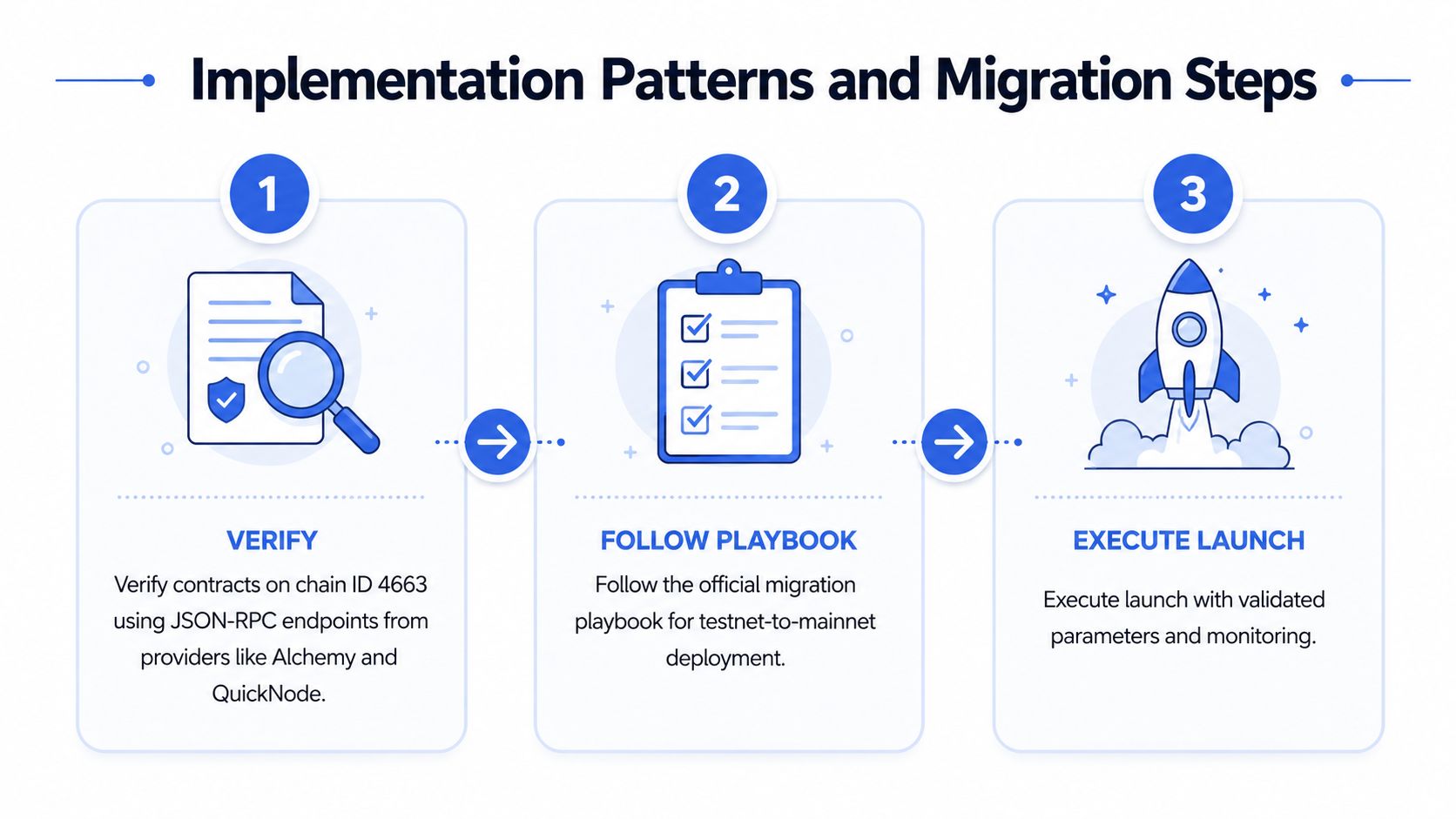
Use chain ID 4663, the official JSON-RPC endpoint, and a supported provider such as Alchemy or QuickNode. Confirm that deployment scripts reject the testnet when the production command is selected. Verify bytecode, constructor parameters, proxy implementations, ownership roles, pausing controls, and oracle addresses before opening any user-facing route.
Do not copy a testnet address into a mainnet configuration because the interface looks familiar. Store environment-specific addresses in reviewed release artefacts, and require an approval step before a production signer can deploy.
Wire the financial dependencies before the UI
Instrument Chainlink Data Streams consumers, Data Feeds, and CCIP receivers as first-class production components. Record update timestamps, accepted ranges, message identifiers, failed deliveries, and destination-chain acknowledgements. A financial application should show operators why a price was rejected or why a message remains pending.
Teams building secure fintech systems should also apply standard financial controls to blockchain operations. Key management, access reviews, segregation of duties, audit logs, and recovery procedures matter as much as contract code.
Re-key, re-index, and release gradually
Create new mainnet keys and rotate API secrets. Replay indexers against the mainnet environment, validate event ordering, and compare balances against direct RPC reads. Configure fallback providers, but test failover rather than assuming it works.
A practical release checklist includes:
- Gas handling: Test estimation, fee ceilings, ETH funding, and failure messages.
- RPC resilience: Maintain provider redundancy and alert on latency, errors, and inconsistent responses.
- Sequencer monitoring: Track availability and define what the application does during interruption.
- Batch behaviour: Exercise retry logic around Arbitrum batch posting and delayed settlement assumptions.
- Circuit breakers: Add feature flags and on-chain pause paths before enabling larger user flows.
- Incident response: Assign owners for contract, oracle, bridge, wallet, and compliance incidents.
A corporate bond tokenisation platform illustrates why these controls matter in capital-markets software. Digital issuance, smart-contract automation, settlement, and investor management all depend on coordinated operational processes, not only a deployed contract.
The Honest View of India-Specific Constraints and Opportunities
Robinhood Chain removes technical friction for Indian developers, but it doesn’t remove Indian financial regulation. Teams serving India still need to assess FIU-IND reporting, PMLA obligations, KYC requirements, sanctions screening, tax treatment, and the RBI’s risk position around digital assets. The relevant constraint is often the customer journey, not the RPC connection.
Tokenised US stock products may be technically accessible through an EVM application while remaining legally uncertain for Indian retail distribution. A wallet address doesn’t establish that the user is eligible, that the asset can be marketed, or that the intermediary has satisfied its obligations. Teams should avoid treating a permissionless chain as permissionless access to every financial product.
Where Indian teams can create practical value
India’s strongest opportunity may sit in B2B infrastructure rather than direct consumer trading. Product teams can build compliance-aware onboarding, transaction monitoring, reporting workflows, treasury tools, asset-issuer backends, oracle operations, and developer services for global applications that use Robinhood Chain liquidity.
The contrast with India’s familiar digital payments experience is important. Users expect fast, organised onboarding through systems such as UPI and account aggregation, while many crypto applications still require wallet installation, seed-phrase management, network selection, gas funding, and fragmented identity checks. A product that ignores this gap may have technically sound contracts and poor adoption.
A sensible first-year strategy is to focus on:
- Institutional infrastructure: Build tools for issuers, brokers, custodians, and market operators.
- Compliance orchestration: Keep KYC, transaction monitoring, wallet risk, and reporting auditable.
- Oracle and data services: Support reliable pricing and asset-state synchronisation without exposing users to unnecessary complexity.
- Developer tooling: Offer testing, indexing, wallet, and observability components for international teams.
Tokenization Platform Development can cover secure and compliant platforms for RWAs, securities, real estate, commodities, and digital assets using enterprise blockchain technology. The strategic question remains narrower: which regulated workflow can the team serve repeatedly, with evidence that customers will adopt it?
Looking Ahead and How Blocsys Can Help You Build
Over the next 12 to 24 months, Robinhood Chain’s opportunity will depend less on launch attention and more on whether reliable financial applications attract repeat users and durable liquidity. A reasonable product outlook includes broader tokenised asset coverage, deeper use of market-data infrastructure for derivatives, and additional interoperability beyond the initial Ethereum and Arbitrum-oriented environment. These are projections, not established mainnet facts.
The infrastructure roadmap will also matter. Sequencer decentralisation, permissioned validator onboarding, and stronger compliance primitives could improve institutional confidence if Robinhood and its ecosystem implement them effectively. Product teams shouldn’t wait for every future feature, but they should avoid architecture that makes provider changes, oracle replacement, key rotation, or jurisdictional restrictions impossible.
A practical build strategy
Start with one production wedge and instrument it heavily. A tokenised asset registry, a constrained lending market, or an institutional settlement service is easier to test than a broad financial super-app. Build RPC redundancy, oracle fallbacks, audit-grade key management, contract monitoring, and clear pause procedures before expanding the asset catalogue.
Blocsys Technologies can support teams across mainnet RPC and indexer setup, Chainlink CCIP and Data Streams integration, smart-contract development and audits, cross-chain bridging, and production monitoring for financial applications. Teams assessing delivery models can also review how Blocsys builds dedicated blockchain development teams for enterprise projects, then map the required engineering, security, product, and compliance roles to the launch plan.
For tokenised equities, lending markets, or agentic trading systems, the right implementation partner should shorten the path from testnet validation to a controlled mainnet release without hiding the operational risks.
Frequently Asked Questions
1. What is Robinhood Chain and why does its mainnet launch matter for developers?
Robinhood Chain is an Ethereum Layer 2 built on the Arbitrum Platform for tokenized assets and financial applications. Its public mainnet launch means developers can now evaluate the network as production infrastructure rather than only a test environment. The EVM-compatible architecture supports familiar tools such as Solidity, Vyper, MetaMask, WalletConnect, ethers.js, viem, Hardhat, and Foundry. Robinhood Chain also launched with Chainlink CCIP, Data Streams, and Data Feeds, giving developers access to important blockchain and market-data infrastructure. For developers building financial applications, the mainnet creates opportunities around tokenized assets, trading, DeFi, and other Web3 financial products. Teams should still evaluate liquidity, compliance, oracle reliability, wallet access, bridging, security, and operational resilience before deploying a production application.
2. How is Robinhood Chain different from Ethereum?
Robinhood Chain is an Ethereum Layer 2 built on the Arbitrum Platform, while Ethereum operates as the underlying Layer 1. Applications execute transactions on Robinhood Chain while benefiting from an Ethereum-compatible development environment. Developers can use familiar technologies such as Solidity, Vyper, Hardhat, Foundry, MetaMask, and other EVM tools. Robinhood Chain uses chain ID 4663 and ETH as its gas currency. Its Layer 2 architecture is designed to support financial applications and tokenized assets with an environment familiar to Ethereum developers. However, EVM compatibility does not eliminate the need for application testing. Businesses should evaluate transaction behavior, oracle performance, bridging, gas management, security, and settlement requirements before migrating an existing application or launching a new financial platform on Robinhood Chain.
3. What can developers build on Robinhood Chain?
Developers can build financial and Web3 applications using Robinhood Chain’s EVM-compatible infrastructure and financial-focused ecosystem. Tokenized assets are an important use case because the network is designed around blockchain-based financial applications. Other potential applications include DeFi lending platforms, prediction markets, perpetual trading platforms, tokenized asset platforms, cross-chain applications, and financial infrastructure services. Developers can also integrate smart contracts, blockchain wallets, market-data services, and cross-chain communication into their applications. The right use case depends on the application’s liquidity, technical, regulatory, and operational requirements. Rather than launching a broad financial ecosystem immediately, businesses can begin with a focused product such as a tokenized asset platform, specialized lending application, or institutional settlement solution and expand as the infrastructure and user base mature.
4. What Chainlink integrations are available on Robinhood Chain?
Robinhood Chain launched with Chainlink CCIP, Data Streams, and Data Feeds. Chainlink CCIP supports cross-chain messaging and token transfers, helping applications communicate with other blockchain networks. Data Streams provide timely market information that can support trading, derivatives, and other financial applications. Data Feeds provide pricing information that can be used for functions such as collateral valuation, liquidation checks, and tokenized asset applications. These integrations can reduce the need for developers to build their own cross-chain messaging and market-data infrastructure. However, businesses still need to design appropriate risk controls around these services. Applications should consider data freshness, price deviations, fallback mechanisms, monitoring, and circuit breakers to ensure reliable financial operations.
5. Is Robinhood Chain suitable for tokenized securities and real-world assets?
Robinhood Chain is well aligned with tokenized securities and real-world assets because its ecosystem focuses heavily on blockchain-based financial assets. Developers can use the infrastructure for programmable ownership, automated settlement, digital asset management, and financial applications. However, blockchain technology alone does not solve the legal and regulatory requirements associated with tokenized securities. Businesses may need to address investor eligibility, custody, disclosures, transfer restrictions, identity verification, and jurisdiction-specific regulations. Before launching a tokenized asset platform, organizations should evaluate both the technical architecture and the legal structure of the product. A focused approach can be useful, starting with a specific asset class, user group, and settlement process before expanding into a larger tokenized financial ecosystem.
6. What should developers check before deploying a financial application on Robinhood Chain mainnet?
Developers should verify the production network configuration, including chain ID 4663, RPC endpoints, wallet settings, contract addresses, proxy implementations, ownership roles, and emergency controls. Teams should create dedicated mainnet credentials, secure API keys, configure indexers, and verify blockchain data against direct RPC responses. Production applications should also include RPC redundancy, gas monitoring, sequencer monitoring, circuit breakers, and incident-response procedures. Chainlink integrations should be monitored independently, particularly when they provide important market or cross-chain data. Developers should also test failure scenarios instead of relying only on successful testnet transactions. Mainnet readiness requires more than functional smart contracts. Security testing, infrastructure monitoring, compliance controls, operational procedures, and recovery plans should all be established before a financial application handles significant user activity.
7. What are the main challenges of building financial applications on Robinhood Chain?
The main challenges include liquidity, regulatory compliance, oracle reliability, wallet access, bridging, infrastructure availability, user onboarding, and operational security. A scalable Layer 2 does not automatically provide sufficient liquidity or solve regulatory requirements. Tokenized securities may require custody, disclosures, investor eligibility, and transfer controls, while DeFi applications need reliable pricing, collateral management, and liquidation mechanisms. Businesses also need RPC redundancy, secure key management, monitoring, circuit breakers, and incident-response procedures. The most suitable applications are those where tokenized assets, on-chain financial markets, or blockchain-based financial infrastructure are central to the product. Companies should evaluate Robinhood Chain based on their actual business requirements rather than choosing it simply because it is a new or EVM-compatible blockchain.
8. Can Indian developers build financial applications on Robinhood Chain?
Indian developers can technically build applications using Robinhood Chain’s EVM-compatible infrastructure. However, technical accessibility does not mean every blockchain financial product can automatically be offered to Indian users. Businesses targeting India should evaluate applicable requirements involving KYC, AML, PMLA, FIU-IND, taxation, sanctions, and digital-asset regulations. For example, a blockchain platform supporting tokenized financial assets may create different regulatory considerations depending on its users, assets, custody model, and distribution strategy. Compliance should therefore be considered during product architecture rather than after development. Indian development teams can also focus on B2B blockchain infrastructure, including compliance systems, transaction monitoring, reporting platforms, treasury tools, asset-issuer infrastructure, oracle services, and developer tools designed for international blockchain applications.
9. How should businesses approach migrating an existing blockchain application to Robinhood Chain?
Businesses should treat migration as a controlled blockchain infrastructure integration. The process should begin with verifying the network configuration, chain ID 4663, RPC providers, wallet settings, deployment scripts, and smart-contract addresses. Existing contracts should be tested for gas behavior, transaction processing, oracle integration, access controls, and settlement logic. Backend systems may need updated RPC configurations, indexers, monitoring tools, and network settings. Chainlink services such as Data Feeds, Data Streams, and CCIP should also be integrated and tested before production release. Businesses should create dedicated mainnet credentials rather than reusing testnet credentials. A gradual rollout with controlled transactions, monitoring, emergency controls, and clear recovery procedures can help reduce migration risks and provide greater confidence before the application handles significant production activity.
10. Why should businesses work with a blockchain development company for Robinhood Chain applications?
Robinhood Chain financial applications require more than basic smart-contract development. Businesses may need EVM development, RPC and indexing infrastructure, Chainlink integrations, blockchain wallets, cross-chain communication, security monitoring, compliance workflows, and financial application architecture. An experienced blockchain development company can bring these components together into a controlled production environment. It can also help businesses evaluate the right application architecture, develop and audit smart contracts, configure infrastructure, integrate blockchain services, and establish monitoring and security procedures. For enterprises, this can reduce development complexity and improve the transition from testing to mainnet deployment. The right development partner should understand both blockchain engineering and financial application requirements, helping organizations build secure, scalable, and production-ready applications on Robinhood Chain.
Blocsys Technologies helps fintechs, exchanges, and digital-asset businesses build tokenisation systems, trading infrastructure, and intelligent compliance workflows for production blockchain environments. Visit Blocsys Technologies to discuss your Robinhood Chain architecture, integration plan, smart-contract scope, or mainnet rollout with a team that can help turn the technical opportunity into an executable delivery plan.
