
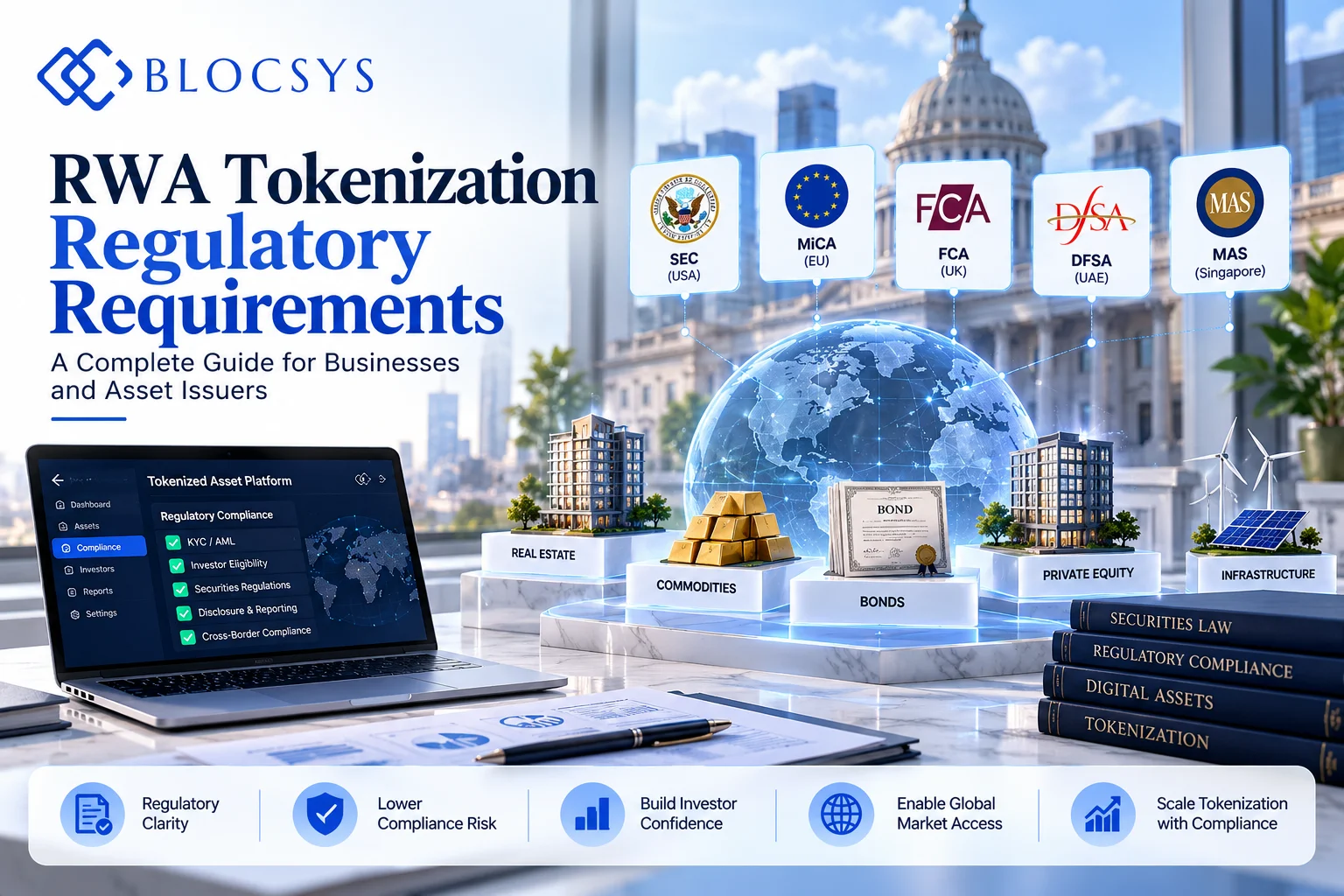
What Regulatory Requirements Should Businesses Consider Before Launching an RWA Tokenization Platform?
If you’re an issuer or asset owner weighing real-world asset tokenization, you’ve probably noticed that most guides skip the hard part. They explain blockchain basics and jump straight to platform features. What you actually need is clarity on RWA tokenization regulatory requirements before you write a single line of smart contract code. The short answer: it depends on your asset, the rights your token represents, your legal structure, the activities you perform, and where your investors live. There’s no single checklist that applies to every deal, and that’s exactly why this decision needs careful upfront work.
We’ve worked with issuers who assumed tokenizing a bond or a property interest was mostly a technology problem. It isn’t. Real world asset tokenization succeeds or fails on the legal foundation underneath it, not the chain you deploy on. Let’s walk through what you actually need to resolve before launch.
How to Determine Which RWA Tokenization Regulatory Requirements Apply
Start by asking what the token actually represents. Does it confer ownership, a debt claim, a profit share, or just a record of rights held elsewhere? This answer drives everything else. A token backed by a corporate bond typically carries the same regulatory character as the bond itself, regardless of the ledger it sits on.
In the US, the SEC continues to apply the Howey test from SEC v. W.J. Howey Co. (1946) to determine whether an arrangement is an investment contract, and therefore a security. If investors expect profit from a common enterprise managed by others, tokenized or not, securities law applies. The SEC’s 2017 DAO Report confirmed this reasoning extends to blockchain-based instruments.
Consequently, the technology layer rarely changes the legal classification. However, it does change who’s responsible for enforcing those rules across custody, transfer, and reporting. That’s the part issuers tend to underestimate.
Tokenizing a security doesn’t convert it into something unregulated. It just moves the same regulatory obligations onto a new rail, and that rail needs its own controls.
Asset Class Changes the Analysis
Tokenized real estate, corporate bonds, equity, fund interests, commodities, and receivables each raise distinct questions. A receivables-backed token might trigger securitization rules in one jurisdiction and ordinary debt-assignment rules in another. Don’t assume one legal opinion covers every asset type in your pipeline.
Ownership Rights and Legal Structure Before Tokenization
Here’s a question many issuers skip: do you actually have unrestricted authority to tokenize this asset? A mortgaged property, for example, may carry lender consent clauses that block fractional transfer without approval. Tokenizing it anyway doesn’t erase the lien; it just creates a token that may not match the legal reality underneath.
Consider a hypothetical: a commercial property owner wants to tokenize equity in a building that still carries an outstanding mortgage. Before any token issuance, the owner needs to check the loan covenants, confirm whether the lender’s consent is required, and verify that the special purpose vehicle holding title can legally issue fractional interests. Skipping this step doesn’t just create legal risk — it can make the token unenforceable against the asset entirely.
Therefore, enforceability between the token and the underlying asset matters as much as the token’s technical design. If a token holder can’t actually claim the rights the token implies, the structure fails regardless of how clean the smart contract looks. This is where platform architecture decisions, covered on our asset tokenization platform page, need to follow legal structure, not the other way around.
Third-Party Consents and Existing Claims
Beyond liens, check for shareholder agreements, co-ownership restrictions, and contractual transfer limits. A corporate bond indenture might restrict assignment to qualified holders only. Moreover, some jurisdictions require registrar or transfer-agent involvement regardless of the ledger used, meaning your smart contract can’t simply override statutory transfer rules.
Licensing, Issuance and Investor Eligibility: RWA Tokenization Licensing Requirements Explained
Does tokenizing an asset automatically require a license? Not always — but issuing, distributing, or operating a trading venue for tokenized securities usually does. RWA tokenization licensing requirements typically attach to the activity, not the technology.
In the US, a public offering generally requires SEC registration unless an exemption applies, such as Regulation D for accredited investors or Regulation S for offshore offerings. A tokenized corporate bond offered only to accredited investors under Reg D faces different disclosure obligations than the same bond offered to retail investors through a registered prospectus.
In the UK, the Financial Conduct Authority doesn’t operate a separate tokenization license. Instead, firms must assess whether their activity falls within the regulated perimeter under the Financial Services and Markets Act 2000, including whether the token qualifies as a “specified investment.” The FCA’s 2023 guidance on cryptoasset promotions also applies where tokens are marketed to UK consumers.
The EU’s Markets in Crypto-Assets Regulation (MiCA), effective from December 2024, explicitly excludes crypto-assets that qualify as financial instruments under MiFID II. In practice, that means most tokenized securities fall outside MiCA and remain governed by existing EU securities law, including the Prospectus Regulation. This is a frequently misunderstood point — MiCA covers utility tokens and asset-referenced tokens, not security tokens.
In the UAE, Abu Dhabi Global Market’s FSRA and the Dubai Financial Services Authority both license firms dealing in “security tokens” under their existing financial services frameworks, separate from VARA’s virtual asset regime, which generally covers non-security tokens. Meanwhile, India’s SEBI has not issued a dedicated tokenized-securities framework as of this writing, though the IFSCA at GIFT City has published consultation papers exploring fintech and tokenization pilots. Treat India as an evolving, not settled, regulatory landscape.
Investor Eligibility Isn’t One-Size-Fits-All
A tokenized fund interest offered only to institutional investors carries lighter disclosure obligations than the same structure opened to retail participants. Our decentralized traded funds platform use case illustrates how fund-level token structures still need investor categorization built into onboarding, not bolted on afterward.
How RWA Tokenization Regulations Differ Across Jurisdictions
RWA tokenization regulations rarely harmonize across borders, and that creates real friction for cross-border offerings. An issuer targeting US accredited investors, EU professional clients, and UAE institutional buyers simultaneously faces three separate compliance regimes, not one unified standard.
For example, a tokenized equity offering compliant under Reg D in the US still needs a separate assessment for EU prospectus exemptions and UAE FSRA or DFSA authorization before UAE investors can participate. Passporting rights that exist within the EU single market don’t extend to the US or UAE automatically.
Additionally, sanctions screening requirements differ by jurisdiction and by investor origin. A platform built for RWA tokenization software used by financial institutions and asset managers needs geofencing and investor-verification logic that reflects these jurisdictional boundaries, not just a single global KYC form. You can review how this is approached for institutional use cases on our RWA tokenization software for financial institutions and asset managers page.
Compliance Responsibilities Across the Tokenization Platform: RWA Tokenization Compliance in Practice
Who’s actually responsible when something goes wrong? RWA tokenization compliance isn’t a single party’s job — it’s distributed across the issuer, the platform operator, the custodian, and any distributor involved in the offering.
The issuer generally owns disclosure accuracy and offering compliance. The platform operator, meanwhile, often handles KYC and AML screening at onboarding, assuming that role is contractually assigned. Custodians hold responsibility for safekeeping and may need their own licensing, such as a trust charter or custody license, depending on jurisdiction.
Distributors and placement agents carry suitability obligations in many markets, especially where retail investors are involved. Transfer agents, if used, maintain the official register of holders, which may still be the legally authoritative record even when a blockchain also tracks balances.
Consequently, issuers need written agreements that clearly allocate these responsibilities. Ambiguity here is one of the most common sources of regulatory exposure, because regulators will still ask who was accountable, even if the contract doesn’t say.
Translating RWA Tokenization Regulatory Requirements into Platform Design
Once you’ve mapped your obligations, the next step is making sure your platform actually enforces them. This is where legal conclusions meet engineering decisions, and the gap between the two is where most problems start.
Identity verification needs to happen before token transfer, not after. Transfer restrictions coded into the smart contract should mirror enforceable legal restrictions — for instance, blocking transfers to unverified wallets or restricted jurisdictions, consistent with your offering exemption. If your corporate bond token can only legally go to qualified institutional buyers, your smart contract’s whitelist logic needs to reflect that exact category, not a looser approximation.
Recordkeeping, reporting, and audit trails also need defined retention periods matching regulatory expectations, which vary by instrument and jurisdiction. Our work on corporate bond tokenization platform development and equity tokenization platform development reflects how differently these controls get configured depending on the instrument and investor base.
A compliant legal structure built on top of a permissionless, unrestricted smart contract is a contradiction. The contract has to enforce what the lawyers agreed to, or the structure isn’t really compliant at all.
Governance and Monitoring Can’t Be an Afterthought
Ongoing monitoring for sanctions list updates, suspicious transfer patterns, and investor eligibility changes needs to run continuously, not just at onboarding. Static KYC checked once at signup doesn’t satisfy ongoing AML obligations in most regulated markets.
What Issuers Should Verify Before Launch
Before you commit to a launch date, resolve these items with qualified legal and compliance advisers:
- Legal classification of the token under the securities, commodities, or other applicable framework in each target jurisdiction.
- Confirmed authority to tokenize the asset, including lender consent, co-owner agreement, and contractual transfer rights.
- Required licenses or registrations for issuance, distribution, custody, and any secondary trading venue.
- Investor eligibility rules and how they map to your offering exemption or registration path.
- Written responsibility allocation across issuer, platform operator, custodian, and distributors.
- Whether smart contract transfer logic actually enforces the legal restrictions your offering relies on.
- Cross-border offering restrictions for every jurisdiction where you intend to market tokens.
Working through RWA tokenization regulatory requirements at this stage costs time, but skipping it costs far more later, often after capital is already committed.
Conclusion: Building an RWA Tokenization Strategy on a Clear Regulatory Foundation
There’s no shortcut around this work. RWA tokenization regulatory requirements depend on your asset, your token structure, your investor base, and your target markets — and that combination is unique to every issuer. What matters is resolving legal classification, ownership authority, and licensing questions before development starts, not after.
A tokenization platform can enforce the rules you define, but it can’t define them for you, and it doesn’t substitute for legal review. If you’re evaluating how to structure a compliant offering, our real world asset tokenization services team can walk through how platform architecture should align with your legal structure once that structure is settled. For teams needing dedicated technical execution alongside legal review, our RWA tokenization developers can help translate confirmed requirements into enforceable platform controls.
Frequently Asked Questions
Here are direct answers to the questions we hear most often about RWA tokenization regulatory requirements.
How can a business determine which regulations apply to an RWA token?
Start by defining what rights the token represents, then classify the underlying asset and the activities involved — issuance, distribution, custody, trading. Securities, commodities, and property law may all apply differently depending on jurisdiction and investor type. This requires a legal opinion specific to your structure, not a general industry assumption.
Does tokenizing a real-world asset automatically require a license?
Not automatically. Licensing usually attaches to the activity performed, such as public offering, custody, or operating a trading venue, rather than the act of tokenizing itself. A private placement to a small group of institutional investors may need no license, while a public retail offering typically does.
Can an asset owner tokenize property subject to an existing mortgage or lien?
Only if the loan documents and any co-ownership agreements permit fractional transfer or allow it with lender consent. Tokenizing without resolving these restrictions doesn’t remove the underlying claim and may make the token unenforceable against the asset. Review existing contracts before structuring the offering.
How do requirements differ for tokenized real estate, bonds, equity, and fund interests?
Each asset class triggers different legal frameworks — property transfer law for real estate, securities law for bonds and equity, and fund regulation for pooled interests. Disclosure, licensing, and investor eligibility rules vary accordingly, so a single compliance template rarely covers multiple asset classes accurately.
Can an issuer offer RWA tokens to investors in multiple countries?
Yes, but each jurisdiction typically applies its own securities, licensing, and sanctions rules independently. Compliance in one market doesn’t automatically satisfy another’s requirements. Cross-border offerings generally need separate legal review for every target jurisdiction before marketing begins.
What determines whether a token is treated as a regulated financial instrument?
Regulators generally look at substance over form — whether the token represents an investment of money, an expectation of profit, and reliance on a third party’s efforts, similar to the US Howey test. The technology layer doesn’t change this analysis; the underlying economic rights do.
Which parties may be responsible for KYC, AML, custody, and investor disclosures?
Responsibility is typically distributed across the issuer, platform operator, custodian, and any distributor involved, based on contractual allocation and local law. Ambiguity in these agreements is a common source of regulatory exposure, so written responsibility allocation matters before launch.
Does using a tokenization platform guarantee regulatory compliance?
No. A platform can enforce rules you’ve already defined through legal structuring, but it can’t determine your legal classification or secure your licensing. Compliance depends on the underlying legal work, with the platform acting as an enforcement layer, not a substitute for it.
What should an issuer verify before selecting an RWA tokenization platform?
Confirm the platform can enforce your specific transfer restrictions, investor eligibility rules, and recordkeeping requirements. Also verify it supports the jurisdictions and asset classes you’re targeting, since generic configurations rarely match every regulatory structure out of the box.
Which regulatory questions should be resolved with legal advisers before launch?
Token classification, licensing obligations, investor eligibility, cross-border offering restrictions, and asset ownership authority all need qualified legal review specific to your jurisdiction and structure. These are not questions a technology vendor can answer on your behalf.
Ready to move beyond theory and build an intelligent platform that delivers real-world value? Blocsys Technologies specialises in engineering enterprise-grade AI and blockchain solutions for the fintech, Web3, and digital asset sectors. Connect with our experts today to discuss your vision and chart a clear path from concept to a secure, scalable reality.
