
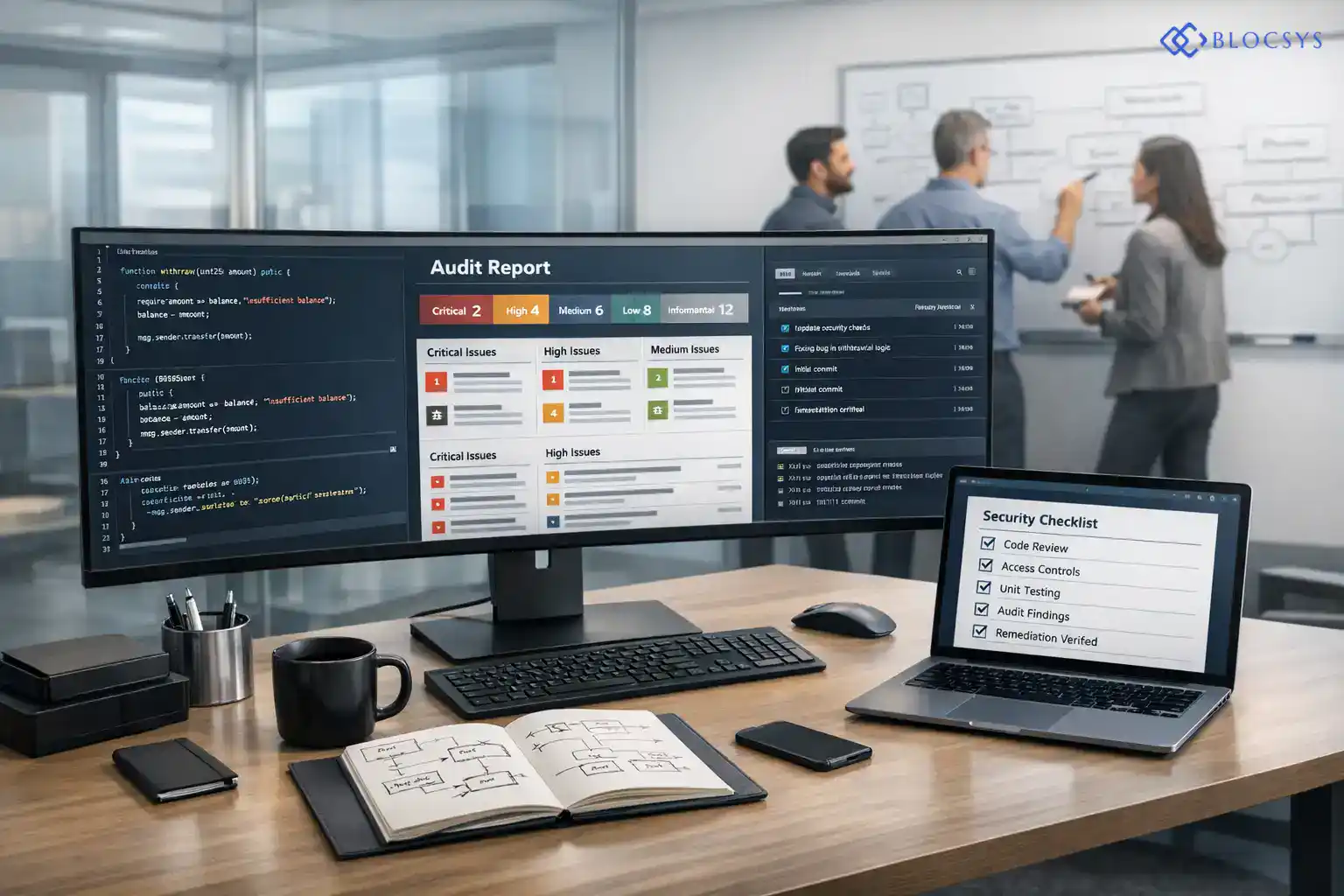
The Ultimate Guide to Smart Contract Auditing
A smart contract audit is a comprehensive security review of a smart contract’s code, designed to catch vulnerabilities, logical errors, and inefficiencies before deployment. Founders, developers, and project leaders across Web3, DeFi, and AI-driven crypto rely on this process to protect digital assets and earn user trust. This guide breaks down exactly what a smart contract audit involves, how much it costs, and how to choose the right auditor for your project.
What Is a Smart Contract Audit?
A smart contract audit is a structured, expert-led examination of a blockchain application’s code. Auditors read the contract line by line, run automated scanners, and stress-test the business logic. The goal is simple: find every flaw before an attacker does.
Unlike traditional software, smart contracts are usually immutable once deployed. Therefore, a single overlooked bug becomes a permanent, public target. This is why smart contract auditing has become a non-negotiable step for any team handling real value on-chain.
A proper smart contract security audit goes beyond spotting typos in code. It verifies that the contract behaves exactly as the whitepaper and business logic intend, under every possible condition.
Why Is a Smart Contract Security Audit Critical?
For teams building in DeFi, real-world asset (RWA) tokenization, and AI-driven crypto, an audit isn’t just best practice. It’s the step that prevents catastrophic losses and secures high-value assets against sophisticated attackers.
How Do Financial and Reputational Risks Affect Projects?
The financial fallout from smart contract vulnerabilities can be severe. In just one six-month period, exploits tied to smart contracts caused over $2.2 billion in losses. This figure alone shows why “good enough” security isn’t good enough.
Consequently, organizations building decentralized financial infrastructure must treat a thorough smart contract audit as a top priority, not an afterthought. A great audit also checks that the code’s logic matches the real-world agreement it’s meant to execute, preventing contracts from behaving in unexpected ways.
How Does an Audit Build a Foundation of Trust?
An audit is more than a technical checkbox; it’s a pillar of trust and a strong market signal. For investors, partners, and users, a professional audit report proves a project is serious about protecting their funds.
A rigorous, independent audit transforms a brilliant idea into a trusted, resilient, and enterprise-ready platform. It’s the difference between building an experiment and building lasting financial infrastructure.
This is especially important for platforms that depend on external data feeds from oracles. To understand how these inputs add another layer of risk, see our guide on discovering the power of Chainlink oracles in blockchain.
What Are the Different Types of Smart Contract Audits?
Not all smart contract audits look the same. The right approach depends on your project’s stage, complexity, and the value it protects. A comprehensive assessment blends several techniques to build layered defenses.
Manual Code Review: The Human Element
At the heart of any worthwhile smart contract auditing process sits the manual code review. Seasoned security engineers comb through your codebase line by line. They don’t just scan for known bugs; they question economic assumptions and scrutinize architectural design.
- Spotting Logical Flaws: Manual review uncovers errors in intended behavior, like a broken incentive mechanism or incorrect state transition.
- Understanding Business Context: An auditor judges whether the code truly reflects the project’s business goals.
- Finding Novel Vulnerabilities: Experienced auditors identify new attack vectors specific to your protocol’s unique design.
Automated Analysis: For Speed and Scale
Automated analysis uses specialized tools to scan code for common vulnerabilities in minutes. These tools flag well-known issues like re-entrancy bugs, integer overflows, and improper access controls. As a result, human auditors can focus on complex logical vulnerabilities instead.
Automated tools find the known unknowns—the common bugs we expect to see. Manual review finds the unknown unknowns—the unique flaws hidden in your project’s specific logic.
Advanced Security Methodologies
Platforms handling significant value often need more than a standard audit. Formal verification uses mathematical proofs to confirm a contract’s behavior matches its specification exactly, eliminating entire categories of bugs. It’s time-consuming but remains the gold standard for core protocol components.
Penetration testing, or VAPT, simulates real-world attacks against your entire system—frontend, backend, and blockchain components alike. Meanwhile, bug bounty programs invite independent researchers to continuously test your deployed code after launch, creating an ongoing, decentralized security force.
Step-by-Step Smart Contract Auditing Process
Understanding how to audit smart contracts starts with knowing the lifecycle. Each phase builds on the last, creating a complete security narrative for your team and your community.
Phase 1: Scoping and Quotation
The audit begins by defining clear boundaries. You’ll specify which contracts are in scope, grant access to the codebase, and share documentation on the protocol’s architecture. A well-defined scope leads to an accurate quote and timeline.
Phase 2: Code Review and Analysis
This is the core of the audit. Security engineers combine automated scanning with exhaustive manual review, focusing on business logic flaws, architectural weaknesses, and novel attack vectors. For insights on resilient architecture, read our article on understanding proxy contracts in Solidity.
Phase 3: Vulnerability Reporting
The audit firm compiles findings into a confidential preliminary report, categorized by severity—Critical, High, Medium, Low, and Informational. Each finding includes a clear explanation, its potential impact, and steps for fixing it.
Phase 4: Remediation
Your engineering team implements the recommended fixes while staying in close contact with the audit team. Teams that conduct detailed audits are notably less likely to suffer serious breaches later.
The goal of remediation isn’t just to fix bugs. It’s to elevate the security posture of the entire codebase, turning audit findings into permanent improvements.
Phase 5: Verification
After your team implements all fixes, auditors re-examine the patched areas. This confirms every vulnerability has been resolved without introducing new side effects.
Phase 6: Final Report Delivery
Once verification finishes, the audit firm issues a final, public-facing report. This document summarizes the scope, process, findings, and final code state. Publishing it builds trust with your community, investors, and partners.
Smart Contract Audit Checklist: Common Vulnerabilities to Catch
A solid smart contract audit checklist keeps both auditors and developers aligned on what matters most. Use this list as a starting point before requesting a formal audit.
- Re-entrancy: Confirm external calls can’t loop back and drain funds before state updates finish.
- Integer overflow and underflow: Verify arithmetic operations use safe math or built-in protections.
- Access control gaps: Check that only authorized addresses can call sensitive functions.
- Oracle manipulation: Confirm price feeds resist flash-loan or manipulation attacks.
- Front-running risks: Assess whether transaction ordering can be exploited for profit.
- Unchecked external calls: Ensure return values from external contracts are always validated.
- Gas limit and denial-of-service risks: Look for loops that could exceed block gas limits.
- Upgradeability risks: Review proxy patterns for storage collisions or unauthorized upgrades.
Working through this checklist early makes the formal smart contract security audit faster and less expensive, since your team resolves obvious issues before the auditors even start.
How Much Does a Smart Contract Audit Cost?
There’s no single price for a smart contract audit. Costs vary based on protocol complexity, lines of code, documentation quality, and the auditor’s reputation. A simple token contract might cost a few thousand dollars, while complex DeFi platforms can easily exceed $50,000.
On leading industry platforms, premier smart contract auditing firms typically charge between $10,000 and over $49,000 per project. Client feedback consistently cites expertise in complex smart contracts as the deciding factor, which is why many teams turn to smart contract audit consulting before committing to a firm.
Think of a proper audit as an investment in security and trust, not just an expense. The cost is a fraction of what a single, preventable exploit could wipe out.
Factors that raise cost include multiple interconnected contracts, novel economic mechanisms, tight deadlines, and poor documentation. Conversely, clean code and clear specifications reduce both time and price.
How to Choose the Right Smart Contract Auditor
Picking a security partner directly shapes your platform’s resilience and reputation. The right smart contract auditor acts as a strategic partner, not just a code reviewer.
Key Evaluation Criteria for Your Audit Partner
- Reputation and Track Record: Look for a public history of high-quality audits on projects with similar complexity to yours.
- Technical Expertise: Confirm deep experience with your specific blockchain and language. A specialist spots things a generalist misses.
- Communication and Remediation Process: The best auditors collaborate with your team throughout remediation, not just at reporting time.
- Cost Versus Long-Term Value: Don’t let price alone guide your decision. A cheap, surface-level scan offers false confidence.
Top Auditing Firms and Tools
Most established audit firms combine proprietary static analysis tools with manual review teams specialized by chain—some focus on EVM-based Solidity contracts, others on Rust or Move ecosystems. When evaluating firms, ask which automated tools they run internally and how much of the process is genuinely manual.
How Do Startup Needs Differ From Enterprise Demands?
The “perfect” audit partner depends on your organization’s size and maturity. An early-stage startup prioritizes speed and investor confidence, while an enterprise needs rigor and compliance alignment.
A great auditor for a startup provides foundational security and builds investor confidence. A great auditor for an enterprise validates and hardens existing, complex systems at scale.
| Evaluation Criteria | Startup Priority | Enterprise Priority |
|---|---|---|
| Cost & Budget | High. Seeking maximum value for a lean budget. | Medium. Focused on long-term value over upfront cost. |
| Speed & Agility | High. Needs quick turnaround for product deadlines. | Low. Prioritizes thoroughness over speed. |
| Reputation & Brand | Medium. Boosts credibility with early investors. | High. Requires a top-tier, recognized firm. |
| Technical Specialization | High. Needs expertise in a specific tech stack. | High. Requires broad expertise across systems. |
| Remediation Support | High. Values a hands-on, collaborative partner. | Medium. Values a partner for validation and second opinions. |
NFT Smart Contract Auditing: What Makes It Different
NFT projects face unique risks that a generic smart contract audit might overlook. Minting logic, royalty enforcement, and metadata handling all introduce distinct attack surfaces beyond typical token contracts.
Auditors reviewing NFT contracts check for unlimited minting exploits, weak randomness in trait generation, and royalty bypass through marketplace workarounds. Additionally, they verify that metadata URIs can’t be hijacked after mint, which would let attackers swap artwork or ownership claims.
Because NFT contracts often integrate with external marketplaces, auditors also test approval and transfer functions for reentrancy and permission leaks. Teams building collections benefit from a smart contract auditing partner who understands ERC-721 and ERC-1155 nuances specifically.
Move-Based Smart Contract Auditing (Aptos and Sui)
Move-based blockchains like Aptos and Sui introduce a resource-oriented programming model that changes how audits work. Resources in Move can’t be copied or accidentally discarded, which eliminates certain bug classes common in Solidity.
However, Move auditing still requires careful review of module permissions, capability leaks, and object ownership transfers. Auditors often use the Move Prover, a formal verification tool, to mathematically confirm module invariants hold under every scenario.
Because Move tooling and best practices are newer than Solidity’s, choosing an auditor with direct Aptos or Sui experience matters. Generalist auditors unfamiliar with Move’s ownership model may miss chain-specific risks entirely.
Sample Smart Contract Audit Report Walkthrough
A typical audit report opens with an executive summary describing scope, methodology, and overall risk posture. Following that, a scope section lists exact contract files, commit hashes, and lines of code reviewed.
The findings section forms the report’s core. Each vulnerability appears with a severity rating, a description, proof-of-concept detail, and a recommended fix. Furthermore, most reports track each finding’s status—open, acknowledged, or resolved—through the remediation cycle.
Finally, an appendix documents tools used, test coverage, and disclaimers about the audit’s limitations. Reading a sample report before hiring an auditor helps you calibrate what “thorough” actually looks like.
Integrating Smart Contract Audits Into Your DevSecOps Pipeline
A formal smart contract audit provides a critical security snapshot, but security must be continuous. For engineering leaders, the goal is weaving security directly into the development lifecycle, an approach known as DevSecOps.
Shifting Left With Automated Security in CI/CD
Integrating automated security tools into your CI/CD pipeline catches vulnerabilities when they’re cheap to fix. Static analysis tools hunt for known bugs like re-entrancy automatically. Meanwhile, dependency scanning vets third-party libraries for known flaws, preventing supply chain attacks.
Building a Culture of Continuous Security
Automated tools help, but a true DevSecOps culture is a mindset shift. Security becomes a shared responsibility across the entire engineering team, not just a task for an external auditor.
Integrating security into every stage of development transforms it from a final gatekeeper into an ongoing accelerator. This makes formal audits far more efficient, focusing expert attention on complex logic rather than common mistakes.
Best Practices for Secure Development Lifecycles
- Threat Modeling Sessions: Before writing code for a new feature, gather developers and architects to brainstorm attack vectors.
- Pre-Deployment Checklists: Maintain a living document covering state variable visibility, access controls, and known exploits.
- Peer Code Reviews: Require security-focused review from at least one other developer before merging any code.
How Blocsys Engineers Secure and Audited Web3 Platforms
At Blocsys, security isn’t a final step; it’s the foundation of everything we build. Our security-first approach architects production-ready Web3 platforms designed to withstand real-world threats from day one.
Our Integrated Security Framework
Our methodology weaves proven security practices directly into development. By the time a third-party auditor reviews our work, the code has already passed multiple layers of internal scrutiny, making the formal smart contract auditing process far more efficient.
- Proactive Threat Modeling: We map attack surfaces and economic exploits tailored to your protocol before coding begins.
- Compliance-Aware Design: We build with regulatory and operational security in mind from the start.
- Continuous Security Testing: We run automated checks and internal code reviews throughout development.
We believe a successful audit begins with exceptional engineering. Our goal isn’t just to pass an audit, but to deliver a platform so inherently secure that the audit simply verifies the quality we’ve built in all along.
From Development to a Confident Launch
Our role extends beyond delivering secure code. We prepare your platform for top-tier third-party auditors and manage the entire remediation process, so you launch with verifiable confidence. Our detailed smart contract development service provides the deep expertise needed to navigate this environment securely.
Frequently Asked Questions
What Is the Main Goal of a Smart Contract Audit?
The main goal is to identify and eliminate security vulnerabilities, logical flaws, and bugs before deployment. It provides independent confirmation that your contract functions as intended, protecting user funds and your reputation.
How Much Does a Smart Contract Audit Cost?
Costs vary based on complexity, code volume, documentation clarity, and auditor reputation. A simple token contract might cost a few thousand dollars, while complex DeFi platforms can exceed $50,000.
How Long Does a Smart Contract Security Audit Take?
A straightforward token contract might take a week. A sophisticated, multi-contract DeFi protocol could require four to six weeks or longer, including reporting, remediation, and verification.
What Happens If Vulnerabilities Are Found?
Finding vulnerabilities is the purpose of an audit, not a failure. Auditors provide a detailed report categorizing findings by severity, your team implements fixes, and auditors verify each resolution.
Is One Smart Contract Audit Enough for a Project?
A single audit is an essential snapshot, but security is ongoing. Any significant update requires a new audit, and long-term projects benefit from bug bounty programs and continuous monitoring.
At Blocsys Technologies, we build with a security-first engineering mindset, ensuring your platform is resilient from the ground up. We don’t just prepare your systems for tough third-party audits; we manage the entire remediation process, so you can launch with total confidence.
Ready to build a secure, production-grade Web3 platform? Connect with our experts today to get started.
