
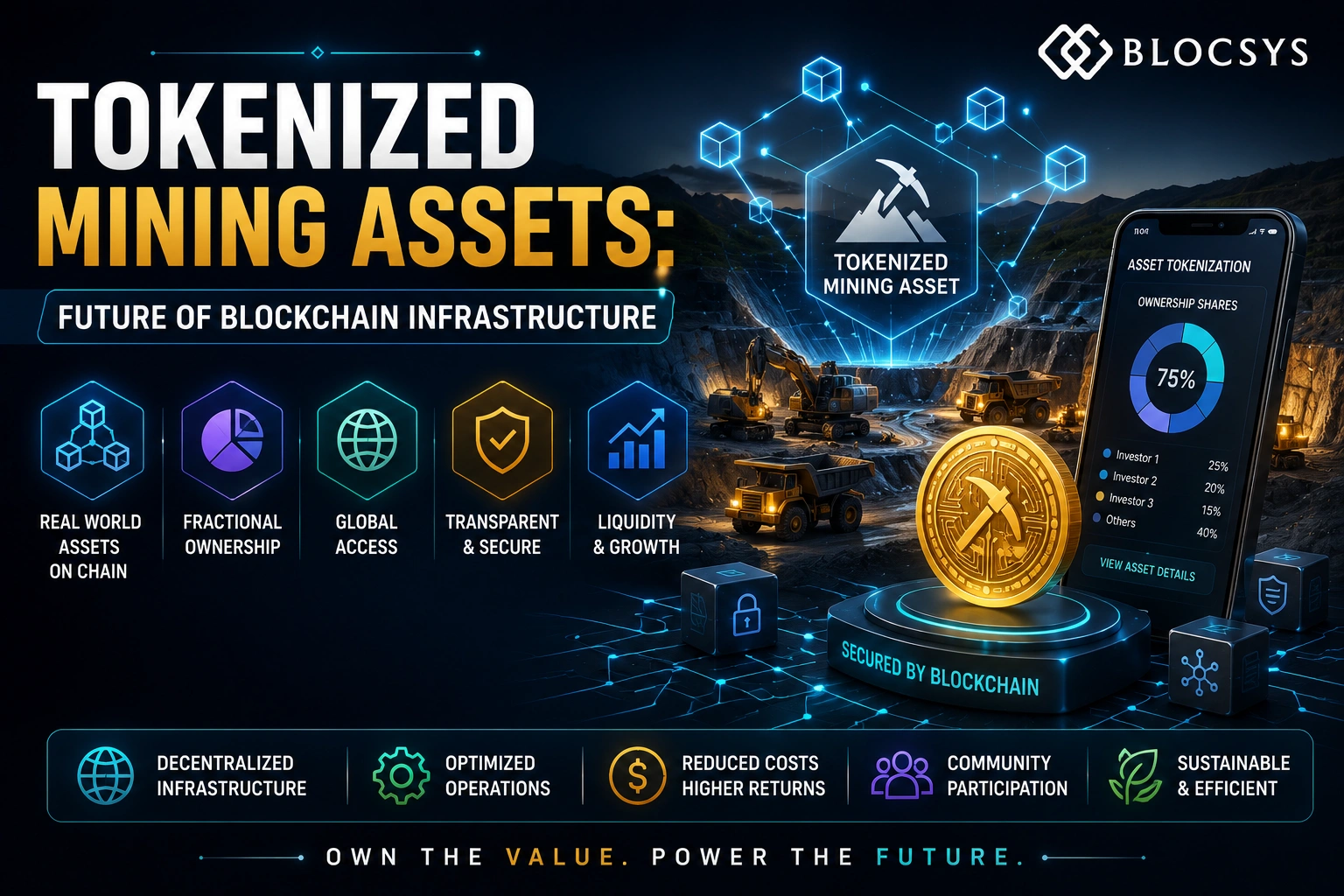
Tokenized Mining Assets: The Future of Institutional Blockchain Infrastructure
Mining has always been capital-heavy, slow-moving, and hard for outside investors to access. That’s changing fast. Tokenized Mining Assets now give institutional investors, mining companies, and enterprise decision-makers a new way to own, trade, and manage mining infrastructure on-chain. If you’ve watched Real World Asset Tokenization reshape private equity and real estate, mining is next in line. At Blocsys, we’ve watched this shift move from theory to production-grade deployment, and it’s worth understanding why now.
What Are Tokenized Mining Assets?
Tokenized mining assets are digital representations of physical mining infrastructure, equipment, mineral rights, or extraction output, recorded on a blockchain. Each token corresponds to a verified claim on real value. That value might be a share of a gold mine, a stake in a cobalt processing facility, or rights to future extraction revenue.
Unlike traditional mining shares, these tokens settle instantly, trade globally, and carry programmable rules. You don’t need a broker, a stock exchange, or weeks of paperwork. Ownership moves at the speed of a blockchain transaction.
How Tokenized Assets Differ From Traditional Mining Investments
Traditional mining investment usually means buying equity in a mining company or purchasing physical commodities directly. Both come with friction: high minimums, illiquid secondary markets, and opaque reporting. Tokenized assets remove much of that friction. Fractional ownership becomes standard, not a special arrangement. Settlement happens on-chain rather than through clearinghouses that take days. Consequently, smaller institutional funds and even accredited individuals can participate in deals once reserved for the largest players.
Can Mining Cash Flows Be Tokenized?
Yes. This is one of the most common questions institutional buyers ask before committing capital, and the answer shapes how a deal gets structured. Mining cash flows, royalties, offtake revenue, and production-linked payments, can all be tokenized as a distinct instrument, separate from equity in the mine itself.
The key distinction is cash-flow rights versus equity. A cash-flow token entitles the holder to a defined share of future revenue, such as a royalty on tonnes extracted or a percentage of gross sales. It does not grant voting rights, board representation, or claims on the underlying asset if operations wind down. Equity tokens, by contrast, represent ownership in the entity that controls the mine, with all the governance rights and risks that come with it.
Mechanically, tokenizing mining cash flows works like this: a legal entity, often a special-purpose vehicle, holds the right to a revenue stream. That right gets documented in a contract defining payment triggers, verification sources, and distribution timing. A smart contract then mirrors those terms. When production data or sales figures get verified, oracle-fed or auditor-confirmed, the contract calculates each token holder’s share and distributes payment automatically.
This structure appeals to institutional buyers because it isolates mining operational risk from pure financial exposure. Therefore, a pension fund or family office can gain commodity-linked yield without taking on mine-closure liability or environmental obligations tied to equity ownership.
Why Mining Assets Are Being Tokenized
Mining companies need capital, and they need it faster than conventional financing allows. Mining asset tokenization opens new funding channels beyond bank loans or private equity rounds. Additionally, it lets operators unlock liquidity from assets that would otherwise sit dormant on a balance sheet for decades.
Investors want this too. Commodity exposure without physical storage, custody headaches, or geographic restrictions is genuinely attractive. Furthermore, tokenization brings transparency that mining, historically, hasn’t offered. Every transaction, royalty payment, and ownership transfer gets recorded immutably. That’s a level of trust legacy mining finance rarely delivered.
Mining has been one of the last major asset classes to resist digitization. What’s changing isn’t the mineral itself — it’s the ownership layer sitting on top of it. That layer is where blockchain earns its value.
Tokenization Platform for Trust Companies and Family Offices
Trust companies and family offices increasingly want exposure to tokenized mining, but most don’t employ blockchain engineers, and few want to hire them just to evaluate one allocation. This is where no-code and low-code tokenization platforms change the calculus.
A modern tokenization platform for trust companies and family offices handles token issuance, investor onboarding, and compliance workflows through a configurable interface rather than custom-written smart contracts for every deal. The trust officer defines investor eligibility rules, distribution schedules, and reporting cadence through a dashboard. The underlying smart contract templates, already audited, already deployed, do the execution.
This matters because family offices typically manage allocations across multiple asset classes with lean internal teams. Consequently, a platform that requires an in-house blockchain developer simply won’t get adopted, regardless of how compelling the underlying mining asset looks. No-code onboarding also shortens due diligence cycles, since compliance officers can review a standardized rule set instead of auditing bespoke code for every new deal.
Moreover, these platforms typically integrate directly with existing custody relationships and reporting software family offices already use. That means a trust company can add tokenized mining exposure to a client portfolio without overhauling its entire operational stack.
Evolution of Institutional Blockchain Infrastructure
Institutional blockchain infrastructure has matured significantly over the past few years. Early blockchain pilots in mining focused narrowly on supply chain tracking. Today, the scope has expanded to full asset lifecycle management, including issuance, custody, compliance, and secondary trading.
Enterprise-grade platforms now support permissioned networks, hybrid public-private architectures, and integration with existing banking rails. This shift matters because institutional investors won’t touch infrastructure that can’t meet regulatory and security standards. Modern institutional blockchain infrastructure is built specifically to satisfy those requirements from day one, rather than retrofitting compliance later.
How Tokenized Mining Assets Work
Here’s the practical flow. A mining company identifies an asset for tokenization, whether that’s a producing mine, equipment fleet, or royalty stream. An independent valuation firm assesses the asset’s worth. Legal structuring then defines what rights each token holder actually receives.
Once structured, a smart contract mints tokens representing fractional shares. Investors purchase tokens through a compliant onboarding process, and ownership records live permanently on the blockchain. Dividends, royalties, or profit distributions flow automatically to token holders based on their holdings.
The Tokenized Assets Lifecycle From Selection to Distribution
Every deal follows a similar arc: asset selection, legal and technical due diligence, smart contract deployment, token issuance, investor onboarding, and ongoing distribution. Tokenized assets aren’t static instruments — they require continuous lifecycle management, including compliance monitoring, secondary market support, and reporting to token holders. Skipping any stage introduces legal or operational risk.
Security Risks and Due Diligence for Tokenized Mining Infrastructure
Institutional capital doesn’t move without a due diligence checklist, and tokenized mining infrastructure introduces risk layers that traditional mining finance never had to address. Below is the checklist we walk clients through before any allocation decision.
- Smart contract audits. Confirm independent, published audits exist for the issuance, distribution, and governance contracts, not just the token standard.
- Oracle and data integrity. Verify how production and sales data feeds the contract. A single compromised oracle can trigger incorrect payouts.
- Custody arrangements. Check whether multi-signature wallets, hardware security modules, or qualified third-party custodians protect investor holdings.
- Legal enforceability. Confirm the token’s underlying rights are enforceable in the jurisdiction where the mine operates, not just where the token is sold.
- Valuation methodology. Review how the independent valuation firm priced the asset, and how often that valuation gets refreshed.
- Regulatory classification. Determine whether the token is treated as a security in every jurisdiction where investors reside.
- Operational resilience. Assess the mining operator’s track record separately from the technology, since a flawless smart contract cannot fix a failing mine.
Due diligence on tokenized mining infrastructure, therefore, means evaluating two separate risk stacks: the physical mining operation and the digital issuance layer. Treating either one as an afterthought exposes investors to losses that better structuring would have prevented.
Blockchain Architecture for Mining Asset Tokenization
Choosing the right blockchain architecture shapes everything downstream. Permissioned chains offer control and privacy, which mining companies often need given sensitive operational data. Public chains offer liquidity and broader investor reach. Many enterprises land on a hybrid model instead.
A solid asset tokenization platform needs modular architecture: an issuance layer, a custody layer, a compliance layer, and a settlement layer that can talk to multiple chains. Interoperability isn’t optional anymore. Investors expect their tokens to move across ecosystems without getting trapped on a single network.
Smart Contracts and Asset Automation
Smart contracts do the heavy lifting behind tokenized mining assets. They automate royalty payments, enforce transfer restrictions, and manage voting rights for token holders without manual intervention. That automation reduces administrative overhead dramatically compared to traditional fund structures.
Think about a royalty-based mining token. Instead of quarterly manual disbursements handled by accountants, a smart contract calculates and distributes payments the moment revenue data gets verified. This is the kind of smart contract development work that turns a static legal agreement into a living, self-executing financial instrument.
Fractional Ownership and Institutional Investment
Fractional ownership is arguably the biggest draw for institutional portfolios. A $50 million mining asset can be split into thousands of tokens, each representing a small, liquid stake. Portfolio managers can diversify across multiple mining projects and geographies instead of committing entirely to one deal.
This model also opens the door for mid-sized institutions that previously couldn’t meet minimum investment thresholds. You don’t need to write a check for the entire mine anymore. You buy exposure proportional to your fund’s risk appetite, and you can exit through secondary markets when liquidity windows open.
Institutional and Regulatory Angle: Switzerland and the EU
Switzerland and the broader EU represent one of the clearest regulatory pathways for tokenized mining, which is exactly why institutional interest there keeps climbing. Switzerland’s DLT Act gives digital securities, including tokenized mining royalty and equity instruments, a defined legal basis, and FINMA has issued clear guidance on how token classification works in practice.
The EU’s Markets in Crypto-Assets Regulation, MiCA, adds a harmonized framework across member states, reducing the jurisdiction-by-jurisdiction guesswork that used to slow down cross-border mining deals. For a Swiss trust company or a German family office, that clarity means tokenized mining assets can be onboarded with a defensible compliance position rather than a legal gray area.
Moreover, Swiss and EU investors tend to prioritize custody standards and auditability above almost everything else. Platforms built for this market need qualified custodian integrations and reporting that satisfies both local regulators and cross-border tax obligations. Institutional blockchain infrastructure built with Switzerland and the EU in mind, consequently, tends to export well to other regulated markets too.
Digital Asset Issuance and Lifecycle Management
Issuing a token is the easy part. Managing it responsibly over years is where most projects struggle. Digital asset issuance requires careful attention to token standards, metadata accuracy, and upgrade paths for smart contracts as regulations evolve.
A proper digital asset platform development approach accounts for corporate actions too — think mergers, asset sales, or changes in mine ownership. Without built-in lifecycle tools, token holders end up with outdated records and mining companies face reconciliation nightmares down the road.
Institutional Custody and Security
Institutional investors won’t allocate capital without robust custody guarantees. Multi-signature wallets, hardware security modules, and third-party custodians all play a role in protecting tokenized mining assets from theft or loss.
Security also extends to smart contract auditing. A single vulnerability can compromise millions in tokenized value overnight. That’s why enterprise-grade platforms run multiple independent audits before mainnet deployment, and why ongoing monitoring matters just as much as the initial launch. Custody isn’t a checkbox; it’s an ongoing operational discipline.
Compliance and Governance Considerations
Regulation is the biggest variable in mining asset tokenization. Jurisdictions from Switzerland to Singapore to the UAE each treat digital securities differently. Consequently, compliance frameworks need to be built into the platform itself, not bolted on afterward.
Governance matters too. Token holders often need voting rights on major decisions, like asset sales or reserve changes. Clear governance structures prevent disputes and build investor confidence. Enterprises pursuing enterprise blockchain development should treat compliance as a design requirement from the first architecture meeting, not a legal afterthought.
Benefits of Tokenized Mining Assets for Enterprises and Investors
Mining companies gain faster access to capital, broader investor pools, and reduced administrative costs. Investors gain liquidity, transparency, and fractional access to assets that were previously out of reach. Everyone gets better data too, since blockchain records can’t be quietly altered after the fact.
There’s also a speed advantage. Traditional mining deals take months to close. Tokenized transactions can settle in days, sometimes hours, once compliance checks clear. That speed changes how quickly capital can respond to new mining opportunities.
Why Tokenized Assets Appeal to Institutional Portfolios
Institutional portfolio managers care about risk-adjusted returns and liquidity above almost everything else. Tokenized assets deliver both, alongside diversification benefits that traditional mining equity rarely provides. Moreover, real-time reporting gives fund managers audit-ready data whenever regulators or LPs come asking.
Challenges in Mining Asset Tokenization
None of this comes without friction. Regulatory uncertainty remains the top barrier, especially across jurisdictions without clear digital securities frameworks. Valuation of physical mining assets also stays complex, since commodity prices and geological data change constantly.
Technical challenges persist as well. Interoperability between blockchain networks isn’t fully solved. Custody solutions still vary widely in maturity. Additionally, mining companies often lack in-house blockchain expertise, which is exactly why partnering with an experienced blockchain development company matters so much during early implementation stages.
The technology isn’t the hard part anymore. The hard part is aligning legal structure, custody, and compliance across every jurisdiction where your investors sit. Get that wrong, and no amount of smart contract elegance saves the deal.
Future Trends in Institutional Blockchain Infrastructure
Expect deeper integration between tokenized mining assets and broader RWA tokenization markets over the next few years. Cross-chain interoperability will improve, letting institutional investors move tokenized assets between ecosystems without friction. Regulatory clarity will also expand, particularly across the US, UAE, Switzerland, and Singapore.
We’re also seeing early moves toward tokenized commodity indices, blending multiple mining assets into diversified digital baskets. That’s a natural next step once single-asset tokenization proves out at scale. Institutional blockchain infrastructure is heading toward full interoperability, not isolated pilot projects.
Real-World Use Cases of Tokenized Mining Assets
Gold mining operators have used tokenization to raise capital for expansion without diluting existing shareholders. Rare earth mineral projects have tokenized future extraction rights, giving early investors exposure years before production begins. Cobalt and lithium producers, facing surging demand from battery manufacturers, have tokenized equipment and infrastructure to attract global capital faster than traditional financing allowed.
Enterprises exploring similar structures for bonds or equities often look at models like Corporate Bond Tokenization Platform Development or Equity Tokenization Platform Development as reference points, since the underlying mechanics of fractional issuance and compliance overlap significantly with mining use cases.
Why Choose Blocsys for Tokenized Mining Asset Development
Blocsys builds enterprise-grade infrastructure for mining companies and institutional investors who need more than a generic token launch. Our team handles blockchain architecture, smart contract development, custody integration, and compliance design as one connected system, not disconnected pieces.
We’ve supported clients across real world asset tokenization projects spanning commodities, bonds, and equities, and mining brings its own operational nuances we account for from day one. If you’re planning tokenized mining infrastructure, our blockchain developers can help you scope, build, and launch with institutional-grade security baked in.
Conclusion
Tokenized Mining Assets aren’t a passing trend in mining finance. They represent a structural shift toward faster capital formation, broader investor access, and transparent asset management. Mining companies that adopt tokenization early position themselves ahead of competitors still relying on slow, opaque financing models.
If you’re an institutional investor, mining operator, or enterprise decision-maker exploring tokenized mining infrastructure, now’s the time to move. Explore how Real World Asset Tokenization can support your next mining project, and reach out to Blocsys to start building your institutional blockchain infrastructure today.
Frequently Asked Questions
Can mining cash flows be tokenized?
Yes. Royalties, offtake revenue, and production-linked payments can all be tokenized as a distinct cash-flow instrument, separate from mine equity. A smart contract calculates and distributes each holder’s share once production or sales data is verified, without granting ownership or voting rights in the underlying mine.
What is a tokenization platform for trust companies and family offices?
It’s a no-code or low-code platform that lets trust officers issue, onboard, and manage tokenized mining assets through a configurable dashboard instead of custom smart contract code. It removes the need for an in-house blockchain engineering team, which most trust companies and family offices don’t have.
What due diligence should investors run on tokenized mining infrastructure?
Check smart contract audits, oracle data integrity, custody arrangements, legal enforceability of token rights, valuation methodology, regulatory classification, and the mining operator’s own operational track record. Tokenized mining infrastructure carries two risk stacks, physical operations and the digital issuance layer, and both need separate review.
How do tokenized mining assets work in Switzerland and the EU?
Switzerland’s DLT Act and the EU’s MiCA regulation give tokenized mining assets a defined legal basis, including clear token classification and custody standards. This regulatory clarity lets Swiss and EU institutional investors, including trust companies and family offices, onboard tokenized mining exposure with a defensible compliance position.
What are tokenized mining assets?
Tokenized mining assets are digital tokens representing ownership or economic rights in physical mining infrastructure, mineral reserves, equipment, or extraction revenue. Each token is recorded on a blockchain and corresponds to a verified, legally structured claim on real value, making the asset far more accessible than conventional mining equity.
How does mining asset tokenization work?
Mining asset tokenization starts with selecting an asset, whether a producing mine, equipment fleet, or royalty stream. An independent valuation and legal structuring process defines investor rights, followed by smart contract deployment that mints tokens representing fractional ownership. Investors then complete compliance onboarding and purchase tokens through a regulated tokenization platform.
Why are institutional investors adopting tokenized mining assets?
Institutional investors want liquidity, transparency, and diversification, and tokenized mining assets deliver all three better than traditional mining equity. Fractional ownership lets funds allocate smaller amounts across multiple mining projects instead of committing heavily to a single deal, while blockchain-based record keeping improves audit readiness.
Ready to move beyond theory and build an intelligent platform that delivers real-world value? Blocsys Technologies specialises in engineering enterprise-grade AI and blockchain solutions for the fintech, Web3, and digital asset sectors. Connect with our experts today to discuss your vision and chart a clear path from concept to a secure, scalable reality.
