
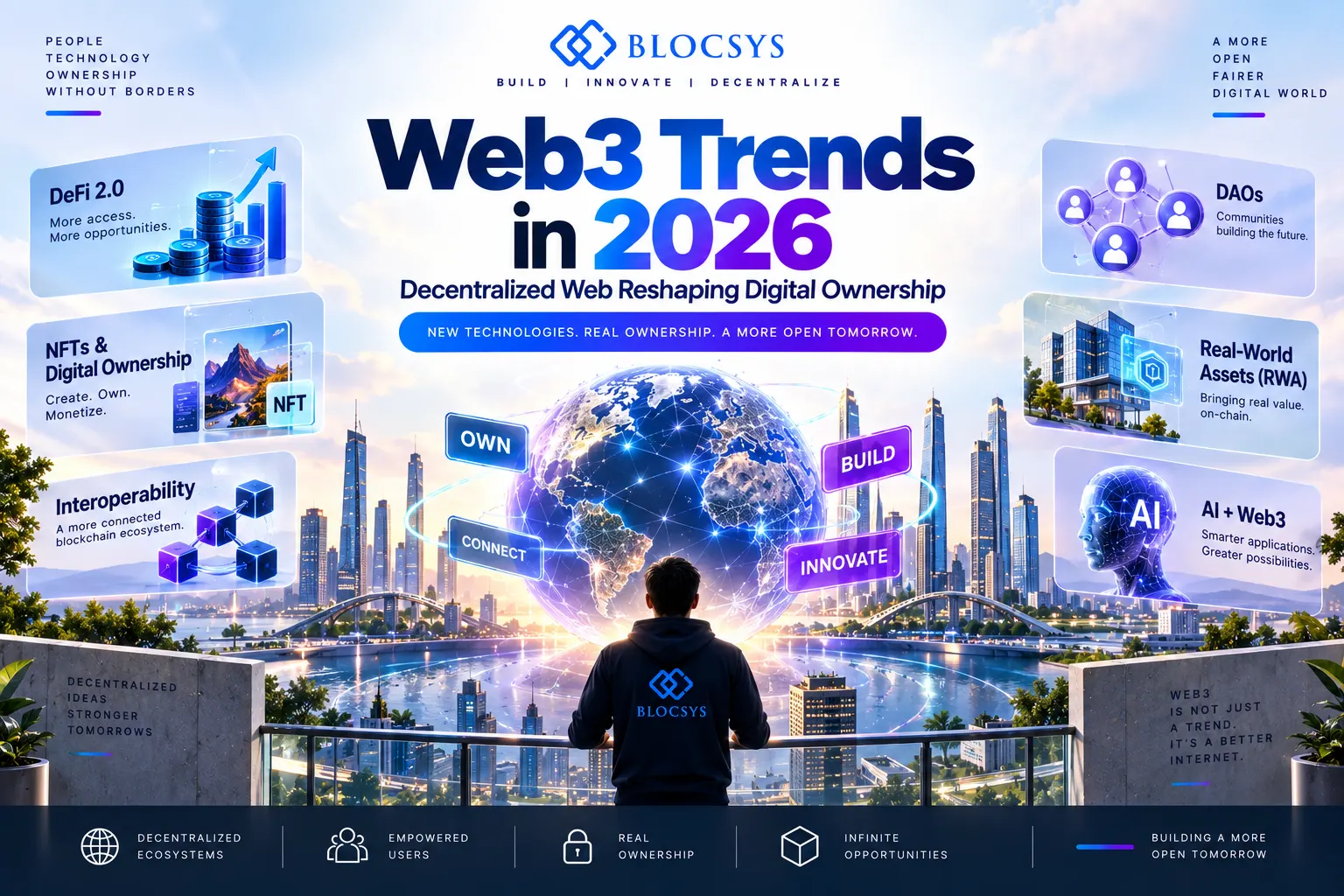
Web3 Trends 2026: How the Decentralized Web Is Reshaping Digital Ownership
The decentralized web has entered its most consequential phase yet. Web3 trends 2026 span regulatory breakthroughs, explosive platform growth, and a developer ecosystem that now rivals traditional web stacks. The Clarity Act is resolving longstanding ambiguity around digital asset classification. Layer 2 networks are handling billions in daily transaction volume. Real-world asset tokenization is unlocking liquidity in markets that were previously inaccessible to retail and institutional participants alike. Whether you are a developer, creator, investor, or enterprise leader, the strategic window is wide open right now. Explore the full landscape at Blocsys and get the complete industry picture in Top Blockchain Trends in 2026.
What Is Web3 and Why Does It Matter in 2026?
Web3 is the read-write-own internet. Web1 delivered static pages with minimal interaction. Web2 added social platforms and interactivity — but centralized corporations owned all data and captured most of the value. Web3 corrects that imbalance. Users now control their data, assets, and digital identities directly, without relying on any intermediary platform.
At its core, Web3 runs on blockchain technology. Smart contracts replace centralized intermediaries. Wallets replace usernames and passwords. Tokens represent ownership of everything from currency and art to real estate and intellectual property. Furthermore, no single entity controls these systems — code enforces the rules, not institutions.
In 2026, Web3 is functioning infrastructure, not an abstract concept. Millions of users interact with decentralized applications every day. Additionally, cross-chain communication now ships as a standard feature, and developer tooling has matured to the point where building on Web3 genuinely compares to building on traditional stacks. The foundation is solid. The growth is measurable.
Web3 Digital Ownership: The Core Value Proposition
Web3 digital ownership is the defining promise of this technology cycle. Unlike Web2 platforms that control user data, assets, and access, Web3 returns control directly to individuals. Smart contracts enforce ownership rules automatically and transparently. NFTs, tokenized assets, and on-chain credentials give users verifiable, immutable proof of ownership that no platform can ever revoke.
Moreover, digital ownership extends far beyond collectibles in 2026. Real-world assets — property, commodities, intellectual property — now convert into on-chain tokens. This process unlocks liquidity in traditionally illiquid markets and allows fractional ownership at scales previously impossible. For a deeper look at real-world applications, explore Blockchain Use Cases 2026.
Why On-Chain Credentials Are Changing Identity
On-chain credentials are gaining serious traction in 2026. Users carry verifiable proof of skills, memberships, and achievements across platforms. Employers and protocols verify credentials without relying on centralized authorities. Therefore, digital identity becomes portable, self-sovereign, and censorship-resistant — a structural shift with lasting implications for hiring, access, and governance.
The Clarity Act and Web3 Regulation: What Builders Must Know
The Clarity Act represents a pivotal shift in US crypto regulatory policy. Introduced to resolve the longstanding jurisdictional dispute between the SEC and CFTC, the Clarity Act establishes clear definitions for digital assets — classifying them as either commodities or securities based on specific criteria. This distinction directly affects how projects structure token launches, DeFi protocols, and exchange listings in 2026.
Before the Clarity Act, regulatory ambiguity stalled institutional capital. Projects could not confidently launch tokens without risking securities violations. Additionally, exchanges struggled to list new assets without clearer classification guidance. The Clarity Act addresses these friction points systematically and gives builders a defined legal framework to work within.
How Clarity Act Crypto Rules Affect Token Issuers and DeFi
Clarity Act crypto implications touch every layer of Web3 development. Token issuers must now conduct clear asset classification before launch. DeFi protocols must evaluate whether their governance tokens meet commodity or security criteria under the new framework. Furthermore, exchanges gain clearer listing standards, which reduces compliance overhead and significantly accelerates time to market for new assets.
For builders and enterprises, regulatory clarity is a net strategic positive. Projects can now raise capital, structure tokenomics, and operate exchanges with defined legal footing. Moreover, institutional investors — previously sidelined by regulatory uncertainty — are entering the market with far greater confidence than at any prior point in Web3’s history. Working with experienced blockchain consulting services helps organizations navigate Clarity Act compliance efficiently and avoid costly misclassification errors.
“The Clarity Act doesn’t just regulate Web3 — it legitimizes it. Clear rules attract institutional capital, mature infrastructure, and serious builders who were waiting on the sidelines for exactly this kind of certainty.” — Blockchain Policy Analyst
Web3 Platform Growth: Adoption Data for 2025–2026
Recent web3 platform growth data confirms adoption has moved well beyond early-adopter cycles into mainstream infrastructure territory. Total value locked in DeFi protocols crossed record highs in Q1 2026. Daily transaction volumes on Layer 2 networks now surpass their 2024 peaks by substantial margins. Active blockchain wallet counts grew at double-digit annual rates, driven by dramatically improved onboarding experiences across major platforms.
Layer 2 network activity now exceeds Layer 1 activity on every major chain. Transaction costs on leading L2 networks have dropped to fractions of a cent — a threshold that fundamentally changes which application categories are economically viable at global scale. Additionally, cross-chain messaging protocols allow assets and data to move fluidly between networks without relying on centralized bridges, reducing ecosystem fragmentation significantly. For a full investor perspective on these numbers, see Crypto Trends 2026.
Web3 User Growth 2026: Wallet Adoption Benchmarks
Web3 user growth 2026 is being driven by three structural shifts that are each removing a different friction layer. First, account abstraction eliminates wallet seed phrase complexity, replacing it with email or social login recovery that mainstream users already understand. Second, gasless transaction models remove the final friction point at the moment of onboarding. Third, mobile-first wallet apps have made daily Web3 interactions feel as natural as standard mobile banking.
Active on-chain addresses across major networks are climbing at double-digit annual rates. Asia-Pacific markets — led by Singapore, South Korea, and India — account for a growing share of daily transaction volume. Furthermore, Middle Eastern hubs like the UAE are attracting Web3 companies with favorable licensing regimes, shifting capital and talent flows in ways that are accelerating regional adoption well beyond what regulatory frameworks alone could achieve.
Web3 Developer Trends 2026: Tools, Frameworks, and Ecosystem Shifts
Web3 developer trends 2026 reveal an ecosystem that has undergone dramatic tooling maturation over the past 18 months. Layer 2-native development environments are now the default deployment target for new applications. No-code and low-code Web3 deployment platforms have opened the ecosystem to teams from traditional software backgrounds who previously had no accessible path into on-chain development.
GitHub activity on Web3 repositories reached record levels in Q1 2026, confirming sustained ecosystem health and growing talent inflow. AI-powered smart contract auditing tools now flag common vulnerabilities — reentrancy, overflow, access control flaws — before code ever reaches mainnet. Furthermore, automated test environments simulate complex multi-contract interactions, reducing audit turnaround times and improving overall protocol security at scale.
Key Developer Tools Gaining Adoption in 2026
- L2-native IDEs: Optimized for deploying on Optimism, Arbitrum, and Base with built-in gas estimation and L1 bridging workflows.
- AI-powered audit tools: Automatically flag vulnerability classes before deployment, cutting manual audit time significantly.
- No-code smart contract builders: Allow non-developer teams to deploy token contracts and DAO governance modules without writing Solidity.
- Cross-chain SDKs: Simplify multi-chain deployment and asset bridging within a single integrated development workflow.
- On-chain analytics APIs: Integrate directly into developer pipelines for real-time monitoring of live deployed contracts.
These tooling shifts are converting traditional web and enterprise software developers into active Web3 contributors. Moreover, blockchain development teams that adopt this modern stack are shipping production applications faster than at any prior point in Web3’s history. The developer bottleneck that constrained earlier cycles has largely resolved.
Web3 Platform Growth Trends in 2026
Web3 platforms continue to evolve across decentralized applications, digital ownership, tokenization, DeFi, gaming, and other blockchain-based use cases. Platform growth is increasingly influenced by improvements in scalability, user experience, interoperability, security, and the ability to connect blockchain infrastructure with existing digital services.
For businesses, Web3 growth is creating opportunities to develop platforms around specific use cases rather than relying on a single blockchain application model. As adoption develops, businesses can evaluate infrastructure, integration requirements, user experience, and long-term scalability when planning a Web3 platform.
Top Web3 Trends 2026: The Innovations Driving Real Adoption
The top web3 trends 2026 span multiple sectors simultaneously and are deeply interconnected. Therefore, businesses that track only one trend risk missing the broader strategic picture shaping competitive advantage. For broader context, start with Top Blockchain Trends in 2026.
Real-World Asset Tokenization
Real-world asset (RWA) tokenization remains among the most impactful blockchain use cases in 2026. Properties, commodities, art, and intellectual property are converting into digital tokens that trade on decentralized markets. Furthermore, this process unlocks liquidity in traditionally illiquid markets and enables fractional ownership at accessible price points. Institutional adoption of blockchain is accelerating rapidly here — tokenized bond issuances now settle in seconds rather than the traditional two-day cycle.
ZK Proofs and Privacy at Scale
Zero-knowledge proofs have matured from research concept to production standard across Web3 infrastructure. They are now essential for privacy-preserving transactions and compliance-friendly DeFi at enterprise scale. Additionally, ZK proofs power identity verification without exposing underlying personal data — a critical capability for regulated industries operating in Web3 environments. Learn more about scaling innovations at Layer 2 Scaling for DEX Platforms.
AI DAOs and Autonomous On-Chain Governance
AI-powered decentralized autonomous organizations are among the most transformative developments in 2026. AI agents monitor protocol health, draft governance proposals from live on-chain data, and execute treasury actions when predefined conditions trigger. The combination of AI agents and ZK proofs makes verifiable autonomous governance possible — protocols prove that an AI action followed correct logic without revealing sensitive inputs.
AI and blockchain integration is producing some of the most consequential Web3 outcomes this year. AI agents now interact directly with smart contracts, enabling autonomous decision-making at scale and speed that human governance cannot match. Explore the full picture in AI and Blockchain Integration in 2026.
Web3 Gaming and Play-to-Own Economies
On-chain gaming has become a major adoption driver in 2026. Play-to-own economies, tokenized in-game assets, and interoperable item standards let players carry real value across titles and platforms. Furthermore, gaming studios increasingly use gasless Layer 2 transactions, making on-chain gameplay feel identical to traditional gaming for mainstream users. This sector is quietly converting millions of mainstream users into active Web3 participants at a scale no other use case has matched.
Modular Blockchain Architecture
Modular blockchain architecture allows companies to mix and match execution, settlement, and data availability layers without unnecessary trade-offs. Networks no longer operate in silos. Composability and modularity now define how serious builders approach infrastructure, and enterprise blockchain solutions in 2026 reflect this shift toward flexible, upgradeable system design.
Web3 Developer Trends in 2026
Web3 development is evolving as blockchain networks, decentralized applications, digital assets, and interoperability technologies mature. In 2026, developers are increasingly focusing on scalable infrastructure, cross-chain applications, improved wallet experiences, smart contract security, and integrations between Web3 and emerging technologies such as AI.
For businesses building decentralized applications, these Web3 developer trends are influencing how platforms are designed and deployed. Developers are placing greater emphasis on interoperability, user experience, security, automation, and infrastructure that can support growing transaction and user volumes.
Businesses planning new Web3 products should therefore consider both current technology capabilities and the infrastructure required to scale as the Web3 ecosystem develops.
Web3 Institutional Adoption: Real-World Use Cases in 2026
Web3 institutional adoption has moved decisively from theoretical to operational. A major European bank launched a tokenized bond issuance platform on a public blockchain, settling trades in seconds rather than the traditional two-day cycle. Furthermore, a global logistics company deployed an immutable supply chain tracking system that reduced disputes and fraud losses by over 30 percent — a concrete, measurable result that speaks to institutional decision-makers.
Healthcare is earlier stage but structurally compelling. Patient data ownership and on-chain credential verification are gaining traction in pilot programs across multiple health systems. Additionally, media and entertainment businesses benefit from NFT-based royalty infrastructure that automates creator payments without requiring platform intermediaries. Review these developments in depth at Enterprise Blockchain Solutions 2026.
“Decentralized prediction markets are the most underrated forecasting tool in Web3. When liquidity is sufficient, market prices consistently outperform expert consensus on real-world outcomes — elections, economic indicators, and protocol votes alike.” — On-Chain Markets Researcher
Web3 Research Dashboards and Smart Money Tracking
Token discovery has become a defining competitive skill in 2026. A modern web3 research dashboard pulls on-chain flows, exchange listings, liquidity depth, and holder distribution into one live view. Traders no longer refresh a dozen scattered block explorers to spot an emerging trend — the dashboard surfaces breakout signals automatically and in real time.
Smart money tracking modules rank wallets by realized profit, win rate, and portfolio concentration. Moreover, they flag when multiple high-performing wallets accumulate the same token within a short window — a strong signal of coordinated conviction among sophisticated market participants. However, smart money signals work best when combined with on-chain liquidity data and contract audit scores. Single-signal tools consistently underperform multi-source dashboards that cross-reference on-chain, wallet, and sentiment data simultaneously.
Global Web3 Policy Landscape: US, EU, and Asia
The global policy landscape is clarifying rapidly in 2026. The European Union’s MiCA regulation is now in full effect across all member states, providing a structured licensing framework for crypto asset service providers. Furthermore, Singapore and the UAE have established themselves as leading Web3 regulatory hubs, attracting projects that need operational certainty and favorable tax treatment simultaneously.
Regulatory arbitrage has become a genuine strategic factor. US Clarity Act rules, EU MiCA requirements, and competitive Asian licensing regimes are pulling projects toward jurisdictions offering the clearest operational frameworks. Therefore, where a project chooses to operate in 2026 directly influences where its liquidity concentrates and which institutional partners it can attract. The latest innovations in blockchain technology are emerging from precisely those jurisdictions that have moved fastest on regulatory clarity.
What This Means for Builders and Businesses
The web3 trends 2026 landscape presents both opportunity and strategic obligation across every sector. The Clarity Act creates compliance clarity for token issuers. Web3 platform growth creates a larger, more accessible user base. Developer tooling maturity reduces time to market. Additionally, RWA tokenization opens entirely new asset classes to on-chain liquidity for the first time.
Choosing the right blockchain consulting services partner is critical at this stage. Specialized blockchain development teams can dramatically accelerate deployment on modern L2 infrastructure. Furthermore, tools like the Blockchain Document Verification System enable organizations to add immediate, tangible on-chain value without a complete infrastructure overhaul. The builders moving now will define the competitive landscape for the next cycle.
Frequently Asked Questions
What are the most important web3 trends in 2026?
The most impactful web3 trends 2026 include real-world asset tokenization, AI-powered DAOs, ZK proof adoption at production scale, modular blockchain architecture, Clarity Act regulatory clarity for crypto assets, and accelerating web3 platform growth across both institutional and retail adoption segments.
What is the Clarity Act and how does it affect Web3?
The Clarity Act establishes clear US regulatory definitions for digital assets, classifying them as either commodities or securities based on specific criteria. This directly affects token issuers, DeFi protocols, and exchanges by providing defined legal frameworks that reduce compliance risk and unlock institutional capital that was previously sidelined by regulatory ambiguity.
What does web3 user growth look like in 2026?
Web3 user growth 2026 is driven by account abstraction, gasless transactions, and mobile-first wallets that remove onboarding friction. Active on-chain addresses are growing at double-digit annual rates, with Asia-Pacific and Middle Eastern markets accounting for an expanding share of daily transaction volume across major chains.
How have web3 developer trends changed in 2026?
Web3 developer trends 2026 show a clear shift toward L2-native development environments, AI-powered smart contract auditing, and no-code deployment platforms. GitHub activity on Web3 repositories hit record levels in Q1 2026, confirming strong ecosystem growth and significant talent inflow from traditional enterprise software backgrounds.
What is web3 digital ownership and why does it matter?
Web3 digital ownership means users hold verifiable, immutable control over their assets, data, and identities through smart contracts and on-chain tokens. No centralized platform can revoke this ownership — which is a fundamental shift from Web2 models where platforms controlled user data, monetized it without consent, and could revoke access at will.
How can a business identify the right Web3 opportunity in 2026?
Businesses can evaluate Web3 opportunities by looking at their target users, existing business model, industry requirements, and the problems blockchain technology can solve. Areas such as tokenization, decentralized applications, digital assets, and blockchain-based ownership can be evaluated based on their practical business use cases and implementation requirements.
What should businesses consider before starting a Web3 project?
Businesses should define the project’s objectives, target users, blockchain network, required integrations, security requirements, scalability needs, and regulatory considerations before development begins. These factors can help determine the appropriate Web3 architecture and development approach.
Should a business build a custom Web3 platform or use an existing solution?
A custom Web3 platform may be suitable when a business requires specific functionality, workflows, integrations, branding, or greater control over its technology infrastructure. Existing solutions may be appropriate for standardized requirements, while custom development allows the platform to be designed around the organization’s specific objectives.
How can I choose a Web3 development company for my project?
When selecting a Web3 development company, businesses should evaluate its experience with blockchain architecture, smart contracts, decentralized applications, wallets, integrations, security, and production deployment. Reviewing relevant projects, technical capabilities, development processes, and post-launch support can also help when evaluating potential development partners.
What services are typically included in Web3 platform development?
Web3 platform development can include blockchain architecture, smart contract development, decentralized application development, wallet integration, tokenization, API integrations, security implementation, testing, and deployment. The required services depend on the platform’s use case, technology stack, and business requirements.
Ready to move beyond theory and build intelligent infrastructure that delivers measurable real-world value? Blocsys Technologies specialises in engineering enterprise-grade AI and blockchain solutions for the fintech, Web3, and digital asset sectors. Connect with our experts today to discuss your vision and chart a clear path from concept to a secure, scalable reality.
