

Before writing a single line of Solidity, it’s critical to understand that professional smart contract development is a structured engineering discipline, not just a coding exercise. For founders and technical leads in Web3, AI, and carbon sectors, this guide provides a clear framework to develop a smart contract that is secure, scalable, and efficient—ensuring your protocol is built for long-term success from day one.
What is the Smart Contract Development Lifecycle?
The smart contract development lifecycle is a structured, multi-stage process for designing, building, testing, and deploying secure and efficient on-chain applications. It adapts traditional software engineering principles to the unique, high-stakes environment of blockchain, where immutability and financial risk demand extreme rigor. This process is essential for building production-ready protocols in DeFi, RWA tokenization, and AI.
From the outset, there are critical factors to consider:
- Architecting for Future Upgrades: Smart contracts are immutable by nature. Planning for future enhancements with patterns like proxies isn’t an afterthought; it’s a core architectural requirement.
- Security-First Mindset: Security cannot be bolted on at the end. It must be woven into every stage, from initial design to final deployment, to prevent catastrophic vulnerabilities.
- Gas Efficiency: High transaction costs can kill a project. Optimizing for low gas fees is vital for user adoption and the long-term viability of your protocol.
This infographic breaks down the core phases of a modern smart contract development workflow.
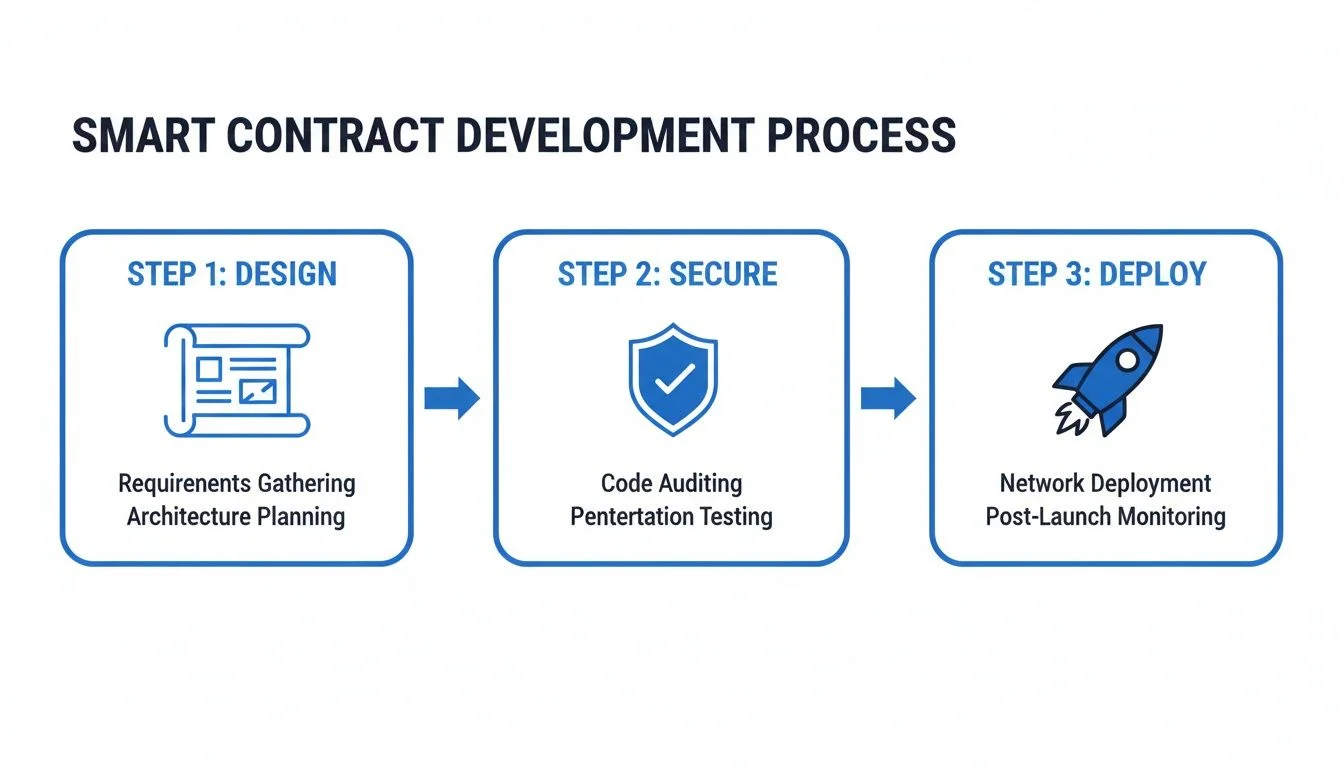
As the visual shows, architectural design, embedded security, and a flawless deployment aren’t isolated steps. They are deeply interconnected phases that influence one another.
Why is a Structured Development Process Necessary?
This disciplined methodology is now the industry standard, driven by the massive value locked in smart contracts and the catastrophic cost of a single mistake. This trend is amplified by the rapid expansion of global tech hubs, which are fueling demand for skilled blockchain developers capable of building enterprise-grade systems.
On a global scale, the smart contract market is expected to surge from $3.2 billion in 2025 to $9.36 billion by 2030, underscoring the urgent need for professional development practices. For decision-makers, this highlights the necessity of partnering with teams that understand this structured approach.
Adopting a formal lifecycle is no longer optional—it’s the only way to build trust and ensure the long-term success of a decentralized protocol. It forces teams to anticipate risks, document decisions, and create a codebase that is both resilient and maintainable.
By embracing this end-to-end perspective, you lay the groundwork for a successful launch that inspires confidence in users and investors alike, positioning your project for sustainable growth.
How Do You Architect and Implement Your Core Logic?
This is where your abstract vision becomes immutable, on-chain code. To properly develop a smart contract for a complex system—whether it’s tokenizing real-world assets or building compliance-aware logic for institutional DeFi—you have to move past the basics. The architecture you design now is the foundation for your protocol’s future security, scalability, and cost-effectiveness.

Your first major decision is the programming language. This choice has far-reaching effects on everything from the available developer talent to the built-in security guarantees of your code. It will set the entire trajectory for your development process, impacting both startup agility and enterprise resilience.
Solidity vs. Rust: Which Language Is Right for Your Project?
The two heavyweights in the smart contract world are Solidity and Rust, and they come with very different trade-offs. Solidity is the established standard, boasting a mature ecosystem and a huge collection of libraries, which makes it the natural choice for most EVM-compatible chains.
On the other hand, Rust is quickly gaining ground because of its focus on raw performance and memory safety. This makes it an incredibly strong candidate for high-throughput chains like Solana or complex computational logic required in AI and advanced financial models.
To help you decide, here’s a comparison framework for enterprise vs. startup needs.
Solidity vs Rust: A Practical Comparison for Smart Contract Development
This table compares key technical and ecosystem attributes of Solidity and Rust to help development teams choose the right language for their project’s specific needs, whether for a rapid-growth startup or a security-focused enterprise.
| Attribute | Solidity | Rust |
|---|---|---|
| Maturity & Ecosystem | Enterprise & Startup: Highly mature, extensive libraries (like OpenZeppelin), vast developer community, and battle-tested tooling accelerate time-to-market. | Enterprise: Growing rapidly with strong community support, but a smaller ecosystem of smart-contract-specific libraries requires more custom development. |
| Performance | Good for most use cases, but its performance is ultimately tied to the EVM’s constraints. Suitable for standard DeFi and NFT projects. | Enterprise & High-Performance Startups: Delivers near-native performance by compiling to efficient machine code, making it perfect for computation-heavy tasks like AI or high-frequency trading. |
| Security Guarantees | Risk: Prone to well-known issues like re-entrancy and integer overflows. Requires expert developers and rigorous auditing to mitigate. | Benefit: The compiler enforces strict memory and ownership rules, preventing entire classes of common bugs at compile time. This is a significant advantage for enterprise-grade security. |
| Primary Use Cases | The dominant language on Ethereum and EVM-compatible Layer-2s for DeFi, NFTs, and DAOs. | The preferred choice for high-performance blockchains like Solana and for complex on-chain systems in AI, carbon markets, and institutional finance. |
Ultimately, the right choice comes down to your protocol’s specific requirements. For a startup building a standard DeFi application on an EVM chain, Solidity’s ecosystem offers speed. But for an enterprise or a high-performance protocol, Rust’s safety and performance features provide a clear long-term advantage.
How Can You Design Modular and Upgradeable Contracts?
After settling on a language, your next challenge is designing a modular architecture that can evolve. Immutability is a core feature of blockchains, but it creates a huge problem: how do you fix bugs or add features after you’ve deployed? The answer is to use specific design patterns that intentionally separate your logic from your data storage.
- Proxy Patterns: This is the most popular method for both startups and enterprises. A simple, permanent proxy contract holds the contract’s state and address but forwards all calls to a separate logic contract. This lets you swap out the logic for a new version without forcing users to migrate their data.
- Diamond Pattern (EIP-2535): For highly complex protocols with many distinct functions, the Diamond pattern provides far better modularity. It allows a single contract address to use logic from multiple implementation contracts (called “facets”), which makes managing and upgrading large, multifaceted systems much cleaner, a key benefit for enterprise applications.
For any serious project, building with these patterns from day one is non-negotiable. To dig deeper into how these structures work, take a look at our detailed article on understanding proxy contracts in Solidity.
A key part of robust architecture is writing clean, readable, and efficient code. The goal is to minimize the attack surface by keeping logic as simple as possible. Every line of code is a potential vulnerability, so clarity and conciseness are paramount security features.
When architecting your smart contract’s core logic, staying on top of the latest Ethereum Improvement Proposals is vital for using new capabilities and ensuring future-proofing. For example, understanding EIP 7702 can offer insight into new standards for account abstraction, which might influence your design choices around user interaction and transaction flows. This kind of foresight ensures your architecture stays resilient and adaptable as the ecosystem evolves.
How to Embed Advanced Security and Auditing Frameworks
In Web3, security isn’t just a feature—it’s the bedrock of your entire protocol. When you develop a smart contract, a single vulnerability can trigger a catastrophic, irreversible loss of user funds. This is what separates professional-grade protocols from amateur projects: a non-negotiable, multi-layered approach to security and auditing that starts on day one.
This process must begin long before an external auditor ever sees your code. It starts with a rigorous internal testing strategy that treats your own codebase as hostile territory. The goal is simple: find and neutralize threats before they ever have a chance to hit the mainnet.
How Do You Build a Battle-Tested Internal Testing Suite?
A truly robust testing suite goes far beyond simple checks. It should involve several complementary techniques designed to stress-test your logic from every conceivable angle, uncovering the hidden edge cases that basic scenarios will always miss. This layered approach is how you build confidence in your code, piece by piece.
Your testing regimen must include:
- Unit Testing: This is your first line of defense. Using powerful frameworks like Foundry, you can write tests directly in Solidity to verify that each function behaves exactly as intended in isolation. This gives you rapid, granular feedback right from the start of development.
- Property-Based Testing: Instead of testing with fixed, predictable inputs, this technique generates a wide range of random data to see if your code upholds certain fundamental “properties.” For instance, a core property could be that a user’s balance never decreases after a deposit, regardless of the deposit amount.
- Fuzz Testing: Think of this as a more aggressive, automated form of testing. A fuzzing engine bombards your functions with invalid, unexpected, and random data. It’s exceptionally good at finding vulnerabilities like integer overflows or unexpected reverts that developers might not anticipate.
Integrating these methods creates a powerful, automated safety net. It allows you to write smart contract code with a much higher degree of confidence, knowing it has already survived a barrage of simulated attacks.
What is the Third-Party Audit Process?
While internal testing is critical, a third-party security audit is an indispensable, non-negotiable step before launch. An audit brings a fresh, expert perspective from specialists who have seen countless attack vectors and anti-patterns across hundreds of projects. To prepare, your codebase needs to be clean, well-documented, and backed by a comprehensive test suite. You can learn more by reviewing our complete guide on smart contract auditing.
Common findings often include:
- Re-entrancy: Where an external call allows an attacker to re-enter a function before its first invocation is complete, a classic technique used to drain funds.
- Integer Overflows/Underflows: When arithmetic operations exceed the maximum or minimum value for a data type, causing the logic to behave in unpredictable ways.
- Improper Access Control: Functions that are missing the proper
onlyOwneror role-based checks, leaving privileged actions exposed to unauthorized users.
An audit isn’t a pass/fail exam; it’s a collaborative process to identify and remediate risk. A clean report from a top-tier firm becomes a powerful signal of trust and security for your users and investors.
The global push for secure smart contracts is intensifying, especially in markets with high crypto adoption. A tech-savvy population is fueling innovation in DeFi and RWAs, with reports showing the smart contract sector accelerating through fintech and BFSI integrations. You can review the full analysis of how smart contract adoption in finance is growing.
Ultimately, embedding security from day one with automated tools and validating it with expert audits is the only responsible way to launch a protocol in today’s environment.
How to Master Gas Optimization and Performance Tuning
In blockchain development, an inefficient smart contract is a dead end. It’s expensive for your protocol and, more importantly, for your users. Sky-high gas fees can kill user adoption before you even get off the ground, leaving your dApp uncompetitive in a crowded market. When you develop a smart contract, mastering gas optimization is what separates a good protocol from a great one.

This isn’t about finding obscure hacks. It’s about a disciplined, systematic approach to writing clean, efficient code that respects the blockchain’s computational limits. Even tiny adjustments can lead to massive cost savings, especially for contracts designed to handle high transaction volumes.
What are the Fundamental Gas-Saving Techniques?
Before you get into the weeds of advanced tuning, there are some foundational practices that offer immediate wins. Think of these as the low-hanging fruit—they should be baked into your standard development workflow to directly slash the operational cost of your contracts.
Here are a few essential techniques to apply from day one:
- Choose the Right Data Types: Not all data types are created equal in the EVM. Using
uint128instead ofuint256when the full range isn’t necessary allows the compiler to pack variables more tightly into storage slots, saving gas on writes. Likewise,bytes32is almost always cheaper thanstringfor fixed-size data. - Optimize Loop Structures: Loops are notorious gas guzzlers. You should never iterate over unbounded arrays sitting in contract storage. If you can, do the heavy computation off-chain and pass only the final results to your contract. Another good pattern is designing functions to operate on single elements rather than entire collections at once.
- Minimize External Calls: Every external call introduces overhead and a potential security vector. Batching multiple operations into a single transaction or designing functions to be more self-contained can dramatically reduce these expensive cross-contract interactions.
Getting these fundamentals right sets the baseline for any cost-effective smart contract. They might seem simple, but their impact on user experience and the long-term sustainability of your protocol is profound.
What are Advanced Performance Tuning Strategies?
With the basics locked down, you can start exploring more advanced methods. These require a much deeper understanding of how the Ethereum Virtual Machine (EVM) actually works and often involve trade-offs between code complexity, readability, and raw performance.
The real secret to advanced gas optimization is understanding the massive cost difference between memory, storage, and calldata. A single
SSTOREoperation (writing to storage) is orders of magnitude more expensive than manipulating data in memory.
Memory vs. Storage Trade-offs
One of the most powerful strategies you can employ is carefully managing where your data lives during function execution.
- Use
memoryfor temporary variables: Any data that’s only needed within a single function call—like arrays or structs—should always be declared asmemory. This avoids incredibly expensive reads and writes to the blockchain’s permanent storage. - Load state variables into
memory: If you need to read a storage variable multiple times inside a function, your first step should be to copy it into a localmemoryvariable. This costs one initialSLOADoperation, but all subsequent reads from the memory variable are significantly cheaper.
Applying this simple principle can produce huge savings, especially in functions that perform complex calculations or data transformations. While the rise of Layer-2s has lowered transaction costs, these core optimizations remain critical for building efficient systems. You can explore our article on the impact of Layer-2 solutions on blockchain scalability to see how they fit into the bigger picture.
Ultimately, mastering these techniques gives you the power to build sophisticated protocols that don’t price out your users. By consistently using gas profiling tools and applying these principles, you can create scalable, high-performance systems ready for mass adoption.
How to Navigate Deployment and Cross-Chain Strategy
Going live is just the beginning. The strategy you choose for deploying your smart contracts will ultimately define their long-term success and resilience. A well-executed launch can be the difference between a thriving protocol and one that never gains traction. To successfully develop a smart contract, this final stage demands the same rigour as the initial coding.

This process isn’t just about pushing code; it involves a series of critical steps that ensure a smooth, secure, and verifiable launch. Rushing this phase introduces immense risk, both to your operations and your reputation.
How Do You Ensure a Secure and Repeatable Launch?
The deployment itself is a high-stakes moment where there’s no room for error. First and foremost, secure private key management is paramount. A compromised deployer key gives an attacker total control, which is why using hardware wallets or multi-sig setups like Safe is a non-negotiable best practice for any serious project.
Furthermore, manual deployments are a recipe for disaster. Instead, professional teams rely on robust deployment scripts using tools like Hardhat or Foundry.
These scripts provide several undeniable advantages:
- Repeatability: They guarantee the deployment process is identical every time—critical for testing on staging networks before a mainnet launch.
- Verifiability: Scripted deployments make it straightforward to manage contract addresses and constructor arguments, which dramatically simplifies post-launch verification.
- Atomicity: Complex deployments with multiple contracts can be executed as a single, atomic transaction, preventing the nightmare of a partial or failed launch.
Immediately after deployment, you must verify your contract’s source code on a block explorer like Etherscan. This step provides transparency and lets users and other developers interact with your contracts confidently, knowing the code they see is exactly what’s running on-chain.
How Should You Choose a Multi-Chain and Layer-2 Strategy?
The question is no longer if you should go multi-chain, but how and when. The blockchain world is no longer a monolith. A smart multi-chain or Layer-2 strategy is now fundamental for reaching a wide user base and delivering a competitive experience.
Deciding between a single-chain vs. multi-chain launch involves clear trade-offs between startup focus and enterprise reach.
A single-chain launch on a major L2 like Arbitrum or Optimism brings focus, allowing you to concentrate liquidity and community-building efforts. However, a multi-chain strategy can capture diverse user segments and tap into ecosystem-specific growth incentives, though it fragments liquidity and adds operational overhead.
Many successful protocols now use a phased approach: launch on a primary chain, find product-market fit, and then expand to other promising networks. This allows for a more controlled and capital-efficient expansion.
What is the 12–24 Month Outlook for Smart Contract Development?
The way we develop smart contract systems is evolving at an incredible pace. Looking ahead, several trends are set to reshape the industry, creating new opportunities and risks for both startups and enterprises.
- AI-Assisted Code Generation: Tools like GitHub Copilot are already speeding up development. Their real impact, however, will come from AI agents that can suggest optimizations, write test cases, and even spot low-level vulnerabilities, transforming the developer workflow.
- Innovative User Acquisition Funnels: The divide between Web2 and Web3 is closing. Integrations with platforms like Telegram through mini-apps are creating powerful, low-friction channels to onboard millions of new users directly into dApps, a key trend for achieving mass adoption.
- New EIP Standards: The continuous evolution of Ethereum Improvement Proposals (EIPs) will introduce new capabilities, from advanced account abstraction to new transaction types, forcing developers to constantly adapt their architectural patterns to remain competitive.
This forward-looking perspective is especially relevant in burgeoning markets. Chainalysis’ Global Crypto Adoption Index shows grassroots adoption remains strong globally, with on-chain activity in the Asia-Pacific region surging 69% year-over-year to $2.36 trillion. You can dive deeper into these findings about India’s crypto adoption on CoinMarketCap. This highlights a worldwide demand for well-built decentralized applications.
How Blocsys Delivers Production-Grade Smart Contracts
Turning a great idea into a live, production-grade protocol is about more than just writing code. It requires serious engineering discipline, a deep understanding of how decentralized systems behave in the wild, and first-hand experience navigating high-stakes launches. This is exactly where Blocsys Technologies comes in. We are the execution partner for teams building systems where failure is simply not an option.
Our end-to-end services are designed to cover every stage of the lifecycle outlined in this guide. We take your vision from the whiteboard to a fully operational system, handling everything from the initial protocol architecture and smart contract engineering in Solidity and Rust to intensive security audits and scalable backend integration. This approach ensures every piece of your infrastructure, both on-chain and off-chain, is built to work together flawlessly.
From Initial Concept to Live System
We’ve guided countless clients through the complex journey from a raw concept to a battle-tested, live system. Our hands-on experience building sophisticated applications in Web3, AI, and carbon markets gives us the foresight needed to de-risk your development process and drastically shorten your time-to-market.
We specialize in delivering highly complex systems, including:
- Decentralized Market Infrastructure: Building the backbone for decentralized perpetuals trading, institutional crypto OTC platforms, and on-chain prediction markets.
- Real-World Asset (RWA) Tokenization: Engineering the protocols needed to tokenize assets like precious metals, complete with compliance-aware logic and secure custody architectures.
- AI and Carbon Tech Integration: Developing platforms for carbon analytics and reporting, as well as integrating AI-assisted workflows to drive operational efficiency.
Whether you’re looking to disrupt traditional finance with a decentralized ETF or build a transparent market for environmental assets, our team has the proven experience to navigate the complexities and deliver a system built for long-term resilience and success.
Choosing the right engineering partner is one of the most critical decisions you will make. If you are building serious decentralized infrastructure and need a team that can execute with precision and speed, connect with our experts to discuss how we can help you build, scale, and launch effectively.
Frequently Asked Questions About Smart Contract Development
When you’re looking to develop a smart contract, whether you’re a founder, product manager, or technical lead, the same critical questions always come up. Getting straight answers is vital for planning, setting a realistic budget, and managing risk before you pour serious resources into a project.
We’ve fielded these questions from countless teams building decentralized systems. Here are the concise, actionable answers you need.
What Is the Most Common Point of Failure When Teams Develop a Smart Contract?
The single most common failure is treating security as an afterthought rather than a core part of the design process. Many teams rush to build features and assume a pre-launch audit will catch all issues. This approach is dangerously flawed because it allows critical vulnerabilities in business logic, access controls, or tokenomics to be deeply embedded in the architecture, making them difficult and costly to fix late in the development cycle.
How Much Does It Cost to Develop and Audit a Complex Smart Contract System?
The cost to develop and audit a complex smart contract system typically ranges from $50,000 to over $500,000. A simple token contract is less, but for production-ready DeFi or RWA protocols, this range is realistic. Development costs are tied to the complexity and number of contracts, while a single security audit from a top-tier firm can cost $30,000 to $150,000+. For innovative or high-value systems, multiple audits are a non-negotiable best practice to ensure robust security.
Is It Better to Hire an In-House Team or Partner with a Specialized Firm?
This decision really comes down to your long-term goals, available budget, and how fast you need to move. Building an elite in-house smart contract team from scratch is incredibly hard. You’re competing for a tiny pool of top-tier talent, and it’s both time-consuming and extremely expensive.
Partnering with a specialized firm like Blocsys offers immediate access to a vetted, experienced team that has already shipped similar, complex projects. This dramatically de-risks execution, shortens your time-to-market, and guarantees that security best practices are embedded from the start.
For the vast majority of projects demanding expert, secure, and rapid execution, a strategic partnership is simply the more efficient and reliable path.
Which Blockchain Is Best for Deploying a New DeFi Protocol?
There’s no single ‘best’ blockchain; the optimal choice depends on your target audience, transaction cost sensitivity, and security needs. Ethereum offers maximum security and liquidity but has higher gas fees. Layer-2s like Arbitrum and Optimism provide a strong balance of low fees and inherited Ethereum security. High-throughput L1s like Solana are ideal for applications requiring extreme speed and low costs, but present different security and decentralization trade-offs.
Turning a powerful idea into a production-grade protocol requires more than just code; it demands deep engineering expertise and rigorous execution discipline. At Blocsys Technologies, we specialize in this domain, partnering with ambitious startups and established enterprises to build secure, scalable, and high-performance decentralized systems. If you’re ready to build serious infrastructure, connect with our team of experts for a strategic consultation.
