
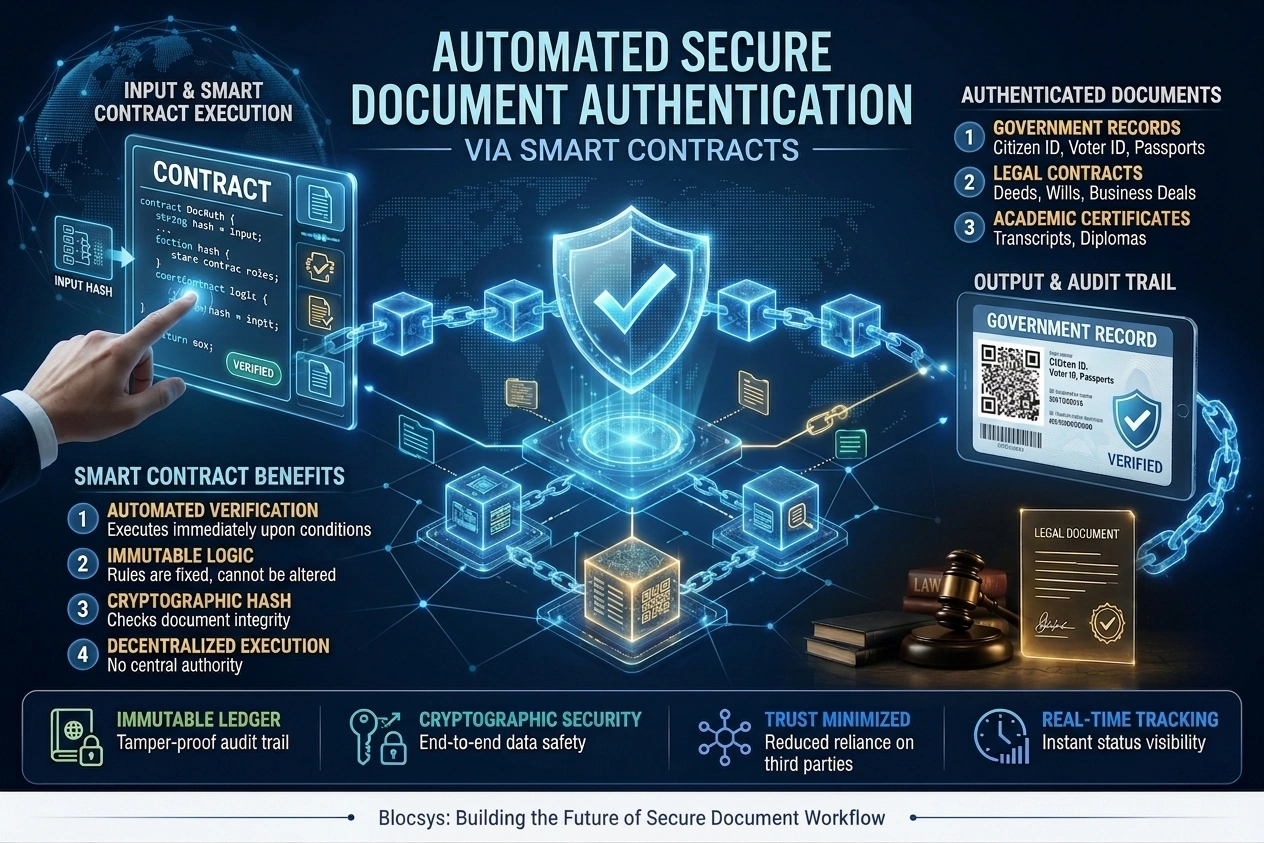
At its core, a smart contract is a self-executing agreement built on a blockchain, designed to automate specific actions when predefined conditions are met. For document authentication, its role is pivotal. When a document is registered on a blockchain, a smart contract creates and locks in its unique digital fingerprint, known as a cryptographic hash. From that moment, the contract automatically and instantly verifies the document against this original hash every time it is accessed or shared, providing tamper-proof validation without human intervention.
This guide is designed for enterprise founders, government agencies, and leaders in healthcare, legal, and compliance-focused sectors. We will explore exactly how smart contracts for document authentication work, why they are superior to legacy systems, and how organizations across Europe, the USA, UAE, and Singapore are already leveraging this technology to build a new foundation of operational trust and efficiency. You will learn the mechanics of smart contract automation, real-world use cases, and the future outlook for AI-powered document verification.
The adoption of blockchain document verification has surged, with enterprise implementation growing by approximately 156% between 2024 and 2026, particularly in regulated industries like financial services and healthcare. The immutability of the blockchain guarantees that once a document’s cryptographic hash is recorded via a smart contract, it cannot be altered without detection. This innovation can eliminate up to 87% of document-related disputes and fraud, with enterprises reporting an average savings of 42% per transaction by removing intermediary costs and enhancing efficiency. Understanding robust data security compliance strategies for enterprises is essential when preparing for this automated future.
Key Automation Functions of Smart Contracts in Document Verification
Smart contracts are not just code; they are autonomous agents executing critical security and verification tasks. The table below summarizes how they perform key functions without human intervention, forming the backbone of automated document verification systems.
| Automated Function | Mechanism | Business Impact |
|---|---|---|
| Integrity Check | Compares a document’s current hash to the original hash stored on-chain. | Guarantees the document is unchanged, preventing forgery and unauthorized edits. |
| Access Control | Executes rules based on predefined conditions (e.g., identity, time, payment). | Enforces permissions automatically, ensuring only authorized parties can view or act on a document. |
| Audit Trail Logging | Records every interaction (view, share, verify) as an immutable transaction on the blockchain. | Creates a transparent, tamper-proof history for compliance and dispute resolution. |
This smart contract automation doesn’t just add a layer of security; it builds a secure document authentication system where trust is the default, not an afterthought.
Table of Contents
- Key Automation Functions of Smart Contracts in Document Verification
- Challenges with Centralized Document Verification Systems
- How Blockchain Creates Tamper-Proof Document Verification Systems
- Comparison: Centralized vs. Blockchain-Based Verification Systems
- Enterprise Use Cases: Smart Contracts in Healthcare and Government
- The Future: AI and Smart Contract Integration for Fraud Prevention
- How Blocsys Develops Secure Smart Contract Verification Infrastructure
- Frequently Asked Questions (FAQ)
- What are smart contracts in document verification?
- How do smart contracts automate secure document authentication?
- What is blockchain-based document verification?
- How do smart contracts prevent document fraud?
- What are tamper-proof document verification systems?
- How secure are blockchain authentication systems?
- What is decentralized document verification?
- How does AI improve smart contract verification systems?
Challenges with Centralized Document Verification Systems
Traditional document verification systems operate on a centralized architecture, much like a fortress with a single gatekeeper. While this model may seem secure, it creates a dangerous single point of failure—a critical vulnerability for enterprises in regulated hubs like Europe, the USA, Dubai, and Singapore. When all sensitive information—from patient records in healthcare to financial statements—is stored in one location, it becomes a high-value target for cyberattacks. A single breach can lead to catastrophic data loss, financial ruin, and irreparable reputational damage.
The Inefficiency and Risk of Manual Processes
Beyond security threats, centralized systems are plagued by operational inefficiencies that hinder growth and inflate costs. They rely heavily on manual checks and human intervention, which introduces several crippling problems:
- Slow Processing Times: Manual document verification is notoriously slow, creating bottlenecks that delay critical business functions like client onboarding, supply chain approvals, and compliance checks.
- High Operational Costs: Employing teams to manually review, compare, and validate documents is expensive and does not scale effectively with business growth.
- Risk of Human Error: Manual data entry and verification are inherently prone to mistakes. These errors can trigger compliance failures, financial losses, and complex legal disputes.
The Hidden Dangers of Data Silos and Internal Fraud
In large organizations, departmental data is often kept in separate, isolated databases known as “data silos.” This fragmentation makes it nearly impossible to achieve a single, trusted view of information across the enterprise. More critically, it creates opportunities for internal fraud.
With data locked away in separate systems, a malicious actor can subtly manipulate records in one silo without it being detected by another. These small, incremental changes can go unnoticed for months or even years, slowly eroding trust and draining company resources.
These systemic flaws—from external breach risks to internal manipulation and crippling inefficiencies—point to one clear conclusion: the centralized model is broken. Its limitations are not just operational headaches; they are fundamental business risks. This necessitates a new model where a decentralized approach, powered by smart contracts for document authentication and blockchain technology, is an enterprise necessity.
How Blockchain Creates Tamper-Proof Document Verification Systems
At its core, blockchain technology functions as a global, incorruptible digital notary, enabling the creation of inherently tamper-proof document verification systems. This is achieved not through human checks but through the immutable rules of cryptography and decentralized consensus. The process begins by generating a unique cryptographic hash for a document—a digital fingerprint representing the entire file. Any change, no matter how small, results in a completely different hash.
The Immutable Ledger and Digital Fingerprints Explained
Once this digital fingerprint is created, it is recorded in a smart contract on a blockchain. This action is analogous to having a document notarized, but with significant technological upgrades:
- Permanent Record: The transaction, including the document’s hash and a precise timestamp, is permanently locked into a “block.”
- Decentralized Security: This block is then copied and distributed across a vast network of computers. No single entity controls the record, eliminating single points of failure.
- Unchangeable History: Each new block is cryptographically chained to the previous one, creating an unbroken and irreversible history of events.
This powerful architecture forms the foundation of modern trust and integrity, allowing organizations to deploy a blockchain-based document authentication system to anchor the authenticity of their most critical assets.
How Does the Blockchain Verification Process Work?
To verify a document’s authenticity, the process is straightforward and absolute. You simply re-calculate the hash of the document in question and compare it to the original hash stored on the blockchain via the smart contract.
There are only two possible outcomes:
- The hashes match: This provides mathematical proof that the document is authentic and has not been altered since it was first recorded.
- The hashes do not match: This provides definitive, undeniable proof that the document has been tampered with.
This verification isn’t based on trust, opinions, or a manual review. It’s a binary, cryptographic certainty that works instantly, anywhere in the world, giving you an immutable source of truth.
When building blockchain compliance systems, it’s crucial to adhere to stringent encryption requirements like those in SOC 2. Blockchain’s cryptographic foundation helps organizations meet these standards by design. For a deeper dive into the core principles, read our guide on what is digital proof of document integrity. This combination of hashing and decentralization is what makes blockchain-based tamper-proof documents superior to vulnerable, centralized alternatives.
Comparison: Centralized vs. Blockchain-Based Verification Systems
For any enterprise today, the choice between a traditional centralized system and a modern, blockchain-based approach is a strategic decision about risk, trust, and future-readiness. For leaders in regulated sectors like healthcare, government, and finance—particularly in markets like the UK, USA, UAE, and Singapore—a clear breakdown of these two models is essential. The core difference lies in their architecture. Centralized systems funnel all data and operations through a single, privately owned database, creating a critical single point of failure. In stark contrast, a blockchain-based decentralized verification system operates on a distributed, shared ledger, eliminating this vulnerability by design.
Security, Trust, and Immutability Models
In a centralized system, trust is placed in the institution controlling the database. Security relies on firewalls, access policies, and human administrators—all of which can be compromised. Fraud, whether internal or external, is a constant threat and can go undetected for extended periods.
Blockchain flips this model by replacing institutional trust with cryptographic certainty. An immutable blockchain authentication system guarantees that once a document’s verification is logged, it cannot be changed or deleted by anyone. This creates a permanent, undeniable source of truth. This is the foundation of a true fraud-proof verification infrastructure.
The infographic below offers a visual summary of the key differences.
As you can see, a secure document verification system built with blockchain is inherently more tamper-proof and resilient.
Head-to-Head Comparison: Centralized vs. Blockchain for Enterprises
To help weigh the ROI and security implications, this table breaks down the most important features of each model.
Centralized vs. Blockchain Document Verification
| Feature | Centralized System | Blockchain-Based System (with Smart Contracts) |
|---|---|---|
| Data Integrity | Vulnerable to alteration, deletion, and internal fraud. | Immutable. Data cannot be changed once recorded, ensuring a tamper-proof audit trail. |
| Security | Relies on a single point of failure; a high-value target for hackers. | Decentralized. Attack vectors are distributed, making a successful breach nearly impossible. |
| Efficiency | Often depends on slow, manual verification processes and human intermediaries. | Automated. Smart contracts execute verifications instantly and without intervention. |
| Transparency | Opaque. Data access and changes are controlled by a central authority. | Transparent. All authorized parties can view the same version of the truth on a shared ledger. |
| Cost | High operational costs due to manual labor, intermediaries, and fraud mitigation. | Lower operational costs by automating processes and eliminating intermediaries. |
Ultimately, this comparison makes the business case clear. For a deeper technical and strategic analysis, you may find our guide on blockchain vs. traditional systems useful. While centralized systems were once the default, the superior security, efficiency, and trust of blockchain verification are making it the new standard for enterprise-grade authentication.
Enterprise Use Cases: Smart Contracts in Healthcare and Government
The theoretical power of smart contracts becomes tangible when applied to high-stakes, regulated industries. For sectors bound by strict compliance frameworks in the USA, UK, UAE, and Germany, smart contract automation is not a luxury—it is a core component for building future-proof, compliant operations. These self-executing agreements provide a powerful framework for trust and efficiency where it matters most, like in healthcare and government document authentication.
Transforming Healthcare with Verifiable and Secure Data
In healthcare, data integrity is often a matter of life and death. Healthcare blockchain verification systems leveraging smart contracts can lock down sensitive information throughout its lifecycle, helping organizations meet stringent standards like HIPAA and GDPR.
- Securing Patient Records (EHRs): A smart contract can serve as a digital gatekeeper for electronic health records. It grants or denies access automatically based on cryptographically verified consent, ensuring only authorized professionals can view data while creating an unchangeable log of every interaction. This is a core function of a secure blockchain authentication platform.
- Ensuring Clinical Trial Integrity: Smart contracts can timestamp and lock in clinical trial data as it is gathered. This produces a tamper-proof audit trail, proving to regulators that results have not been manipulated.
- Validating Pharmaceutical Supply Chains: To combat counterfeit drugs, a smart contract can track a batch of medication from factory to pharmacy. Each handover is logged as a transaction on the blockchain, creating an unbreakable and verifiable chain of custody.
As experts like CatchDiff on contract lifecycle point out, integrating smart contracts significantly enhances security and efficiency in existing workflows.
Modernizing Government with Tamper-Proof Public Records
Government agencies are custodians of our most fundamental data, from property deeds to digital identities. Government blockchain authentication software offers a way to secure public trust with unprecedented transparency and efficiency.
By anchoring public records to a blockchain through smart contracts, governments create a single source of truth that is naturally resistant to fraud, corruption, and human error. This builds public trust by making key processes both transparent and easily verifiable.
For instance, land registries can be tokenized and managed by a smart contract. A property sale automatically triggers the contract to transfer ownership and update the public ledger, eliminating weeks of manual processing. Similarly, governments can issue verifiable digital identities, giving citizens secure control over their personal data. These are practical blueprints for public sector leaders aiming to slash fraud and enhance operational efficiency.
The applications for blockchain document security in healthcare and government are vast. Explore a more detailed breakdown in our guide on blockchain document verification for healthcare, legal, and government records.
The Future: AI and Smart Contract Integration for Fraud Prevention
Looking ahead 12–24 months, the integration of Artificial Intelligence (AI) and smart contract automation is set to create a new paradigm in enterprise security. While smart contracts provide an unbreakable, automated foundation for verification, AI introduces a critical layer of predictive intelligence. This fusion marks a shift from reactive fraud detection to proactive, pre-emptive prevention, which is central to modern blockchain fraud prevention solutions.
Organizations are already adopting “pre-chain” analysis, where AI algorithms analyze a document’s content, structure, and metadata before it is recorded on the blockchain. This is fast becoming a non-negotiable step in high-stakes security workflows.
AI-Powered Anomaly Detection and Autonomous Identity
The next frontier is building systems that not only verify facts but also interpret intent. AI-driven anomaly detection can identify subtle red flags in document workflows that signal sophisticated fraud attempts long before they cause damage.
- AI-Powered Anomaly Detection: Machine learning models trained on millions of legitimate documents develop a deep understanding of “normal.” Any new document that deviates—in its formatting, metadata, or submission pattern—is automatically flagged for review before it can be locked into an immutable record.
- Autonomous Digital Identity: The ultimate vision is a fully autonomous, self-sovereign digital identity managed by a dedicated AI agent. This agent would use smart contracts to execute transactions and confirm attestations with absolute cryptographic certainty, forming the basis of a decentralized identity verification platform.
This fusion of AI’s predictive power with blockchain’s immutable truth creates a powerful defense mechanism, positioning the combined technology as the next major advancement in enterprise cybersecurity and decentralized document verification.
The synergy is profound: intelligent analysis meets unbreakable execution. Learn more about how AI in smart contracts is driving automation’s future in blockchain. This blend of AI-powered verification systems and immutable blockchain authentication systems will become essential for enterprises in regulated sectors, from Dubai and Singapore to the USA and Europe.
How Blocsys Develops Secure Smart Contract Verification Infrastructure
We have explored the “what” and “why” of automated document verification. Now, let’s discuss “how.” At Blocsys, we engineer enterprise-grade, compliant, and globally scalable verification systems. As a trusted blockchain and AI infrastructure engineering company, we don’t just theorize; we build resilient smart contract security infrastructure for leaders in healthcare, government, and finance across regulated markets like the USA, UK, UAE, and Singapore.
Our process begins with designing secure, gas-efficient smart contracts that automate the core logic of your verification system. We then deploy them on robust blockchain networks architected for high availability and throughput.
From Smart Contract Automation to AI-Powered Fraud Prevention
Blocsys integrates AI-powered workflows to add an advanced layer of fraud prevention, creating an intelligent and genuinely tamper-proof document verification platform. Our focus is on building the backend blockchain authentication infrastructure that solves your most complex security and compliance challenges, fundamentally transforming how your organization manages trust.
At Blocsys, we build the underlying systems that make secure, automated, and trustworthy verification a reality. We specialize in smart contract automation, decentralized verification systems, and creating the blockchain cybersecurity infrastructure enterprises need to operate with confidence.
We bring deep engineering expertise to design and execute these complex systems. Our complete methodology is detailed in our guide to enterprise blockchain solutions architecture and implementation.
Whether your goal is securing patient records with a healthcare blockchain verification system, creating tamper-proof public registries with government blockchain authentication software, or streamlining financial compliance, Blocsys delivers the engineering excellence to build, scale, and execute effectively. We help you construct your future operations on a foundation of verifiable trust and intelligent automation.
Frequently Asked Questions (FAQ)
Here are concise answers to common questions enterprise leaders have about using smart contracts for document authentication.
What are smart contracts in document verification?
A smart contract in document verification is a self-executing program on a blockchain that automates authentication. It works by storing a document’s unique cryptographic hash (its digital fingerprint) on an immutable ledger. The contract then automatically enforces rules for access and verification, ensuring that the document’s integrity can be proven instantly without intermediaries.
How do smart contracts automate secure document authentication?
Smart contracts automate authentication by executing predefined rules when conditions are met. When a document is presented for verification, the contract automatically recalculates its hash and compares it to the original hash stored on the blockchain. A match confirms authenticity instantly. This process eliminates manual checks, reduces processing time, and removes the risk of human error.
What is blockchain-based document verification?
Blockchain-based document verification is a method of confirming a document’s authenticity and integrity using a decentralized, immutable ledger. Each document is assigned a unique cryptographic hash that is recorded on the blockchain. This creates a permanent, tamper-proof record that can be used to verify the document’s origin and prove it has not been altered.
How do smart contracts prevent document fraud?
Smart contracts prevent fraud by creating an immutable and transparent record of a document’s history. Once a document’s unique hash is recorded, it cannot be altered. If a document is tampered with, its hash changes. The smart contract will immediately detect this mismatch during verification, instantly flagging the document as fraudulent and making unauthorized changes impossible to hide.
What are tamper-proof document verification systems?
Tamper-proof document verification systems are platforms built on blockchain technology that ensure a document’s integrity cannot be compromised. By recording a document’s cryptographic hash on a decentralized and immutable ledger, these systems create a permanent, verifiable record. Any attempt to alter the document is immediately detectable, guaranteeing its authenticity.
How secure are blockchain authentication systems?
Blockchain authentication systems are exceptionally secure due to their decentralized and cryptographic nature. Unlike centralized systems with a single point of failure, blockchain distributes data across a network of nodes, making it nearly impossible for a single actor to compromise. The use of cryptographic hashing ensures that all recorded data is immutable and tamper-proof.
What is decentralized document verification?
Decentralized document verification is a process that relies on a distributed network (a blockchain) rather than a single central authority to authenticate documents. This approach eliminates single points of failure, enhances security, and provides a transparent, censorship-resistant method for proving a document’s integrity and origin to all authorized parties.
How does AI improve smart contract verification systems?
AI improves smart contract verification by adding a layer of proactive intelligence. While smart contracts verify a document’s integrity based on its hash, AI can analyze the document’s content, metadata, and context before it is submitted to the blockchain. This allows for the detection of sophisticated fraud patterns, anomalies, and potential threats that a standard smart contract might miss, preventing fraud before it happens.
Ready to build a foundation of absolute trust and efficiency for your enterprise documents? Blocsys is a blockchain and AI infrastructure engineering company that builds enterprise-grade, secure, and AI-enhanced blockchain authentication systems. We provide the enterprise smart contract development services and blockchain document verification services that protect your most critical assets.
Contact Blocsys today to discuss building a secure blockchain authentication platform or a tamper-proof document verification solution for your healthcare, government, or legal enterprise.
