
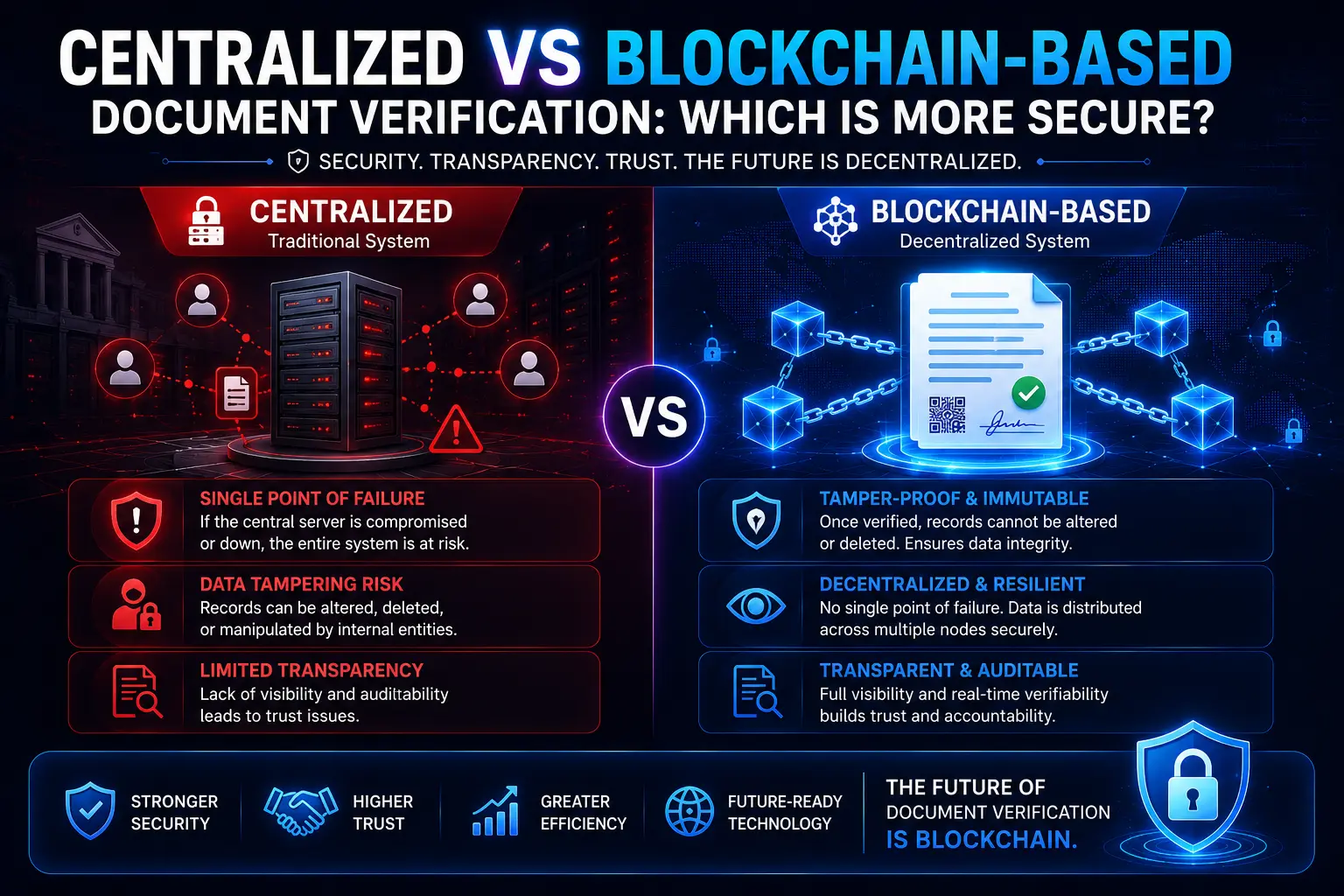
Most boards ask the wrong question about document verification. They ask which model is faster to deploy or easier to integrate. The more important question is which model concentrates risk, and which one contains it.
That distinction matters because the cost of failure isn’t limited to a forged file or a delayed approval. It extends into audit exposure, breach response, regulatory scrutiny, operational downtime, and long-term maintenance of trust across healthcare, government, legal, and fintech workflows. In high-stakes environments, security architecture is a business decision.
For leaders evaluating Centralized vs Blockchain-Based Document Verification: Which Is More Secure?, the answer depends on what you need the system to survive. If the requirement is basic record lookup, centralized tools can still work. If the requirement is tamper evidence, durable auditability, and resilience against single-point compromise, blockchain-based verification has a structural advantage.
Table of Contents
- Understanding the Security Risks of Centralized Document Verification
- How Blockchain Creates Tamper-Proof Document Authentication
- Security and Compliance A Direct Comparison
- Real-World Applications in Healthcare and Government
- The Future of Verification AI and Decentralized Identity
- Build Your Enterprise Blockchain Verification Infrastructure with Blocsys
- Frequently Asked Questions
- Is blockchain-based document verification always more secure than centralized verification
- Can blockchain verification support privacy laws such as GDPR or DPDP
- Should healthcare records be stored directly on a blockchain
- Does blockchain remove the need for manual review
- Is blockchain verification harder to integrate with existing enterprise systems
- What should a board ask before approving a verification platform
Understanding the Security Risks of Centralized Document Verification
A centralized document verification system usually follows a familiar client-server pattern. Documents are uploaded to a single application stack, checked against rules or databases, and stored in a centrally managed repository under one operator’s control.
That model is common because it’s straightforward to build and easy to govern at first. It also creates the very condition attackers look for. A single administrative plane, a single storage tier, and a single trust boundary.
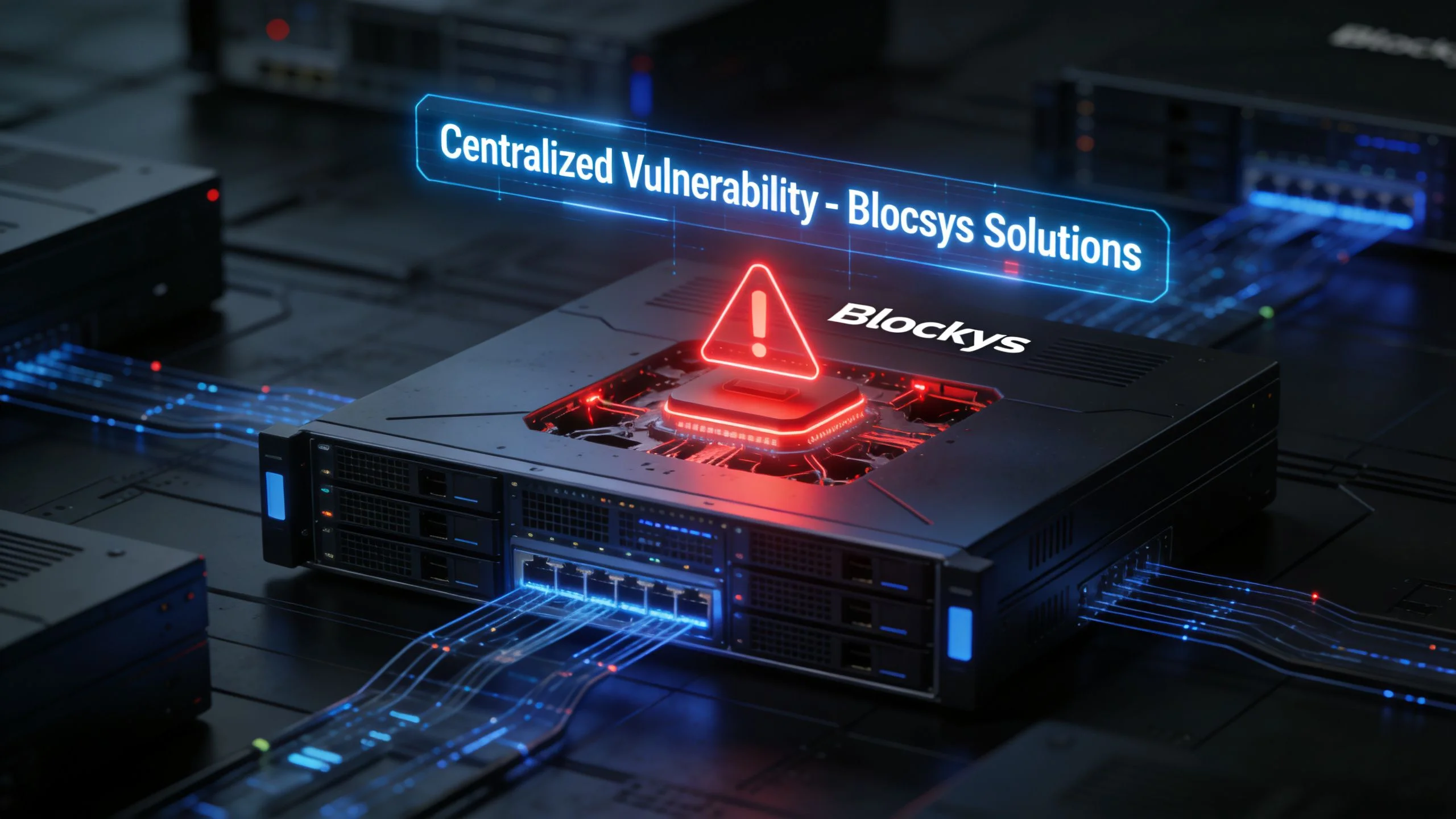
How centralized verification works
In most enterprise deployments, the workflow looks like this:
- Document intake happens through a portal, API, or internal application.
- Validation logic checks formatting, metadata, issuer details, or human review queues.
- Storage and status logging happen in a central database.
- Re-verification or audit retrieval depends on the same platform remaining accurate, available, and uncompromised.
This isn’t automatically insecure. The weakness comes from the concentration of authority. If an attacker compromises the database, admin console, backup chain, or privileged user account, they can affect the system of record itself.
Why the architecture creates concentrated risk
The security problem isn’t just breach likelihood. It’s breach blast radius.
A single repository becomes a high-value target for ransomware, credential theft, insider manipulation, and silent record tampering. India’s experience shows how severe that can become. Centralized KYC databases faced 1,247 reported cyber incidents in 2025, the CoWIN portal breach exposed over 100 million vaccination certificates, and 68% of Indian fintechs reported data tampering in a 2025 cybersecurity audit, according to research published in IJCRT.
Practical rule: When the same platform stores documents, controls permissions, and owns the audit log, compromise of one control plane can compromise all three.
This is why boards should look beyond perimeter tooling and ask whether the underlying design can support meaningful cybersecurity incident prevention. Detection tools help, but they don’t remove the architectural issue that a central repository remains a single point of failure.
A second-order risk appears during compliance review. Centralized systems often make auditability dependent on internal logs that the same operator can modify or lose. That weakens evidentiary confidence during disputes, investigations, or regulator requests. Security teams then spend more time proving integrity after the fact, rather than relying on a system that preserves integrity by design.
For organisations managing regulated records, this becomes an information governance problem as much as a cyber problem. That’s why security leaders increasingly connect document verification decisions to broader information security risk management, not just application procurement.
How Blockchain Creates Tamper-Proof Document Authentication
Blockchain-based verification changes the trust model. Instead of asking users and auditors to trust a central operator’s database, it records proof of a document’s integrity on a distributed ledger using cryptography.
The document itself doesn’t need to be exposed publicly. What gets anchored is typically a hash, which acts like a unique fingerprint. If even one character changes, the fingerprint changes too.
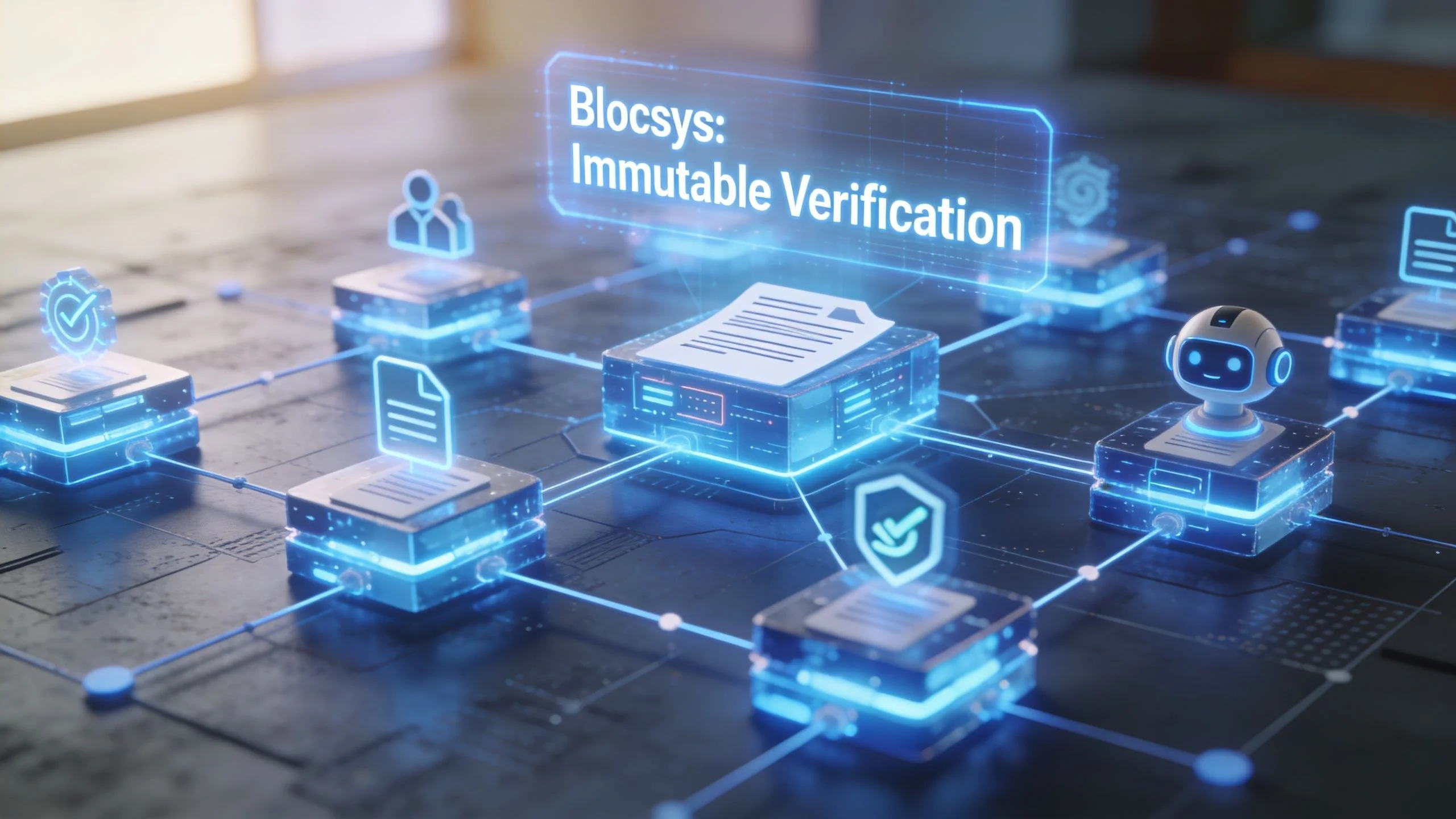
The verification model in practical terms
A secure blockchain verification workflow usually has three layers.
First, hashing. The system generates a cryptographic digest for a document at the moment of issuance or approval. That digest becomes the integrity reference.
Second, decentralized recording. The digest is written to a blockchain network, where multiple nodes validate and preserve the record. Because the ledger is distributed, no single administrator can secretly rewrite history.
Third, programmable verification. Smart contracts can automate who may submit a proof, how revocation is handled, and how a verifier checks authenticity. That reduces manual handling and makes the process consistent.
A useful way to think about this model is that blockchain doesn’t make forged documents impossible to create. It makes them much harder to pass off as authentic when verifiers compare the presented file against an immutable on-chain proof.
For readers who want a parallel example outside document verification, this Defacto Labs guide on food origin data shows the same core principle. A distributed record is valuable because provenance matters as much as storage.
What immutability means for audit and trust
Immutability is often described in abstract technical language. For boards and risk teams, the practical meaning is simpler. Once a valid record of a document’s fingerprint is committed, neither the issuing organisation nor a malicious insider can alter that proof without leaving evidence.
That changes audit posture in four ways:
- Tamper evidence becomes built-in. You don’t need to infer alteration from logs alone.
- Cross-party verification becomes easier. A regulator, hospital, bank, or agency can validate integrity against a shared proof.
- Dispute handling improves. The argument shifts from “which system should we trust?” to “does the hash match?”
- Operational trust no longer depends on one database.
India’s National Informatics Centre showed what this looks like in practice. A 2024 NIC pilot using Hyperledger Fabric for academic credential verification achieved 100% tamper detection accuracy across 50,000 documents and reduced verification time from 7 days to 2 minutes, as reported in IJARSCT.
That result matters less as a headline speed gain and more as a proof point. When verification is cryptographic and automated, organisations spend less effort reconciling trust across disconnected systems.
A short explainer helps visualise the mechanics:
In enterprise settings, smart contract design is where much of the control discipline lives. It is through this discipline that secure document authentication with smart contracts moves from theory into enforceable workflow.
The strongest blockchain verification designs don’t store sensitive personal data on-chain. They store proofs, references, and rules, while protected data remains off-chain under controlled access.
Security and Compliance A Direct Comparison
Security teams often compare centralized and blockchain systems at the feature level. That’s too shallow for regulated sectors. The better comparison is how each model behaves under stress, audit, and legal scrutiny.
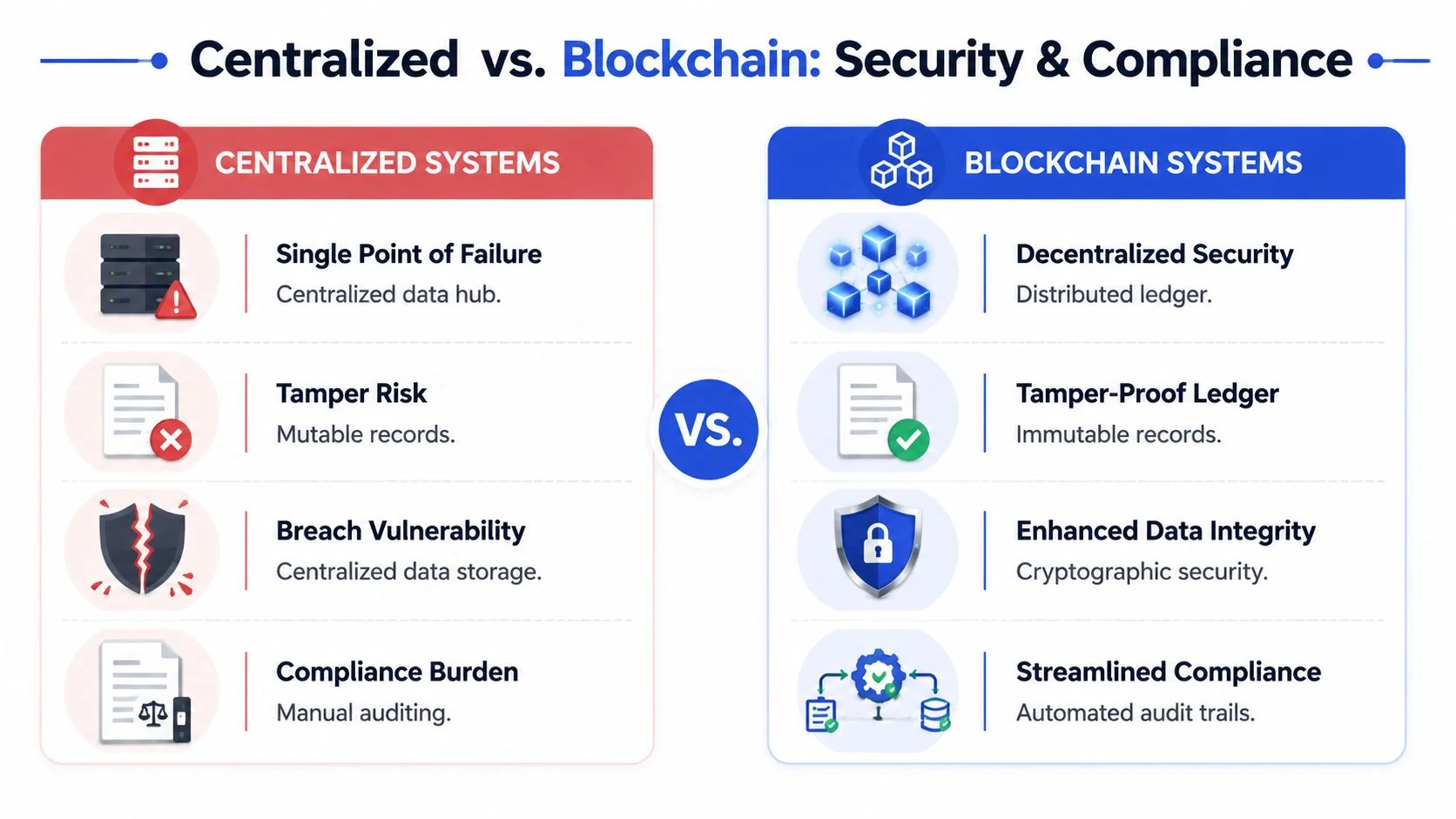
Centralized vs Blockchain Verification
| Attribute | Centralized Systems | Blockchain-Based Systems |
|---|---|---|
| Trust model | Depends on one operator and one system of record | Depends on cryptographic proof and distributed consensus |
| Tamper resistance | Records can be altered by privileged access or compromise | Integrity proofs are immutable once anchored |
| Failure mode | Single point of failure | Distributed resilience |
| Auditability | Audit logs are often platform-dependent | Verification can be independently checked |
| Compliance posture | Heavy reliance on process controls and reconciliations | Stronger evidentiary trail when designed with off-chain privacy controls |
| Long-term cost of risk | Breach response, manual audits, and dispute handling can accumulate | Upfront design discipline can reduce recurring verification and audit burden |
Where the security gap becomes a board issue
Centralized systems usually look cheaper until you account for the full cost of control. They require defensive layers around storage, privileged access management, log integrity, backup assurance, and exception handling. None of that is wasted investment, but it does mean the architecture needs more compensating controls.
Blockchain-based systems shift that equation. They don’t remove security responsibilities, but they reduce dependence on mutable internal records as the final source of truth.
The clearest data point in the verified set comes from fintech. A 2026 KPMG India analysis found that Polygon-powered document systems in RBI-regulated fintechs reduced verification costs by 87% to INR 50 per document and detected 100% of tampering attempts, compared to a 40% detection rate in centralized systems, according to IJSAT.
That should interest boards for two reasons.
First, it shows that tamper detection isn’t just a security quality metric. It affects fraud exposure, rework, and response cost.
Second, cost reduction at the verification layer can be misleading if interpreted narrowly. The bigger gain is often in reduced compliance friction, fewer disputes over document provenance, and less dependence on manual exception review.
Compliance is an architecture choice
For GDPR, DPDP, HIPAA, and similar frameworks, the key question isn’t whether blockchain is compliant in the abstract. It’s whether the implementation minimises personal data exposure and preserves clear control boundaries.
That usually means:
- Keeping personal or clinical data off-chain and storing only hashes, identifiers, or revocation references on-chain.
- Using selective disclosure models so verifiers see only the minimum required claim.
- Separating issuance, storage, and presentation so no single actor controls the entire trust chain.
- Retaining clear revocation and governance processes for credentials, access, and policy changes.
Board view: Compliance teams prefer systems that make evidence easier to produce and harder to dispute. That’s where immutable verification becomes commercially valuable, not merely technically interesting.
A centralized platform can meet regulatory requirements, but it often does so through policy overlays and manual evidence gathering. A well-designed blockchain system can encode more of that trust into the infrastructure itself. That doesn’t eliminate legal and operational work. It lowers the amount of trust you must place in mutable databases and internal reconciliation.
For organisations weighing blockchain and traditional systems, the practical conclusion is clear. In high-security environments, blockchain verification isn’t just a different stack. It’s a different control model.
Real-World Applications in Healthcare and Government
The strongest argument for blockchain-based document authentication appears when record integrity affects real-world rights, care, or entitlements. Healthcare and government are the clearest examples because both sectors carry high compliance obligations and low tolerance for unverifiable records.
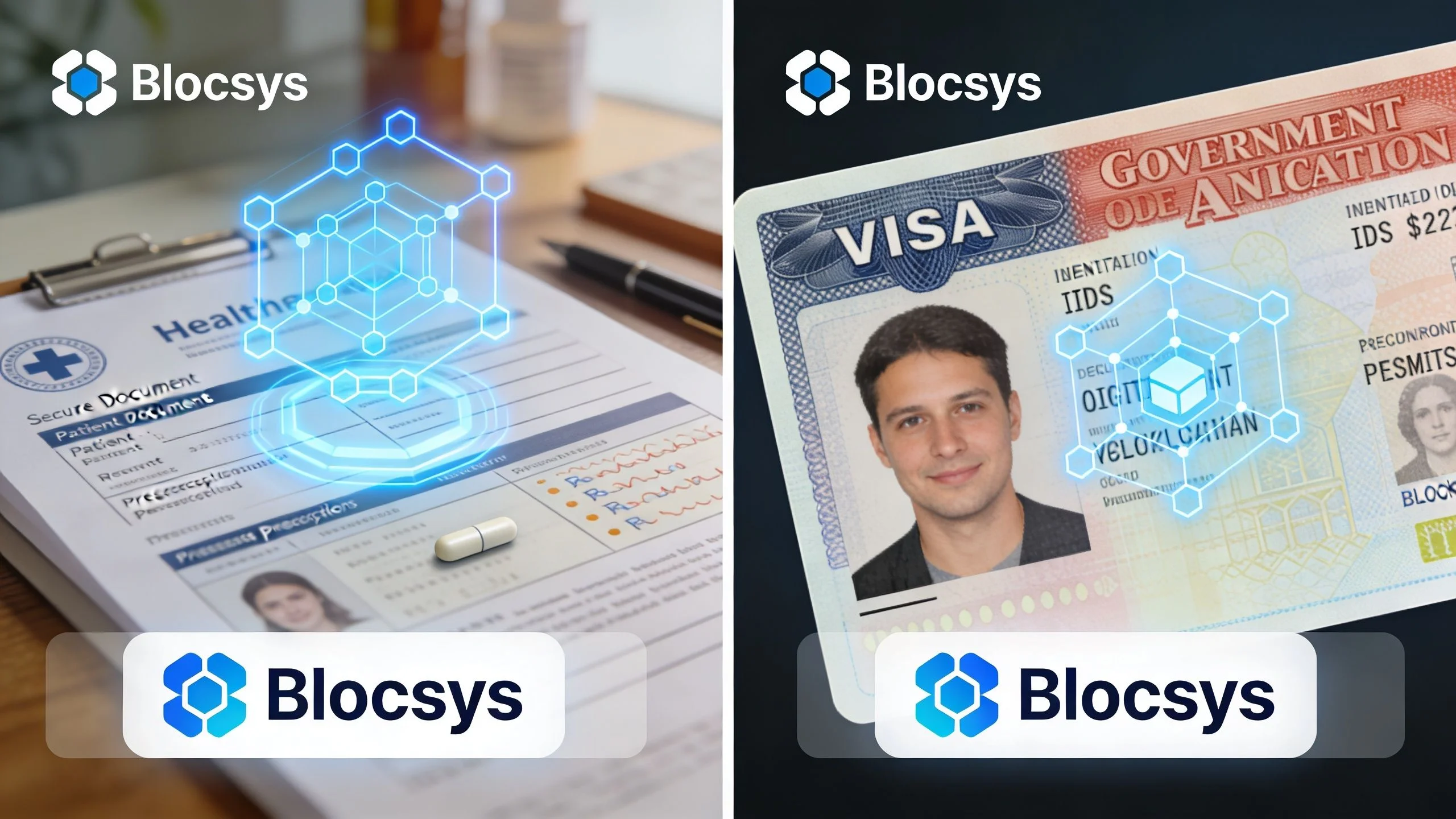
Healthcare verification where integrity affects care delivery
Hospitals and health systems don’t just verify documents. They verify identities, clinician credentials, consent artefacts, discharge records, referrals, laboratory outputs, and sometimes supply-chain records tied to treatment. If those workflows depend on central databases that can be altered, delayed, or rendered unavailable, the risk is operational as well as regulatory.
A blockchain-based model is particularly useful where multiple parties must trust the same proof without sharing one database. Examples include:
- Clinician credential verification across hospital groups, licensing bodies, and staffing vendors.
- Patient consent records where timestamp integrity matters during dispute or audit.
- Inter-organisational referrals where receiving providers need confidence that records haven’t been modified.
- Pharmaceutical and device traceability where provenance affects safety and liability.
The practical benefit isn’t that every health record belongs on a blockchain. It doesn’t. The benefit is that high-value proofs can be anchored immutably while sensitive data remains controlled off-chain. That helps satisfy privacy expectations while improving evidentiary confidence.
In healthcare, a delayed or disputed verification event can interrupt treatment, credentialing, reimbursement, and breach reporting all at once.
This is why many healthcare leaders are moving toward a layered architecture. Clinical data stays in governed systems of care delivery. Verification proofs, credential claims, and approval artefacts use decentralised trust rails.
Government verification where trust must outlast the platform
Government agencies face a different version of the same challenge. Public trust depends on records remaining authentic across administrative changes, vendor transitions, and long retention periods.
That makes blockchain especially relevant for:
- Land and property records
- Educational and professional certificates
- Licences and permits
- Judicial and legal evidence chains
- Citizen identity and eligibility claims
These use cases require more than availability. They require confidence that a document presented years later is the same one that was originally issued, and that any change followed a valid process.
A modern blockchain verification platform for healthcare and government records supports that by separating what must remain private from what must remain provable. Agencies can preserve control over sensitive data while giving verifiers a durable authenticity layer.
The long-term advantage is institutional, not merely technical. Governments outlive software contracts. If authenticity depends entirely on one vendor’s database or archive format, the public record becomes weaker over time. If authenticity depends on portable cryptographic proof, the record can remain verifiable even as systems evolve.
That matters in legal technology as well. Courts, registries, and compliance teams care less about where a file was stored than whether its chain of authenticity is defensible.
The Future of Verification AI and Decentralized Identity
The next stage of document verification won’t be blockchain alone. It will be AI at ingestion plus blockchain at proof, combined with decentralized identity standards that reduce unnecessary data exposure.
That combination addresses a problem both centralized and blockchain systems face. A document can be cryptographically preserved after submission, but it still needs to be inspected intelligently before trust is anchored.
AI should inspect before blockchain preserves
AI is most useful at the front of the workflow. It can classify document types, detect anomalies in layout or metadata, flag suspicious edits, identify mismatches between declared and observed attributes, and route exceptions to human review.
In a mature architecture, AI doesn’t replace trust. It triages risk.
That distinction is important for regulated organisations. If AI makes a probabilistic assessment and blockchain preserves a deterministic proof, the two together create a stronger verification chain than either technology can provide alone. AI helps detect what looks wrong. Blockchain proves what was accepted and when.
A sensible future-state stack often looks like this:
- AI-based pre-screening for fraud signals and document anomalies.
- Human or policy review for exceptions and high-risk claims.
- Hash anchoring on blockchain for accepted records or credentials.
- Ongoing revocation and presentation controls for downstream verifiers.
This approach improves security without forcing organisations to over-disclose data. It also creates a more defensible operating model when auditors ask not just what was approved, but how approval decisions were made.
Decentralized identity changes the operating model
Decentralized identity shifts verification away from repeated data collection and toward reusable proofs. Instead of every hospital, agency, or financial platform storing a fresh copy of a user’s sensitive documents, trusted issuers can provide Verifiable Credentials that a holder presents when needed.
The verifier checks authenticity cryptographically. The issuer doesn’t need to be contacted each time. The holder can often disclose only the required claim.
That has several consequences for enterprise architecture:
- Data minimisation becomes easier because organisations collect fewer raw documents.
- Cross-border and cross-entity verification improves because credentials are portable.
- Data sovereignty strategy gets cleaner because fewer systems need to retain full copies of regulated records.
- Vendor lock-in risk declines because the proof model is more portable than a proprietary archive.
The strategic shift isn’t from paper to digital. It’s from storing copies everywhere to proving authenticity anywhere.
Over the next 12 to 24 months, the winners in verification won’t be the firms with the largest document vaults. They’ll be the ones with the strongest trust fabric. That means cryptographic proof, privacy-aware credential design, AI-assisted fraud detection, and governance that can survive platform change.
Build Your Enterprise Blockchain Verification Infrastructure with Blocsys
For enterprises deciding where to place trust, the conclusion is straightforward. Centralized verification can still serve low-risk workflows, but it carries structural weaknesses that become expensive in regulated environments. Blockchain-based verification offers a stronger architecture for tamper evidence, audit resilience, and long-term integrity.
That matters most when the organisation handles sensitive records, cross-entity verification, or public-facing trust obligations. Healthcare providers, government agencies, legal platforms, fintechs, and compliance-driven enterprises need more than a document repository. They need verification infrastructure that stands up under scrutiny.
Blocsys builds that kind of infrastructure. The team focuses on production-ready blockchain and AI systems for secure, scalable, enterprise-grade operations. That includes document authentication workflows, smart contract automation, digital identity verification patterns, and verification stacks designed for high-volume regulated use cases.
If you’re evaluating a move from mutable, centralised verification toward a stronger trust model, a purpose-built blockchain document verification system is the right starting point. The business case isn’t only about fraud reduction. It’s about lowering the total cost of risk across security, compliance, disputes, and platform maintenance.
Frequently Asked Questions
Is blockchain-based document verification always more secure than centralized verification
For high-stakes use cases, usually yes. The main reason is architectural. Blockchain-based systems reduce reliance on one mutable database and one administrative control plane. That gives them a stronger position on tamper evidence, auditability, and resilience. For simple internal workflows with low risk, centralized tools may still be sufficient.
Can blockchain verification support privacy laws such as GDPR or DPDP
Yes, if it’s designed correctly. The safer pattern is to keep personal data off-chain and place only hashes, references, or credential proofs on-chain. That supports data minimisation and reduces exposure. Compliance depends on implementation choices, governance, and access controls, not on the word blockchain by itself.
Should healthcare records be stored directly on a blockchain
In most cases, no. Healthcare organisations should keep protected health information in governed systems and use blockchain to anchor integrity proofs, credential claims, or consent artefacts. That preserves privacy while improving authenticity and audit confidence.
Does blockchain remove the need for manual review
No. It changes where manual effort is spent. Teams still need governance, exception handling, policy controls, and security operations. What blockchain reduces is the need to trust mutable internal logs as the only proof that a document is authentic.
Is blockchain verification harder to integrate with existing enterprise systems
It can be integrated incrementally. Most organisations don’t replace every repository or workflow at once. They start by anchoring high-value proofs, adding credential verification layers, or automating specific approval chains. The right design works alongside existing IAM, document management, and compliance systems.
What should a board ask before approving a verification platform
Boards should ask five things:
- What happens if the core database is compromised
- Can an insider alter records without immediate evidence
- How will we prove authenticity during an audit or dispute
- Where is regulated data stored and who controls it
- What is the long-term cost of operating this trust model
Those questions reveal more than a feature checklist ever will.
If your organisation is assessing tamper-proof verification for healthcare, government, legal, fintech, or digital asset workflows, Blocsys Technologies can help you design the right architecture. Blocsys builds enterprise blockchain and AI infrastructure for secure document authentication, decentralised verification systems, and fraud-resistant compliance workflows. To evaluate your current verification risks or plan a production-ready blockchain implementation, connect with Blocsys for expert guidance.
