
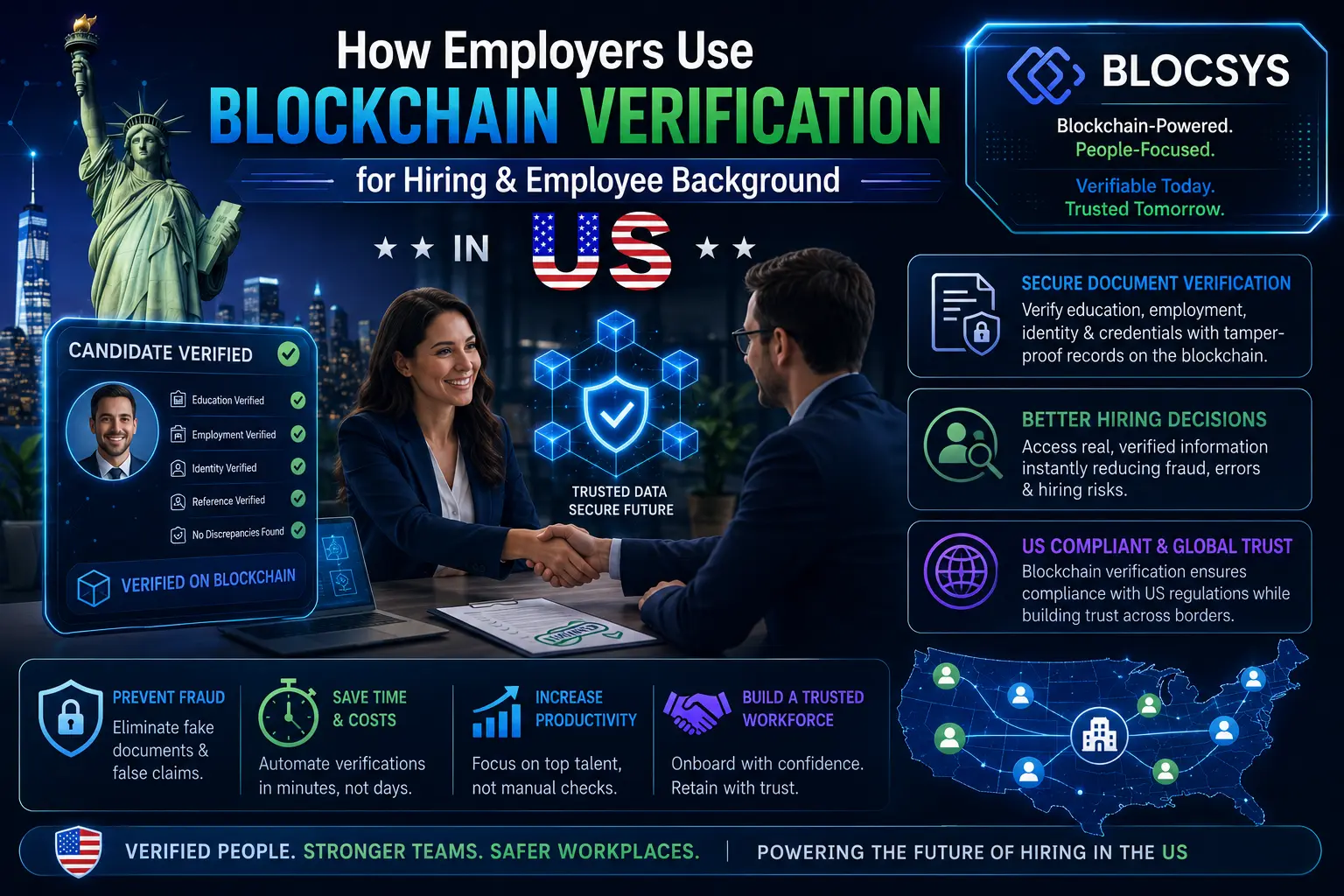
A hiring manager has a finalist lined up, the team needs the role filled, and the offer is ready. Then the verification process stalls. One former employer doesn’t reply. A university registrar asks for a manual request. A PDF certificate looks real, but no one is fully sure. The recruiter waits, the candidate gets frustrated, and the business carries the risk.
That situation is common across enterprise hiring. Traditional background verification still depends on phone calls, emails, PDFs, and fragmented records spread across schools, prior employers, staffing firms, and screening vendors. It works, but it often works slowly and inconsistently. It also creates openings for document tampering, unverifiable claims, and privacy headaches.
Blockchain employee verification is a model where trusted issuers, such as employers, universities, or certification bodies, create digitally verifiable credentials that a candidate can share securely. The hiring team then checks cryptographic proof of authenticity and timestamp integrity instead of relying only on repeated manual confirmation.
In the U.S., the shift towards digital credentials is already underway. The American Council on Education reported that by 2023, over 9 million digital credentials had been issued through its Learning and Employment Record ecosystem, a useful signal that employers now have a growing base of records that can be verified and shared digitally through blockchain-based hiring verification models.
For HR leaders, founders, recruitment platforms, and compliance teams, the practical question isn’t whether blockchain sounds modern. It’s whether it reduces friction without creating new legal or operational problems. Teams that already identify and analyze fraud know the core issue is rarely one fake document alone. It’s weak process design, poor chain of custody, and too many manual handoffs.
That’s why the useful conversation is about operations, not hype. If you’re evaluating tamper-resistant workflows for hiring, this guide to blockchain-based document verification and fraud prevention is a relevant starting point. The rest of this article focuses on how employers use blockchain verification for hiring and employee background in the US, what proves effective, and where the limits still are.
Table of Contents
- Introduction The Growing Problem of Hiring Fraud
- Why Traditional Employee Verification Systems Are Failing
- How Blockchain Hiring Verification Works A Practical Explainer
- Real-World Use Cases for Tamper-Proof Workforce Authentication
- Navigating Compliance and Risk in the US Hiring Market
- How Blocsys Builds Enterprise-Grade Blockchain Verification Systems
- Frequently Asked Questions About Blockchain in HR
Introduction The Growing Problem of Hiring Fraud
Hiring teams don’t usually lose confidence because of one bad actor. They lose confidence when the process itself keeps forcing them to guess. A degree may be valid, but the registrar is slow. A previous employer may exist, but the records are archived. A licence may be current, but the proof arrives as a screenshot.
That’s where hiring fraud becomes more than a security issue. It becomes an operating model problem. Recruiters need speed. Compliance officers need auditability. Candidates want control over their records. Legacy verification rarely gives all three at once.
The practical pressure on HR teams
Manual verification creates friction in places employers can least afford it:
- Recruiting bottlenecks: offer approvals wait on callbacks and email trails.
- Inconsistent evidence: one candidate submits PDFs, another sends scans, another relies on a screening vendor.
- Privacy exposure: teams often collect more raw data than they need, just to verify one fact.
- Dispute risk: if a record is challenged later, proving chain of custody can be messy.
Practical rule: If a hiring workflow depends on repeated phone and email confirmation for the same facts, it won’t scale cleanly.
Blockchain verification matters because it changes the proof model. Instead of asking every issuer to reconfirm the same claim each time, the issuer creates a verifiable credential once. The candidate shares that proof when needed. The employer verifies authenticity without starting from zero.
Why this matters now in the US
The U.S. market is a strong fit for this model because employment verification is highly fragmented. Schools, former employers, certifying bodies, staffing partners, and screening vendors often sit in separate systems. Digital credentials create a more reusable layer across those handoffs.
The primary appeal is not replacing background checks wholesale. It’s strengthening the most repetitive checks first, especially education, certifications, and employment history. Those are the records that often slow down hiring while adding little strategic value through manual repetition.
Why Traditional Employee Verification Systems Are Failing
Legacy verification systems aren’t failing because HR teams are careless. They’re failing because the architecture is old. The process assumes each new employer should re-run the same checks from scratch, gather the same documents again, and contact the same issuers again.
That creates drag in every market, but especially in large organisations and regulated sectors where multiple functions touch the same record.
The process breaks at the handoff points
The weakest part of traditional verification is the handoff between systems and institutions. The issue isn’t just speed. It’s inconsistency.
A typical failure pattern looks like this:
- Candidate submits static files. PDFs and scans are easy to alter and hard to validate at scale.
- Recruiter forwards documents. Each transfer adds a new place for error or delay.
- Vendor or HR team contacts issuer. Response times vary, and records may be incomplete or inaccessible.
- Evidence gets stored locally. Later reviews depend on whether someone retained the right version.
This creates several operational gaps:
- Fraud risk stays high: visual inspection doesn’t prove authenticity.
- Turnaround is unpredictable: one missing response can hold up the entire file.
- Data quality degrades: records get duplicated across inboxes, portals, and spreadsheets.
- Candidate experience suffers: applicants keep re-submitting information they’ve already proven elsewhere.
For teams comparing models, this overview of centralised versus blockchain-based document verification security is useful because it frames the issue as a system design problem, not just a tooling choice.
Traditional vs. Blockchain Employee Verification
| Metric | Traditional Verification | Blockchain Verification |
|---|---|---|
| Speed | Often depends on manual follow-up and third-party response times | Verification can be near real time once trusted credentials exist |
| Security | Relies heavily on documents, screenshots, and local storage | Uses cryptographic proof, issuer signature, and immutable timestamp |
| Fraud resistance | Tampered files can be difficult to catch consistently | Altered records are easier to detect because proof integrity is checked |
| Candidate control | Employer or vendor often gathers and stores broad datasets | Candidate can share selected proofs rather than full raw records |
| Audit trail | Evidence may be scattered across email chains and portals | Verification logs are more structured and defensible |
| Reusability | Same facts are often re-verified repeatedly | Verified credentials can be reused across roles and employers |
Traditional screening is document-centric. Blockchain verification is proof-centric.
That distinction matters. Employers don’t need every raw document every time. In many cases, they only need reliable proof that a claim is authentic and issued by a trusted source.
How Blockchain Hiring Verification Works A Practical Explainer
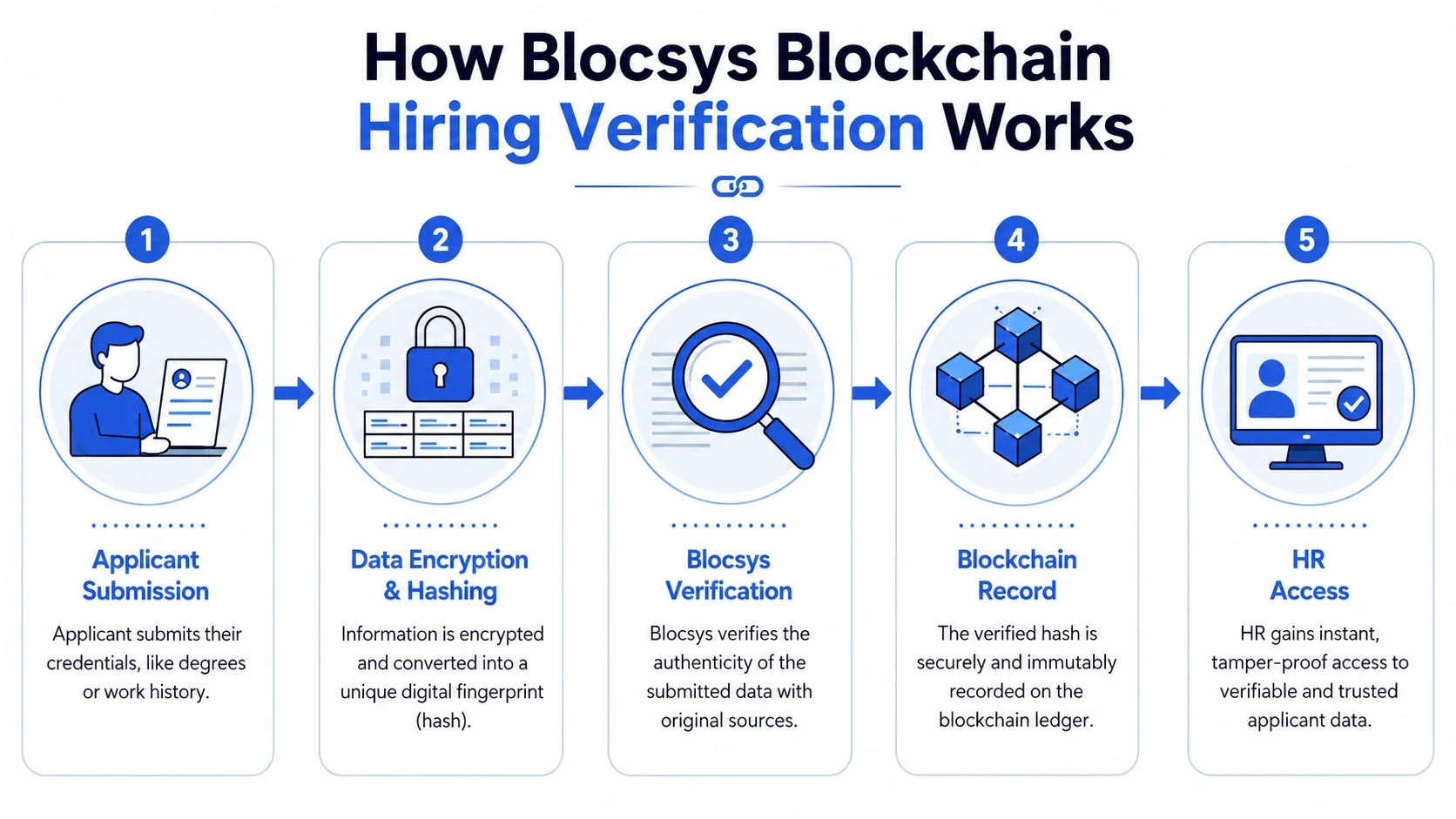
Blockchain hiring verification works as a trust layer under existing hiring and background check workflows. For HR teams and compliance owners, the practical value is straightforward. It creates a reliable way to confirm that a credential came from a recognized issuer, has not been altered, and is still valid at the time of review.
A typical hiring scenario makes the model clear. A candidate applies for a role that requires a degree, an active license, and prior employment in a regulated setting. Instead of sending PDFs, screenshots, and manual contact details for each institution, the candidate shares digitally signed credentials. The employer’s system verifies the issuer, checks the credential status, and records the result in an audit trail that can support internal review and downstream compliance processes.
That does not replace FCRA-governed screening or other regulated checks. It improves the front end of verification by reducing document handling, shortening manual review cycles, and limiting exposure to unnecessary personal data.
The three operational stages
Credential issuance
The process starts with a trusted issuer such as a university, former employer, licensing board, or certification provider. After confirming the underlying fact, the issuer creates a digital credential with a cryptographic signature and timestamp.
In most enterprise deployments, the blockchain does not hold the full document. It stores a proof artifact, hash, or reference that makes unauthorized changes detectable. That design matters because HR teams need verification strength without exposing raw employee data on a public record.
Employee-controlled sharing
The candidate stores the credential in a wallet or secure credential repository and shares it during the hiring process. Decentralised identifiers help tie that credential to the right person without requiring broad disclosure of the source record.
This changes the data flow. The employer can request proof of a specific claim, such as license validity or degree completion, instead of collecting a full file and sorting through fields that are irrelevant to the hiring decision. For privacy, retention, and access control, that is a meaningful operational improvement.
Instant verification by the hiring team
The employer or screening platform verifies the issuer signature, timestamp, revocation status, and credential integrity. If the checks pass, the hiring team has defensible evidence that the submitted claim is authentic and current.
The operational benefit is consistency. Recruiters, HR operations, and compliance staff are no longer relying on email chains, scanned attachments, or repeated calls to verify the same fact. They are reviewing machine-verifiable proof with a clear record of who checked what and when.
A well-designed blockchain HR workflow reduces unnecessary data collection and gives hiring teams clearer evidence for audit and compliance review.
Where smart contracts fit
Smart contracts handle policy enforcement around verification workflows. They do not replace judgment, and they do not decide whether a candidate should be hired. They make sure the system follows predetermined rules every time.
Common uses include:
- Issuer controls: only approved institutions can issue specific credential types.
- Access controls: only authorized users or systems can request or validate credentials.
- Consent logging: candidate approval can be recorded before a credential is shared or checked.
- Audit records: verification events can be written to a traceable log for internal oversight.
- Status management: expired or revoked credentials can be flagged before a file reaches final review.
Teams building these workflows often need a more technical view of how smart contracts automate secure document authentication. If the verification stack also connects to identity, ATS, payroll, or screening vendors, this essential guide for API integration is a useful companion because trust in the credential layer still depends on sound access control and system-to-system authentication.
Real-World Use Cases for Tamper-Proof Workforce Authentication
The most practical blockchain hiring systems don’t start with a full HR overhaul. They start with a narrow, repeated verification problem that causes measurable friction.
High-volume hiring across distributed teams
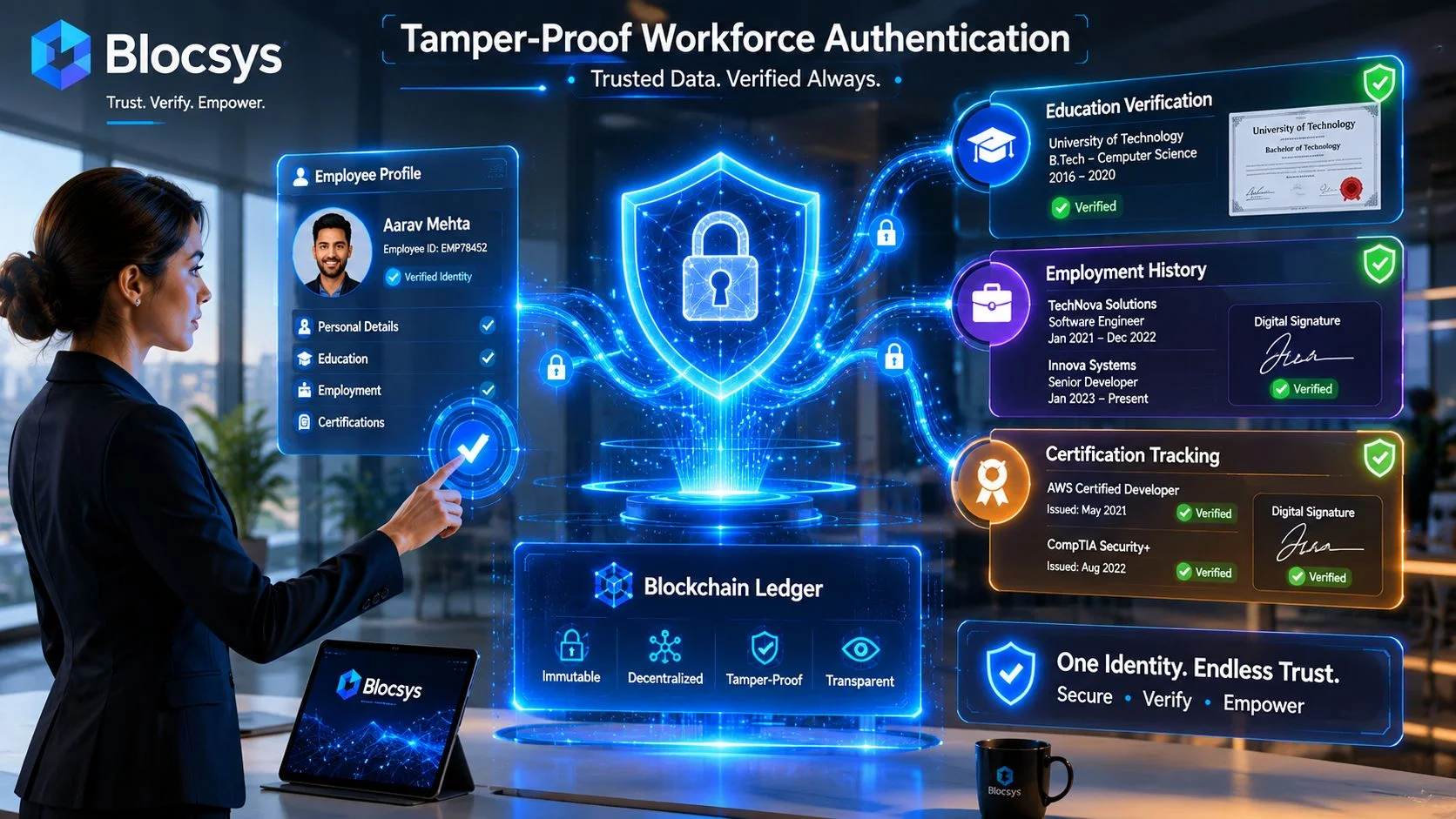
A common use case is remote or multi-state hiring where recruiters need to verify education and employment history quickly. In those environments, delays often come from repeated requests to separate institutions and past employers.
Industry coverage has noted that when credentials are blockchain-verified, background checks that used to take weeks can be completed in minutes, especially as self-sovereign identity and wallet-based credentials became more visible in HR workflows during the early 2020s through employee-owned data sharing models described by SHRM.
What works well here:
- Education checks at scale: engineering, sales, and operations roles often need the same degree verification pattern.
- Repeatable contractor onboarding: staffing firms can reuse verified claims across multiple client placements.
- Cross-border team hiring: the proof model is more portable than email-based back-and-forth.
What doesn’t work well is trying to push every possible hiring signal on-chain from day one. Enterprises get better results when they target narrow credential categories first.
Regulated credential checks in healthcare and finance
In healthcare, finance, and similar sectors, employers don’t just need speed. They need confidence that a credential hasn’t been altered and that the proof can stand up during internal review.
The strongest pattern is to use blockchain for issuer-backed records such as licences, certifications, and employment history, then connect that layer to the broader screening workflow already required by policy.
A useful operational fit includes:
- Clinical roles: confirm training and licence-related credentials before role assignment.
- Financial services roles: validate certification history and prior-employment claims with stronger proof integrity.
- Vendor and contingent labour checks: maintain a reusable verification layer for workers moving across engagements.
For organisations exploring certificate integrity specifically, this tamper-proof digital certificates guide is closely aligned with the education and employee verification use case.
A short explainer helps when teams need to socialise the concept internally:
Internal mobility and skills verification
One of the most overlooked use cases is inside the company. Enterprises often struggle to verify internal credentials when employees change teams, apply for promotions, or move into compliance-sensitive projects.
Blockchain-based workforce authentication can support:
- Internal skills passports: employees present verified training and project credentials.
- Role eligibility checks: managers confirm whether a person meets baseline requirements before reassignment.
- Reusable audit records: HR and compliance teams can review who verified what, and when.
This use case tends to succeed because the issuer network is smaller and governance is easier. The enterprise already controls many of the issuing processes.
Navigating Compliance and Risk in the US Hiring Market
A lot of blockchain hiring content stops at speed and fraud prevention. That’s not enough for U.S. employers. The harder question is whether the system fits regulated hiring practice.
Blockchain is a control layer, not a legal shortcut
For U.S. hiring, blockchain’s most practical value is chain-of-custody integrity. Once an issuer records a credential hash or proof on-chain, later edits are detectable. That creates an auditable log that is more defensible during compliance reviews. At the same time, industry guidance is clear that blockchain generally complements rather than replaces regulated background checks because employers still need identity validation, authorisation, and jurisdiction-specific controls, as described in this analysis of blockchain background checks and auditable screening logs.
That distinction matters under frameworks such as FCRA and EEOC-related hiring obligations. A tamper-resistant record does not remove the need for notice, consent, dispute handling, or role-specific screening policy. It only makes the evidence layer stronger.
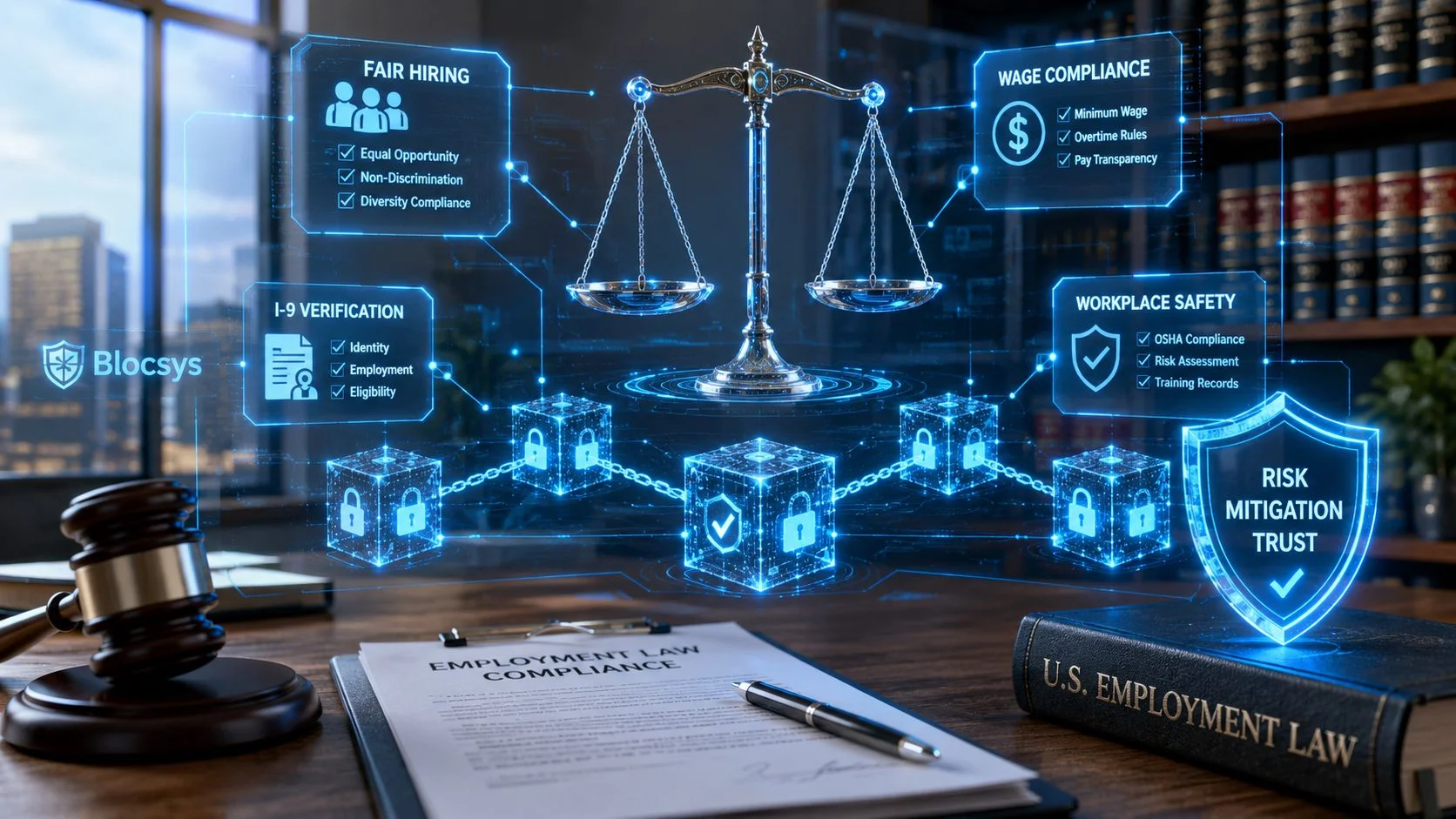
Employers don’t reduce legal exposure by adding blockchain alone. They reduce exposure by designing blockchain into a compliant workflow.
What compliant design looks like
The right design principles are operational, not theoretical:
- Consent-first workflows: candidates should authorise how credentials are shared and verified.
- Selective disclosure: verify the fact required for the job, not the full underlying file.
- Dispute handling: candidates need a process to challenge inaccuracies or outdated records.
- Retention controls: blockchain evidence should fit the company’s broader record governance model.
- Human review points: adverse decisions should never be delegated blindly to automated proof checks.
This is also where governance becomes the actual barrier. The unresolved question for many employers isn’t whether blockchain can verify a credential. It’s whether the organisation can manage issuer trust, privacy expectations, and regulated process design in a disciplined way. That’s consistent with the broader concern raised in PEO Metrics’ compliance guidance and with enterprise needs for structured frameworks such as this Web3 regulatory compliance model.
How Blocsys Builds Enterprise-Grade Blockchain Verification Systems
Most enterprises don’t need a generic blockchain app. They need a verification system that fits existing hiring operations, identity controls, and compliance review paths.
What enterprises actually need from the stack
The stack usually has five parts:
- Issuer management so only approved institutions or employers can create trusted credentials.
- Credential architecture using verifiable credentials and privacy-aware disclosure patterns.
- Workflow automation for consent, verification triggers, logging, and exception handling.
- Integration layers that connect HRIS, ATS, screening vendors, and internal admin systems.
- Governance controls covering access, retention, and audit review.

For companies building this capability rather than buying a narrow point solution, Blocsys Technologies works as an infrastructure engineering partner for secure blockchain and AI-powered platforms. In this context, the relevant fit is custom verification architecture, smart contract workflow design, and enterprise-grade integration support across identity and compliance systems.
A practical build path usually starts small. Pick one reusable credential type, one issuer network, and one business process where verification delays are already visible. Then harden governance before expanding.
Frequently Asked Questions About Blockchain in HR
How does blockchain improve employee background verification
Blockchain improves employee background verification by making issuer-backed credentials easier to authenticate and harder to tamper with. Instead of relying only on files and callbacks, employers can verify cryptographic proof tied to a trusted issuer. That reduces repetitive manual checks and creates cleaner audit trails.
What is blockchain hiring verification
Blockchain hiring verification is the use of distributed ledger-based proof, digital signatures, and verifiable credentials to confirm hiring-related claims such as education, certifications, or employment history. In practice, it works as a trust layer under the hiring process, not as a full replacement for every screening step.
How does blockchain prevent fake employee credentials
It prevents many fake credential scenarios by making alterations detectable. If a candidate changes a record after issuance, the proof no longer matches the issuer-backed signature or timestamp. Employers can then verify whether the credential is authentic without depending only on visual document review.
Is blockchain legally safer than standard background checks in the US
Not automatically. A major employer concern is whether blockchain is legally safer than standard background checks, but background screening in the U.S. still sits within regulated frameworks such as FCRA and EEOC-related requirements. The harder part is governance, not technical feasibility, so systems need proper consent, notice, and dispute resolution design, as noted in this discussion of blockchain’s legal and compliance limits in background verification.
How can a company start building a blockchain HR verification system
Start with one high-friction verification category, usually education, certifications, or prior employment. Define trusted issuers, map consent and review steps, connect the workflow to existing HR systems, and keep legal teams involved early. The best implementations are narrow at first, then expand once governance and user experience are proven.
If your organisation is evaluating blockchain employee verification, tamper-proof hiring authentication, or decentralised workforce verification infrastructure, Blocsys Technologies can help you assess the architecture, compliance design, and integration approach needed to build it responsibly. Connect with Blocsys to discuss a practical roadmap for secure hiring verification systems, digital credential workflows, and enterprise-grade blockchain infrastructure.
