
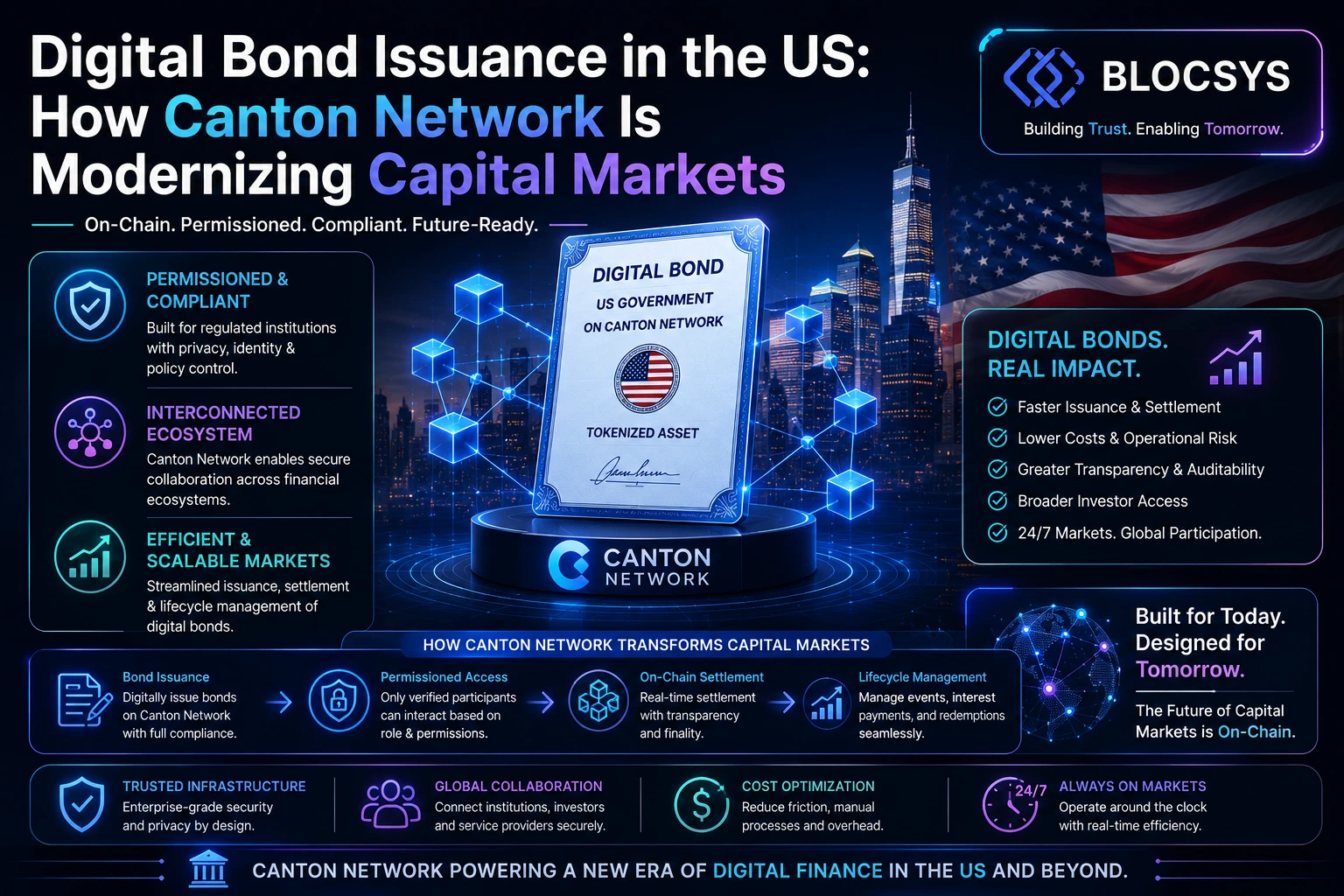
The US bond market is already enormous. SIFMA reports that US corporate bond issuance reached $1,013.9 billion through April 2026, with average daily trading at $39.6 billion. That scale changes how digital bond issuance should be viewed. This isn’t a story about replacing capital markets. It’s a story about upgrading the operational layer inside one of the world’s deepest markets.
For banks, infrastructure providers, and institutional investors, the key question isn’t whether tokenized bonds are interesting. It’s whether networks such as Canton can fit into existing issuance, registrar, custody, and servicing processes without introducing new operational fragility. That’s where most high-level coverage stops too early.
This analysis is for institutions evaluating digital bond issuance in the US and the role of Canton Network in modernising capital markets infrastructure. If you’re assessing tokenized securities platforms, smart contract servicing, or blockchain post-trade workflows, the outcome you need is practical clarity: what changes, what doesn’t, and where the true adoption constraints sit.
Table of Contents
Understanding Digital Bond Issuance and Tokenized Securities
Frequently Asked Questions About Digital Bonds and Canton Network
The Trillion-Dollar Challenge in US Capital Markets
More than $1 trillion in U.S. corporate bond issuance has already come to market this year, and average daily trading remains measured in tens of billions, as noted earlier. At that scale, the economic case for digital issuance is not based on replacing a broken market. It rests on reducing the cost of coordination inside a market that already works, but works through many separate ledgers, service providers, and control points.
Europe’s recent growth in digital fixed-income issuance adds a second signal. The strategic question for U.S. institutions is no longer whether tokenized debt can be issued at all. It is whether digital workflows can fit the existing operating model of U.S. capital markets without creating legal ambiguity or operational fragmentation.
Where the friction still sits
The pressure point is not the bond launch itself. It is the post-issuance operating cycle.
A conventional bond may involve issuers, underwriters, counsel, paying agents, registrars, custodians, depositories, and investor servicing teams, each maintaining records for a different purpose. That structure has proved durable, but it also creates recurring reconciliation work. Ownership records, payment obligations, transfer restrictions, and exception handling often move across multiple systems before they are treated as final.
That is why firms evaluating distributed ledger infrastructure for financial markets are focusing less on digitizing the front-end issuance event and more on compressing the number of recordkeeping handoffs across the bond lifecycle.
Three operating realities shape the problem:
Issuance is periodic: Teams can tolerate manual effort for a defined execution window.
Servicing is persistent: Coupon events, investor updates, and corporate actions create ongoing operational load.
Transfers depend on record alignment: Secondary activity only scales cleanly when entitlement, cash, and position data stay synchronized across participants.
For institutions, the operational burden is often hidden in exception queues rather than headline issuance volumes. A failed record update or mismatched position can trigger downstream work across custody, settlement, and investor reporting teams long after pricing day.
Practical rule: In bond modernization, the largest efficiency gains usually come from reducing duplicate records, approval loops, and lifecycle exceptions.
This is also why production examples matter more than pilot announcements. The relevant benchmark is not whether a token can represent a bond. It is whether a digital bond can coexist with registrars, custody arrangements, payment processes, and legal servicing obligations that institutional investors already rely on. For readers who want broader context on the instruments behind these workflows, learn about financial assets.
Why this is a capital markets redesign issue
The strategic implication is straightforward. A credible digital bond model must fit into the current U.S. market structure while improving how information, entitlement, and cash events are coordinated.
That raises a more disciplined evaluation standard for banks, issuers, and buy-side firms. The question is whether a network can support issuance, servicing, and transfer in a governed workflow, while preserving regulated roles, auditability, and fallback procedures. Institutions that treat digital bonds as an infrastructure redesign effort are more likely to identify where value appears, and where integration risk still sits.
Understanding Digital Bond Issuance and Tokenized Securities
A digital bond is a bond whose issuance and lifecycle processes are managed through digital ledger infrastructure rather than only through conventional record systems. A tokenized security is the digital representation of a legally recognised financial instrument. The token doesn’t replace the underlying legal claim on its own. It acts as the operational representation of that claim within the system designed to issue, hold, transfer, and service it.
What a digital bond actually is
In practical terms, digital bond issuance combines familiar bond mechanics with a new operating layer:
Security terms still matter: Maturity, coupon structure, investor rights, and legal documentation remain central.
Smart contract logic can automate events: Coupon and principal workflows can be triggered according to pre-defined terms.
Ledger records can improve consistency: Ownership and transaction history become easier to audit within a shared, permissioned environment.
For readers who want a quick refresher on how securities fit into broader investment structures, this overview of financial assets and investment securities is a helpful primer before moving into tokenized issuance mechanics.
The important distinction is that tokenization doesn’t automatically create efficiency. The benefit appears only when issuance, investor onboarding, entitlement records, settlement logic, and servicing are connected end to end. Otherwise, firms just add a digital layer on top of an unchanged manual process.
Why Quincy mattered
The strongest US proof point so far is public finance. ICMA’s tracker of fintech applications in bond markets identifies the City of Quincy, Massachusetts’ $10 million bond deal on 25 April 2024, completed with J.P. Morgan’s Digital Debt Service on its Onyx Digital Assets platform, as the first bond in the United States issued on a blockchain-based platform.
That matters for two reasons.
First, it moved digital issuance from concept to execution in a live US public-finance use case. Second, it showed that tokenized bond workflows could support real municipal borrowing rather than staying confined to lab environments and pilots.
Here’s the operational takeaway many readers miss. Quincy was not important because it proved blockchain can store a bond record. It was important because it showed a US issuer could borrow through a blockchain-based issuance workflow tied to actual market practice.
A digital bond becomes meaningful when the issuer, investors, and service providers can all rely on the same workflow without duplicating the truth across disconnected systems.
Institutions thinking about real-world asset tokenization in blockchain systems should read Quincy as a signal that legal and operational design now matter more than novelty.
What Is the Canton Network Blockchain Architecture
Canton is best understood as a network architecture for regulated financial workflows, not as a generic public-chain pitch repackaged for institutions. Its relevance to capital markets comes from the fact that participants often need to share state and coordinate transactions without exposing all data to every other participant.
A network built for regulated participants
That design goal sounds simple, but it addresses a core institutional constraint. Banks, registrars, custodians, and issuers need interoperability, yet they also need strict control over data visibility, permissions, and workflow boundaries.
In that sense, Canton operates more like a secure financial internet than a single shared book where every participant sees everything. Different institutions can run applications that interoperate, while each party keeps control over the information it’s permitted to disclose.
Three architecture features matter most in capital markets:
CapabilityWhy institutions carePrivacy controlsBond workflows often involve sensitive investor, trading, and servicing dataSmart contract executionLifecycle events can be encoded into controlled, repeatable processesInteroperabilitySeparate applications and market roles can coordinate without one institution surrendering system control
For firms comparing infrastructure models, this discussion of multi-chain API patterns for businesses is useful context because it highlights a broader systems problem: interoperability is only valuable when it preserves operational control.
Why privacy and interoperability matter together
Earlier enterprise ledger efforts often struggled with a walled-garden problem. A firm could digitise part of its workflow, but cross-institution coordination remained awkward because each platform became its own silo.
Canton’s strategic appeal is that it aims to avoid that trap. In bond markets, that means an issuer-side process, a registrar function, a custody function, and an investor-facing record can remain distinct while still synchronising key events.
The architecture only matters if it lets institutions coordinate on shared facts without forcing them into a single operational stack.
That’s why the technology discussion has to stay grounded in market structure. A bond network isn’t useful because it is distributed. It’s useful if it supports a regulated division of responsibilities while reducing the reconciliation work created by that same division.
For teams designing enterprise systems, modular blockchain architecture approaches are especially relevant because bond infrastructure rarely gets rebuilt as one monolith. It gets assembled as an interoperable operating model.
How Canton Network Modernizes Capital Market Infrastructure
The most important question in digital bond issuance isn’t how a token gets created. It’s who runs the post-issuance machinery, where the authoritative record sits, and how the workflow connects to existing market roles.
That’s where the US digital bond issued by Societe Generale provides a more useful signal than generic “tokenization is coming” commentary.
The market plumbing is the real story
Societe Generale-FORGE’s account of its US digital bond states that the transaction used Broadridge’s tokenization capability on Canton, with Societe Generale-FORGE acting as registrar, and that the infrastructure was built for issue, trade, and manage functions with embedded privacy, credential management, and direct investor ownership capabilities.
That is the practical clue. The operational bottleneck isn’t issuance alone. It’s whether a tokenized bond can slot into regulated functions such as registrar activity, investor ownership records, trade processing, and lifecycle management without creating parallel processes that staff then have to reconcile manually.
What changes in a production workflow
In a conventional bond setup, market participants often maintain multiple records that must be compared and updated over time. In a Canton-based model, the workflow can be organised around a shared but permissioned ledger process.
A simplified production pattern looks like this:
Issuance logic is created through a controlled application that reflects the bond’s legal and economic terms.
The registrar role remains explicit, which matters because ownership and entitlement records still need clear governance.
Investor access is credentialed, so transfer and holding conditions can be enforced inside the workflow.
Lifecycle events are automated, including coupon and principal actions where the operating model allows it.
Trade and management functions stay connected, reducing the need to rebuild the bond’s history across disconnected systems.
The key insight is that tokenization doesn’t erase capital-markets roles. It rewires how those roles coordinate.
A registrar still matters. Custody still matters. Legal documentation still matters. What changes is the sequencing and reliability of the data exchanges between them.
To see why institutions care about this layer, the discussion around blockchain post-trade reconciliation platforms is directly relevant. The pain point in bond markets is often not the transaction itself, but the repetitive operational effort required to prove that each participant’s record matches everyone else’s.
This short video gives additional context on how these workflows are being discussed in practice:
A practical operating model for US institutions
The strongest current design pattern is a hybrid model. Institutions use DLT for issuance, immutable event records, and smart-contract-based servicing logic, while retaining conventional legal documentation and fallback servicing rails.
That hybrid model is strategically important because it lowers adoption risk. It allows a bank or issuer to modernise workflow orchestration without pretending the surrounding legal and operational ecosystem has already been fully rebuilt.
If a digital bond platform can’t support issuance, servicing, and transfer in one governed workflow, it hasn’t modernised the market. It has only digitised one step.
For US institutions, that’s the main relevance of Canton. It offers a way to connect digital workflows to market infrastructure that already has assigned roles, controls, and liabilities.
Key Benefits and Use Cases for Financial Institutions
The value case for digital bond issuance is often summarised as “efficiency”. That’s too vague to be useful. Institutional buyers need to know where the operational advantage appears and which teams capture it.
Where banks and investors gain operational value
For investment banks and dealers, the clearest gain is process integrity. A workflow that links issuance terms, investor permissions, ownership records, and lifecycle servicing reduces the need for repeated manual confirmation across separate systems.
For investors, the gain is less about novelty and more about confidence in the asset record. When transfer history, entitlement logic, and transaction state are kept in a controlled ledger environment, it becomes easier to verify who holds what and under which conditions.
For infrastructure providers and market operators, tokenized bonds create a path to more programmable post-issuance servicing.
Coupon automation: Smart contract logic can trigger payment processes according to pre-defined terms.
Ownership traceability: A governed ledger can provide a clearer chain of state changes than fragmented off-ledger updates.
Operational continuity: A well-designed platform can preserve regulated roles instead of forcing firms into an all-or-nothing migration.
Where tokenized bonds are most usable today
The strongest current use cases tend to share one feature: they benefit from controlled participant sets and clear workflow governance.
Institutional userImmediate use caseWhy it fits nowIssuersDigital primary issuanceFewer handoffs at launch and cleaner lifecycle setupBanksRegistrar and servicing workflowsBetter control over record integrity and event automationAsset managersPermissioned holdings and transfersClearer rules around investor access and asset movementMarket infrastructure firmsIntegrated issue-trade-manage servicesReduces fragmentation across workflow stages
These benefits shouldn’t be overstated. They don’t eliminate every legacy dependency. Cash settlement, identity controls, and legal enforceability still need to be coordinated carefully.
But the strategic upside is real. If institutions can align issuance, servicing, and transfer under one controlled architecture, they reduce the amount of operational labour spent maintaining consistency after the deal closes.
Future Outlook and Overcoming Adoption Hurdles
Fourteen rated digital bond issues totaling USD 1.6 billion over the 18 months to mid-2024 is enough to show production viability, but not enough to suggest broad market conversion. In ION’s review of digital bond momentum, citing S&P Global’s observations, the binding constraints were not core cryptography. They were legal fragmentation, weak interoperability across platforms, and limited secondary market depth.
That distinction matters for strategy. Canton and similar networks do not need to prove that tokenized securities can exist on regulated infrastructure. They need to prove that issuance, registrar functions, custody records, entitlement changes, cash settlement coordination, and exception handling can work together with less reconciliation than the current model. For U.S. institutions, adoption will expand only when those connections are reliable enough for operations, compliance, and control teams to sign off.
The next phase is therefore less about launching more pilots and more about tightening production workflow design. A bank evaluating digital bond issuance over the next 12 to 24 months should test whether the proposed model can support the full post-issuance chain, including servicing events, transfers, books and records, and failover to conventional processes when required.
A useful evaluation framework includes:
Legal enforceability: Whether tokenized records map cleanly to offering documents, transfer restrictions, and existing market conventions
Operational completeness: Whether the platform supports lifecycle servicing, not just issuance-day token creation
Infrastructure connectivity: Whether it can coordinate with custodians, registrars, cash systems, and internal control environments
Fallback procedures: Whether the firm can maintain continuity if a digital workflow needs manual intervention or parallel recordkeeping
Many programs stall. The hard problem is not writing smart contract logic for coupons or transfers. The hard problem is designing a controlled operating model around exceptions, entitlements, reconciliations, and responsibility boundaries across multiple regulated parties.
That is why the analogy in software risks for AI product founders is useful. In both cases, failure tends to emerge from integration design, process assumptions, and edge-case handling rather than from the headline technology itself.
For institutions building a longer-term roadmap, this practical framework for institutional blockchain adoption in 2026 is a relevant reference point. The firms that gain ground will not be the ones making the broadest tokenization claims. They will be the ones that can fit DLT into existing U.S. market plumbing, improve control points without adding new operational breaks, and show that digital issuance can function under production conditions rather than controlled demos.
Building Your Digital Asset Infrastructure with Blocsys
Institutions exploring digital bonds usually don’t need a generic blockchain build. They need infrastructure that can support tokenization logic, permissioned workflows, lifecycle automation, and integration with existing financial systems.
That’s where implementation discipline matters. A workable programme typically includes smart contract design for security terms, issuer and investor workflow controls, audit-friendly event records, and clear interfaces to registrar, custody, and compliance functions.
One option in that build category is Blocsys Technologies, which works on production-focused blockchain and AI infrastructure for digital asset platforms. In practice, that kind of support is most relevant when firms need to translate strategy into systems such as a blockchain development company model for enterprise delivery, real world asset tokenization infrastructure, or crypto trading platform development.
The key is not choosing a vendor based on tokenization language alone. The better test is whether the team can design around institutional constraints:
Governed asset logic
Lifecycle servicing workflows
Integration with existing operational roles
Security review and fallback procedures
Digital bond issuance becomes useful when architecture, legal process, and operations are designed together. Without that alignment, institutions end up with a pilot. With it, they get infrastructure.
Frequently Asked Questions About Digital Bonds and Canton Network
QuestionAnswerWhat is digital bond issuance?It’s the process of issuing and managing a bond through digital ledger infrastructure so that issuance records, ownership changes, and lifecycle events can be coordinated in a governed digital workflow.What are tokenized securities?Tokenized securities are digital representations of legally recognised financial instruments. The token reflects the asset within a digital system, but legal rights still depend on the governing issuance structure and documentation.How does Canton Network differ from a public blockchain used for crypto assets?Canton is designed for regulated financial workflows where privacy, permissions, and role-based data sharing are essential. That makes it more suitable for institutions that can’t expose full transaction data across an open network.How do smart contracts help in bond markets?They can automate operational events such as coupon and principal workflows, provided the surrounding legal, servicing, and settlement design supports that automation.Why are institutions interested in tokenized bonds?The main attraction is operational. Institutions want cleaner issuance-to-servicing workflows, stronger record consistency, and better coordination across market roles such as registrars, investors, and infrastructure providers.What is the biggest barrier to adoption right now?Market structure. Legal fragmentation, limited interoperability across platforms, and weak secondary liquidity remain bigger constraints than the ledger technology itself.
If your team is evaluating digital bond issuance, tokenized securities infrastructure, or institutional blockchain workflows, Blocsys Technologies can help you assess the operating model, map the integration points, and build production-ready systems for tokenization, servicing, trading, and compliance. Connect with Blocsys to discuss how your organisation can move from experimentation to deployable capital-markets infrastructure.
AI Is Enhancing DeFi Strategies for Tokenized Fixed-Income Assets
Artificial intelligence is transforming DeFi asset management by enabling data-driven investment strategies for tokenized financial assets. Advanced AI models can continuously analyze corporate bond yields, corporate bond spreads, market volatility, and on-chain transaction data to optimize portfolio performance and identify emerging investment opportunities. Combined with enterprise blockchain applications, these intelligent systems provide greater transparency, automated risk assessment, and real-time decision-making for decentralized investment platforms. As real-world asset (RWA) tokenization continues to expand, asset managers are increasingly using AI to automate portfolio rebalancing, improve liquidity management, and strengthen compliance monitoring across digital investment ecosystems. This combination of AI, blockchain, and tokenized fixed-income assets enables more efficient, secure, and scalable asset management while helping institutional and enterprise investors make informed decisions in rapidly evolving financial markets. Businesses looking to build next-generation DeFi investment platforms can leverage Corporate Bond Tokenization Platform solutions to tokenize fixed-income assets and create intelligent, blockchain-powered investment ecosystems.
