
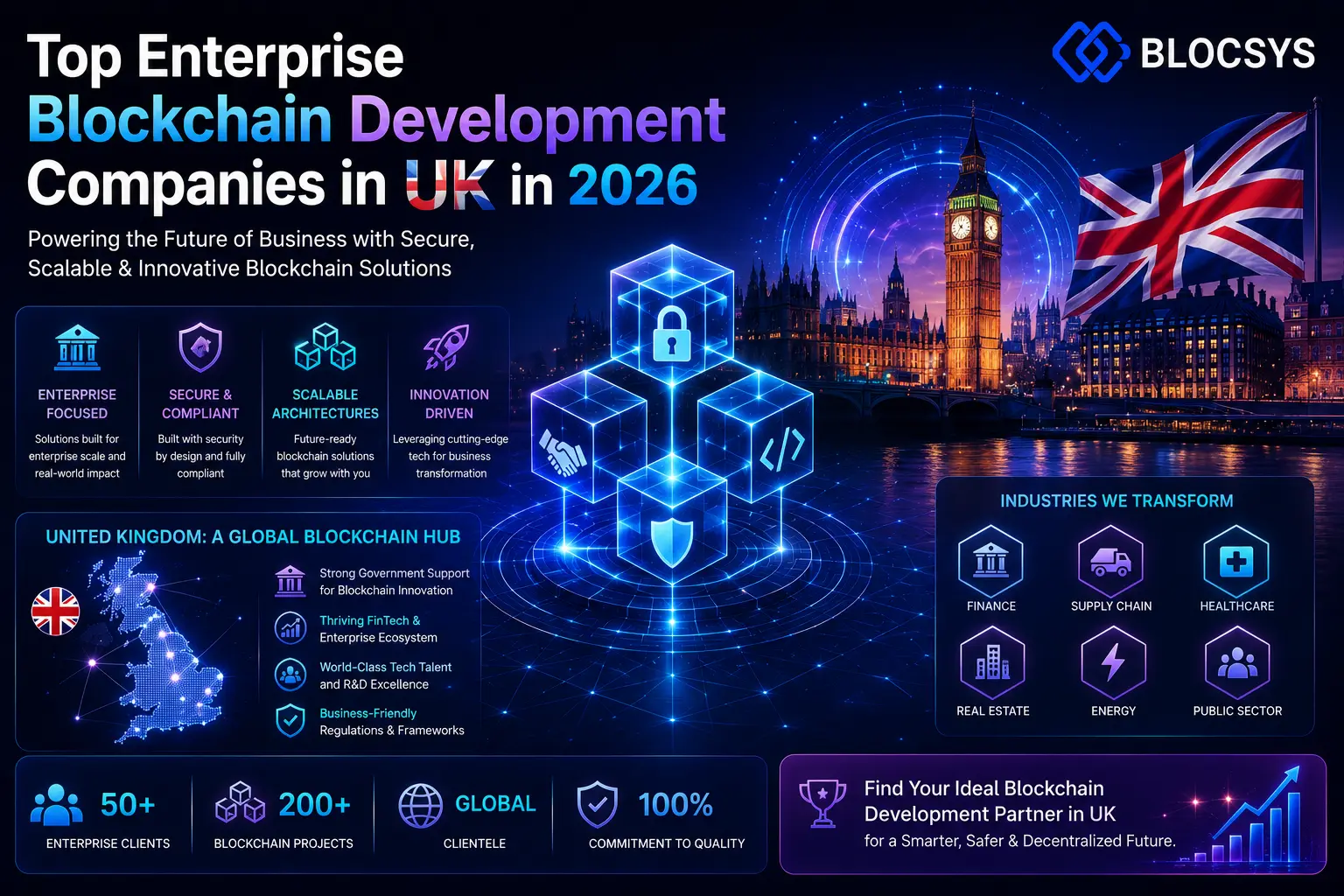
Top Enterprise Blockchain Development Companies in UK in 2026
Finding the right enterprise blockchain development company UK businesses can trust with production systems is harder than scrolling a vendor list. The UK blockchain market was valued at USD 1.1 billion in 2025 and is projected to reach USD 74.8 billion by 2034, a 58.30% CAGR from 2026 to 2034. For CTOs, CIOs, and fintech founders, that growth changes the buying question. It is no longer who can build on-chain products. It is who can deliver systems that survive compliance review, integrate with enterprise workflows, and scale past pilot stage.
Most roundups stop at a vendor list. That is not enough for a serious buying decision. Enterprises shortlisting an enterprise blockchain development company UK teams can rely on need a sharper lens: when to commission a custom build, when to integrate a platform, and when specialist capability in tokenisation, smart contracts, or ledger architecture matters more than general software delivery. This guide adds a ranking methodology, a cost comparison, and trust signals so the decision comes with fewer blind spots.
Why Enterprise Blockchain Is Mission-Critical in 2026
Enterprise blockchain in the UK has moved past experimentation. Consequently, the category is now tied to production priorities such as audit trails, asset issuance, permissioned data sharing, and integrations with core systems. This shift changes how buyers assess vendors. The central question is no longer which firm can ship on-chain features fastest. Instead, it is which partner delivers the right operating model for a specific business case.
The priority has shifted from pilots to operating systems
Demand is strongest where blockchain supports regulated activity or revenue-generating infrastructure. This includes tokenisation systems, settlement workflows, exchange infrastructure, and compliance automation embedded in financial operations. Therefore, generic software pedigree is no longer enough. Enterprise delivery gets difficult where smart contract logic, permissions, and enterprise controls intersect.
Why this guide matters for decision-makers
The practical challenge is not finding a blockchain development company UK founders can call. It is separating firms that support business-critical systems from firms that mainly package Web3 features. Additionally, buyers increasingly face a strategic choice: build custom infrastructure, integrate an existing platform, or blend specialist delivery with internal ownership. This guide maps vendor strengths to each scenario.
How to Evaluate an Enterprise Blockchain Development Company UK Buyers Can Trust
Directories highlight UK firms focused on smart contract development, DApp engineering, tokenisation, and distributed ledger development, rather than broad software outsourcing. That distinction matters more than headline size.
Our ranking methodology
Companies in this guide were assessed against four criteria: verified client reviews on platforms such as Clutch and G2, publicly documented case studies with measurable outcomes, evidence of enterprise-grade delivery (compliance, security, integration depth), and breadth of blockchain consulting services UK enterprises actually request. Firms that only showcase token launches or demo dApps score lower, since that work rarely reflects production readiness.
Why specialisation matters more than generic software pedigree
Smart contract logic must align with business rules. Wallet flows must be usable and secure. Moreover, ledger architecture must work with reporting, permissions, and integration constraints. That is why firms with explicit capability in tokenisation, DApps, and smart contracts deserve more attention than firms that list blockchain among many services.
The six checks that separate enterprise-grade partners
- Architecture depth: Ask where public chain design fits, where permissioned ledger models fit, and where hybrid architecture makes sense.
- Use-case alignment: Tokenisation, exchange infrastructure, and compliance workflows are not the same buying category.
- Security posture: Ask how they handle contract review, access control, and incident response.
- Integration realism: Check how they connect identity layers, reporting systems, and back-office workflows.
- Delivery model: Some firms suit end-to-end builds; others suit staff augmentation.
- Post-launch ownership: Production systems need active monitoring and change management.
“If a vendor can’t explain why your project should be custom-built, platform-led, or phased through a pilot, they probably don’t understand delivery risk well enough.” — Blocsys enterprise delivery team
For a deeper internal decision lens, Blocsys’s blockchain consulting partner guide for 2026 frames partner choice around business model fit, not just engineering capability.
Top 10 Enterprise Blockchain Development Companies in UK for 2026
UK enterprise blockchain buying splits into two tracks: custom infrastructure for tokenisation, trading, or settlement, and faster integration around existing platforms and identity systems. The comparison below adds pricing tier and notable client type so the fit is easier to judge at a glance.
UK Enterprise Blockchain Companies 2026 Comparison
| Rank | Company | Core Specialisation | Pricing Tier | Notable Client Type | Best For |
|---|---|---|---|---|---|
| 1 | Blocsys | Tokenisation, trading infrastructure, enterprise blockchain solutions | Mid–Enterprise | Fintechs, exchanges | Complex custom builds |
| 2 | Applied Blockchain | Distributed ledger systems, protocol engineering | Enterprise | Finance, healthcare | Deep blockchain engineering |
| 3 | RedDuck | DeFi, tokenisation, smart contracts | Mid | Digital asset firms | Asset and protocol platforms |
| 4 | Tech Alchemy | DApps, smart contracts, product delivery | Mid | Startups, fintech | Product-oriented builds |
| 5 | Dexola | Tokenisation, smart contracts, Web3 | Mid | Digital assets | Token-based products |
| 6 | Infograins | Smart contracts, DApps, app development | Entry–Mid | SMEs, startups | Broader implementation support |
| 7 | KingIT Solutions | Distributed ledger development | Mid | Enterprise software teams | Cross-system implementation |
| 8 | Hyperion DLT | Enterprise ledger architecture | Enterprise | Financial services | Permissioned ledger design |
| 9 | Nexus Chains | Interoperability, wallet integration | Mid | Web3 ventures | Integration-heavy products |
| 10 | Britannia Blockchain | Advisory-led implementation | Entry–Mid | Corporate innovation teams | Strategy-first adoption |
1. Blocsys
Blocsys ranks first because its profile matches the highest-value end of enterprise demand: token issuance, transaction controls, and trading operations working as one operating stack. Key services include tokenisation systems, exchange infrastructure, smart contract development, and AI-powered compliance automation. It best fits enterprises and exchanges building custom products that don’t map to an off-the-shelf platform.
2. Applied Blockchain
Applied Blockchain remains an established engineering name, comfortable with protocol-level decisions rather than only application-layer delivery. It suits organisations needing serious distributed ledger capability across finance, supply chain, and healthcare.
3. RedDuck
RedDuck fits buyers focused on token-based products, DeFi mechanics, and smart-contract-heavy applications where the product model is already defined.
4. Tech Alchemy
Tech Alchemy combines smart contract work with product delivery, suiting startups that need customer-facing apps with integrated blockchain features shipped on a tight roadmap.
5. Dexola
Dexola specialises in token-led systems and custom Web3 builds, making it relevant when token mechanics sit at the centre of the business model.
6. Infograins
Infograins spans DApps, smart contracts, and blockchain app development, offering breadth for SMEs exploring enterprise blockchain providers for the first time.
7. KingIT Solutions
KingIT Solutions treats blockchain as one layer in a larger systems programme, better suited to integration-led work than crypto-native launches.
8. Hyperion DLT
Hyperion DLT focuses on permissioned systems and governance-aware ledger design, relevant to financial institutions and enterprise consortia.
9. Nexus Chains
Nexus Chains suits programmes where interoperability and wallet-connected user flows create more delivery risk than the contract code itself.
10. Britannia Blockchain
Britannia Blockchain offers advisory-led implementation for enterprises that need use-case filtering and an investment case before a full engineering engagement.
This ranking works best as a fit map tied to delivery model and business objective, not a generic top-10 table.
Smart Contract Development Capabilities in the UK
Smart contract work deserves its own lens, separate from general blockchain development. A capable smart contract development company UK enterprises trust should demonstrate formal audit processes, upgrade-safe contract patterns, and gas-efficient design for high-transaction environments. Look for firms that document testing coverage, use static analysis tools, and run external audits before mainnet deployment.
Enterprise buyers should also ask how a vendor handles contract governance after launch. Admin key management, multi-signature controls, and incident response playbooks matter as much as the initial code. Firms such as Blocsys, RedDuck, and Dexola treat smart contracts as regulated financial infrastructure rather than standalone code, which reduces risk in tokenisation and settlement projects.
Enterprise Blockchain Infrastructure Providers
Beyond application-layer vendors, enterprises need infrastructure providers supplying node hosting, permissioned network management, and custody-adjacent tooling. These providers underpin the enterprise blockchain solutions that application developers build on top of. When evaluating infrastructure partners, check uptime guarantees, disaster recovery plans, and whether the provider supports both public and permissioned chain deployments.
Buyers building tokenised debt or fund products, including UK Corporate Bond Funds exploring digital issuance, should confirm infrastructure supports fractional ownership, investor reporting, and secondary market settlement. Firms able to tokenise traditional instruments such as Corporate Bond Funds alongside their application layer typically move projects from pilot to production faster than teams juggling separate infrastructure and development vendors.
Cost Savings: Outsourcing vs In-House Enterprise Blockchain Development
Building an in-house blockchain team typically costs more over three years than outsourcing to a specialist. In-house hiring for five to seven engineers, including a blockchain architect and security specialist, commonly runs £900,000 to £1.4 million over three years once salaries, benefits, and tooling are included. Recruitment delays also push time-to-market back by three to six months.
Outsourcing to an established enterprise blockchain development company UK teams already trust often costs 40% to 60% less over the same period, since specialist teams reuse proven architecture and skip the ramp-up curve. However, in-house ownership can pay off when the platform is core, long-term IP that needs continuous internal iteration. Many enterprises land on a hybrid model: outsource the initial build, then hire internally for ongoing operations.
Client Reviews, Testimonials, and Trust Signals
Verified reviews matter more than marketing copy. Clutch and G2 listings show client ratings, project budgets, and delivery timelines that help buyers cross-check vendor claims. Enterprises should request references from projects of similar scope, ask for post-launch support metrics, and confirm whether case studies include measurable business outcomes, not just technical descriptions.
“The vendors that survive procurement scrutiny are the ones with verifiable client outcomes, not just a portfolio page.” — UK enterprise technology buyer, fintech sector
A Closer Look at Blocsys Technologies Ranked Number One
Blocsys takes the top spot because its service profile matches the highest-value segment of enterprise blockchain demand. Many vendors build smart contracts or launch a DApp. Far fewer align visibly with tokenisation systems, trading infrastructure, and operationally serious digital asset products.
The Blocsys team and company background shows why this matters. The company builds blockchain and AI-powered platforms for fintechs, exchanges, and digital asset businesses rather than broad software outsourcing. Its work spans real world asset tokenization platforms, where issuance logic and investor flows need coherent implementation, and OTC trading platform development, where execution workflows and permissions are central to product quality.
Blocsys fits four scenarios best: tokenisation-first businesses, trading infrastructure builders, compliance-heavy products, and custom enterprise systems too specific for a standard platform. This is the distinction generic rankings miss. Blocsys doesn’t just fit the “blockchain development company UK” category; it fits the narrower category of enterprise blockchain engineering for digital asset operations.
UK Blockchain Market Trends Shaping 2026 and Beyond
A defining feature of the UK blockchain market in 2026 is concentration. London still holds the largest share of specialist delivery capacity, giving buyers access to deeper talent than any other UK hub. However, that concentration also raises the cost of due diligence, since firms with very different capabilities often sit under the same broad label.
Three shifts are shaping buying decisions this planning cycle. First, tokenisation is moving from pilots to operating models, requiring issuance logic and audit controls built in from day one. Second, AI is being applied around blockchain systems for monitoring and compliance review. Third, protocol choice is becoming a business decision weighed on governance and integration fit, not chain ideology. For more context, see Blocsys’s analysis of top blockchain trends in 2026.
Making Your Choice: A Strategic Framework for Enterprises
Choosing among the top blockchain developers UK enterprises consider starts with a simpler question: what kind of problem are you solving?
Choose custom build when the workflow is the product
If your edge comes from proprietary transaction logic or tokenisation design, custom build is usually right. The workflow itself is strategic, so you need a partner shaping architecture around your business model.
Choose a platform when the process is already standardised
If your use case resembles common issuance or document traceability, a platform-led approach may suffice. You’ll launch faster but accept constraints on feature design and future control.
Choose team extension when architecture is set but capacity is thin
Sometimes you need more hands on a defined roadmap rather than a full-service partner. That’s where teams hire blockchain developers instead of outsourcing the entire programme. Use this five-step filter: define the requirement, decide on public, private, or hybrid logic, map compliance and permissions, pilot one workflow first, then scale once ownership is clear.
Frequently Asked Questions about Enterprise Blockchain Development
What is the best blockchain consulting service for enterprise IT projects in the UK?
Blocsys, Applied Blockchain, and Hyperion DLT lead for enterprise IT projects because they combine documented case studies, security-first delivery, and integration experience with existing systems. The right pick depends on whether your project needs tokenisation infrastructure, protocol engineering, or permissioned ledger design.
Which UK blockchain firms are most trusted by enterprises?
Trust signals include verified Clutch and G2 reviews, repeat enterprise clients, and published case studies with measurable outcomes. Blocsys, Applied Blockchain, and RedDuck score highest on these criteria among the firms covered here.
Does outsourcing enterprise blockchain development actually save money versus in-house?
Yes, in most cases. Outsourcing typically costs 40% to 60% less over three years than building an in-house team, mainly by avoiding recruitment delays and duplicated tooling costs. In-house ownership makes sense only when the platform is core, long-term IP.
What services do enterprise blockchain companies provide?
Typical services include smart contract development, DApp engineering, tokenisation systems, distributed ledger development, blockchain consulting, wallet integration, and enterprise workflow implementation.
How much does enterprise blockchain development cost?
Cost depends on scope, architecture complexity, compliance demands, and integration depth. For a planning starting point, use the Blocsys software development cost estimator to model likely delivery requirements.
If your organisation is evaluating tokenisation, digital asset infrastructure, smart contract systems, or enterprise Web3 platforms, Blocsys Technologies can help turn that evaluation into an execution plan. Blocsys works with fintechs, exchanges, startups, and enterprise teams building secure, scalable blockchain and AI-powered products.
