
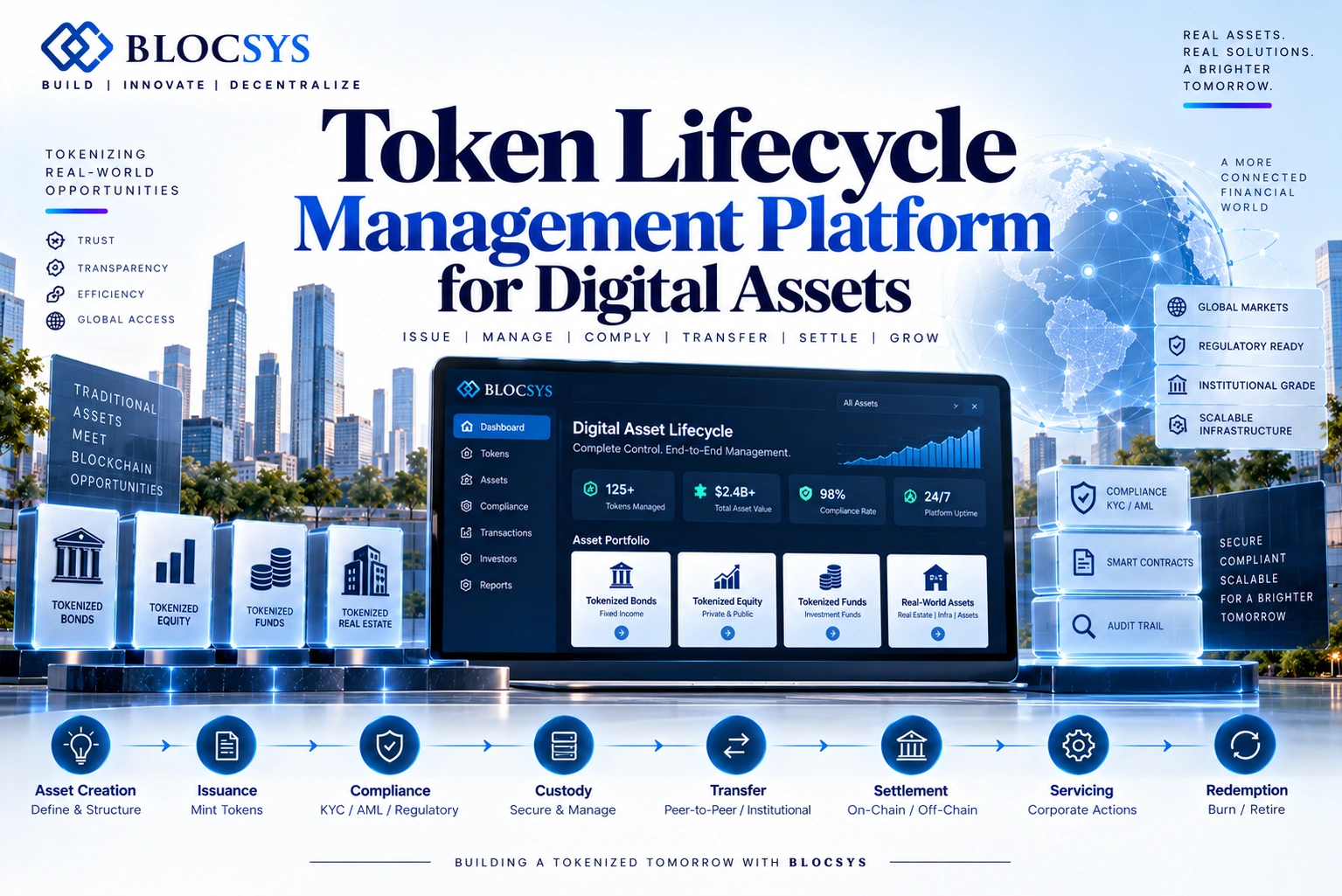
If you’re running token issuance, custody handoffs, transfer approvals, and reporting through a mix of wallets, spreadsheets, email threads, and Slack messages, you’re already behind. That setup works for pilot volume. It breaks the moment finance asks for reconciled ownership records, compliance asks for evidence, or regulators ask how a specific transfer was approved.
A Token Lifecycle Management Platform fixes that by turning token operations into a controlled system instead of an improvised process. For token issuers, exchanges, custodians, fintechs, and institutions managing tokenized assets, the goal isn’t just faster execution. It’s auditable execution across creation, distribution, transfer, settlement, redemption, and retirement.
For teams exploring real-world asset tokenization platforms or broader blockchain development services, the practical question is simple: how do you automate digital asset operations without losing control of compliance, custody, and reporting? That’s the problem worth solving.
Direct answer: Token lifecycle management is the end-to-end control of a digital asset from issuance to retirement, including minting, allocation, transfers, permissions, custody, monitoring, settlement, redemption, and burning. A platform automates those steps with approval rules, wallet controls, smart contracts, integrations, and audit logs so operations stay scalable and reviewable.
Table of Contents
- When Manual Token Operations Stop Working
- The Token Lifecycle from Issuance to Retirement
- Embedding Compliance and Controls Across Every Stage
- The Automation Stack Behind a Production Platform
- Why Lifecycle Automation Pays Off for the Business
- A Practical Roadmap to Build Your Own Platform
- Key Takeaways and How Blocsys Can Help
- FAQs
- What is a token lifecycle management platform
- Why do businesses need token lifecycle management
- How does the token lifecycle work from issuance to retirement
- What should be automated in token issuance and minting
- How should token distribution and ownership management be handled
- How do token transfers and permissions work in an enterprise platform
- Can smart contracts handle the full token lifecycle on their own
- How do compliance and custody fit into token lifecycle automation
- What integrations does a digital asset lifecycle platform usually need
- How much does token lifecycle management platform development cost
When Manual Token Operations Stop Working
A mid-sized fintech launches a tokenized asset product. The first few issuances go smoothly. Ops approves wallet addresses in Slack. Finance tracks allocations in spreadsheets. Compliance stores KYC files in a shared drive. Engineering watches chain events and manually updates internal records.
Then volume rises and the weak points surface all at once.
One investor receives tokens before the final approval note is logged. A transfer is blocked on-chain but still appears as settled in an internal dashboard. A redemption request sits in a queue because nobody knows whether treasury or compliance owns the sign-off. Reporting deadlines tighten, but the evidence is scattered across five systems and two messaging channels.
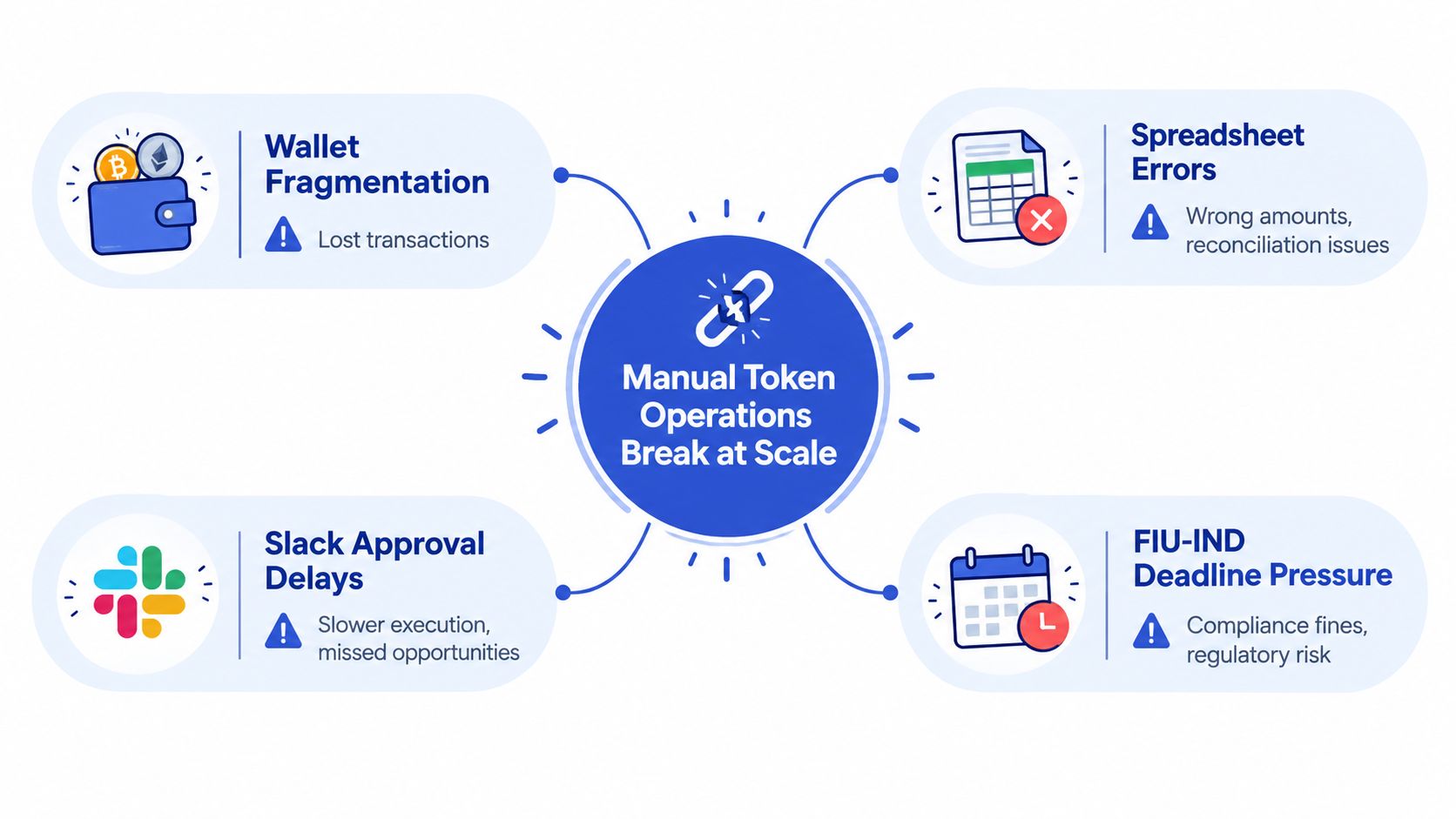
This is the point where many teams realise token operations aren’t a wallet problem. They’re an orchestration problem. The same failure pattern shows up in adjacent operational domains too, which is why this comparison of manual versus automated trust-platform operations feels familiar even outside digital assets.
What token lifecycle management actually means
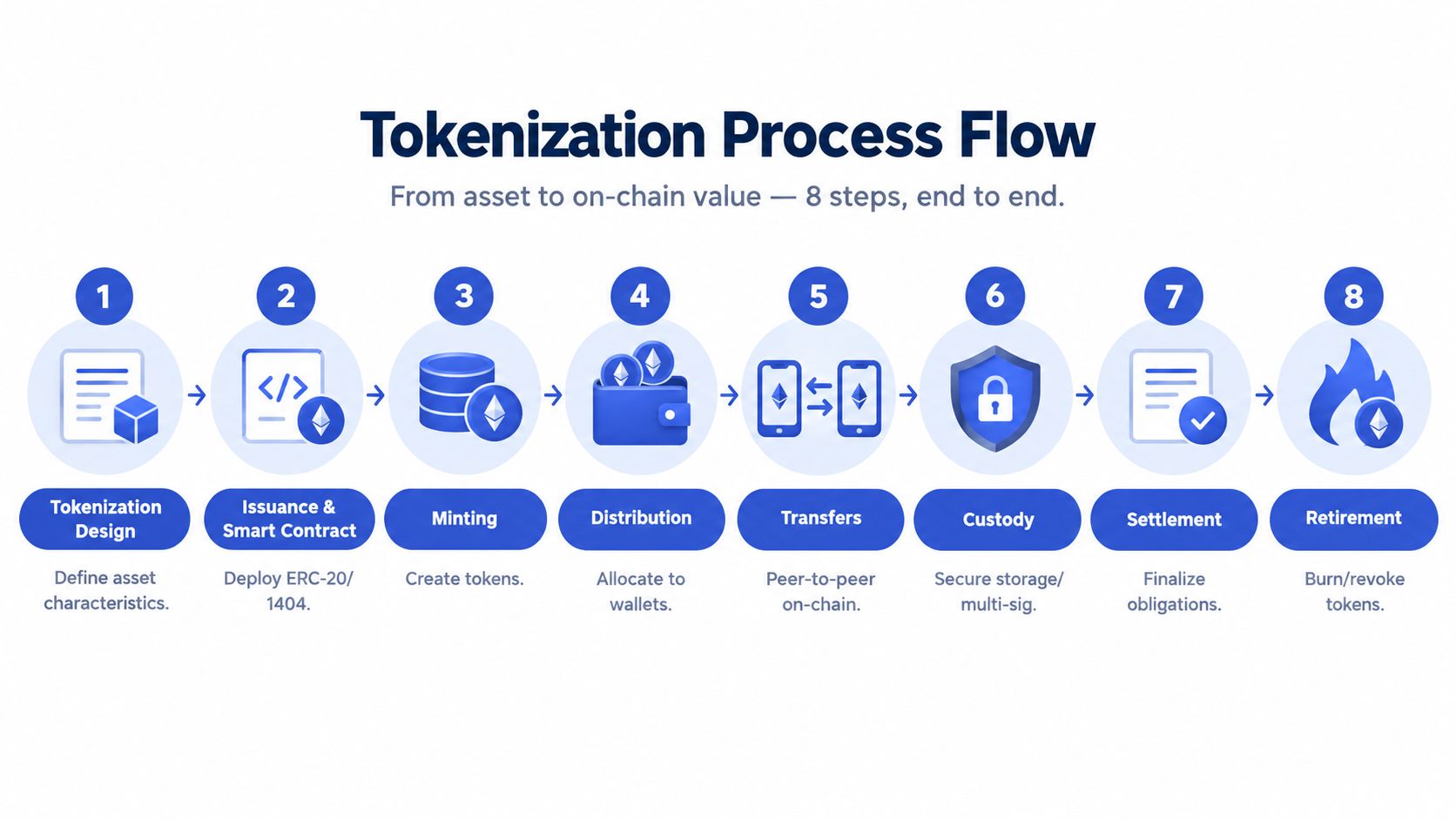
Token lifecycle management is the controlled handling of a digital asset across its full operational life:
- Issuance: define the asset, deploy contracts, set supply and rights
- Distribution: allocate tokens to approved parties
- Custody: secure keys, wallets, and ownership records
- Transfers: enforce permissions, restrictions, and approvals
- Servicing: process corporate actions, entitlements, and status changes
- Settlement and redemption: complete obligations and close positions
- Retirement: burn, revoke, or archive the asset under policy
A proper platform doesn’t just observe these events. It governs them.
Why the real constraint is compliance
Most buyers initially ask for automation because their teams are overloaded. That’s fair, but it’s not the main reason to build the platform. The reason is that manual controls collapse faster than transaction growth. Every extra transfer, wallet, jurisdiction, and approval path increases the chance of mismatched records and missing evidence.
In India, that pressure is no longer theoretical. The compliance environment has moved into enforceable operations. As of 9 March 2026, 54 VDASPs were registered with FIU-IND as reporting entities, and FIU-IND had directed the takedown of 53 unregistered virtual digital asset exchanges, according to this India digital assets regulatory round-up. Registration now requires live walkthroughs of KYC systems, cybersecurity audits, sanctions screening, transaction monitoring, blockchain analysis, and Travel Rule compliance.
Manual process is not a neutral starting point. It’s technical debt with regulatory consequences.
A useful platform treats compliance as the design constraint from day one. Throughput matters. Auditability matters more.
The Token Lifecycle from Issuance to Retirement
A strong operating model follows a strict sequence. Every stage needs a trigger, a rule set, and an immutable record. If any of those are missing, your platform isn’t managing lifecycle risk. It’s just moving tokens around.
Start with asset design, not code
Before deployment, define what the token represents, who can hold it, what transfer restrictions apply, what events change ownership, and which off-chain records remain authoritative. Teams that skip this step usually end up rewriting contract logic or adding brittle overrides later.
For tokenized corporate bonds in India, the workflow is best understood as a five-stage lifecycle: issuer onboarding and KYC, allocation and DLT issuance, atomic delivery-versus-payment settlement through the wholesale digital rupee, permissioned secondary transfer, and coupon or redemption servicing, as outlined in this analysis of India’s demat 2.0 tokenized corporate bond infrastructure. The lesson is clear. Lifecycle management is not one ledger function. It’s a control layer across legal, compliance, product, and engineering.
A token management system should therefore start with a state model, not a token standard checklist.
Issuance and minting need explicit authority
At issuance, the platform should define:
- the smart contract address and version
- mint authority and signer policy
- supply parameters
- eligibility constraints
- asset metadata and legal reference documents
The trigger for this stage is usually approval of the issuance package. The record that matters is the signed issuance decision plus the deployment artefacts and transaction hash.
If you’re building for debt markets, a corporate bond tokenization platform can support digital bond issuance, smart contract automation, faster settlements, and investor management. That only works operationally when each issuance event is tied back to governed approvals and servicing logic.
Distribution is where most internal gaps appear
After minting, tokens move into allocation and distribution. This may involve treasury wallets, primary subscribers, vesting schedules, escrow rules, or whitelisted recipients. The trigger is not “tokens exist”. The trigger is that the receiving wallet and beneficial owner have passed the required checks.
Capture these records at this stage:
- Wallet binding: which wallet belongs to which approved account
- Allocation logic: who received what, under which rule
- Restriction status: lock-up, jurisdiction, accreditation, or internal flags
- Approval evidence: who approved distribution and when
Airdrops and promotional distributions often create the messiest audit trails because teams treat them as marketing events instead of regulated asset movements.
Practical rule: every token movement that changes beneficial ownership should produce both an on-chain event and an off-chain business event.
Transfers, servicing, and retirement complete the lifecycle
Secondary transfers should be permission-aware. The transition event may be lock-up expiry, a bilateral trade approval, a settlement instruction, or a compliance clearance. The platform has to check sender eligibility, receiver eligibility, sanctions status, wallet policy, and asset-specific restrictions before release.
Servicing sits in the middle of the lifecycle and is often neglected. This includes coupon handling, entitlement changes, freezes, reissuance, corrections, and partial redemptions. These are not edge cases. They are routine operating events in real asset programmes.
Retirement closes the loop. Redemption or burn should only happen when the corresponding cash leg, legal release, or asset claim has been confirmed. The immutable record here includes the redemption decision, settlement confirmation, burn transaction if applicable, and the final ownership state.
A token that can be minted and transferred but not retired cleanly is not production-ready. It’s a prototype with accounting risk.
Embedding Compliance and Controls Across Every Stage
Most content treats compliance as a separate layer added after the token model is finished. That’s the wrong approach. In practice, the controls determine the lifecycle design.
India makes this especially clear. The IFSCA expert committee report dated 27 February 2025 explicitly recommends legal and regulatory recognition for digital tokens, along with mechanisms for issuance, trading, custody, and clearing and settlement, with specific focus on AML and KYC, governance, technology, cyber risk, investor protection, and disclosure standards in its report on the regulatory approach toward tokenization of real-world assets. That is not a narrow policy note. It’s a direct signal that tokenization infrastructure needs lifecycle-grade controls.
Automation has to match the control point
Each lifecycle event should map to a specific control obligation. If it doesn’t, your audit trail will be incomplete.
| Lifecycle Stage | Applicable Control | Automation Requirement |
|---|---|---|
| Issuer onboarding | KYC, AML, internal approval policy | Identity verification workflow, approval routing, evidence storage |
| Token issuance | Governance, authorised minting, disclosure | Role-based contract deployment, issuance checklist, signed approval logs |
| Allocation | Sanctions screening, eligibility, wallet verification | Automated screening, whitelist sync, allocation rules engine |
| Transfer | Travel Rule data capture, transaction monitoring, policy checks | Originator and beneficiary data capture, risk scoring, hold or release logic |
| Custody | Key governance, access segregation, custody records | Multi-step approval, wallet-policy enforcement, custody event logs |
| Settlement | Reconciliation, exception handling, tax treatment | Ledger matching, settlement confirmation, exception queue |
| Redemption | Ownership validation, payout checks, retirement attestation | Beneficial ownership validation, payout workflow, burn or revoke confirmation |
| Reporting | Recordkeeping, FIU-IND reporting, tax support | Structured exports, evidence vault, report generation |
India-specific controls change architecture choices early
India’s digital asset activity already warrants industrial-grade operations. Chainalysis-based reporting says India ranked first in the 2025 Global Crypto Adoption Index for the third consecutive year, received about $338 billion in on-chain crypto value between July 2024 and June 2025, and saw on-chain transaction volume grow 99% year over year. The same reporting cites Ministry of Finance tax data showing declared Virtual Digital Asset transaction value rose to ₹51,180 crore in FY2024–25 from ₹36,270 crore in FY2023–24, while TDS collected under Section 194S increased to ₹511.83 crore from ₹362.70 crore, a 41% jump in this summary of India crypto adoption statistics. That mix of scale and traceability is exactly why manual reporting workflows stop working.
You should architect for these control points from day one:
- FIU-IND readiness: retain evidence for KYC, screening, monitoring, and reporting actions
- Section 194S support: track taxable transfer events and related reporting artefacts
- Travel Rule capture: bind originator and beneficiary data to transfer workflows
- IFSCA-aligned tokenization controls: treat issuance, trading, custody, and settlement as linked operating domains
Teams looking for examples of common compliance pitfalls in automation projects should pay attention to one recurring mistake. They automate the visible workflow but leave evidence capture, exception handling, and reviewer accountability outside the system.
What software can and cannot do
A platform can enforce required fields, stop unapproved transfers, trigger reviews, preserve logs, and generate reports. It cannot decide legal interpretation on its own. It cannot absorb liability. It cannot resolve ambiguous ownership disputes without a policy owner.
For platforms serving Indian market participants, that’s even more important because the jurisdiction still lacks a dedicated framework for asset tokenization, as discussed in this digital asset custody and compliance analysis. Build the controls so they can adapt without rewriting the core transaction model.
The Automation Stack Behind a Production Platform
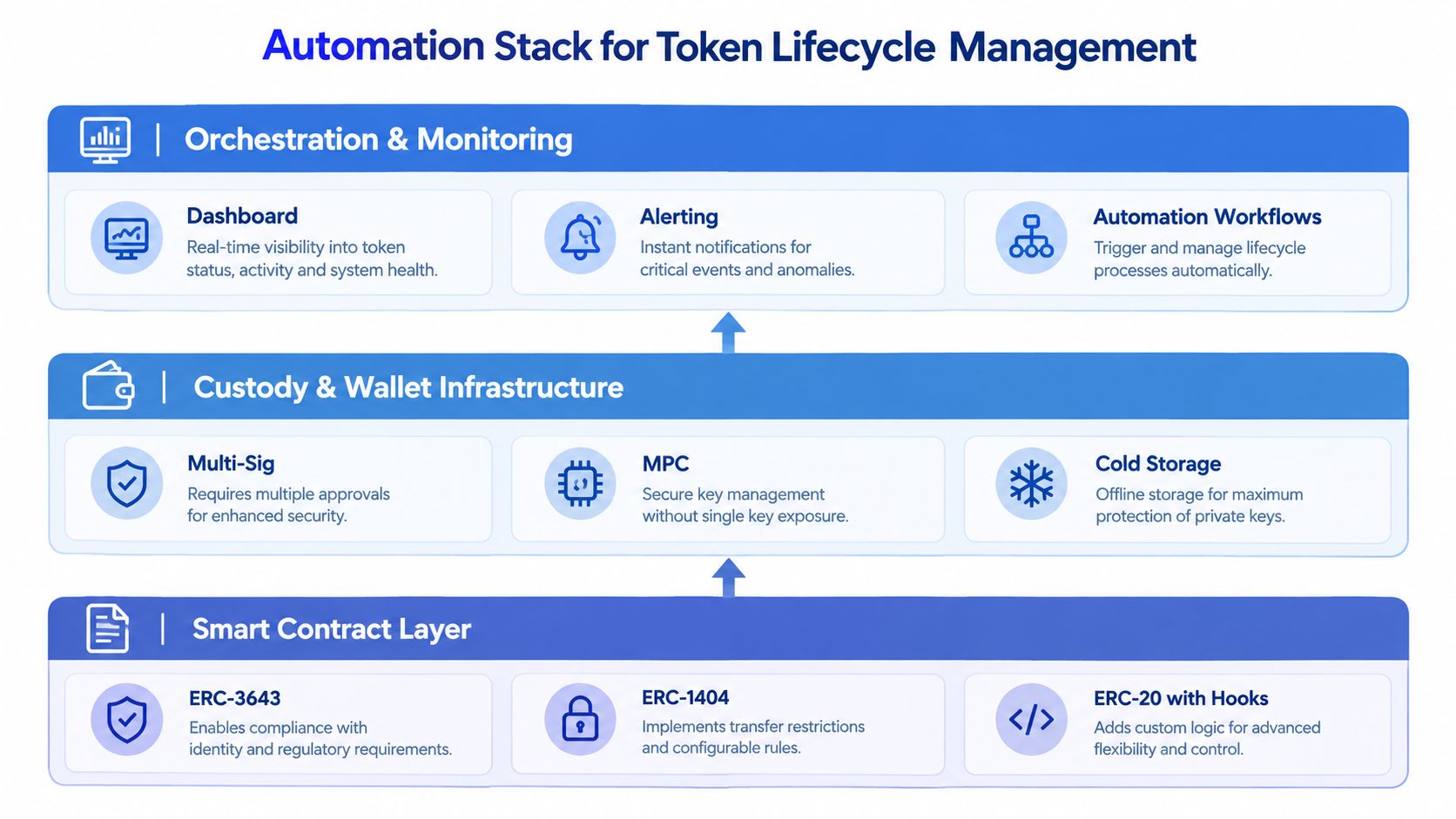
The production stack is not one product. It’s a coordinated set of layers that have to stay in sync under failure conditions, policy changes, and transaction spikes. Most implementation pain appears at the seams between those layers, not inside any single component.
Smart contracts set the allowed behaviour
Start with the contract layer. Depending on the asset and policy model, teams often evaluate restricted transfer standards such as ERC-1404, identity-aware frameworks such as ERC-3643, or ERC-20 implementations with custom compliance hooks. The right choice depends less on popularity and more on your control surface.
The contract should expose functions for:
- issuance and mint control
- transfer validation
- pause or freeze actions
- redemption or burn
- administrative role changes
- event emission for downstream systems
This contract layer should stay narrow. Don’t cram every operational policy into on-chain code. Keep deterministic controls on-chain and move changeable business logic into the orchestration layer.
Custody and wallet infrastructure carry most of the operational risk
Wallet design isn’t just about storage. It’s about authority, recovery, segregation, and transaction release. Production platforms usually need treasury wallets, issuance wallets, operational wallets, customer wallets, and cold-storage paths. Key management should be backed by hardened controls such as HSM-governed signing policies or multi-party approval flows.
This becomes especially important in RWA tokenization and asset servicing automation, where token state and off-chain servicing state must remain aligned across entitlements, restrictions, and settlement events.
A practical stack usually includes:
- Signer policy engine: who can initiate, review, and release transactions
- Wallet registry: links between customer accounts, beneficial owners, and approved addresses
- Recovery design: what happens if a key is lost, compromised, or rotated
- Custody ledger: internal record of balances, holds, and pending events
Orchestration, monitoring, and APIs make the platform usable
This is the platform. The orchestration layer receives lifecycle triggers, applies policy, calls contract functions, updates internal records, and stores evidence. It should also manage retries, dead-letter queues, exception workflows, and operator dashboards.
A reliable build usually includes these services:
| Layer | Role in lifecycle automation |
|---|---|
| Identity and KYC services | Approve parties before issuance, distribution, or transfer |
| Compliance engine | Applies sanctions, policy, and transaction-monitoring rules |
| Event indexer | Watches chain events and synchronises internal state |
| Reconciliation service | Matches on-chain state to books, custody, and servicing records |
| Audit log store | Preserves decisions, approvals, payloads, and timestamps |
| Reporting APIs | Exports records for finance, compliance, and operations teams |
Production failures usually start with mismatched state, not failed transactions. If the chain says transferred and your internal books say pending, your real problem is reconciliation.
Where external build support is needed, Blockchain Development typically covers secure, scalable blockchain applications across public, private, and hybrid networks. That’s relevant here because lifecycle platforms rarely live on-chain alone. They sit across custody, dashboards, integrations, compliance tooling, and enterprise middleware.
The most common failure points are predictable: indexer lag, duplicate webhook processing, stale whitelist caches, wallet-to-ledger mismatch, and weak disaster recovery for signing infrastructure. Design those seams first.
Why Lifecycle Automation Pays Off for the Business
The business case isn’t about making token operations look modern. It’s about reducing avoidable labour, reducing operational error, and making each control action provable.
Teams that stay manual usually add headcount every time volume rises or a new asset type launches. That model doesn’t scale cleanly because every extra approval path, transfer review, and redemption check increases coordination cost. Automation changes that by standardising decisions and preserving evidence at the moment of action.
The operating difference is easy to see
| Metric | Manual Operations | Automated Platform |
|---|---|---|
| Issuance readiness | Depends on emails, spreadsheets, and ad hoc review | Uses workflow states, required approvals, and deployment records |
| Transfer control | Separate checks across teams and tools | Policy engine applies rules before release |
| Ownership updates | Often reconciled after the fact | Synchronised through event-driven updates |
| Reporting support | Evidence assembled manually under deadline | Structured logs and exportable records available by design |
| Exception handling | Buried in chat threads and inboxes | Routed into queues with named owners and timestamps |
| Scale | More volume usually means more manual reviewers | More volume is handled through rule execution and targeted escalation |
Automation also shortens response time when finance, audit, or compliance asks a pointed question. Who approved this mint? Why was this transfer held? Which wallet received the redeemed position? If the platform is designed properly, those answers are retrievable. If not, your team starts reconstructing events from fragments.
The gain is control, not magic
A good platform can deliver:
- Cleaner audit trails: every decision leaves a record
- Lower reconciliation drag: books and chain events stay closer
- Fewer preventable release errors: approvals and restrictions are enforced systematically
- Faster product expansion: new asset classes can reuse the operating model
For teams evaluating adjacent front-end and transaction experiences, examples from building decentralised applications through app development are useful because user journeys often fail when workflow controls aren’t considered alongside interface design.
Software can automate evidence capture, transaction gating, monitoring, and report assembly. It cannot replace legal judgement, board-approved policy, or accountability for a bad control decision.
That distinction matters. A platform lowers operational risk. It doesn’t eliminate regulatory exposure by itself. Governance still has to exist above the software. If you ignore that, you’ll build a slick dashboard over a weak control framework.
For organisations trying to scale workflow-heavy operations, AI-powered SaaS platforms for Web3 automation show where orchestration and exception handling can be improved. But the business value only appears when the process being automated is already clearly owned.
A Practical Roadmap to Build Your Own Platform
Most firms shouldn’t build everything at once. The safer path is phased delivery with hard control boundaries from the start.
Phase one sets the architecture
Begin with the essentials.
- jurisdiction and regulatory mapping
- asset type and rights model
- wallet and custody architecture
- transfer restrictions and approval policy
- reporting obligations and evidence design
If you’re still debating product scope, a visible feature planning roadmap is a useful reference point for how to separate immediate requirements from later-stage enhancements. The same discipline matters here. Core controls belong in phase one. Nice-to-have dashboards don’t.
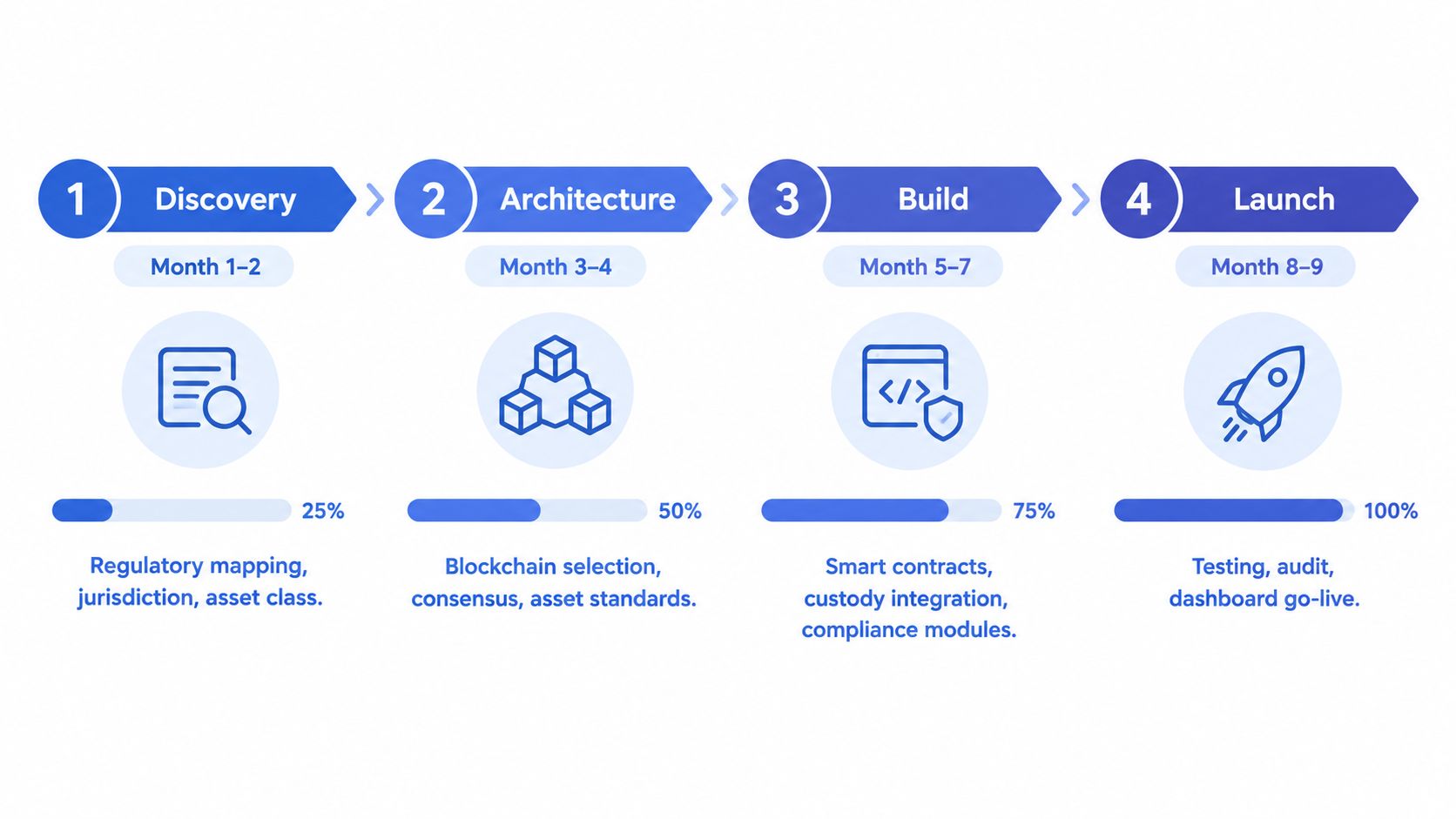
Phase two delivers the minimum viable control system
Your MVP should include:
- issuance workflow
- core smart contracts
- wallet and custody integration
- basic compliance rules
- transfer approval logic
- audit logging
- one reporting path
- one external integration partner
That is enough to prove the operating model. It is not enough to prove enterprise readiness.
Phase three hardens for scale
Most serious cost appears. You add redundancy, richer monitoring, multi-jurisdiction handling, stronger access segregation, security reviews, recovery procedures, and broader enterprise integrations. You also formalise ownership across engineering, compliance, DevOps, and operations.
India-aligned scope usually pushes projects upward in complexity because FIU-IND-style evidence capture, tax-related reporting support, Travel Rule data handling, and tokenization controls touch multiple systems. If you need a rough planning baseline, Blocsys provides a software development cost estimator that can help frame effort before detailed scoping.
Build the first version around one asset class, one custody model, and one reporting path. Complexity multiplies when you add optionality too early.
The wrong roadmap starts with token issuance screens. The right roadmap starts with control ownership, then builds the transaction machine around it.
Key Takeaways and How Blocsys Can Help
A token lifecycle management platform is not a minting tool with a dashboard attached. It is the operating system for digital asset control. The serious work sits in issuance governance, wallet authority, transfer restrictions, custody records, servicing logic, redemption handling, and evidence preservation.
The strongest design choice is to treat lifecycle automation as a compliance architecture problem. That framing forces better decisions. You define who can approve what. You map each token event to a control point. You preserve the records needed for audit, finance, and operational review. You also avoid the common mistake of assuming a smart contract alone is a production platform.
India adds urgency to that design discipline. The policy direction from IFSCA, the scale and traceability of digital asset activity, FIU-IND enforcement, and reporting-linked obligations mean enterprises can’t treat compliance as an afterthought. They need systems that can survive regulatory tightening without core rework.
Blocsys Technologies can support that work through architecture reviews, MVP design, custom tokenization platform builds, custody and workflow integration, and modernisation of legacy digital asset operations. That includes platform design for token issuance, smart contract automation, transfer controls, reporting workflows, and enterprise integration patterns that align with how regulated teams operate.
If you’re deciding whether to build, buy, or modernise, start with a scoped platform assessment. The right outcome isn’t more features. It’s a lifecycle model your operations, compliance, and engineering teams can all defend.
FAQs
What is a token lifecycle management platform
A token lifecycle management platform is software that controls a digital asset from issuance to retirement. It manages token creation, minting, allocation, distribution, transfers, permissions, custody, settlement, redemption, burning, monitoring, reporting, and audit trails through structured workflows instead of manual coordination across disconnected tools.
Why do businesses need token lifecycle management
Businesses need token lifecycle management because token operations quickly become difficult to control when issuance, custody, transfers, and reporting are handled manually. A platform reduces fragmentation, standardises approvals, preserves evidence, and helps teams operate digital asset products with better auditability and clearer ownership of each operational step.
How does the token lifecycle work from issuance to retirement
The lifecycle usually starts with asset design and smart contract deployment, then moves through minting, allocation, distribution, custody, transfers, servicing, settlement, redemption, and retirement. Each stage should have a clear trigger, a rule set, and a permanent record so ownership changes and control actions can be reconstructed later.
What should be automated in token issuance and minting
Issuance and minting automation should cover approval workflows, contract deployment controls, signer policy, supply configuration, metadata registration, and evidence capture. The goal is to ensure tokens are only created by authorised parties under approved parameters, with transaction records and decision logs stored for later review.
How should token distribution and ownership management be handled
Distribution should only occur after the receiving account and wallet have passed the required checks. Ownership management should link beneficial owner records, approved wallets, allocation logic, and restriction status so the platform can show who holds the asset, under what conditions, and how that ownership changed over time.
How do token transfers and permissions work in an enterprise platform
Enterprise transfer workflows usually apply policy before release. That includes checking wallet eligibility, transfer restrictions, sanctions status, internal approvals, and any required transfer data. Permissions should be role-based and event-driven, so a transfer is allowed, held, or escalated according to defined business and compliance rules.
Can smart contracts handle the full token lifecycle on their own
No. Smart contracts are essential, but they do not handle the full lifecycle alone. They can enforce deterministic rules on-chain, but identity checks, approval routing, exception handling, custody workflows, reporting, reconciliation, and evidence management usually depend on off-chain orchestration and enterprise integrations.
How do compliance and custody fit into token lifecycle automation
Compliance and custody are core parts of lifecycle automation, not add-ons. Compliance controls should attach to lifecycle events such as onboarding, allocation, transfer, settlement, and redemption. Custody design should govern wallet roles, key authority, approval flows, recovery, and internal recordkeeping so asset control remains secure and reviewable.
What integrations does a digital asset lifecycle platform usually need
A production platform usually needs integrations with wallet infrastructure, custody systems, identity and KYC providers, sanctions screening tools, transaction monitoring systems, blockchain indexers, finance and reporting systems, and internal approval tools. The exact mix depends on asset type, jurisdiction, and how much of the workflow remains off-chain.
How much does token lifecycle management platform development cost
Cost depends on asset complexity, jurisdictional scope, custody architecture, compliance requirements, reporting obligations, and enterprise integrations. A simple MVP is very different from a production platform designed for regulated tokenized assets. The best approach is to scope the lifecycle stages, control requirements, and integrations first, then estimate based on actual operational needs.
Blocsys Technologies builds custom token lifecycle platforms, tokenization systems, smart contract workflows, custody integrations, and enterprise digital asset infrastructure for teams that need operational control from issuance through retirement. If you’re planning a new platform or untangling a fragmented one, visit Blocsys Technologies to discuss your lifecycle requirements, assess fit, and map the right build path.
