
India’s first wave of tokenised corporate bonds moved ₹1,025 crore, about $107 million, onto blockchain rails within about a week, with settlement compressed from days to hours through the Demat 2.0 pilot and RBI digital-rupee settlement. That result changes the question for banks, issuers, fintechs and asset managers. The issue isn’t whether tokenised bonds are technically possible. It’s which companies can connect issuance, custody, compliance and settlement to India’s regulated capital-markets infrastructure.
This curated list of top tokenised bond companies in India to watch in 2027 includes technology providers, issuers, depositories and market-infrastructure participants. It doesn’t present an objectively proven ranking. Instead, it maps the companies that matter for different parts of the value chain, then gives decision-makers a practical way to assess a tokenised bond platform or implementation partner.
Table of Contents
- Introduction to Tokenized Bonds in India and Why 2027 Matters
- What Tokenized Bonds Are and How Corporate Bond Tokenization Works
- Types of Tokenized Bond Companies Operating in India
- Comparison of the Top 10 Tokenized Bond Companies to Watch
- Detailed Profiles of the 10 Tokenized Bond Companies
- How to Evaluate a Tokenized Bond Platform or Technology Provider
- India Tokenized Bond Market Outlook for 2027 and Next Steps with Blocsys
- What are tokenized bonds in India?
- How does corporate bond tokenization work?
- Which companies are involved in tokenized bonds in India?
- What is a tokenized bond platform?
- Are tokenized bonds available to retail investors in India?
- What blockchain infrastructure do tokenized bonds require?
- What regulatory issues should issuers consider?
- What are the benefits of corporate bond tokenization?
- What are the risks of tokenized bonds?
- How should a business choose a tokenization technology provider?
Introduction to Tokenized Bonds in India and Why 2027 Matters
India’s corporate bond market provides the scale behind the tokenisation opportunity. Market reporting in 2026 placed it near ₹59 lakh crore, or roughly $620–$624 billion, after expanding from about ₹17.5 lakh crore in FY2015 to about ₹53.6 trillion in FY2025. The addressable market is therefore an established debt market, not a small crypto-native segment.
The Demat 2.0 pilot supplied an important operating baseline. REC raised ₹500 crore from 18 investors, Larsen & Toubro raised ₹500 crore from four investors, and IIFL Finance raised ₹25 crore from one investor, for three issuances totalling ₹1,025 crore (Moneylife).
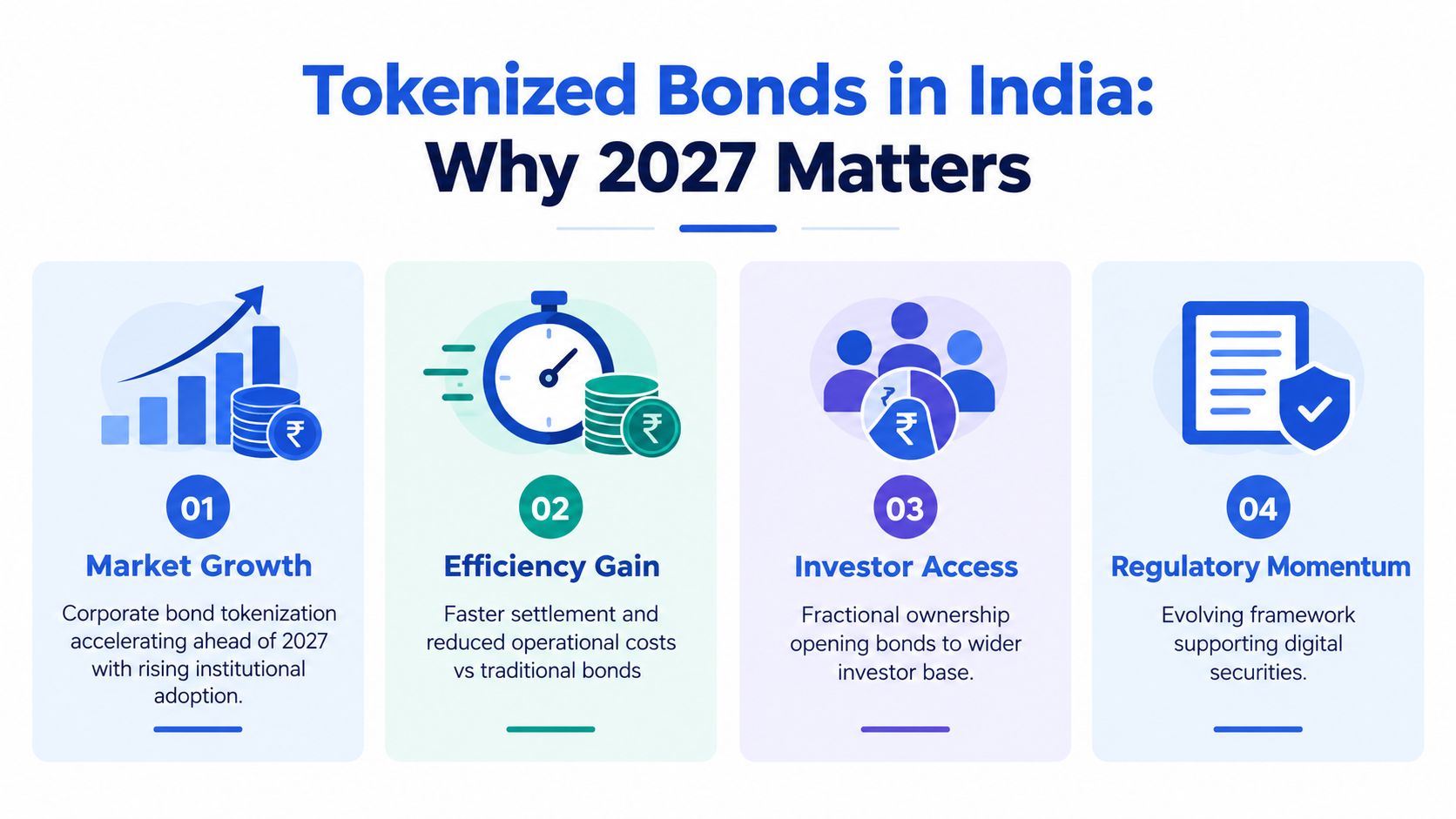
The first deals are revealing because they combine large-denomination issuance with different investor counts. REC and L&T raised the same amount but reached very different numbers of investors, while IIFL tested a smaller issue in the same regulated framework. That suggests early tokenisation may improve workflow coordination and settlement more clearly than it changes pricing or retail access.
For 2027, decision-makers should focus on four questions:
- Who controls the record of ownership?
- Where are private keys held?
- How does cash settlement connect to RBI rails?
- Can the system support compliance and later secondary-market activity?
The pilot’s design and implications are examined in this SEBI and RBI Demat 2.0 analysis. The central conclusion is straightforward: companies that integrate with regulated depository and settlement infrastructure deserve more attention than vendors making broad blockchain claims.
What Tokenized Bonds Are and How Corporate Bond Tokenization Works
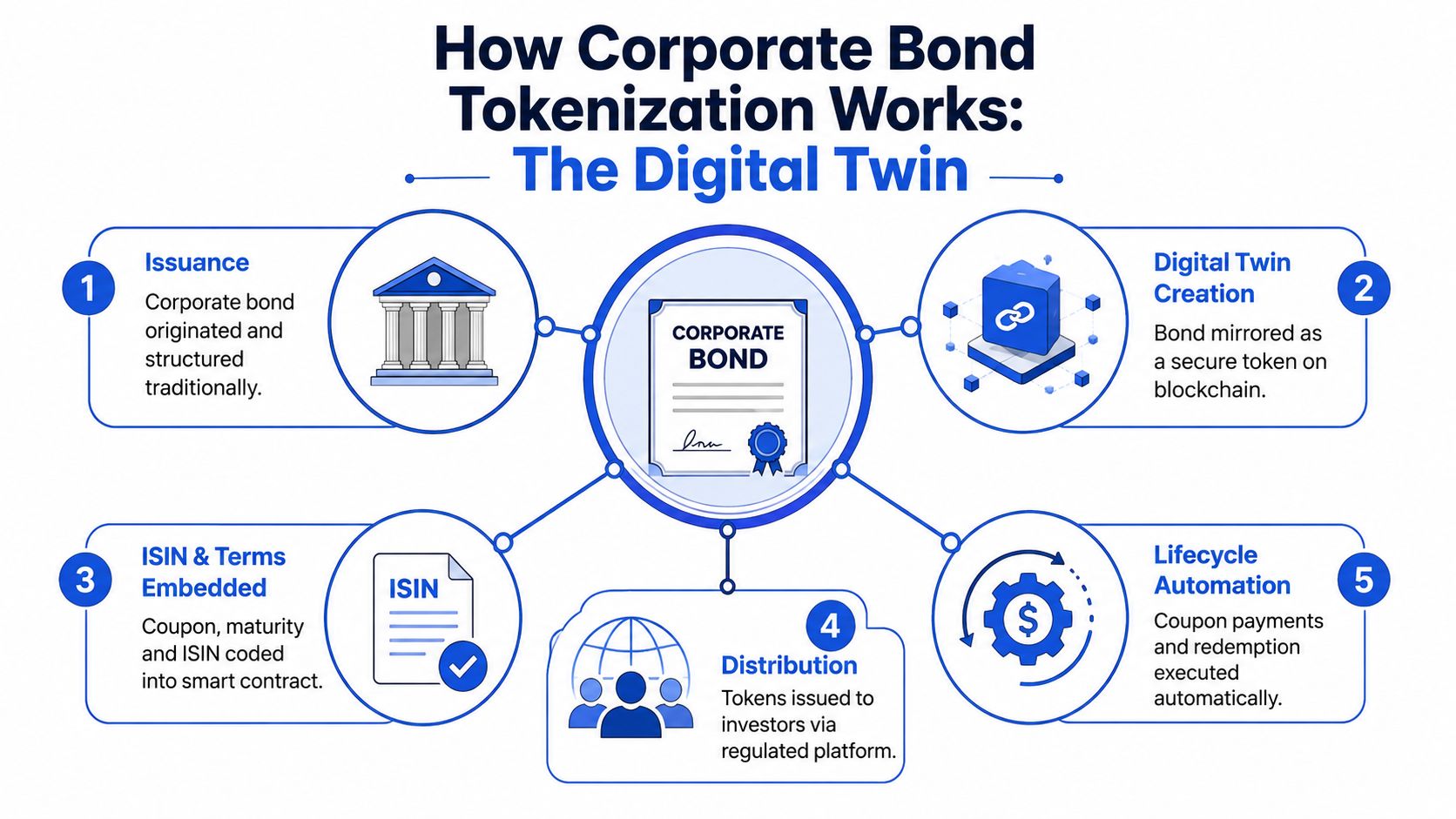
A tokenised bond is a digital representation of a conventional debt security on distributed ledger infrastructure. The token doesn’t automatically become a new asset class just because its record sits on a blockchain. In India’s pilot structure, the bond remains a security under the Securities Contracts (Regulation) Act, 1956, and its ISIN, coupon, maturity, covenants, rating, security and investor rights continue to apply .
A useful analogy is a digital twin. The legal bond remains the underlying instrument, while the token mirrors its essential terms and ownership record within a controlled technical environment.
The issuance and settlement flow
Corporate bond tokenisation typically involves several connected actions:
- Structure the bond. The issuer defines principal, coupon, maturity, covenants, investor eligibility and other legal terms using the existing securities process.
- Create the digital representation. A permissioned ledger records the bond and links it to the relevant ownership and security information.
- Encode controls. Smart contracts can enforce transfer rules, investor permissions, lifecycle events and payment instructions, subject to the legal and operational design.
- Distribute to eligible investors. In the initial Indian pilot, access was limited to institutional investors and required both a wholesale CBDC wallet and a Demat 2.0 securities wallet.
- Settle and administer. The tokenised security and the payment leg are coordinated through the approved settlement arrangement. Depositories, rather than individual investors, hold the private keys in the pilot design.
A regulated corporate bond tokenization platform can therefore cover digital issuance, smart contract automation, settlement workflows and investor management, but its technical capabilities don’t replace securities law, custody controls or issuer obligations.
The legal nature of the instrument also matters during distress. Tokenisation doesn’t remove default risk, covenant enforcement or recovery questions. Teams assessing issuance structures should pair technical analysis with legal guidance, including this Kons Law bond default guide.
The implementation question is how to connect smart contracts to depository records, payment systems, investor onboarding and enterprise finance software. This step-by-step guide to tokenising corporate bonds on blockchain provides a useful technical reference for that workflow.
Types of Tokenized Bond Companies Operating in India
Not every company associated with tokenised bonds is a tokenisation vendor. Treating an issuer, a depository and a software developer as interchangeable creates poor procurement decisions and obscures the adoption bottlenecks.
Technology and tokenisation platform providers
These companies build the software layer. Their work may include ledger design, token issuance, smart contracts, permissioning, investor workflows, reporting and integrations with custody or settlement systems. A bank or bond issuer would normally assess them for implementation capability, security governance and compatibility with its operating model.
A provider of Tokenization Platform Development may support tokenisation for securities and other real-world assets using enterprise blockchain technology. That broader capability is relevant, but it doesn’t by itself prove that a provider is connected to India’s live bond pilot or approved to perform a regulated function.
Regulated market infrastructure
Depositories and settlement operators control essential records and transaction plumbing. In India’s Demat 2.0 model, the pilot uses permissioned infrastructure, institutional access and a wholesale digital rupee settlement layer. Depositories also hold private keys rather than leaving individual investors responsible for key management.
This makes infrastructure operators strategically important even when they don’t market themselves as blockchain companies. A platform that can’t integrate with the approved securities and cash rails may demonstrate token creation without delivering a usable bond market process.
Issuers, distributors and service enablers
Issuers such as REC, Larsen & Toubro and IIFL Finance bring real funding demand. Banks, custodians, compliance providers, exchanges and distribution platforms may support onboarding, custody, settlement orchestration or future trading.
Practical rule: classify each company by the function it performs, then assess whether that function is the one your transaction actually needs.
The initial pilot is not a retail revolution. Public access wasn’t part of the first rollout, and tokenised bonds purchased in the initial phase cannot be sold for three months, while secondary-market mechanisms are expected to develop later. For 2027, enterprise compliance automation and settlement orchestration may therefore matter sooner than consumer-facing bond applications.
Comparison of the Top 10 Tokenized Bond Companies to Watch
The table uses a curated relevance framework, not an objective performance ranking. Blocsys appears first because this article evaluates technology and implementation partners, while the other entries represent infrastructure operators, issuers and financial-market participants that help define India’s tokenised bond ecosystem.
| Company | Company Type | Tokenized Bond Role | Target Users |
|---|---|---|---|
| Blocsys Technologies Pvt Ltd | Blockchain technology provider | Corporate bond tokenisation, smart contracts and digital asset infrastructure | Banks, issuers, financial institutions and capital-markets teams |
| National Securities Depository Limited | Securities depository | Dematerialised securities custody and regulated ownership infrastructure | Issuers, institutions, intermediaries and investors |
| Central Depository Services (India) Limited | Securities depository | Dematerialised securities custody and market infrastructure | Issuers, intermediaries, institutions and investors |
| Reserve Bank of India | Central bank and settlement authority | Wholesale digital rupee settlement context for the pilot | Banks, regulated institutions and market infrastructure |
| Securities and Exchange Board of India | Securities regulator | Regulatory framework and pilot oversight context | Issuers, intermediaries, exchanges and investors |
| REC Limited | Corporate bond issuer | Early tokenised corporate bond issuer in Demat 2.0 | Institutional investors and debt-market participants |
| Larsen & Toubro | Corporate issuer | Early large-ticket tokenised corporate bond issuer | Institutional investors and capital-markets participants |
| IIFL Finance | Financial institution and issuer | Early smaller-scale tokenised corporate bond issuer | Institutional investors and debt-market participants |
| National Stock Exchange of India | Stock exchange and market infrastructure | Potential future venue and market-infrastructure relevance | Issuers, intermediaries and investors |
| BSE Limited | Stock exchange and market infrastructure | Potential future venue and market-infrastructure relevance | Issuers, intermediaries and investors |
For a technology procurement process, the most relevant entries are providers that can support issuance and integration. For market access, custody or settlement planning, the depositories, regulators and exchanges become more important. This comparison of corporate bond tokenisation platforms and real-world examples adds context without treating every participant as the same kind of supplier.
Detailed Profiles of the 10 Tokenized Bond Companies
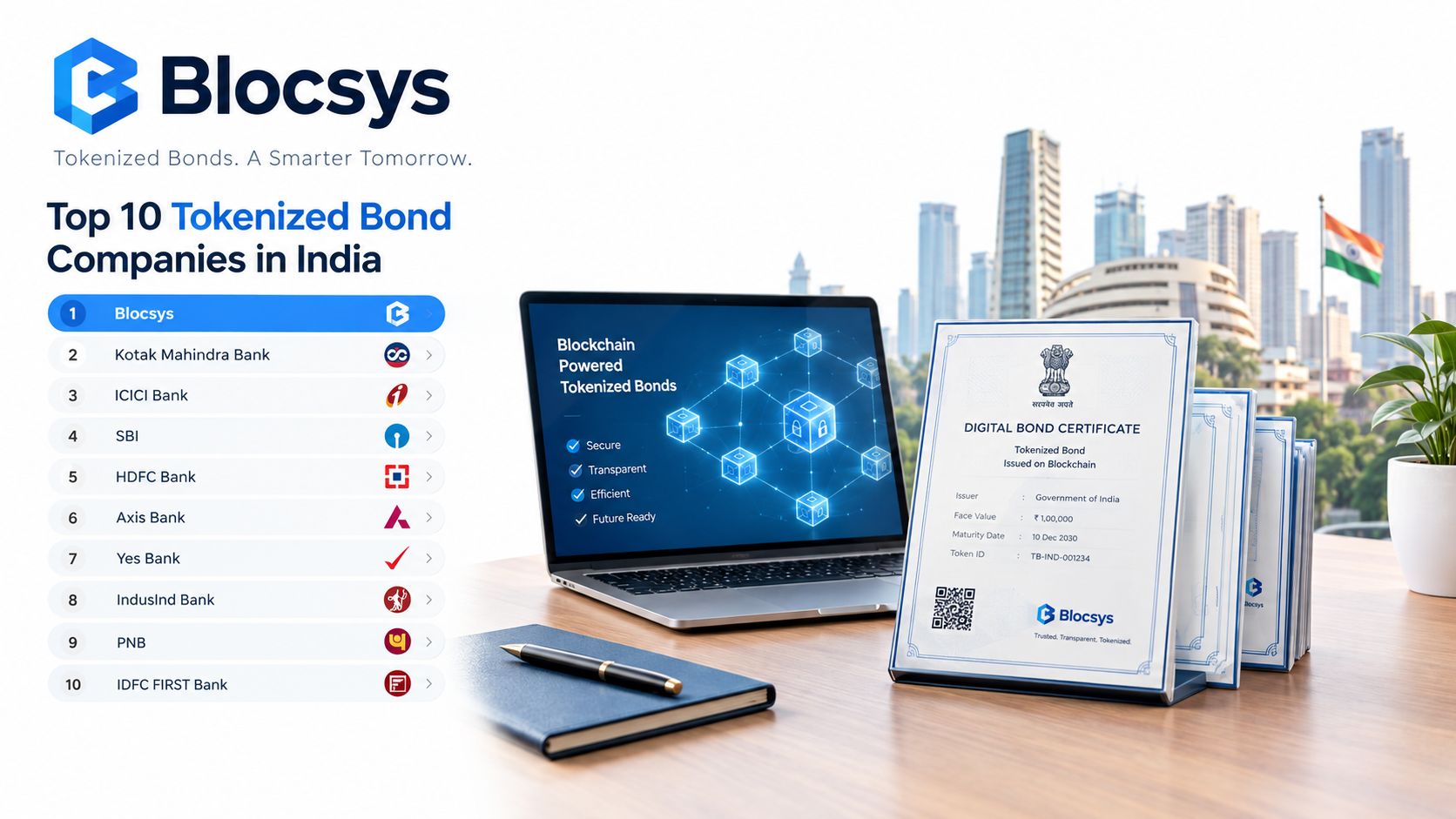
1. Blocsys Technologies Pvt Ltd
Blocsys Technologies Pvt Ltd is a blockchain technology and tokenisation solutions provider focused on enterprise digital assets and tokenised securities. Its corporate bond tokenisation solutions cover digital bond issuance, smart contract automation, token lifecycle management, investor workflows, permissioned access and integration with existing financial systems.
With capabilities spanning corporate bond tokenisation, real-world asset tokenisation, smart contract development and enterprise blockchain development, Blocsys supports banks, financial institutions, bond issuers, fintech companies and investment firms looking to build and integrate tokenised asset infrastructure.
Blocsys also focuses on custom blockchain architecture and enterprise-grade implementation, enabling organisations to develop tokenisation platforms around their specific business, compliance and operational requirements. This approach allows financial institutions to connect blockchain-based securities infrastructure with existing systems while creating a scalable foundation for digital asset issuance and management.
Its combination of tokenisation expertise and blockchain engineering makes Blocsys relevant to India’s growing institutional digital-asset and tokenised securities ecosystem.
2. National Securities Depository Limited
National Securities Depository Limited is a securities depository and market-infrastructure participant, not a standalone tokenisation software vendor. Its relevance comes from the role depositories play in holding securities records, supporting dematerialised ownership and providing the controlled infrastructure on which digital securities processes depend.
The Demat 2.0 design makes depository custody especially important because private keys are held by depositories rather than individual investors. That arrangement places operational responsibility around institutional custody, access controls and record integrity.
Issuers and financial institutions evaluating tokenised bond infrastructure should therefore ask how a proposed platform connects to depository processes. The depository isn’t being selected as a smart-contract developer. It is being considered as part of the trust, custody and ownership framework.
3. Central Depository Services (India) Limited
Central Depository Services (India) Limited is another regulated securities depository relevant to India’s digital securities infrastructure. Its role should be separated from that of a technology provider. The company’s importance lies in securities custody, dematerialised records and the institutional processes that support ownership and transfer.
For tokenised bonds, this type of infrastructure can determine whether a blockchain representation remains aligned with the legally recognised securities record. The technical ledger is only useful when participants can reconcile it with custody, investor identity, corporate actions and settlement requirements.
Financial institutions should examine interoperability, reconciliation and governance rather than assume that depository participation means every tokenisation feature is already available. Capabilities must be verified against the relevant pilot, service scope and current regulatory arrangements.
4. Reserve Bank of India
The Reserve Bank of India is a central bank and settlement authority, not a commercial tokenisation company. Its relevance comes from the RBI digital-rupee settlement layer used in the Demat 2.0 pilot.
That settlement design is central to understanding India’s model. The pilot didn’t just place bonds on a blockchain and leave cash movement to a separate process. It tested tokenised corporate debt with wholesale digital-rupee settlement, creating a framework in which the cash leg and securities workflow can be coordinated within regulated rails.
Banks and infrastructure providers must distinguish a technical token from a settlement asset. A vendor may write smart contracts, but it can’t independently recreate the monetary authority or settlement finality supplied by the RBI framework.
5. Securities and Exchange Board of India
The Securities and Exchange Board of India is a securities regulator, not a technology platform. Its relevance is regulatory. The Demat 2.0 pilot sits within India’s existing securities environment, where bond terms, investor rights and issuer obligations continue to apply.
For companies assessing corporate bond tokenisation, SEBI-related requirements shape investor eligibility, disclosure, market conduct, custody and future trading arrangements. A provider that uses the language of compliance should be able to explain how those controls are implemented, tested and updated.
The practical implication is that a tokenisation project needs regulatory mapping before development begins. Technology can enforce eligibility and workflow rules, but the issuer and regulated intermediaries remain accountable for the legal and market framework.
6. REC Limited
REC Limited is a corporate bond issuer, not a tokenisation technology provider. It raised ₹500 crore from 18 investors in the first Demat 2.0 wave and reported a 7.30% coupon for that issue (Ledger Insights).
REC matters because it demonstrates issuer-side demand for a regulated tokenised debt process. Its transaction gives technology vendors and infrastructure operators a concrete reference point for issuance size, investor participation and settlement design.
For issuers considering a similar route, the relevant lesson isn’t that REC is a platform. It is that a large corporate funding transaction can be placed within permissioned distributed-ledger infrastructure while preserving conventional bond characteristics.
7. Larsen & Toubro
Larsen & Toubro is a corporate issuer and capital-markets participant. Its Demat 2.0 issue raised ₹500 crore from four investors.
The transaction is useful for comparison with REC’s issue. The two deals had the same issuance value but different investor counts, indicating that tokenisation can support different distribution patterns within the same regulated framework.
L&T should therefore be watched as an issuer-side benchmark, not evaluated as a bond-tokenisation vendor. Banks, arrangers and software providers can study how large issuers use the infrastructure, what documentation and controls are required, and whether repeated access becomes possible as the market matures.
8. IIFL Finance
IIFL Finance is a financial institution and corporate bond issuer. It raised ₹25 crore from one investor in the first pilot wave.
Its smaller transaction is strategically relevant because it shows that the pilot wasn’t limited to identical large-scale issuance patterns. The same regulated structure accommodated a smaller issue and a single institutional investor.
That makes IIFL useful for teams testing whether tokenised issuance can support different funding sizes and investor configurations. It still shouldn’t be labelled a tokenisation platform. Its contribution is evidence of issuer participation and market design flexibility.
9. National Stock Exchange of India
The National Stock Exchange of India is a stock exchange and market-infrastructure operator, not an identified tokenisation software provider in the verified data. Its relevance to a 2027 watchlist is tied to the future development of secondary-market mechanisms for tokenised securities.
The initial pilot imposed a three-month transfer restriction, and secondary trading requires exchanges and infrastructure providers to build appropriate mechanisms. That places exchanges in a future-facing role, subject to applicable approvals, market design and integration with custody and settlement systems.
Decision-makers should treat this as ecosystem relevance rather than evidence of an active tokenised bond marketplace. A credible assessment must separate current pilot functions from possible later-stage trading infrastructure.
10. BSE Limited
BSE Limited is a stock exchange and market-infrastructure participant. Like the National Stock Exchange of India, it shouldn’t be described as a tokenisation technology vendor without specific evidence of such a product or service.
Its relevance comes from the role exchanges may play if India develops regulated secondary trading for tokenised bonds. That future function would require more than a blockchain ledger. It would involve eligibility rules, market surveillance, disclosure, settlement finality, custody coordination and integration with the existing securities framework.
For issuers and investors, BSE belongs on a market-structure watchlist. For software procurement, it belongs in the ecosystem map rather than the shortlist of platform developers.
How to Evaluate a Tokenized Bond Platform or Technology Provider
Choosing a tokenised bond provider requires a capital-markets technology assessment, not a crypto feature checklist. Start by identifying the functions your organisation will own and the functions regulated intermediaries or infrastructure operators will perform.
Check the issuance workflow
The platform should support bond creation, investor eligibility, document and term management, approvals, allocation, settlement instructions and lifecycle events. Smart contracts need clear governance, version control and change-management procedures. Ask who can update code, how changes are approved and what happens if an automated instruction conflicts with the legal documentation.
Test custody and settlement integration
India’s pilot demonstrates that tokenised securities and wholesale digital-rupee settlement must work together. Ask how the system integrates with depository custody, wallet controls, investor identity, reconciliation and payment operations. Key management should be designed for institutional accountability, not handed casually to end users.
Assess controls before features
A due-diligence review should cover:
- Security assurance: request architecture documentation, audit evidence, access-control design and incident-response procedures.
- Compliance configuration: verify whether eligibility, transfer restrictions, disclosures and reporting can be configured and monitored.
- Lifecycle handling: test coupon events, maturity, redemption, exceptions and manual intervention.
- Secondary-market readiness: confirm how the platform would support future trading while recognising that current pilot transfers face a three-month restriction.
- Enterprise integration: examine APIs, data exports, reconciliation and connections to treasury, custody, accounting and investor systems.
- Operating accountability: document which party remains responsible for legal ownership, custody, settlement finality and investor servicing.
A provider should explain not only how it creates a token, but how the token remains governed throughout its legal and financial lifecycle.
The procurement process may also involve investors and strategic backers. This overview of fintech VC firms in India can help teams understand the wider funding ecosystem, but investment interest isn’t a substitute for regulatory or technical diligence.
For a deeper implementation review, examine the features, cost factors and technology stack for corporate bond tokenisation platforms. The final shortlist should be based on integration evidence, governance and operating responsibility rather than the number of blockchain features in a product presentation.
India Tokenized Bond Market Outlook for 2027 and Next Steps with Blocsys
India’s 2027 tokenised bond outlook is likely to be infrastructure-led. The early pilot validates institutional issuance and faster settlement, but the initial access model, depository custody and transfer restrictions indicate that retail distribution and open secondary markets are later-stage questions.
The companies to watch are therefore not only issuers. They include the technology providers that build issuance workflows, the depositories that protect ownership records, the settlement infrastructure that coordinates the cash leg, and exchanges that may support future trading. This analysis of private debt and corporate bond tokenisation in India places those roles in the broader market context.
For banks, enterprises and fintechs, the next step is to define the transaction, identify the regulated responsibilities and test the required integrations. Blocsys Technologies offers blockchain development, corporate bond tokenisation, smart-contract automation, digital asset platforms and financial-technology integrations as relevant components of that technology discussion.
Frequently Asked Questions
What are tokenized bonds in India?
Tokenised bonds are digital representations of regulated debt securities recorded on distributed-ledger infrastructure. In India’s Demat 2.0 pilot, the underlying bond continues to retain its ISIN, coupon, maturity, covenants, rating, security and investor rights, while tokenised workflows support issuance and settlement within permissioned infrastructure.
How does corporate bond tokenization work?
Corporate bond tokenisation starts with conventional bond structuring, followed by creation of a digital representation, encoding of relevant terms and controls, distribution to eligible investors, and settlement through approved payment and securities infrastructure. Smart contracts can automate defined lifecycle actions, but they don’t replace legal documentation or regulatory accountability.
Which companies are involved in tokenized bonds in India?
The ecosystem includes blockchain technology providers, securities depositories, regulators, settlement authorities, exchanges, financial institutions and corporate issuers. These roles are different. A company may issue a tokenised bond without providing tokenisation software, while a technology provider may build the platform without acting as a custodian, exchange or regulator.
What is a tokenized bond platform?
A tokenised bond platform is software infrastructure that can support digital bond issuance, investor onboarding, smart-contract controls, ownership workflows, settlement coordination and lifecycle administration. Its usefulness depends on integration with regulated securities records, custody arrangements, payment rails and compliance processes.
Are tokenized bonds available to retail investors in India?
The initial Demat 2.0 rollout was limited to institutional investors and required a wholesale CBDC wallet alongside a Demat 2.0 securities wallet. Public access wasn’t part of the first phase, so retail availability should be treated as a future policy and infrastructure question rather than an established feature.
What blockchain infrastructure do tokenized bonds require?
Tokenised bonds require controlled ledger infrastructure, identity and permissioning, smart-contract governance, secure key management, auditability, investor records and integration with custody and settlement systems. In a regulated market, the infrastructure must also support reconciliation with legally recognised securities records.
What regulatory issues should issuers consider?
Issuers should consider securities classification, disclosure, investor eligibility, custody, transfer restrictions, settlement finality, issuer obligations and applicable SEBI and RBI requirements. Tokenisation changes the technical representation and workflow, but it doesn’t remove the legal requirements attached to the underlying bond.
What are the benefits of corporate bond tokenization?
Potential benefits include faster issuance workflows, more coordinated settlement, automated lifecycle processing and improved operational visibility. The Indian pilot showed that meaningful corporate debt could move through blockchain rails with settlement compressed from days to hours, although that doesn’t prove pricing improvements or immediate retail access.
What are the risks of tokenized bonds?
Risks include smart-contract defects, cyber incidents, key-management failures, integration errors, unclear operational accountability, limited liquidity and restrictions on transfers. The initial pilot also included a three-month period during which purchased tokenised bonds couldn’t be sold, showing why secondary-market design matters.
How should a business choose a tokenization technology provider?
A business should evaluate issuance workflows, smart-contract governance, security controls, custody and settlement integration, compliance configuration, lifecycle automation, secondary-market readiness and enterprise-system connectivity. It should also verify which responsibilities remain with the issuer, depository, custodian, settlement authority and other regulated participants.
Blocsys Technologies can help banks, issuers and financial institutions assess and build blockchain-based corporate bond workflows, including digital issuance, smart contracts and investor-management infrastructure. Visit Blocsys Technologies to discuss your tokenisation requirements and determine the appropriate technical next steps.
