
A blockchain pilot can pass its technical review and still stall when compliance teams can’t verify customer identities, monitor transactions, produce evidence, or explain who approved an exception. That gap concerns CTOs, compliance officers, product leaders, and digital transformation teams evaluating enterprise blockchain adoption across finance, supply chain, healthcare, tokenisation, and Web3 platforms.
Enterprise blockchain strategy consulting connects the business case with the control environment. It helps teams assess regulatory exposure, select suitable KYC and AML tooling, design monitoring, preserve audit-ready evidence, and automate compliance decisions without putting sensitive personal data directly on-chain. This guide provides a practical sequence for moving from a blockchain idea to a governed production workflow, including where a permissioned network, public chain, or conventional database makes the most sense.
Table of Contents
- Introduction to Compliance in Blockchain Strategy
- Understanding Regulatory Context and Risk Assessment
- Selecting and Integrating KYC AML Tooling
- Configuring Monitoring and Alerting for On-Chain Activity
- Designing Reporting and Audit-Ready Trails
- Embedding Automated Compliance Workflows
- Conclusion and Next Steps with Blocsys
- Frequently Asked Questions
- What does enterprise blockchain strategy consulting include?
- How should a business plan blockchain adoption?
- Which enterprise blockchain use cases are usually suitable?
- What does a blockchain feasibility assessment examine?
- How should a company choose blockchain technology?
- What should enterprise blockchain architecture include?
- How can blockchain integrate with existing enterprise systems?
- How should compliance workflows operate on a blockchain platform?
- What makes blockchain reporting audit-ready?
- When should a business engage a blockchain consultant?
Introduction to Compliance in Blockchain Strategy
A compliance team supporting a blockchain pilot often works across disconnected systems. Customer verification sits in one application, wallet screening in another, transaction approvals arrive through email, and audit evidence is assembled manually after the event. The technology may record transactions reliably, but the operating model still leaves gaps around ownership, escalation, reporting, and remediation.
That’s why blockchain strategy consulting must address more than network architecture or smart contract design. The useful question is not whether a ledger can store an event. It’s whether the organisation can prove that the right customer was verified, the right transaction was approved, the right control ran at the right time, and the resulting evidence can be reviewed.
A practical strategy starts by mapping the use case and its obligations, then connecting KYC and AML tooling to transaction flows. It continues with on-chain monitoring, alert triage, reporting, audit trails, and automated workflows. Teams that need a broader operating model can use this Web3 regulatory compliance framework as a reference point while shaping their own control design.
The outcome should be a stepwise blockchain adoption strategy with clear decision gates, accountable owners, documented exceptions, and measurable business and compliance objectives.
Understanding Regulatory Context and Risk Assessment
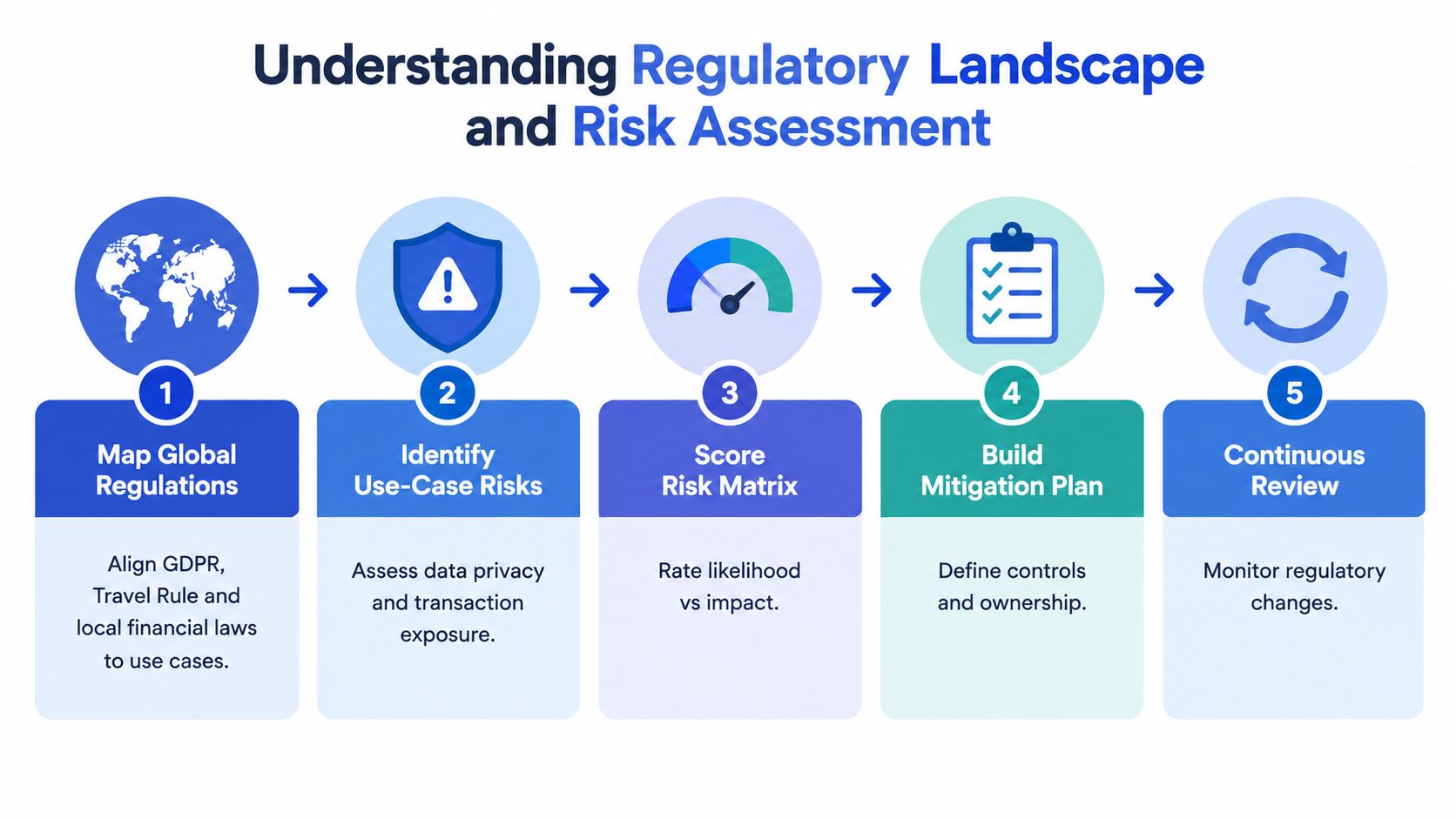
Regulatory analysis should start with the business process and its participants, not the blockchain brand. A cross-border payment workflow, tokenised security platform, and credential registry expose different data, users, service providers, and legal questions. Map each activity to the jurisdictions involved, customer or asset type, information exchanged, decision owner, and required evidence.
Privacy obligations such as GDPR can shape personal-data storage and deletion design. The Travel Rule can affect information exchange between virtual asset service providers, while local financial regulations may determine licensing, reporting, custody, and transaction controls. Legal and compliance teams should validate each interpretation for the operating jurisdictions rather than applying a global checklist as legal advice.
Build a use-case risk matrix
A risk matrix turns regulatory requirements into design choices. Score each workflow against:
- Data sensitivity: Identify identity data, financial information, commercially sensitive records, and public credentials.
- Transaction exposure: Assess volume, settlement value, reversibility, and the consequences of a compromised key or incorrect smart contract rule.
- Participant profile: Separate known consortium members from anonymous users, intermediaries, customers, and external service providers.
- Jurisdictional complexity: Record where participants, infrastructure, data stores, and regulated activities are located.
- Control dependency: Identify decisions that rely on external KYC, sanctions, fraud, custody, or reporting services.
Consider a cross-border stablecoin payout pilot operating in the EU and India. Score data sensitivity as high because KYC records contain personal information, jurisdictional complexity as high because GDPR and local licensing requirements apply, and control dependency as high because sanctions screening comes from an external service. That result supports keeping personal information off-chain while storing cryptographic references on the ledger. It also creates clear review points for legal ownership, vendor availability, alert failure, and exception handling.
A high-sensitivity workflow may require governed off-chain storage with cryptographic references on-chain. A multi-party process with known participants may favour a permissioned network. A public chain may suit a verifiable public record only after privacy, governance, and transaction controls are addressed.
India provides a useful regional signal. Its enterprise blockchain market grew to USD 1,088 million in 2025 and is projected to reach USD 85,107 million by 2034, according to IMARC’s India blockchain market analysis. Indian teams can use this blockchain compliance roadmap when converting regulatory uncertainty into delivery controls.
Practical rule: Never put personal information on-chain simply because the ledger is tamper-evident. Store the minimum necessary proof on-chain and keep sensitive records in governed systems with controlled access.
For implementation capacity, Blockchain Development may include custom applications across public, private, and hybrid blockchain networks. The development choice should follow the risk assessment. Teams should also distinguish a registered address from an operational or KYC address, as explained in this guide to KYC address vs legal address.
Selecting and Integrating KYC AML Tooling
KYC and AML tooling should be selected as part of the operating model. A vendor that screens wallets well may not support the identity coverage, jurisdictional workflow, case management, or API controls required by an enterprise. Compare vendors on supported asset types, geographic coverage, sanctions and adverse-media capabilities, webhook support, evidence retention, service-level commitments, and the effort required to integrate with identity, custody, CRM, and ledger systems.
The table below is a decision aid, not a universal ranking. Product capabilities change, and legal teams should confirm suitability directly with each provider.
Comparison of leading KYC AML tooling
| Vendor | Key Features | Use Case Fit | Integration Complexity |
|---|---|---|---|
| Chainalysis | Blockchain intelligence, transaction tracing, risk signals, investigative workflows | Digital assets, exchange monitoring, investigations | Moderate to high, especially where case workflows and internal risk models must connect |
| TRM Labs | Wallet screening, transaction monitoring, tracing, sanctions and investigation support | Virtual asset platforms, financial institutions, compliance operations | Moderate, with careful mapping required for alerts and case data |
| Elliptic | Blockchain analytics, wallet risk screening, transaction tracing, compliance intelligence | Asset screening, investigations, financial crime controls | Moderate, depending on the number of transaction and customer systems |
| ComplyAdvantage | KYC, sanctions, screening, customer risk and monitoring services | Customer onboarding and financial crime screening | Moderate, particularly when identity and blockchain analytics are separate services |
| Sumsub | Identity verification, KYC, AML checks, onboarding workflow and case handling | Digital asset onboarding and customer lifecycle controls | Moderate, with integration effort driven by identity, document, and decision flows |
Choose for the full control path
Start with a sandbox and test representative customer journeys, including successful onboarding, failed verification, sanctions matches, duplicate identity records, stale credentials, and manual review. Then test how the vendor returns decisions, evidence, reason codes, and timestamps. A simple pass or fail response isn’t enough for a regulated workflow that may need later explanation.
Define the service boundary before signing. Decide which party owns data quality, screening configuration, alert investigation, model changes, incident notification, and retention. Vendor support matters because a technically available API doesn’t guarantee that your compliance team can resolve ambiguous results quickly.
For banking use cases, teams can examine how blockchain verification for KYC and customer onboarding might fit into a broader identity architecture. For asset-focused platforms, Tokenization Platform Development covers compliant tokenisation platforms for real-world assets, securities, real estate, commodities, and digital assets using enterprise blockchain technology.
Configuring Monitoring and Alerting for On-Chain Activity
On-chain monitoring should turn raw transaction activity into decisions that named teams can act on. Start by defining the monitored entities, including wallets, contracts, custodians, bridges, treasury accounts, and counterparties. Then classify events such as unusual wallet behaviour, rapid movement through linked addresses, interaction with sanctioned exposure, unexpected contract calls, or transactions that conflict with an account’s approved profile.
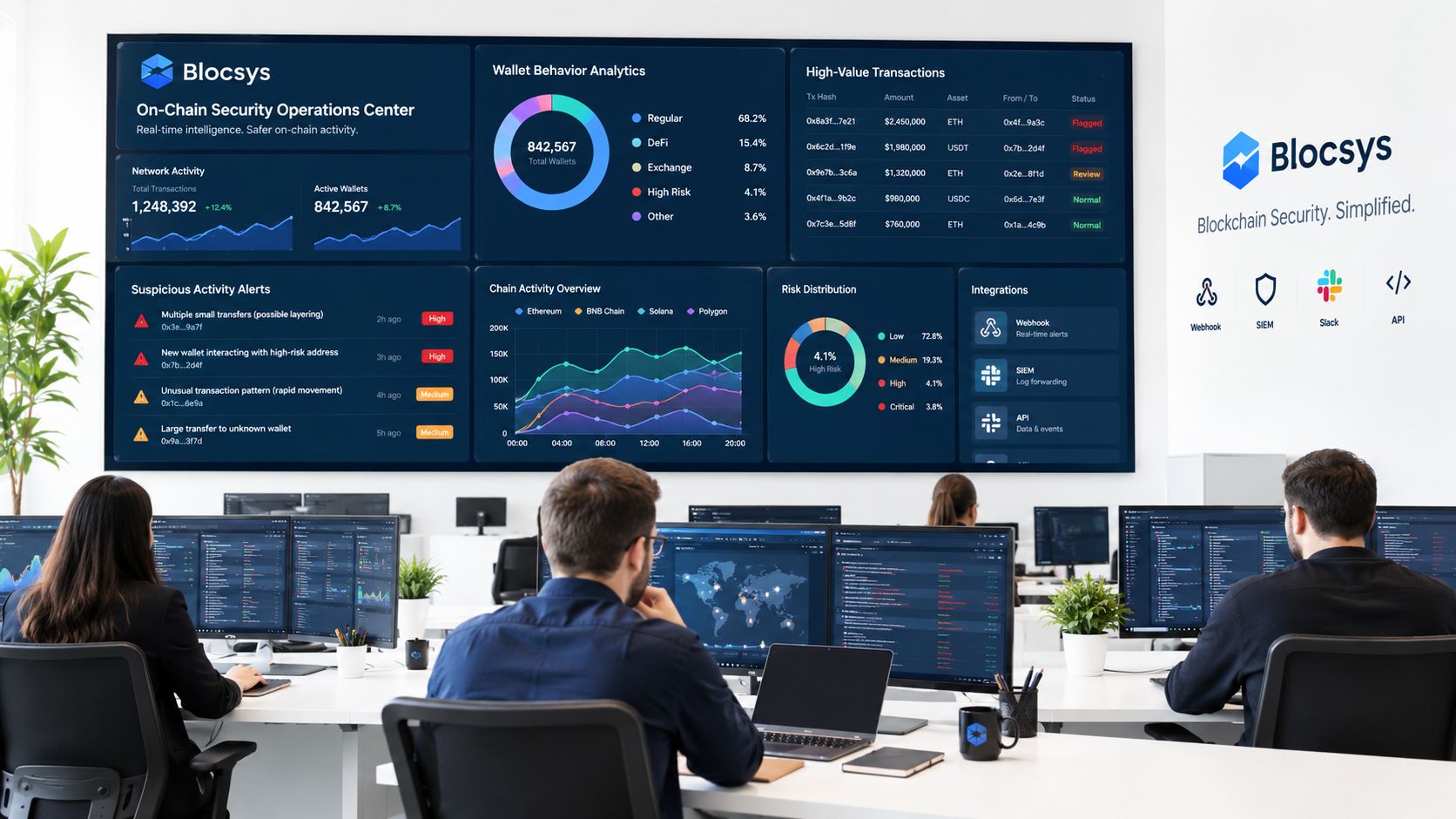
Configure alerts around decisions
Avoid starting with every available rule. Build a small control catalogue that maps each alert to a risk, an owner, an action, and an evidence requirement.
- High-value movement: Route a transaction above the organisation’s approved policy threshold to compliance review before settlement where the workflow allows it.
- Rapid transaction changes: Flag repeated transfers, unusual asset conversions, or sudden activity from a normally inactive wallet.
- Sanctions and exposure: Escalate transactions linked to prohibited or restricted exposure, with the screening result preserved for investigation.
- Contract anomalies: Send unexpected function calls, permission changes, or administrative actions to security and smart contract owners.
- Identity mismatch: Hold activity when wallet ownership, customer status, or credential validity no longer matches the approved profile.
The threshold itself should come from the risk assessment and business policy. Don’t copy a value from another organisation. A retail marketplace, an institutional trading platform, and a corporate treasury operation will have different customer profiles and escalation needs.
Connect monitoring to response
Choose platforms that can send webhooks or integrate with a SIEM, case-management system, and ticketing workflow. A useful event should include the transaction reference, relevant wallet or contract, risk reason, detection time, current customer status, assigned owner, and required next action.
This structure reduces alert fatigue because analysts can see context before opening several systems. Deduplication, suppression for known operational patterns, severity tiers, and escalation timers also help teams focus on material issues. Keep suppression rules under change control, and review them when the product, customer base, or regulatory profile changes.
A practical enterprise blockchain analytics guide can help teams connect transaction intelligence with business reporting rather than treating analytics as a separate dashboard.
The video below can support stakeholder discussions about how security teams interpret blockchain activity and operational signals.
Designing Reporting and Audit-Ready Trails
An audit-ready blockchain system preserves more than transaction hashes. It records what happened, which control ran, what decision it produced, who reviewed an exception, and how the organisation corrected or closed the issue. On-chain records provide durable evidence of ledger events, while off-chain systems usually hold identity information, investigation notes, vendor responses, access records, and remediation documents.
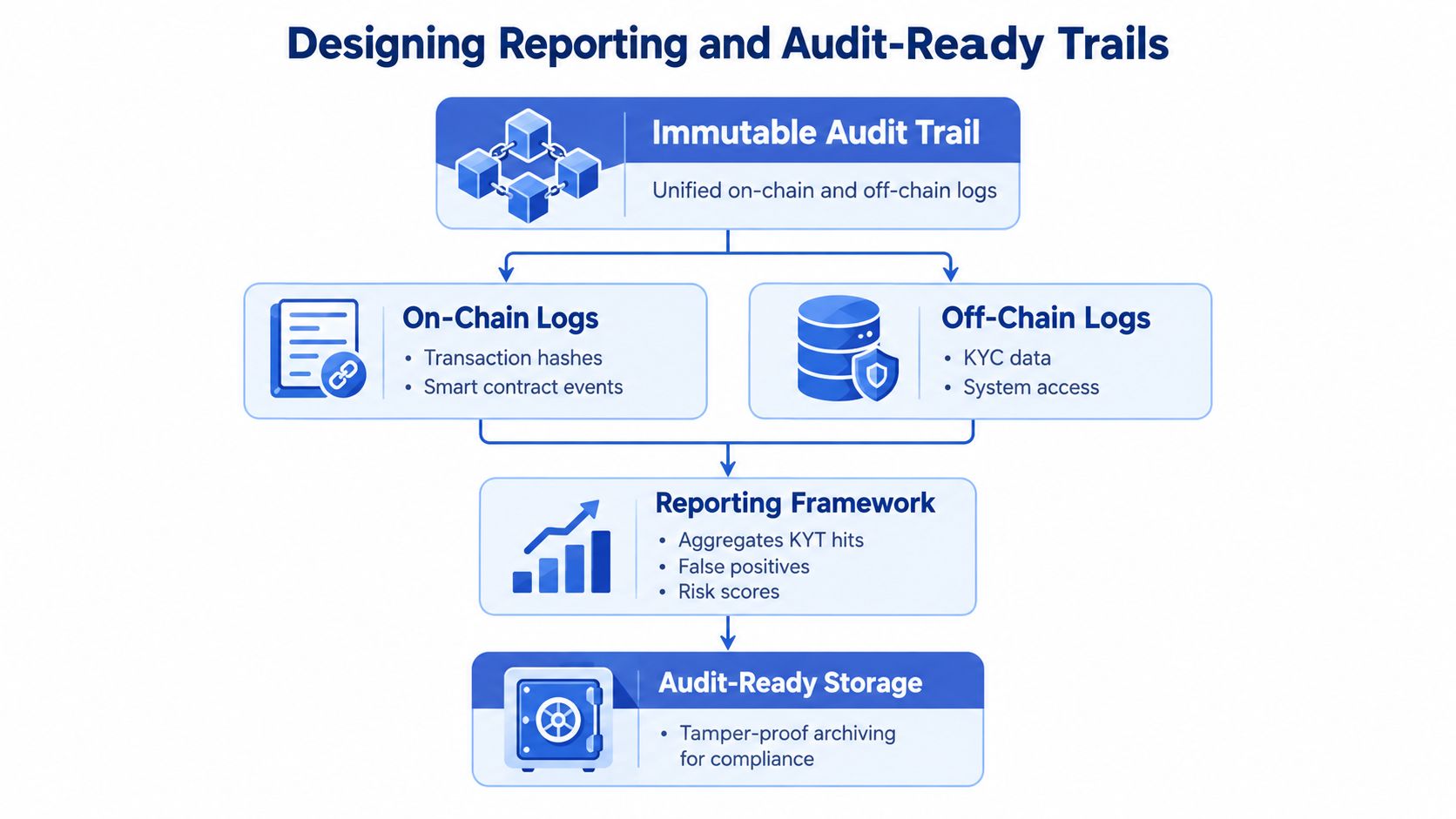
Define the evidence model
Create an evidence record for each material compliance event. It should connect the customer or entity reference, the wallet or account, the transaction, the screening result, the decision, the reviewer, the timestamp, and any remediation. Use stable identifiers so an auditor can follow the chain of events without exposing unnecessary personal information.
A reporting layer can aggregate:
- KYT hits: The alerts generated by transaction and wallet monitoring.
- False positives: Alerts reviewed and dismissed, together with the reason.
- Risk scores: The score at decision time and any subsequent change.
- KYC events: Verification requests, outcomes, refreshes, and failures.
- Remediation actions: Holds, escalations, customer contact, restrictions, and closure decisions.
The system should export reports in a format that internal audit, compliance leadership, regulators, and legal teams can use. It should also preserve the underlying evidence, not just a summary chart.
Audit principle: A dashboard shows the result. An audit trail must show how the result was produced.
Retention and access require equal attention. Encrypt sensitive off-chain records, restrict access by role, log administrative activity, and define retention periods with legal and compliance owners. Store cryptographic commitments or references where they strengthen integrity without placing personal data permanently on a ledger.
Teams working in highly structured reporting environments may also find the concept of automated iGaming compliance reports useful when designing recurring evidence packs, even though the specific reporting obligations differ by sector. For blockchain-native evidence design, compliance-ready audit trails with cryptographic evidence offers a relevant implementation direction.
Embedding Automated Compliance Workflows
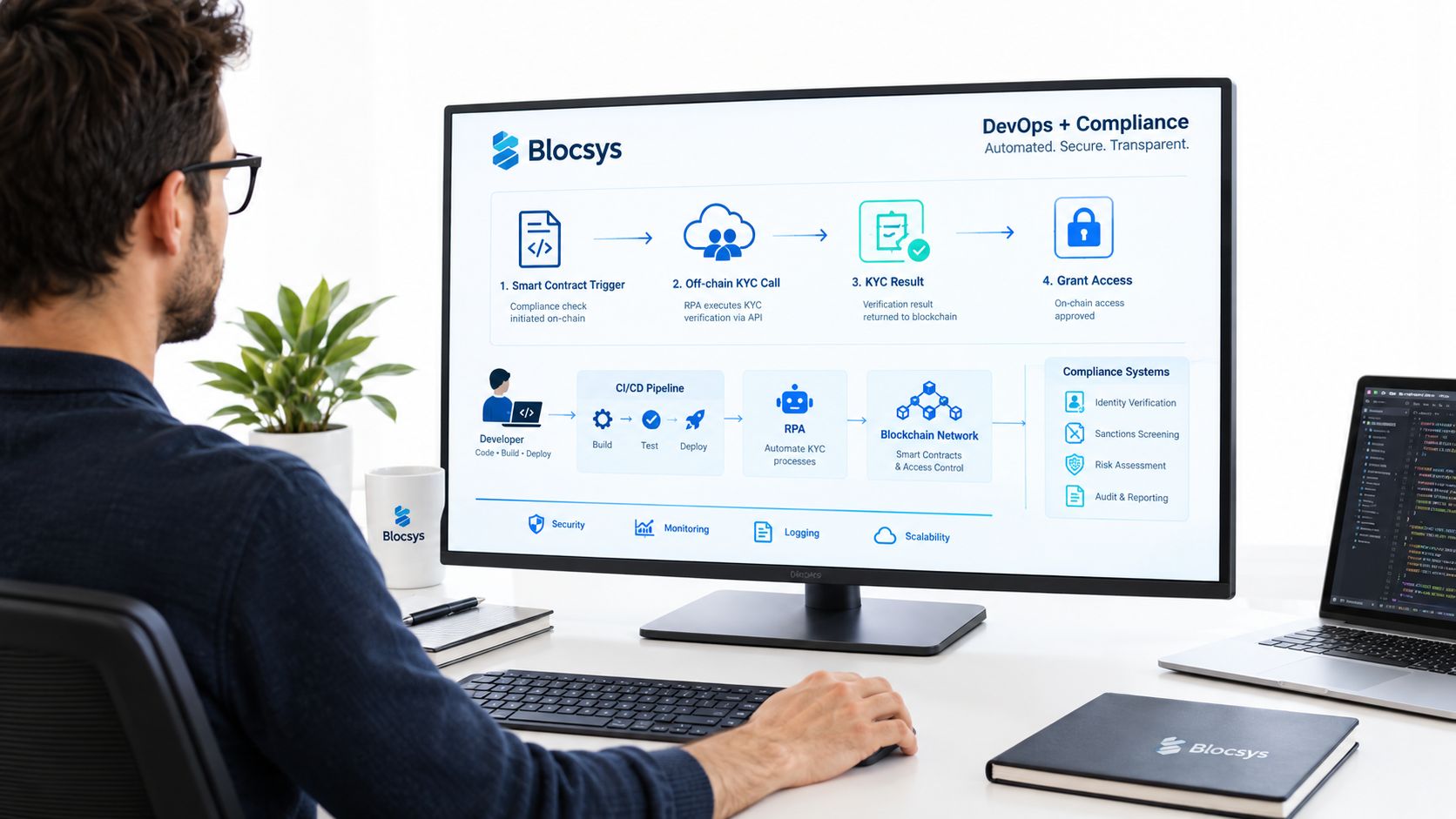
Compliance works best when it runs inside the transaction lifecycle rather than after settlement. A smart contract can emit an event when a participant requests access, transfers an asset, or invokes a controlled function. An orchestration service can receive that event, call KYC or AML providers, apply policy logic, and return an approval, rejection, hold, or manual-review state to the application.
Keep policy outside irreversible code
Not every compliance rule belongs in a smart contract. Contract logic is appropriate for deterministic permissions, transfer restrictions, approved states, and role-based actions. Rules that change frequently, require external interpretation, or involve confidential data usually belong in a policy service or workflow engine.
A pattern separates four layers:
- Event capture: The blockchain application records the event and assigns a traceable correlation identifier.
- Compliance orchestration: A workflow engine or microservice calls identity, screening, risk, and policy services.
- Decision storage: The system stores the decision, evidence reference, policy version, and expiry state off-chain, with a verifiable reference where appropriate.
- Access enforcement: The application or contract permits, blocks, or pauses the requested action based on the approved state.
Design for failure. External providers may be unavailable, responses may arrive late, and a customer may need manual review. Use explicit pending states, idempotent requests, timeout handling, compensating actions, and a controlled emergency process. Never treat a missing response as approval.
Version every policy and contract change. Test changes in a sandbox, obtain compliance sign-off, define rollback or pause procedures, and keep an exception queue for cases that need human judgement. Operational guardrails should cover automated decisions, access rights, data handling, and escalation. A practical reference is AletheionAGI’s guardrails guide, which frames guardrails as controls around business automation.
The result is not “compliance by code” alone. It’s a coordinated system where code, policy, external data, human review, and evidence work together.
Conclusion and Next Steps with Blocsys
A credible enterprise blockchain strategy treats compliance as a connected operating capability. The sequence runs from regulatory mapping and risk scoring through KYC and AML integration, on-chain monitoring, alert handling, reporting, audit evidence, and automated enforcement. That approach reduces avoidable ambiguity, supports audit readiness, and gives business and technology leaders a clearer basis for deciding whether to proceed.
Blocsys Technologies Pvt Ltd works across blockchain consulting, blockchain development, smart contract development, enterprise blockchain solutions, and digital asset and tokenisation platforms. Its role can include evaluating a use case, designing the target architecture, connecting compliance workflows, and supporting the move from an approved strategy towards implementation.
If your organisation is considering a blockchain pilot, start with a focused compliance strategy workshop. Define one workflow, its control obligations, its evidence model, and its production decision criteria before commissioning a larger build.
Frequently Asked Questions
What does enterprise blockchain strategy consulting include?
Enterprise blockchain strategy consulting connects business objectives with use-case selection, feasibility analysis, network choice, architecture, integration, governance, security, compliance, and delivery planning. A consultant should also define decision gates, ownership, evidence requirements, and the conditions under which a conventional database is preferable to blockchain.
How should a business plan blockchain adoption?
Begin with a process and stakeholder assessment. Identify the shared-trust problem, map participants and data flows, test blockchain fit against a traditional database, assess regulatory and operational risks, select a network and architecture, define measurable objectives, and validate the design through a narrow proof of concept before expanding.
Which enterprise blockchain use cases are usually suitable?
Suitable use cases often involve multiple organisations that need a shared, verifiable record. Examples include supply-chain provenance, trade finance, credential verification, healthcare records, land registries, digital identity, and controlled asset transfers. The strongest candidates need auditability or multi-party coordination that existing systems struggle to provide efficiently.
What does a blockchain feasibility assessment examine?
A feasibility assessment examines the business problem, participant incentives, process ownership, data sensitivity, transaction requirements, interoperability, legal context, security model, operating costs, and organisational readiness. It should explicitly test whether shared governance and tamper-evident records justify blockchain complexity.
How should a company choose blockchain technology?
Choose the network after defining requirements. Compare permissioning, governance, privacy, transaction behaviour, smart contract capability, interoperability, operational support, key management, and regulatory fit. Public, private, and hybrid networks each involve trade-offs, so platform selection should reflect the workflow rather than a preferred technology brand.
What should enterprise blockchain architecture include?
Architecture should cover applications, smart contracts, ledger nodes, identity, wallets or custody, API and event layers, off-chain data stores, monitoring, key management, audit evidence, and operational support. It should also document data residency, permission boundaries, failure handling, upgrade procedures, and integration points with enterprise systems.
How can blockchain integrate with existing enterprise systems?
Use APIs, event streams, workflow services, and controlled adapters to connect the ledger with ERP, CRM, identity, custody, payment, analytics, and case-management systems. Keep systems of record clearly defined, avoid duplicating sensitive data unnecessarily, and use correlation identifiers so teams can trace a business event across platforms.
How should compliance workflows operate on a blockchain platform?
A blockchain event should trigger an orchestration service that performs KYC, AML, sanctions, or policy checks. The service returns an approved, rejected, held, or manual-review state, while evidence and policy versions remain auditable. Smart contracts should enforce deterministic permissions, not contain every changing regulatory interpretation.
What makes blockchain reporting audit-ready?
Audit-ready reporting links transaction history with KYC events, screening results, risk decisions, reviewer actions, exceptions, and remediation. Preserve on-chain and off-chain logs, protect sensitive records, record timestamps and policy versions, restrict access, and make both summary reports and supporting evidence exportable.
When should a business engage a blockchain consultant?
Engage a consultant before selecting a platform or commissioning development when the use case involves several parties, regulated activity, sensitive data, tokenised assets, complex integrations, or uncertain return. Early guidance can expose poor blockchain fit, clarify controls, and produce a roadmap that engineering and compliance teams can execute together.
Blocsys Technologies can help evaluate enterprise blockchain opportunities, design adoption and compliance strategies, and connect architecture planning with smart contracts, blockchain development, tokenisation, and automation. Discuss your use case, control requirements, or pilot scope by visiting Blocsys Technologies.
