
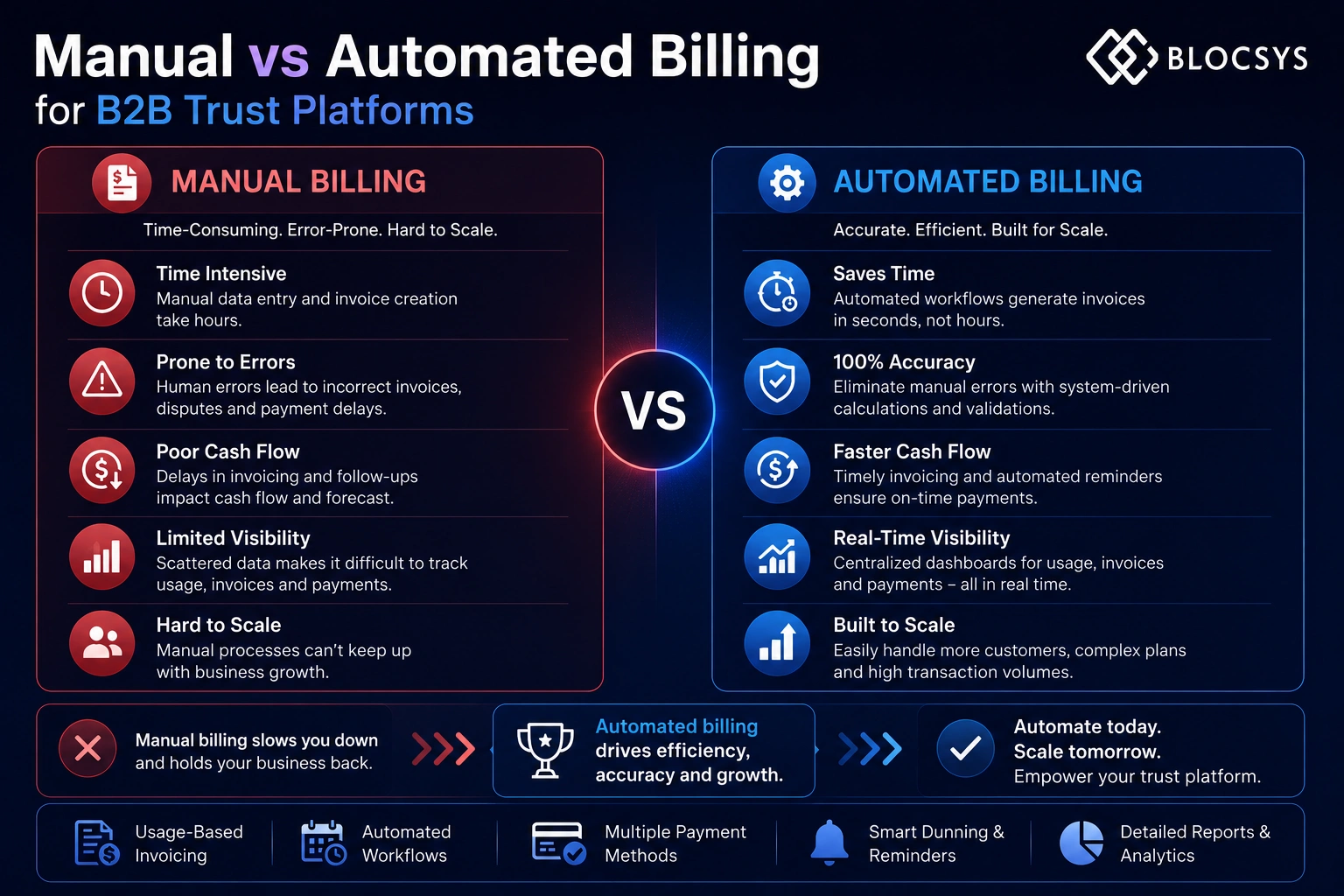
A familiar pattern plays out in growing B2B trust platforms. Finance starts with spreadsheets because the first few customers are manageable. Product adds a recurring plan, then usage pricing for API calls, then a custom enterprise contract in another currency. Suddenly, invoices take days to prepare, reconciliation slips behind collections, and every month-end close feels riskier than it should.
That’s the scaling dilemma behind manual vs automated billing for B2B trust platforms. What worked at launch often breaks when a platform begins handling subscriptions, consumption pricing, partner settlements, or cross-border invoicing. The problem isn’t only efficiency. It’s control. Teams lose confidence in invoice accuracy, customers challenge charges they can’t trace, and leadership stops getting a clean view of revenue operations.
This issue matters most to CTOs, CFOs, founders, and product leaders building in SaaS, Web3, AI, crypto, and trust-led digital infrastructure. If you’re evaluating whether to keep patching manual processes or redesign your revenue stack properly, this guide is for you. It’s written for decision-makers who need both the strategic lens and the implementation detail.
For teams planning the next stage of revenue infrastructure, Blocsys offers broader context on enterprise software, blockchain, and AI delivery, and its software development cost estimator is useful when you need to frame build-versus-buy discussions early.
Table of Contents
- Introduction The Scaling Dilemma for B2B Trust Platforms
- Understanding The Manual Billing Bottleneck
- When to Switch The Automated Billing Advantage
- Billing Architectures for Modern Trust Platforms
- Automating Complex Monetization API and Usage-Based Billing
- Ensuring Security Compliance and Audit Trails
- Implementation Roadmap and Future Billing Trends in 2026
- How Blocsys Builds Enterprise-Grade Billing Solutions
- Frequently Asked Questions
Introduction The Scaling Dilemma for B2B Trust Platforms
The hardest billing problems rarely start as billing problems. They start when a trust platform adds one more pricing exception, one more legal entity, one more currency, or one more enterprise customer with negotiated terms. What looked like a finance workflow becomes a systems architecture issue.
For B2B trust platforms, billing sits at the centre of customer trust. A tokenisation platform has to meter usage correctly. An AI API platform has to convert events into billable records cleanly. A blockchain marketplace has to align invoicing, payment status, and ledger evidence without creating disputes. If those pieces don’t line up, revenue operations become fragile.
Three signals usually show up at once:
- Finance spends too much time assembling invoices: data lives across exports, spreadsheets, email threads, and payment portals.
- Product pricing outpaces billing capability: recurring fees, overages, credits, and custom contract terms need manual intervention.
- Leadership loses real-time visibility: receivables, collections, and recognised revenue stop lining up in a way anyone fully trusts.
Manual billing can survive early growth. It usually can’t survive pricing complexity.
For teams in the UK, Europe, the USA, UAE, Singapore, Canada, Australia, and other global SaaS markets, the challenge is broader than local invoicing. Cross-border trust platforms need a revenue system that can handle varied tax logic, multiple currencies, payment rails, and defensible audit records. That’s why the manual versus automated billing decision is no longer an operational clean-up exercise. It’s a core infrastructure decision.
Understanding The Manual Billing Bottleneck
Manual billing often looks controlled from the outside because people can “see” each step. In practice, that visibility is deceptive. What teams really have is a chain of handoffs that depends on memory, spreadsheets, and timing.
How manual billing actually runs day to day
A typical workflow starts with usage or contract data pulled from product systems, CRM exports, or account notes. Finance checks customer entitlements, calculates charges, prepares invoices in spreadsheets or templates, and sends them individually. Then someone tracks responses, follows overdue accounts, and reconciles incoming payments against bank activity.
That model becomes brittle quickly. According to AvidXchange’s comparison of manual and automated AP systems, manual B2B payment processes rely heavily on paper such as checks, invoices, and purchase orders, which leads to higher fraud risk, slower approvals, and inefficient information access. The same analysis notes that automated systems reduce paper use, speed approvals, and give finance teams real-time access to invoice and payment data.
For trust platforms, manual billing creates a second-order problem. Billing evidence gets fragmented across internal tools. A usage record may live in one system, invoice logic in another, and payment confirmation in a third. That’s manageable for a small customer base. It becomes dangerous when customers ask for billing traceability.
Where the hidden drag appears
The hidden cost isn’t only labour. It’s the operational drag created by exception handling.
- Usage disputes: A customer questions API call volume, storage consumption, or token-based service fees.
- Version confusion: Finance resends corrected invoices, but collections still references the older amount.
- Delayed reconciliation: Payments arrive, yet no one is sure which invoice or contract period they settle.
- Approval lag: Internal review for custom terms slows invoice dispatch and extends time to cash.
A useful mental model comes from distributed systems. Once the same financial fact exists in several places, consistency matters more than effort reduction. That’s one reason engineering teams interested in scalable proof and batching patterns often study approaches like Merkle batching for one-chain transaction handling many proofs. The principle is similar in billing. You need fewer manual touchpoints and stronger consistency across records.
Operational warning: When finance has to reconcile system outputs manually every billing cycle, the billing model has already outgrown the process.
When to Switch The Automated Billing Advantage
The switch from manual to automated billing shouldn’t be framed as “nice to have automation”. It should be framed as the point where revenue infrastructure stops scaling with headcount and starts scaling with system design.
The threshold is clearer than most teams think
The threshold is often not ambiguous. BillingPlatform’s analysis of manual versus automated billing states that for B2B trust platforms, migration becomes critical at approximately 200 active customers or when pricing includes a usage or consumption component. The same source notes that manual billing scales with headcount, while automated billing scales with configuration, reducing marginal costs by up to 90% as transaction volume grows.
A separate analysis from Monto on manual versus automated invoice processing sharpens the financial case. It reports that leading organisations using AI automation achieve invoice processing costs below $5 per invoice, while manual processing ranges from $15 to $40 per invoice, which equals a 67% to 87% cost reduction. That source also notes automation tends to become critical when a business exceeds 200 active customers, operates with usage-based or hybrid pricing, uses multiple currencies, or has billing cycles that exceed two days. In B2B contexts, 42% of payments are now fully automated, according to the same source.
Here’s the visual summary many buyers look for before they commit to change.
Manual vs Automated Billing a Side-by-Side Comparison
| Criteria | Manual Billing | Automated Billing |
|---|---|---|
| Cost per invoice | Higher processing cost, with manual processing reported at $15 to $40 per invoice | Lower processing cost, with leading AI-enabled organisations achieving below $5 per invoice |
| Scaling model | Scales with headcount | Scales with configuration |
| Fit for usage pricing | Weak, because every exception adds manual work | Strong, because rules can be encoded and reused |
| Multi-currency support | Error-prone and slow | Better suited to repeatable workflows and system integration |
| Collections visibility | Fragmented across email, sheets, and bank data | More structured with payment tracking and workflow control |
| Customer experience | Inconsistent invoice timing and explanation | Faster, more predictable invoice delivery and follow-up |
| Marginal cost at growth | Rises linearly with more customers and transactions | Can reduce marginal cost by up to 90% as volume grows |
After the first decision point, many teams want to see how the operating model feels in practice. This short explainer is useful context.
The strategic shift is this. Automation changes billing from a monthly finance event into a product-aligned system. That allows product, finance, and engineering to work from one revenue logic instead of negotiating exceptions at the end of every cycle.
Billing Architectures for Modern Trust Platforms
For CTOs, the core question isn’t whether billing should be automated. It’s how the architecture should be assembled so billing remains accurate when product design changes.
The core components of a modern billing stack
An enterprise-grade billing architecture usually contains five layers.
Metering layer
This collects raw consumption data. For an API platform, that could be requests, compute time, storage use, or feature invocations. For a blockchain trust platform, it may include wallet activity, settlement events, custody actions, or asset issuance flows.Rating engine
This converts usage into charges. The engine applies rules such as flat recurring fees, tiers, overages, contracted allowances, or hybrid pricing logic.Invoice engine
This assembles billable events into customer-ready invoices with tax details, payment terms, credits, and supporting line items.Payments and collections orchestration
This layer interacts with gateways, bank rails, reminders, status changes, and collections workflows.Accounting and ledger sync
This posts approved billing outcomes into finance systems so revenue, receivables, and cash records remain aligned.
A clean implementation keeps these components decoupled but event-connected. Usage shouldn’t be hard-coded inside invoice templates. Payment outcomes shouldn’t be trapped in a gateway dashboard. Invoice state should flow back into customer, finance, and support systems.
For teams comparing operating models, tools such as Intelligent Contacts’ quote invoice platform are useful to review because they show how quote-to-invoice workflows can be structured before full enterprise automation is deployed.
Why multi-currency design needs to be deliberate
Multi-currency usage-based billing is where many trust platforms discover that “automation” alone isn’t enough. Alternative Payments’ review of B2B payments in 2024 highlights a gap in most market content: it doesn’t address the billing friction created when trust platforms move from manual to automated billing while supporting multi-currency usage models. That gap matters because invoice reconciliation can drift when currency conversion changes between usage capture, rating, invoice generation, and settlement.
The architecture needs explicit FX handling. Teams should decide which rate source is authoritative, when rates are locked, how invoice currency differs from settlement currency, and how exchange adjustments appear in financial records.
A strong pattern is to make billing logic API-first. That gives product and finance a shared contract for usage events, pricing rules, and invoice generation. For technical teams designing this properly, API-first trust infrastructure for developers in 2026 is a helpful internal architecture reference.
A billing stack fails quietly when pricing logic lives in code, invoice logic lives in spreadsheets, and FX logic lives in people’s heads.
Automating Complex Monetization API and Usage-Based Billing
Trust platforms rarely stay on a simple monthly subscription for long. They move into seat-based access, transaction fees, usage thresholds, storage charges, compute metering, or combinations of all of them. That’s where manual billing stops being inconvenient and starts becoming structurally unfit.
Why pricing model and billing architecture must match
There are three monetisation patterns that matter most in modern B2B platforms:
- Recurring subscription billing: a fixed platform fee billed monthly, quarterly, or annually.
- Pure usage-based billing: charges based on measurable consumption such as API calls, processed documents, storage, or compute.
- Hybrid billing: a base subscription plus overage or event-driven charges.
The more dynamic the pricing model, the more dangerous manual intervention becomes. A spreadsheet can model a fixed monthly fee. It can’t reliably model entitlements, late-arriving usage events, customer-specific discounts, contract minimums, credits, and overages at scale.
What accurate usage billing looks like operationally
Hyperline’s explanation of automated billing systems describes the operational flow clearly. In automated billing cycles designed for usage-based pricing, the system analyses customer purchase data and product usage metrics, generates invoices automatically, dispatches them, monitors payment status, follows up on overdue balances, and syncs all transaction details with financial records.
That matters for product trust as much as revenue collection. When customers can trace an invoice line back to actual usage logic, disputes usually shift from “this invoice looks wrong” to “let’s review the underlying event definition”. That’s a healthier argument because it’s technical, not speculative.
A practical implementation often includes:
- Event normalisation: convert raw platform activity into billable events with consistent fields.
- Rule versioning: preserve old pricing logic for existing contract periods while allowing new terms for new periods.
- Customer-facing transparency: show usage summaries, thresholds, and invoice components clearly.
- Late-event handling: define whether delayed usage lands in the current invoice, next invoice, or a separate adjustment.
For Web3 founders, billing design also shapes product strategy. A platform built around revenue-first event design will monetise more cleanly than one that tries to retrofit billing after launch. That’s why building revenue-first blockchain products in 2026 is increasingly a platform architecture question, not only a pricing question.
Design principle: If product can launch a new chargeable action in a sprint, billing should be able to recognise it without rebuilding the finance stack.
Ensuring Security Compliance and Audit Trails
Billing automation is often sold as an efficiency project. For trust platforms, the more important benefit is control. Compliance failures usually begin with weak process design, not with missing policy documents.
Compliance failures usually begin as process gaps
A trust platform can have strong product security and still fail a billing audit. Missing invoice terms, inconsistent tax data, weak receivables tracking, and fragmented evidence across systems all create risk. This is especially relevant when a platform serves regulated customers or operates across the UK, EU, UAE, USA, and other markets with different invoicing and retention expectations.
Billtrust’s guidance on B2B invoicing notes that automated billing systems eliminate manual data entry errors and accelerate invoice delivery by integrating directly with accounting software. The same source highlights that automation also supports precise tax calculations, regulatory disclosures such as tax registration numbers and jurisdiction-specific rules, and structured collections processes with defined escalation timelines and third-party criteria.
That combination is easy to underestimate. It means automation doesn’t only help finance move faster. It standardises how invoice data is produced, disclosed, and escalated.
What stronger auditability looks like in practice
One unanswered market question has become more important for digital asset businesses. CFO.com’s discussion of hidden manual payment costs points to a gap in current coverage: most commentary focuses on efficiency and ignores compliance risks such as missing invoice terms, unreconciled receivables, and audit trail fragmentation when moving from manual to automated billing. For trust platforms facing stricter digital asset and fintech regulation, that’s a material concern.
A stronger audit trail has several characteristics:
- Source-linked billing records: each invoice line can be traced to a contract rule, event source, or approved adjustment.
- Change history: billing logic changes are versioned, timestamped, and attributable.
- Immutable evidence options: critical billing events can be hashed, sealed, or anchored for stronger evidentiary posture.
- Collections traceability: reminder cadence, dispute status, and payment follow-up are recorded consistently.
For teams operating in regulated or semi-regulated environments, compliance-ready audit trails with cryptographic evidence provides a strong implementation pattern to review.
The more a platform sells trust, the less it can afford invisible billing logic.
Implementation Roadmap and Future Billing Trends in 2026
Billing migrations fail when teams treat them as a finance tool replacement. Successful programmes treat them as cross-functional infrastructure change with product, data, finance, and compliance implications.
A practical migration sequence
A clean rollout usually follows a phased approach.
Start with revenue logic, not software demos.
Map current pricing, invoice rules, exceptions, and approval workflows first. If those rules are unclear, automation will only hard-code confusion.
Define the system boundary.
Decide what the billing platform owns versus what remains in CRM, ERP, payment gateways, tax tooling, and data pipelines.
Migrate in slices.
Move one billing model first, often fixed subscriptions or a contained customer segment. Then layer in usage billing, multi-currency logic, and contract-specific rules.
Run parallel validation.
For an initial period, compare automated invoice outputs against existing finance processes. Differences should be investigated, not waived through.
Later-stage optimisation often includes workflow refinements that reduce duplicate ledger actions and repetitive settlement costs. In adjacent blockchain infrastructure, teams facing similar efficiency questions often explore patterns like anchor reuse when duplicate content should not pay gas again.
Where billing is heading next
The next phase of enterprise billing combines AI-led operations with blockchain-native settlement paths. The most immediate forward-looking shift is in cross-border B2B payments. Web3 Enabler’s guide to blockchain B2B payments reports that blockchain-based automated payment systems reduce transaction costs by 90% and make settlement 95% faster than conventional methods. The same source states transaction fees can fall below 1% of transaction value, compared with 4% to 8% for traditional cross-border payments.
That’s strategically important for trust platforms with global customers because billing and payment architecture are starting to converge. In practical terms, the next 12 to 24 months will likely push teams toward:
- Faster settlement-linked billing workflows
- More embedded payment automation for B2B receivables
- AI-supported exception handling and collections prioritisation
- Stronger evidence layers for invoice integrity and compliance review
The winners won’t be the platforms with the most complicated pricing. They’ll be the ones whose billing system can express pricing cleanly, settle efficiently, and withstand audit pressure.
How Blocsys Builds Enterprise-Grade Billing Solutions
Blocsys approaches billing as part of revenue infrastructure, not as an isolated invoicing module. That matters for trust platforms because billing logic has to align with product architecture, payment orchestration, compliance workflows, and the evidentiary demands that come with regulated or high-trust environments.
Its strength is the combination of enterprise software delivery, blockchain-native system design, and practical implementation thinking. That mix is useful when a platform needs to support recurring subscriptions, API usage billing, hybrid commercial models, and customer-specific contract logic without creating a separate manual process for each exception. It’s equally relevant when finance teams need clean accounting integration and engineering teams need API-first control over metering and pricing logic.
For digital asset businesses, exchanges, tokenisation platforms, AI products, and B2B SaaS companies, the harder problem usually isn’t generating invoices. It’s creating a billing system that remains accurate when the product evolves, volumes rise, currencies multiply, and compliance scrutiny increases. Blocsys is well positioned in that space because it works where software, trust, and financial operations intersect.
If your current process still depends on spreadsheets, invoice edits, and month-end reconciliation clean-up, the next step isn’t another patch. It’s a billing architecture decision. Blocsys can help you scope it, design it, and deliver it with the rigour enterprise platforms need.
Frequently Asked Questions
| Question | Answer |
|---|---|
| What is manual billing for B2B platforms | Manual billing is a process where teams collect usage or contract data, calculate charges, create invoices, send them, and reconcile payments by hand across spreadsheets, email, accounting tools, and bank records. It works early on, but it becomes fragile when pricing, volume, or currencies grow more complex. |
| What is automated billing software | Automated billing software captures billing inputs from source systems, applies pricing rules, generates invoices, tracks payment status, and synchronises financial records without repeated manual handling. For B2B trust platforms, it acts as a revenue control layer that connects product activity to invoicing and receivables in a repeatable way. |
| Which billing model is better for enterprise SaaS platforms | It depends on the product, but automated billing is usually the better operating model once enterprise SaaS pricing includes subscriptions, usage, overages, or negotiated contracts. It gives finance and product teams a consistent way to manage recurring charges without rebuilding workflows for every customer exception. |
| How does automated billing reduce operational costs | Automated billing lowers process cost by reducing repetitive invoice preparation, limiting manual data entry, and improving payment tracking. It also cuts downstream cost from disputes, delayed reconciliation, and fragmented collections. The biggest savings often come from preventing finance headcount from growing linearly with billing complexity. |
| What is usage-based API billing | Usage-based API billing charges customers according to measured consumption, such as request volume, compute, storage, or feature use. A proper system meters events, rates them under contract rules, and translates them into invoices customers can validate. Without automation, this model usually becomes difficult to manage accurately. |
| How do blockchain trust platforms automate invoicing | They automate invoicing by connecting service events, wallet or transaction activity, contract terms, and payment workflows into a single billing process. The stronger implementations also preserve evidence of billing inputs and changes, which helps when enterprise customers or regulators ask how a charge was produced. |
| How can businesses migrate from manual to automated billing | The safest path is phased. Document current billing rules, define system ownership, migrate one billing segment first, validate outputs in parallel, and only then expand into usage billing, multi-currency support, and advanced collections. Teams that skip rule mapping usually automate exceptions instead of fixing them. |
| Why should businesses choose Blocsys for enterprise trust platform and billing system development | Blocsys fits organisations that need more than generic invoicing software. It combines blockchain, AI, and enterprise software expertise, which is valuable when billing must support trust infrastructure, complex monetisation, auditability, and scalable integrations across product, finance, and compliance systems. |
If you’re planning a move from manual invoicing to scalable revenue infrastructure, Blocsys Technologies can help you design the right architecture, evaluate build-versus-buy options, and deliver billing systems for SaaS, AI, blockchain, crypto, and trust platforms. For an early budgeting view, use the software development cost estimator from Blocsys, or connect with the team directly to discuss enterprise billing automation, API infrastructure, and custom platform development.
