
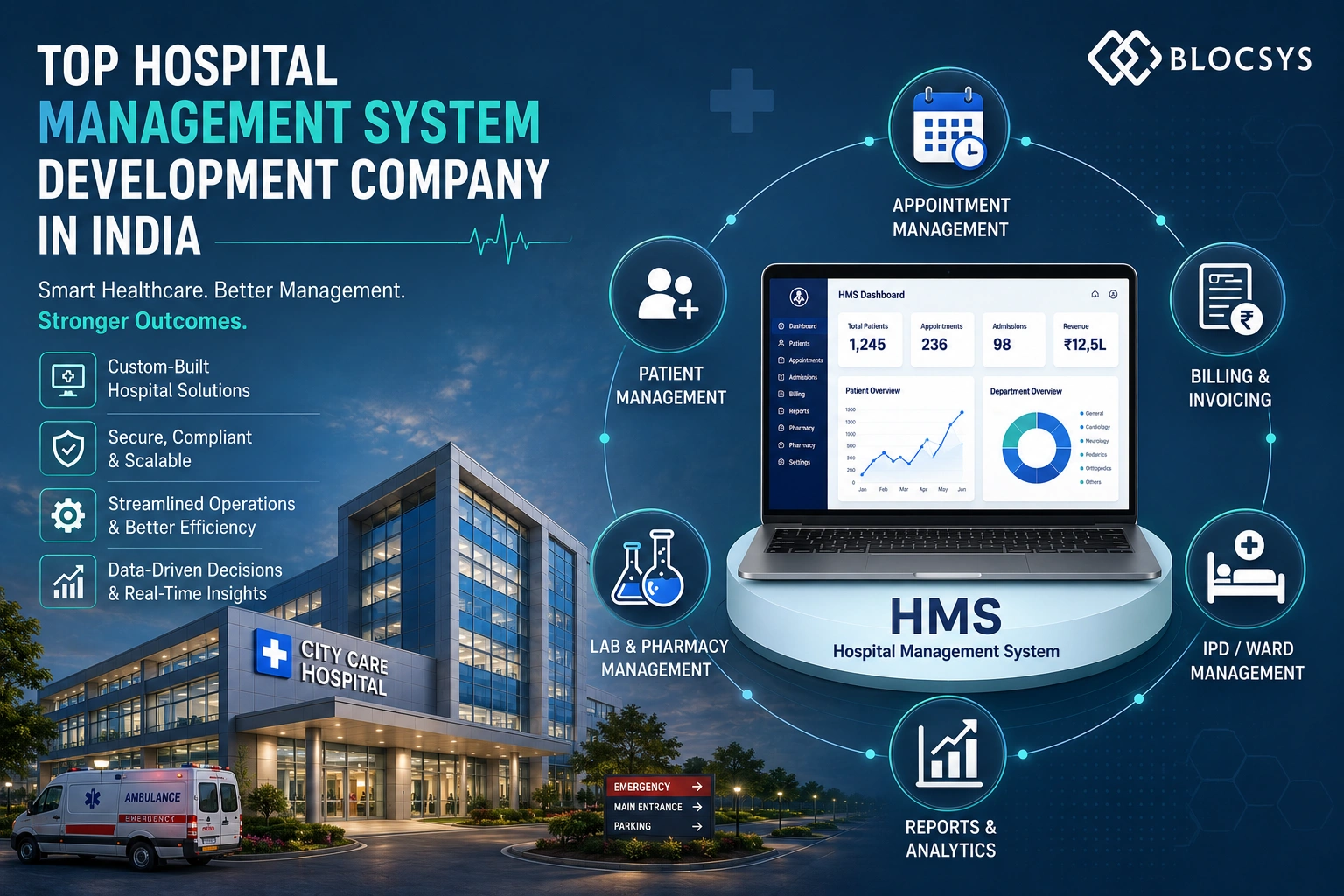
India’s hospital information system market isn’t moving gradually. It generated USD 1,250.0 million in 2025 and is projected to reach USD 2,890.3 million by 2033, with a 21.3% CAGR from 2025 to 2030, according to Grand View Research’s India hospital information system outlook. For a hospital board, that number matters for one reason: an HMS is no longer an IT upgrade. It’s operating infrastructure.
That changes how you should evaluate a hospital management system development company in India. The key question isn’t which vendor offers the longest feature list. It’s whether the system can support clinical workflows, financial control, telemedicine, compliance, and future AI adoption without creating risk in the process.
This guide is written for hospital owners, CTOs, administrators, healthcare startups, and enterprise buyers assessing hospital management software development in India and for organisations in markets such as the UK, Europe, USA, UAE, Singapore, Canada, and Australia that need Indian development capability aligned with international expectations. The practical outcome is a board-level decision framework for architecture, implementation, compliance, partner selection, and long-term scalability. It also addresses an issue most vendor pages miss: local regulatory fit, including NDHM and DPDP considerations, alongside realistic AI adoption paths for mid-sized hospitals.
Table of Contents
- The Digital Transformation Imperative in Indian Healthcare
- Core Architecture of a Modern Hospital Management System
- The HMS Development Process and Implementation Timeline
- Future-Proofing Your HMS with AI and Telemedicine
- Navigating Security and Data Sovereignty in India
- How to Evaluate and Select Your Development Partner
- Why Blocsys is Your Partner for Enterprise Healthcare Solutions
- Frequently Asked Questions About HMS Development
- What is a Hospital Management System
- Why do hospitals need hospital management software
- How much does it cost to develop a Hospital Management System in India
- How long does it take to build hospital management software
- What features should a modern HMS include
- What is the difference between EMR and EHR
- Can AI improve hospital management systems
- Is cloud deployment suitable for hospitals in India
- What should hospitals ask a development company before signing
- Why do HMS projects fail after launch
- Should hospitals buy off-the-shelf software or build custom
- How should a board define success for an HMS project
The Digital Transformation Imperative in Indian Healthcare
Indian hospitals are investing more aggressively in digital infrastructure because fragmented operations now carry visible clinical, financial, and compliance costs. An effective hospital management system connects registration, appointments, clinical documentation, pharmacy, laboratory workflows, billing, insurance, and reporting into one operating model instead of leaving each department to maintain its own record trail.
That strategic shift is not only about replacing paper or old software. It is about reducing delays in admission and discharge, limiting billing leakage caused by incomplete clinical capture, and creating a usable data foundation for quality monitoring, insurer coordination, and multi-site management. As noted earlier, the Indian market outlook for hospital information systems points to sustained growth. The more important board-level conclusion is what that growth reflects: hospitals now treat HMS decisions as infrastructure decisions, with long-term effects on margin control and care delivery.
A custom HMS must therefore be judged on two questions. First, does it fit the operational reality of an Indian hospital, including mixed payer models, variable digital maturity across departments, and local compliance duties? Second, can it support the next five years of change without forcing a second rebuild?
Board view: An HMS is an operating backbone for care delivery, revenue integrity, and compliance execution.
This distinction matters in India more than many vendor guides suggest. Generic offshore products often cover basic workflows but fall short on the issues that create downstream risk: DPDP Act obligations, ABDM and NDHM interoperability expectations, consent-aware data exchange, local hosting preferences, and the need to introduce AI in stages that a mid-sized hospital can afford. A system that ignores these constraints can increase implementation risk even if the feature list looks strong in a demo.
The evaluation must then shift from software procurement to platform design and partner capability. Hospitals need development teams that understand clinical workflow dependencies, Indian data governance requirements, and interoperability patterns across diagnostics, insurance, telemedicine, and referral networks. Teams assessing long-term data exchange models should also review how blockchain in healthcare can support data security and interoperability.
The practical takeaway is simple. Digital transformation in Indian healthcare is no longer defined by digitisation alone. It is defined by whether the hospital can build a system that improves daily operations now, meets Indian regulatory expectations, and creates a financially workable path to AI, analytics, and coordinated care later.
Core Architecture of a Modern Hospital Management System
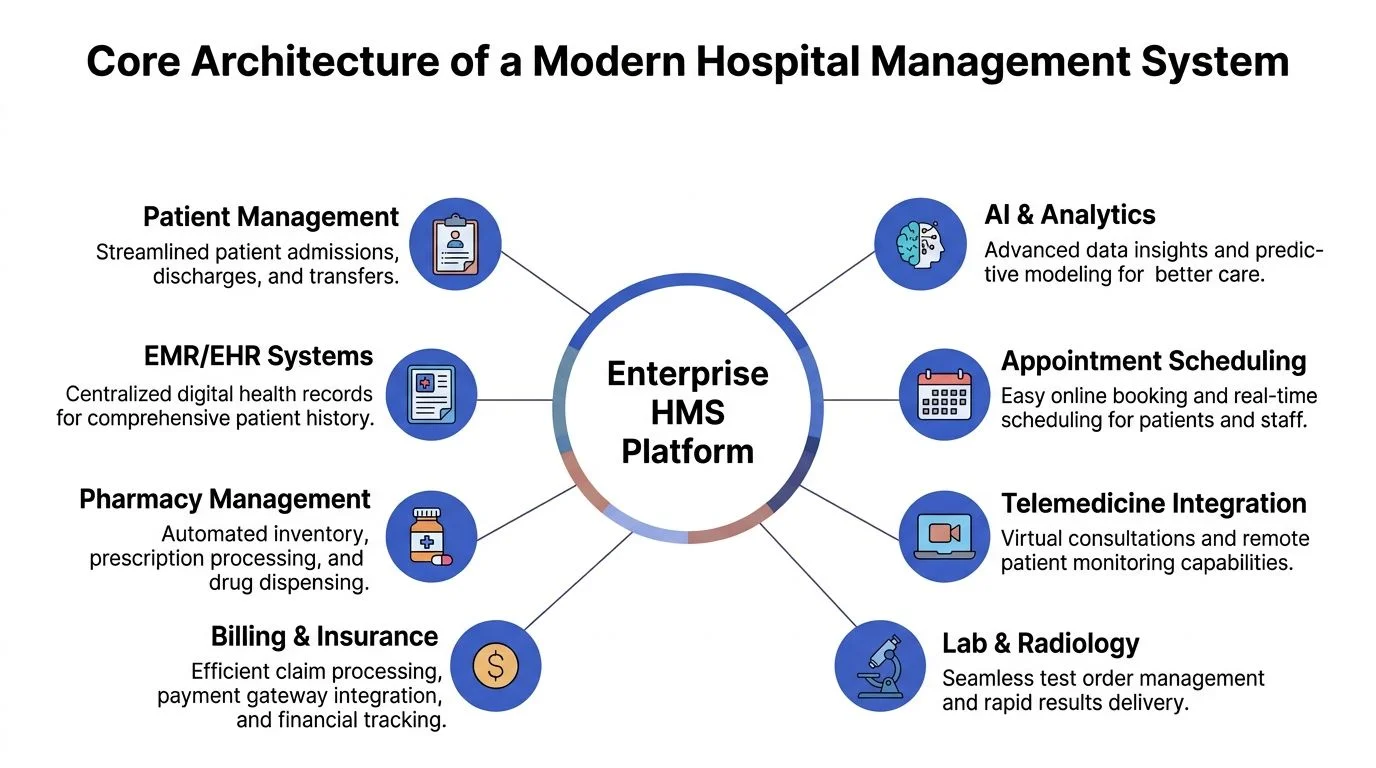
An enterprise HMS succeeds or fails at the architecture layer. Most boards see demonstrations of screens. What matters more is whether those screens sit on top of a coherent operational model.
Why architecture matters more than feature count
Hospitals don’t run as one process. They run as dozens of interdependent workflows. Registration affects billing. Doctor documentation affects pharmacy dispensing. Lab reporting affects discharge timing. Insurance approvals affect cash flow. If these functions are built as separate software silos, staff create manual bridges.
A strong custom hospital management system should therefore be judged on three architectural qualities:
| Architectural priority | What it should do in practice | What failure looks like |
|---|---|---|
| Workflow continuity | Carry patient, clinical, and financial data across modules without re-entry | Staff duplicate work across departments |
| Role-based usability | Present different interfaces for front desk, clinicians, finance, pharmacy, and management | Everyone sees too much or too little |
| Integration readiness | Connect with EMR/EHR, telemedicine, labs, insurers, and reporting systems | Data stays trapped in one module |
The modules that carry operational weight
The front office layer starts with patient management. That includes registration, demographic capture, appointment scheduling, admission and discharge handling, and queue visibility. For smaller hospitals, software first proves its value through these operations. It reduces front-desk delays and creates a reliable patient identity record for everything that follows.
The clinical layer includes doctor and nurse workflows plus EMR or EHR integration. Here, the board should ask a practical question: can clinicians chart care without fighting the system? A vendor that understands healthcare application development will design around consultation notes, order management, medication history, observations, and follow-up visibility, not just generic form fields.
Administrative control sits in the financial and operational modules:
- Billing and insurance management should handle tariff logic, package billing, claims support, payment tracking, and reconciliation.
- Inventory and procurement should support medical consumables, stock visibility, and reorder discipline.
- Management reporting should help administrators monitor utilisation, department load, and revenue bottlenecks.
Ancillary services are equally important because they close the care loop.
- Pharmacy management should align prescription issuance, dispensing, stock movement, and audit trails.
- Laboratory and radiology modules should manage orders, status tracking, and result delivery back into the patient record.
- Telemedicine integration should support remote consultations within the same operational environment, not as a detached app.
The strongest HMS platforms don’t feel modular to the user. They feel continuous.
For buyers comparing vendors, a specialist HMS software development company demonstrates its distinction from a generic software team. The question isn’t whether they can code each module. It’s whether they can make the modules behave like one hospital. That’s also where adjacent capabilities such as secure data workflows and advanced product engineering matter, especially if your roadmap includes intelligent automation or interoperable health services. Organisations assessing complex platform builds often review broader engineering capabilities through providers such as Blocsys.
The HMS Development Process and Implementation Timeline
Projects of this type rarely fail because a hospital chose the wrong screen layout. They fail because requirements were underspecified, integrations were underestimated, and compliance decisions were postponed until late-stage testing.
What a disciplined build cycle looks like
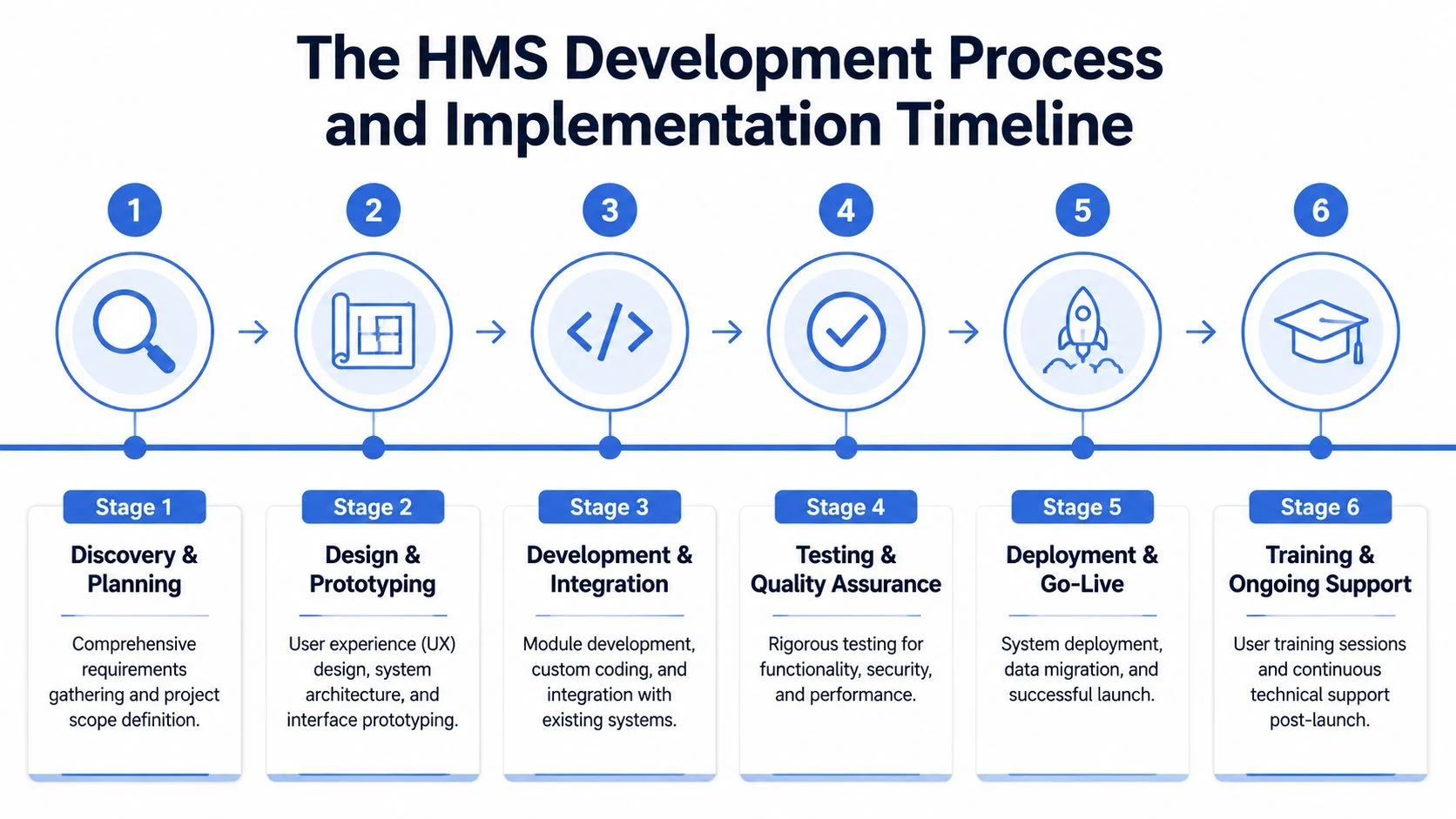
Indian hospitals that implement HMS platforms successfully tend to follow a controlled delivery model rather than a generic software sprint plan. The JIER paper on HMS development methodology describes a four-stage approach covering requirements and planning, design, development with integration, and implementation with testing and release. In that study, the methodology was associated with reduced clinical errors by 30% and improved billing accuracy by 25%.
For a hospital board, that is not an IT detail. It is an operating model issue tied to revenue capture, patient risk, and adoption across departments.
A workable sequence usually has four gates:
Requirements validation and workflow mapping
The vendor should map outpatient, inpatient, pharmacy, diagnostics, finance, discharge, and exception workflows with actual users. In India, this stage should also identify DPDP Act exposure, ABDM or NDHM interoperability targets, consent handling, and whether legacy systems hold data that must remain in-country.Design, access controls, and prototype sign-off
This stage should settle role-based permissions, approval hierarchies, patient journey logic, and dashboard priorities before core build work starts. Hospitals that skip prototype review often discover late that nursing stations, billing desks, and consultants need different interfaces and escalation paths.Development, integration, and migration planning
The hard part is usually not feature coding. It is integration with lab devices, PACS or radiology workflows, pharmacy systems, TPA processes, and accounting tools, plus migration of inconsistent historical records. Mid-sized hospitals should also decide here whether to add limited AI capabilities now or reserve architecture for later deployment.Testing, training, and phased go-live
Technical QA is only one layer. Operational acceptance testing should cover registration bottlenecks, medication issue workflows, discharge billing, claim edge cases, and downtime procedures. A phased rollout by department often reduces disruption more effectively than a single hospital-wide cutover.
One pattern deserves more scrutiny. Vendors often present compliance as a final checklist. In practice, privacy rules, audit logging, data retention, and interoperability standards shape architecture choices from the first month. If those decisions are deferred, rework costs rise and go-live dates slip.
How boards should read cost and timeline estimates
The widest variation in HMS proposals usually comes from three factors. Scope definition, integration depth, and regulatory design assumptions.
As noted earlier in the article, peer-reviewed research on hospital information system implementation in India places typical development costs in the $30,000 to $300,000 range, with timelines from 4 months to over 12 months, depending on complexity, customisation, interoperability requirements, and privacy controls. Boards should treat that range as a benchmarking frame, not as a procurement number.
A more useful reading of vendor estimates looks like this:
| Project type | Typical board expectation |
|---|---|
| Foundational implementation | Registration, billing, basic clinical workflows, limited third-party integration |
| Multi-department custom build | Department-specific workflows, reporting controls, migration complexity, selective interoperability |
| Enterprise platform programme | Multi-site readiness, stronger governance, custom analytics, deeper integration, compliance engineering |
This is also where many hospitals misread low bids. A short timeline can mean the vendor excluded migration cleanup, user training, audit trails, or consent workflows from the estimate. The cheaper proposal is sometimes the one that transfers delivery risk back to the hospital.
Hospitals that want earlier budget discipline before vendor selection can use a structured planning tool such as the software development cost estimator for pre-hire budgeting. It helps frame cost around modules, integrations, and deployment assumptions before commercial negotiations begin.
Staffing assumptions matter too. If your roadmap includes virtual care, the implementation plan should account for remote scheduling, clinician availability, and cross-state consultation workflows, including support models shaped by markets such as remote telehealth nurse practitioner jobs. That has implications for queue design, documentation standards, and access controls inside the HMS.
A credible implementation plan gives the board more than a date and a price. It shows which decisions are irreversible, which modules can be phased, where compliance risk sits, and how much operational change the hospital can absorb in each quarter.
Future-Proofing Your HMS with AI and Telemedicine
The next HMS decision isn’t whether to add AI. It’s how to add it without destabilising the system you already rely on.
Why hybrid AI is the practical path for mid-sized hospitals
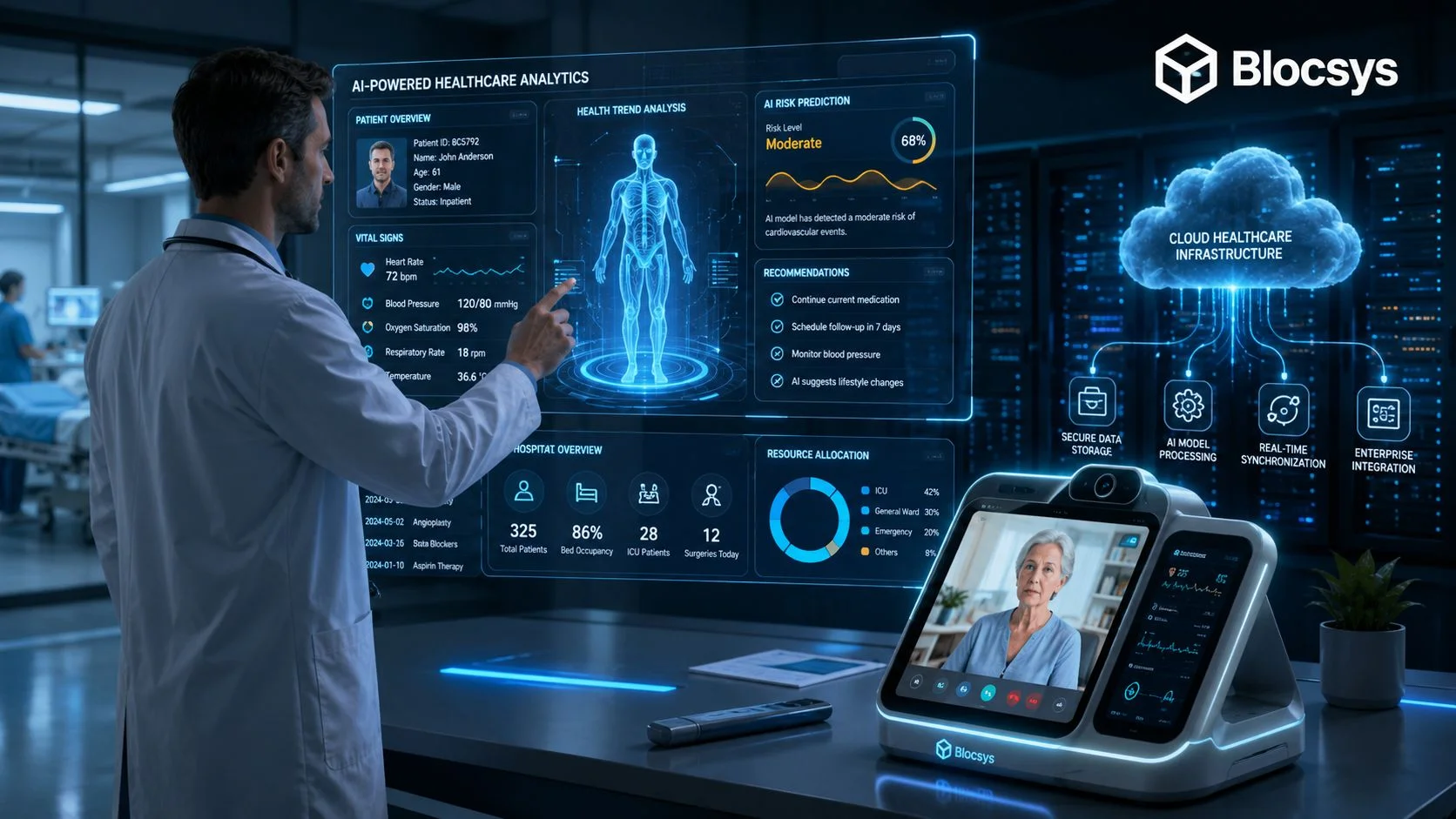
A common procurement mistake is assuming that meaningful healthcare AI requires a full custom rebuild. In India, that assumption excludes much of the market. A 2024 NASSCOM study, cited in this analysis of hospital management software development in India, found that 75% of Indian mid-sized hospitals cannot afford full custom AI-HMS builds, with average costs of ₹25-40 Lakhs. The same research points to a more realistic option: hybrid approaches that add lightweight AI capabilities into existing ₹5-10 Lakhs systems.
For boards, this changes the roadmap. Instead of asking for “AI features”, ask where selective intelligence creates operational value without rewriting core workflows.
Good candidates include:
- Triage support for routing patients by urgency or specialty
- Resource optimisation for bed, room, or staff allocation
- Administrative automation for coding support, discharge summaries, or exception flagging
- Analytics overlays that surface bottlenecks to management teams
These are narrower use cases, but they’re often more deployable than ambitious, fully custom predictive platforms.
AI should enter the HMS where data quality is strongest and workflow friction is highest.
Telemedicine is now part of the care model
Telemedicine can’t sit outside the main hospital workflow anymore. If virtual consultations produce notes, prescriptions, follow-up actions, or billing events, those records belong inside the same operational system. Otherwise, hospitals create a second care stream with weaker visibility.
India is also moving towards broader cloud-based adoption. According to MocDoc’s overview of HMS adoption in India, the healthcare sector is projected to adopt cloud-based HMS at a rate of 65% by 2027. That trend supports telemedicine because video consultation, remote coordination, and cross-location access are easier to manage in cloud-native or hybrid environments.
Workforce design intersects with platform design. Health systems expanding virtual care often need to think not only about software, but also about the operating model for distributed clinicians. For teams planning virtual service lines, WeekdayDoc’s guide to remote telehealth nurse practitioner jobs is a useful reference for understanding how remote clinical roles are being structured.
A practical telemedicine-ready HMS should include appointment orchestration, consultation notes, e-prescription support, digital follow-up, and billing continuity. If AI is also on the roadmap, the integration strategy matters even more. Hospitals exploring combined intelligent workflow models can review related thinking on AI and blockchain integration for next-generation platforms.
Later-stage buyers often ask whether telemedicine belongs in phase one or phase two. The answer depends less on ambition and more on workflow maturity. If outpatient operations are already standardised, integrating telemedicine earlier can make sense. If not, the hospital should stabilise patient identity, scheduling, billing, and clinical records first.
A short briefing video can help align non-technical stakeholders around what modern digital care delivery looks like in practice.
Navigating Security and Data Sovereignty in India
Most global HMS content still frames healthcare compliance through a broad HIPAA lens. That’s incomplete for India. Hospital boards now need to think in terms of data sovereignty, local legal accountability, and national digital health interoperability.
Why compliance is now a build requirement
Recent industry reporting highlights a sharp gap between risk and vendor messaging. According to Webority’s hospital management system page, 68% of Indian hospital IT chiefs cite regulatory compliance failure as their top development risk, yet only 12% of vendor marketing materials explicitly detail NDHM integration or DPDP workflows.
That gap should concern every procurement committee. It means many vendors still discuss hospital software as if compliance were a documentation exercise added near go-live. It isn’t. In India, it has to shape architecture, data handling, access control, storage decisions, and auditability from the start.
A hospital can recover from feature delays more easily than from compliance defects embedded in the platform.
What hospitals should require technically
NDHM readiness and DPDP alignment should appear in technical discussions, not just legal annexures. Boards don’t need to dictate implementation details, but they should require evidence that the development partner can translate regulatory obligations into system behaviour.
At minimum, ask for clarity on the following:
Data fiduciary workflow design
The system should support accountable handling of personal data through explicit governance, access boundaries, and action traceability.Consent-aware integrations
If the platform exchanges patient information with external services, the design should reflect how those data movements are authorised and recorded.India-aware hosting and data placement decisions
Data location, cloud configuration, and vendor dependencies should be reviewed through the lens of Indian operational and legal requirements.Audit trails and role-based control
Hospitals need to know who accessed what, when, and for what operational reason.API planning for digital health interoperability
NDHM-related integration capability shouldn’t appear as a vague future promise.
A vendor that can discuss only encryption and passwords is not discussing healthcare compliance at the right depth. Boards should also be careful with offshore templates that mirror international healthcare software language but don’t demonstrate Indian legal-tech fluency. For organisations handling cross-border data or multi-jurisdiction policy questions, this broader guide to GDPR, DPDP Act, and compliance challenges is useful context.
The strategic conclusion is straightforward. In India, compliance competence is not an add-on capability. It is one of the main criteria for choosing a hospital management system development company.
How to Evaluate and Select Your Development Partner
A hospital rarely buys “software” in these engagements. It is choosing an operating model for clinical coordination, revenue capture, compliance execution, and future change. Two proposals with similar feature lists can carry very different long-term costs if one depends on rigid third-party modules, weak integration design, or loosely defined support after go-live.
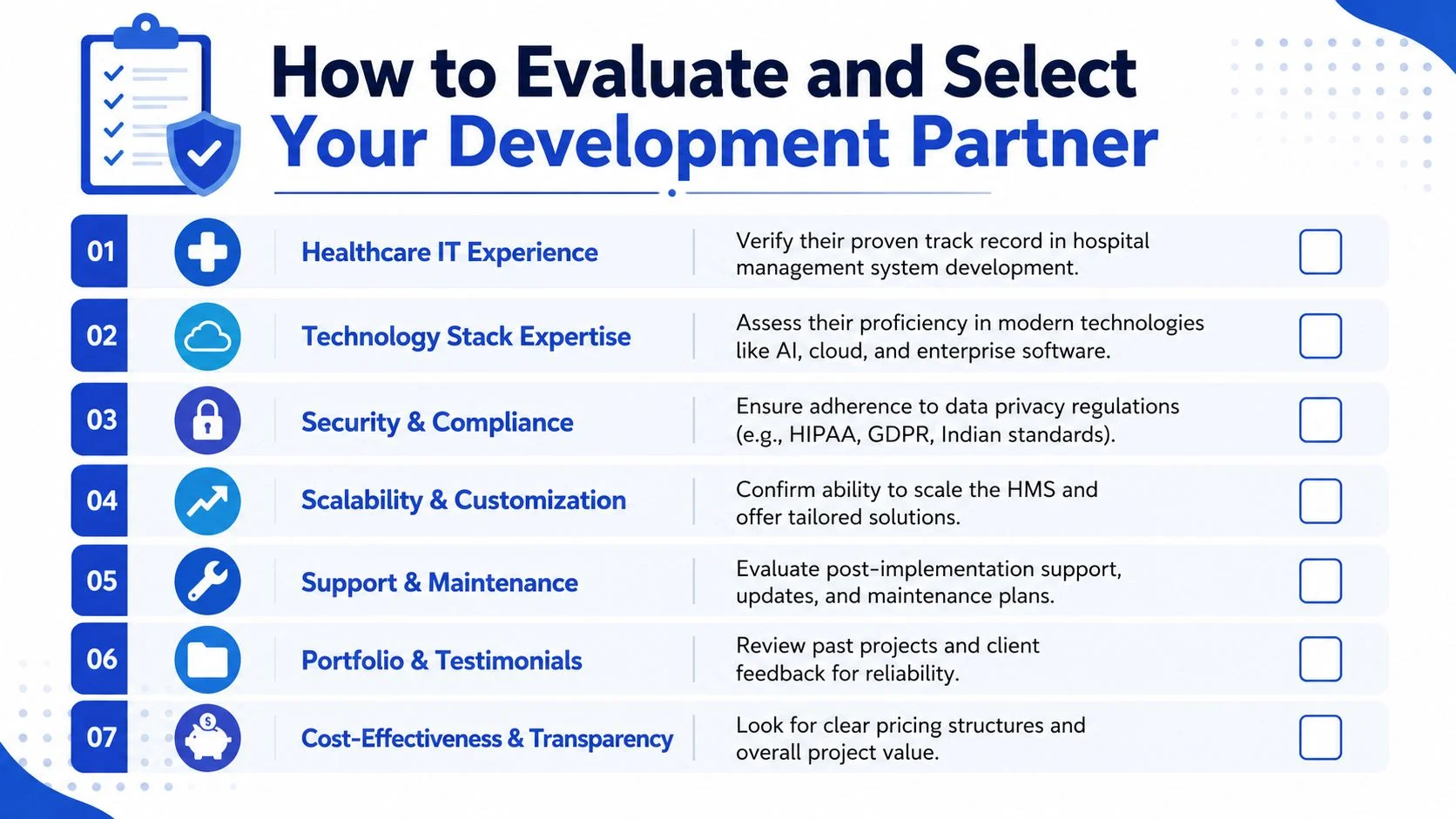
A board-level selection framework
As noted earlier in the article, hospital digitisation projects often underperform for predictable reasons. The pattern is familiar. Vendors understand software delivery but not ward operations, exception-heavy billing, diagnostic workflows, or the operational discipline needed after launch. Boards should therefore assess delivery fitness, governance maturity, and healthcare context together, not treat vendor selection as a procurement exercise driven by demo quality or lowest bid.
A useful test is whether the partner can explain trade-offs clearly. For example, a custom HMS may fit local workflows better and reduce workaround costs over time, but it demands stronger product governance. A configurable platform may shorten initial deployment, but hospitals often pay later through change-request inflation, integration constraints, and clinical process compromises. Mid-sized Indian hospitals should examine this choice carefully because budget pressure is real, yet regulatory and interoperability expectations are rising.
Use this framework during RFP review and final management presentations:
| Evaluation area | What to ask | Why it matters |
|---|---|---|
| Clinical workflow depth | Ask the vendor to map OPD, IPD, emergency, pharmacy, diagnostics, billing, discharge, and claims exceptions | Generic enterprise logic breaks down in hospitals where delays and handoff failures affect care, revenue, and patient experience |
| Architecture and integration design | Request the target architecture, API approach, migration plan, and method for integrating EMR/EHR, LIS, RIS, insurance, telemedicine, and finance systems | Integration failures create duplicate data entry, reporting gaps, and hidden operating costs |
| India-specific compliance execution | Ask how DPDP Act obligations, consent records, auditability, retention rules, and ABDM alignment change product design and hosting decisions | Vendors that speak only about encryption usually have not thought through Indian healthcare governance in enough detail |
| AI practicality | Ask where AI will be used first, what data it needs, how accuracy will be monitored, and whether the use case actually saves staff time | Mid-sized hospitals do not need expensive AI theatre. They need focused automation in triage, coding support, queue management, and document workflows |
| Post-go-live operating model | Ask who owns incident response, release management, training refreshers, uptime reporting, and optimisation after deployment | Adoption declines when support is left to a junior helpdesk or an undefined offshore team |
| Scalability and commercial structure | Ask how the system supports multi-site growth, specialty additions, transaction growth, and future cloud changes. Review what is fixed-price versus variable | A low initial quote can become expensive if every integration, report, and process change triggers new fees |
One more distinction matters. Staff augmentation and end-to-end product delivery are not interchangeable. Hospitals with an experienced CIO office, internal architects, and product owners may manage a blended team well. Hospitals without that capability usually need a partner that can own architecture decisions, implementation governance, and measured rollout planning.
Red flags that usually appear too late
Several warning signs appear during selection but are often ignored until the hospital is already committed.
Presentation strength without operational depth
If the discussion stays at the level of dashboards and screen design, ask the vendor to walk through bed transfers, cancelled tests, package billing conflicts, referral leakage, and discharge delays.Vague statements on AI
If the pitch promises predictive analytics, automation, or intelligence without naming the model boundary, data source, validation method, and user accountability, the hospital is hearing marketing rather than implementation planning.Loose language on compliance and hosting
A credible partner should be able to explain where data will sit, how access decisions are logged, how consent-linked data flows are recorded, and how Indian legal requirements affect vendor dependencies.No named owner after launch
Hospitals should know who is accountable for stabilisation, training, backlog control, and configuration governance in the first six to twelve months.Unclear change economics
Boards should ask what happens when a specialty expands, a reporting format changes, or a payer workflow shifts. That is where many “affordable” contracts become expensive.
Procurement teams should also test how the vendor reasons under stress. Ask each shortlisted firm to analyse a failed patient journey. Use a real scenario such as a delayed lab result that affects discharge, an insurance rejection after admission, or a consultant order change that alters pharmacy and billing records. Strong partners describe workflows, system dependencies, escalation logic, and audit impact. Weak partners return to the demo.
For boards comparing specialist technology firms, the diligence method is similar to other high-consequence platform decisions. This framework for assessing specialist consulting and technology partners is a useful reference for tightening commercial, technical, and governance review.
Why Blocsys is Your Partner for Enterprise Healthcare Solutions
Hospitals choosing a development partner need more than software delivery. They need architecture discipline, compliance awareness, and the ability to build systems that can evolve with AI, telemedicine, and enterprise integration demands.
That’s where Blocsys is relevant. As a healthcare software, AI, blockchain, and enterprise technology company, Blocsys works on secure, scalable digital platforms and intelligent compliance workflows. For a hospital board, that matters because the next-generation HMS increasingly sits at the intersection of application engineering, data governance, and interoperable digital infrastructure.
The fit is strongest for organisations that don’t want a surface-level hospital ERP. They want a platform that can support patient operations, administrative control, selective automation, and future integration without creating regulatory or architectural debt. This is particularly relevant for multi-specialty hospitals, healthcare groups, digital health ventures, and institutions modernising legacy systems while preparing for cloud and AI adoption.
If your board is assessing a hospital management software development company in India, the useful test is simple: can the partner handle real healthcare workflows, data-sensitive engineering, and long-horizon product thinking in one programme? That’s the standard modern hospital systems now require.
Frequently Asked Questions About HMS Development
What is a Hospital Management System
A Hospital Management System is an integrated software platform for patient administration, clinical documentation, billing, pharmacy, laboratory operations, and management reporting. Its business value comes from reducing fragmented workflows. A hospital that runs registration, diagnostics, discharge, and billing on separate tools usually pays for that fragmentation through delays, duplicate data entry, and weaker operational control.
Why do hospitals need hospital management software
Hospitals use hospital management software to standardise processes, improve coordination across departments, and create a reliable operational record of what happened, when, and by whom. That matters in India because growth in bed capacity, payer complexity, and digital reporting obligations tends to increase administrative load faster than staffing can absorb it.
How much does it cost to develop a Hospital Management System in India
Custom HMS development in India usually falls within a broad range of $30,000 to $300,000, depending on module scope, integration requirements, security design, and the level of workflow customisation. Boards should treat that number as a planning range. The actual cost driver is rarely the first release alone. It is the total programme cost across implementation, migration, support, compliance updates, and future integrations.
How long does it take to build hospital management software
Typical delivery timelines range from 4 months to over 12 months. A focused deployment for registration, appointments, billing, and pharmacy can move faster. A multi-site programme with EMR workflows, lab and PACS integration, migration from legacy systems, and phased user training will take longer. The timeline usually depends less on coding speed and more on process clarity, decision-making discipline, and integration complexity.
What features should a modern HMS include
A modern HMS should include patient registration, appointment scheduling, clinician workflows, EMR or EHR support, billing, insurance handling, pharmacy, laboratory management, reporting, and role-based access controls. For Indian hospitals, the stronger question is not which features exist on a checklist. It is whether those modules reflect real operating conditions such as delayed discharge approvals, partial payments, referral coordination, package billing, and exceptions in lab or pharmacy workflows.
Telemedicine support and consent tracking also matter if the hospital expects to expand beyond in-person care.
What is the difference between EMR and EHR
EMR usually refers to digital records used within a single provider environment. EHR refers to a broader record structure designed for information exchange across care settings. In board-level evaluation, the practical issue is interoperability. A vendor can use either term, but the hospital should verify whether the system can exchange data cleanly with diagnostics, insurers, public health platforms, and external providers.
Can AI improve hospital management systems
Yes, if AI is applied to defined operational or clinical problems rather than added as a generic feature. Mid-sized hospitals often see better returns from targeted use cases such as coding assistance, no-show prediction, triage support, claims review, discharge summarisation, and queue management.
This is also where many projects go wrong. Hospitals overpay when they commission broad AI programmes before cleaning data structures, access controls, and workflow logic. In most cases, a selective AI layer added to a stable HMS is a lower-risk and more cost-effective approach.
Is cloud deployment suitable for hospitals in India
Cloud deployment can be suitable if the architecture supports security, uptime, auditability, and local data handling requirements. For hospital groups, cloud often improves multi-site access, central administration, and disaster recovery. The trade-off is governance. Boards need clarity on hosting location, encryption, vendor access, backup policy, outage response, and how the design aligns with India’s data protection and digital health expectations.
What should hospitals ask a development company before signing
Ask how the team captures clinical workflows, manages integrations, structures post-launch support, and handles exceptions that happen in real hospitals, not ideal process maps. Ask for clarity on NDHM alignment, DPDP Act readiness, data hosting assumptions, audit logging, migration risk, and user training.
A capable partner should also explain how it will handle change requests without destabilising the system or pushing the hospital into expensive rework.
Why do HMS projects fail after launch
Most post-launch failures come from weak process discovery, limited user training, under-scoped support, poor master data quality, or delayed integrations. Low adoption is often a design and governance problem. Staff usually resist systems when the software adds clicks, breaks familiar care sequences, or fails to reflect how the hospital works.
Should hospitals buy off-the-shelf software or build custom
Off-the-shelf software can work for hospitals with standardised workflows and limited integration demands. Custom development makes more sense when the organisation has specialty-specific processes, multi-entity operations, stricter reporting requirements, or a roadmap that includes AI, telemedicine, and deeper interoperability.
The decision is financial as much as technical. Buying a packaged product may lower initial cost, but repeated workarounds, forced process changes, and vendor limitations can raise total cost over time.
How should a board define success for an HMS project
Success should be defined in operating terms, not by go-live alone. Boards should look for measurable adoption across departments, cleaner billing cycles, fewer manual workarounds, better reporting reliability, stronger audit trails, and faster issue resolution after launch.
A strong HMS also leaves the hospital with options. It should support future compliance changes, selective AI adoption, and expansion without forcing a full rebuild.
If your organisation is evaluating custom HMS strategy, compliance-ready healthcare software architecture, or phased AI and telemedicine integration, connect with Blocsys Technologies for a practical discussion. You can also review the software development cost estimator to frame scope, budget, and delivery options before you enter vendor selection.
