
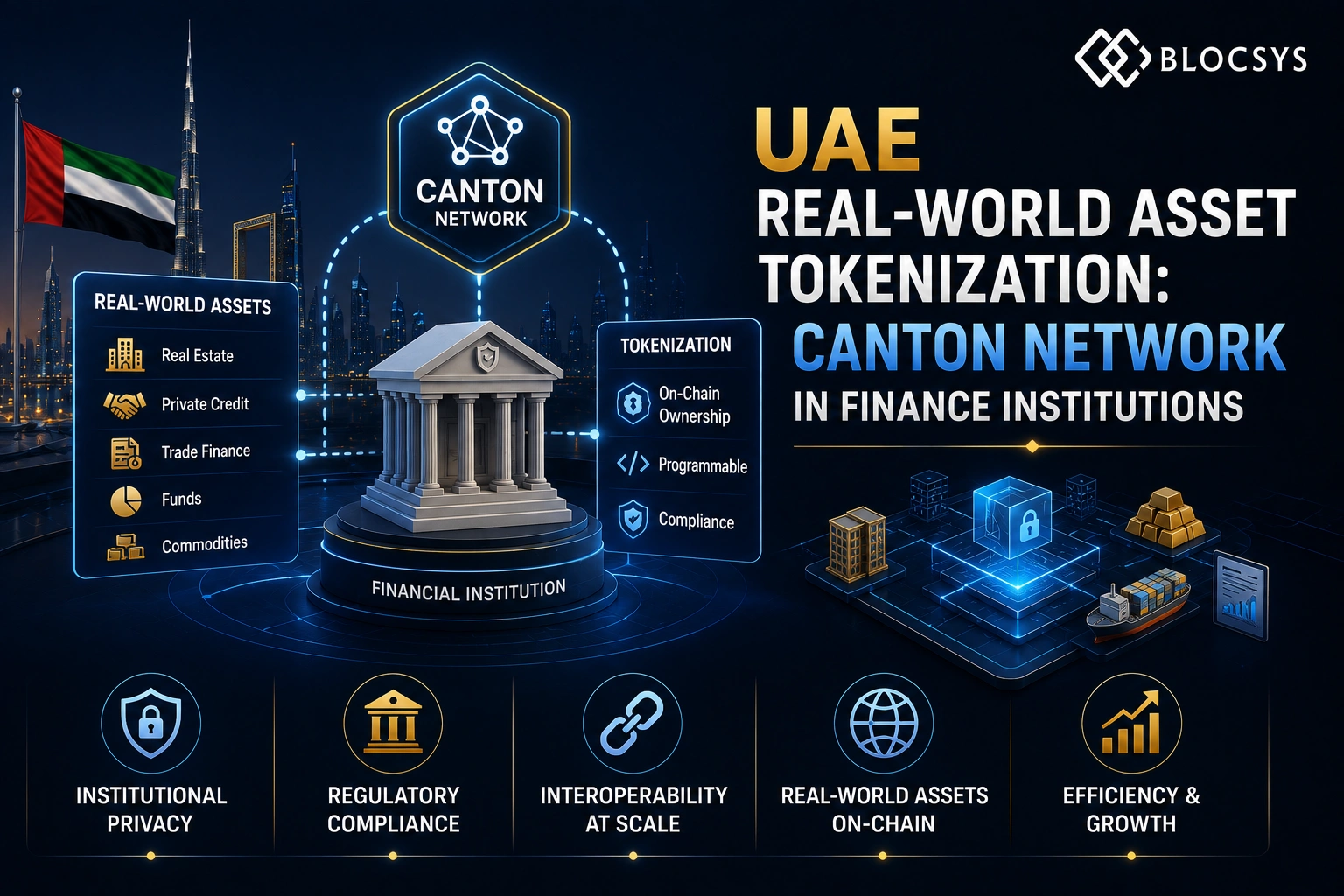
The tokenized real-world asset market has already crossed a threshold that large financial institutions can’t ignore. The tokenized Real-World Asset market exceeded $36 billion, excluding stablecoins, by late 2025, while liquidity remains constrained by fragmentation across chains (Canton Network analysis of the 2026 market state). For banks, asset managers, and market infrastructure providers in the UAE, that changes the conversation from experimentation to operating model design.
That’s where the strategic question lies. Not whether tokenization matters, but which architecture can support regulated issuance, controlled transfer, servicing, reconciliation, privacy, and integration into existing banking and post-trade systems without forcing institutions into a blockchain-first compromise.
For financial institutions, CTOs, digital asset leaders, and founders evaluating UAE real-world asset tokenization, this is the point of focus. The practical opportunity is to design tokenized assets as part of a regulated financial stack, not as an isolated crypto product. Firms exploring enterprise blockchain delivery with Blocsys or modelling budgets with a software development cost estimator usually reach the same conclusion early: architecture and compliance choices made at the start will determine whether a tokenization programme scales or stalls. For broader market context on digital asset trading behaviour and institutional market shifts, TradingList’s crypto trading insights are also useful.
Table of Contents
- The Future of Finance Is Tokenized
- What Is Real-World Asset Tokenization
- Why the UAE Is a Global Hub for Digital Asset Innovation
- Canton Network’s Architecture for Regulated Markets
- Unlocking Institutional Value with Canton Network in the UAE
- Enterprise Use Cases and Implementation Roadmap
- How Blocsys Enables Your Canton Network Strategy
- Frequently Asked Questions
- What is real-world asset tokenization
- How does Canton Network support institutional finance
- Why are UAE financial institutions adopting Canton Network
- What assets can be tokenized on Canton Network
- How does DAML improve institutional blockchain applications
- How much does it cost to build an RWA tokenization platform
The Future of Finance Is Tokenized
Capital markets are shifting from document-driven processes to programmable asset workflows. That shift matters most in environments where institutions need strict control over investor access, transfer rules, servicing events, collateral treatment, and reporting. UAE real-world asset tokenization has become strategically important because the region combines regulatory ambition with a clear appetite for modern financial infrastructure.
A market shift that changes institutional priorities
Tokenization is no longer just a product innovation exercise. For regulated institutions, it’s becoming a redesign of how assets are issued, held, transferred, serviced, and reconciled. The value is not the token itself. The value is the ability to encode the operating logic of a financial instrument into the transaction stack.
That’s why Canton Network stands out in finance institution strategy discussions. It addresses a problem that public-chain conversations often skip. Institutions don’t need generic token rails first. They need a coherent market operating model.
Practical rule: If a tokenized asset can’t support existing compliance, servicing, and post-trade responsibilities, it isn’t ready for institutional balance sheets.
What changes over the next operating cycle
Over the next 12 to 24 months, the strongest programmes in the UAE are likely to be the ones that start with narrowly defined asset classes and clear control frameworks. Banks and asset managers won’t win by launching the broadest tokenization catalogue. They’ll win by choosing assets whose lifecycle events can be codified cleanly and connected to existing internal controls.
That points to a finance-native approach. Not every tokenization project needs full interoperability on day one. But every institutional project does need legal clarity, participant permissions, and operational accountability from day one.
What Is Real-World Asset Tokenization
Real-world asset tokenization is the process of representing ownership interests or economic rights in off-chain assets through digital tokens and programmable contract logic on blockchain-based infrastructure. Those assets can include real estate, bonds, funds, credit instruments, commodities, and similar financial or physical assets.
A practical definition for institutions
An institutional tokenized asset is not just a digital wrapper around a paper record. It’s a structured representation of the asset’s rights, restrictions, participant roles, and lifecycle events. That means the token model has to reflect who may hold the asset, how transfers are approved, how servicing actions are triggered, and how the institution records each state change.
For banks and asset managers, tokenization becomes useful when it reduces manual coordination across issuance, onboarding, settlement, servicing, and reporting. This is the core implementation objective. Better process integrity with stronger auditability.
A more detailed primer on the mechanics sits in this guide to how real-world asset tokenization works in blockchain.
Why institutions treat RWAs differently from crypto assets
Crypto markets and tokenized RWA markets are often discussed together, but they solve different problems. Crypto-native assets are usually designed for open market participation and broad composability. Institutional RWA programmes are usually designed around legal ownership, investor qualification, policy enforcement, and servicing discipline.
That distinction shapes technology selection.
| Consideration | Crypto-native token focus | Institutional RWA focus |
|---|---|---|
| Primary objective | Market access and liquidity | Legal and operational control |
| Participant model | Broad participation | Permissioned eligibility |
| Transfer design | Open transferability | Rule-based transfer restrictions |
| Data handling | Wider visibility norms | Need for controlled privacy |
| Core success metric | Ecosystem activity | Regulatory and operational fit |
Tokenization works when the digital representation mirrors the real-world obligations of the asset. If it doesn’t, operations teams still carry the same friction, just in new software.
Institutions exploring real-world asset tokenization solutions usually discover that the business case depends less on token issuance itself and more on whether the surrounding controls are programmable, testable, and integration-ready.
Why the UAE Is a Global Hub for Digital Asset Innovation
The UAE has become one of the most credible environments for institutional tokenization because policy ambition and market structure are reinforcing each other. Dubai and Abu Dhabi have both created conditions where digital asset projects can move from concept to production with clearer regulatory intent than many competing jurisdictions.
Regulation and market appetite are moving together
That matters for financial institutions because tokenization programmes fail when legal structure, operational model, and technology stack evolve in isolation. In the UAE, those elements are increasingly being designed in parallel. This creates a more workable path for banks, investment firms, and infrastructure providers that need certainty before committing internal resources.
Dubai also shows why tokenization resonates commercially, not only technically. Fractional ownership in tokenized real estate is legally permitted in Dubai, with investments starting at AED 2,000 according to this review of fractional property tokenization in Dubai. That’s significant because it proves the market is not limited to institutional theory. The regulatory environment can support practical product design.
Why the region favours institutional-grade infrastructure
UAE institutions operate in a market that values cross-border connectivity, capital efficiency, and regulatory credibility. That naturally favours tokenization platforms that can support strict permissions, private transactions, and integration into existing finance operations.
Three forces are shaping adoption decisions:
- Cross-border relevance means firms can’t treat tokenization as a local-only stack. Assets, counterparties, and reporting obligations often span jurisdictions.
- Reputation sensitivity means institutions need infrastructure that reduces compliance ambiguity rather than introducing it.
- Operational continuity means tokenization projects must connect with current custody, banking, and post-trade systems rather than replacing them outright.
For that reason, the UAE isn’t merely an enthusiastic digital asset market. It’s an environment where architecture quality becomes a competitive differentiator.
Canton Network’s Architecture for Regulated Markets
The strongest reason regulated institutions look at Canton Network is simple. It starts from financial market requirements, not from generic blockchain assumptions.
Why financial system first matters
UAE financial institutions using Canton prioritise a financial system first architecture rather than a blockchain-first approach. In practice, that means the platform is designed to handle instrument definition, investor eligibility, transfer logic, servicing events, collateral usage, reconciliation, reporting, and exception management within one coherent operating model, as described in Blocsys’s analysis of why financial institutions are adopting DAML and Canton Network for digital assets.
That design choice is more important than it sounds. Many tokenization projects can issue a token. Far fewer can manage the entire lifecycle of a regulated instrument without splitting critical logic across disconnected systems. Once that split happens, institutions lose one of the main benefits of tokenization: consistent control across the asset lifecycle.
How DAML turns policy into operating logic
Canton’s use of DAML smart contracts is one of the clearest reasons it fits institutional finance. The contract layer explicitly defines the instrument, the parties involved, permissions, and lifecycle state transitions. Compliance and policy checks are built into transaction flow before a transaction propagates.
For a regulated institution, that changes how risk is controlled:
- Investor controls can be enforced before ownership changes.
- Transfer restrictions can be embedded directly in the asset logic.
- Sanctions and internal policy checks can be applied as part of transaction validation.
- Lifecycle servicing can be managed through explicit state transitions rather than off-ledger workarounds.
Operating principle: Compliance shouldn’t sit beside the workflow. It should sit inside it.
Many board-level discussions take on a concrete form. DAML is not valuable because it is another smart contract language. It is valuable because it allows legal, operational, and technical rules to be represented in a form institutions can govern.
Privacy without isolating the market
Regulated markets need privacy, but they also need interoperability. That tension has blocked many enterprise blockchain efforts. Full transparency is often unacceptable for institutional trading behaviour, yet completely siloed systems destroy network value.
Canton’s architecture addresses that by allowing sensitive transaction information to remain controlled while still supporting coordinated market activity. For UAE institutions, this is particularly relevant when counterparties, regulators, and service providers all require different visibility rights.
The practical outcome is that assets such as bonds, credit instruments, and funds can be represented in programmable form with strict issuance control and integration into core banking and post-trade systems. This constitutes the bridge between traditional finance and blockchain. Not public visibility. Controlled programmability.
Unlocking Institutional Value with Canton Network in the UAE
The business case for Canton Network is strongest when a financial institution is trying to solve an operational bottleneck, not when it is trying to launch a token for branding reasons. In the UAE, the most compelling use cases usually involve collateral mobility, controlled settlement, private market access, and better coordination across internal and external participants.
Where the business case becomes tangible
Canton’s architecture is engineered to meet the security standards expected by banks and asset managers, enabling tokenization of assets such as real estate, bonds, private equity, commodities, carbon credits, and infrastructure. A key market signal cited in Alwin’s review is that tokenized value on BNB Chain grew from $5 million to over $1.8 billion in total RWA ecosystem value in the broader ecosystem context around institutional tokenization (Alwin’s Canton tokenization overview).
The direct implication for UAE institutions is not that every asset belongs on the same network. It’s that demand for tokenized exposure is scaling, while fragmented infrastructure still creates avoidable liquidity friction. Canton’s privacy-enabled, finance-native design is one answer to that problem.
A practical example for regional banks appears in this discussion of why Dubai banks are adopting Canton Network for enterprise blockchain infrastructure.
The main trade-off institutions need to accept
Canton is not a shortcut to open retail liquidity. It is an institutional coordination layer. That makes it attractive for regulated markets, but it also means participants must accept more structured onboarding, permissions, and governance.
That trade-off is often worthwhile when the institution values:
- Collateral efficiency through movement of tokenized assets across connected digital infrastructure
- Settlement discipline with fewer manual hand-offs between counterparties and internal teams
- Legal defensibility because each token is backed by verifiable off-chain ownership records
- Integration potential with existing financial systems rather than parallel crypto-only workflows
Privacy only matters if institutions can still transact across a shared market structure. Canton’s advantage is that it doesn’t force a choice between those two goals.
For many institutions, that is the hidden strategic value. Canton doesn’t merely digitise an asset. It restructures how trusted participants coordinate around that asset.
Enterprise Use Cases and Implementation Roadmap
The best tokenization strategies in the UAE start with asset classes that already suffer from process fragmentation or restricted access. That is why real estate, private credit, funds, and fixed-income style instruments tend to surface early in institutional planning.
A useful planning reference for internal teams is this RWA tokenization checklist for asset tokenization projects.
Use cases that fit UAE market structure
One of the clearest examples is tokenized real estate. Dubai has already established a practical foundation for fractional participation, and the legal permission for entry points starting at AED 2,000 makes the model easier to understand commercially for product teams and investors alike, as noted earlier in the market context.
Other UAE-relevant use cases include:
- Private credit instruments where transfer permissions and servicing events need tight control.
- Bond-style products where issuance logic, investor eligibility, and coupon-related workflows benefit from programmable state management.
- Funds and structured products where distributor permissions, investor classes, and reporting obligations create operational complexity.
- Commodity-linked assets where ownership verification and controlled transferability matter as much as market access.
For teams evaluating the execution side, access to specialised engineering matters. Firms that don’t have internal blockchain capability often need to hire blockchain developers with experience in institutional systems rather than public-chain product builds.
Later in the process, stakeholders usually need a shared view of what the model looks like in practice.
A phased roadmap for adoption
A disciplined roadmap usually looks like this:
Select an asset with constrained workflows
Start where current processes are manual, approval-heavy, or fragmented across systems.Define the legal and policy perimeter
Clarify holder eligibility, transfer restrictions, servicing obligations, and reporting expectations before contract design begins.Model the lifecycle in DAML and workflow logic
Encode state transitions, participant rights, and exception handling so the digital instrument behaves like its physical counterpart.Integrate with surrounding systems
Connect onboarding, custody, payment, reporting, and reconciliation functions. The integration of these functions determines whether many pilots become viable or fail.Expand through controlled interoperability
Add counterparties, service providers, and new asset classes only when governance and observability are proven.
The institutions that move fastest are rarely the ones that start largest. They’re the ones that choose the cleanest first workflow.
How Blocsys Enables Your Canton Network Strategy
Institutions usually need two things at the same time: strategic clarity on operating model design and practical delivery across blockchain, compliance workflow, and enterprise software integration. That combination is where implementation programmes either gain momentum or stall.
Blocsys can support that work as a delivery partner through blockchain consulting for tokenization strategy and execution. In practical terms, that means helping firms design RWA tokenization platforms, model DAML-based workflows, connect policy controls to transaction logic, and integrate digital asset infrastructure with existing enterprise systems.
The most valuable support usually isn’t just smart contract development. It’s coordination across legal structure, product design, permissions, settlement flows, servicing events, and operational controls. For UAE financial institutions, that’s especially important because tokenization programmes have to satisfy internal governance as much as external regulatory expectations.
If your organisation is assessing Canton Network development, DAML smart contracts, or a broader institutional blockchain roadmap, the right next step is a scoped architecture review tied to a real asset class and target workflow.
Emirates Crypto and UAE RWA Tokenization
The growth of emirates crypto is supporting the UAE’s broader shift toward blockchain-based financial infrastructure, particularly as financial institutions explore real-world asset tokenization. By combining digital assets with enterprise blockchain networks such as Canton, UAE institutions can explore more efficient approaches to asset issuance, ownership management, settlement, and transaction processing. This evolving ecosystem can help connect traditional financial assets with programmable blockchain infrastructure while supporting the security, transparency, and operational requirements of institutional finance.
RWA Tokenization Infrastructure for Financial Institutions in GIFT City
GIFT City can be considered a relevant environment for financial institutions exploring RWA tokenization and enterprise blockchain infrastructure. A tokenization platform can support the digital representation of real-world assets while bringing together asset management, ownership records, transaction workflows, and institutional participation. For financial institutions evaluating RWA solutions, these capabilities can help shape a structured tokenization platform suited to the GIFT City ecosystem.
Frequently Asked Questions
What is real-world asset tokenization
Real-world asset tokenization is the digital representation of ownership rights or economic interests in assets such as real estate, bonds, funds, or commodities using blockchain-based infrastructure and programmable contract logic.
How does Canton Network support institutional finance
Canton Network supports institutional finance by using a finance-native architecture that can embed permissions, compliance rules, lifecycle events, privacy controls, and integration points into the operation of a regulated asset.
Why are UAE financial institutions adopting Canton Network
UAE institutions are drawn to Canton because it aligns with regulated market needs. It supports controlled issuance, investor eligibility checks, transfer restrictions, privacy, and integration with existing financial systems.
What assets can be tokenized on Canton Network
Canton is suited to assets such as bonds, credit instruments, funds, real estate, commodities, private equity, infrastructure-related assets, and other instruments that require controlled ownership and servicing logic.
How does DAML improve institutional blockchain applications
DAML lets teams define the instrument, the parties, permissions, and lifecycle state changes directly in contract logic. That helps institutions encode policy and process rules into the asset workflow itself.
How much does it cost to build an RWA tokenization platform
Cost depends on the asset type, compliance scope, workflow complexity, integration requirements, and whether the institution is building a pilot or a production-grade platform. Most firms start with a scoped design and architecture assessment before budgeting delivery.
For banks, fintechs, asset managers, and digital asset providers exploring UAE real-world asset tokenization on Canton, Blocsys Technologies can help assess the operating model, define the implementation roadmap, and translate compliance-heavy requirements into production-ready platform architecture. If you’re planning an RWA tokenization platform, Canton Network development, or DAML smart contract workflow, connect with Blocsys to discuss the next practical step.
